
Study Guides
Cambridge IGCSE World History (0470): Why, and With What Effects, Did Nations Gain and Expand Their Overseas Empires?
Cambridge IGCSE History 0470 key question 1.5 in depth: weighing imperial motives, comparing impacts in Africa, India after 1857 and US rule in Cuba.
- Subject
- World History
- Level
- IGCSE
- Topic
- Core Content – Option A: The Nineteenth Century, 1848–1914
- Author
- Marlbridge Academic Team
- Updated
- Reviewed by
- Azam Siddique (what this means)
Aligned to Cambridge IGCSE World History (0470), 2024-2026. Official specification .
Syllabus page (what it covers and how it is assessed): Cambridge IGCSE World History.
Syllabus points this page covers
0470
- 1.5 Why, and with what effects, did nations gain and expand their overseas empires in the nineteenth century?
Found an error? Report a correction.
Need help with this topic? Request a free trial class for IGCSE World History (0470).
This guide goes deeper into key question 5 of Core Content Option A in Cambridge IGCSE History 0470 (2024-2026): “Why, and with what effects, did nations gain and expand their overseas empires in the nineteenth century?” The four focus points ask about the motives behind European and US imperialism, how varied the impacts of European imperialism on Africans were, why Indians resisted British rule and with what effects, and why the United States gained former Spanish colonies and with what effects. The specified content names the case studies: Faidherbe and Senegal, Lugard and Nigeria, Leopold II and the Congo, the British in India in 1857, and the wars of independence in Cuba and the Philippines, the Spanish-American War and the Treaty of Paris, including the debate in the USA and American intervention in Cuba to 1906.
This topic was prescribed for Paper 2 in November 2024 and is prescribed again for March 2026 (India only). The case-study narratives are set out in the Overseas Empires in the Nineteenth Century guide; this page adds the analysis examiners reward: how to weigh motives, how to compare impacts, and how to handle the “with what effects” half of each focus point. Condensed notes are in the 0470 overseas empires revision notes and questions in the 0470 overseas empires practice questions.
Weighing the five motives
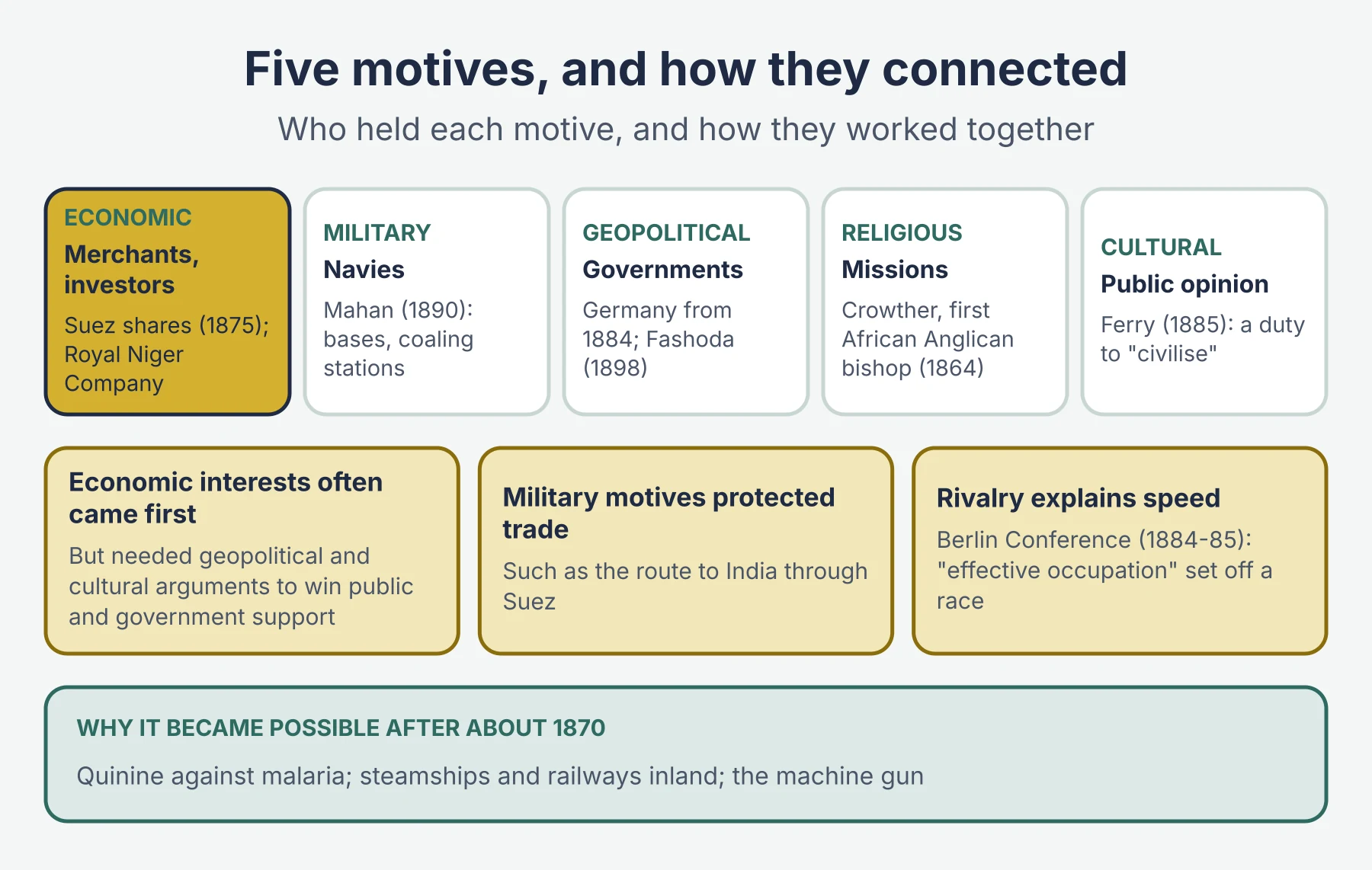
The syllabus lists five motives: economic, military, geopolitical, religious and cultural. A list gains few marks. The skill is to show who held each motive and how the motives connected.
| Motive | Who held it | A further example to use |
|---|---|---|
| Economic | Merchants, investors, chartered companies | Britain bought shares in the Suez Canal Company in 1875; Goldie’s Royal Niger Company traded along the Niger before Britain ruled there |
| Military | Navies and strategists | The American naval writer Alfred Thayer Mahan argued in 1890 that sea power needed overseas bases and coaling stations |
| Geopolitical | Governments competing for status | Germany claimed colonies in Africa from 1884; France and Britain clashed at Fashoda (1898) over the upper Nile |
| Religious | Missionary societies | Samuel Ajayi Crowther, a formerly enslaved Yoruba man, became the first African Anglican bishop in 1864, working in the Niger region |
| Cultural | Public opinion, writers and politicians | Jules Ferry told the French parliament in 1885 that “superior races” had a duty to “civilise” others |
Connections to make: economic interests often came first, but needed geopolitical and cultural arguments to win public and government support; military motives were usually about protecting trade routes, such as the route to India through Suez. Rivalry also explains speed: after the Berlin Conference (1884-85) required “effective occupation” of coastlines to support a claim, powers raced to occupy land before others did.
Why it became possible: motive is not the whole answer. Quinine reduced deaths from malaria among Europeans, steam ships and railways allowed movement inland, and the machine gun gave small forces a huge advantage. These explain why empires grew so fast after about 1870.
How varied were the impacts on Africans?
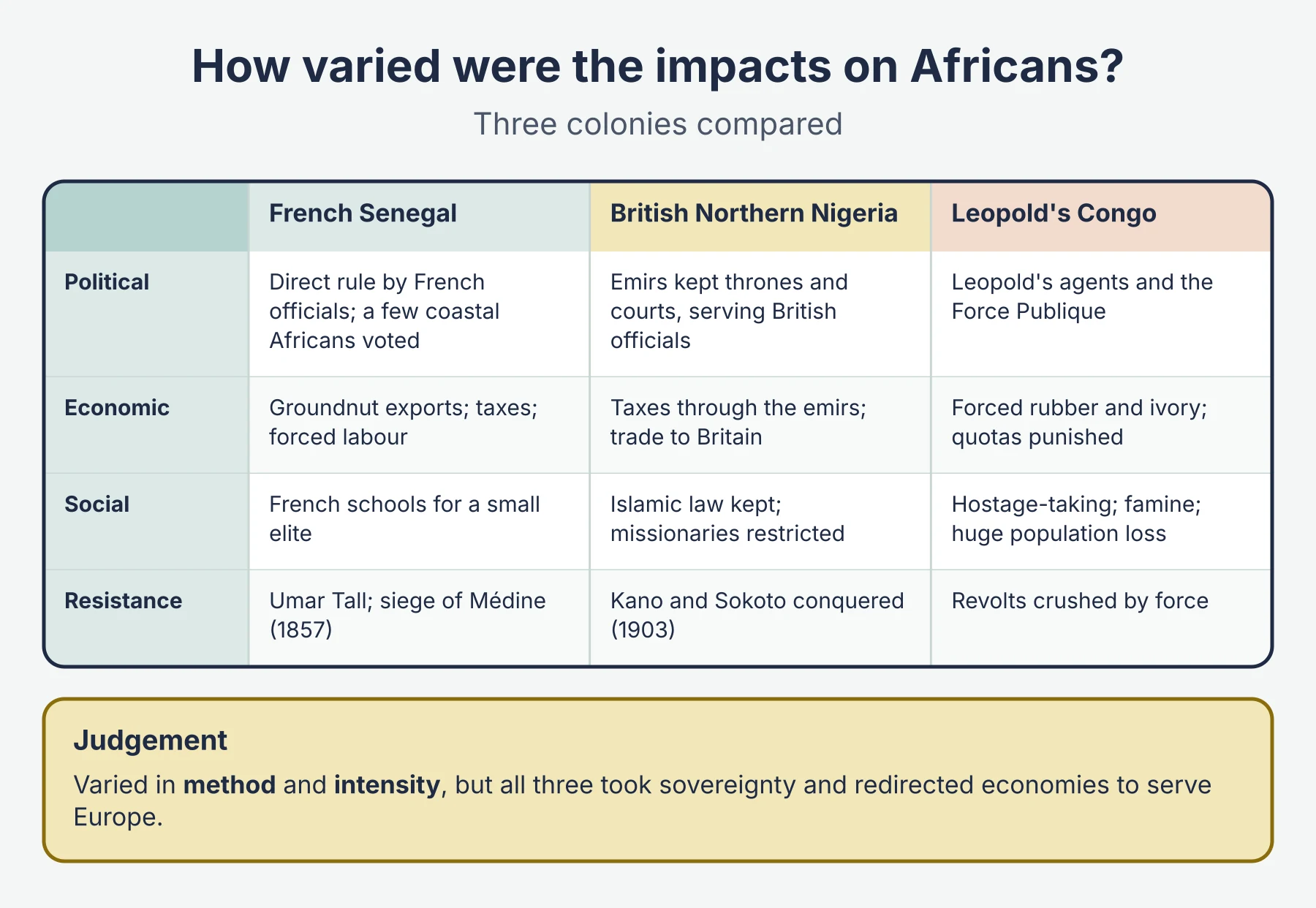
Use three headings to compare the case studies: political, economic and social or cultural impact.
| Impact | French Senegal | British Northern Nigeria | Leopold’s Congo |
|---|---|---|---|
| Political | Local states conquered; French officials ruled directly; a few Africans in the coastal communes voted | Emirs kept their thrones and courts but now served British officials | All authority in the hands of Leopold’s agents and the Force Publique |
| Economic | Groundnut (peanut) exports encouraged; taxes and forced labour for roads and railways | Taxes collected through the emirs; trade redirected to Britain | Forced collection of rubber and ivory; villages that missed quotas punished |
| Social and cultural | French schools for a small elite, including Faidherbe’s school for the sons of chiefs | Islamic law and customs largely kept; missionaries restricted in the north | Families broken up by hostage-taking; famine and disease; population loss on a huge scale |
| Resistance | Umar Tall’s forces fought Faidherbe, including at the siege of Médine (1857) | Conquest of Kano and Sokoto in 1903 | Revolts by Congolese soldiers and villagers, crushed by force |
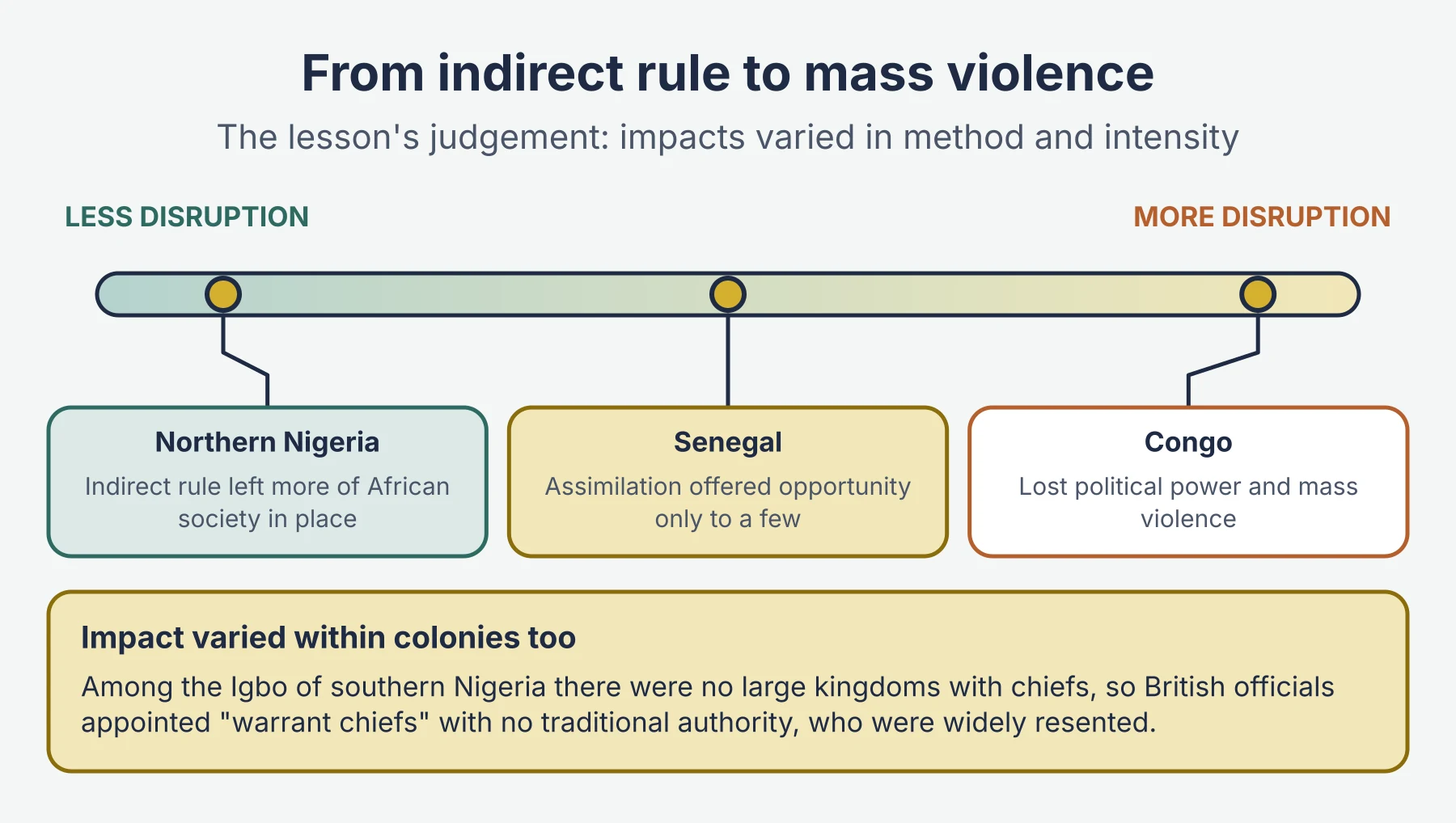
Judgement: the impacts varied in method and intensity. Indirect rule left more of African society in place, assimilation offered opportunity only to a few, and the Congo combined loss of political power with mass violence. But all three took sovereignty and redirected economies to serve Europe.
A further point for strong answers: impact varied within colonies too. In southern Nigeria, especially among the Igbo, there were no large kingdoms with chiefs, so British officials appointed “warrant chiefs” who had no traditional authority and were widely resented.
Why, and with what effects, did Indians resist British rule?
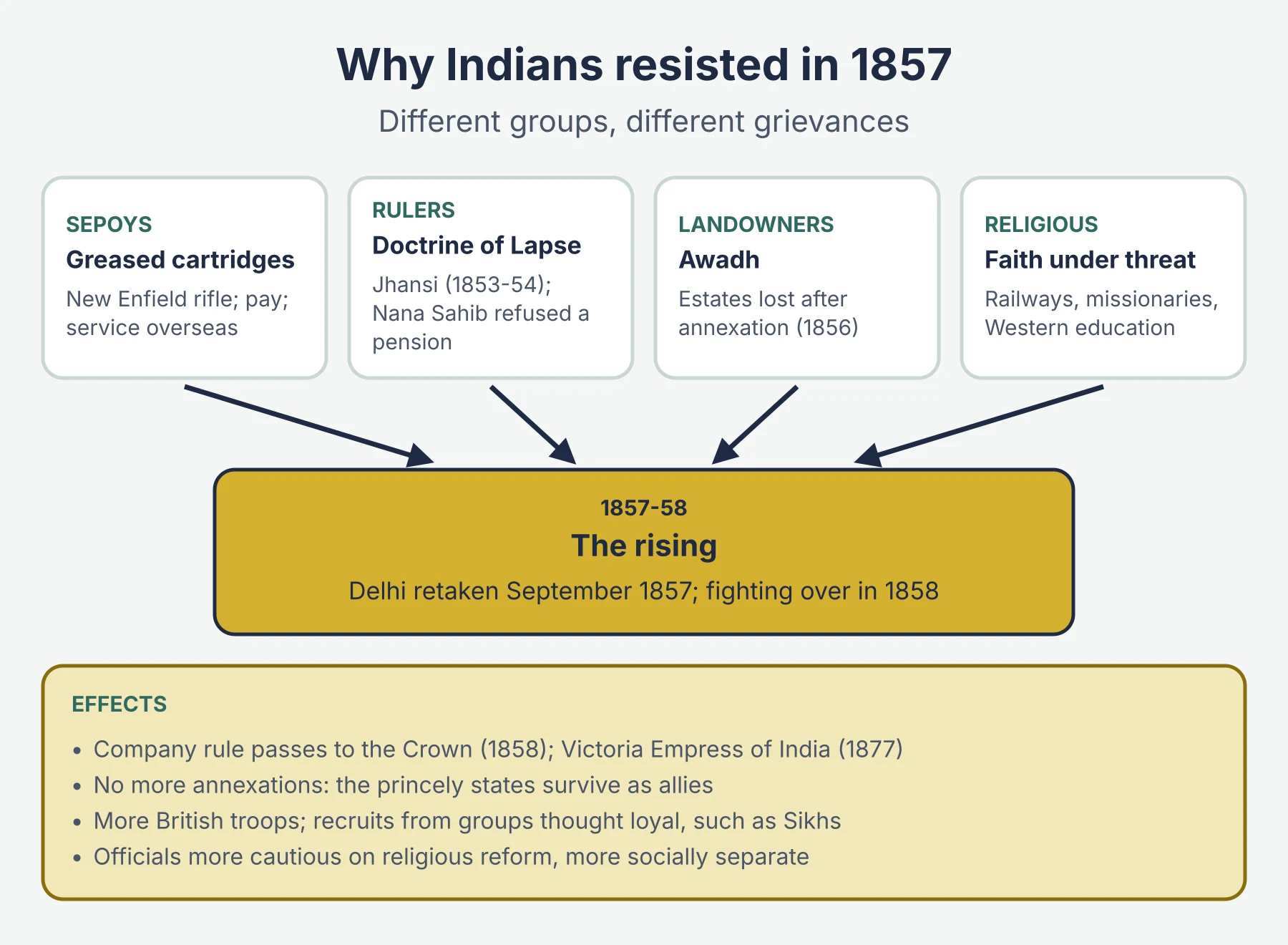
Break “why” down by group, since different Indians joined for different reasons:
- Sepoys: the greased cartridges for the new Enfield rifle; grievances over pay and service overseas.
- Rulers: the Doctrine of Lapse took states whose rulers died without a natural heir, including Jhansi (1853-54); Nana Sahib, adopted heir of the last Peshwa, was refused his father’s pension.
- Landowners in Awadh: after the annexation of 1856, many lost estates in British land settlements.
- Religious leaders and communities: fears that railways, missionaries and Western education would undermine Hinduism and Islam.
Effects: the rising was defeated (Delhi was retaken in September 1857 and fighting ended in 1858), with savage reprisals on both sides. Rule passed from the East India Company to the Crown in 1858. Britain stopped annexing Indian states, so the princely states survived as allies, and in 1877 Victoria was proclaimed Empress of India. The army was reorganised, with more British troops and more recruits from groups the British thought loyal, such as Sikhs from the Punjab. British officials became more cautious about religious reform but more socially separate from Indians.
Why, and with what effects, did the USA gain former Spanish colonies?
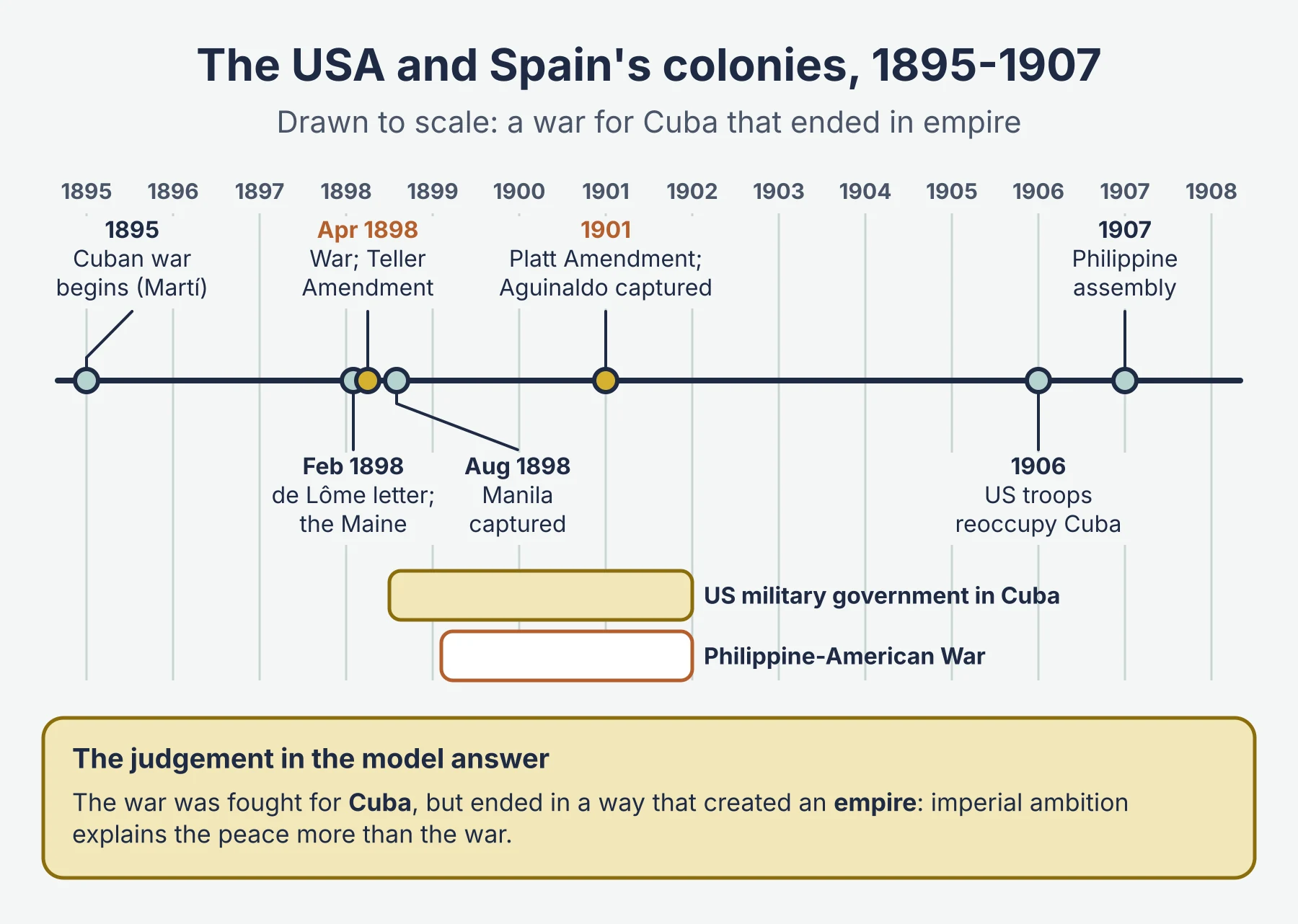
Why: the USA did not set out to build an empire in 1898. Sympathy for Cuban rebels, whose war began in 1895 under leaders including José Martí, was inflamed by the “yellow press” of Hearst and Pulitzer. The leaked de Lôme letter (February 1898), in which the Spanish minister insulted President McKinley, and the destruction of the USS Maine pushed Congress to war in April. The Teller Amendment promised the USA would not annex Cuba. But victory brought control of the Philippines, and McKinley decided to keep them for strategic, commercial and “civilising” reasons, which he called “benevolent assimilation”.
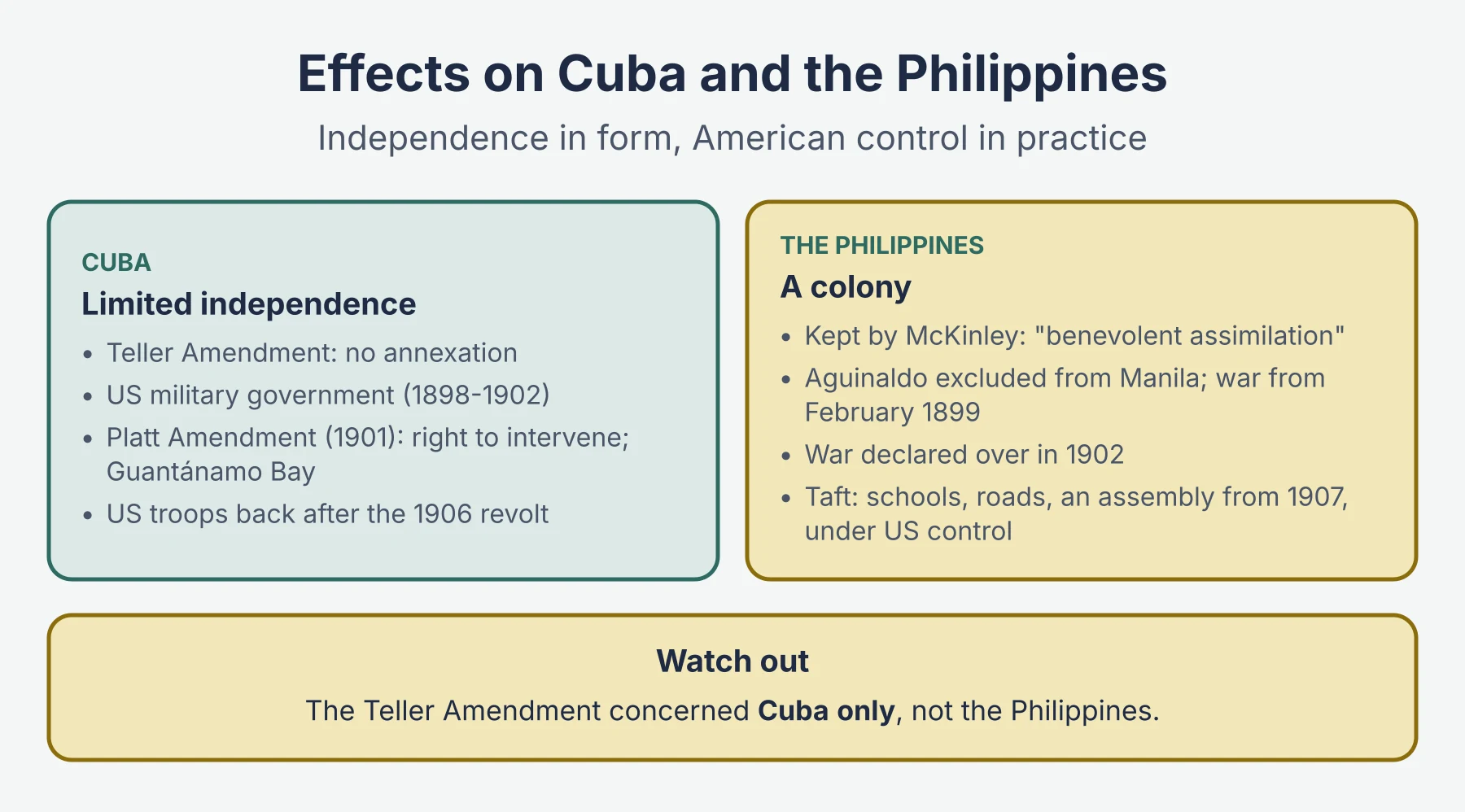
Effects on the Philippines: Aguinaldo’s government was excluded from the capture of Manila (August 1898); war with the USA began in February 1899. Aguinaldo was captured in 1901 and the USA declared the war over in 1902. Civil government under William Howard Taft followed, with schools, roads and an elected assembly from 1907, under American control.
Effects on Cuba: US military government (1898-1902); the Platt Amendment (1901) was written into Cuba’s constitution, giving the USA the right to intervene and a naval base at Guantánamo Bay. After a revolt in 1906, US troops occupied Cuba again. Independence was real in form but limited in practice.
Annotated model answer
An original practice question: “The USA went to war with Spain in 1898 to gain an empire.” How far do you agree? [10]
Some Americans did want an empire. Writers such as Mahan argued for overseas bases, and after victory McKinley kept the Philippines, Guam and Puerto Rico, showing that strategic and commercial ambitions shaped the outcome. [Agree, explained.] However, the immediate reasons for war were about Cuba: public outrage at Spanish rule, stirred by the yellow press, the de Lôme letter and the sinking of the Maine. The Teller Amendment promised not to annex Cuba, which suggests empire was not the original aim. [Disagree, explained.] The war was fought for Cuba, but it was ended in a way that created an empire, so imperial ambition explains the peace more than the war. [Judgement distinguishing causes from results.]
Common mistakes
- Answering only the “why” half of a “why, and with what effects” question.
- Describing one African case study when the question asks “how varied”.
- Treating 1857 as a single cause. Separate the grievances of sepoys, rulers, landowners and religious groups.
- Saying the Teller Amendment applied to the Philippines. It concerned Cuba only.
- Forgetting the 1906 intervention in Cuba, which is named in the specification.
Exam technique
For Paper 2, attribute every source: a missionary, a company agent and an African ruler will see the same event very differently. For Paper 1 part (c), choose a clear criterion, such as “harm to Africans” or “control over government”, and apply it to each case study.
Official syllabus
Cambridge IGCSE History (0470) syllabus for 2024, 2025 and 2026, Core Content Option A, key question 5 – cambridgeinternational.org.
Related resources
-
Practice questions
Cambridge IGCSE World History (0470): Why, and With What Effects, Did Nations Gain and Expand Their Overseas Empires? – Practice Questions
Twelve original questions with mark-scheme answers on imperial motives, Africa, India after 1857 and US rule overseas, for Cambridge IGCSE History 0470.
World History · Cambridge · IGCSE
Try questions -
Revision notes
Cambridge IGCSE World History (0470): Why, and With What Effects, Did Nations Gain and Expand Their Overseas Empires? – Revision Notes
Recall notes for Cambridge IGCSE History 0470 key question 1.5: motives, impacts in Africa compared, 1857 by group, Cuba and the Philippines, self-test.
World History · Cambridge · IGCSE
Revise topic -
Study guides
Cambridge IGCSE World History (0470): Were the Revolutions of 1848 Important?
Study guide to Cambridge IGCSE History 0470 key question 1.1: liberalism, nationalism and the 1848 revolutions in France, Italy, Germany and Austria.
World History · Cambridge · IGCSE
Read guide
Get free revision emails (optional)
Occasional emails with practice questions, worked explanations and links to free resources for the qualification and subjects you choose. No spam, and you can unsubscribe from any email. The free tools on this site never need an email.