
Study Guides
Cambridge IGCSE World History (0470): Were the Revolutions of 1848 Important?
Study guide to Cambridge IGCSE History 0470 key question 1.1: liberalism, nationalism and the 1848 revolutions in France, Italy, Germany and Austria.
- Subject
- World History
- Level
- IGCSE
- Topic
- Core Content – Option A: The Nineteenth Century, 1848–1914
- Author
- Marlbridge Academic Team
- Updated
- Reviewed by
- Azam Siddique (what this means)
Aligned to Cambridge IGCSE World History (0470), 2024-2026. Official specification .
Syllabus page (what it covers and how it is assessed): Cambridge IGCSE World History.
Syllabus points this page covers
0470
- 1.1 Were the revolutions of 1848 important?
Found an error? Report a correction.
Need help with this topic? Request a free trial class for IGCSE World History (0470).
This guide covers key question 1 of Core Content Option A in Cambridge IGCSE History 0470 (2024-2026): “Were the revolutions of 1848 important?” The syllabus sets five focus points: why liberalism and nationalism had grown by 1848, why there were so many revolutions, whether they had anything in common, why most failed, and whether they changed anything. The specified content names four case studies: France, Italy, Germany and the Austrian Empire. For the overview of all six Option A key questions, see the Nineteenth Century 1848-1914 guide.
Condensed facts are in the 1848 revision notes and exam-style questions in the 1848 practice questions.
Liberalism and nationalism before 1848
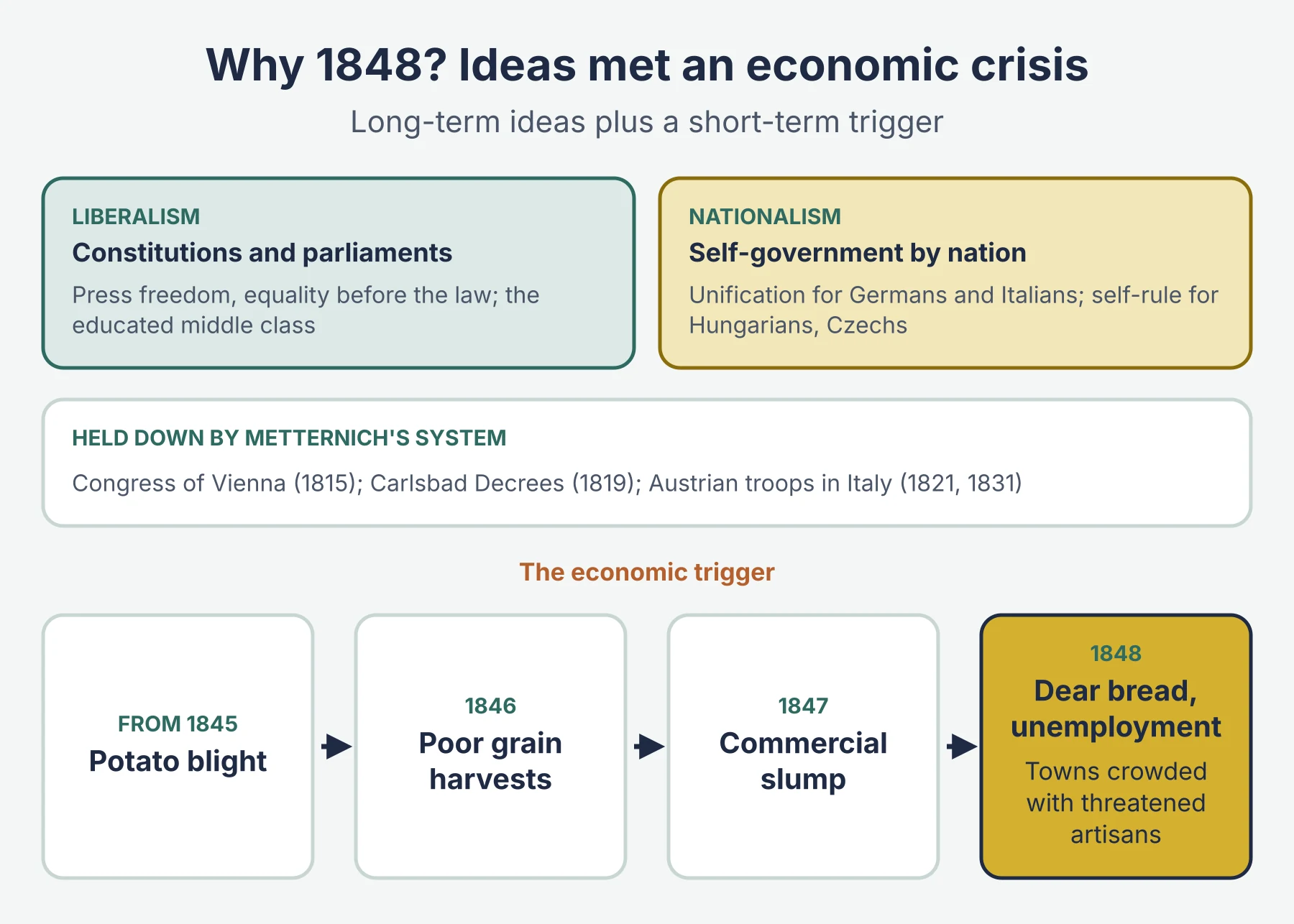
After Napoleon’s defeat, the Congress of Vienna (1815) restored monarchs and redrew borders with little regard for national feeling. The Austrian chancellor Metternich led a system designed to stop revolution: the Carlsbad Decrees (1819) imposed censorship and supervision of universities across the German Confederation, and Austrian troops put down risings in Italy in 1821 and 1831.
Two sets of ideas challenged this order:
- Liberalism demanded written constitutions, elected parliaments, freedom of the press and equality before the law. Its supporters were mostly from the educated middle class: lawyers, teachers, students, journalists and businessmen, who resented being excluded from power.
- Nationalism held that people sharing a language and culture should govern themselves. It meant unification for Germans and Italians, who lived in many separate states, and independence or self-rule for Hungarians, Czechs and others inside the multinational Austrian Empire.
These ideas grew because of the memory of the French Revolution, the spread of newspapers, universities and reading societies, and the expanding middle class created by trade and early industry. In 1848 they met an economic crisis: potato blight from 1845, poor grain harvests in 1846 and a commercial slump in 1847 brought high bread prices and unemployment to towns already crowded with artisans whose trades were threatened by machines.
The four case studies
France
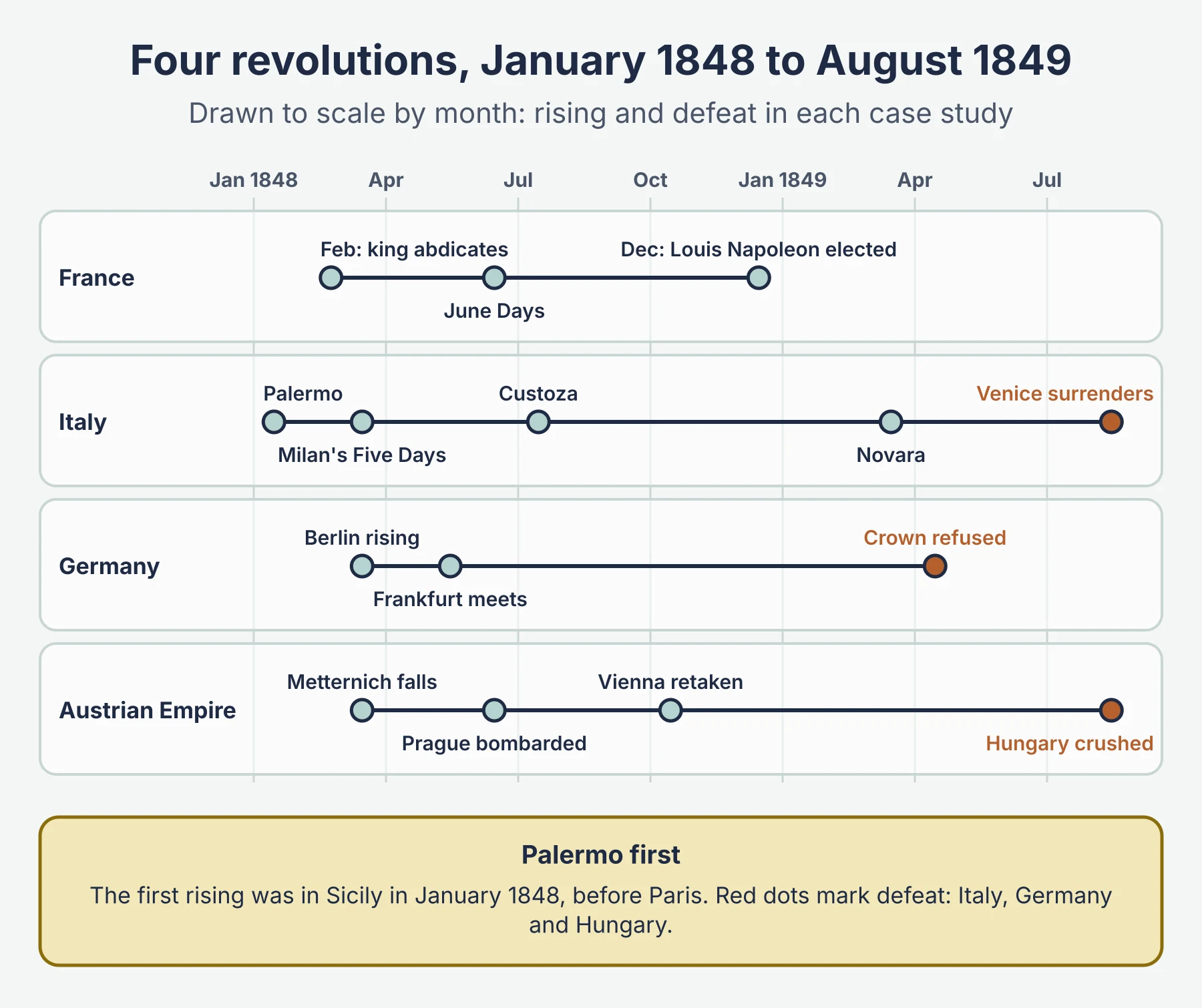
King Louis-Philippe’s July Monarchy allowed only a small, wealthy minority to vote. When the government banned a reform banquet in Paris in February 1848, crowds built barricades, the National Guard sided with them and the king abdicated (24 February). A Second Republic was proclaimed with universal male suffrage. The provisional government set up National Workshops to give the unemployed work, but the April elections returned a cautious assembly that closed them. Paris workers rose in the June Days and were crushed by General Cavaignac’s troops. In December 1848 Louis Napoleon, Napoleon Bonaparte’s nephew, was elected president by a huge majority; his coup of December 1851 ended the republic and he became Emperor Napoleon III in 1852.
Italy
The first rising came in Palermo, Sicily (January 1848), before Paris. Rulers in Naples, Tuscany, Piedmont and the Papal States granted constitutions. In March, Milan expelled the Austrian army in the Five Days, and Venice declared the Republic of St Mark under Daniele Manin. Charles Albert of Piedmont declared war on Austria but was beaten at Custoza (July 1848) and again at Novara (March 1849), after which he abdicated. In Rome, Pope Pius IX refused to fight Catholic Austria and later fled; a Roman Republic (1849) led by Mazzini and defended by Garibaldi fell to French troops sent by Louis Napoleon. Venice surrendered in August 1849.
Germany
Risings spread across the German states in March 1848. In Berlin, after street fighting, Frederick William IV withdrew his troops and promised a constitution. An elected Frankfurt Parliament met in May 1848 to create a united Germany. Its members, mostly lawyers, officials and professors, spent months debating rights and borders. It had no army of its own: when it wanted to fight Denmark over Schleswig-Holstein it depended on Prussia, which made peace without consulting it. By the end of 1848 Frederick William had brought troops back into Berlin and dissolved the Prussian assembly. In April 1849 he refused the crown of a united Germany offered by Frankfurt, and the parliament broke up.
The Austrian Empire
News from Paris sparked a rising in Vienna (March 1848); Metternich resigned and fled. Hungary, led by Lajos Kossuth, won the April Laws giving it its own government. Czech nationalists met in Prague, and the imperial assembly abolished peasants’ labour services (robot) in September 1848. Then the army struck back: General Windischgrätz bombarded Prague (June) and retook Vienna (October); Radetzky reconquered northern Italy. Franz Joseph replaced Ferdinand as emperor in December 1848. Hungary fought on and declared independence in 1849, but was crushed in August 1849 by Austrian forces helped by the army of Tsar Nicholas I of Russia.
Did the revolutions have anything in common?
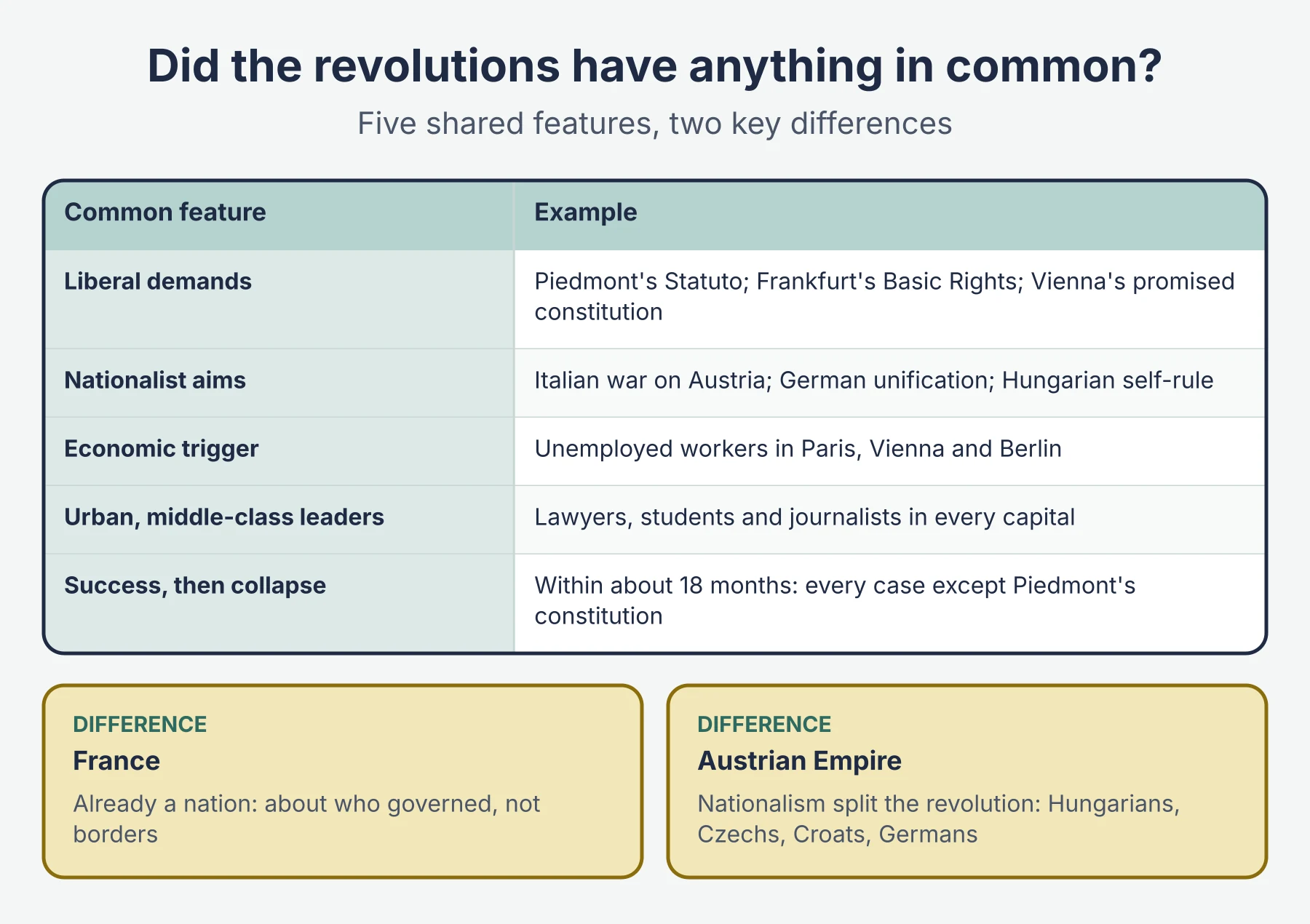
| Common feature | Example |
|---|---|
| Liberal demands for constitutions | Piedmont’s Statuto; Frankfurt’s Basic Rights; Vienna’s promised constitution |
| Nationalist aims | Italian war on Austria; German unification; Hungarian self-rule |
| Economic distress as a trigger | Unemployed workers in Paris, Vienna and Berlin |
| Urban, middle-class leadership | Lawyers, students and journalists in every capital |
| Initial success, then collapse within about 18 months | Every case except Piedmont’s constitution |
They also differed. France already existed as a nation, so its revolution was about who governed, not about borders. In the Austrian Empire, nationalism split the revolution itself, because Hungarians, Czechs, Croats and Germans wanted different things.
Why did most of the revolutions fail?
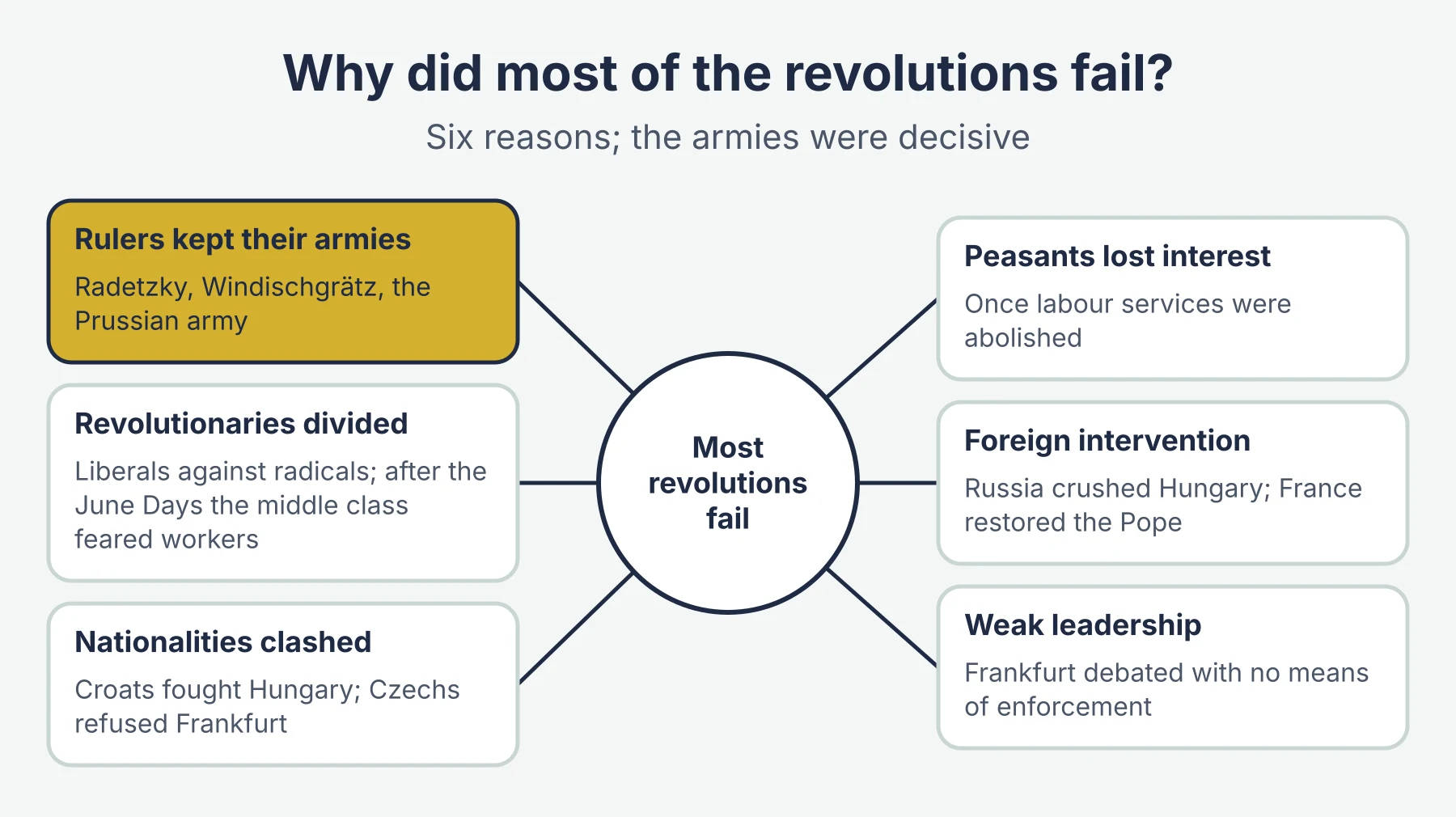
- Rulers kept their armies. Radetzky, Windischgrätz and the Prussian army stayed loyal; once monarchs recovered their nerve, troops decided the outcome.
- Revolutionaries were divided. Moderate liberals wanted constitutions; radicals and workers wanted republics and social reform. After the June Days, the middle classes feared the workers more than the kings.
- Nationalities clashed. Croats under Jelačić fought for the emperor against Hungary; Czechs refused to join Frankfurt’s German state.
- Peasants lost interest once labour services were abolished.
- Foreign intervention. Russia crushed Hungary; France restored the Pope.
- Weak leadership and inexperience. Frankfurt debated while Prussia and Austria rebuilt their power, and it had no means of enforcing its decisions.
Did the revolutions change anything?
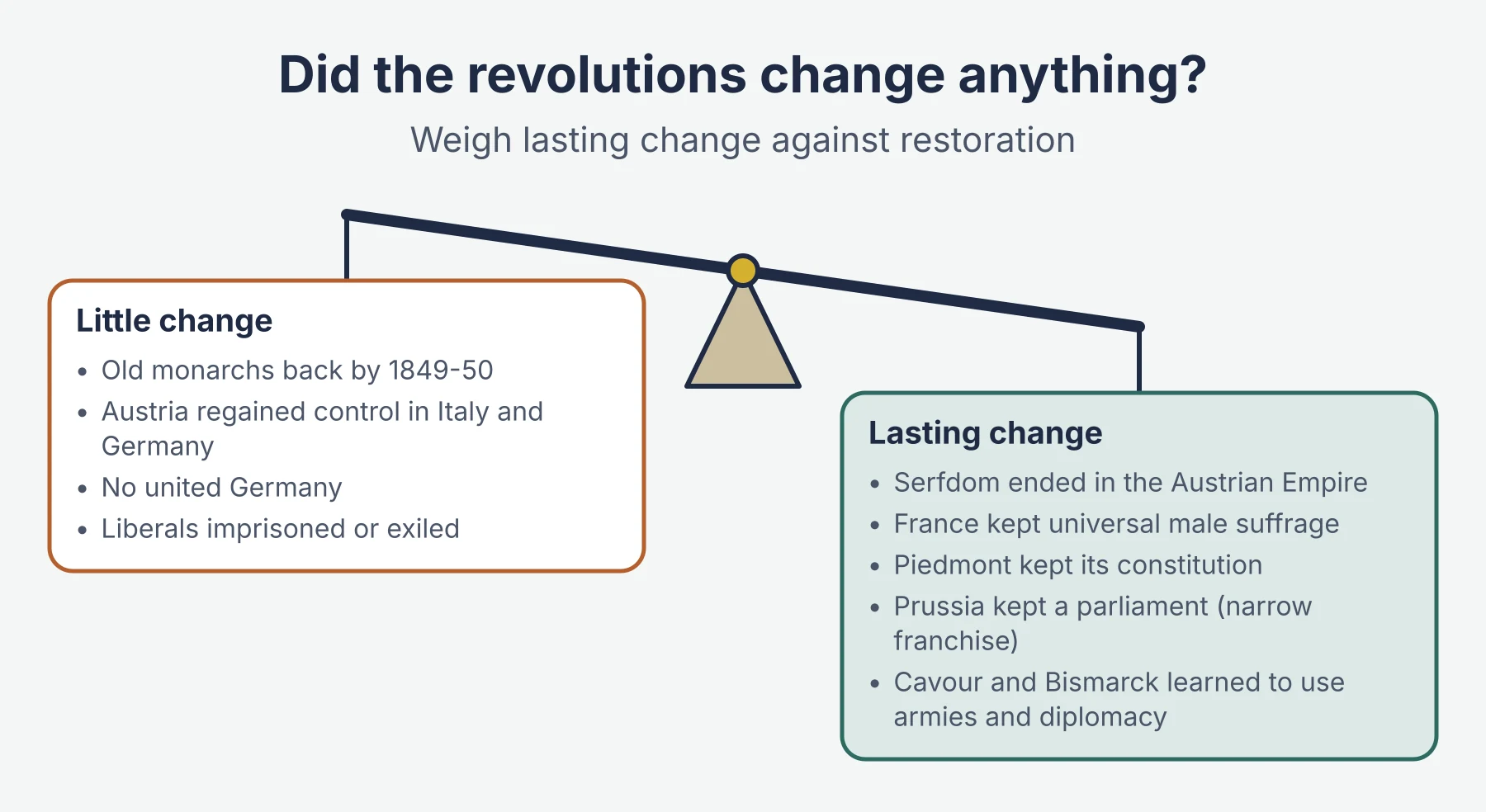
This is the focus point that turns a description into an argument. Evidence of lasting change:
- Serfdom ended in the Austrian Empire and was not restored.
- France kept universal male suffrage, even under Napoleon III.
- Piedmont kept its constitution and became the natural leader of the Italian cause.
- Prussia kept a parliament, though elected on a narrow, unequal franchise.
- Lessons were learned. Cavour and Bismarck concluded that unification would come through diplomacy, alliances and armies, not through parliaments and barricades.
Evidence of little change: the old monarchs were back by 1849-50; Austria regained control in Italy and Germany; Frankfurt left no united Germany; liberals were imprisoned or went into exile.
Annotated model answer
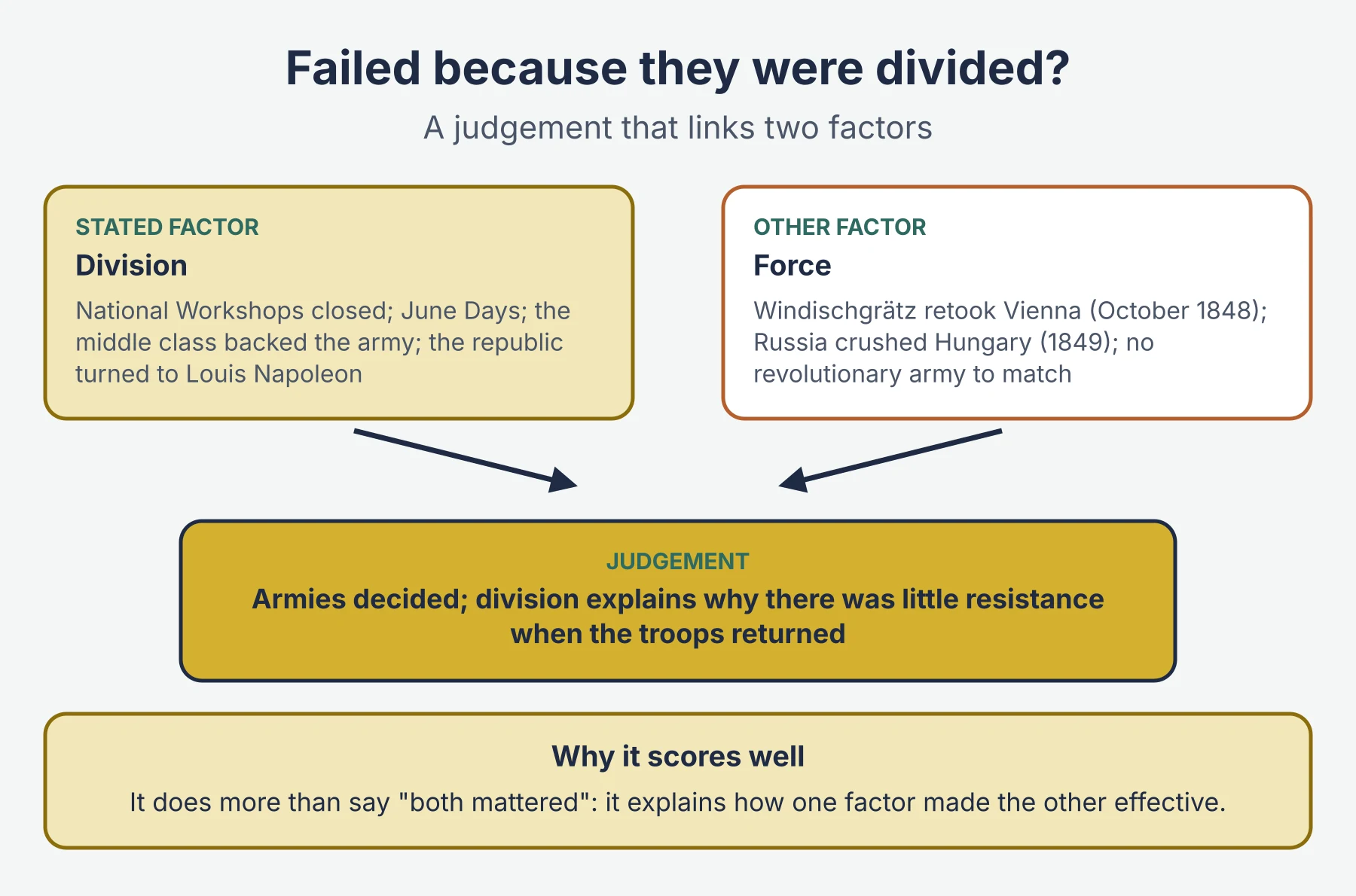
The paragraph below answers an original practice question: “The revolutions of 1848 failed because the revolutionaries were divided.” How far do you agree? [10]
Divisions among the revolutionaries were a major reason for failure. In Paris, the closure of the National Workshops led to the June Days, and the middle class backed the army against the workers, so the republic lost its popular base and turned to Louis Napoleon. [One side explained with a specific example.] However, division alone did not defeat the revolutions: the decisive factor was force. Windischgrätz retook Vienna in October 1848 and the Russian army crushed Hungary in 1849, and no revolutionary government had an army to match them. [Other side explained.] Overall, divisions weakened the revolutionaries, but they failed mainly because the rulers kept control of their armies; divisions explain why there was little resistance when the troops returned. [Judgement that links the two factors.]
The judgement does more than say “both mattered”: it explains how one factor made the other effective.
Common mistakes
- Treating 1848 as one event. Learn the four case studies separately, then compare.
- Starting the story in Paris. Palermo rose first, in January 1848.
- Saying the Frankfurt Parliament was “defeated in battle”. It collapsed because it lacked power and Frederick William refused its crown.
- Writing “the revolutions changed nothing”. Serfdom’s end in Austria and French male suffrage are lasting changes.
- Confusing the 1848-49 wars in Italy with the war of 1859, which belongs to key question 1.2.
Exam technique
- Describe (part (a), 4 marks): give four precise, separate points, such as four events of the Vienna rising. No explanation is needed.
- Explain why (part (b), 6 marks): develop two reasons fully, each with a “because” and a named example.
- How far (part (c), 10 marks): explain both sides and reach a judgement that weighs them.
- 1848 was the Paper 2 prescribed topic for the March 2024 series (India only). If it is prescribed again, read each source’s date carefully: a source from March 1848 and one from 1849 describe very different situations.
Official syllabus
Cambridge IGCSE History (0470) syllabus for 2024, 2025 and 2026, Core Content Option A, key question 1 – cambridgeinternational.org. Always check the current syllabus for the full list of focus points and specified content.
Related resources
-
Practice questions
Cambridge IGCSE World History (0470): Were the Revolutions of 1848 Important? – Practice Questions
Twelve original questions with mark-scheme answers on the 1848 revolutions in France, Italy, Germany and Austria, for Cambridge IGCSE History 0470.
World History · Cambridge · IGCSE
Try questions -
Revision notes
Cambridge IGCSE World History (0470): Were the Revolutions of 1848 Important? – Revision Notes
Recall notes for Cambridge IGCSE History 0470 key question 1.1: causes, events and failure of the 1848 revolutions, key terms, traps and a self-test.
World History · Cambridge · IGCSE
Revise topic -
Study guides
Cambridge IGCSE World History (0470): How Was Germany Unified?
Study guide to Cambridge IGCSE History 0470 key question 1.3: the Zollverein, 1848-50, Bismarck's three wars and the German Empire of 1871.
World History · Cambridge · IGCSE
Read guide
Get free revision emails (optional)
Occasional emails with practice questions, worked explanations and links to free resources for the qualification and subjects you choose. No spam, and you can unsubscribe from any email. The free tools on this site never need an email.