
Study Guides
Cambridge IGCSE World History (0470): What Caused the First World War?
Study guide to Cambridge IGCSE History 0470 key question 1.6: alliances, the arms race, colonial crises, the Balkans and the July Crisis of 1914.
- Subject
- World History
- Level
- IGCSE
- Topic
- Core Content – Option A: The Nineteenth Century, 1848–1914
- Author
- Marlbridge Academic Team
- Updated
- Reviewed by
- Azam Siddique (what this means)
Aligned to Cambridge IGCSE World History (0470), 2024-2026. Official specification .
Syllabus page (what it covers and how it is assessed): Cambridge IGCSE World History.
Syllabus points this page covers
0470
- 1.6 What caused the First World War?
Found an error? Report a correction.
Need help with this topic? Request a free trial class for IGCSE World History (0470).
This guide covers key question 6 of Core Content Option A in Cambridge IGCSE History 0470 (2024-2026): “What caused the First World War?” The specified content covers the origins of the war from 1890 to 1914: the Alliance System and the European diplomatic system, the 1902 Anglo-Japanese Alliance, the arms race, colonial rivalries, developments in the Balkans, and the crisis of June-July 1914. The four focus points ask whether the Alliance System and global diplomacy made war more or less likely, how far colonial problems created tension, why Balkan problems were so hard to solve, and how the assassination of Franz Ferdinand led to war. This topic was the Paper 2 prescribed topic for June 2024.
Pair this guide with the causes of the First World War revision notes and the causes of the First World War practice questions. If you also study Depth Study A, note that the war itself belongs there, not here: see the First World War depth study guide.
The Alliance System, 1879-1907
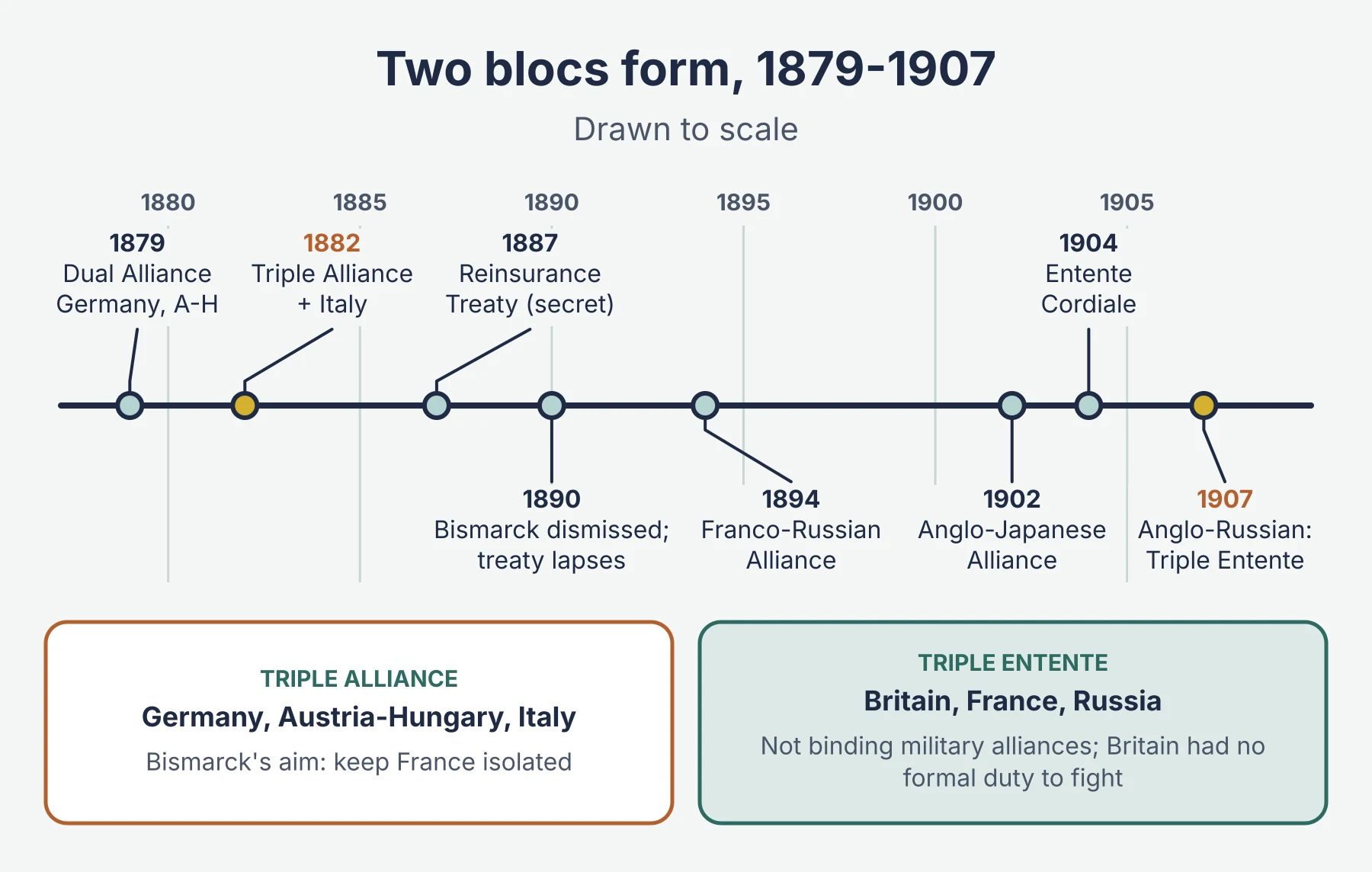
Bismarck built alliances to keep France, defeated in 1871, isolated:
- Dual Alliance (1879): Germany and Austria-Hungary, a defensive alliance against Russia.
- Triple Alliance (1882): Italy joined Germany and Austria-Hungary.
- Reinsurance Treaty (1887): a secret agreement keeping Germany and Russia friendly.
After Bismarck’s dismissal in 1890, Kaiser Wilhelm II’s government let the Reinsurance Treaty lapse. Russia turned to France, and the Franco-Russian Alliance (1894) meant Germany faced possible enemies on two fronts.
Britain had avoided permanent alliances, a policy later called “splendid isolation”. This changed after 1900:
- Anglo-Japanese Alliance (1902): each would stay neutral if the other fought one power, and help if the other fought two. For Britain it protected interests in the Far East against Russia and allowed ships to be brought home; for Japan it meant it could fight Russia in 1904-05 without fear of another power joining in. Japan’s victory weakened Russia and turned Russian attention back to the Balkans.
- Entente Cordiale (1904): Britain and France settled colonial disputes, Britain accepting French influence in Morocco and France accepting Britain’s position in Egypt.
- Anglo-Russian Convention (1907): settled rivalry in Persia, Afghanistan and Tibet, creating the Triple Entente.
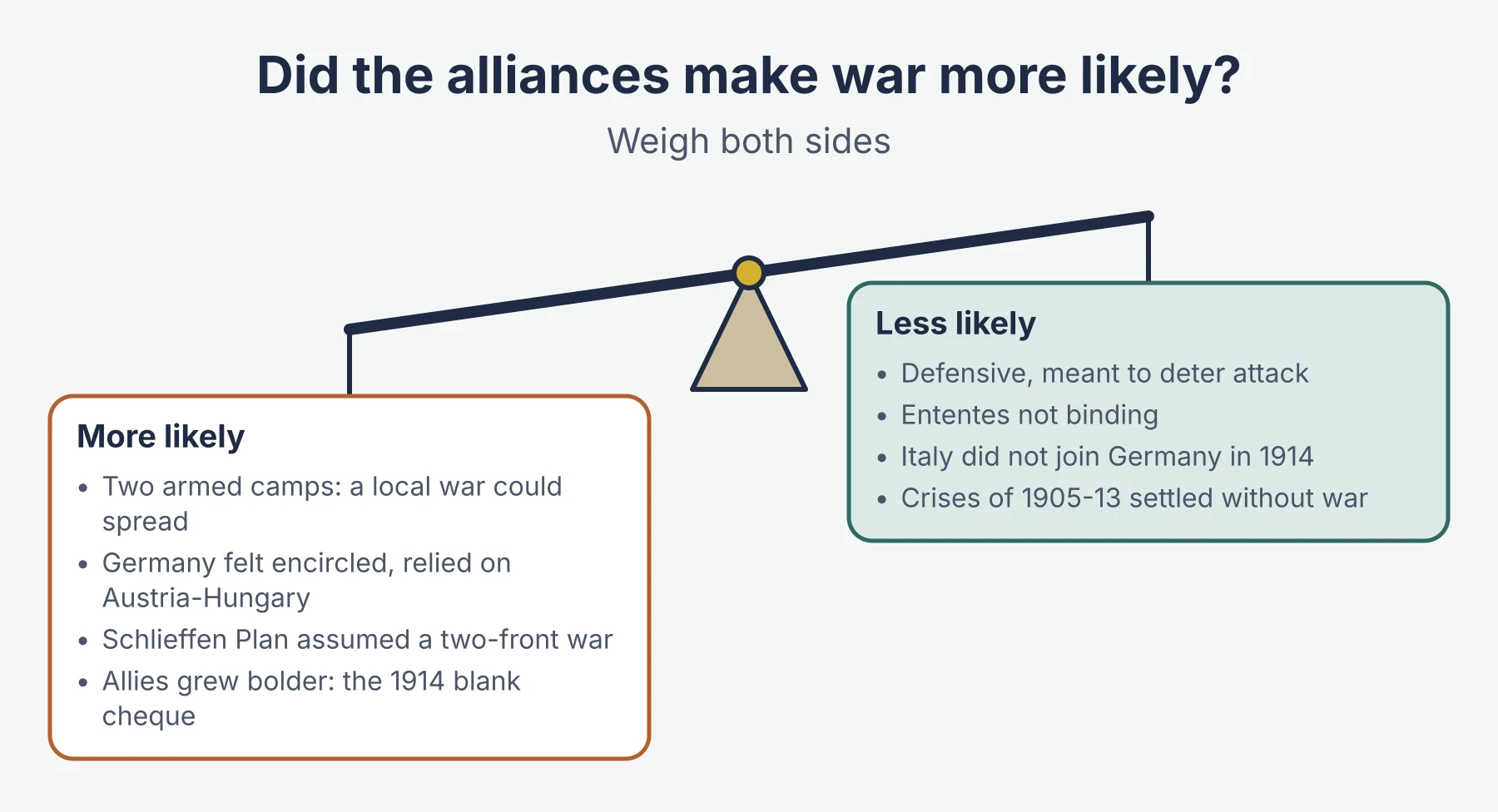
Did the alliances make war more or less likely?
| More likely | Less likely |
|---|---|
| Europe was divided into two armed camps, so a local war could spread | The alliances were defensive and were meant to deter attack |
| Germany felt encircled and relied more on Austria-Hungary, its only reliable ally | The ententes were not binding military alliances; Britain had no formal duty to fight in 1914 |
| Military plans, such as Germany’s Schlieffen Plan, assumed a two-front war | Italy did not join Germany in 1914, showing alliances did not automatically decide action |
| Alliance support made allies bolder in crises, as Germany’s backing of Austria in 1914 showed | Crises between 1905 and 1913 were settled without war |
The arms race
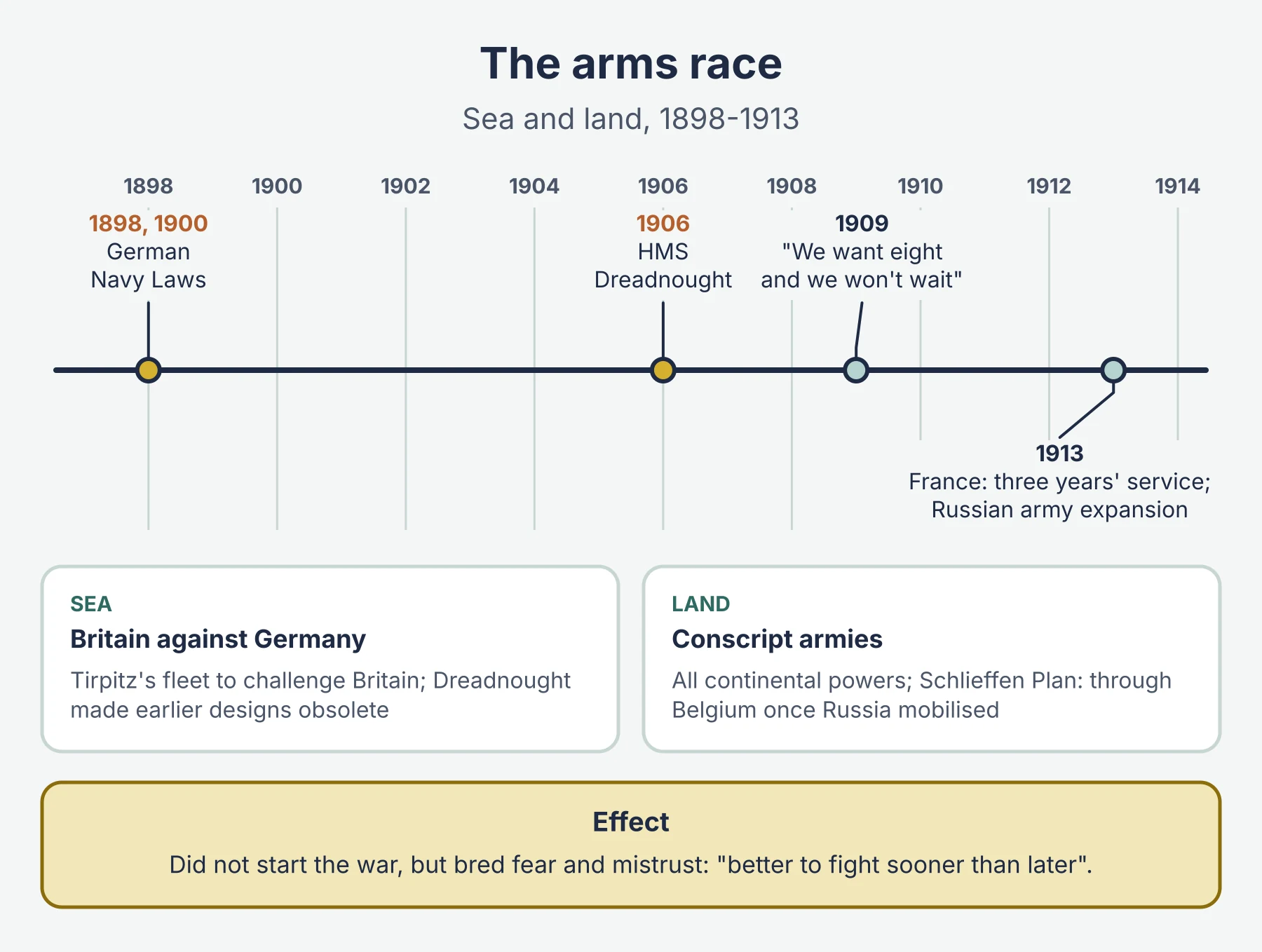
- Naval race: Germany’s Navy Laws of 1898 and 1900, driven by Admiral Tirpitz, aimed to build a fleet to challenge Britain. Britain launched HMS Dreadnought in 1906, a battleship that made earlier designs obsolete, and Germany began building its own. In 1909 the British public demanded more dreadnoughts with the slogan “We want eight and we won’t wait”.
- Land armies: all continental powers had conscription. Germany’s army grew, France extended military service to three years in 1913, and Russia announced a major army expansion programme in 1913.
- War plans: the Schlieffen Plan required Germany to attack France through Belgium as soon as Russia mobilised.
The arms race did not start the war, but it created fear and mistrust, especially between Britain and Germany, and made governments believe that if war came it was better to fight sooner than later.
Colonial rivalries
- Weltpolitik: after 1897 Germany sought a “world policy” with colonies and a navy, which alarmed Britain.
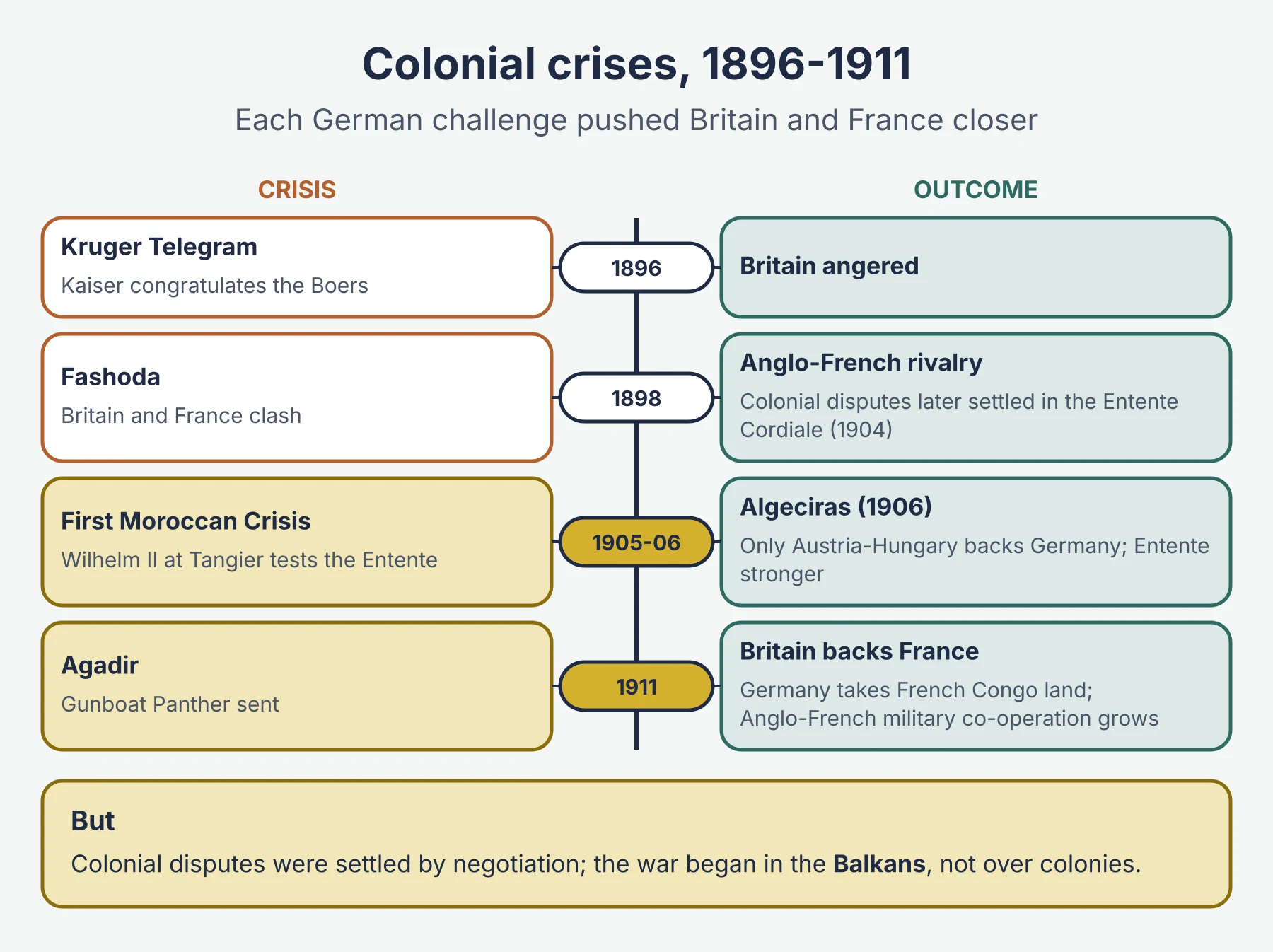
- First Moroccan Crisis (1905-06): Wilhelm II visited Tangier to support Moroccan independence and test the new Entente. At the Algeciras Conference (1906) only Austria-Hungary supported Germany; France’s position was confirmed and the Entente grew stronger.
- Second Moroccan (Agadir) Crisis (1911): Germany sent the gunboat Panther to Agadir. Britain backed France strongly; Germany accepted land in the French Congo in return for recognising French control of Morocco. British and French military co-operation increased.
- Earlier tension: Britain and France clashed at Fashoda (1898), and the Kaiser’s Kruger Telegram (1896), congratulating the Boers on defeating a British raid, angered Britain.
How far did colonial problems create tension? They hardened the alliances: Germany’s attempts to break the Entente drove Britain and France closer. But colonial disputes were also settled by negotiation, and the war began in the Balkans, not over colonies.
The Balkans: why the problems were hard to solve
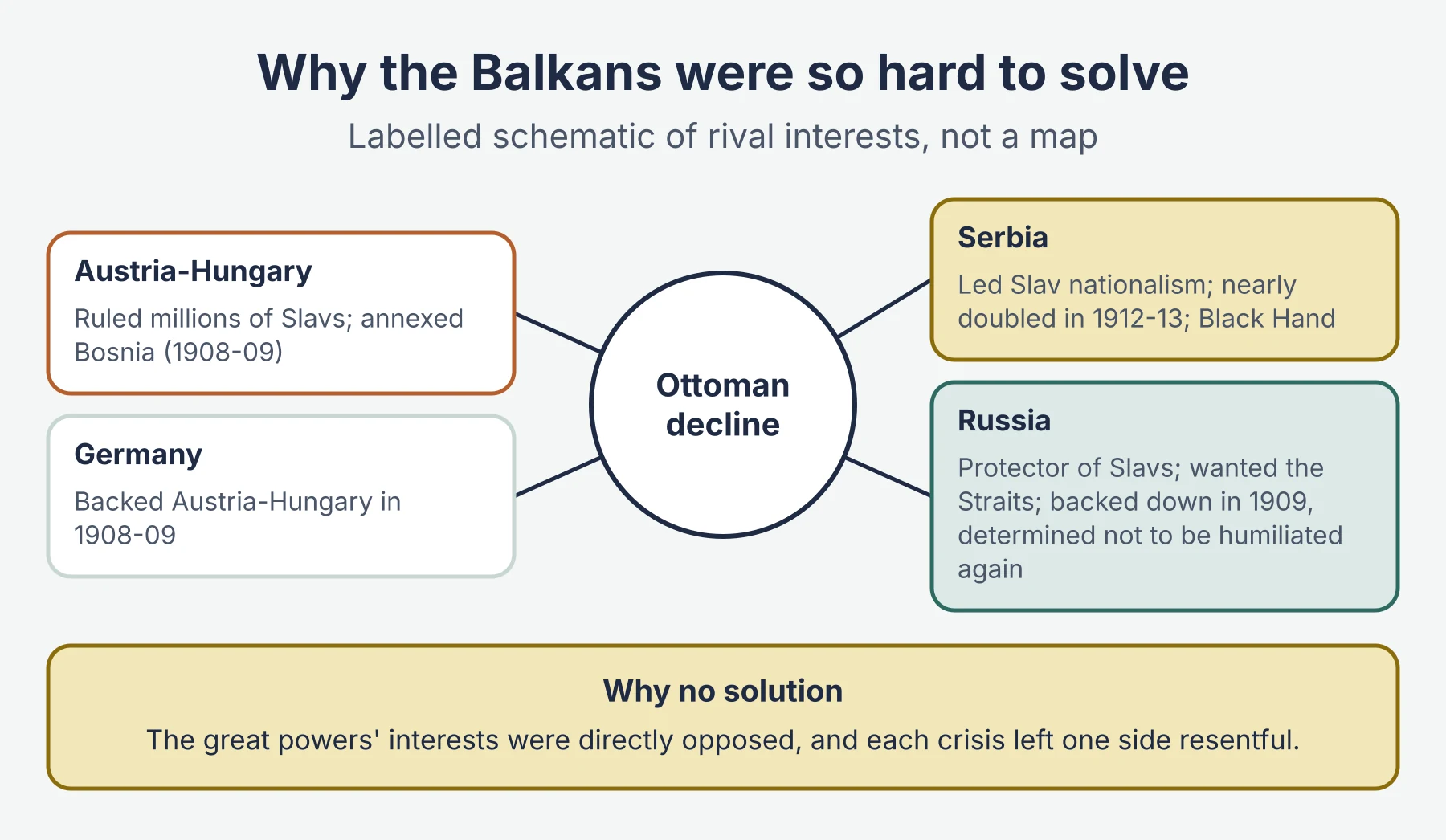
- Ottoman decline left a power vacuum that Austria-Hungary and Russia both wanted to fill.
- Slav nationalism, led by Serbia, threatened Austria-Hungary, which ruled millions of Slavs.
- Russia saw itself as protector of Slav and Orthodox peoples and wanted access through the Straits.
- The Bosnian Crisis (1908-09): Austria-Hungary annexed Bosnia-Herzegovina. Serbia was furious; Russia backed down when Germany supported Austria-Hungary, and was determined not to be humiliated again.
- The Balkan Wars (1912-13): Serbia nearly doubled its territory, making it more confident and Austria more anxious.
- Secret societies such as the Black Hand used terrorism to promote a greater Serbia.
The problems were hard to solve because the great powers’ interests were directly opposed, and each crisis left one side resentful.
The crisis of June-July 1914
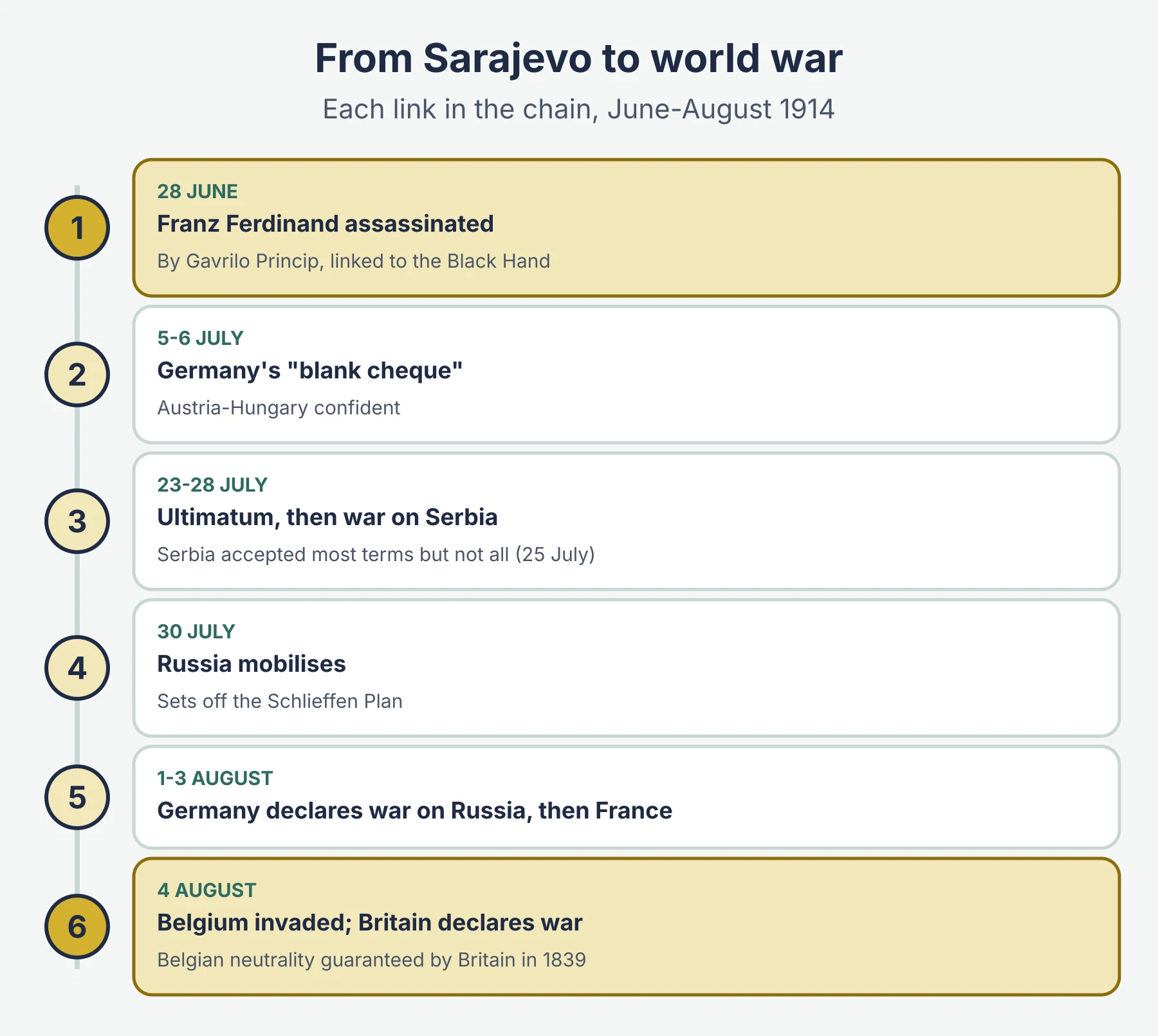
| Date | Event |
|---|---|
| 28 June | Archduke Franz Ferdinand and his wife assassinated in Sarajevo by Gavrilo Princip, a Bosnian Serb linked to the Black Hand |
| 5-6 July | Germany promises Austria-Hungary full support, the “blank cheque” |
| 23 July | Austria-Hungary sends Serbia an ultimatum with deliberately harsh terms |
| 25 July | Serbia accepts most terms but not all |
| 28 July | Austria-Hungary declares war on Serbia |
| 30 July | Russia orders general mobilisation |
| 1 August | Germany declares war on Russia |
| 3 August | Germany declares war on France |
| 4 August | Germany invades Belgium; Britain declares war on Germany |
How the assassination led to war: Austria-Hungary used it as a chance to crush Serbia; the blank cheque made it confident; Russian mobilisation in support of Serbia set off the Schlieffen Plan, which meant war with France and the invasion of Belgium; the violation of Belgian neutrality, guaranteed by Britain in 1839, brought Britain in.
Annotated model answer
An original practice question: “The Alliance System was the main cause of the First World War.” How far do you agree? [10]
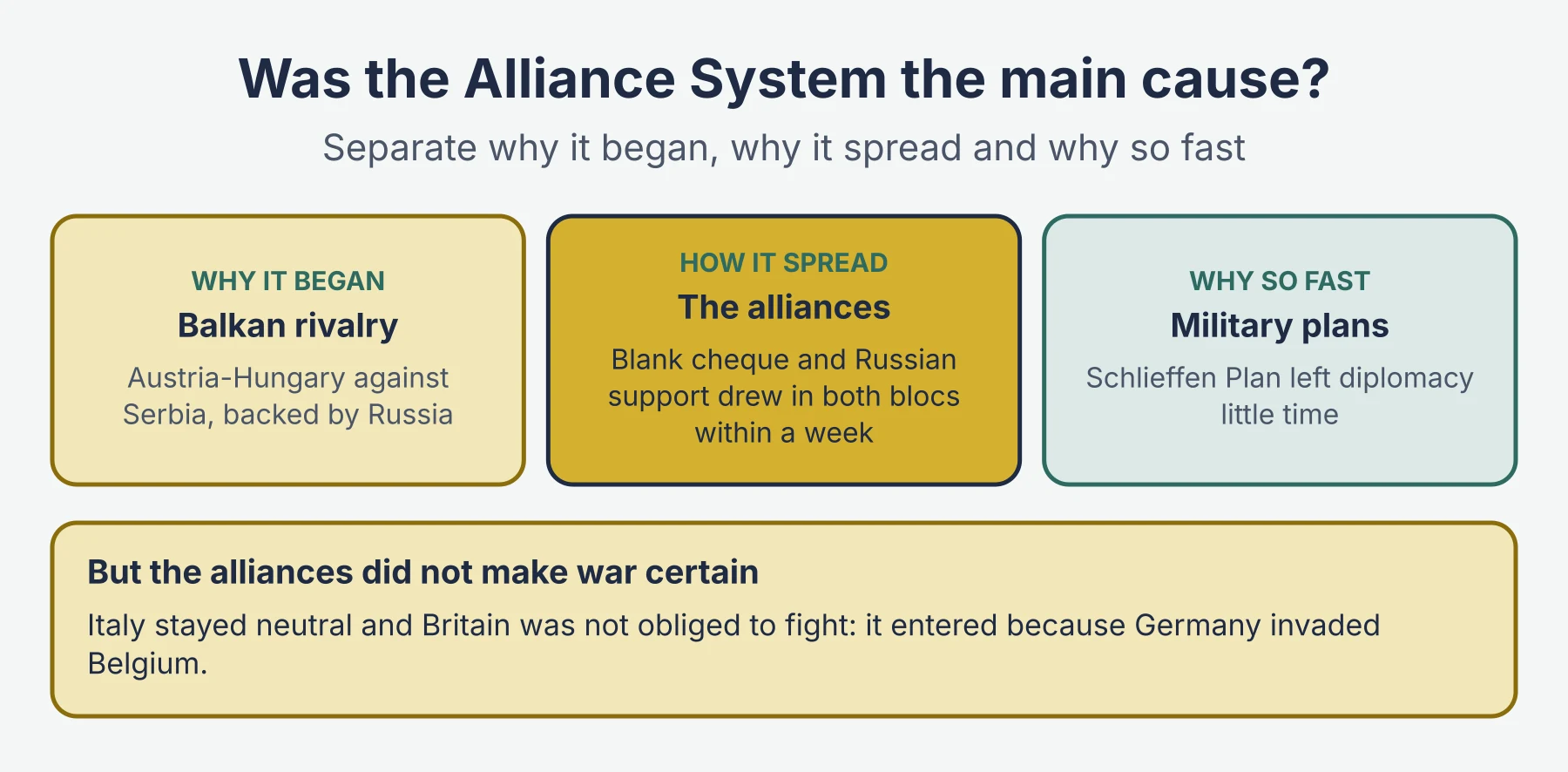
The alliances turned a Balkan quarrel into a European war. Germany’s support for Austria-Hungary in the blank cheque, and Russia’s support for Serbia, meant that the war of 28 July drew in both blocs within a week. [Agree, explained.] However, the alliances did not make war certain: Italy stayed neutral and Britain was not obliged to fight. Britain entered because Germany invaded Belgium, a result of the Schlieffen Plan, which was a product of the arms race and military planning. [Disagree, explained.] The alliances explain how the war spread, but Balkan rivalry explains why it began and military plans explain why diplomacy had so little time. [Judgement separating cause, spread and speed.]
Common mistakes
- Starting with the assassination and ignoring 1890-1914.
- Missing the Anglo-Japanese Alliance, which is named in the specification.
- Calling the Triple Entente a military alliance like the Triple Alliance.
- Saying the war began over colonies. Colonial crises raised tension; the trigger was in the Balkans.
Exam technique
For “how did the assassination lead to war” questions, explain the links in the chain rather than listing dates. For “how far” questions, separate long-term causes, the trigger and the reasons the war spread.
Official syllabus
Cambridge IGCSE History (0470) syllabus for 2024, 2025 and 2026, Core Content Option A, key question 6 – cambridgeinternational.org.
Related resources
-
Practice questions
Cambridge IGCSE World History (0470): What Caused the First World War? – Practice Questions
Twelve original questions with mark-scheme answers on the causes of the First World War, 1890-1914, for Cambridge IGCSE History 0470 key question 1.6.
World History · Cambridge · IGCSE
Try questions -
Revision notes
Cambridge IGCSE World History (0470): What Caused the First World War? – Revision Notes
Recall notes for Cambridge IGCSE History 0470 key question 1.6: alliances, arms race, Moroccan crises, the Balkans and July 1914, with a self-test.
World History · Cambridge · IGCSE
Revise topic -
Study guides
Cambridge IGCSE World History (0470): Why, and With What Effects, Did Nations Gain and Expand Their Overseas Empires?
Cambridge IGCSE History 0470 key question 1.5 in depth: weighing imperial motives, comparing impacts in Africa, India after 1857 and US rule in Cuba.
World History · Cambridge · IGCSE
Read guide
Get free revision emails (optional)
Occasional emails with practice questions, worked explanations and links to free resources for the qualification and subjects you choose. No spam, and you can unsubscribe from any email. The free tools on this site never need an email.