
Study Guides
Cambridge O Level Islamiyat (2058): The History and Importance of the Qur'an
Study guide to the revelation, compilation, legal use and significance of the Qur'an for Cambridge O Level Islamiyat 2058 Paper 1, with a model answer.
- Subject
- Islamiyat
- Level
- O LEVELS
- Topic
- Paper 1
- Author
- Marlbridge Academic Team
- Updated
- Reviewed by
- Azam Siddique (what this means)
Aligned to Cambridge O Level Islamiyat (2058), 2026-2027. Official specification .
Syllabus page (what it covers and how it is assessed): Cambridge O Level Islamiyat.
Syllabus points this page covers
2058
- 1.2 The History and Importance of the Qur’an
Found an error? Report a correction.
Need help with this topic? Request a free trial class for O Level Islamiyat (2058).
The History and Importance of the Qur’an is Paper 1 Question 2 in Cambridge O Level Islamiyat 2058,
and it is compulsory. It is an essay question worth 14 marks, usually split into a knowledge part
(a) worth 10 and an understanding part (b) worth 4. Because every candidate must answer it, you need
secure, detailed knowledge of each stage of the Qur’an’s history, not just the outline.
What the syllabus asks you to study
The 2026–2027 syllabus lists five areas:
- the revelation of the Qur’an to the Prophet (pbuh) between 610 and 632;
- the compilation of the Qur’an under the Rightly Guided Caliphs;
- the major themes of the Qur’an, in the set passages and in similar passages;
- the use of the Qur’an in legal thinking, and its relationship with the Hadith, consensus (ijma’) and analogy (qiyas);
- its significance as the basis of all thought and action in Islam.
Area 3 overlaps with Question 1; this guide concentrates on the other four.
Revelation, 610–632
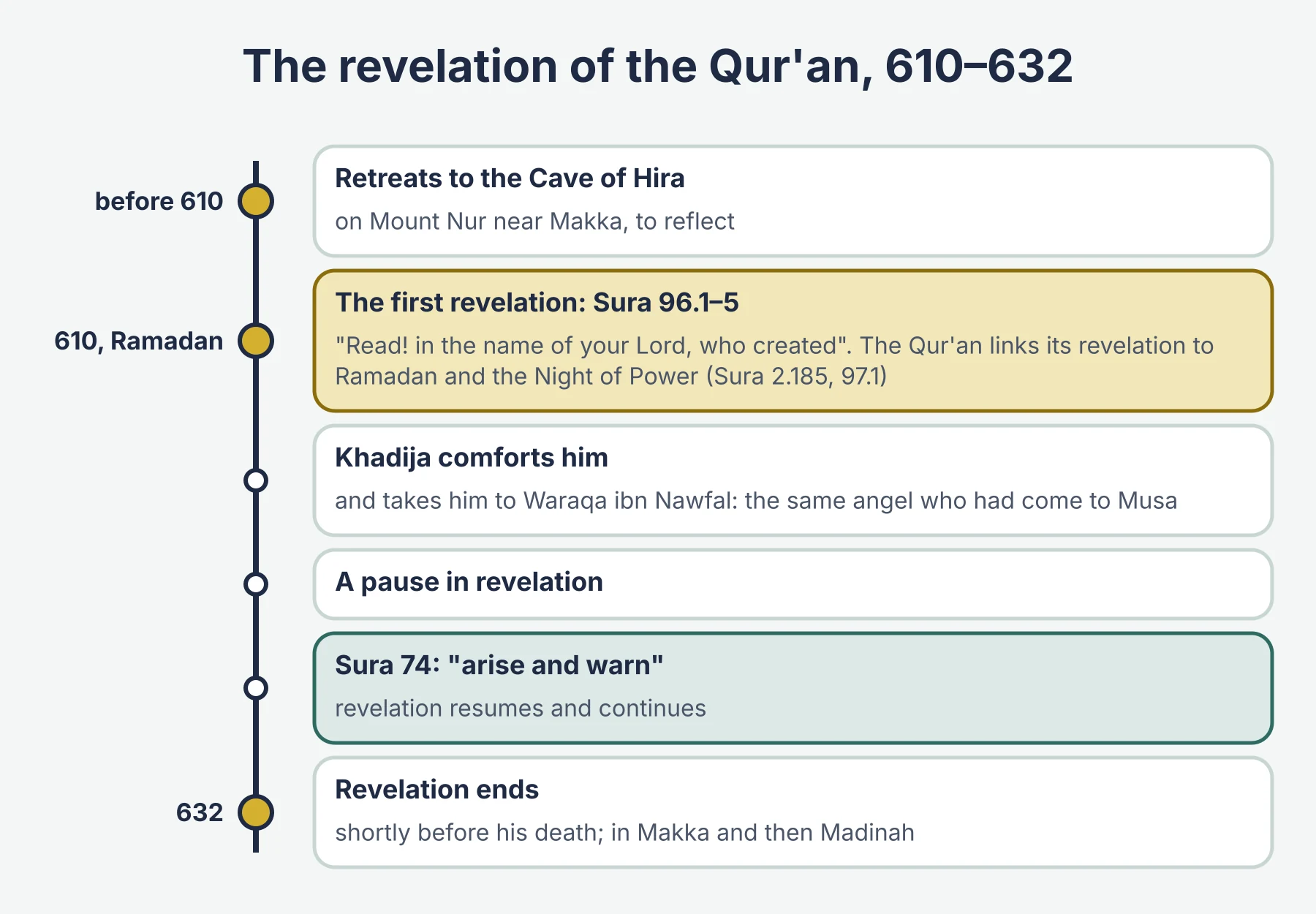
The first revelation. The Prophet (pbuh) used to retreat to the Cave of Hira on Mount Nur near Makka to reflect. In 610, during Ramadan, the angel Jibril appeared and commanded him to read. He replied that he could not read; the angel pressed him and repeated the command, and the first words revealed were Sura 96.1–5, beginning “Read! in the name of your Lord, who created”. The Prophet (pbuh) returned shaken to Khadija (RA), who comforted him and took him to her cousin Waraqa ibn Nawfal, a Christian scholar who said this was the same angel who had come to Musa. The Qur’an links its revelation to this month and night: “Ramadan is the month in which the Qur’an was sent down” (Sura 2.185) and “We have indeed revealed this in the Night of Power” (Sura 97.1).
A pause, then continuous revelation. After the first revelation there was a pause. Revelation resumed with the opening verses of Sura 74, commanding the Prophet (pbuh) to “arise and warn”, and from then on it continued until shortly before his death in 632.
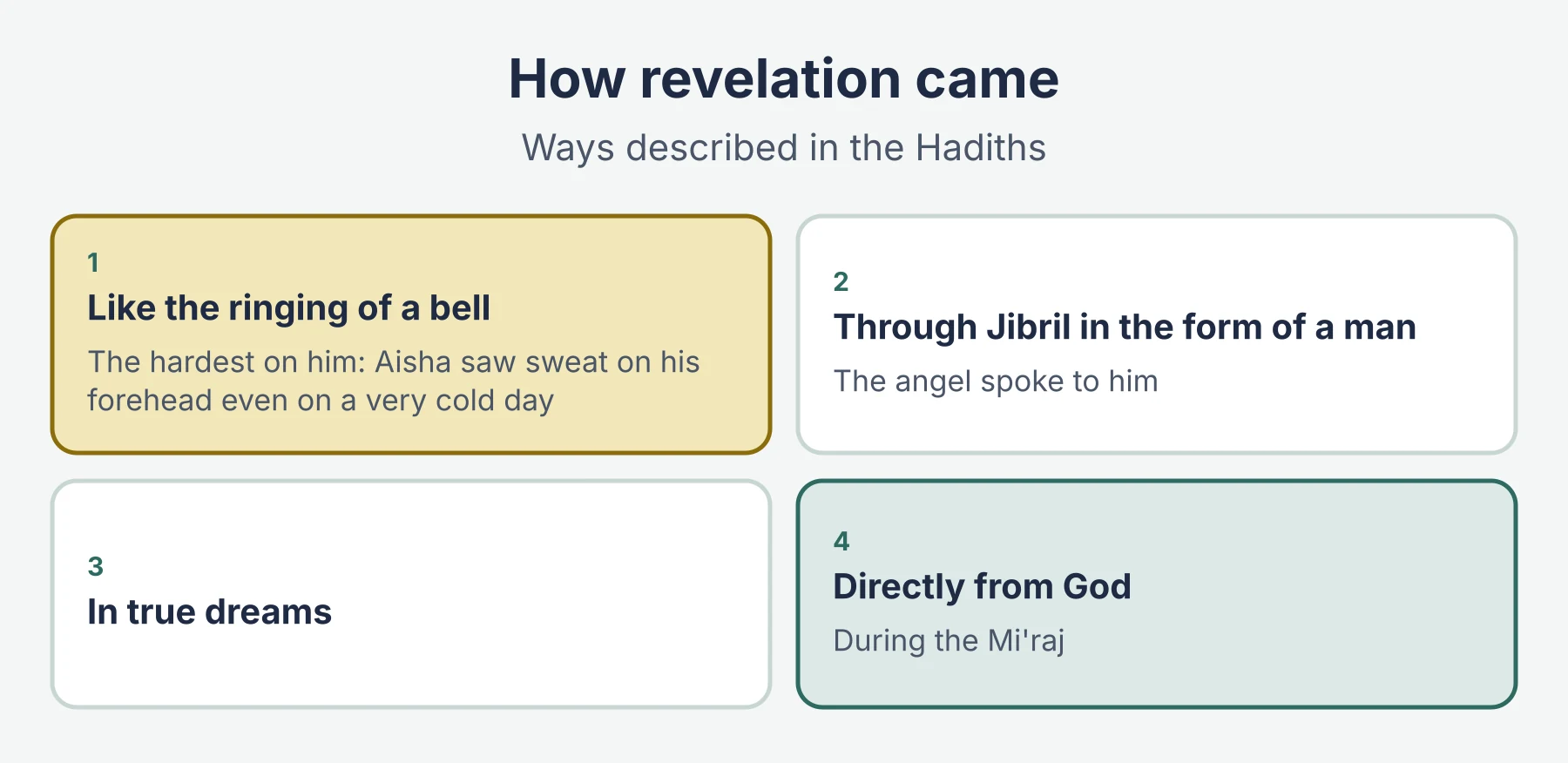
How revelation came. Hadith describe several ways. Sometimes it came like the ringing of a bell, which the Prophet (pbuh) said was the hardest on him; Aisha (RA) reported seeing sweat on his forehead even on a very cold day. Sometimes Jibril came in the form of a man and spoke to him. Revelation also came in true dreams, and God spoke to the Prophet (pbuh) directly during the Mi’raj.
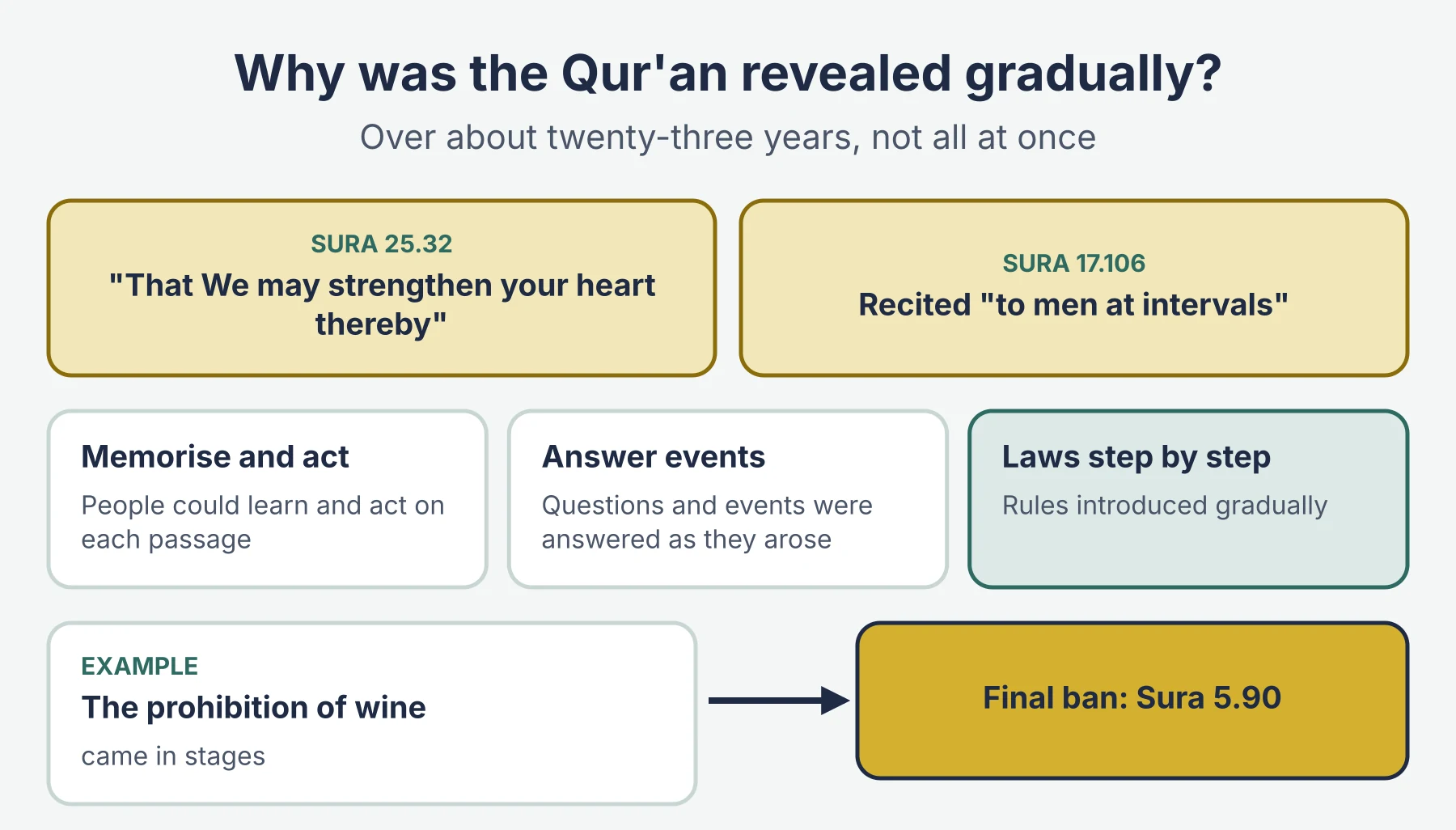
Why it was gradual. The Qur’an answers critics who asked why it was not sent down all at once: it was revealed in stages “that We may strengthen your heart thereby” (Sura 25.32) and so that it could be recited “to men at intervals” (Sura 17.106). Gradual revelation allowed people to memorise and act on each passage, answered questions and events as they arose, and introduced laws step by step, as with the prohibition of wine, which came in stages before the final ban in Sura 5.90.
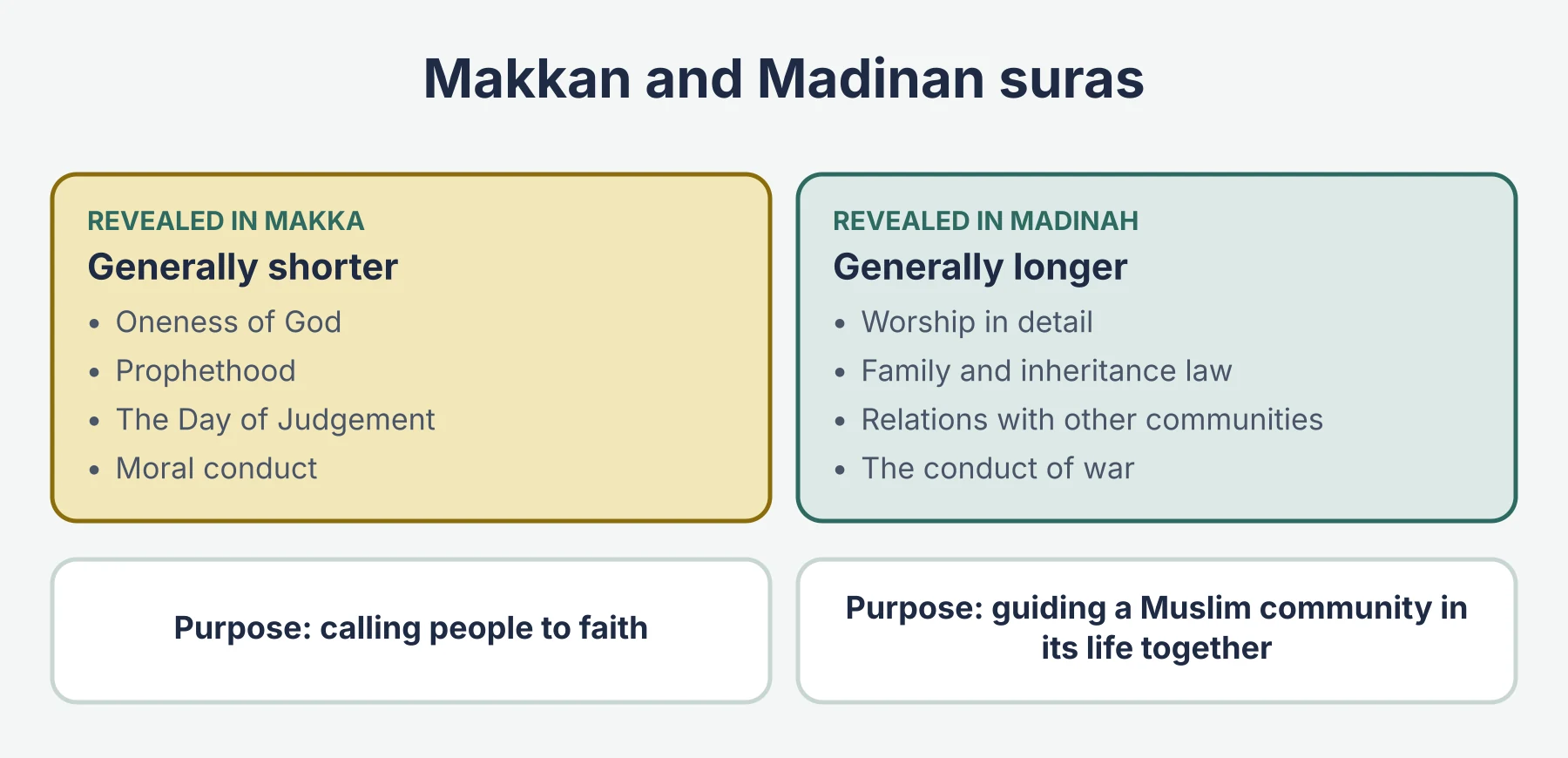
Makkan and Madinan suras. Passages revealed in Makka are generally shorter and concentrate on the oneness of God, prophethood, the Day of Judgement and moral conduct, calling people to faith. Passages revealed in Madina are generally longer and deal with worship in detail, family and inheritance law, relations with other communities and the conduct of war, because a Muslim community now existed that needed guidance for its life together.
Preservation during the Prophet’s (pbuh) lifetime
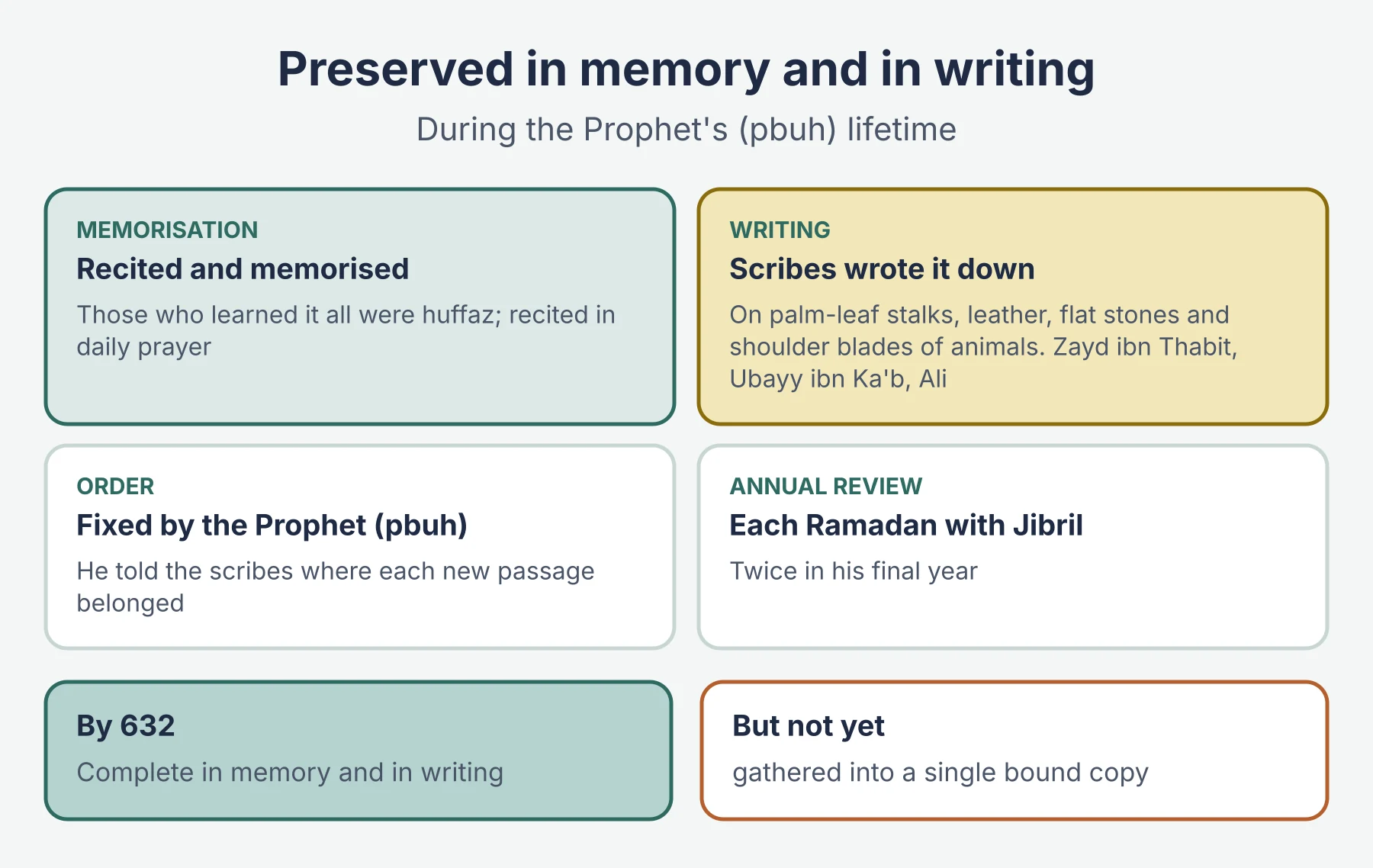
- Memorisation. The Prophet (pbuh) recited each revelation to his Companions, who memorised it; those who learned the whole Qur’an were known as huffaz. The Qur’an was also recited in daily prayer, which kept it in constant use.
- Writing. Scribes wrote revelations down on whatever was available, such as palm-leaf stalks, pieces of leather, flat stones and the shoulder blades of animals. Zayd ibn Thabit (RA) was the best known; others included Ubayy ibn Ka’b (RA) and Ali (RA).
- Order. The Prophet (pbuh) told the scribes where each new passage belonged, so the arrangement of verses within the suras was fixed by him.
- Annual review. Each Ramadan Jibril reviewed the revealed Qur’an with the Prophet (pbuh); in his final year this happened twice.
The Qur’an was therefore complete in memory and in writing by 632, but not yet gathered into a single bound copy.
Compilation under Abu Bakr (RA)
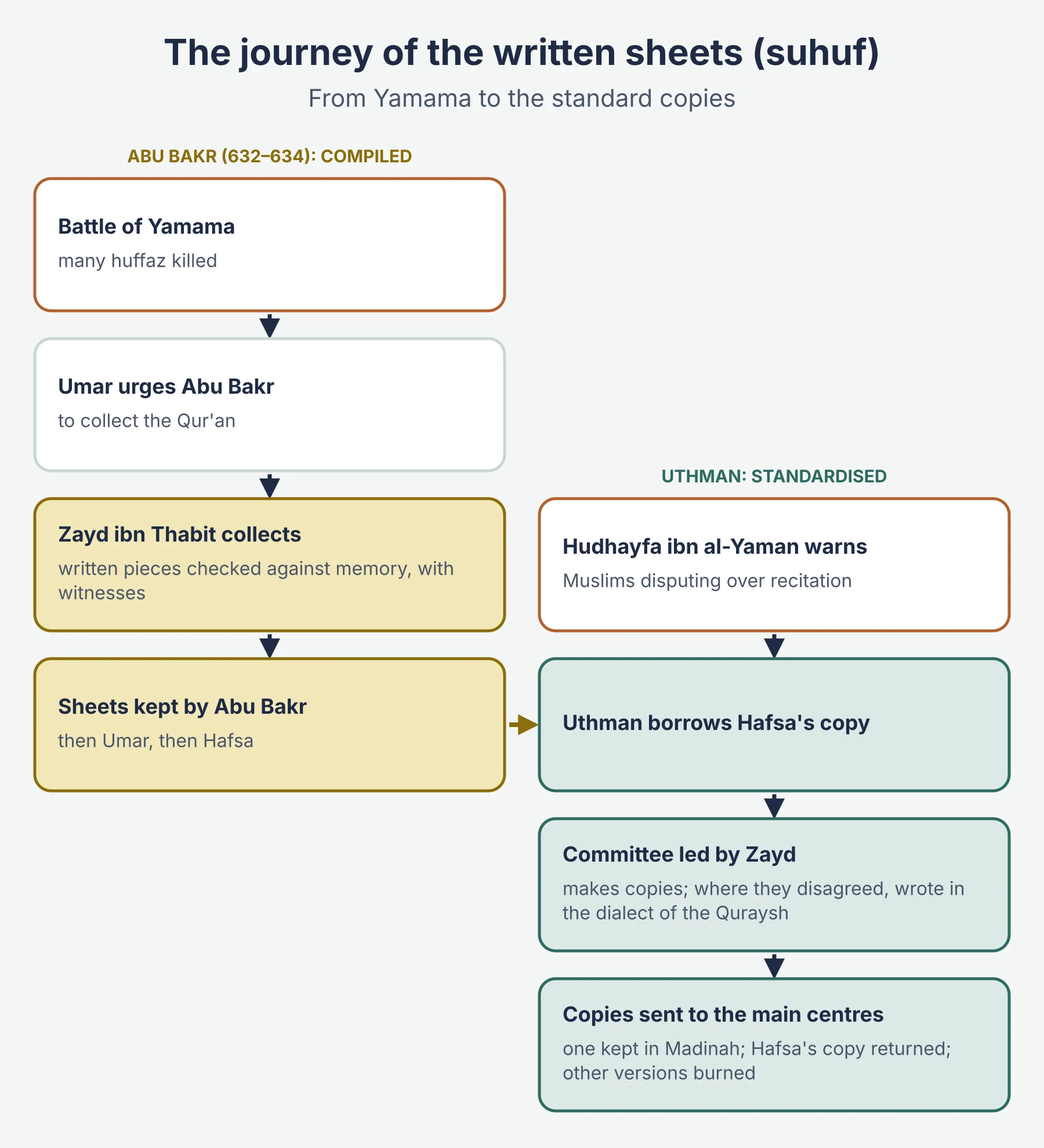
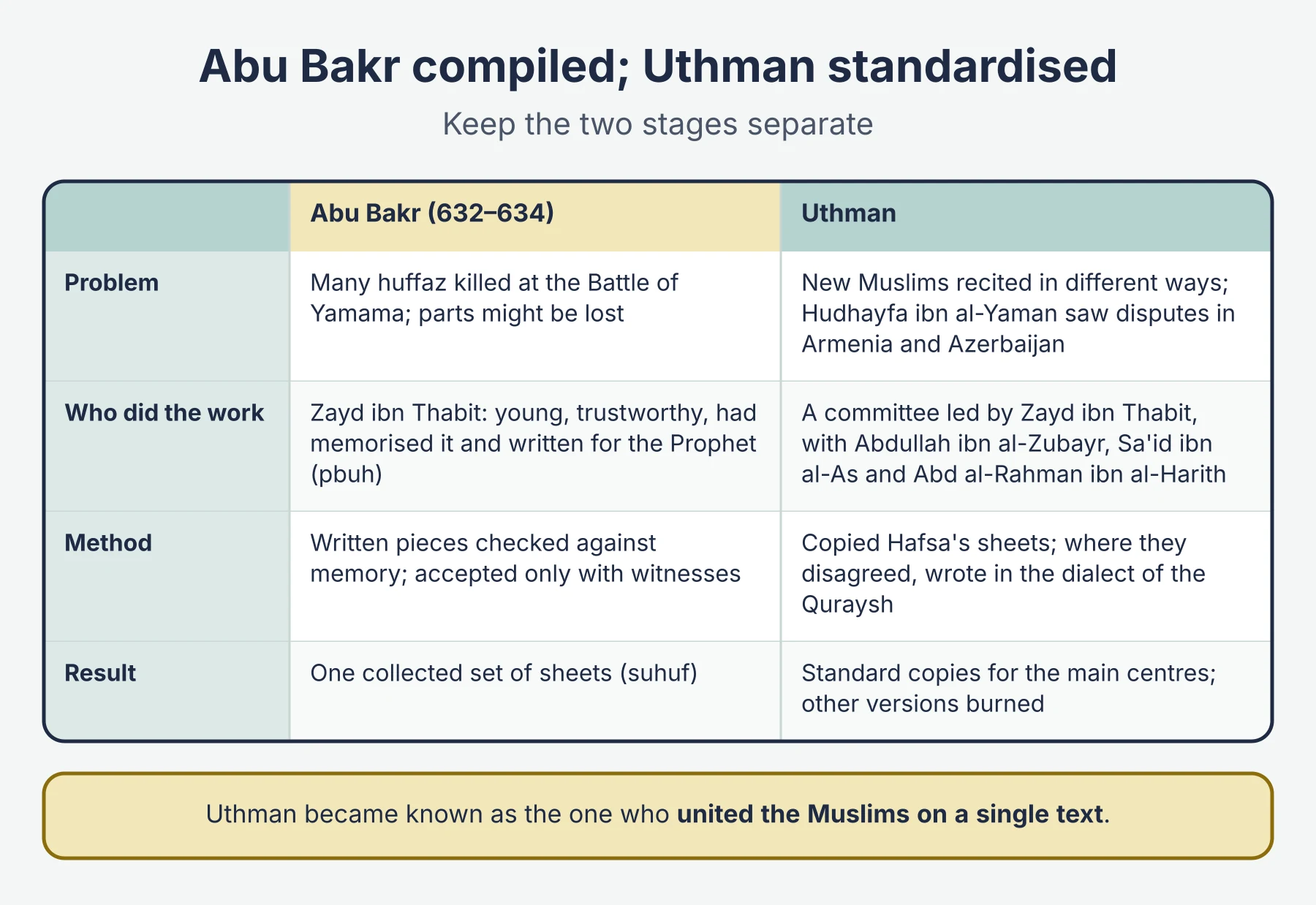
During Abu Bakr’s (RA) caliphate (632–634) the Muslims fought the false prophet Musaylima at the Battle of Yamama, where many huffaz were killed. Umar (RA) feared that more would die and parts of the Qur’an would be lost, and urged Abu Bakr (RA) to collect it. Abu Bakr (RA) hesitated, asking how he could do something the Prophet (pbuh) had not done, but became convinced it was right.
He gave the task to Zayd ibn Thabit (RA), because Zayd was young, trustworthy, had memorised the Qur’an and had written revelation for the Prophet (pbuh). Zayd said that moving a mountain would have been easier. His method was strict: he gathered the written pieces and checked them against what was memorised, and he accepted written material only when witnesses confirmed it had been written in the Prophet’s presence. The final verses of Sura 9 were found in writing only with Abu Khuzayma al-Ansari. The completed sheets (suhuf) stayed with Abu Bakr (RA), then Umar (RA), and then Umar’s (RA) daughter Hafsa (RA), a wife of the Prophet (pbuh).
Standardisation under Uthman (RA)
As the state expanded, new Muslims learned to recite in different ways. During campaigns in Armenia and Azerbaijan, Hudhayfa ibn al-Yaman saw Muslims disputing over recitation and urged Uthman (RA) to act before they differed over their Book as earlier communities had. Uthman (RA) borrowed Hafsa’s (RA) copy and appointed a committee led by Zayd ibn Thabit (RA), with Abdullah ibn al-Zubayr, Sa’id ibn al-As and Abd al-Rahman ibn al-Harith. They made copies, and where they disagreed they wrote in the dialect of the Quraysh, in which the Qur’an had been revealed. Copies were sent to the main centres of the Muslim world, one was kept in Madina, Hafsa’s (RA) copy was returned to her, and other written versions were burned. Uthman (RA) became known as the one who united the Muslims on a single text.
The Qur’an in legal thinking
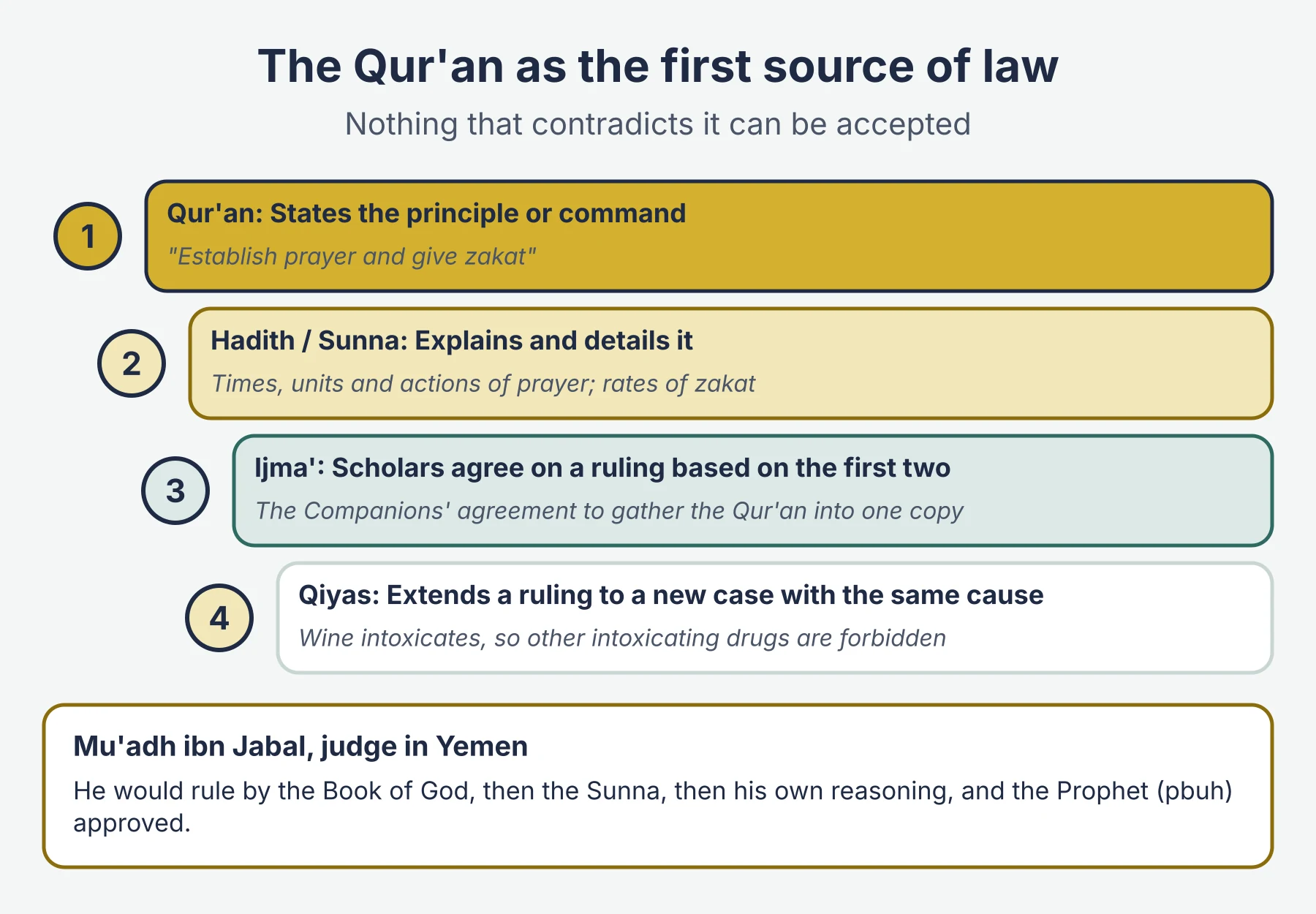
The Qur’an is the first source of Islamic law; nothing that contradicts it can be accepted.
| Source | Role | Example |
|---|---|---|
| Qur’an | States the principle or command | “Establish prayer and give zakat” |
| Hadith/Sunna | Explains and details it | The times, units and actions of prayer; rates of zakat |
| Ijma’ | Scholars agree on a ruling based on the first two | The Companions’ agreement to gather the Qur’an into one copy |
| Qiyas | Extends a ruling to a new case with the same cause | Wine is forbidden because it intoxicates, so other intoxicating drugs are forbidden |
The Hadith of Mu’adh ibn Jabal shows the order: as a judge in Yemen he would rule by the Book of God, then the Sunna, then his own reasoning, and the Prophet (pbuh) approved.
Why the Qur’an matters: significance
- The word of God, preserved. Muslims believe it is God’s own speech, unchanged: “We have, without doubt, sent down the Message; and We will assuredly guard it” (Sura 15.9).
- Guidance for all of life. It calls itself guidance “to those who fear Allah” (Sura 2.2), so belief, worship, family life, business and government are all judged by it.
- Worship. It is recited in every prayer, memorised by children, and recited in full by many during Ramadan.
- Unity. One text, in one language, is shared by Muslims of every country.
Worked example
Question: Describe how the Qur’an was revealed to the Prophet Muhammad (pbuh). [10]
Model answer (summary of a top-level response): The Prophet (pbuh) used to meditate in the Cave of Hira. In 610, in the month of Ramadan, Jibril came and ordered him to “Read!” (iqra); after he replied that he could not read, the angel pressed him three times and then recited Sura 96.1–5. He went home trembling, and Khadija (RA) wrapped him in a cloak, reassured him and took him to Waraqa ibn Nawfal, who recognised the angel as the one who had come to Musa. After a pause, Sura 74 was revealed, telling him to “arise and warn”. Revelation continued for about twenty-three years until 632, in Makka and then Madina. It came in different ways: like the ringing of a bell, which was the hardest for him; through Jibril in human form; and in true dreams. It was revealed gradually, as Sura 25.32 explains, to strengthen the Prophet’s (pbuh) heart and so that believers could learn and apply it step by step. Each passage was memorised by Companions and written down by scribes such as Zayd ibn Thabit (RA).
Why it reaches the top level: it is in order, gives names, places and the first words, quotes the Qur’an and covers the whole period, not only the first night.
Answering part (b): understanding questions
Part (b) asks you to explain, not describe. A strong answer makes two developed points, each with a reason. For example, to “Why was the compilation under Abu Bakr (RA) important?”:
- It ensured that the Qur’an did not depend on the memory of huffaz who could be killed in battle, so the text was safe for later generations.
- It produced the agreed copy that Uthman (RA) later used, so his standard text rested on material checked in the time of the Companions.
Common mistakes
- Mixing up the two stages. Abu Bakr (RA) collected the Qur’an into one copy; Uthman (RA) produced standard copies for the provinces.
- Starting the story at Yamama. Questions on compilation reward knowledge of how the Qur’an was preserved in the Prophet’s (pbuh) lifetime too.
- Vague significance. “The Qur’an is very important to Muslims” earns little; say how it guides a decision, a law or an act of worship.
- Confusing ijma’ and qiyas. Ijma’ is agreement; qiyas is comparison with an existing ruling.
Exam technique for the command words
- Describe / Write about / Give an account of (part a): narrate in order, with names, dates and quotations. Aim for about five well-developed points.
- Explain why / What is the importance of (part b): give reasons and link them to Muslims then or now; two developed points are better than four bare ones.
Related pages
- History and Importance of the Qur’an revision notes
- History and Importance of the Qur’an practice questions
- Paper 1 study guide
Source: Cambridge International, Cambridge O Level Islamiyat 2058 syllabus for examination in 2026 and 2027, Paper 1 Topic 2.
Related resources
-
Practice questions
Cambridge O Level Islamiyat (2058): The History and Importance of the Qur'an — Practice Questions
Eleven original questions on revelation, compilation, legal use and significance of the Qur'an for Cambridge O Level Islamiyat 2058, with mark-scheme answers.
Islamiyat · Cambridge · O Level
Try questions -
Revision notes
Cambridge O Level Islamiyat (2058): The History and Importance of the Qur'an — Revision Notes
Recall notes on revelation, compilation, standardisation and the legal role of the Qur'an for Cambridge O Level Islamiyat 2058, with a 12-question self-test.
Islamiyat · Cambridge · O Level
Revise topic -
Study guides
Cambridge O Level Islamiyat (2058): The Life and Importance of the Prophet Muhammad (pbuh)
Study guide to the Prophet's life from birth to death, his character and his example today, for Cambridge O Level Islamiyat 2058 Paper 1, with a model answer.
Islamiyat · Cambridge · O Level
Read guide
Get free revision emails (optional)
Occasional emails with practice questions, worked explanations and links to free resources for the qualification and subjects you choose. No spam, and you can unsubscribe from any email. The free tools on this site never need an email.