
Study Guides
Cambridge O Level Islamiyat (2058): The Life and Importance of the Prophet Muhammad (pbuh)
Study guide to the Prophet's life from birth to death, his character and his example today, for Cambridge O Level Islamiyat 2058 Paper 1, with a model answer.
- Subject
- Islamiyat
- Level
- O LEVELS
- Topic
- Paper 1
- Author
- Marlbridge Academic Team
- Updated
- Reviewed by
- Azam Siddique (what this means)
Aligned to Cambridge O Level Islamiyat (2058), 2026-2027. Official specification .
Syllabus page (what it covers and how it is assessed): Cambridge O Level Islamiyat.
Syllabus points this page covers
2058
- 1.3 The Life and Importance of the Prophet Muhammad (pbuh)
Found an error? Report a correction.
Need help with this topic? Request a free trial class for O Level Islamiyat (2058).
The Life and Importance of the Prophet Muhammad (pbuh) is one of the two optional topics of Paper 1 in Cambridge O Level Islamiyat 2058. One or two essay questions are set on it among Questions 3–5, each worth 14 marks, normally 10 for a knowledge part (a) and 4 for an understanding part (b). The syllabus expects you to give accounts of the main events of his life and to explain why his actions matter as examples for Muslim individuals and communities today.
What the syllabus covers
- his life from birth to the call to prophethood;
- his activities in Makka and his experiences with his opponents;
- his activities in Madina, his leadership of the community and his conflicts with the Makkans and others;
- his actions and character;
- his example for individuals, in personal conduct and in relations with others, including women and non-Muslims;
- his example for Muslim communities in their relations with other states;
- his significance as Seal of the Prophets and last Messenger of God.
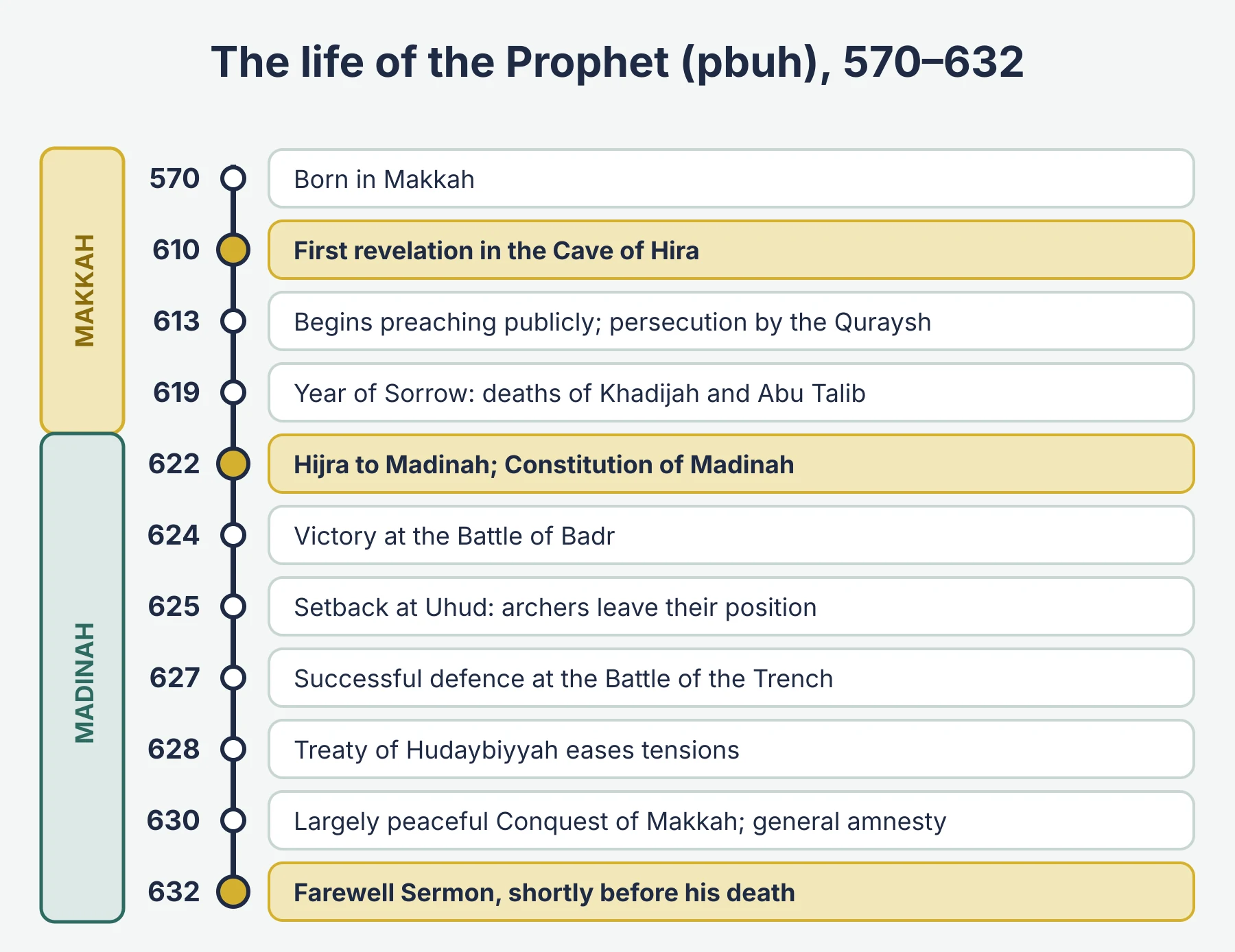
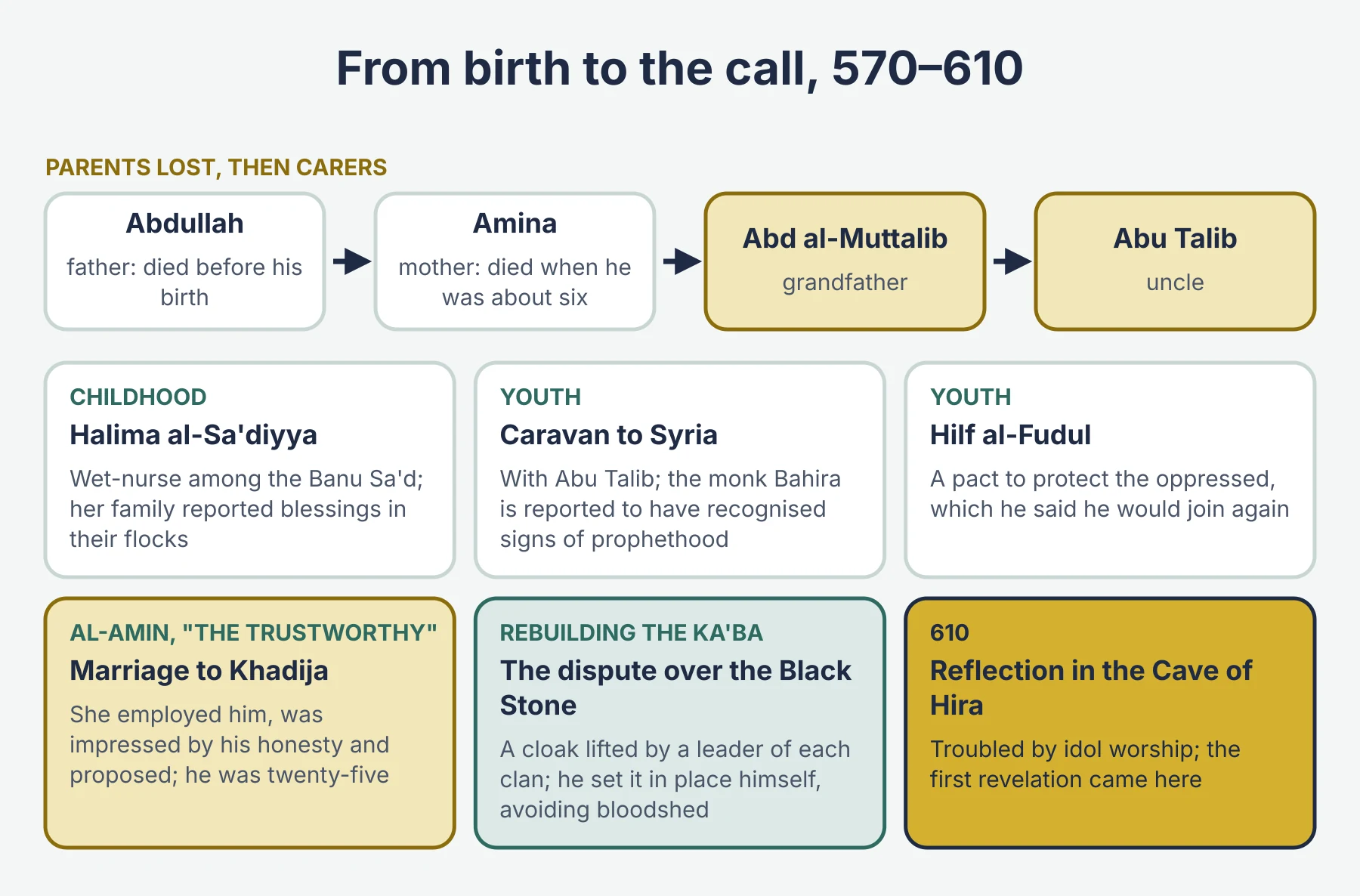
Part 1: Birth to the call (570–610)
- Birth and orphanhood. He was born in Makka in 570, into the clan of Hashim of the Quraysh. His father Abdullah died before his birth and his mother Amina when he was about six. His grandfather Abd al-Muttalib cared for him, and after his death his uncle Abu Talib.
- Childhood in the desert. As was the custom, he spent his early years with a wet-nurse, Halima al-Sa’diyya, among the Banu Sa’d; her family reported blessings in their flocks while he lived with them.
- Youth. He travelled with Abu Talib’s trading caravan to Syria, where the Christian monk Bahira is reported to have recognised signs of prophethood in him. He worked as a shepherd and was present at the Hilf al-Fudul, a pact to protect the oppressed, which he later said he would join again if invited.
- Al-Amin. His honesty earned him the title al-Amin, “the trustworthy”. Khadija (RA) employed him to trade for her, was impressed by his honesty, and proposed marriage; they married when he was twenty-five.
- The Black Stone. When the Ka’ba was rebuilt, the clans quarrelled over who would replace the Black Stone. He placed it on a cloak, had a leader of each clan lift a corner, and set it in place himself, avoiding bloodshed.
- Hira. He grew increasingly troubled by idol worship and spent time in reflection in the Cave of Hira, where the first revelation came in 610.
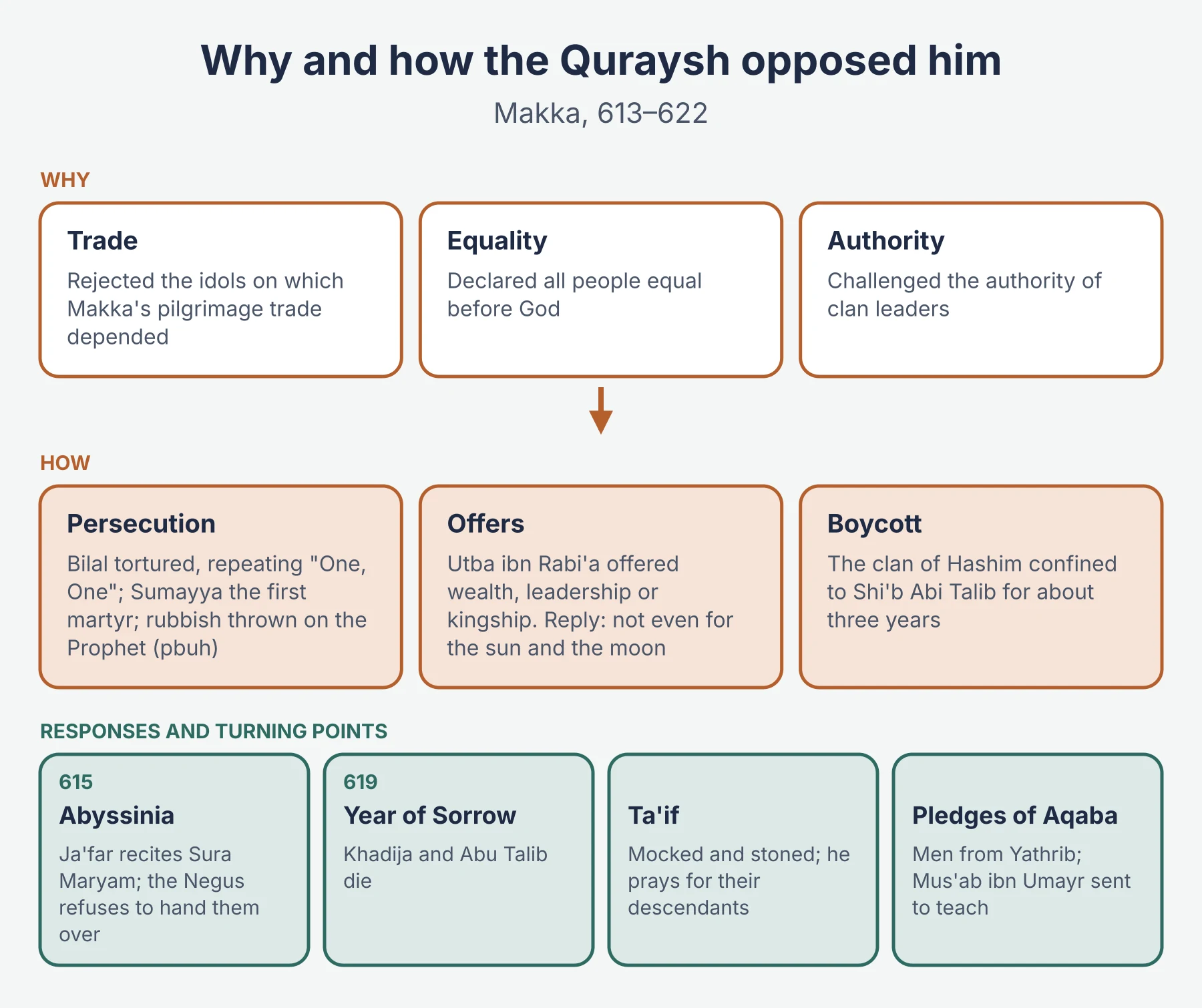
Part 2: Makka and the opponents (610–622)
- First believers. Khadija (RA), Ali (RA), Abu Bakr (RA) and Zayd ibn Haritha (RA) were among the first. For about three years the call was private.
- Public preaching, 613. He called the clans from Mount Safa. His uncle Abu Lahab cursed him, and Sura 111 was revealed about him.
- Why the Quraysh opposed him. The message rejected the idols on which Makka’s pilgrimage trade depended, declared all people equal before God, and challenged the authority of clan leaders.
- Persecution. Weaker Muslims suffered most: Bilal (RA) was tortured by his master Umayya ibn Khalaf and kept repeating “One, One”; Sumayya, mother of Ammar, became the first martyr. The Prophet himself was insulted, and rubbish was thrown on him.
- Offers and refusal. The Quraysh sent Utba ibn Rabi’a to offer wealth, leadership or kingship if he would stop. When they pressed Abu Talib, the Prophet (pbuh) replied that even if they placed the sun in his right hand and the moon in his left he would not give up his mission.
- Abyssinia, 615. He sent a group of Muslims to the Christian king (the Negus). When the Quraysh demanded their return, Ja’far ibn Abi Talib explained Islam and recited from Sura Maryam; the king refused to hand them over.
- Boycott. The Quraysh boycotted the clan of Hashim, who were confined to a valley known as Shi’b Abi Talib for about three years.
- Year of Sorrow, 619. Khadija (RA) and Abu Talib died, leaving him without his closest support and his clan’s protection.
- Ta’if. He sought support in Ta’if but was mocked and stoned. When offered the destruction of the town, he refused and prayed that their descendants would worship God.
- Isra and Mi’raj. He was taken by night from Makka to Jerusalem and raised through the heavens (Sura 17.1); the five daily prayers were made obligatory.
- The pledges of Aqaba. Men from Yathrib accepted Islam and pledged first to worship God alone and follow his teaching and then, the following year, to protect him; he sent Mus’ab ibn Umayr (RA) to teach them.
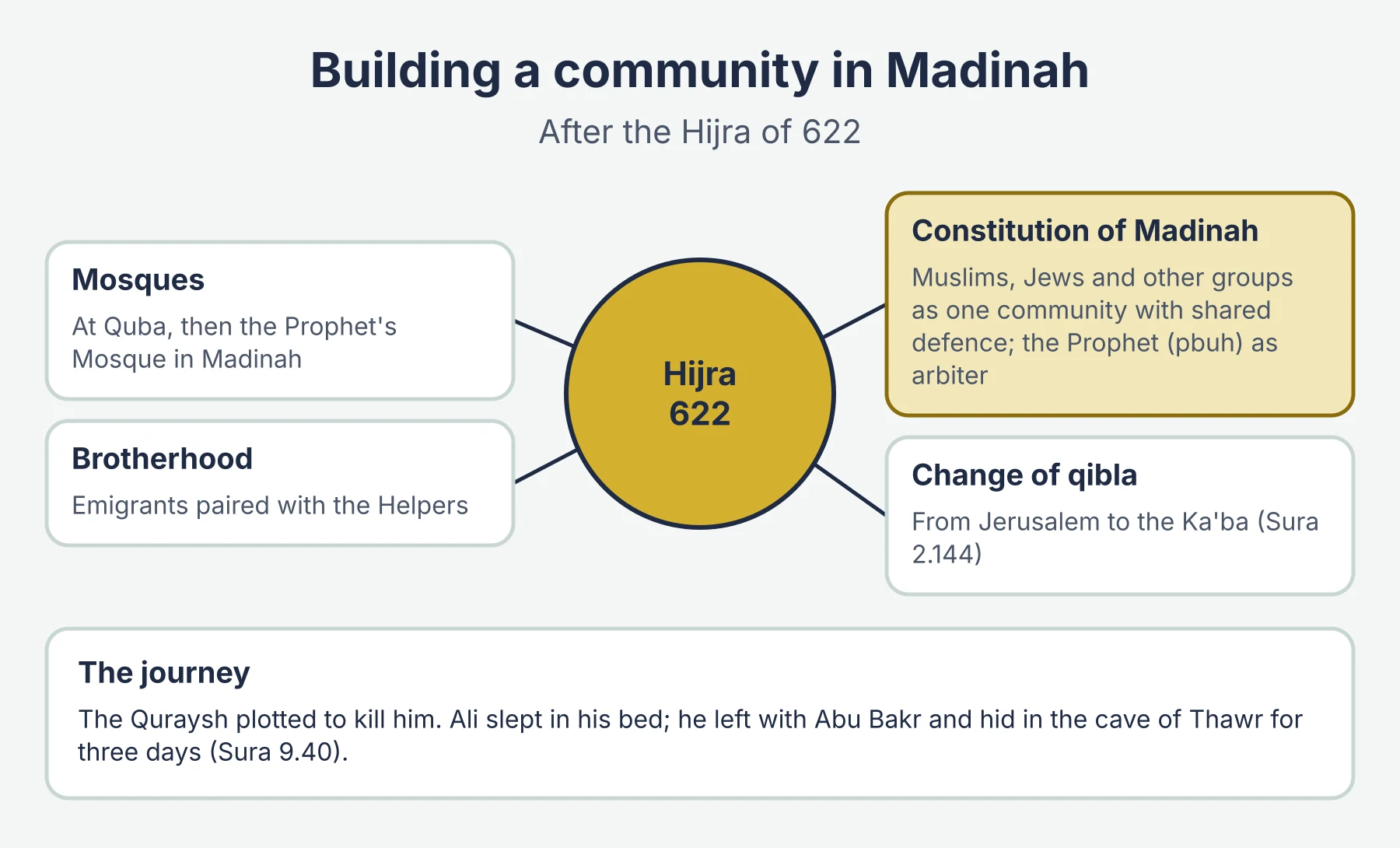
Part 3: Madina (622–632)
- Hijra, 622. The Quraysh plotted to kill him; Ali (RA) slept in his bed, and he left with Abu Bakr (RA), hiding in the cave of Thawr for three days (Sura 9.40). He built a mosque at Quba and then the Prophet’s Mosque in Madina.
- Building a community. He paired the Emigrants with the Helpers in brotherhood and agreed the Constitution of Madina, which made Muslims, Jews and other groups one community with shared defence and gave him the role of arbiter.
- Change of qibla. The direction of prayer changed from Jerusalem to the Ka’ba (Sura 2.144).
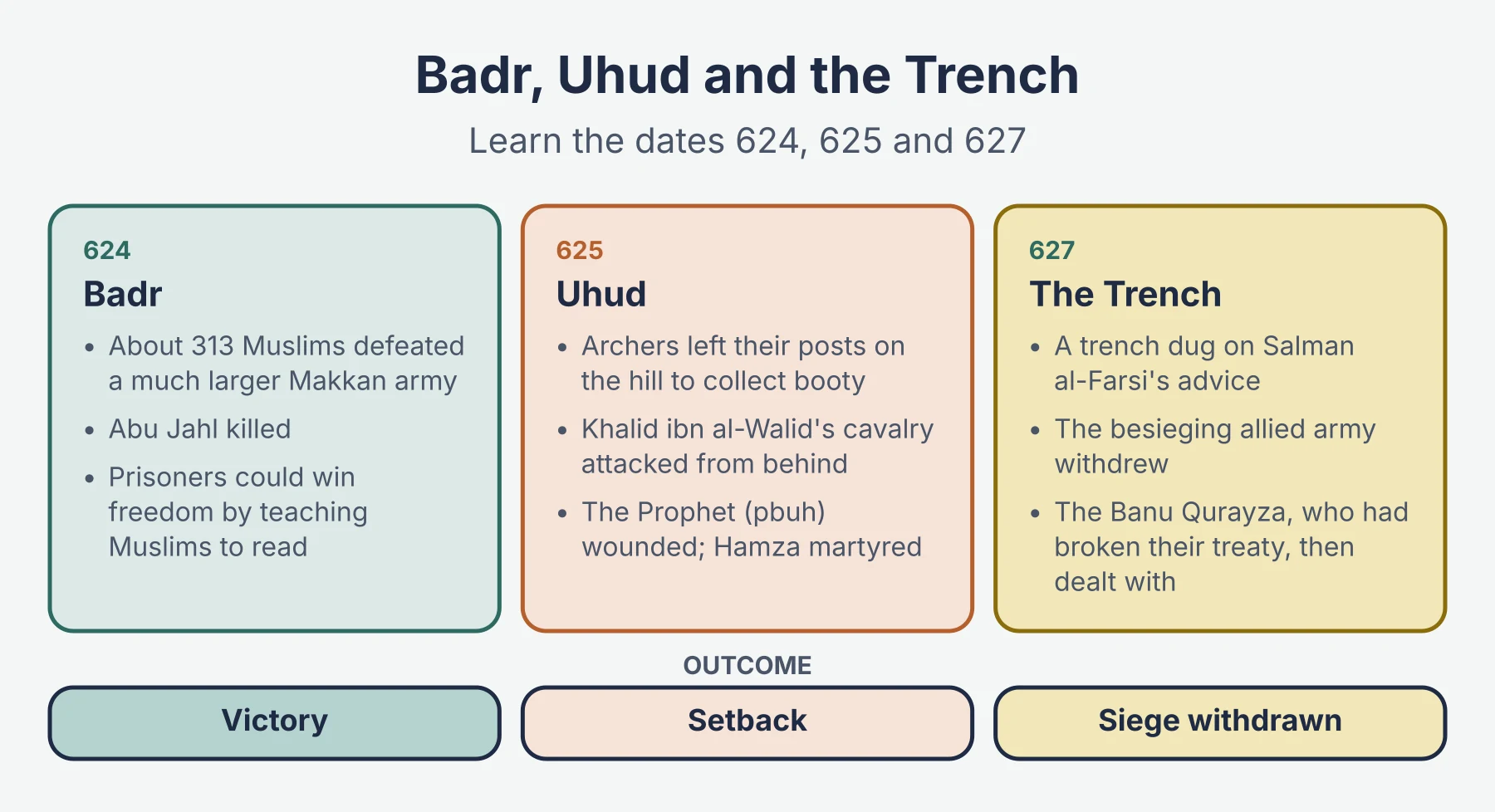
- Badr, 624. About 313 Muslims defeated a much larger Makkan army; Abu Jahl was killed. Prisoners could win freedom by teaching Muslims to read.
- Uhud, 625. Archers placed on a hill left their posts to collect booty; Khalid ibn al-Walid’s cavalry attacked from behind; the Prophet (pbuh) was wounded and his uncle Hamza (RA) was martyred.
- The Trench, 627. On Salman al-Farsi’s (RA) advice a trench was dug; the besieging allied army withdrew. The Banu Qurayza, who had broken their treaty, were then dealt with.
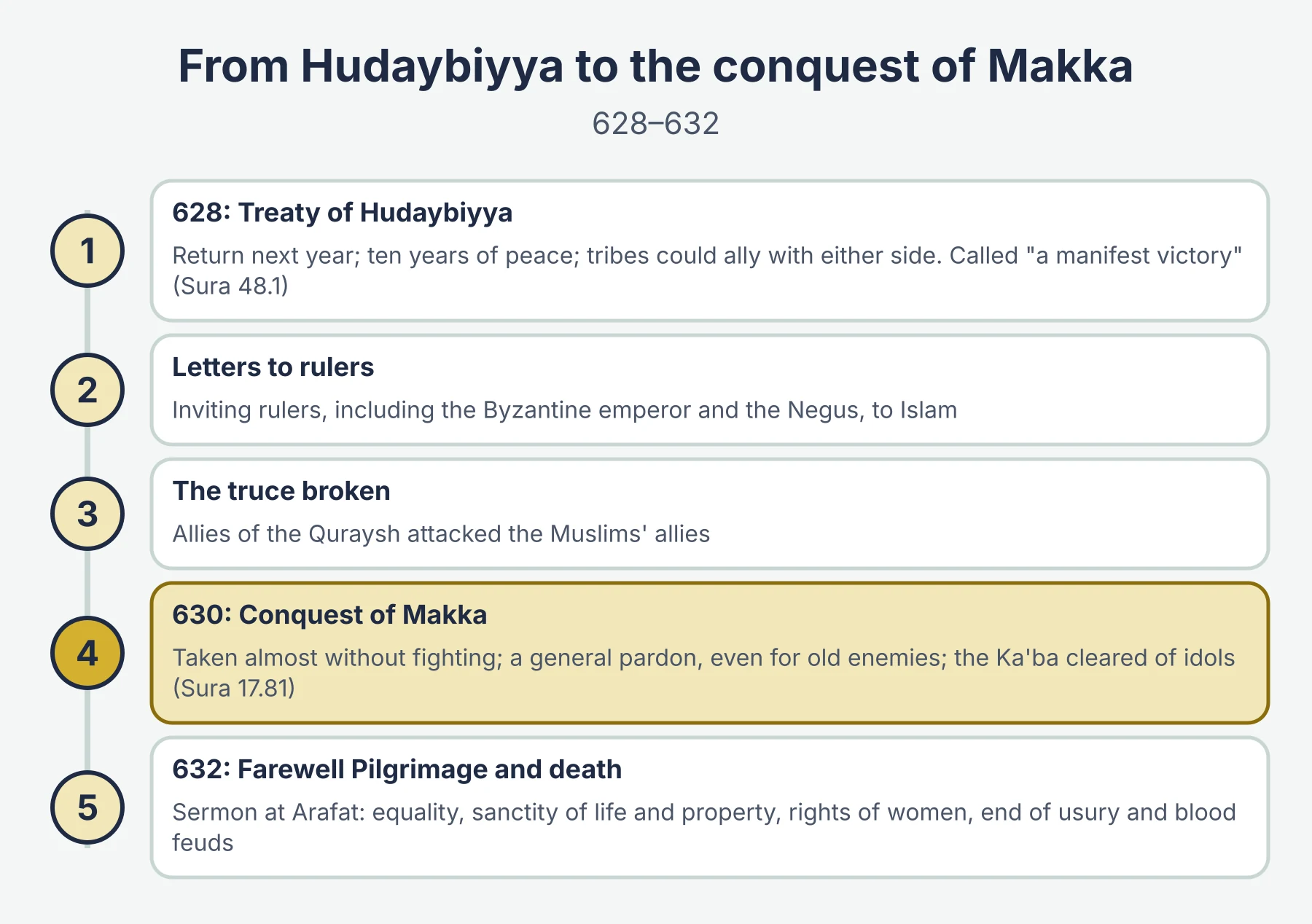
- Hudaybiyya, 628. Prevented from performing umra, he agreed a truce: the Muslims would return next year, there would be ten years of peace, and tribes could ally with either side. Though the terms seemed unfavourable, the Qur’an called it “a manifest victory” (Sura 48.1). He then sent letters inviting rulers, including the Byzantine emperor and the Negus, to Islam.
- Conquest of Makka, 630. After allies of the Quraysh attacked the Muslims’ allies, he marched on Makka, which was taken almost without fighting. He declared a general pardon, including for old enemies, and cleared the Ka’ba of idols, reciting “Truth has come and falsehood has vanished” (Sura 17.81).
- Farewell Pilgrimage and death, 632. In his sermon at Arafat he stressed equality, the sanctity of life and property, the rights of women, and the abolition of usury and blood feuds. He died in Madina later that year, in Aisha’s (RA) room.
His character and example
| Area | Example from his life | Lesson today |
|---|---|---|
| Honesty | Known as al-Amin before prophethood | Truthfulness in work and study |
| Forgiveness | Pardon at the conquest of Makka; prayer for Ta’if | Forgive personal wrongs |
| Women | Respected Khadija’s (RA) judgement; helped at home | Treat wives and daughters with respect |
| Non-Muslims | Constitution of Madina; protection in Abyssinia | Fair treatment of minorities |
| Other states | Hudaybiyya; letters to rulers; envoys respected | Keep treaties; diplomacy before conflict |
| Leadership | Consulted Companions before Uhud and the Trench | Consult before deciding |
The Qur’an calls him “a beautiful pattern of conduct” (Sura 33.21) and says “you are of an exalted standard of character” (Sura 68.4).
Seal of the Prophets
Sura 33.40 calls him “the Messenger of Allah and the Seal of the Prophets”. Muslims believe that no prophet comes after him, that his message completes those of earlier prophets, and that it is for all people, not one nation. This makes his Sunna permanently binding as the model for life.
Worked example
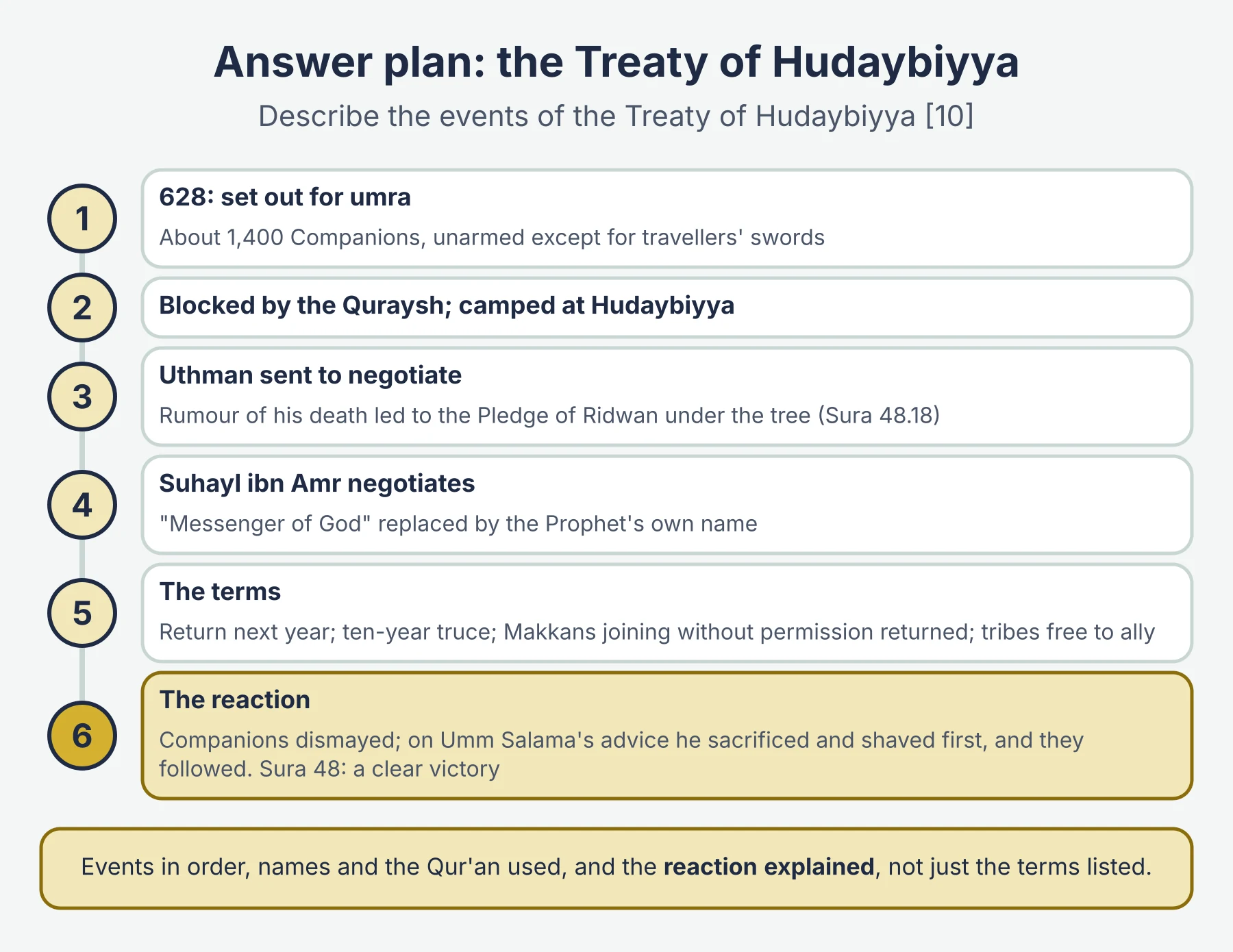
Question: Describe the events of the Treaty of Hudaybiyya. [10]
Strong answer plan: in 628 the Prophet (pbuh) set out with about 1,400 Companions to perform umra, unarmed except for travellers’ swords → camped at Hudaybiyya when the Quraysh blocked the way → sent Uthman (RA) to negotiate; rumour of his death led to the Pledge of Ridwan under the tree (Sura 48.18) → Suhayl ibn Amr negotiated for the Quraysh; he objected to “Messenger of God” in the text, and the Prophet had it replaced by his own name → terms: return next year, ten-year truce, Makkans joining the Muslims without permission to be returned, tribes free to ally → Companions dismayed; on Umm Salama’s (RA) advice the Prophet (pbuh) sacrificed and shaved first, and they followed → Sura 48 called it a clear victory.
Why it scores well: the events are in order, names and the Qur’an are used, and the reaction is explained rather than only the terms listed.
Common mistakes
- Losing the sequence. Badr, Uhud and the Trench are often confused; learn the dates 624, 625 and 627.
- Narrating when asked for importance. Part (b) needs a lesson or significance, not more events.
- Generic examples. “He was kind” earns little; name the incident.
- Ignoring the syllabus’s named groups. Questions may ask specifically about women, non-Muslims or other states.
Exam technique
- “Describe” / “Give an account of”: tell the events in order, with places, people and dates.
- “Explain the importance” / “What can Muslims learn”: link a specific event to a modern situation and give a reason.
- Read all of Questions 3–5 before choosing; one question on this topic may suit your knowledge better than the other.
Related pages
- Life of the Prophet (pbuh) revision notes
- Life of the Prophet (pbuh) practice questions
- The First Islamic Community study guide
Source: Cambridge International, Cambridge O Level Islamiyat 2058 syllabus for examination in 2026 and 2027, Paper 1 Topic 3.
Related resources
-
Practice questions
Cambridge O Level Islamiyat (2058): The Life and Importance of the Prophet Muhammad (pbuh) — Practice Questions
Twelve original questions on the Prophet's life, battles, treaties and example for Cambridge O Level Islamiyat 2058 Paper 1, with full mark-scheme answers.
Islamiyat · Cambridge · O Level
Try questions -
Revision notes
Cambridge O Level Islamiyat (2058): The Life and Importance of the Prophet Muhammad (pbuh) — Revision Notes
Recall notes on the Prophet's life in Makka and Madina, his battles and treaties and his example today, for Cambridge O Level Islamiyat 2058 Paper 1.
Islamiyat · Cambridge · O Level
Revise topic -
Practice questions
Cambridge O Level Islamiyat (2058): Major Themes of the Qur'an — Practice Questions
Twelve original questions on the set Qur'an passages for Cambridge O Level Islamiyat 2058 Paper 1 Question 1, with themes, key Arabic words and marked answers.
Islamiyat · Cambridge · O Level
Try questions
Get free revision emails (optional)
Occasional emails with practice questions, worked explanations and links to free resources for the qualification and subjects you choose. No spam, and you can unsubscribe from any email. The free tools on this site never need an email.