
Revision Notes
Cambridge O Level Islamiyat (2058): The Life and Importance of the Prophet Muhammad (pbuh) — Revision Notes
Recall notes on the Prophet's life in Makka and Madina, his battles and treaties and his example today, for Cambridge O Level Islamiyat 2058 Paper 1.
- Subject
- Islamiyat
- Level
- O LEVELS
- Topic
- Paper 1
- Author
- Marlbridge Academic Team
- Updated
- Reviewed by
- Azam Siddique (what this means)
Aligned to Cambridge O Level Islamiyat (2058), 2026-2027. Official specification .
Syllabus page (what it covers and how it is assessed): Cambridge O Level Islamiyat.
Syllabus points this page covers
2058
- 1.3 The Life and Importance of the Prophet Muhammad (pbuh)
Found an error? Report a correction.
Need help with this topic? Request a free trial class for O Level Islamiyat (2058).
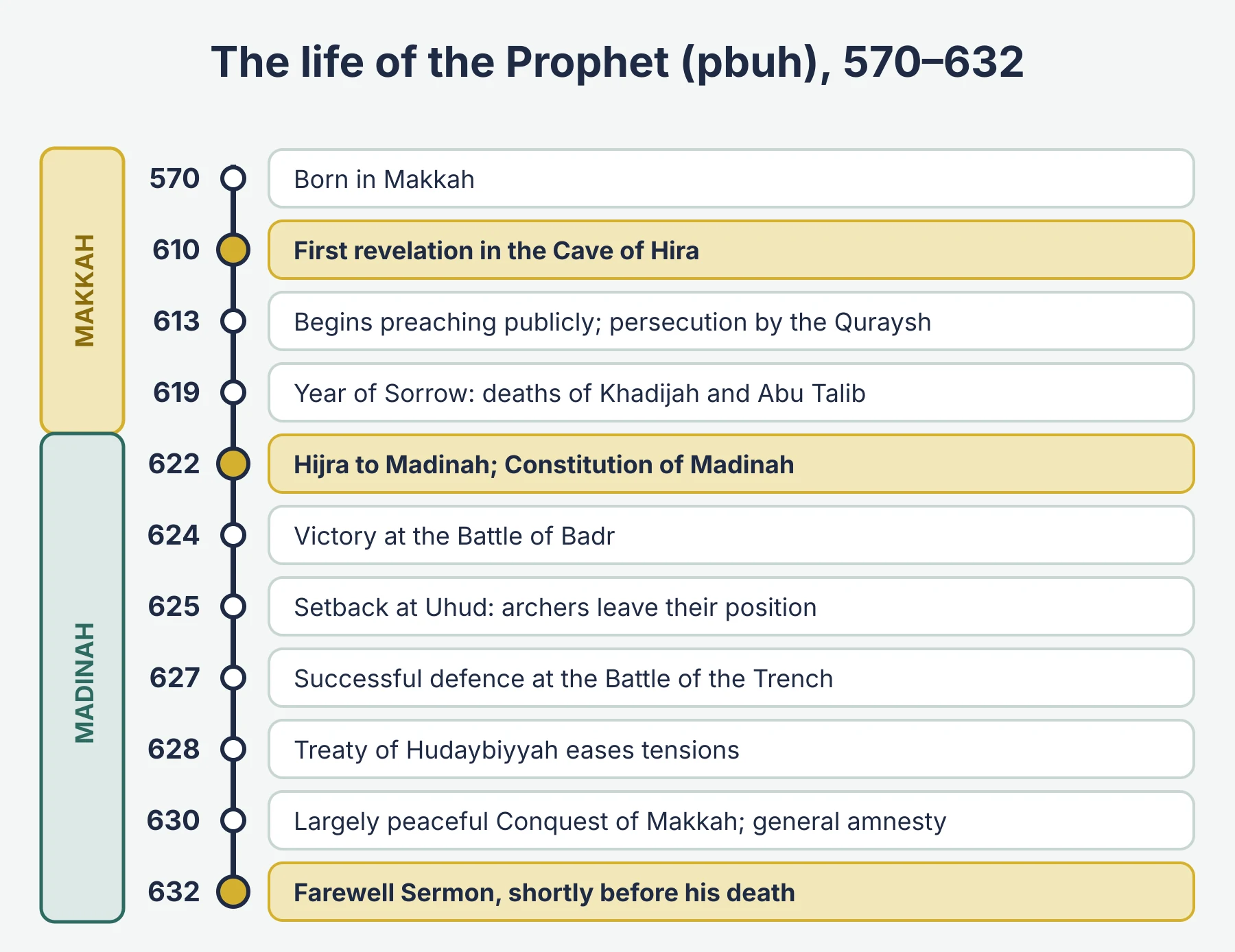
These notes condense the Paper 1 topic The Life and Importance of the Prophet Muhammad (pbuh) for Cambridge O Level Islamiyat 2058. One or two 14-mark questions are set on it among Questions 3–5. Each card below gives an event, the details examiners reward, and the significance you can use in part (b). For the full narrative, use the Life of the Prophet (pbuh) study guide.
Early life cards (570–610)
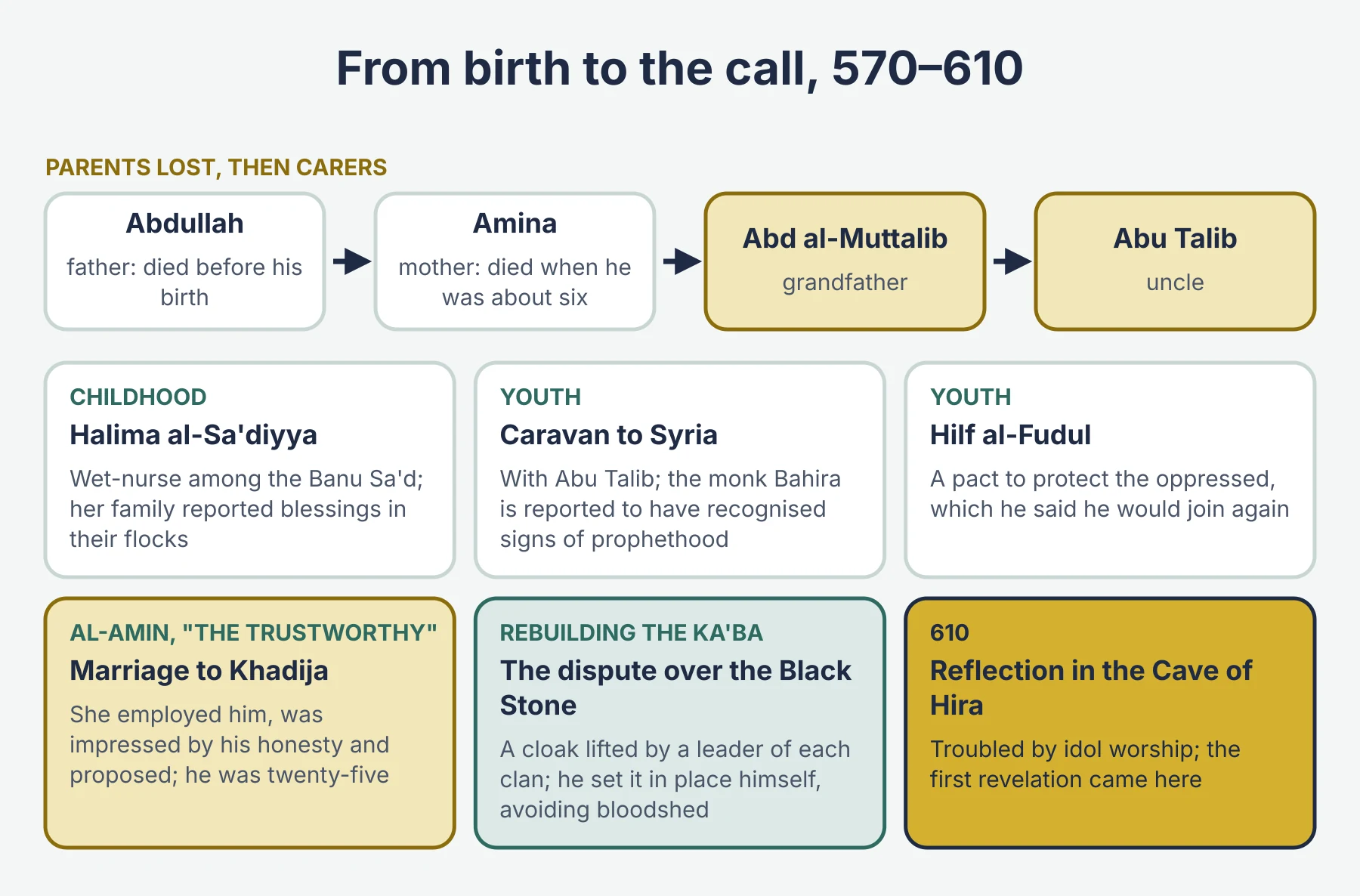
Orphan. Born 570 in Makka (clan of Hashim, Quraysh). Father Abdullah died before his birth; mother Amina when he was about six; then grandfather Abd al-Muttalib; then uncle Abu Talib. Significance: Sura 93.6, “Did He not find you an orphan and give you shelter?”, and his later teaching on caring for orphans.
Halima. Wet-nurse among the Banu Sa’d in the desert. Significance: pure Arabic, healthy desert life; her family saw blessings.
Bahira. Christian monk on the Syria trading journey with Abu Talib who saw signs of prophethood.
Hilf al-Fudul. Pact to defend the oppressed; he said he would join such a pact again. Significance: justice for the weak is part of Islam.
Al-Amin and Khadija (RA). Trusted trader; married Khadija (RA) at twenty-five. Significance: model of honest business and of a marriage built on respect.
Black Stone. Solved the dispute with a cloak lifted by every clan. Significance: wisdom and peacemaking.
Makka cards (610–622)
| Event | Key details | Significance |
|---|---|---|
| Hira, 610 | Jibril; Sura 96.1–5; Khadija (RA) and Waraqa | Start of prophethood |
| Private call | Khadija (RA), Ali (RA), Abu Bakr (RA), Zayd ibn Haritha (RA) | Faith begins with family and friends |
| Public call, 613 | Mount Safa; Abu Lahab; Sura 111 | Courage in proclaiming the truth |
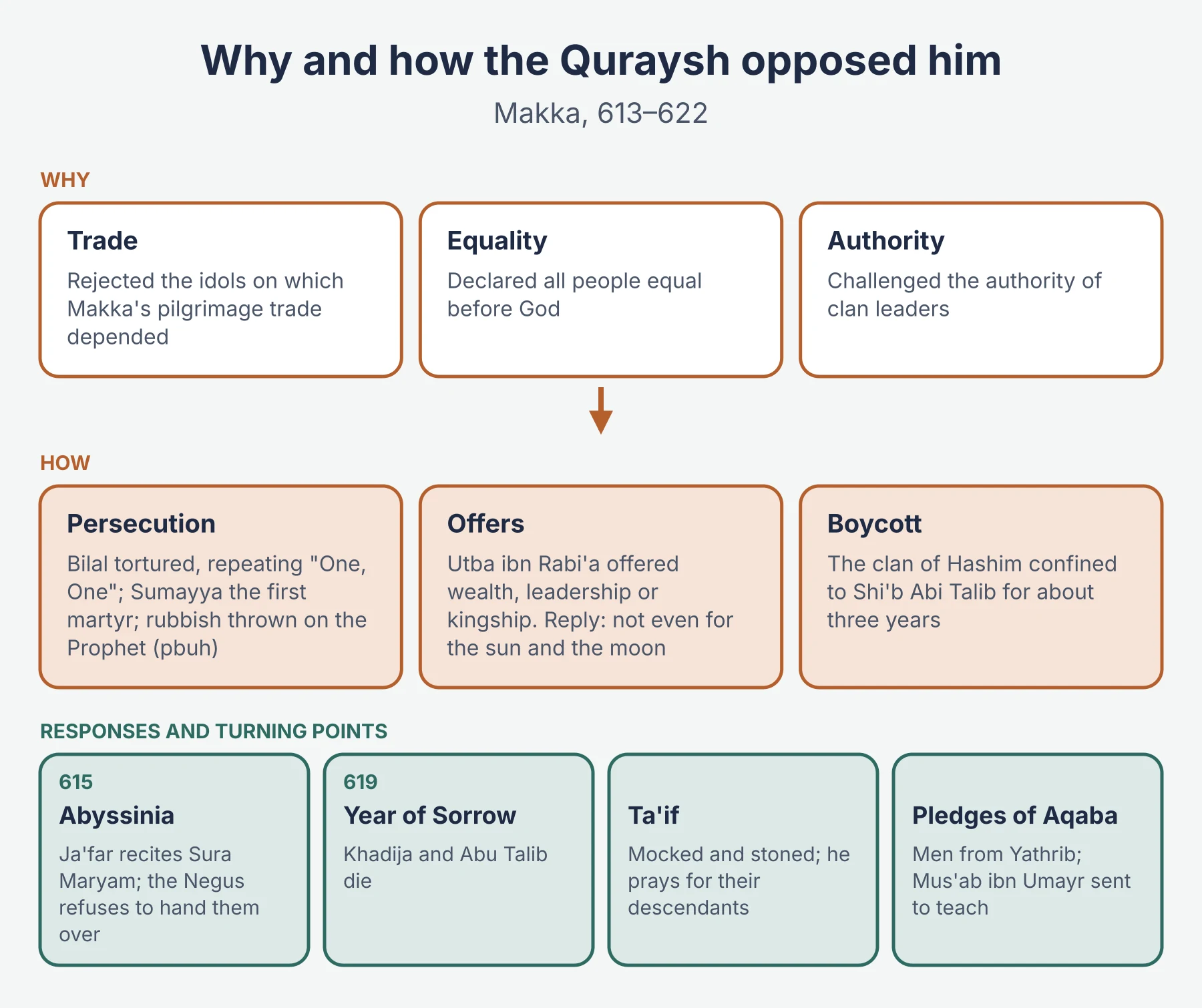
| Persecution | Bilal (RA) (“One, One”); Sumayya first martyr | Patience and firmness under pressure |
| Offers refused | Utba’s offer; “sun in my right hand…” | Faith not for sale |
| Abyssinia, 615 | Ja’far before the Negus; Sura Maryam | Seeking refuge with a just ruler |
| Boycott | Banu Hashim in Shi’b Abi Talib | Endurance as a community |
| Year of Sorrow, 619 | Deaths of Khadija (RA) and Abu Talib | Loss of support and protection |
| Ta’if | Stoned; refused to have the town destroyed | Mercy towards enemies |
| Isra and Mi’raj | Makka to Jerusalem, heavens; five prayers (Sura 17.1) | Gift of prayer; honour of Jerusalem |
| Aqaba pledges | Yathrib’s believers; Mus’ab ibn Umayr (RA) sent | Prepared the Hijra |
Madina cards (622–632)
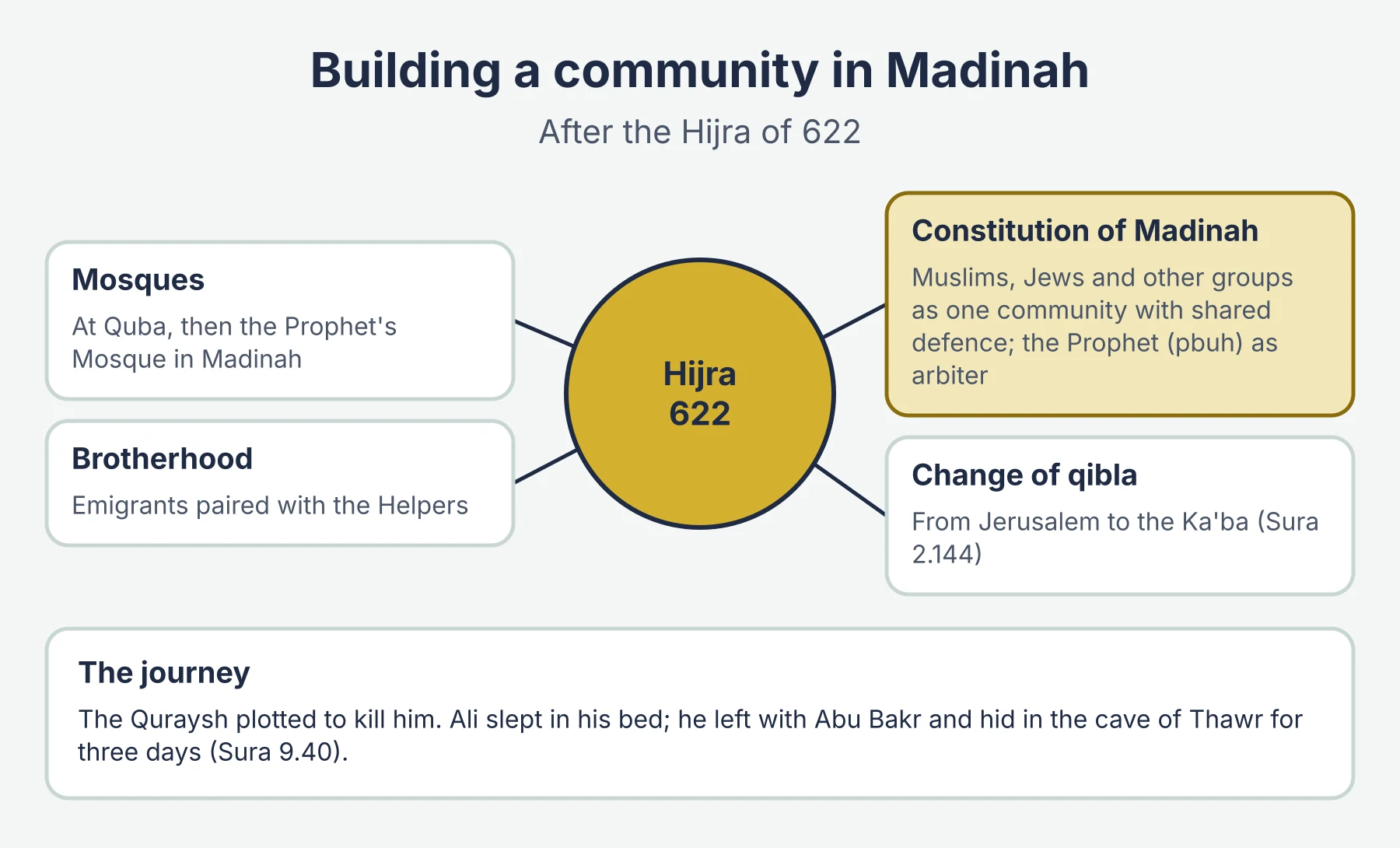
Hijra 622. Plot to kill him → Ali (RA) in his bed → leaves with Abu Bakr (RA) → cave of Thawr three days (Sura 9.40) → Quba mosque → Madina. Significance: start of the Islamic calendar; from persecuted group to a community with its own authority.
Founding the state. Prophet’s Mosque; brotherhood of Emigrants and Helpers; Constitution of Madina (one community, shared defence, the Prophet (pbuh) as arbiter). Significance: model of a fair, plural society.
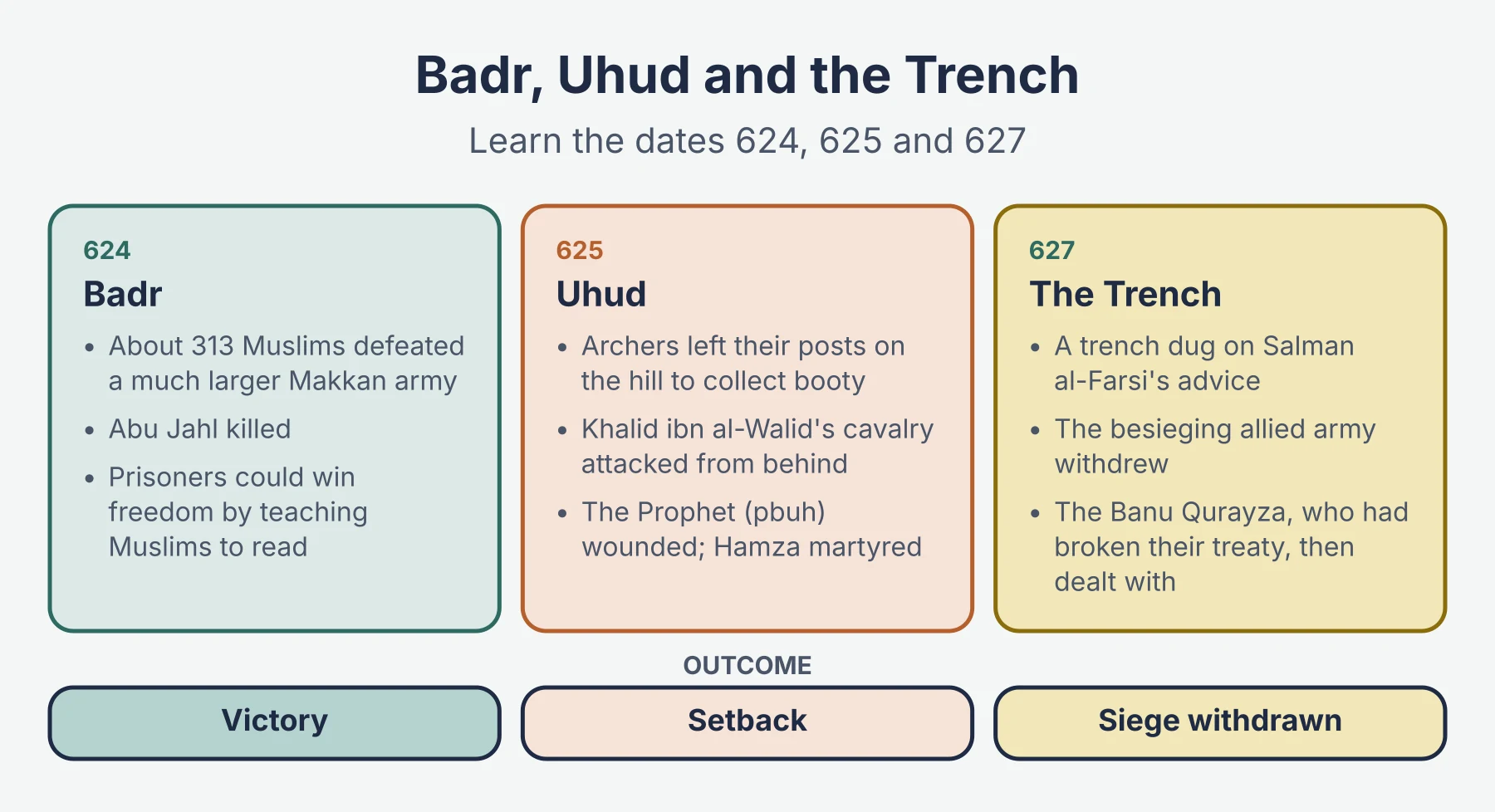
Badr 624. About 313 Muslims vs a much larger force; victory; Abu Jahl killed; prisoners freed for teaching reading. Significance: God’s help to the faithful (Sura 3.123); value of education.
Uhud 625. Archers left the hill; Khalid’s cavalry attack; Prophet wounded; Hamza (RA) martyred. Significance: obedience and discipline; reverse caused by disobedience, not lack of numbers.
Trench 627. Salman al-Farsi’s (RA) idea; the allied siege withdrew. Significance: consultation and new ideas welcomed.
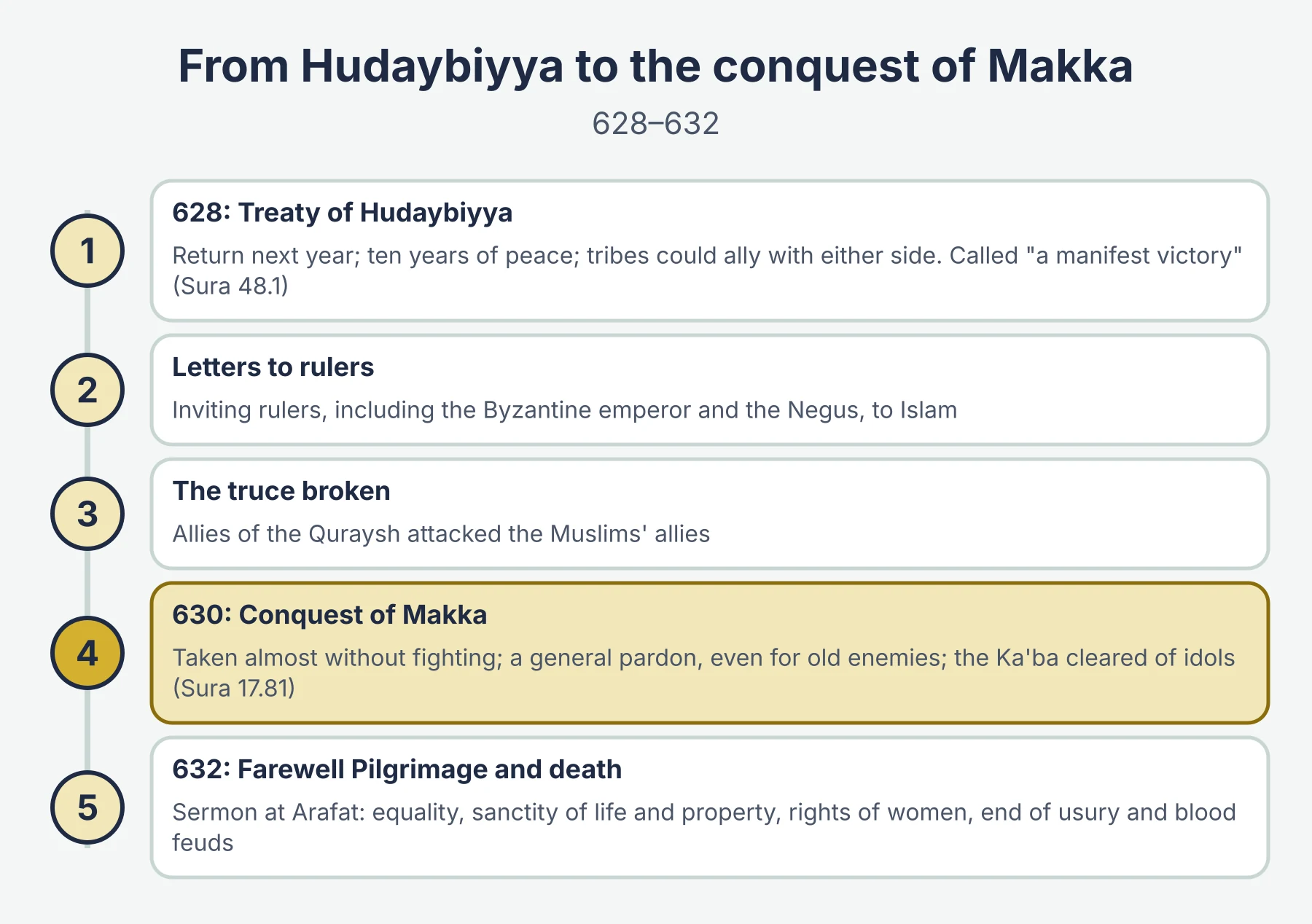
Hudaybiyya 628. Truce of ten years; return next year for umra; Pledge of Ridwan (Sura 48.18); “a manifest victory” (Sura 48.1). Significance: patience and diplomacy; peace allowed Islam to spread.
Letters to rulers. Invitations to Islam to rulers including the Byzantine emperor and the Negus. Significance: a universal message; respectful dealings with other states.
Conquest of Makka 630. Treaty broken by Quraysh allies; city taken almost without fighting; general pardon; idols removed (Sura 17.81). Significance: forgiveness in victory.
Farewell Sermon and death 632. Equality, sanctity of life and property, women’s rights, end of usury and blood feuds. Significance: summary of Islamic ethics.
Character and example: one-line evidence
- Mercy: “We sent you not but as a mercy for all creatures” (Sura 21.107).
- Model: “a beautiful pattern of conduct” (Sura 33.21).
- Character: “an exalted standard of character” (Sura 68.4).
- Seal of the Prophets: Sura 33.40; no prophet after him; message for all people.
Key terms
| Term | Meaning |
|---|---|
| Al-Amin | “The trustworthy”, his title before prophethood |
| Hijra | Migration from Makka to Madina, 622 |
| Muhajirun / Ansar | Emigrants from Makka / Helpers of Madina |
| Qibla | Direction of prayer |
| Umra | The lesser pilgrimage |
| Khatam al-nabiyyin | Seal of the Prophets |
| Sunna | His practice, followed as a model |
Exam traps
- The order of battles: Badr 624 (victory), Uhud 625 (reverse), Trench 627 (siege withstood).
- Hudaybiyya was not a defeat: the Qur’an called it a victory, and peace helped Islam spread.
- Ta’if and Abyssinia are different events: Ta’if was the Prophet’s (pbuh) own visit after 619; Abyssinia was a migration of Companions in 615.
- Do not end at 622. Questions on Madina and on his example are common.
- Name the group the question names. “Relations with non-Muslims” needs examples involving non-Muslims, not just Companions.
Self-test
- Who cared for the Prophet (pbuh) after the death of his grandfather?
- What was the Hilf al-Fudul?
- How did he settle the dispute over the Black Stone?
- Which sura was revealed about Abu Lahab?
- Who spoke to the Negus for the Muslims, and what did he recite?
- What happened in the Year of Sorrow?
- How did the Prophet (pbuh) respond to the people of Ta’if?
- Why did the Muslims suffer a reverse at Uhud?
- Whose idea was the trench in 627?
- Give two terms of the Treaty of Hudaybiyya.
- What did the Prophet (pbuh) do with his former enemies at the conquest of Makka?
- Which verse calls him the Seal of the Prophets?
Answers: 1. His uncle Abu Talib. 2. A pact among Makkan clans to defend the oppressed, which he supported. 3. He placed it on a cloak, had each clan leader lift a corner, then set it in place himself. 4. Sura 111. 5. Ja’far ibn Abi Talib, who recited from Sura Maryam. 6. Khadija (RA) and Abu Talib died, in 619. 7. He refused the offer to destroy them and prayed for their descendants to believe. 8. The archers left their position against his orders, allowing Khalid ibn al-Walid’s cavalry to attack from behind. 9. Salman al-Farsi (RA). 10. Any two: Muslims to return next year for umra; ten years of peace; Makkans joining the Muslims without permission to be returned; tribes free to ally with either side. 11. He declared a general pardon. 12. Sura 33.40.
Related pages
- Life of the Prophet (pbuh) practice questions
- The First Islamic Community revision notes
- Paper 1 revision notes
Source: Cambridge International, Cambridge O Level Islamiyat 2058 syllabus for examination in 2026 and 2027, Paper 1 Topic 3.
Related resources
-
Practice questions
Cambridge O Level Islamiyat (2058): Major Themes of the Qur'an — Practice Questions
Twelve original questions on the set Qur'an passages for Cambridge O Level Islamiyat 2058 Paper 1 Question 1, with themes, key Arabic words and marked answers.
Islamiyat · Cambridge · O Level
Try questions -
Study guides
Cambridge O Level Islamiyat: Major Themes of the Qur'an, Subtopic 1.1 (2058)
Subtopic 1.1 of Cambridge O Level Islamiyat 2058, Major themes of the Qur'an: God in Himself, God and creation, and God's Messengers, with exam guidance.
Islamiyat · Cambridge · O Level
Read guide -
Revision notes
Cambridge O Level Islamiyat: Major Themes of the Qur'an — Revision Notes (2058)
Question-and-answer recall notes on the 15 set Qur'an passages for Cambridge O Level Islamiyat 2058 Paper 1, grouped by theme, with links between passages.
Islamiyat · Cambridge · O Level
Revise topic
Get free revision emails (optional)
Occasional emails with practice questions, worked explanations and links to free resources for the qualification and subjects you choose. No spam, and you can unsubscribe from any email. The free tools on this site never need an email.