
Revision Notes
Cambridge O Level Islamiyat (2058): The First Islamic Community — Revision Notes
Person-by-person notes on the Prophet's wives, family, Imams and Companions before 632, for Cambridge O Level Islamiyat 2058 Paper 1, with a self-test.
- Subject
- Islamiyat
- Level
- O LEVELS
- Topic
- Paper 1
- Author
- Marlbridge Academic Team
- Updated
- Reviewed by
- Azam Siddique (what this means)
Aligned to Cambridge O Level Islamiyat (2058), 2026-2027. Official specification .
Syllabus page (what it covers and how it is assessed): Cambridge O Level Islamiyat.
Syllabus points this page covers
2058
- 1.4 The First Islamic Community
Found an error? Report a correction.
Need help with this topic? Request a free trial class for O Level Islamiyat (2058).
These notes condense the Paper 1 topic The First Islamic Community for Cambridge O Level Islamiyat 2058. Questions on this topic ask you to write about named people and explain the importance of their actions. Each person below has three or four facts you can expand in an answer, plus a “why it matters” line for part (b). The full explanation is in the First Islamic Community study guide.
The three groups in the syllabus
1. Wives            -> the Mothers of the Believers (Sura 33.6)
2. Descendants      -> children, grandchildren, the Shi'a Imams
3. Leading Companions -> Ten Blessed, Scribes, major characters,
                         Emigrants and Helpers, the four caliphs (before 632 only)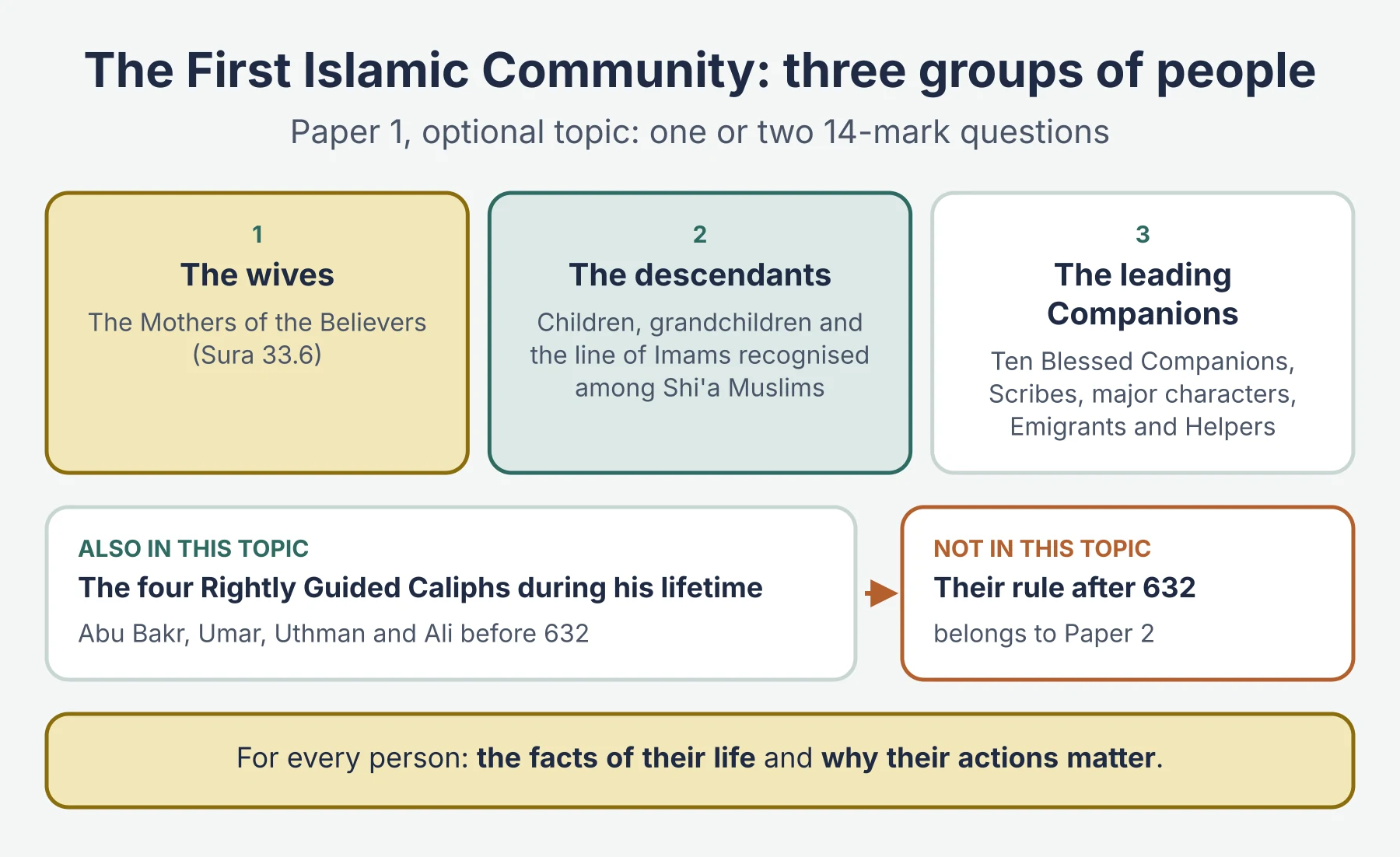
Wives: fact strings
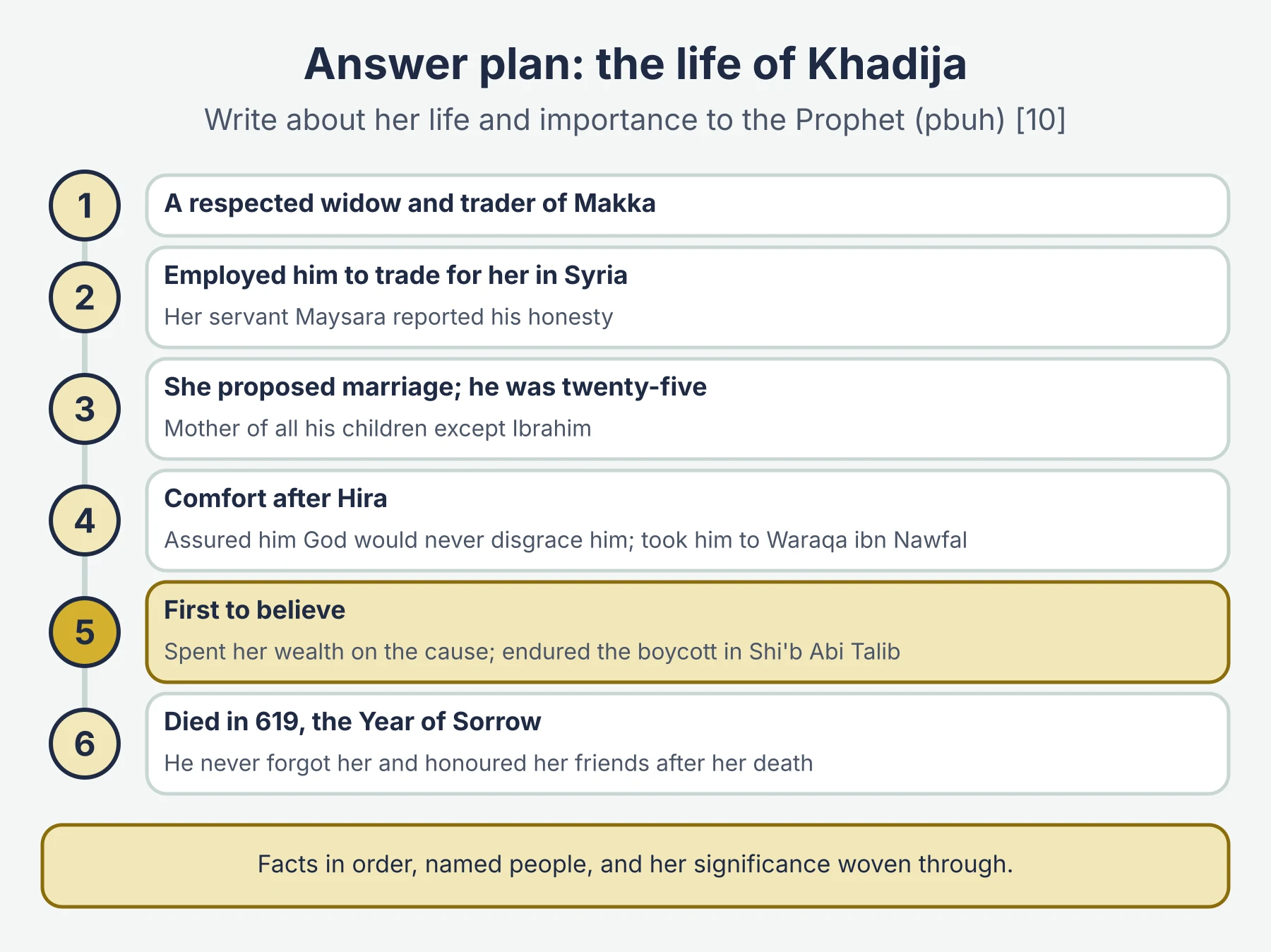
- Khadija (RA) — widow, trader → hired him, Maysara praised his honesty → proposed; he was 25 → first believer; comforted him after Hira → all children but Ibrahim → spent wealth, endured boycott → died 619. Matters: loyalty and sacrifice; a woman’s support at the start of Islam.
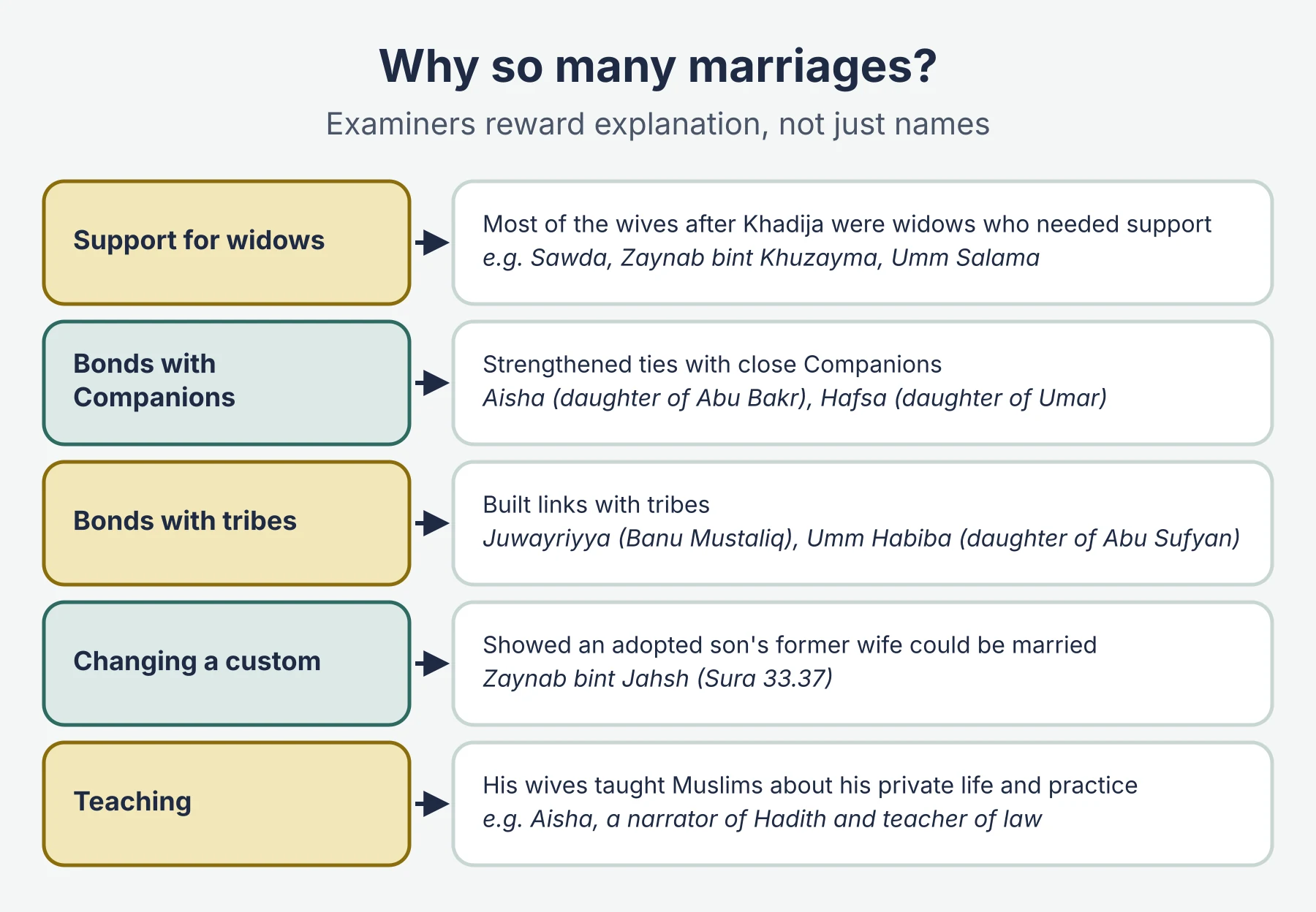
- Sawda (RA) — widow, had migrated to Abyssinia → married after Khadija (RA) → cared for his daughters. Matters: care for widows.
- Aisha (RA) — daughter of Abu Bakr (RA) → narrator of very many Hadith and teacher of law → the Prophet (pbuh) died in her room. Matters: women as scholars; source of knowledge of his private life.
- Hafsa (RA) — daughter of Umar (RA), a widow → kept Abu Bakr’s (RA) collected Qur’an. Matters: trusted with the most precious text.
- Umm Salama (RA) — widow of Abu Salama → at Hudaybiyya advised him to sacrifice and shave first; the Companions followed. Matters: he valued his wife’s counsel.
- Zaynab bint Jahsh (RA) — his cousin → marriage ended the custom treating an adopted son like a son by birth (Sura 33.37). Matters: Qur’anic law set through example.
- Juwayriyya (RA) — daughter of the Banu Mustaliq chief → captives of her tribe freed. Matters: marriage that brought peace and freedom.
- Umm Habiba (RA) — daughter of Abu Sufyan → stayed Muslim in Abyssinia. Matters: faith over family pressure.
- Safiyya (RA) — from a Jewish family, taken captive at Khaybar → freed and given the choice to go back to her people or stay; she chose to stay and he married her → when other wives taunted her for her Jewish descent, he told her to answer that Harun (Aaron) was her father, Musa (Moses) her uncle and Muhammad (pbuh) her husband (Tirmidhi). Matters: respect for people of other backgrounds.
- Zaynab bint Khuzayma (RA) (“mother of the poor”) and Maymuna (RA) (last marriage) complete the list.
Descendants
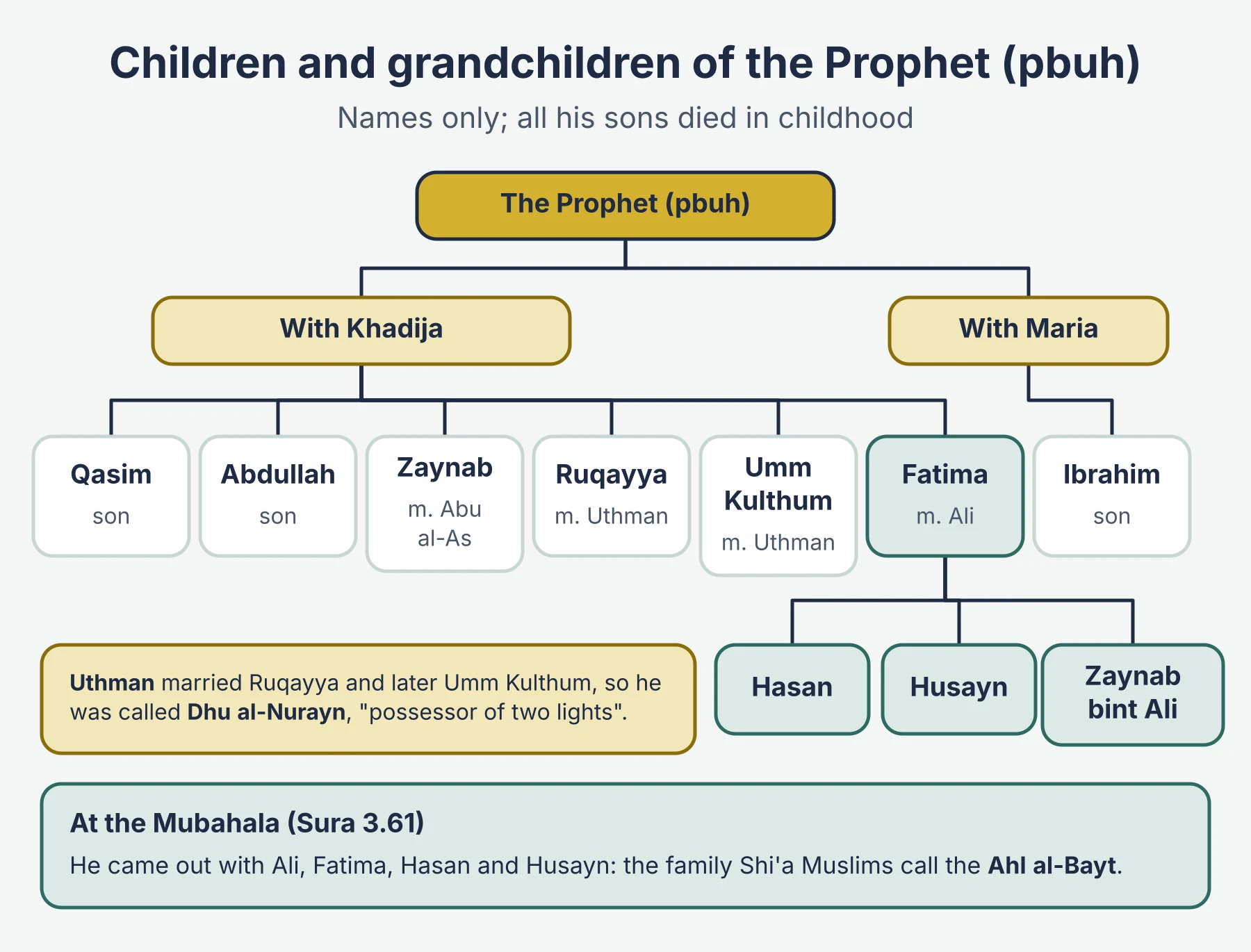
| Person | Facts | Why it matters |
|---|---|---|
| Qasim, Abdullah, Ibrahim | Sons who died young; eclipse at Ibrahim’s death not caused by it | Patience in grief; rejection of superstition |
| Zaynab | Eldest daughter; married Abu al-As | Loyalty to faith and family |
| Ruqayya, Umm Kulthum | Married Uthman (RA) in turn (Dhu al-Nurayn) | Bond between the Prophet (pbuh) and Uthman (RA) |
| Fatima (RA) | Al-Zahra; married Ali (RA); mother of Hasan (RA) and Husayn (RA); died months after him | Model of devotion and simple living |
| Hasan (RA), Husayn (RA) | “Leaders of the youth of Paradise”; at the Mubahala (Sura 3.61) | Love for children; the Ahl al-Bayt |
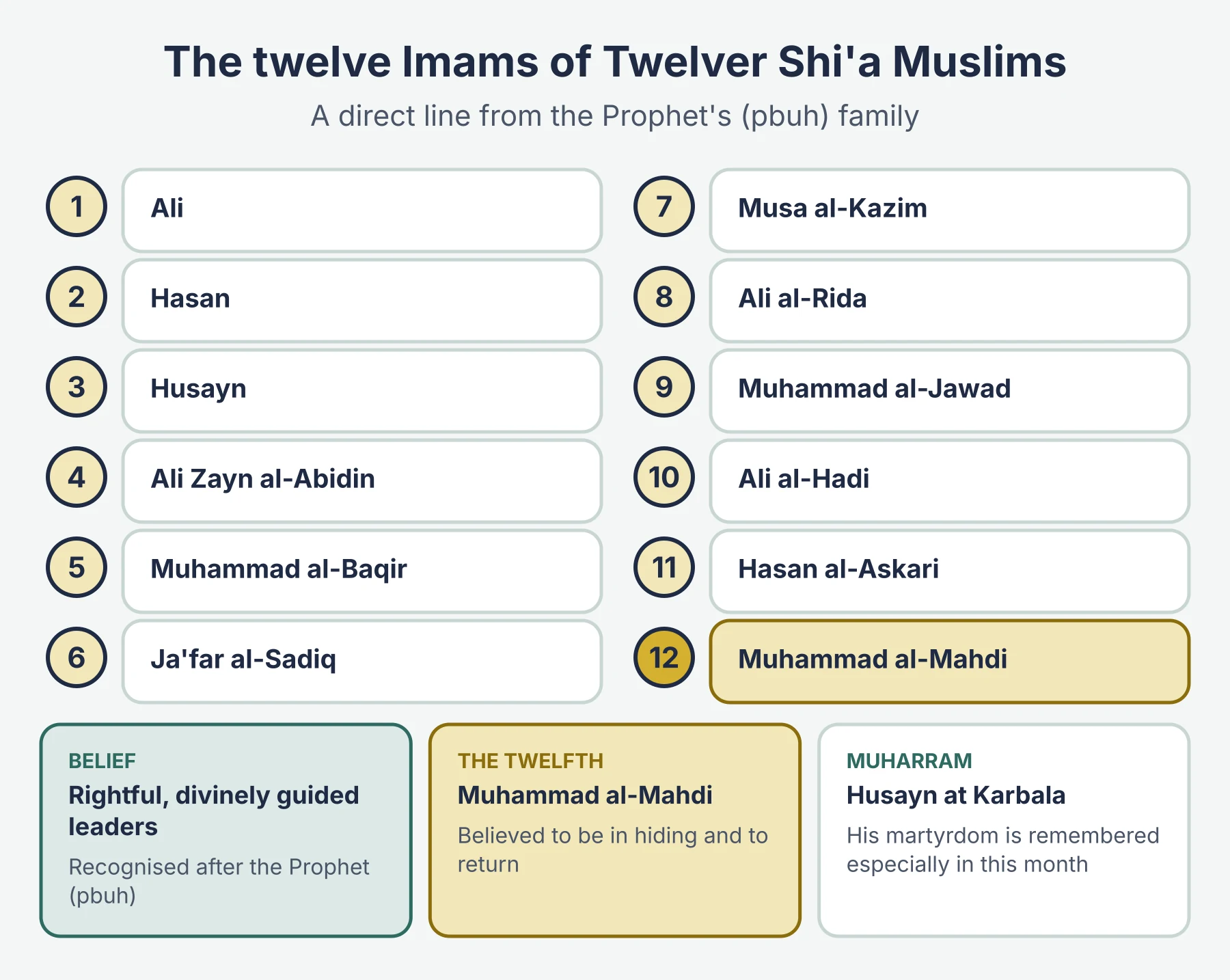
The twelve Imams (Twelver Shi’a): Ali (RA) → Hasan (RA) → Husayn (RA) → Ali Zayn al-Abidin → Muhammad al-Baqir → Ja’far al-Sadiq → Musa al-Kazim → Ali al-Rida → Muhammad al-Jawad → Ali al-Hadi → Hasan al-Askari → Muhammad al-Mahdi (in hiding, awaited). Shi’a Muslims see them as divinely guided leaders from the Prophet’s (pbuh) line. Sunni Muslims honour the Prophet’s (pbuh) family, including Ali (RA), Hasan (RA) and Husayn (RA), but do not recognise the Imams as divinely appointed leaders.
The Ten Blessed Companions
Memory hook, in two rows of five:
Abu Bakr (RA) · Umar (RA) · Uthman (RA) · Ali (RA) · Talha ibn Ubaydullah (RA)
al-Zubayr ibn al-Awwam (RA) · Abd al-Rahman ibn Awf (RA) · Sa'd ibn Abi Waqqas (RA) · Sa'id ibn Zayd (RA) · Abu Ubayda ibn al-Jarrah (RA)
Scribes and major characters
- Zayd ibn Thabit (RA): chief scribe; learned another script for letters; later compiled the Qur’an.
- Ubayy ibn Ka’b (RA): scribe and leading reciter.
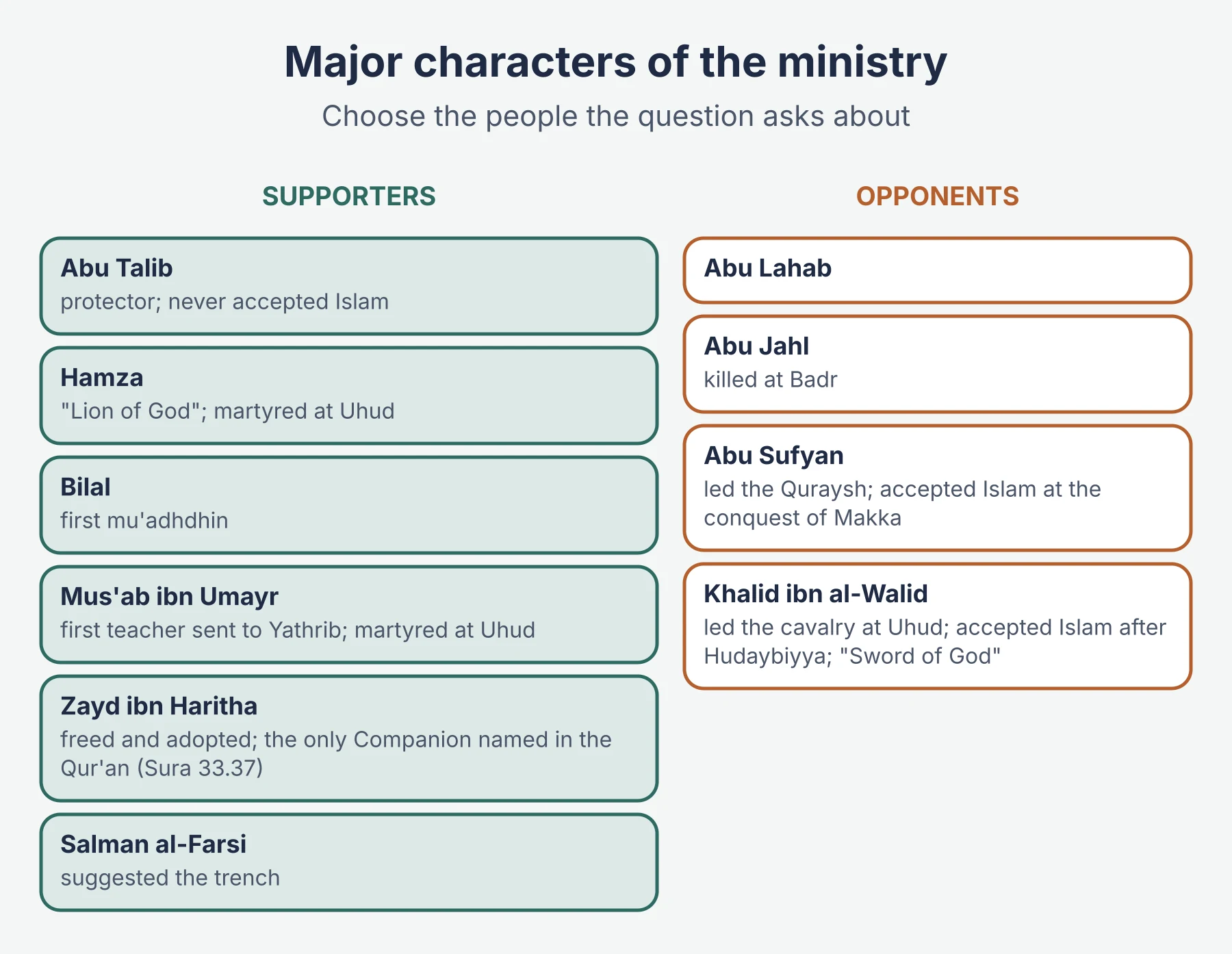
- Hamza (RA): uncle; “Lion of God”; martyred at Uhud.
- Bilal (RA): tortured slave freed by Abu Bakr (RA); first mu’adhdhin.
- Mus’ab ibn Umayr (RA): gave up wealth; first teacher sent to Yathrib (the city later called Madinah after the Hijra; Yathrib and Madinah are the same place); martyred at Uhud.
- Zayd ibn Haritha (RA): freed and adopted by the Prophet (pbuh); by the widely held view, the only Companion named in the Qur’an (Sura 33.37).
- Salman al-Farsi (RA): Persian seeker of truth; idea of the trench.
- Opponents who matter: Abu Lahab (Sura 111), Abu Jahl (killed at Badr), Abu Sufyan (Muslim at the conquest of Makka), Khalid ibn al-Walid (Uhud cavalry, later “Sword of God”).
Emigrants and Helpers
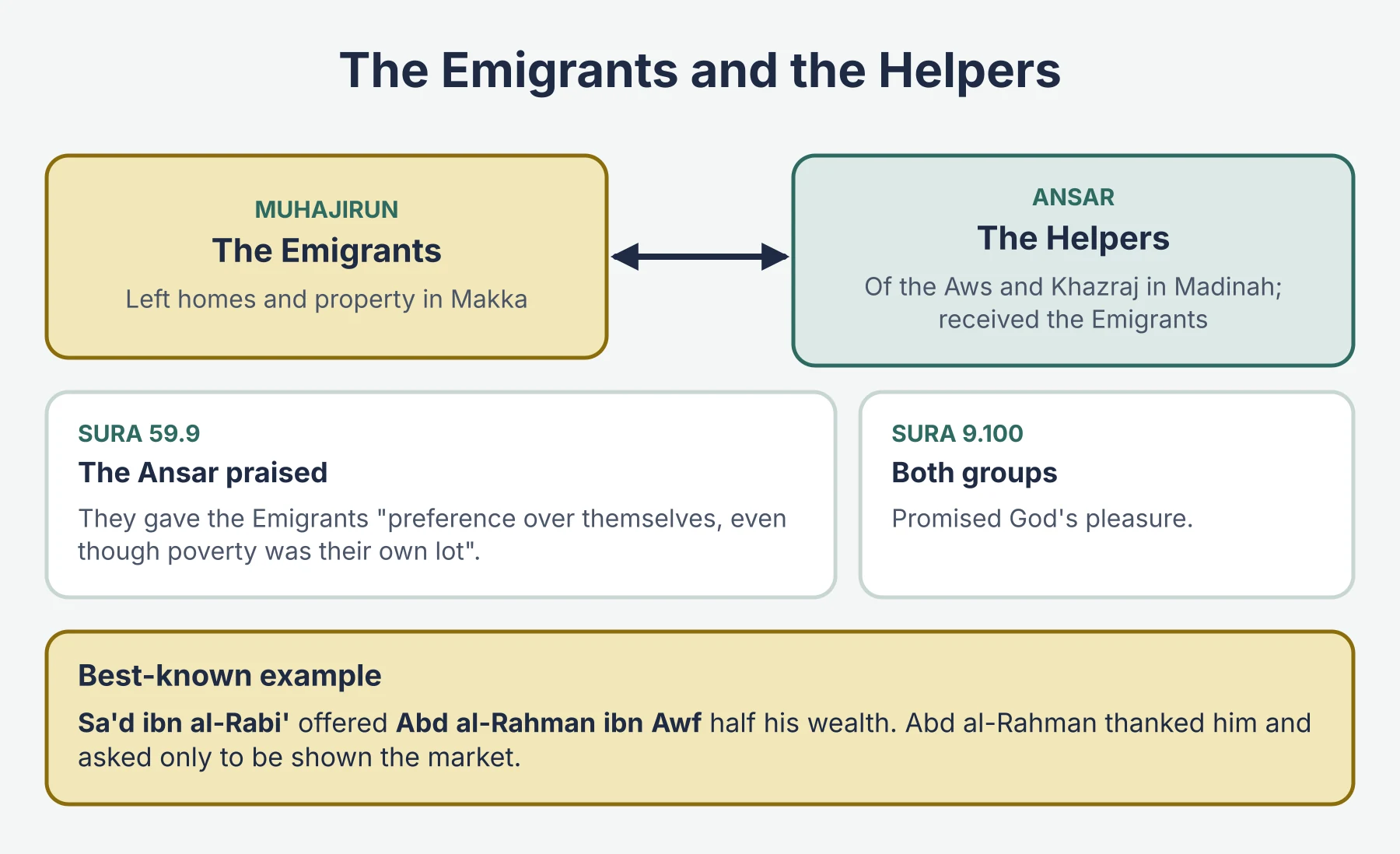
- Muhajirun left property in Makka; Ansar (Aws and Khazraj) welcomed them.
- Paired in brotherhood; Sa’d ibn al-Rabi’ (RA) offered half his wealth to Abd al-Rahman ibn Awf (RA), who asked to be shown the market.
- Qur’an praise: Sura 59.9 (Ansar preferred others over themselves); Sura 9.100 (both groups).
The four caliphs before 632
| Caliph | Facts to use |
|---|---|
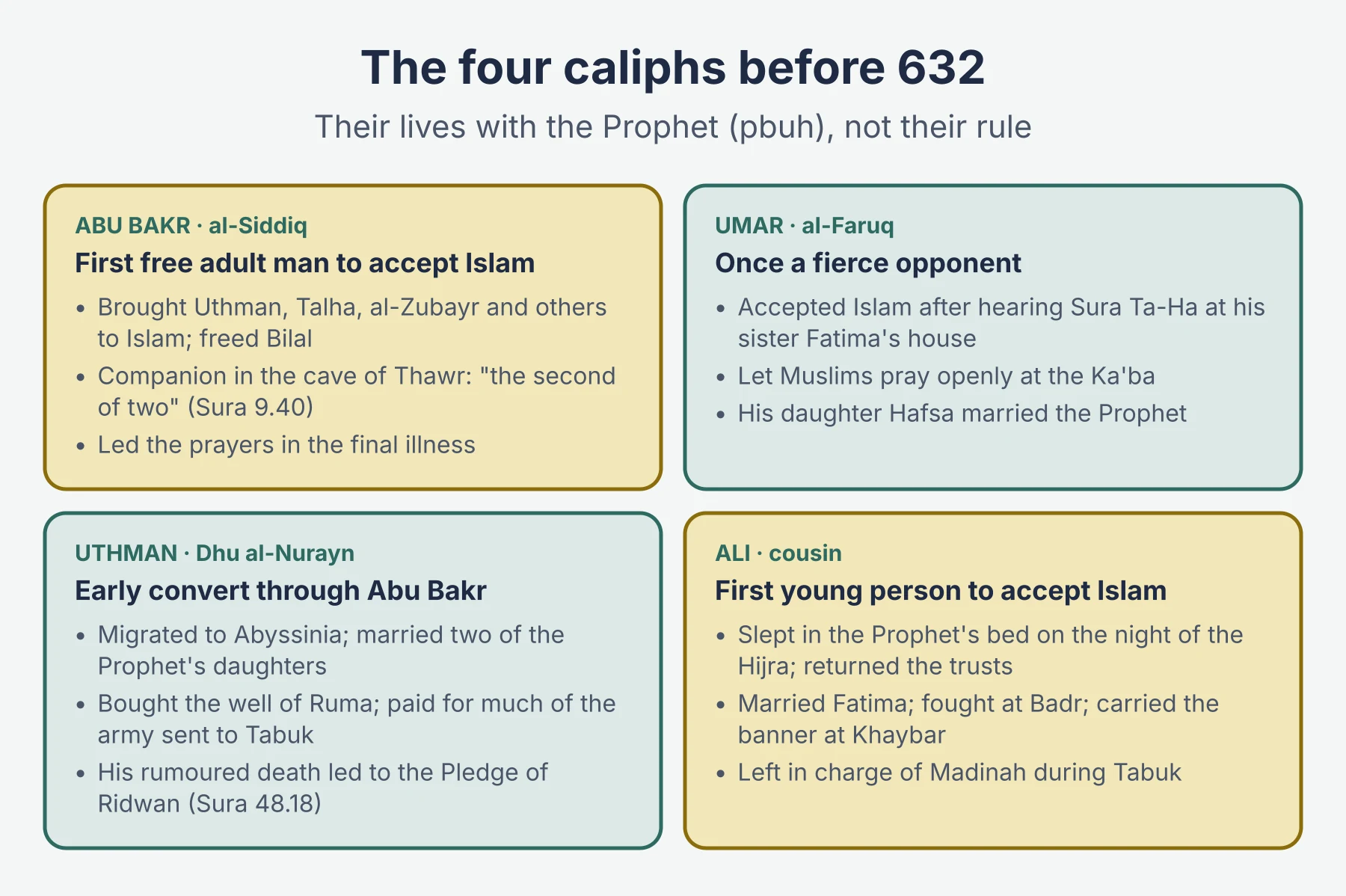
| Abu Bakr (RA) | First free adult male believer; al-Siddiq after the Mi’raj; “second of two” in Thawr (Sura 9.40) |
| Umar (RA) | Converted after Sura Ta-Ha; Muslims prayed openly at the Ka’ba; al-Faruq |
| Uthman (RA) | Married two daughters of the Prophet (pbuh); bought the well of Ruma; Pledge of Ridwan after rumours of his death |
| Ali (RA) | First young believer; slept in the Prophet’s (pbuh) bed at the Hijra; married Fatima (RA); banner at Khaybar |
Key terms
| Term | Meaning |
|---|---|
| Ummahat al-Mu’minin | Mothers of the Believers, the Prophet’s (pbuh) wives |
| Ahl al-Bayt | People of the House, the Prophet’s (pbuh) family |
| Imam (Shi’a) | Divinely guided leader from the Prophet’s (pbuh) line |
| Sahaba | Companions of the Prophet (pbuh) |
| Al-’Ashara al-Mubashshara | The Ten promised Paradise |
| Katib al-wahy | Scribe of revelation |
| Muhajirun / Ansar | Emigrants / Helpers |
Exam traps
- A caliph question in Paper 1 means before 632; conquests and government are Paper 2.
- Abu Talib protected the Prophet (pbuh) but is not counted among the Companions who accepted Islam.
- Zaynab bint Khuzayma (RA) and Zaynab bint Jahsh (RA) are different wives; Zaynab the daughter is different again.
- Name facts, not virtues alone: “Uthman (RA) was generous” needs the well of Ruma or Tabuk.
Self-test
- What title does the Qur’an give the Prophet’s (pbuh) wives?
- Which wife kept the collected copy of the Qur’an?
- What advice did Umm Salama (RA) give at Hudaybiyya?
- Why was Uthman (RA) called Dhu al-Nurayn?
- Name the Prophet’s (pbuh) grandsons through Fatima (RA).
- Who is the twelfth Imam of Twelver Shi’a Muslims?
- Name any five of the Ten Blessed Companions.
- According to the widely held view, which Companion is named in the Qur’an?
- Who was the first teacher sent to Yathrib?
- What did Abd al-Rahman ibn Awf (RA) ask of Sa’d ibn al-Rabi’ (RA)?
- Which verse calls Abu Bakr (RA) “the second of two”?
- What did Ali (RA) do on the night of the Hijra?
Answers: 1. Mothers of the Believers (Sura 33.6). 2. Hafsa (RA). 3. That he should sacrifice and shave his head first, so the Companions would follow; they did. 4. He married two of the Prophet’s (pbuh) daughters, Ruqayya and then Umm Kulthum. 5. Hasan (RA) and Husayn (RA). 6. Muhammad al-Mahdi. 7. Any five of Abu Bakr (RA), Umar (RA), Uthman (RA), Ali (RA), Talha (RA), al-Zubayr (RA), Abd al-Rahman ibn Awf (RA), Sa’d ibn Abi Waqqas (RA), Sa’id ibn Zayd (RA), Abu Ubayda (RA). 8. Zayd ibn Haritha (RA), by the widely held view (Sura 33.37). 9. Mus’ab ibn Umayr (RA). 10. To be shown the market so he could trade. 11. Sura 9.40. 12. He slept in the Prophet’s (pbuh) bed as a decoy and later returned the goods people had left with the Prophet (pbuh) for safekeeping.
Related pages
Source: Cambridge International, Cambridge O Level Islamiyat 2058 syllabus for examination in 2026 and 2027, Paper 1, topic 4 (numbered 1.4 on this site).
Related resources
-
Study guides
Cambridge O Level Islamiyat (2058): The History and Importance of the Qur'an
Study guide to the revelation, compilation, legal use and significance of the Qur'an for Cambridge O Level Islamiyat 2058 Paper 1, with a model answer.
Islamiyat · Cambridge · O Level
Read guide -
Practice questions
Cambridge O Level Islamiyat (2058): The History and Importance of the Qur'an — Practice Questions
Eleven original questions on revelation, compilation, legal use and significance of the Qur'an for Cambridge O Level Islamiyat 2058, with mark-scheme answers.
Islamiyat · Cambridge · O Level
Try questions -
Revision notes
Cambridge O Level Islamiyat (2058): The History and Importance of the Qur'an — Revision Notes
Recall notes on revelation, compilation, standardisation and the legal role of the Qur'an for Cambridge O Level Islamiyat 2058, with a 12-question self-test.
Islamiyat · Cambridge · O Level
Revise topic
Get free revision emails (optional)
Occasional emails with practice questions, worked explanations and links to free resources for the qualification and subjects you choose. No spam, and you can unsubscribe from any email. The free tools on this site never need an email.