
Revision Notes
Cambridge O Level Islamiyat (2058): The History and Importance of the Qur'an — Revision Notes
Recall notes on revelation, compilation, standardisation and the legal role of the Qur'an for Cambridge O Level Islamiyat 2058, with a 12-question self-test.
- Subject
- Islamiyat
- Level
- O LEVELS
- Topic
- Paper 1
- Author
- Marlbridge Academic Team
- Updated
- Reviewed by
- Azam Siddique (what this means)
Aligned to Cambridge O Level Islamiyat (2058), 2026-2027. Official specification .
Syllabus page (what it covers and how it is assessed): Cambridge O Level Islamiyat.
Syllabus points this page covers
2058
- 1.2 The History and Importance of the Qur’an
Found an error? Report a correction.
Need help with this topic? Request a free trial class for O Level Islamiyat (2058).
These notes condense Paper 1 Question 2 of Cambridge O Level Islamiyat 2058, The History and Importance of the Qur’an. The question is compulsory and worth 14 marks: part (a) tests knowledge (10) and part (b) understanding (4). For full explanations and a model answer, use the History and Importance of the Qur’an study guide.
Timeline to memorise
610       First revelation in the Cave of Hira, Ramadan: Sura 96.1-5
          Khadija comforts the Prophet; Waraqa ibn Nawfal recognises the angel
          Pause in revelation; it resumes with Sura 74 ("arise and warn")
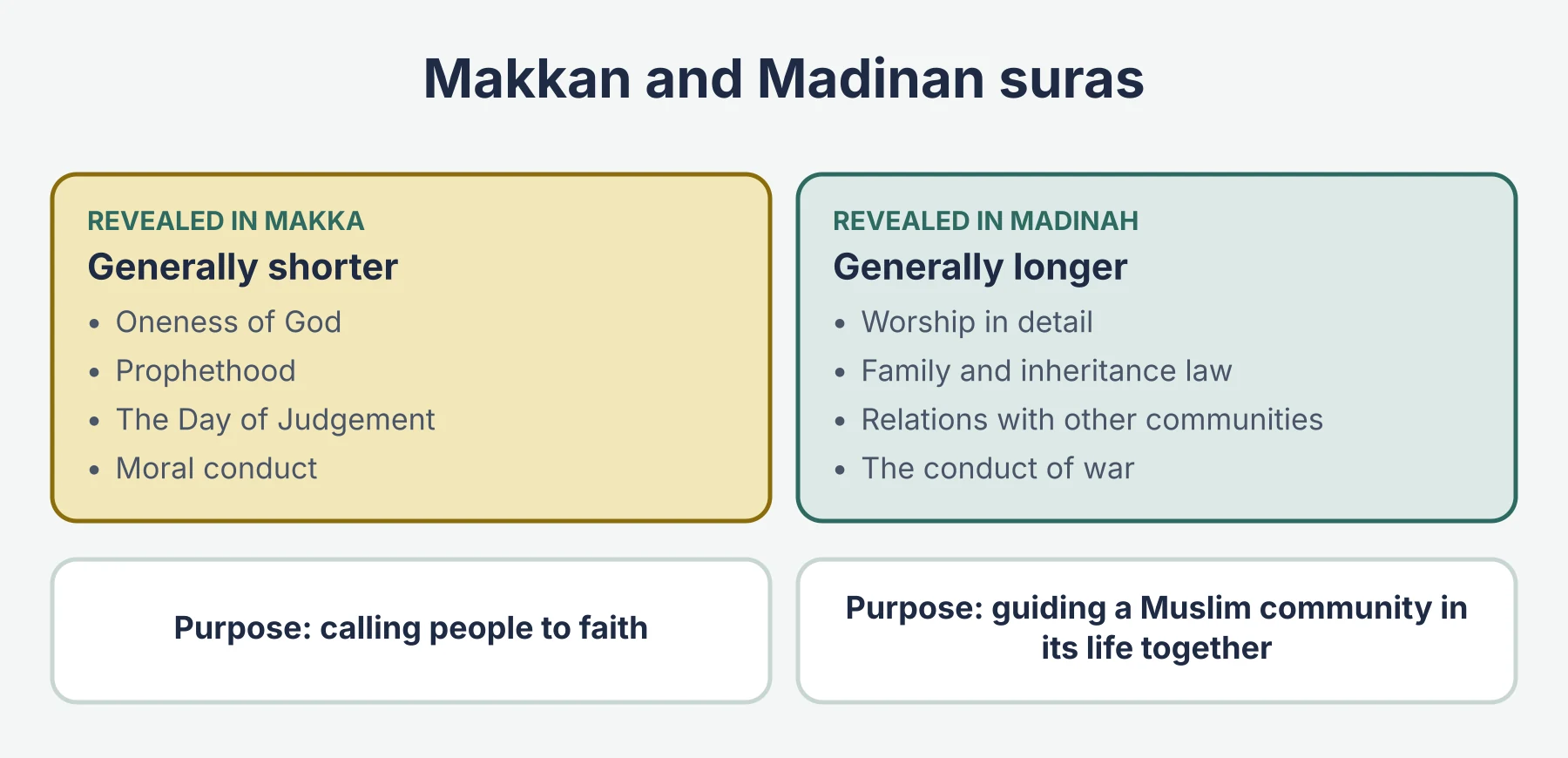
610-622   Makkan revelation: tawhid, prophethood, judgement, morals
622-632   Madinan revelation: worship in detail, law, community, war
632       Final revelations; death of the Prophet (pbuh)
632-634   Abu Bakr: Battle of Yamama, huffaz killed; Zayd collects the Qur'an
634-644   Umar keeps the collected sheets; they pass to Hafsa
644-656   Uthman: disputes over recitation; standard copies sent out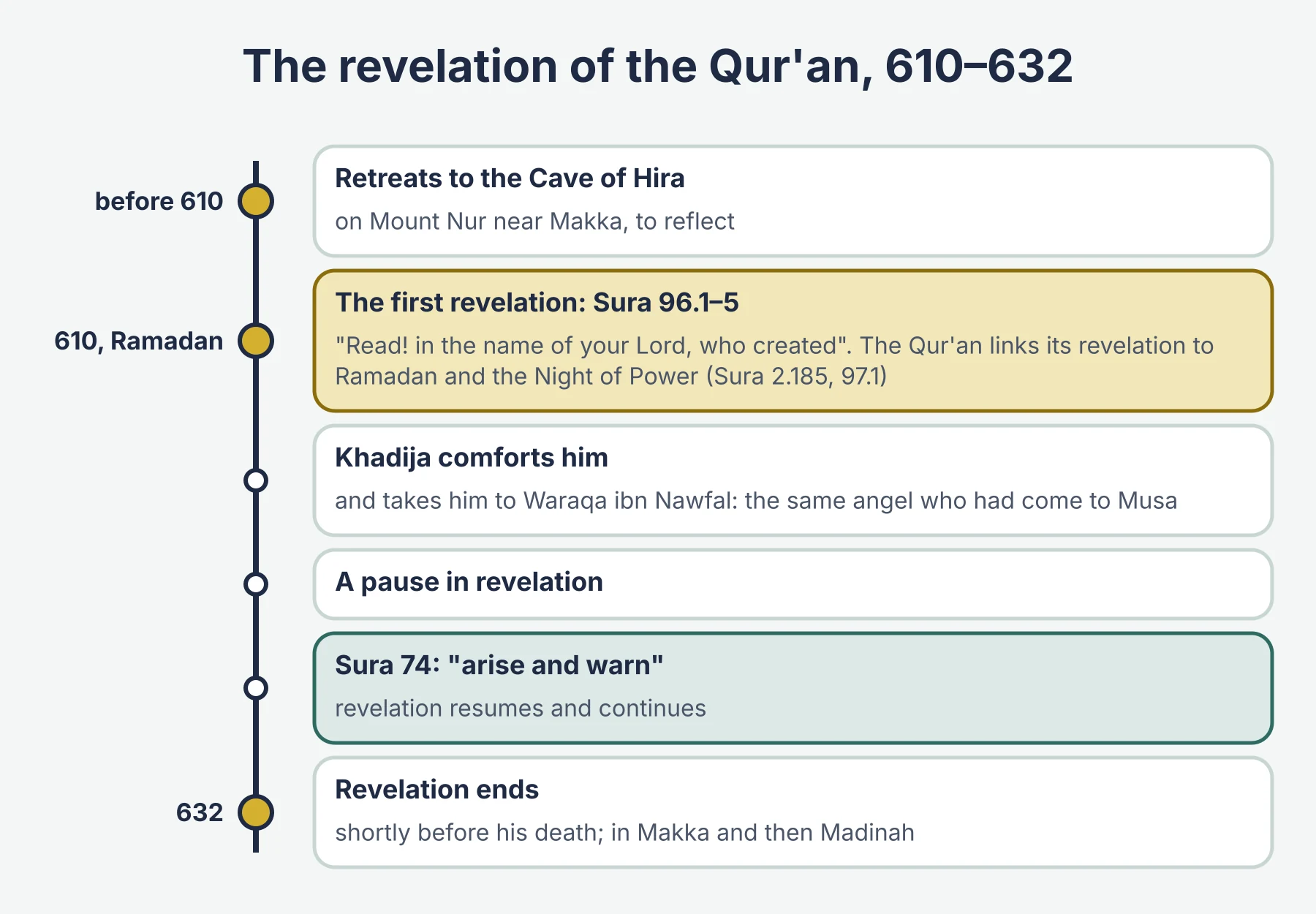
Revelation: the five things to know
- Where and when: Cave of Hira on Mount Nur, near Makka, in Ramadan 610, when the Prophet (pbuh) was about forty.
- Who brought it: the angel Jibril.
- The first words: “Read! in the name of your Lord, who created” (Sura 96.1).
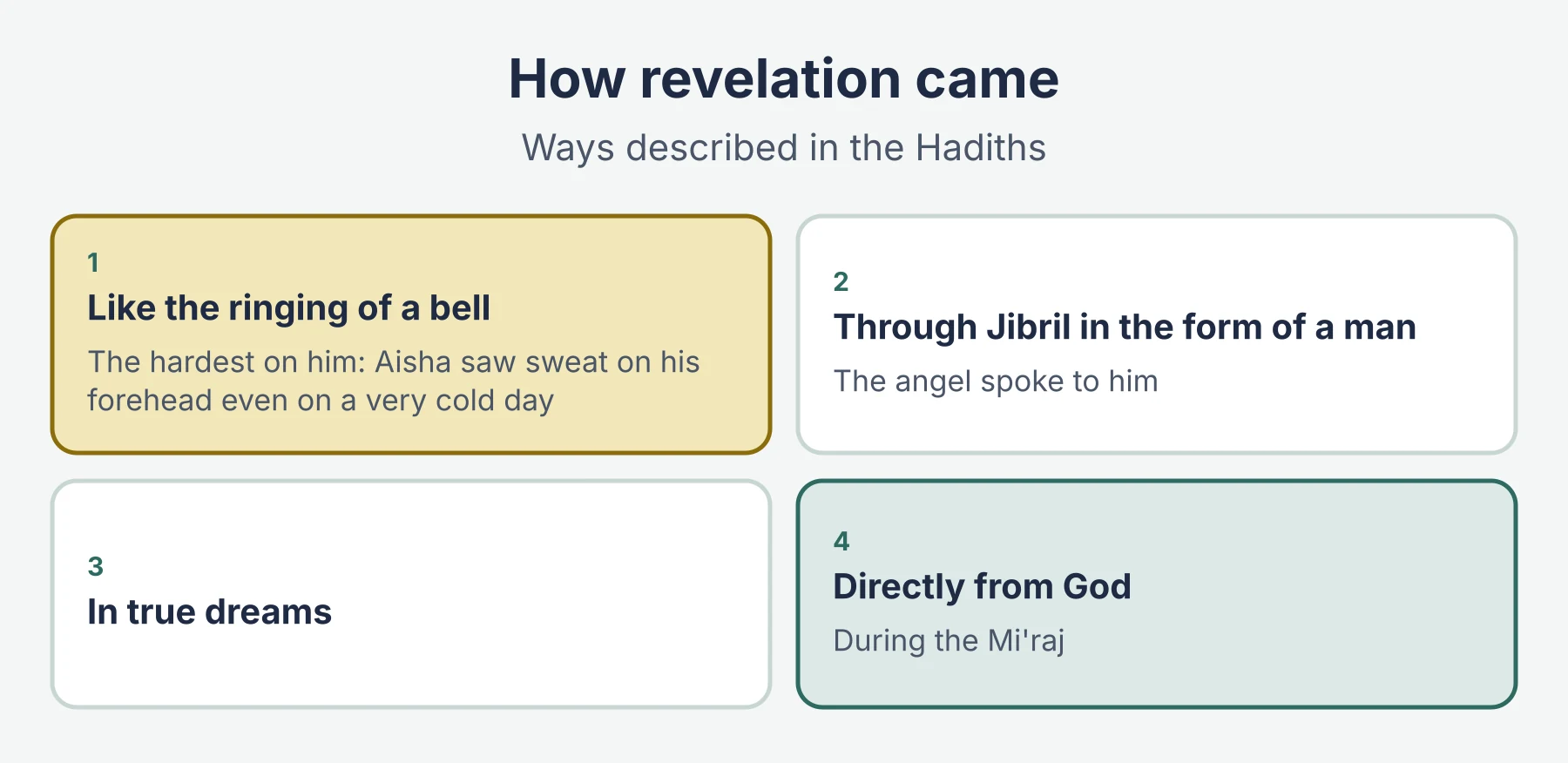
- How it came: like the ringing of a bell (hardest for him); Jibril in the form of a man; true dreams; direct speech from God during the Mi’raj.
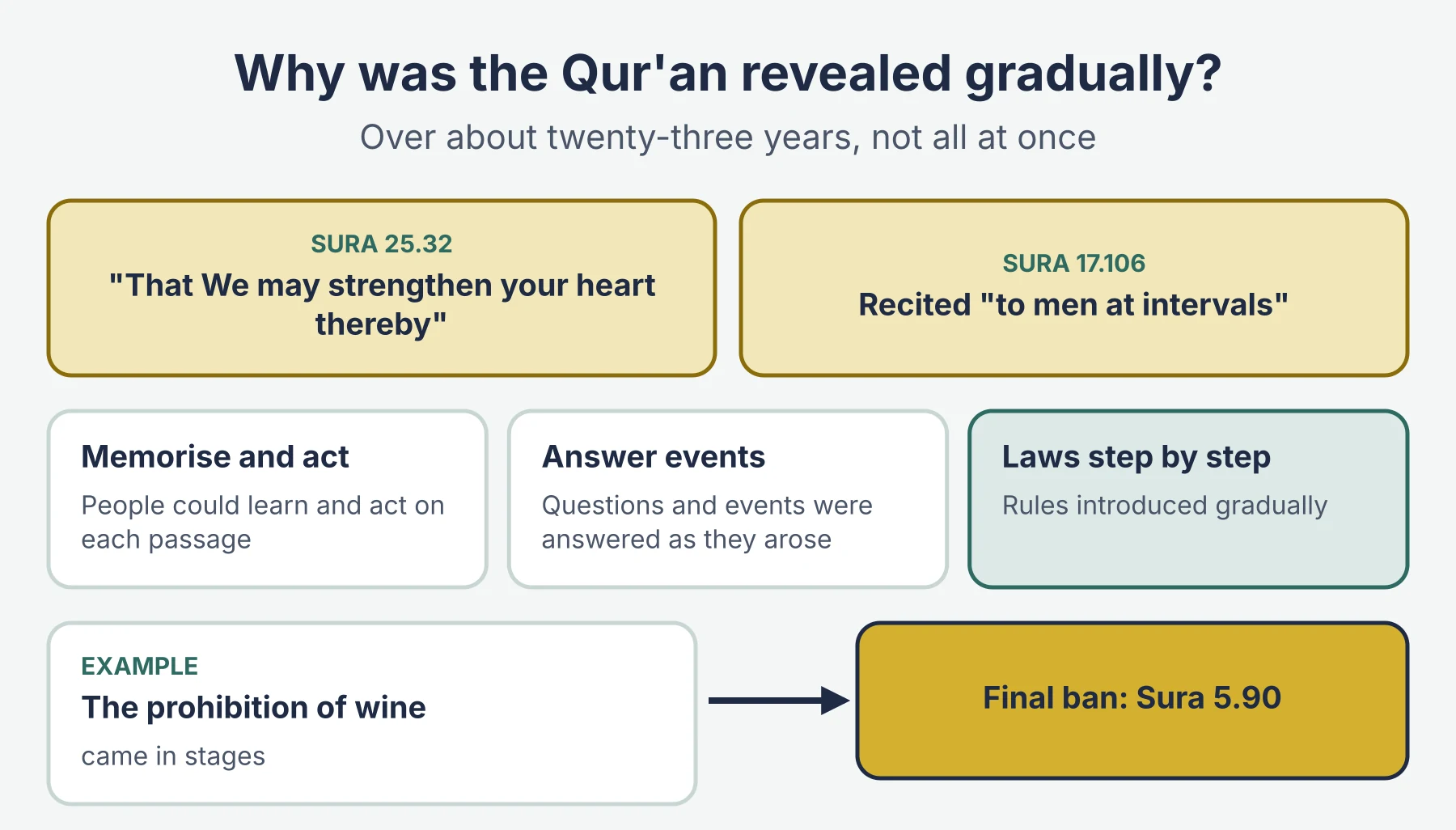
- Over what period: gradually, for about twenty-three years. Reasons from the Qur’an itself: “to strengthen your heart” (Sura 25.32) and to be recited “at intervals” (Sura 17.106).
Why gradual revelation helped: easier to memorise; answered real events and questions; laws introduced step by step (wine forbidden in stages, ending with Sura 5.90).
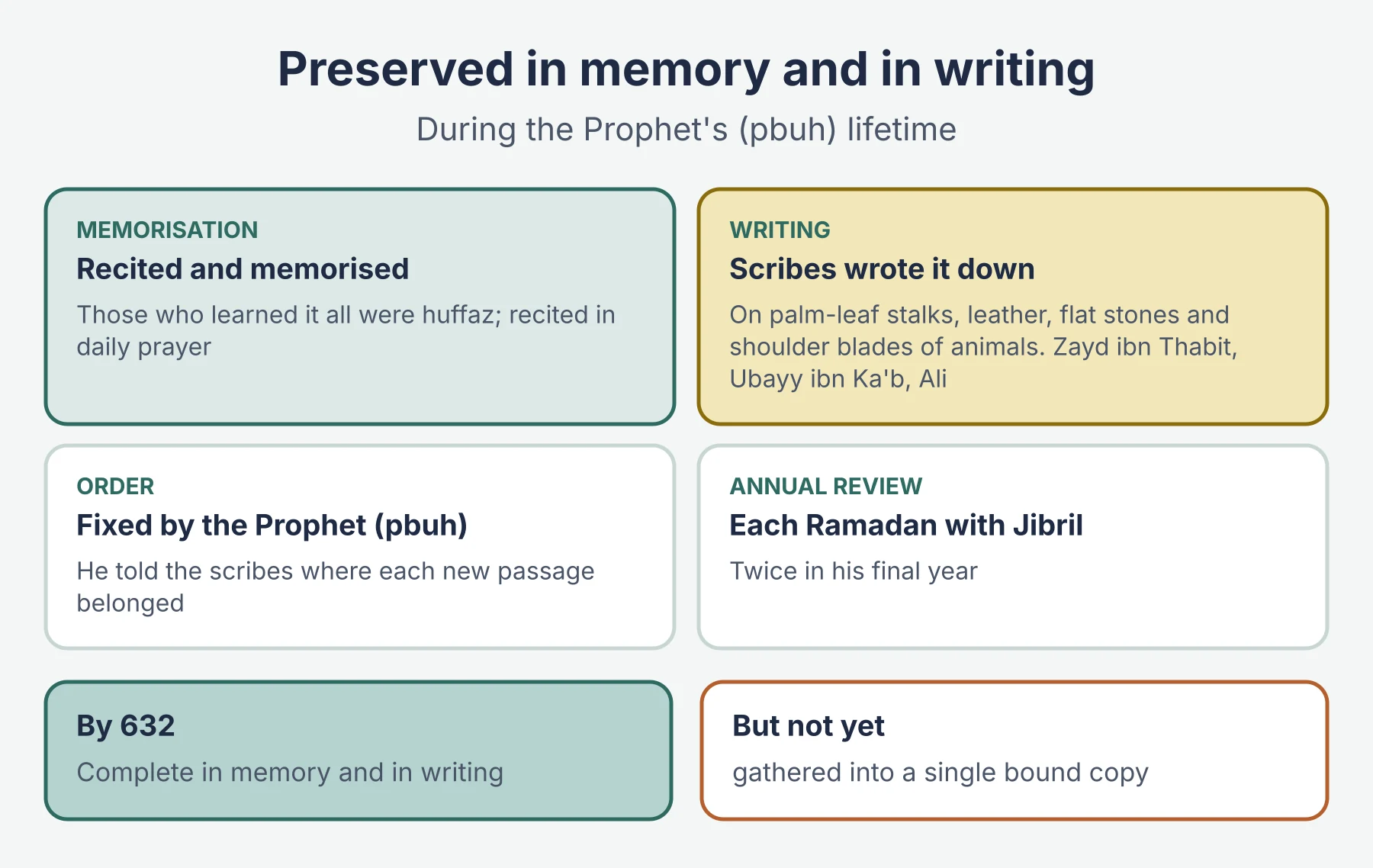
Preservation in the Prophet’s (pbuh) lifetime
- Memory: Companions learned each passage as it came; huffaz knew the whole Qur’an.
- Writing: scribes such as Zayd ibn Thabit (RA), Ubayy ibn Ka’b (RA) and Ali (RA) wrote on palm stalks, leather, flat stones and animal shoulder blades.
- Arrangement: the Prophet (pbuh) told the scribes where each passage belonged.
- Review: Jibril went over the Qur’an with him each Ramadan, twice in the last year.
Key point for answers: the whole Qur’an existed in memory and writing by 632, but scattered, not as one volume.
Abu Bakr’s (RA) compilation: the chain of cause and effect
Yamama (many huffaz killed fighting Musaylima) → Umar’s (RA) fear that the Qur’an could be lost → Abu Bakr’s (RA) hesitation, then agreement → Zayd ibn Thabit (RA) appointed (young, trusted, a hafiz, a scribe of revelation) → strict checking of writing against memory, with witnesses → suhuf kept by Abu Bakr (RA), then Umar (RA), then Hafsa (RA).
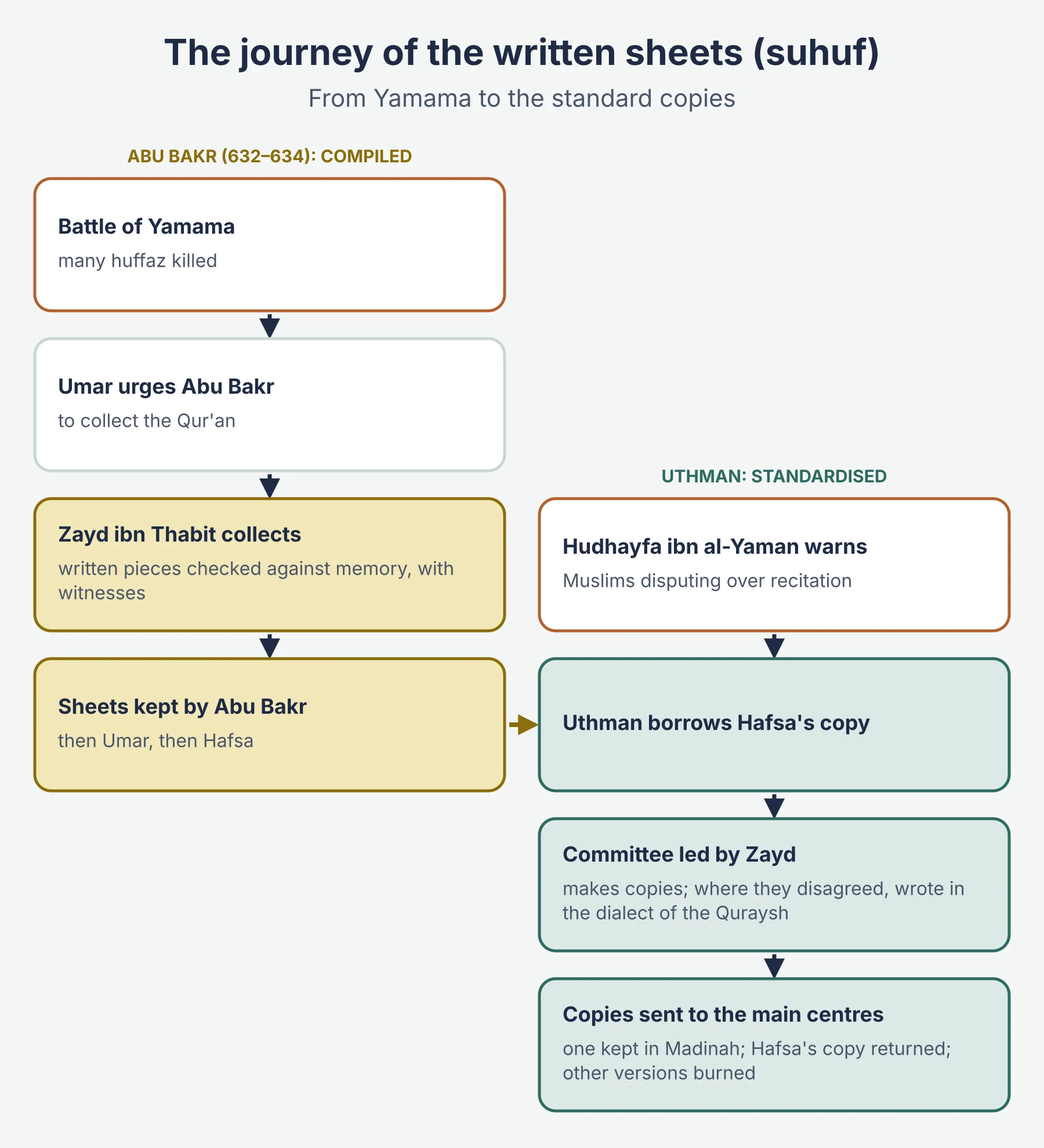
Uthman’s (RA) standardisation: the chain of cause and effect
Expansion of the state → different ways of reciting among new Muslims → Hudhayfa ibn al-Yaman alarmed during the Armenia and Azerbaijan campaigns → Uthman (RA) borrows Hafsa’s (RA) copy → committee under Zayd (with Abdullah ibn al-Zubayr, Sa’id ibn al-As, Abd al-Rahman ibn al-Harith) → Quraysh dialect used where they differed → copies sent to the main centres, one kept in Madina → other versions burned; Hafsa’s (RA) copy returned.
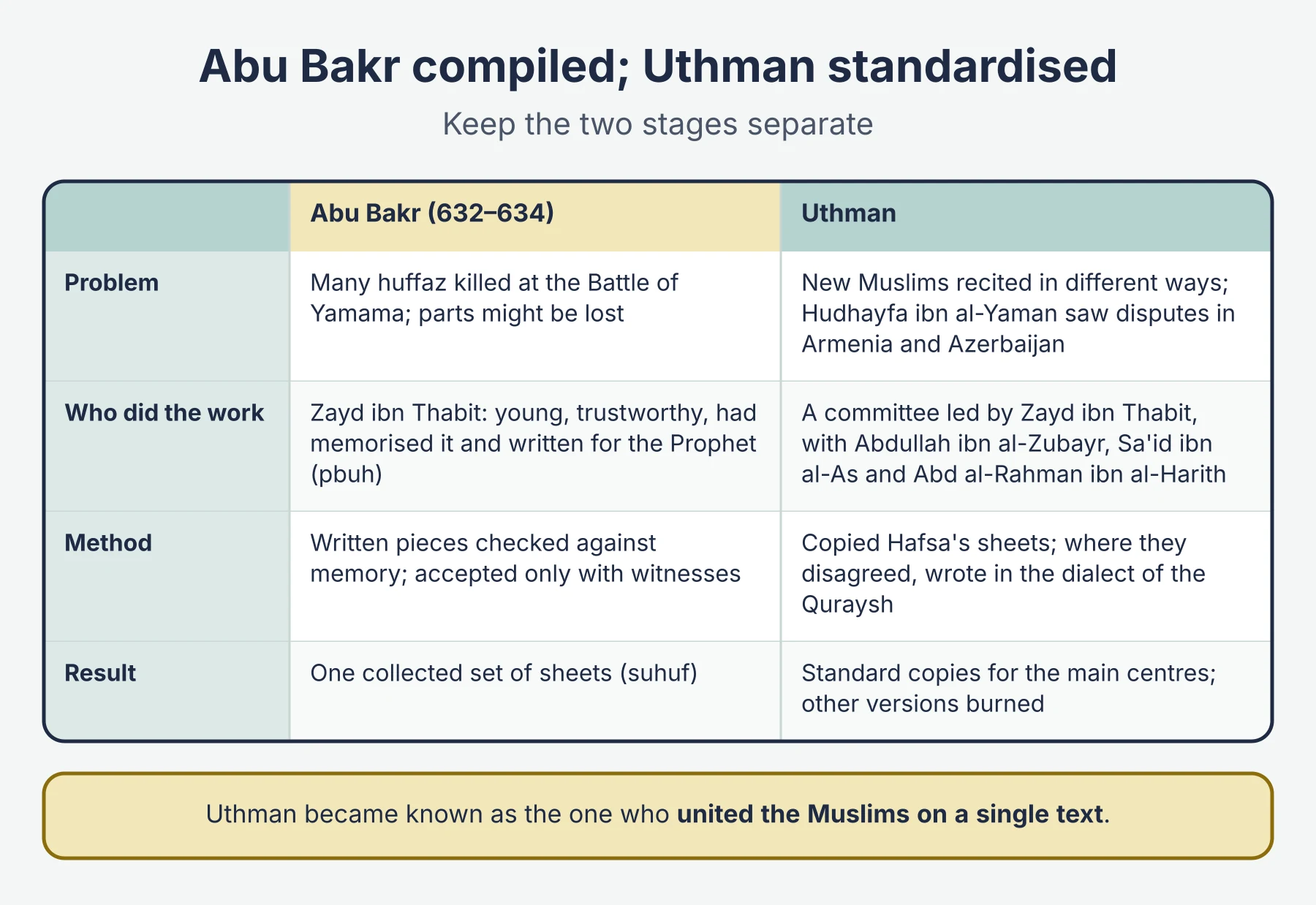
| Abu Bakr (RA) | Uthman (RA) | |
|---|---|---|
| Problem | Loss of huffaz at Yamama | Disputes over recitation |
| Aim | Gather the Qur’an into one copy | Unite all Muslims on one text |
| Led by | Zayd ibn Thabit (RA) | Committee led by Zayd ibn Thabit (RA) |
| Result | Suhuf kept by the caliph, then Hafsa (RA) | Standard copies in the main cities |
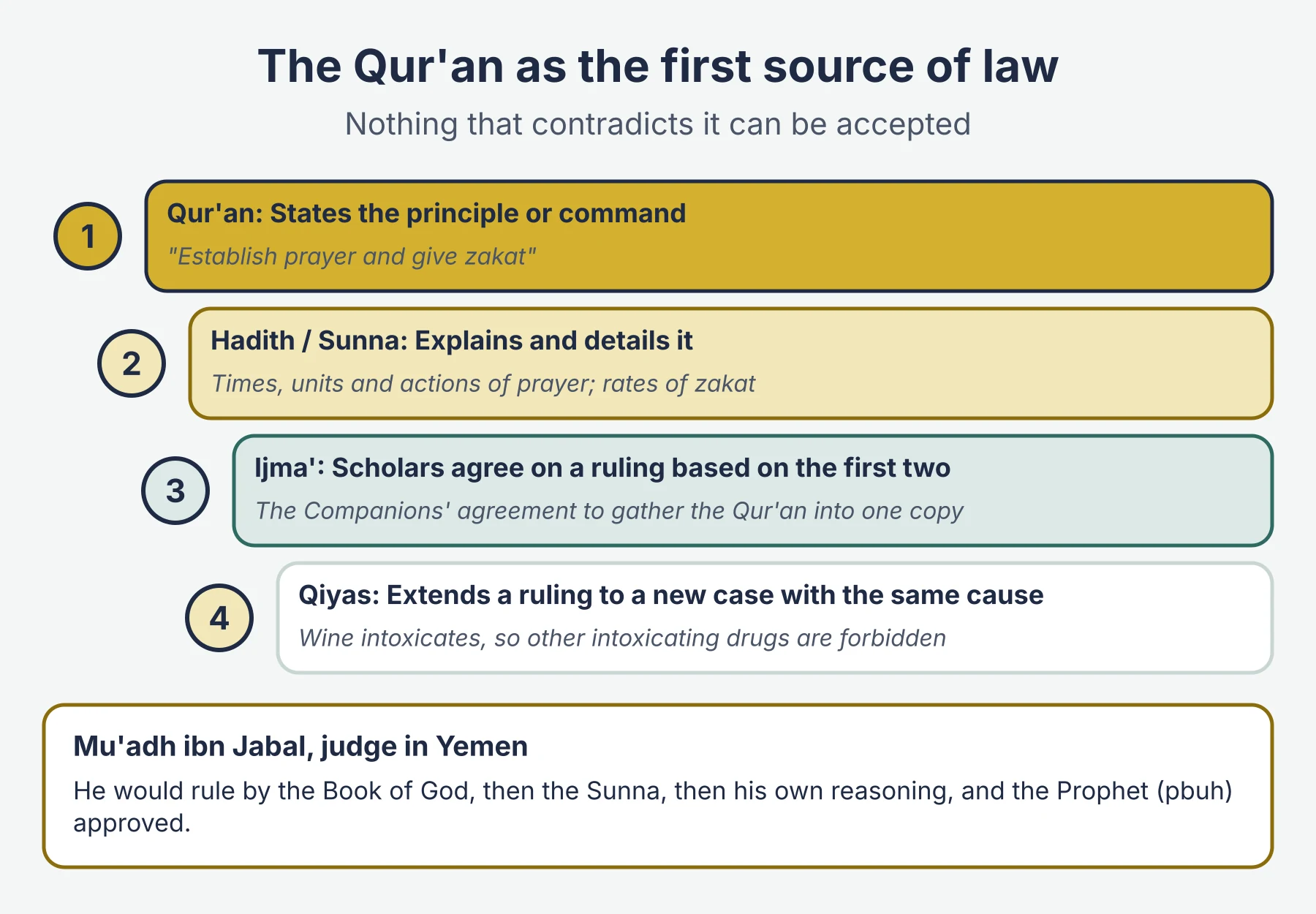
Legal thinking: the four sources
Qur'an  -> the principle           e.g. prayer and zakat commanded
Sunna   -> the detail              e.g. how to pray; zakat rates
Ijma'   -> agreement of scholars   e.g. Companions agree to compile the Qur'an
Qiyas   -> analogy, same cause     e.g. wine forbidden -> other intoxicants forbidden
The order comes from the Hadith of Mu’adh ibn Jabal: Book of God, then Sunna, then his own reasoning, approved by the Prophet (pbuh).
Significance: four points with evidence
| Point | Evidence to quote |
|---|---|
| God’s own word, protected | “We will assuredly guard it” (Sura 15.9) |
| Guidance for every part of life | “guidance sure, without doubt” (Sura 2.2) |
| Central to worship | Recited in every prayer; recited in full in Ramadan |
| Unites the Ummah | One text in one language worldwide since Uthman (RA) |
Key terms
| Term | Meaning |
|---|---|
| Wahy | Revelation from God |
| Hira | Cave on Mount Nur where revelation began |
| Hafiz (pl. huffaz) | Person who has memorised the whole Qur’an |
| Katib | Scribe who wrote down revelation |
| Suhuf | The sheets collected under Abu Bakr (RA) |
| Mushaf | A written copy of the Qur’an |
| Makki / Madani | Revealed in Makka / in Madina |
| Ijma’ | Consensus of qualified scholars |
| Qiyas | Analogy from an existing ruling |
Exam traps
- Yamama is a battle under Abu Bakr (RA), not an event in the Prophet’s (pbuh) lifetime.
- Hafsa (RA) kept the copy; she did not compile it.
- Uthman (RA) did not compose or rearrange the Qur’an; he copied the text already collected.
- Ijma’ and qiyas do not stand alone; both must rest on the Qur’an and Sunna.
- Part (b) is not more narrative. Give reasons: what would have gone wrong without this step?
Self-test
- In which month and year did revelation begin?
- What were the first words revealed, and from which sura?
- Who did Khadija (RA) take the Prophet (pbuh) to after the first revelation, and what did he say?
- Give two ways in which revelation came to the Prophet (pbuh).
- Quote one reason the Qur’an gives for its gradual revelation.
- Name two materials on which the Qur’an was written in the Prophet’s (pbuh) lifetime.
- Which battle led to the first compilation, and why?
- Why was Zayd ibn Thabit (RA) chosen?
- Who kept the collected sheets after Umar’s (RA) death?
- Who reported the disputes that led to Uthman’s (RA) standardisation?
- Which dialect was used where the committee disagreed?
- Explain qiyas with one example.
Answers: 1. Ramadan, 610. 2. “Read! in the name of your Lord, who created”, Sura 96. 3. Waraqa ibn Nawfal, who said the angel was the same one who had come to Musa. 4. Any two: like the ringing of a bell; Jibril in human form; true dreams; direct speech during the Mi’raj. 5. “That We may strengthen your heart thereby” (Sura 25.32), or so it could be recited “at intervals” (Sura 17.106). 6. Any two: palm-leaf stalks, leather, flat stones, animal shoulder blades. 7. Yamama, because many huffaz were killed and Umar (RA) feared parts of the Qur’an would be lost. 8. He was young, trustworthy, a hafiz and a scribe of revelation for the Prophet (pbuh). 9. Hafsa (RA), Umar’s (RA) daughter and a wife of the Prophet (pbuh). 10. Hudhayfa ibn al-Yaman. 11. The dialect of the Quraysh. 12. Applying an existing ruling to a new case with the same cause, for example forbidding intoxicating drugs because wine is forbidden for causing intoxication.
Related pages
Source: Cambridge International, Cambridge O Level Islamiyat 2058 syllabus for examination in 2026 and 2027, Paper 1 Topic 2.
Related resources
-
Study guides
Cambridge O Level Islamiyat (2058): The Life and Importance of the Prophet Muhammad (pbuh)
Study guide to the Prophet's life from birth to death, his character and his example today, for Cambridge O Level Islamiyat 2058 Paper 1, with a model answer.
Islamiyat · Cambridge · O Level
Read guide -
Practice questions
Cambridge O Level Islamiyat (2058): The Life and Importance of the Prophet Muhammad (pbuh) — Practice Questions
Twelve original questions on the Prophet's life, battles, treaties and example for Cambridge O Level Islamiyat 2058 Paper 1, with full mark-scheme answers.
Islamiyat · Cambridge · O Level
Try questions -
Revision notes
Cambridge O Level Islamiyat (2058): The Life and Importance of the Prophet Muhammad (pbuh) — Revision Notes
Recall notes on the Prophet's life in Makka and Madina, his battles and treaties and his example today, for Cambridge O Level Islamiyat 2058 Paper 1.
Islamiyat · Cambridge · O Level
Revise topic
Get free revision emails (optional)
Occasional emails with practice questions, worked explanations and links to free resources for the qualification and subjects you choose. No spam, and you can unsubscribe from any email. The free tools on this site never need an email.