
Study Guides
Cambridge O Level First Language Urdu (3247): Part 1 Reading Comprehension
How to answer the 3247 Paper 1 Part 1 comprehension questions on a 400-word non-literary Urdu text, objective by objective, with an annotated example.
- Subject
- Urdu Language
- Level
- O LEVELS
- Topic
- Paper 1 – Reading and Writing
- Author
- Marlbridge Academic Team
- Updated
- Reviewed by
- Farheen Zehra (what this means)
Aligned to Cambridge O Level Urdu Language (3247), 2027. Official specification .
Syllabus page (what it covers and how it is assessed): Cambridge O Level Urdu Language.
Found an error? Report a correction.
Need help with this topic? Request a free trial class for O Level Urdu Language (3247 / 3248).
This guide covers one part of Cambridge O Level First Language Urdu 3247, Paper 1 Reading and Writing: Part 1 Reading, where the syllabus says candidates “answer comprehension questions requiring answers of differing lengths on a non-literary text of approximately 400 words”. For the whole paper, and how it differs from the Second Language paper, start with the O Level Urdu Paper 1 study guide. This page goes further into the reading part alone: what each reading objective asks you to do, how to judge the length of an answer, and how to put an answer into your own Urdu.
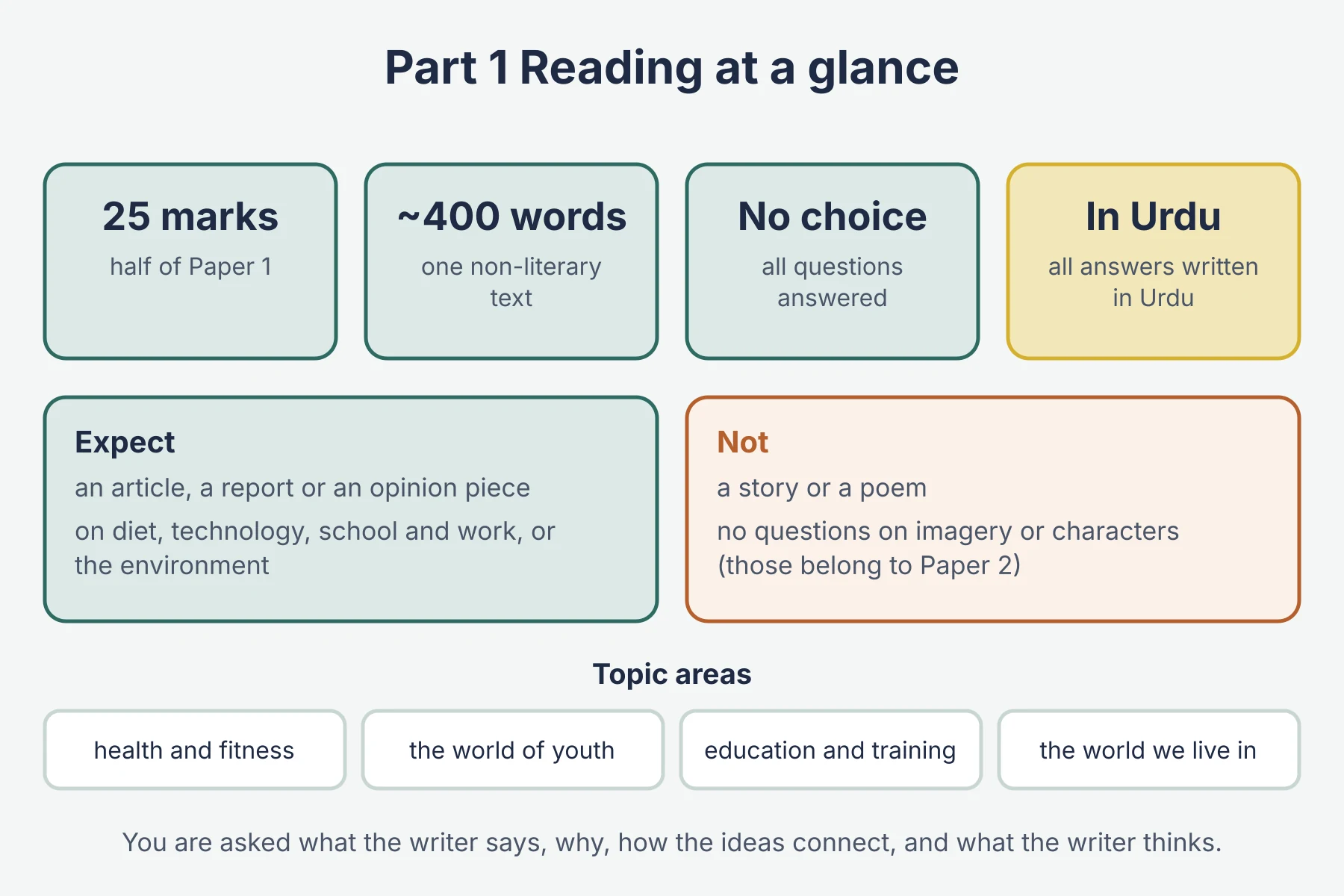
What Part 1 contains
| Feature | What the syllabus sets |
|---|---|
| Marks | 25, half of Paper 1 |
| Text | one non-literary text of about 400 words |
| Questions | comprehension questions needing answers of differing lengths |
| Choice | none: all questions in Part 1 are answered |
| Language | all questions answered in Urdu |
| Topic areas | health and fitness; the world of youth; education and training; the world we live in |
“Non-literary” matters. The passage is not a story or a poem: expect an article, a report or an opinion piece on a subject such as diet, technology, school and work, or the environment. That shapes the questions. You are not asked about imagery or characters, as you are in Paper 2. You are asked what the writer says, why, how the ideas connect, and what the writer thinks about it.
The syllabus does not publish how the 25 marks are split between questions. The marks shown on this page and on the linked practice set are practice values, chosen to show how the length of an answer should follow its tariff.
The four reading objectives in practice
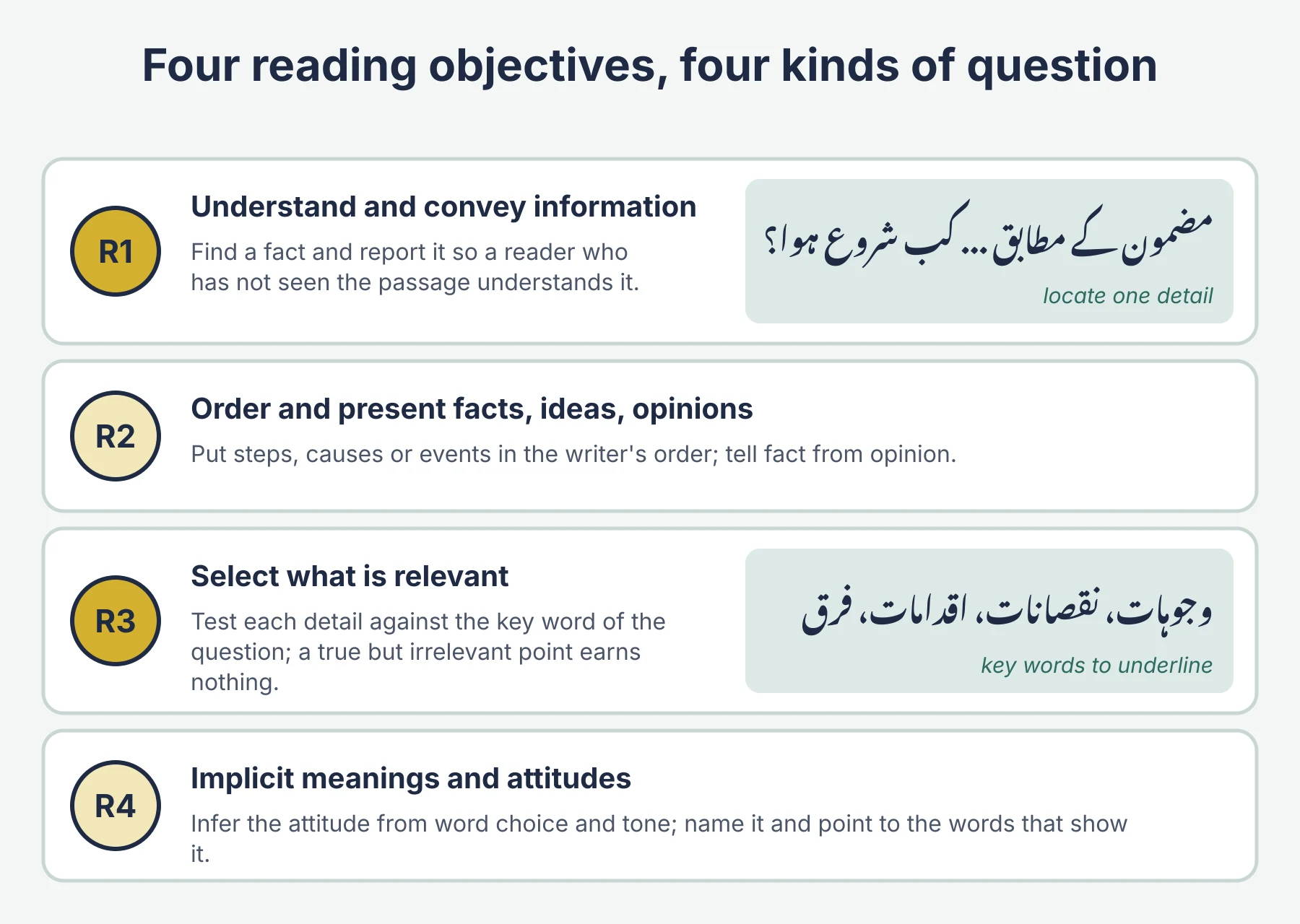
Part 1 is marked against four objectives. Each one points to a different kind of question.
R1 – understand and convey information. Find a fact and report it clearly. A question such as مضمون کے مطابق … کب شروع ہوا؟ wants the located detail and nothing more. “Convey” means your answer must make sense to a reader who has not seen the passage: a bare word lifted from the middle of a sentence may not do that.
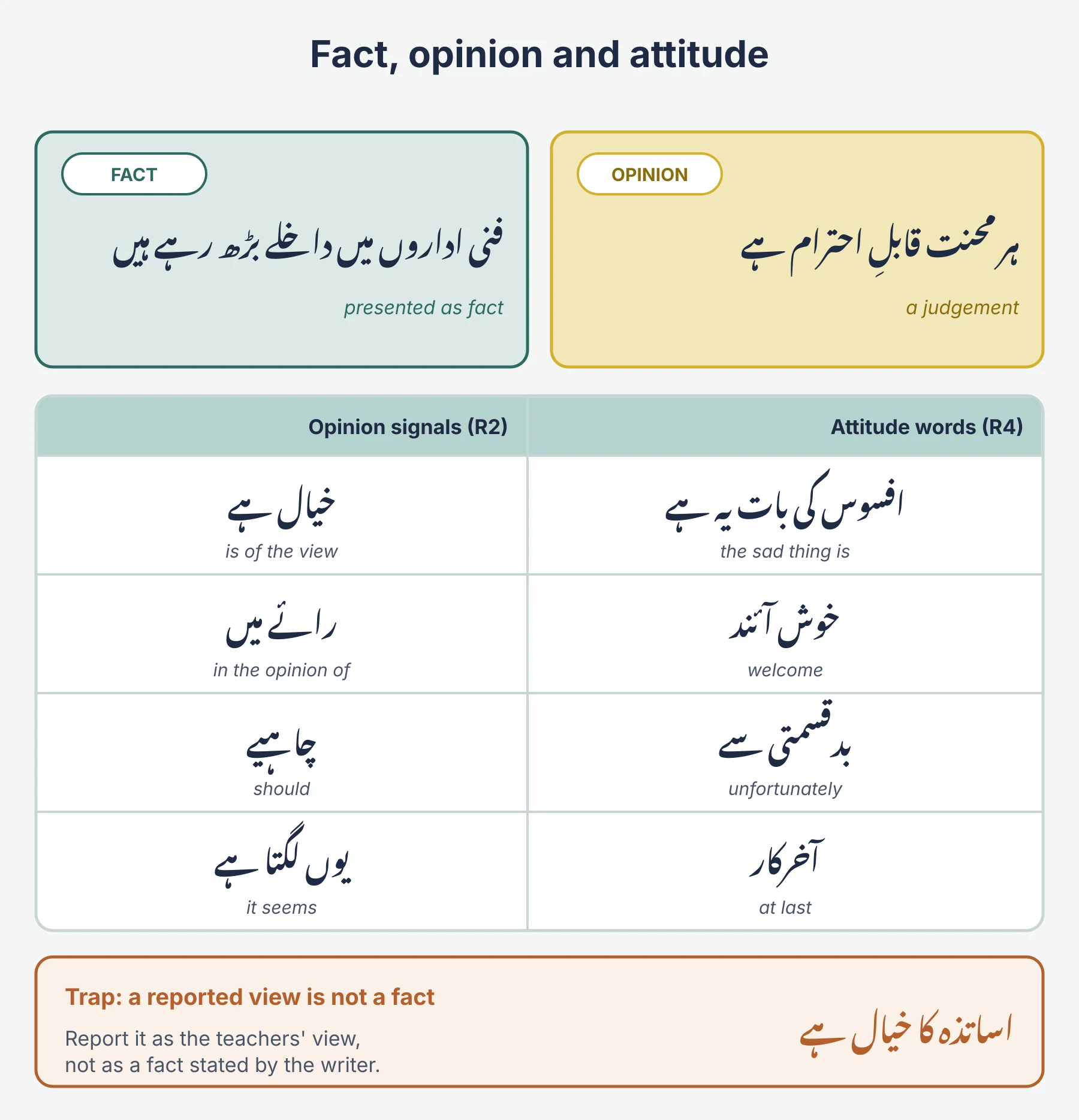
R2 – understand, order and present facts, ideas and opinions. Two skills sit here. The first is sequence: putting steps, causes or events in the order the writer gives them. The second is telling fact from opinion. فنی اداروں میں داخلے بڑھ رہے ہیں is presented as fact; ہر محنت قابلِ احترام ہے is a judgement. Opinions are often signalled by verbs and phrases such as خیال ہے، رائے میں، چاہیے، یوں لگتا ہے.
R3 – evaluate information and select what is relevant to specific purposes. The passage holds more than any one question needs. A question about disadvantages earns nothing for advantages, however accurately you report them. Before writing, underline the key word of the question (وجوہات، نقصانات، اقدامات، فرق) and test each detail against it.
R4 – recognise implicit meanings and attitudes. The writer may never say “I approve” or “I am worried”. You infer the attitude from word choice and tone. افسوس کی بات یہ ہے، خوش آئند، بدقسمتی سے، آخرکار each carry a judgement. A good R4 answer names the attitude and points to the words that show it.
Matching answer length to the question
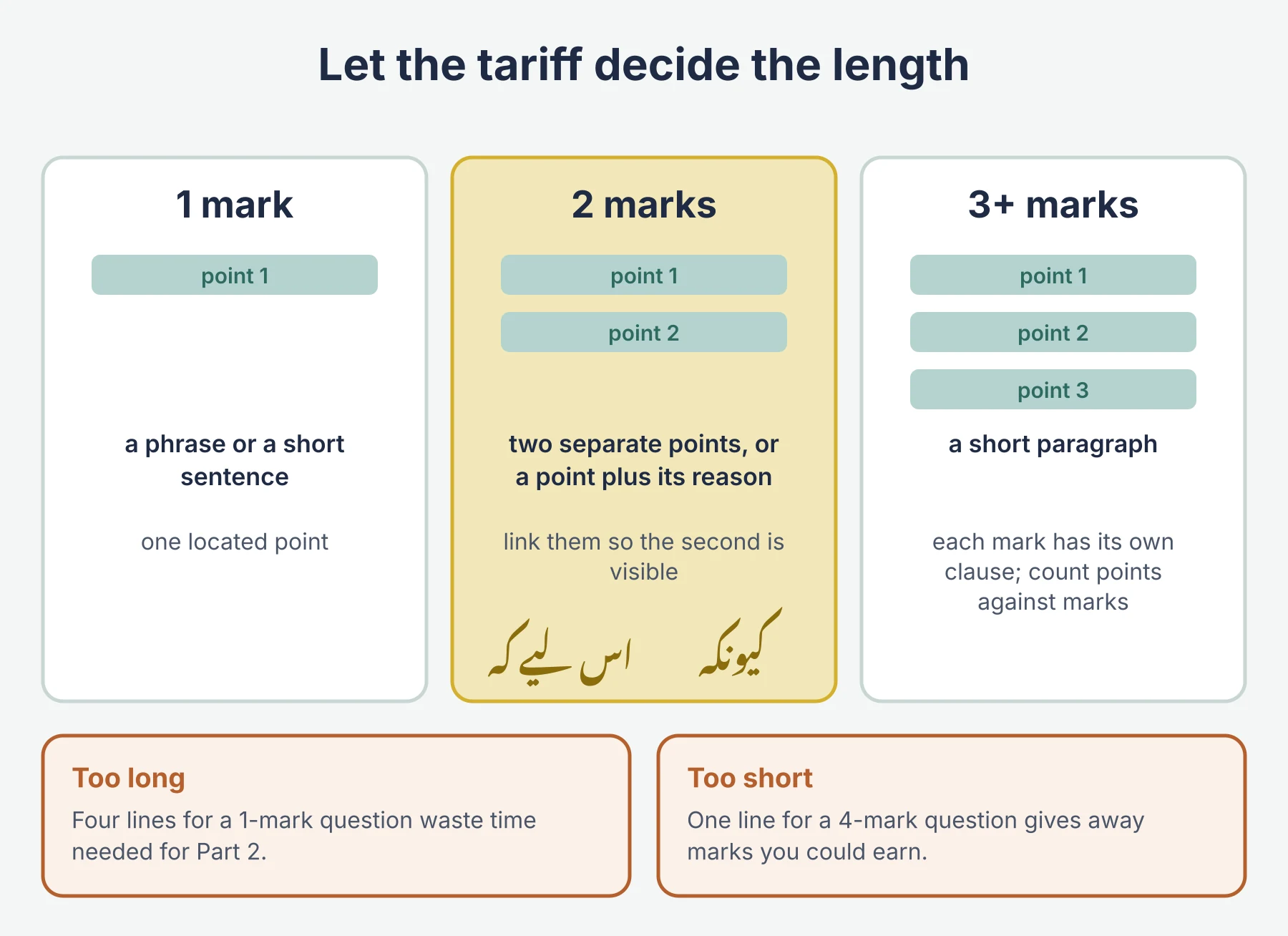
“Answers of differing lengths” is a deliberate part of the design. Let the tariff decide:
- 1 mark: a phrase or a short sentence. One located point.
- 2 marks: two separate points, or one point plus its reason. Use a linking word such as کیونکہ or اس لیے کہ so the second point is visible.
- 3 or more marks: a short paragraph in which each mark has its own clause. Count your points against the marks before you move on.
Writing four lines for a one-mark question wastes time you need for the composition in Part 2. Writing one line for a four-mark question gives away marks you could have earned.
Putting answers into your own words
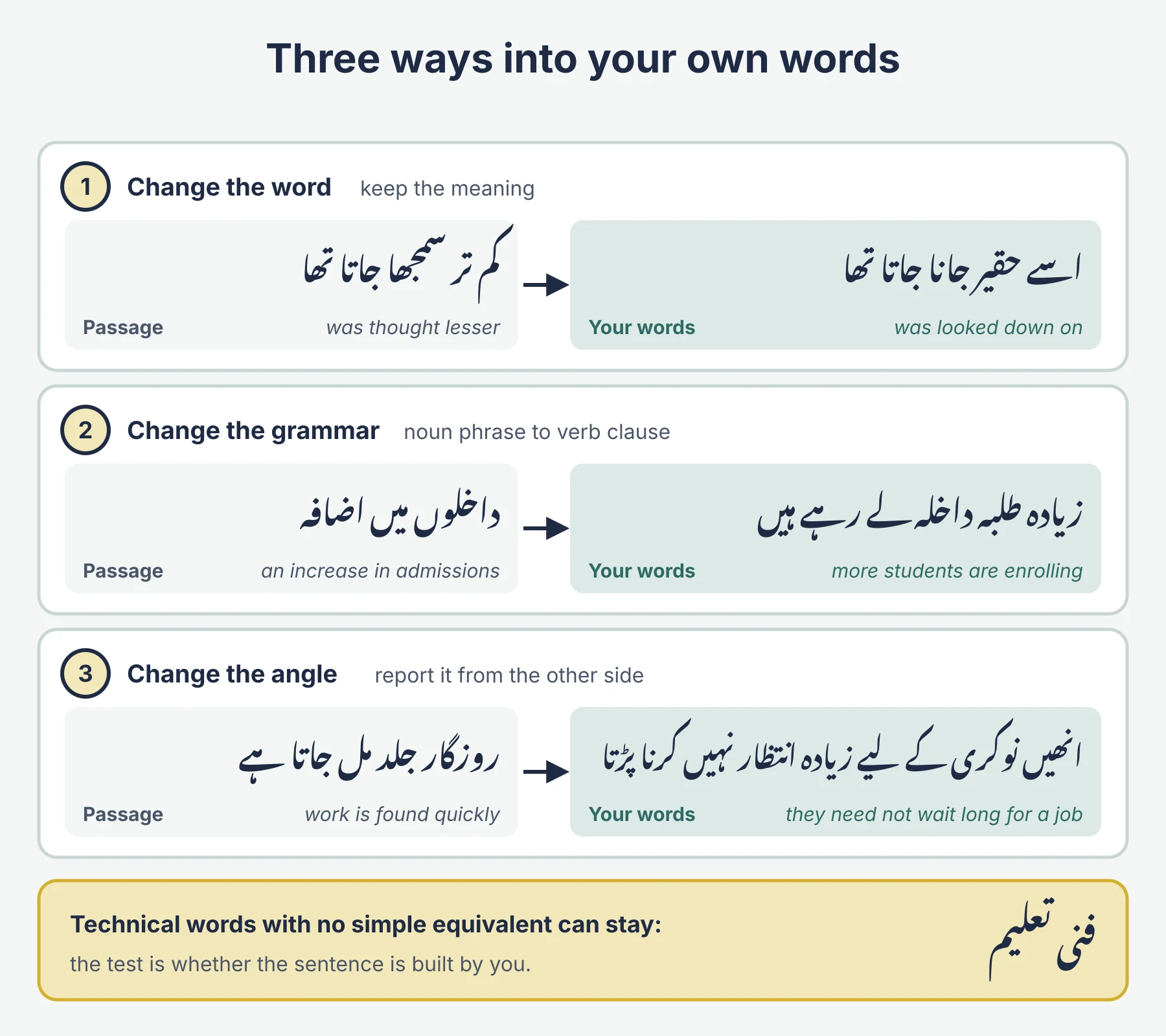
Many questions ask you to answer اپنے الفاظ میں. Copying the passage’s sentence then shows only that you can locate it, not that you understood it. Three methods work well in Urdu:
- Change the word, keep the meaning. کم تر سمجھا جاتا تھا becomes اسے حقیر جانا جاتا تھا or اسے عزت کا کام نہیں سمجھا جاتا تھا.
- Change the grammar. Turn a noun phrase into a verb clause: داخلوں میں اضافہ becomes زیادہ طلبہ داخلہ لے رہے ہیں.
- Change the angle. Report the idea from the other side: روزگار جلد مل جاتا ہے becomes انھیں نوکری کے لیے زیادہ انتظار نہیں کرنا پڑتا.
Key technical words with no simple equivalent (for example فنی تعلیم) can stay. The test is whether your sentence is built by you.
Worked example
The passage below is original, written for this guide in the style of a Part 1 text.
آج کل بہت سے طلبہ میٹرک کے بعد فنی تعلیم کا راستہ اختیار کر رہے ہیں۔ پہلے اکثر والدین یہی چاہتے تھے کہ ان کا بچہ ڈاکٹر یا انجینئر بنے، اور الیکٹریشن یا درزی کا کام کم تر سمجھا جاتا تھا۔ اب صورتِ حال بدل رہی ہے۔ ایک فنی ادارے کے سربراہ کے مطابق ان کے ہاں داخلے کے خواہش مند طلبہ ہر سال بڑھ رہے ہیں، کیونکہ ہنر مند افراد کو جلد روزگار مل جاتا ہے۔ تاہم بعض اساتذہ کا خیال ہے کہ صرف ہنر سکھانا کافی نہیں؛ طلبہ کو زبان اور حساب کی بنیادی تعلیم بھی ملنی چاہیے تاکہ وہ آگے چل کر اپنا کاروبار سنبھال سکیں۔ یوں لگتا ہے کہ معاشرہ آخرکار یہ تسلیم کرنے لگا ہے کہ ہر محنت قابلِ احترام ہے۔
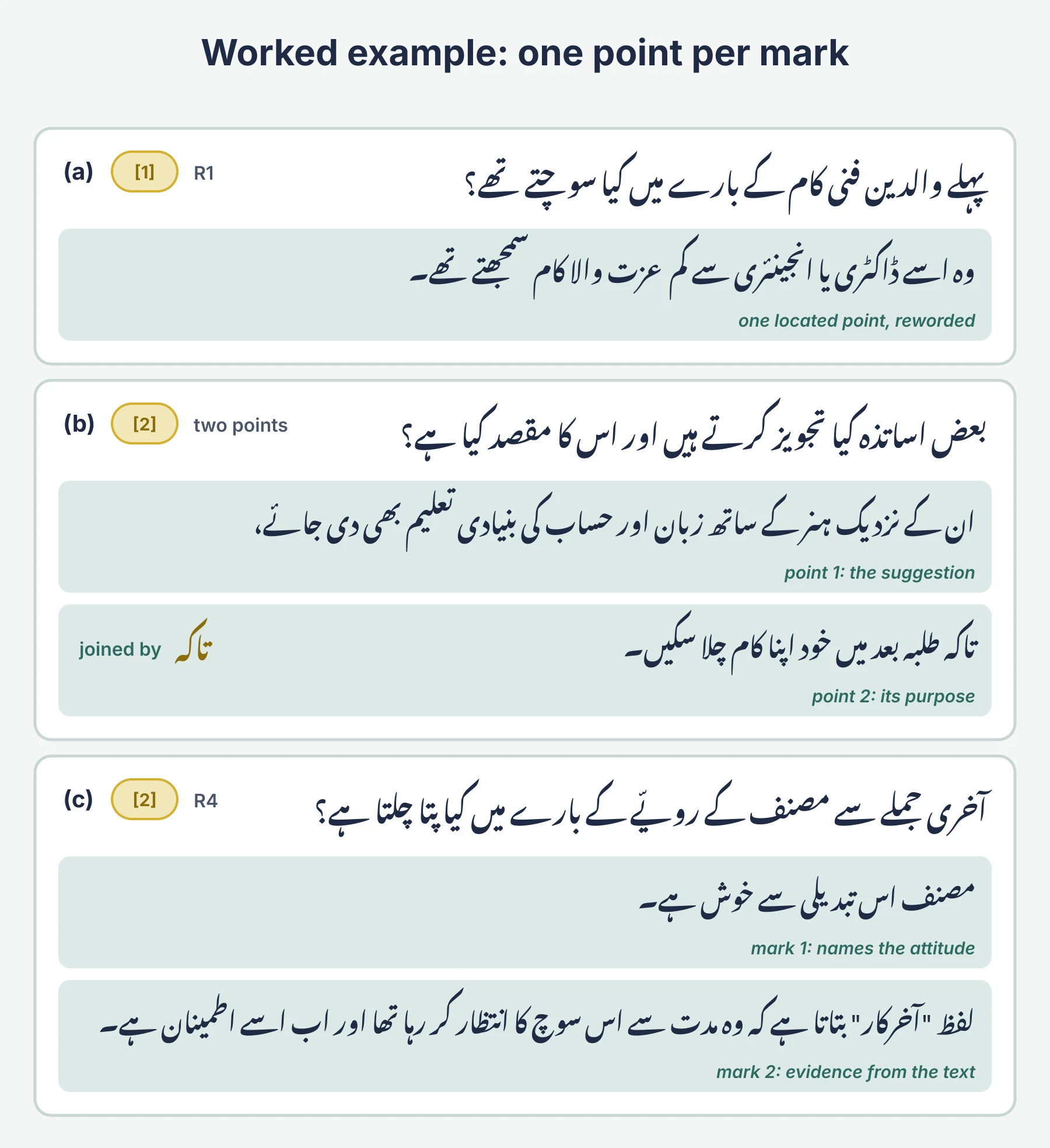
Question (a). پہلے والدین فنی کام کے بارے میں کیا سوچتے تھے؟ [1]
Answer: وہ اسے ڈاکٹری یا انجینئری سے کم عزت والا کام سمجھتے تھے۔
Commentary: an R1 answer. It conveys one located point and rewords کم تر so a reader who has not seen the passage understands it.
Question (b). بعض اساتذہ کیا تجویز کرتے ہیں اور اس کا مقصد کیا ہے؟ [2]
Answer: ان کے نزدیک ہنر کے ساتھ زبان اور حساب کی بنیادی تعلیم بھی دی جائے، تاکہ طلبہ بعد میں خود اپنا کام چلا سکیں۔
Commentary: two marks, two visible points joined by تاکہ: the suggestion, then its purpose. A weaker answer stops after the first clause and earns one mark.
Question (c). آخری جملے سے مصنف کے رویّے کے بارے میں کیا پتا چلتا ہے؟ [2]
Answer: مصنف اس تبدیلی سے خوش ہے۔ لفظ “آخرکار” بتاتا ہے کہ وہ مدت سے اس سوچ کا انتظار کر رہا تھا اور اب اسے اطمینان ہے۔
Commentary: an R4 answer. It names the attitude (approval, relief) and supports it with one word from the text. Saying only “the writer is positive” with no evidence would earn at most one mark.
Common mistakes
- Answering from general knowledge. Every answer comes from the passage. A true statement about vocational training that the passage does not make earns nothing.
- Lifting a whole sentence where the question asks for your own words, or where only part of the sentence answers the question.
- Mixing up fact and opinion. Reporting a teacher’s view (اساتذہ کا خیال ہے) as if the writer had stated it as fact.
- Naming an attitude without evidence, or quoting evidence without naming the attitude.
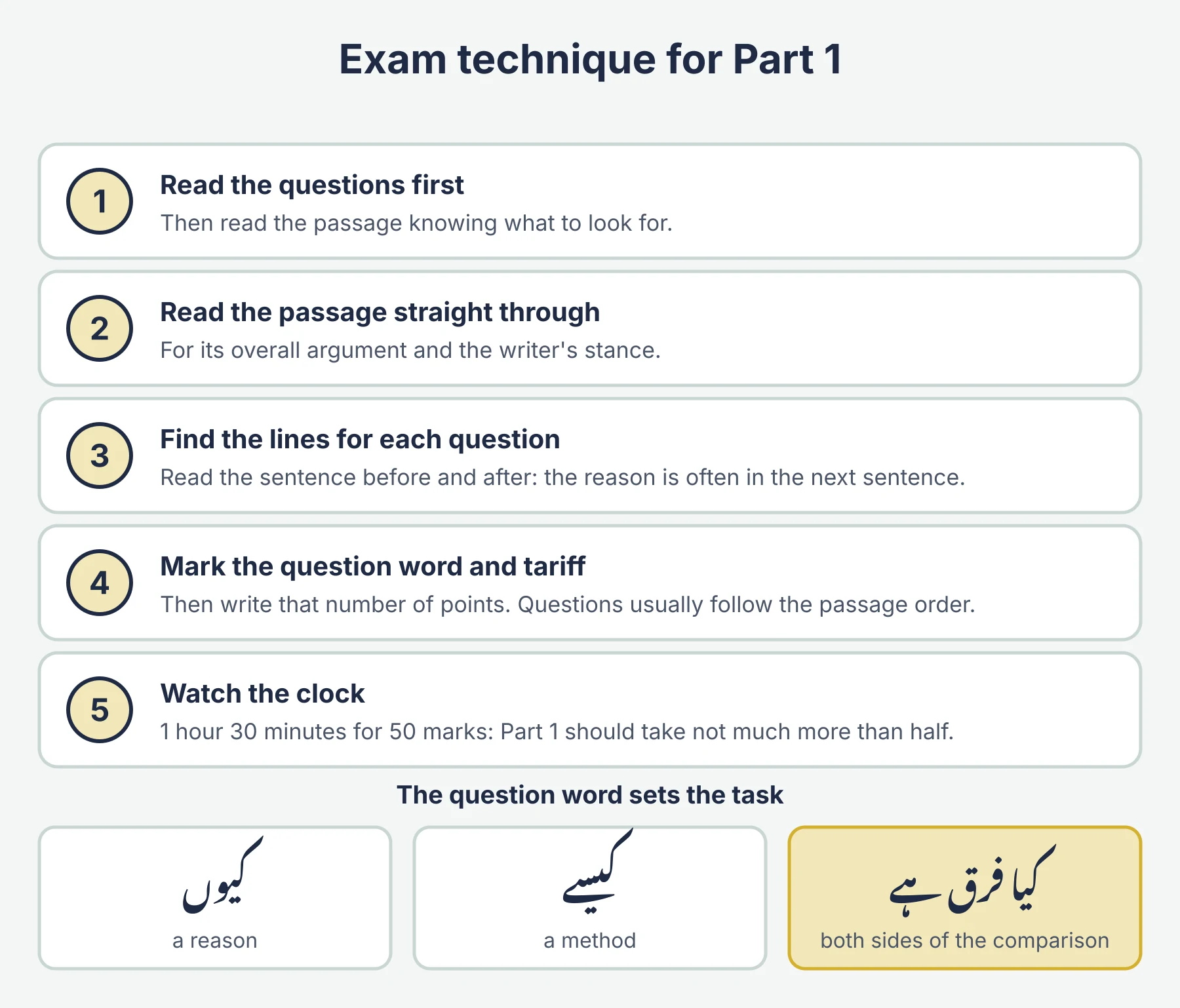
- Ignoring the question word. کیوں asks for a reason; کیسے asks for a method; کیا فرق ہے needs both sides of the comparison.
- Careless script. A missing dot or a wrong ی/ے can change the word an examiner reads.
Exam technique
- Read the questions first, so you read the passage knowing what to look for.
- Read the passage once straight through for its overall argument and the writer’s stance.
- For each question, find the lines, then read the sentence before and after: the reason for a fact is often in the next sentence.
- Mark the question word and the tariff, then write that number of points.
- Questions usually follow the order of the passage. If question (d) seems to have no answer, look between the lines you used for (c) and (e).
- Paper 1 is 1 hour 30 minutes for 50 marks, split equally between reading and writing, so do not let Part 1 take much more than half the paper. Leave the last few minutes to check agreement and spelling in both parts.
More resources on this topic
- Part 1 Reading Comprehension: revision notes – the objectives, key terms and traps in condensed form, with a self-test
- Part 1 Reading Comprehension: practice questions – an original passage with questions of differing lengths and full answers
- O Level Urdu Paper 1 study guide – both syllabuses’ Paper 1 formats side by side
- Part 2 argumentative and discursive composition – the writing half of the same paper
Related resources
-
Practice questions
Cambridge O Level First Language Urdu (3247): Part 1 Reading Comprehension – Practice Questions
Twelve original comprehension questions on a new non-literary Urdu passage in the 3247 Paper 1 Part 1 style, covering R1 to R4, with full marked answers.
Urdu Language · Cambridge · O Level
Try questions -
Revision notes
Cambridge O Level First Language Urdu (3247): Part 1 Reading Comprehension – Revision Notes
Condensed notes on 3247 Paper 1 Part 1 Reading: the four reading objectives, question words, answer length, own-words methods, traps and a self-test.
Urdu Language · Cambridge · O Level
Revise topic -
Study guides
Cambridge O-Level Urdu: First and Second Language (3247/3248)
First Language and Second Language Urdu – the two distinct, currently examined Cambridge O-Level Urdu syllabuses, each built around Paper 1 Reading and Writing plus a second, differently-focused paper.
Urdu Language · Cambridge · O Level
Read guide
Get free revision emails (optional)
Occasional emails with practice questions, worked explanations and links to free resources for the qualification and subjects you choose. No spam, and you can unsubscribe from any email. The free tools on this site never need an email.