
Revision Notes
Cambridge O Level First Language Urdu (3247): Part 1 Reading Comprehension – Revision Notes
Condensed notes on 3247 Paper 1 Part 1 Reading: the four reading objectives, question words, answer length, own-words methods, traps and a self-test.
- Subject
- Urdu Language
- Level
- O LEVELS
- Topic
- Paper 1 – Reading and Writing
- Author
- Marlbridge Academic Team
- Updated
- Reviewed by
- Farheen Zehra (what this means)
Aligned to Cambridge O Level Urdu Language (3247), 2027. Official specification .
Syllabus page (what it covers and how it is assessed): Cambridge O Level Urdu Language.
Found an error? Report a correction.
Need help with this topic? Request a free trial class for O Level Urdu Language (3247 / 3248).
These notes cover Part 1 Reading of Cambridge O Level First Language Urdu 3247 Paper 1, in which candidates “answer comprehension questions requiring answers of differing lengths on a non-literary text of approximately 400 words”. For the whole paper see the O Level Urdu Paper 1 study guide; for the full explanation of this part see the Part 1 Reading Comprehension study guide.
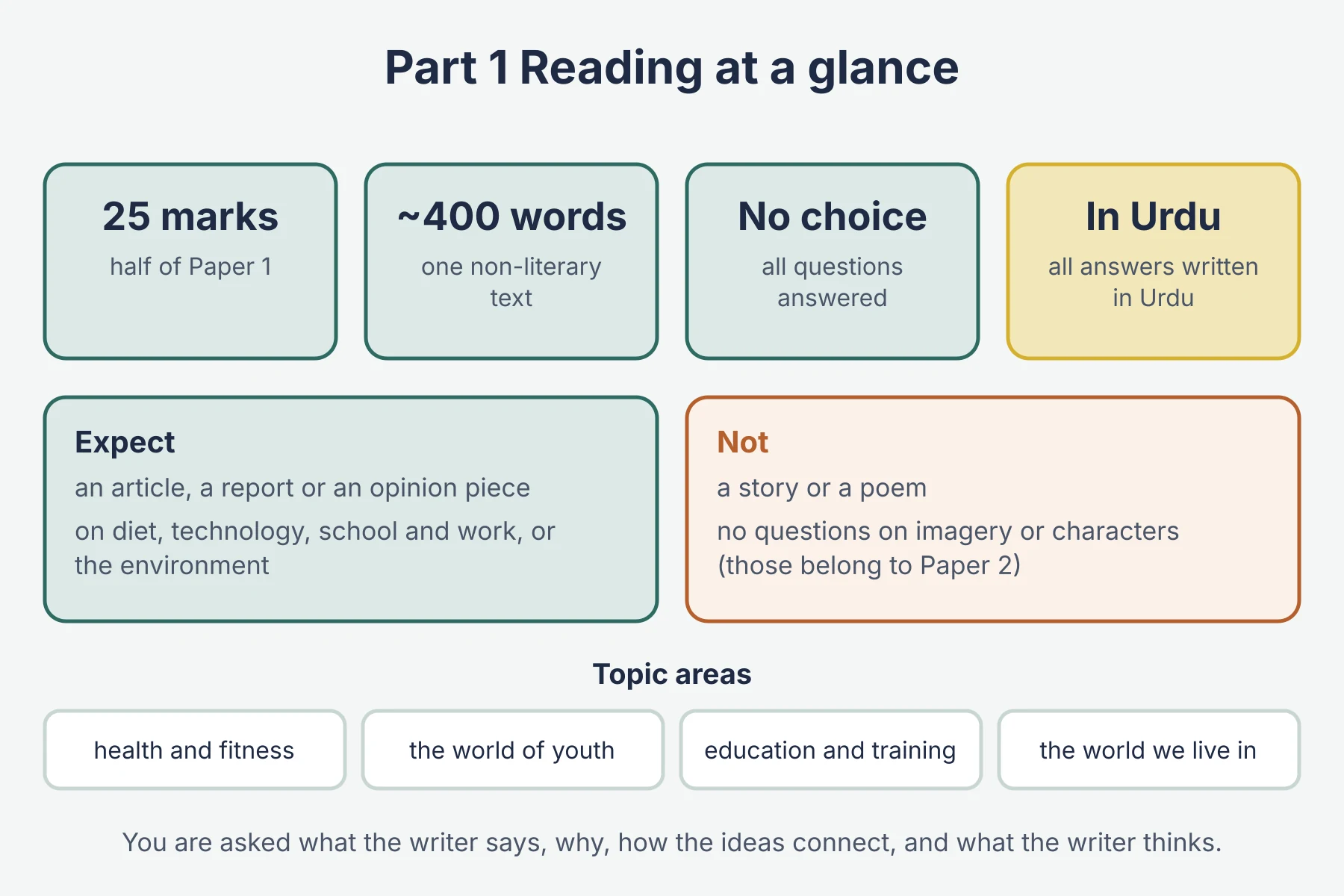
Part 1 in one box
- 25 marks, half of Paper 1 (1 hour 30 minutes, 50 marks in all).
- One non-literary text, about 400 words: article, report or opinion piece.
- All questions compulsory, answered in Urdu, answers of differing lengths.
- Text drawn from the four topic areas: health and fitness; the world of youth; education and training; the world we live in.
- Marked against R1–R4 only. Writing objectives are not credited here, but an answer still has to be clear enough for the examiner to read the point.
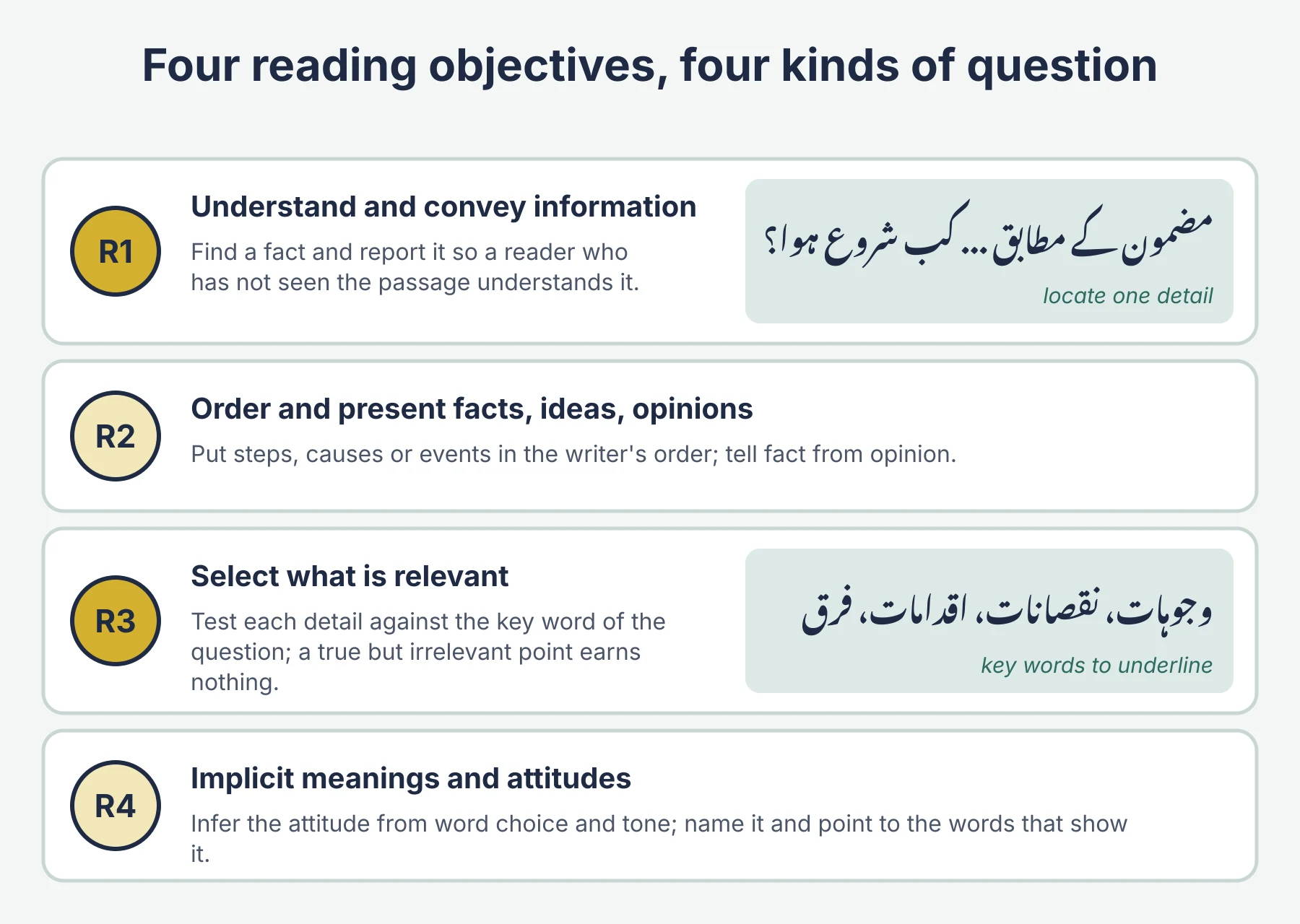
The objectives as questions
| Objective | Syllabus wording | The question really asks |
|---|---|---|
| R1 | understand and convey information | What does the text say? Report it so it makes sense alone. |
| R2 | understand, order and present facts, ideas and opinions | In what order? Which is fact, which is view? |
| R3 | evaluate information and select what is relevant to specific purposes | Which details answer this question and no other? |
| R4 | recognise implicit meanings and attitudes | What does the writer feel, and which words show it? |
Key terms
| Urdu | English | Use in an answer |
|---|---|---|
| اقتباس | extract, quotation | the words you point to as evidence |
| مفہوم | sense, meaning | what a phrase means in context |
| اپنے الفاظ میں | in your own words | reword: do not copy the sentence |
| حقیقت / رائے | fact / opinion | R2: separate what is shown from what is believed |
| رویّہ | attitude | R4: approval, worry, irony, regret |
| لہجہ | tone | the feeling carried by word choice |
| وجہ / نتیجہ | cause / result | two-mark questions often want both |
| ترتیب | order, sequence | R2: keep the writer’s order |
| استنباط | inference | what is meant but not stated |
| متعلقہ | relevant | R3: only what the question asks for |
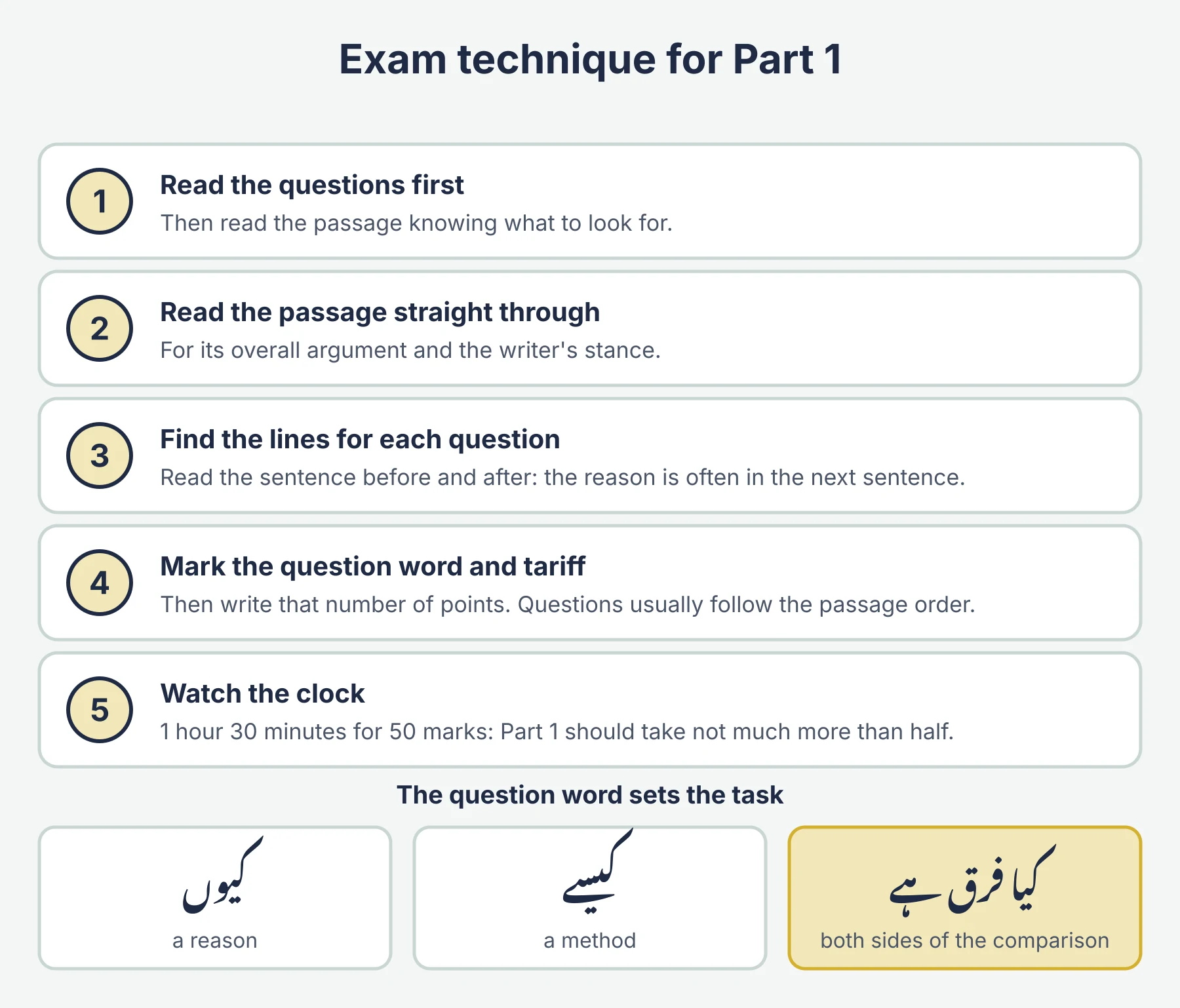
Question words decide the answer
- کیا – a located detail (R1).
- کیوں / کس وجہ سے – a reason. Start with کیونکہ or اس لیے کہ.
- کیسے / کس طرح – a method or process, often in steps (R2).
- کیا فرق ہے – both sides: جبکہ or اس کے برعکس joins them.
- مصنف کا رویّہ / مصنف کیا محسوس کرتا ہے – name the attitude, then cite the words (R4).
- اپنے الفاظ میں – the same content, your vocabulary and structure.
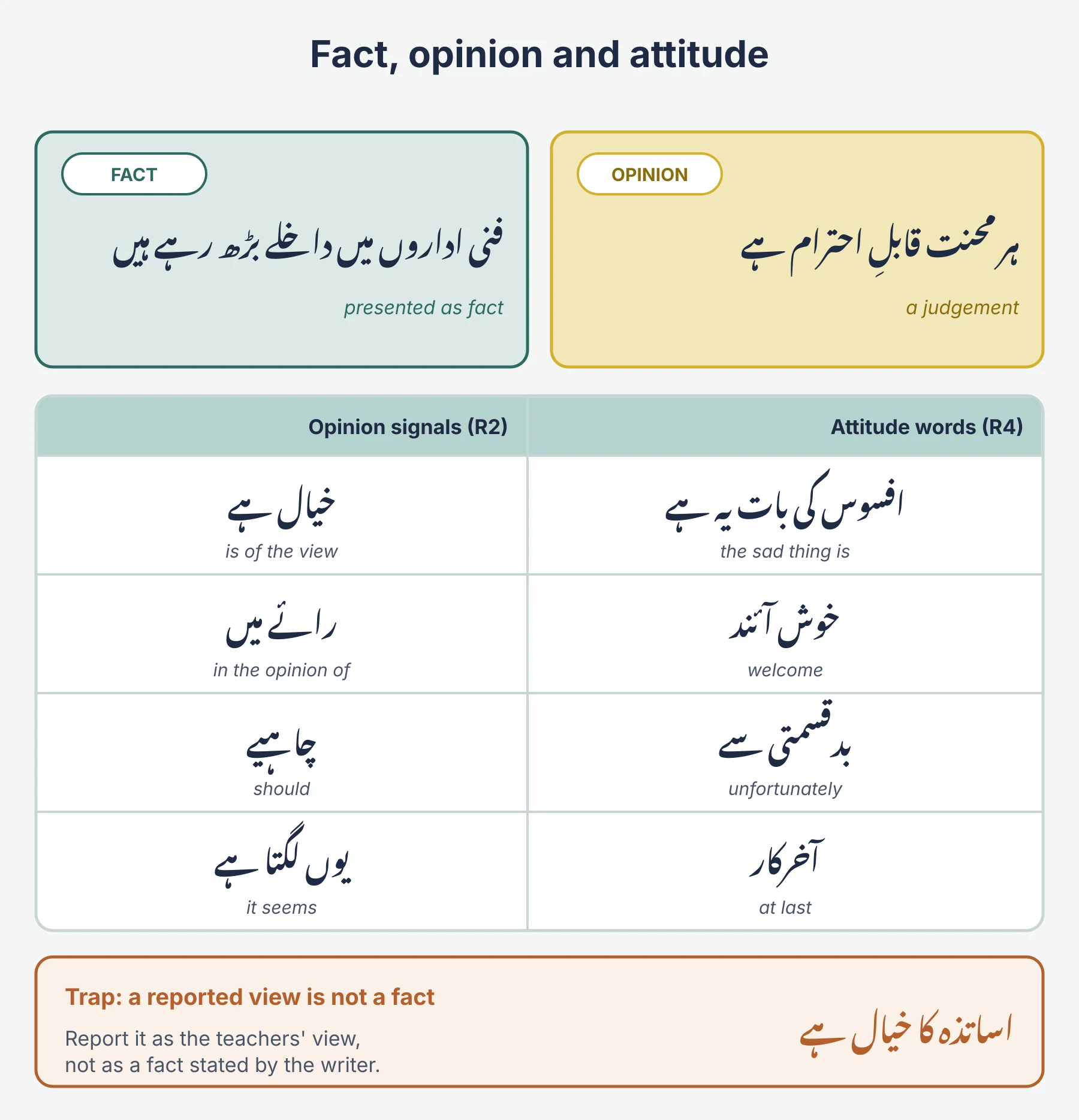
Signal words in the passage
- Opinion: خیال ہے، رائے میں، چاہیے، میرے نزدیک، یوں لگتا ہے.
- Contrast (the answer is often after it): تاہم، لیکن، اس کے باوجود، برعکس.
- Cause and result: کیونکہ، اس لیے، نتیجتاً، جس کی وجہ سے.
- Attitude: افسوس، خوش آئند، بدقسمتی سے، آخرکار، حیرت کی بات.
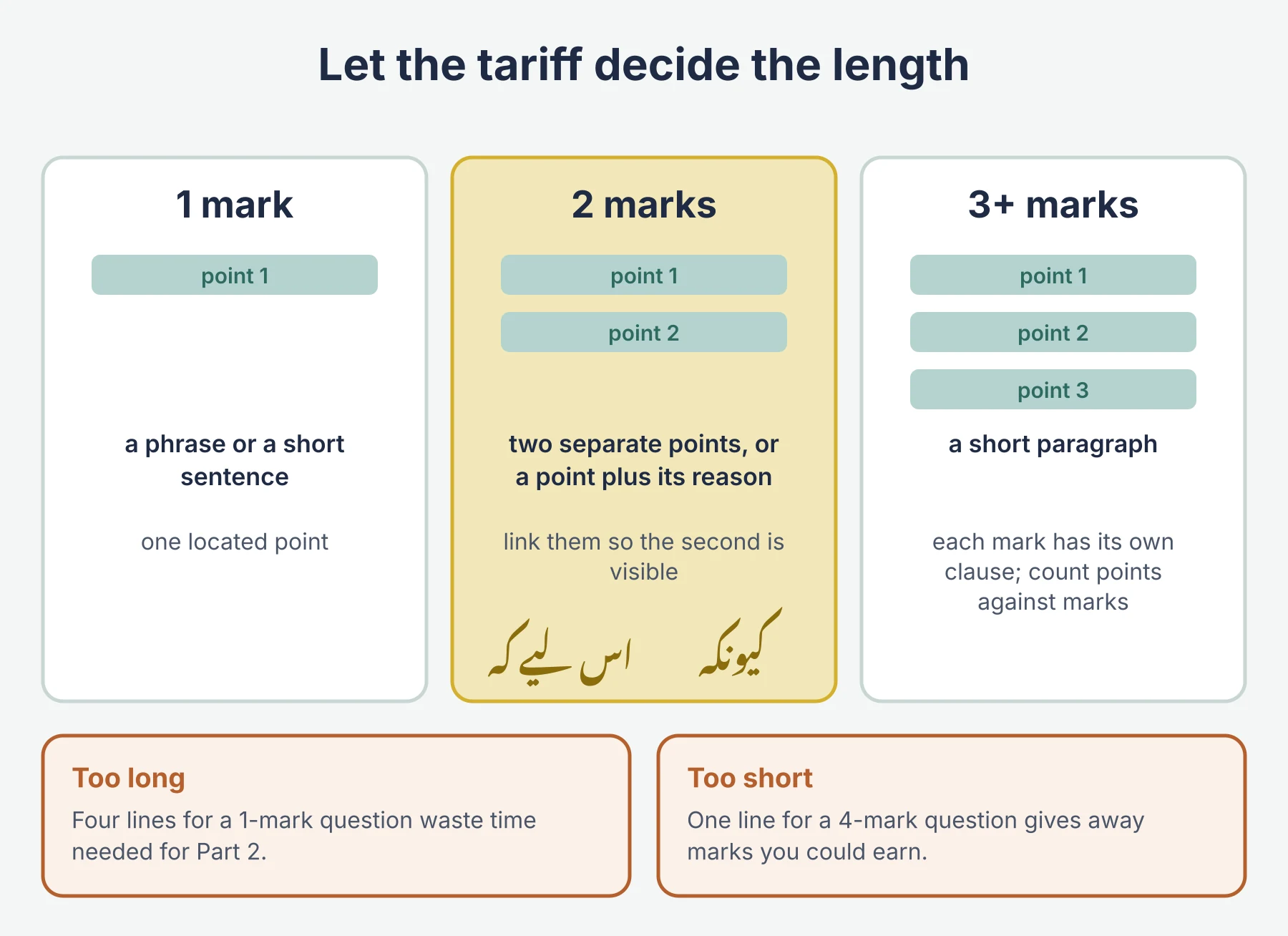
Answer length by tariff (practice rule)
The syllabus does not publish question tariffs; this is a working rule for practice.
| Marks | Write |
|---|---|
| 1 | a phrase or one short sentence |
| 2 | two points, or a point and its reason |
| 3+ | one clause per mark, checked against the tariff |
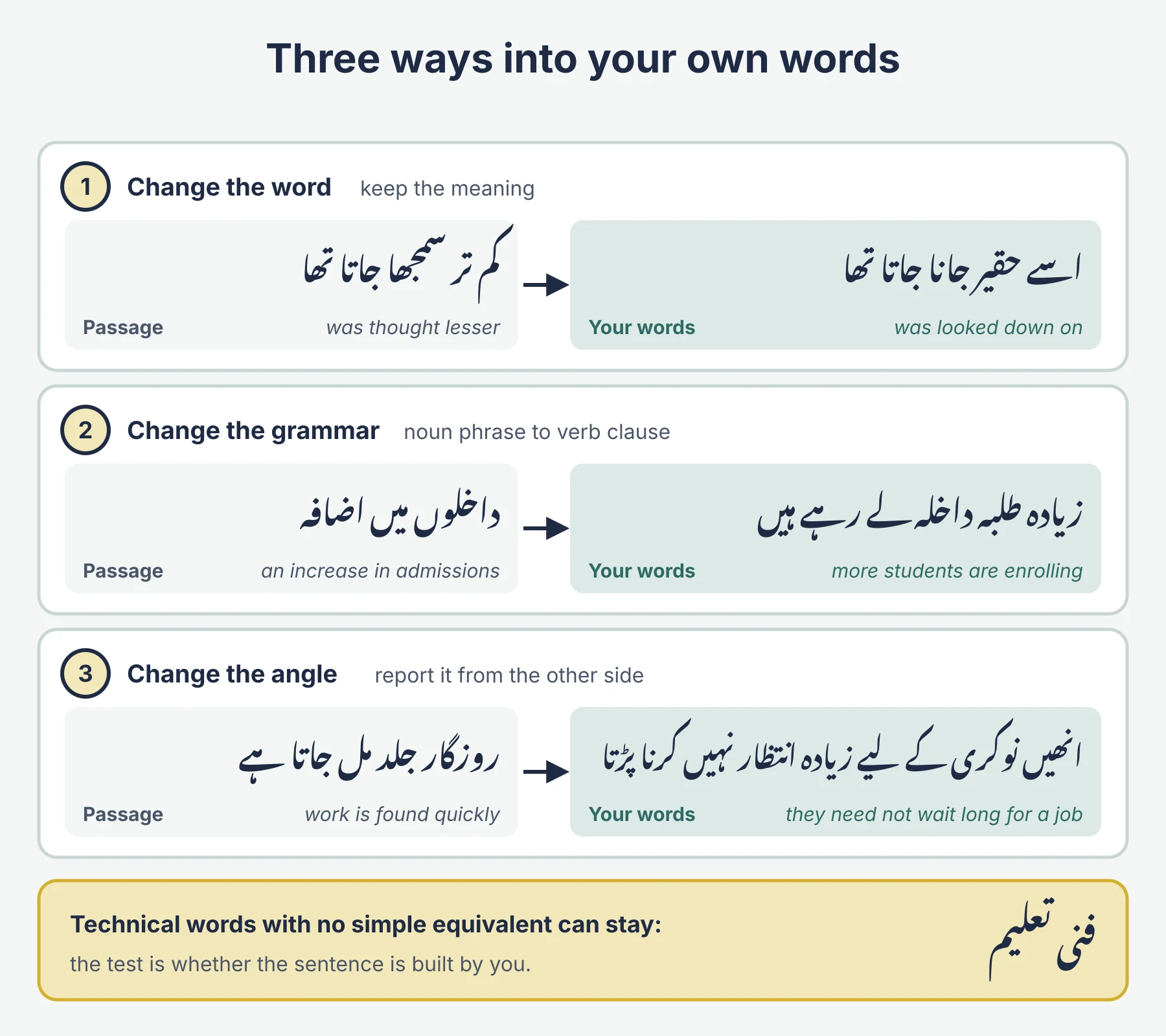
Own-words methods
- Synonym: کم تر → حقیر، کم عزت والا.
- Grammar shift: noun to verb, اضافہ → بڑھ رہے ہیں.
- Angle shift: جلد ملتا ہے → انتظار نہیں کرنا پڑتا.
Technical terms (فنی تعلیم، ماحولیاتی آلودگی) may stay as they are.
Exam traps
- Adding facts from your own knowledge that the passage does not contain.
- Reporting an opinion the writer quotes from someone else as the writer’s own view.
- Answering کیوں with what happened instead of the reason.
- Giving an attitude with no textual evidence, or evidence with no attitude named.
- Using the right detail for the wrong question because the two questions sit close together.
- Letting Part 1 overrun into the time needed for the 300–400-word composition.
- Script slips that change a word: ی/ے endings and missing dots.
Self-test
- How many marks is Part 1 worth, and how many questions may you leave out?
- What kind of text is set, and roughly how long is it?
- Which objective covers putting ideas in order and separating fact from opinion?
- A question asks for disadvantages; you give one advantage and one disadvantage. Which objective have you failed to meet with the first point?
- Name two opinion signals you might find in an Urdu passage.
- What two things does a full R4 answer contain?
- Reword in your own Urdu: اسے کم تر سمجھا جاتا تھا.
- What does a two-mark کیوں question usually need?
- Which word in a passage often comes just before the most important point in a paragraph?
- Why might a single word lifted from the passage fail to “convey” information?
- Which four topic areas can the passage come from?
- Are questions on imagery and characterisation part of Part 1?
Answers
- 25 marks; none, because all Part 1 questions are answered.
- A non-literary text of about 400 words, such as an article or report.
- R2: understand, order and present facts, ideas and opinions.
- R3: selecting what is relevant to a specific purpose.
- Any two of خیال ہے، رائے میں، چاہیے، میرے نزدیک، یوں لگتا ہے.
- The attitude named, and the words from the text that show it.
- For example اسے عزت کا کام نہیں سمجھا جاتا تھا or لوگ اسے حقیر جانتے تھے.
- The reason, usually as two linked points (cause and its result, or two causes).
- A contrast word such as تاہم or لیکن, which introduces the writer’s real point.
- Out of its sentence it may not make sense to a reader who has not seen the passage.
- Health and fitness; the world of youth; education and training; the world we live in.
- No. The text is non-literary; analysis of literary texts belongs to Paper 2 Texts.
More resources on this topic
Related resources
-
Study guides
Cambridge O-Level Urdu: First and Second Language (3247/3248)
First Language and Second Language Urdu – the two distinct, currently examined Cambridge O-Level Urdu syllabuses, each built around Paper 1 Reading and Writing plus a second, differently-focused paper.
Urdu Language · Cambridge · O Level
Read guide -
Practice questions
Cambridge O-Level Urdu (3247/3248): Paper 1 Practice Questions
Original exam-style practice for both Cambridge O-Level Urdu Paper 1 formats: 3247 First Language's Reading and Writing parts, and 3248 Second Language's five-exercise structure, with full worked answers.
Urdu Language · Cambridge · O Level
Try questions -
Revision notes
Cambridge O-Level Urdu (3247/3248): Paper 1 Revision Notes
Condensed recall notes on the exact Paper 1 exercise structure, mark allocations and technique differences between Cambridge O-Level Urdu 3247 (First Language) and 3248 (Second Language).
Urdu Language · Cambridge · O Level
Revise topic
Get free revision emails (optional)
Occasional emails with practice questions, worked explanations and links to free resources for the qualification and subjects you choose. No spam, and you can unsubscribe from any email. The free tools on this site never need an email.