
Study Guides
Cambridge O Level First Language Urdu (3247): Argumentative and Discursive Composition
Planning and writing an argumentative or discursive title in 3247 Paper 1 Part 2: the 300-400-word Urdu composition, its marking strands and model paragraphs.
- Subject
- Urdu Language
- Level
- O LEVELS
- Topic
- Paper 1 – Reading and Writing
- Author
- Marlbridge Academic Team
- Updated
- Reviewed by
- Farheen Zehra (what this means)
Aligned to Cambridge O Level Urdu Language (3247), 2027. Official specification .
Syllabus page (what it covers and how it is assessed): Cambridge O Level Urdu Language.
Found an error? Report a correction.
Need help with this topic? Request a free trial class for O Level Urdu Language (3247 / 3248).
This guide covers two of the four title types in Part 2 Writing of Cambridge O Level First Language Urdu 3247 Paper 1. The syllabus says candidates “write one composition of 300–400 words in response to a choice of argumentative, discursive, descriptive and narrative titles”, each “taken from a different topic or sub-topic”. Here we deal only with the argumentative and discursive titles: the ones that ask you to reason rather than to tell or describe. For the paper as a whole see the O Level Urdu Paper 1 study guide.
Two different tasks
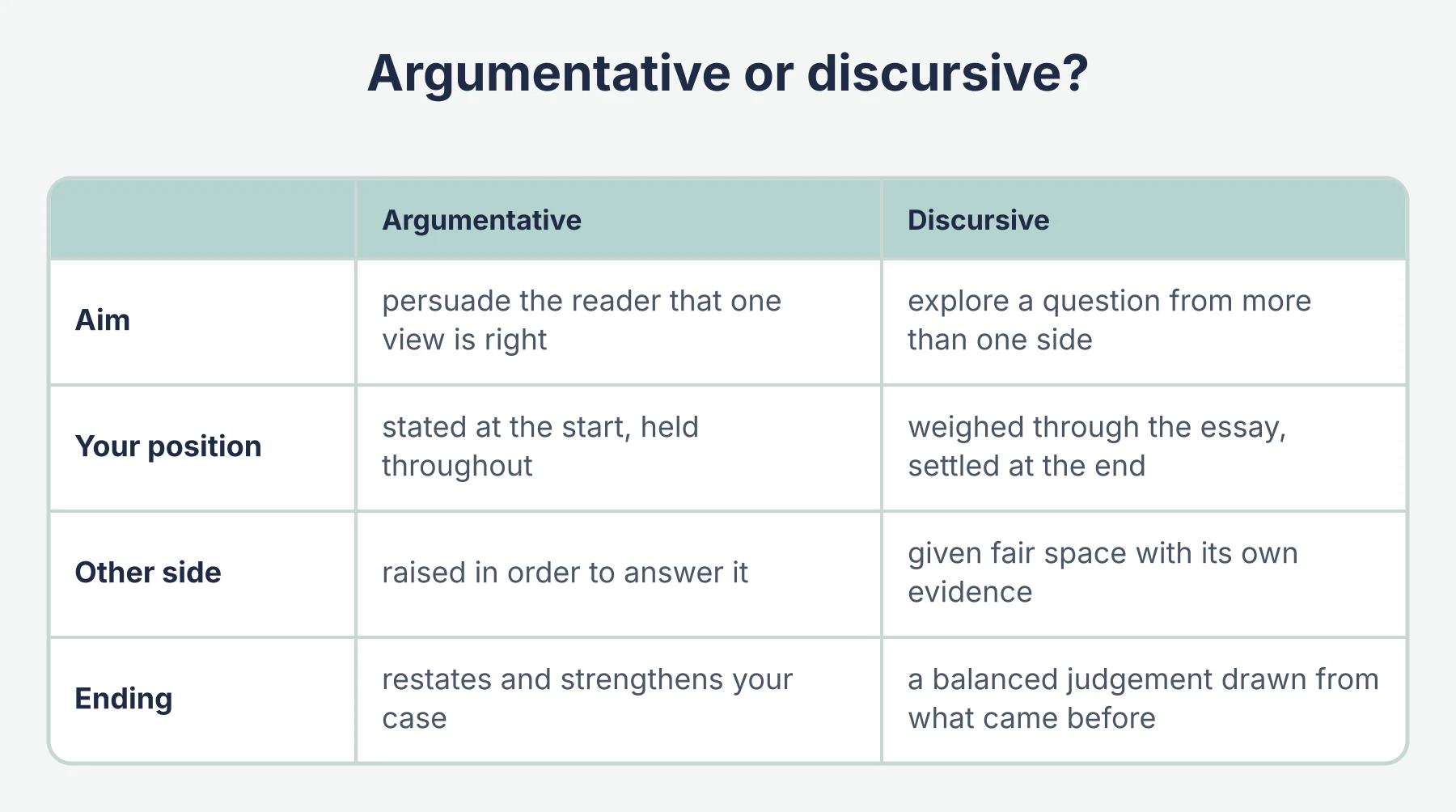
The two types look alike on the question paper, but they ask for different shapes of thinking.
| Argumentative | Discursive | |
|---|---|---|
| Aim | persuade the reader that one view is right | explore a question from more than one side |
| Your position | stated at the start, held throughout | weighed through the essay, settled at the end |
| Other side | raised in order to answer it | given fair space with its own evidence |
| Ending | restates and strengthens your case | a balanced judgement drawn from what came before |
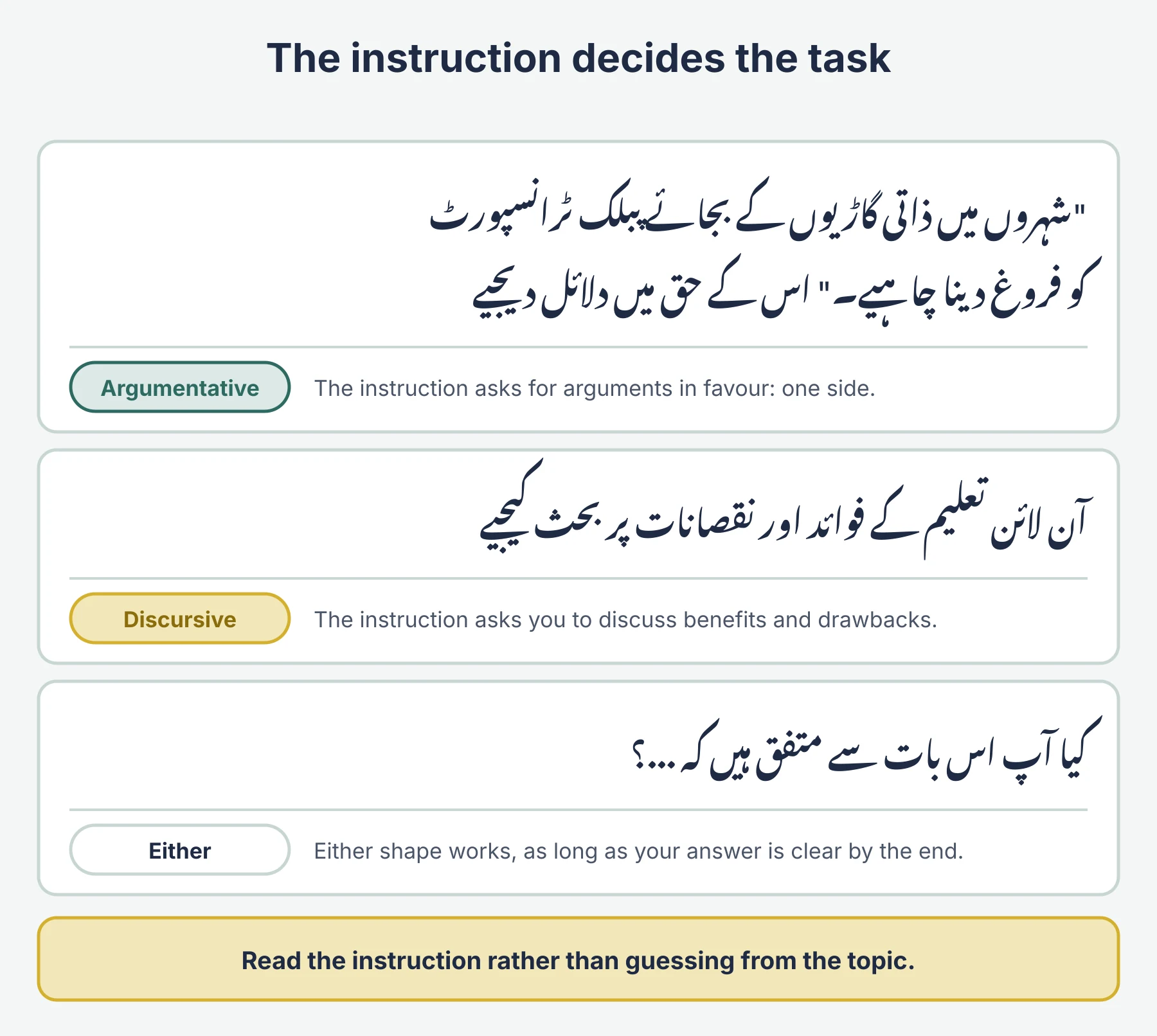
Titles can be worded in many ways, so read the instruction rather than guessing from the topic. A title such as “شہروں میں ذاتی گاڑیوں کے بجائے پبلک ٹرانسپورٹ کو فروغ دینا چاہیے۔” اس کے حق میں دلائل دیجیے is plainly argumentative. آن لائن تعلیم کے فوائد اور نقصانات پر بحث کیجیے is plainly discursive. کیا آپ اس بات سے متفق ہیں کہ …؟ allows either, as long as your answer to the question is clear by the end.
What the three strands reward
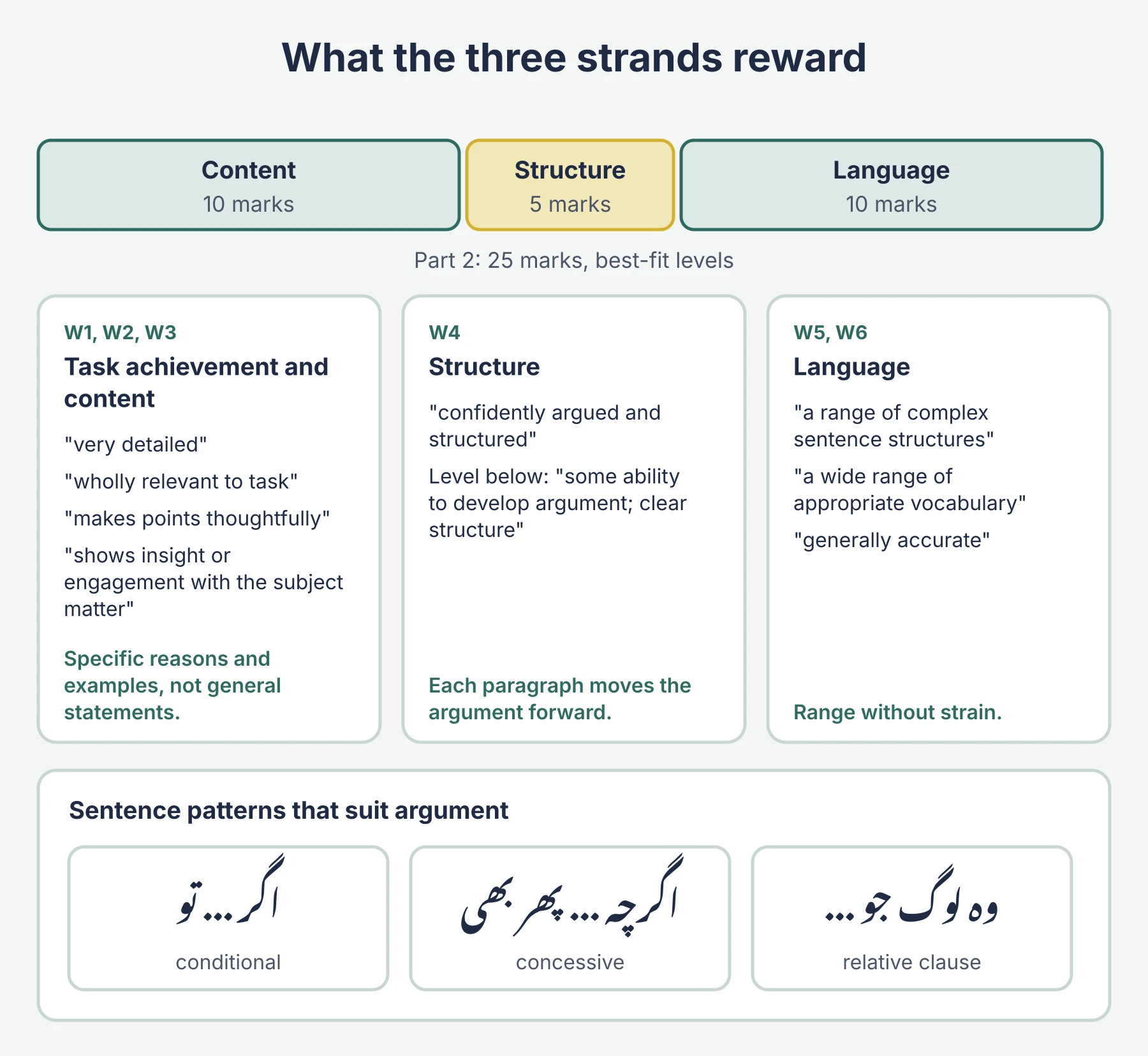
Part 2 carries 25 marks, marked on a best-fit levels scheme in three strands.
Task achievement and content (10 marks; W1, W2, W3). The top level describes a response that is “very detailed”, “wholly relevant to task”, “makes points thoughtfully”, “shows insight or engagement with the subject matter” and has a style “fully appropriate”. For an argument this means specific reasons and examples rather than general statements. “Pollution is bad” is a mechanical point. “A child who walks to school along a main road breathes the exhaust of every waiting car” engages the reader.
Structure (5 marks; W4). The top level is “confidently argued and structured”; the level below shows “some ability to develop argument; clear structure”. This strand suits argumentative and discursive writing better than any other, because it is about the order and linking of ideas. Each paragraph should move the argument forward, not repeat it.
Language (10 marks; W5, W6). The top level asks for “confident use of a range of complex sentence structures”, “a wide range of appropriate vocabulary” and writing that is “generally accurate”. Conditional sentences (اگر … تو), concessive ones (اگرچہ … پھر بھی) and relative clauses (وہ لوگ جو …) are natural tools for argument and show range without strain.
Planning in five minutes
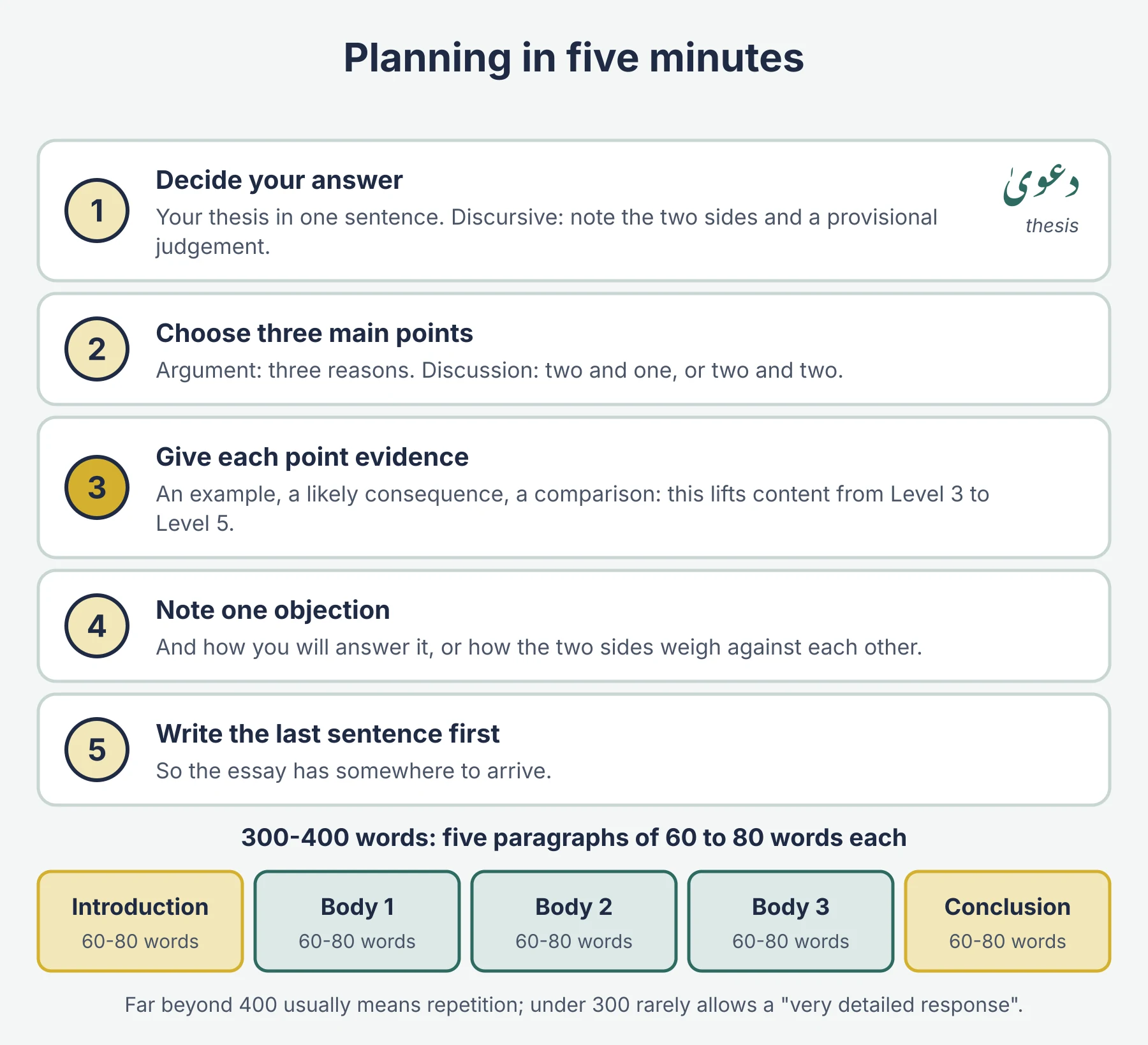
- Decide your answer to the title in one sentence: your thesis (دعویٰ). For a discursive title, note the two sides and a provisional judgement.
- Choose three main points. For an argument, three reasons; for a discussion, two on one side and one or two on the other, or two and two.
- Give each point evidence: an example, a likely consequence, a comparison. The evidence is what lifts content from Level 3 to Level 5.
- Note one objection and how you will answer it (argumentative), or how the two sides weigh against each other (discursive).
- Write the last sentence first in your plan, so the essay has somewhere to arrive.
With 300–400 words, five paragraphs of 60 to 80 words each is a workable shape: introduction, three body paragraphs, conclusion. Going far beyond 400 words usually means repetition, which the content strand does not reward.
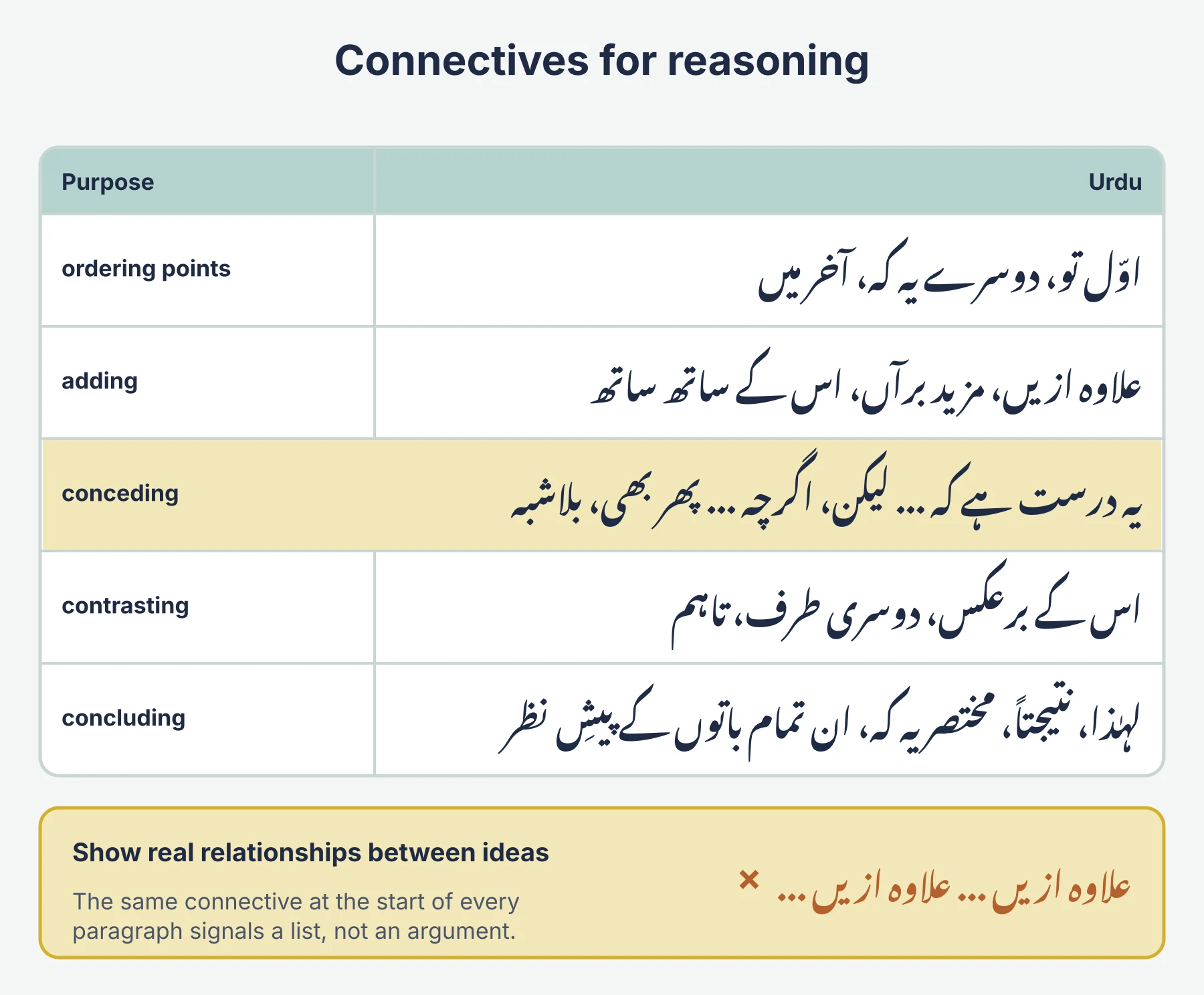
Connectives for reasoning
| Purpose | Urdu |
|---|---|
| ordering points | اوّل تو، دوسرے یہ کہ، آخر میں |
| adding | علاوہ ازیں، مزید برآں، اس کے ساتھ ساتھ |
| conceding | یہ درست ہے کہ … لیکن، اگرچہ … پھر بھی، بلاشبہ |
| contrasting | اس کے برعکس، دوسری طرف، تاہم |
| concluding | لہٰذا، نتیجتاً، مختصر یہ کہ، ان تمام باتوں کے پیشِ نظر |
Use them to show real relationships between ideas. A string of علاوہ ازیں at the start of every paragraph signals a list, not an argument.
Worked example: an argumentative title
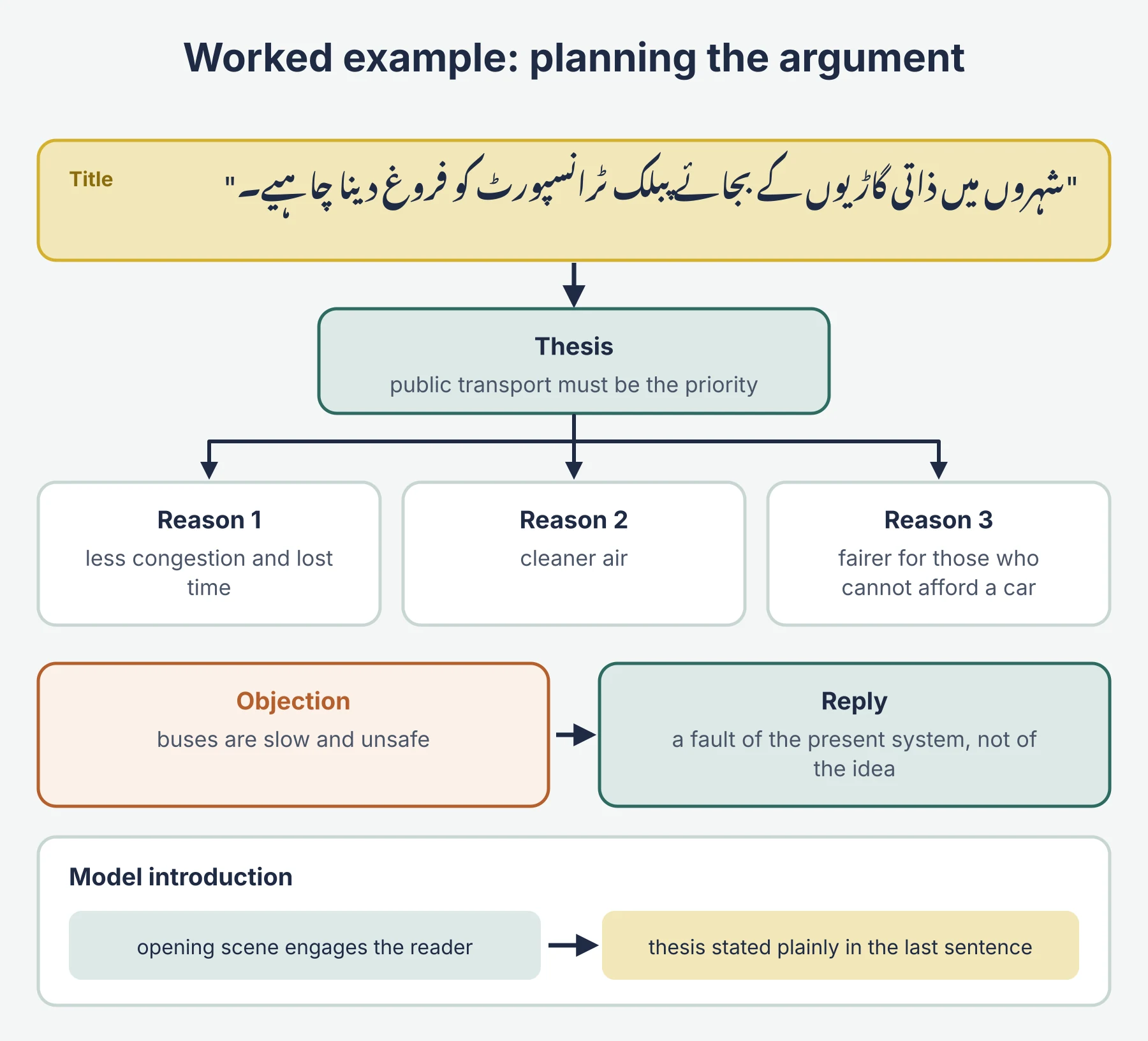
Title (original): “شہروں میں ذاتی گاڑیوں کے بجائے پبلک ٹرانسپورٹ کو فروغ دینا چاہیے۔” اس کے حق میں دلائل دیجیے۔
Plan: thesis, public transport must be the priority. Reasons: less congestion and lost time; cleaner air; fairer for those who cannot afford a car. Objection: buses are slow and unsafe. Reply: that is a fault of the present system, not of the idea.
Model introduction:
صبح آٹھ بجے کسی بڑے شہر کی سڑک پر کھڑے ہو جائیے: گاڑیوں کی لمبی قطاریں، ہارن کا شور اور دھوئیں سے بوجھل فضا۔ ان میں سے اکثر گاڑیوں میں صرف ایک مسافر بیٹھا ہوتا ہے۔ میرا پختہ یقین ہے کہ اگر ہم اپنے شہروں کو رہنے کے قابل رکھنا چاہتے ہیں تو ذاتی گاڑیوں پر انحصار کم کر کے ایک اچھے، سستے اور محفوظ پبلک ٹرانسپورٹ کے نظام کو فروغ دینا ہو گا۔
Commentary: the opening scene engages the reader before the thesis arrives in the last sentence. The thesis is stated plainly, so the examiner knows which way the essay will argue.
Model paragraph answering the objection:
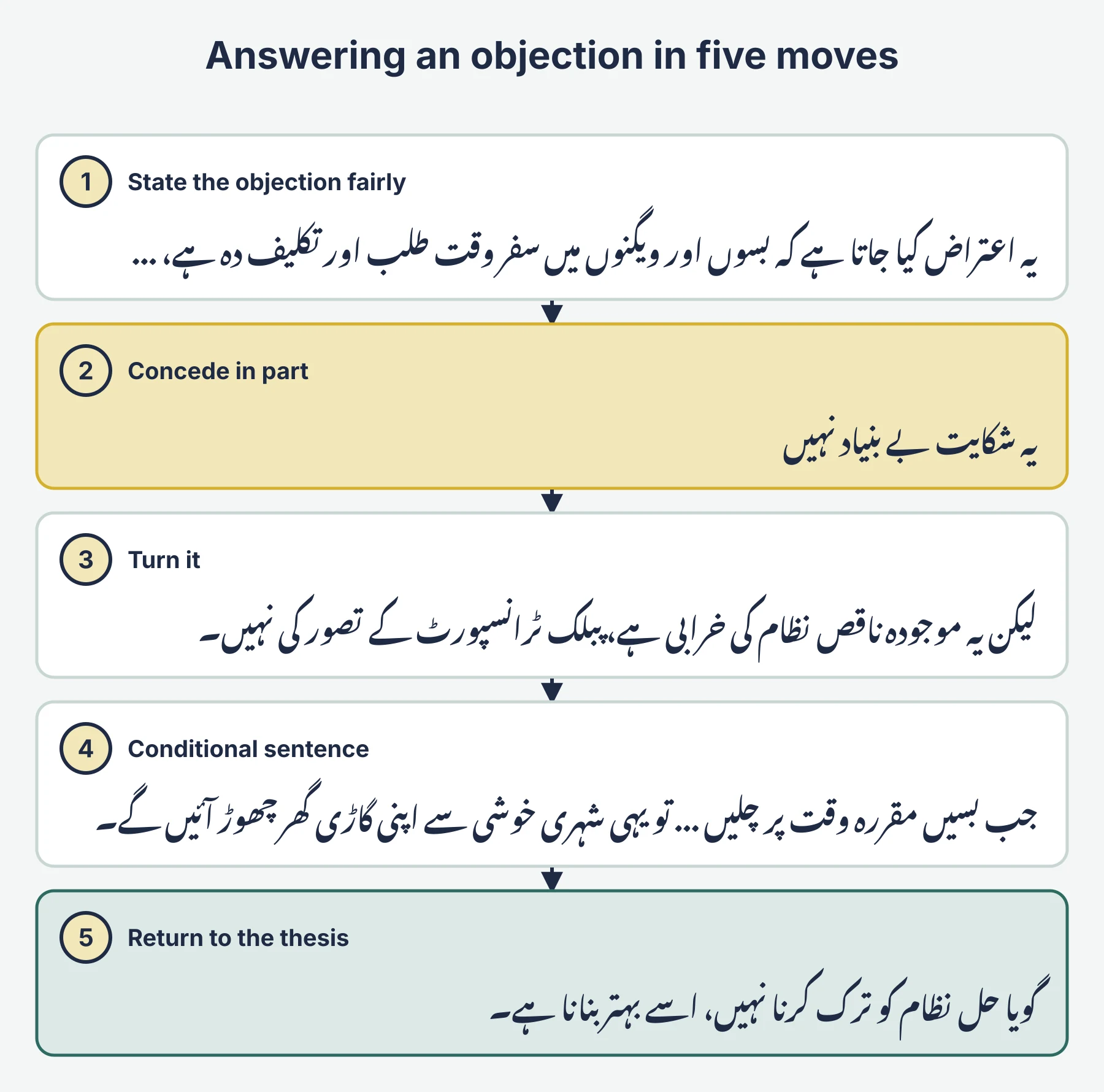
یہ اعتراض کیا جاتا ہے کہ بسوں اور ویگنوں میں سفر وقت طلب اور تکلیف دہ ہے، اور خواتین اور بزرگوں کے لیے غیر محفوظ بھی۔ یہ شکایت بے بنیاد نہیں، لیکن یہ موجودہ ناقص نظام کی خرابی ہے، پبلک ٹرانسپورٹ کے تصور کی نہیں۔ جب بسیں مقررہ وقت پر چلیں، ان میں خواتین کے لیے الگ نشستیں ہوں اور اسٹاپ روشن اور محفوظ ہوں، تو یہی شہری خوشی سے اپنی گاڑی گھر چھوڑ آئیں گے۔ گویا حل نظام کو ترک کرنا نہیں، اسے بہتر بنانا ہے۔
Commentary: the objection is stated fairly, conceded in part (یہ شکایت بے بنیاد نہیں), then turned. The conditional sentence and the closing گویا sentence show the “complex sentence structures” the language strand rewards, and the paragraph ends by returning to the thesis.
Turning the same material into a discussion
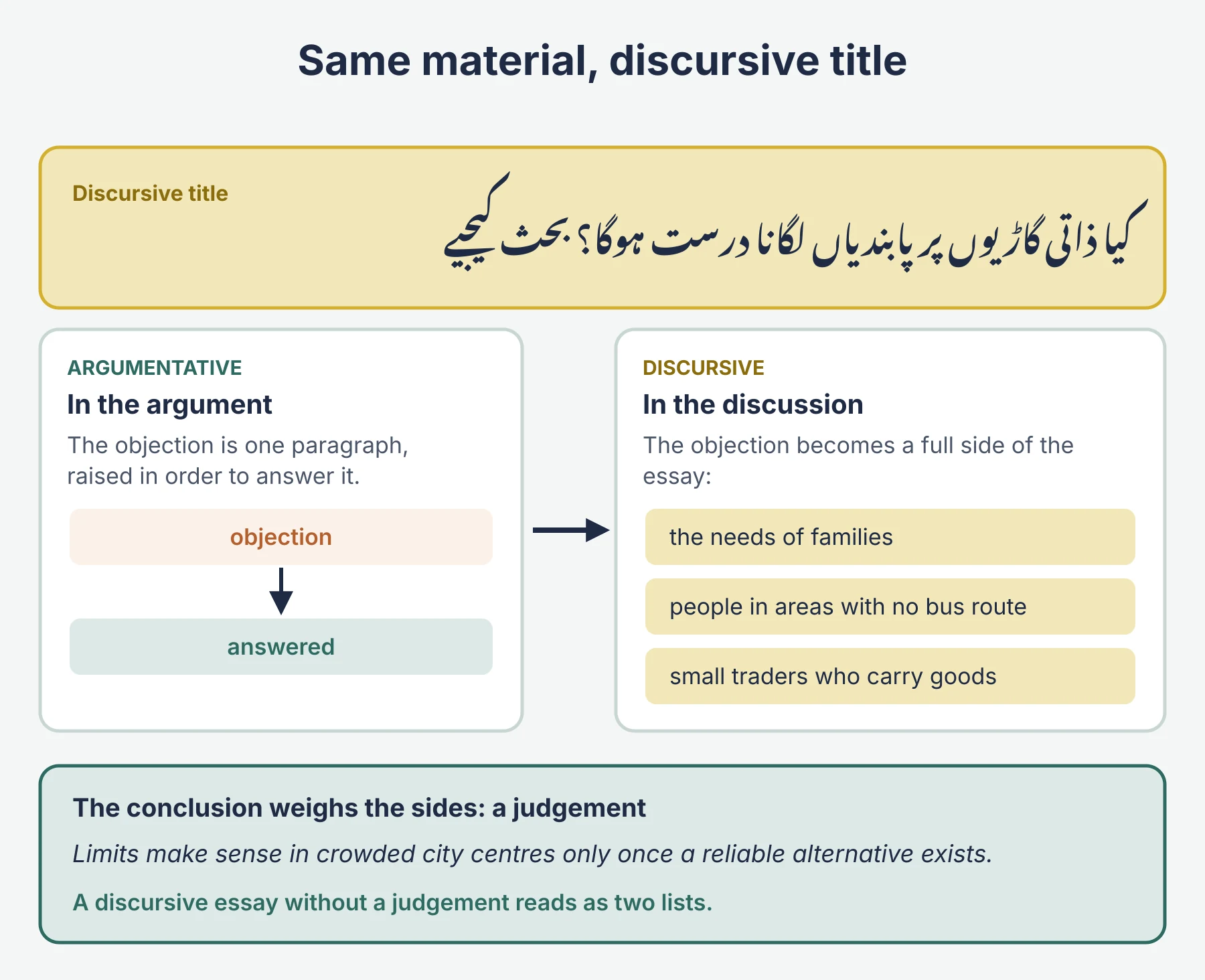
Had the title been کیا ذاتی گاڑیوں پر پابندیاں لگانا درست ہوگا؟ بحث کیجیے, the same objection would become a full side of the essay: the needs of families, of people in areas with no bus route, and of small traders who carry goods. The conclusion would then weigh the sides, for example by arguing that limits make sense in crowded city centres only once a reliable alternative exists. That “only once” is a judgement, and a discursive essay without a judgement reads as two lists.
Common mistakes
- Writing a discussion when an argument was asked for, or the reverse, so the response is only “usually relevant to task”.
- Assertion without evidence. Three reasons with no example each stay at a mechanical level.
- Repeating the thesis in every paragraph instead of developing it.
- Ignoring the topic of the title. Each title comes from a specific topic or sub-topic; an essay on transport in general when the title is about school travel drifts from the task.
- Register slips: colloquial phrases or English words in Roman script in a formal essay.
- Simple, repeated sentence patterns (… ہے۔ … ہے۔ … ہے۔), which hold language at Level 3 even when every sentence is accurate.
- Ignoring the word range. Under 300 words rarely allows a “very detailed response”.
Exam technique
- Read all four titles, then choose the one on which you have the most specific examples, not the one that sounds easiest.
- Spend about five minutes planning; a planned essay is easier to make “confidently argued”.
- Keep a consistent voice: میرے خیال میں or impersonal یہ کہا جا سکتا ہے, but not a mixture of persons and respect levels.
- Leave time to check gender and number agreement, the ergative نے and spelling, since the language strand carries as many marks as content.
More resources on this topic
Related resources
-
Practice questions
Cambridge O Level First Language Urdu (3247): Argumentative and Discursive Composition – Practice Questions
Original skill tasks and a full composition for 3247 Paper 1 Part 2 argumentative and discursive titles, with model Urdu answers and levels guidance.
Urdu Language · Cambridge · O Level
Try questions -
Revision notes
Cambridge O Level First Language Urdu (3247): Argumentative and Discursive Composition – Revision Notes
Condensed notes for argumentative and discursive titles in 3247 Paper 1 Part 2: the two task shapes, marking strands, Urdu connectives, traps and a self-test.
Urdu Language · Cambridge · O Level
Revise topic -
Study guides
Cambridge O Level First Language Urdu (3247): Part 1 Reading Comprehension
How to answer the 3247 Paper 1 Part 1 comprehension questions on a 400-word non-literary Urdu text, objective by objective, with an annotated example.
Urdu Language · Cambridge · O Level
Read guide
Get free revision emails (optional)
Occasional emails with practice questions, worked explanations and links to free resources for the qualification and subjects you choose. No spam, and you can unsubscribe from any email. The free tools on this site never need an email.