
Revision Notes
Cambridge O Level First Language Urdu (3247): Argumentative and Discursive Composition – Revision Notes
Condensed notes for argumentative and discursive titles in 3247 Paper 1 Part 2: the two task shapes, marking strands, Urdu connectives, traps and a self-test.
- Subject
- Urdu Language
- Level
- O LEVELS
- Topic
- Paper 1 – Reading and Writing
- Author
- Marlbridge Academic Team
- Updated
- Reviewed by
- Farheen Zehra (what this means)
Aligned to Cambridge O Level Urdu Language (3247), 2027. Official specification .
Syllabus page (what it covers and how it is assessed): Cambridge O Level Urdu Language.
Found an error? Report a correction.
Need help with this topic? Request a free trial class for O Level Urdu Language (3247 / 3248).
These notes cover the argumentative and discursive titles in Part 2 Writing of 3247 Paper 1, where candidates “write one composition of 300–400 words in response to a choice of argumentative, discursive, descriptive and narrative titles”. For the paper as a whole see the O Level Urdu Paper 1 study guide; for model paragraphs and full explanation see the argumentative and discursive composition study guide.
The facts to know
- One composition, 300–400 words, from a choice of titles of four types.
- Each title is taken from a different topic or sub-topic of the four topic areas.
- 25 marks: task achievement and content 10, structure 5, language 10.
- Marked best fit: the examiner places the response in a level for each strand, then adjusts within it.
Argument or discussion?
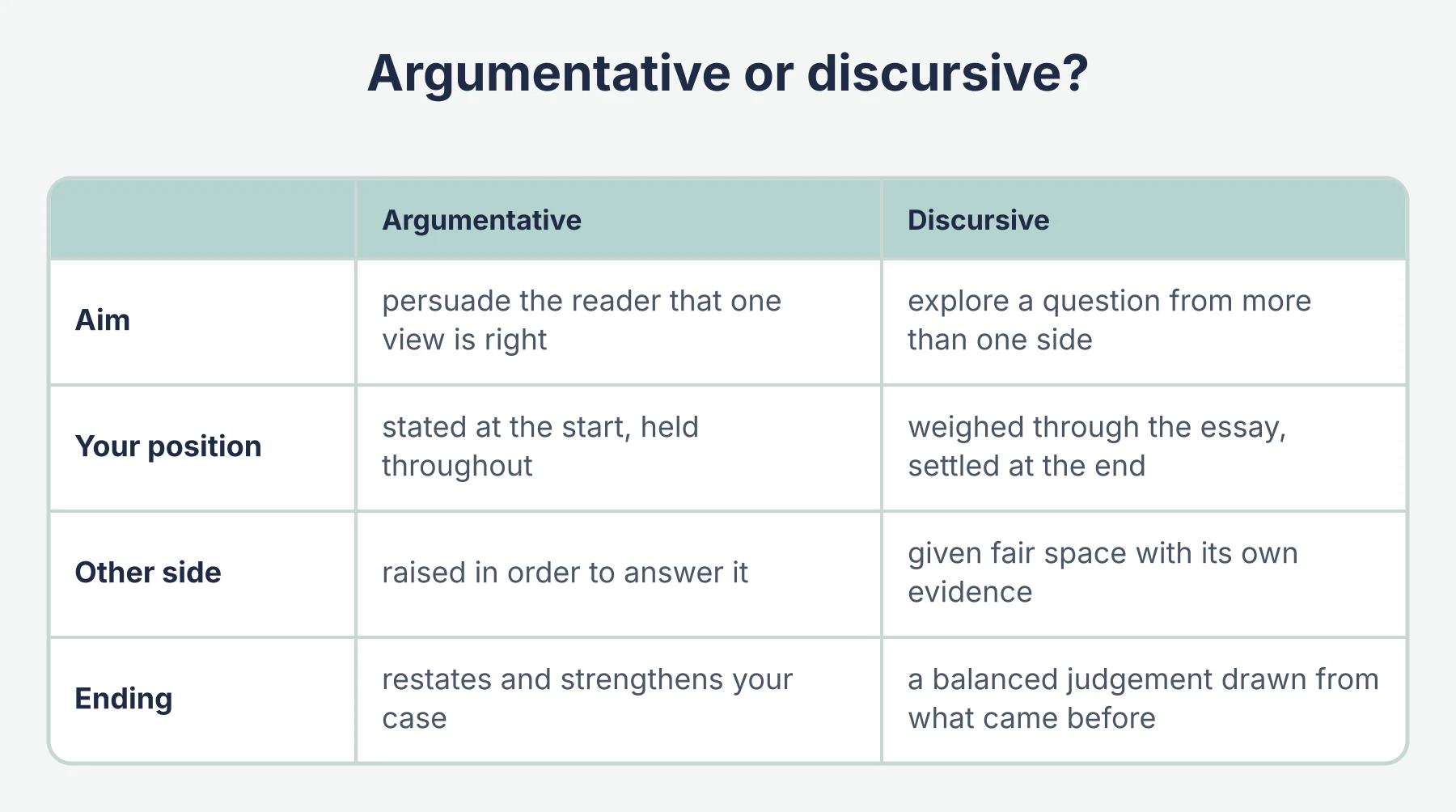
| Argumentative (استدلالی) | Discursive (بحث طلب / مباحثی) | |
|---|---|---|
| Starts with | your position | the question and why it matters |
| Middle | reasons for your side, one objection answered | evidence on both sides, weighed |
| Ends with | a stronger restatement | a balanced judgement |
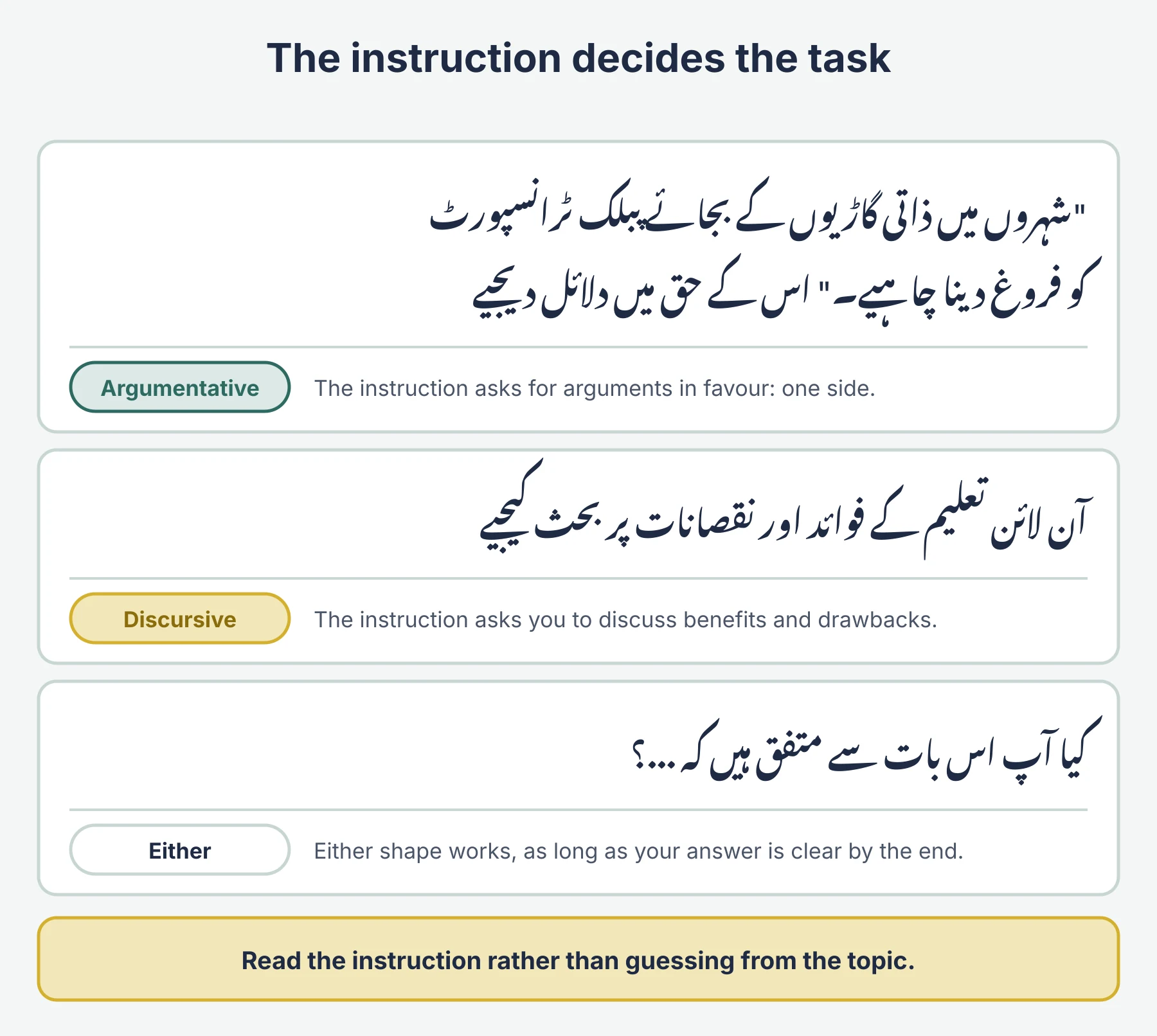
| Typical instruction | حق میں / خلاف دلائل دیجیے | بحث کیجیے، فوائد و نقصانات |
کیا آپ متفق ہیں …؟ allows either shape; the answer to the question must be clear by the end.
The marking strands in plain words
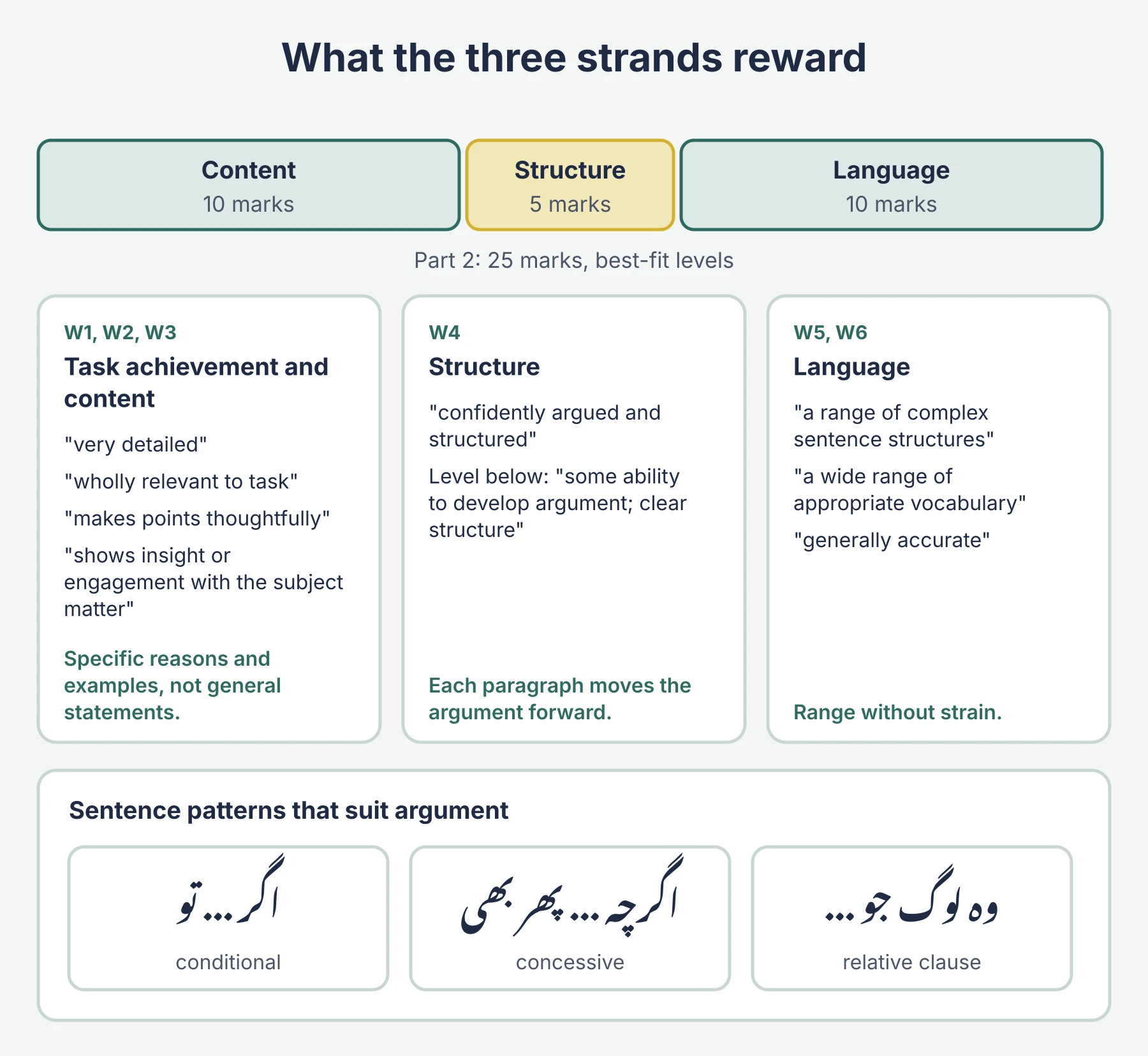
| Strand | Top-level wording | What that means for an argument |
|---|---|---|
| Content (10) | very detailed, wholly relevant, thoughtful points, insight or engagement, style fully appropriate | each reason has a specific example or consequence |
| Structure (5) | confidently argued and structured | every paragraph moves the case forward and links to the last |
| Language (10) | range of complex structures, wide appropriate vocabulary, generally accurate | conditionals, concessions, relative clauses; precise words |
Level 3 descriptors to avoid: content that is “a mechanical response to the subject matter”; structure with “some linked ideas” but an attempt “not entirely successful”; language that “tends to be simple and repetitive”.
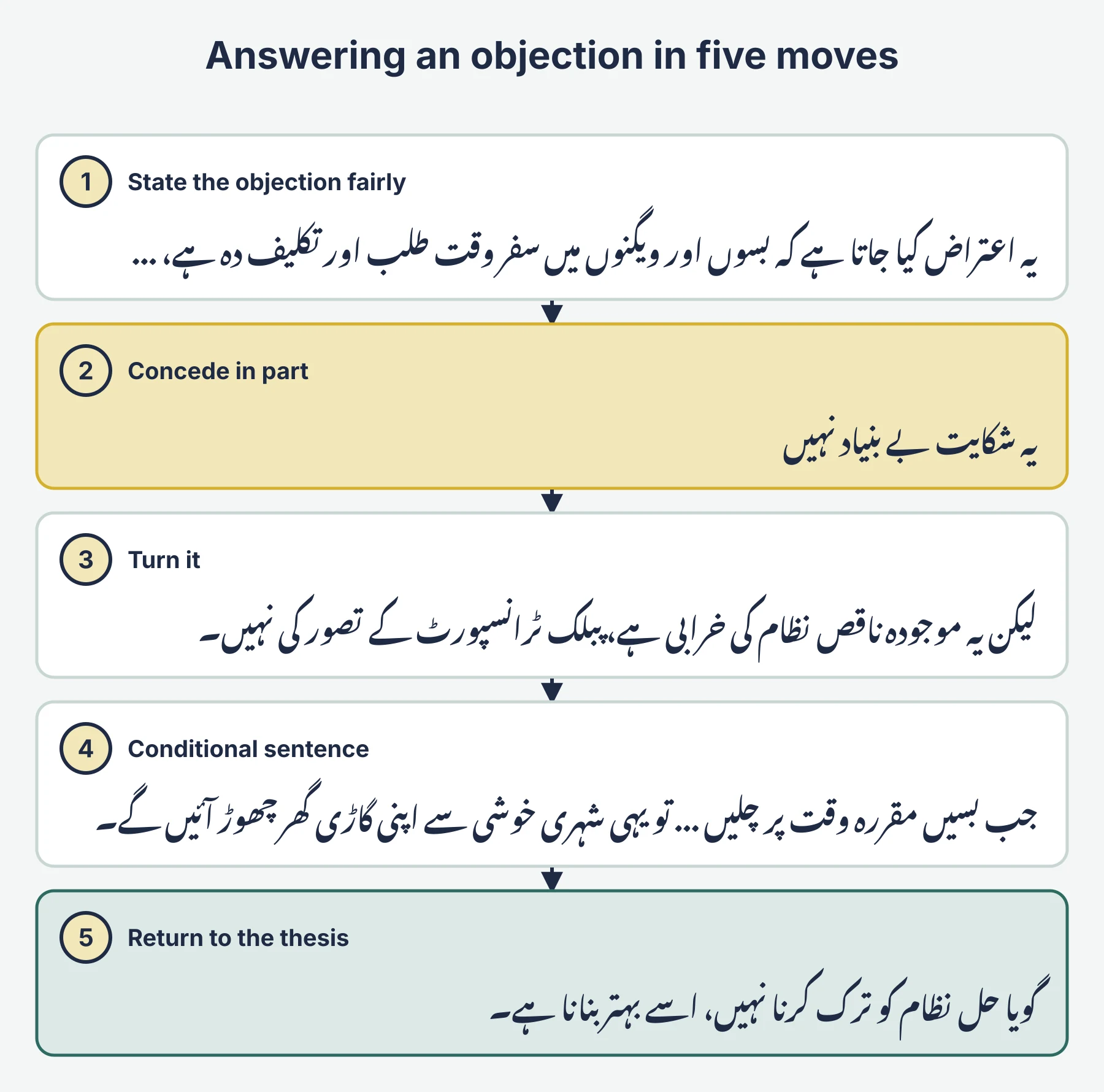
Five-paragraph frame (practice shape)
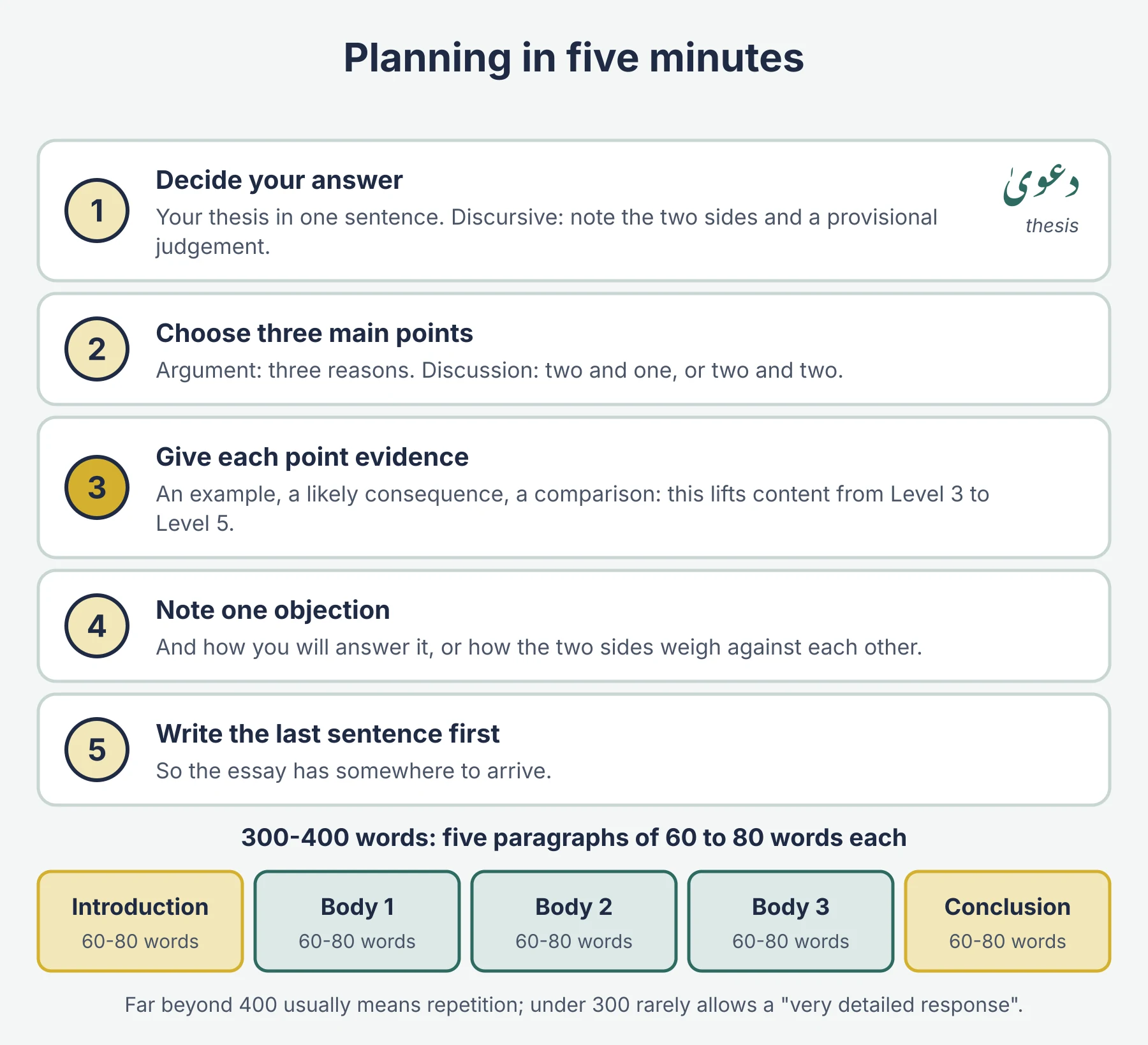
- Introduction – a hook (scene, question, striking comparison) and the thesis.
- Point 1 – strongest reason or first side, with evidence.
- Point 2 – second reason or first side developed.
- Point 3 / objection – the other side, conceded and answered or weighed.
- Conclusion – restate or judge; do not add a new argument.
About 60–80 words per paragraph keeps the whole within 300–400 words.
Key terms
| Urdu | English |
|---|---|
| دعویٰ | claim, thesis |
| دلیل / دلائل | argument, reasons |
| ثبوت / مثال | evidence, example |
| اعتراض | objection |
| جواب / رد | reply, rebuttal |
| موازنہ | weighing, comparison |
| نتیجہ | conclusion |
| اسلوب | style |
| ربط | linkage between ideas |
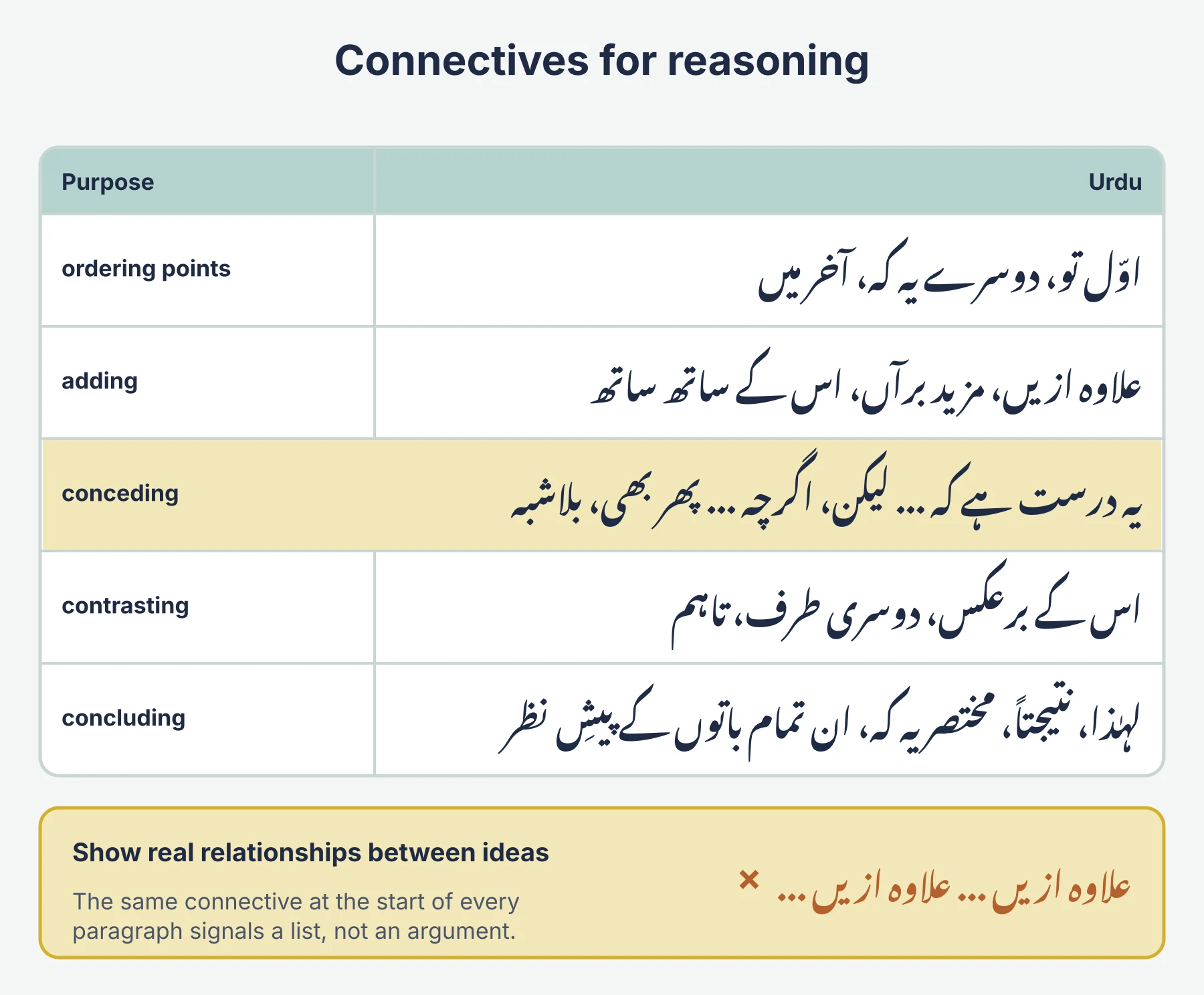
Connectives by job
- Order: اوّل تو، دوسرے یہ کہ، آخر میں
- Add: علاوہ ازیں، مزید برآں
- Concede: یہ درست ہے کہ … لیکن؛ اگرچہ … پھر بھی؛ بلاشبہ
- Contrast: اس کے برعکس، دوسری طرف، تاہم
- Cause/result: چنانچہ، اسی لیے، نتیجتاً
- Conclude: لہٰذا، مختصر یہ کہ، ان تمام باتوں کے پیشِ نظر
Sentence patterns that show range
- Conditional: اگر بسیں وقت پر چلیں تو لوگ گاڑیاں چھوڑ دیں گے۔
- Concessive: اگرچہ یہ منصوبہ مہنگا ہے، پھر بھی طویل مدت میں فائدہ مند ہے۔
- Relative: وہ طلبہ جو روز گھنٹوں سفر کرتے ہیں، پڑھائی پر کم توجہ دے پاتے ہیں۔
- Rhetorical question, used once: کیا ہم اپنے بچوں کو یہی فضا دینا چاہتے ہیں؟
Exam traps
- Answering an argumentative title with an even-handed discussion that never takes a side.
- A discursive essay that lists both sides and stops, with no judgement.
- Reasons stated but not supported; examples so general they could fit any essay.
- Drifting from the title’s topic or sub-topic into a broader subject.
- Mixed register: slang, English words, or switching between ہم and میں without reason.
- Paragraphs that repeat the thesis instead of developing it.
- Writing well under 300 words, or far over 400 and running out of time to check accuracy.
Self-test
- How many words should the composition be, and how many titles do you answer?
- Name the three marking strands and their marks.
- What is the key difference between how an argumentative and a discursive essay end?
- Which strand most directly rewards linking ideas into a developed argument?
- Give an Urdu connective for conceding a point.
- Why is “pollution is harmful” alone unlikely to reach the top content level?
- Write a concessive sentence on the topic of school homework.
- A candidate writes علاوہ ازیں at the start of all four paragraphs after the introduction. What is the weakness?
- What does “best fit” mean in the marking of Part 2?
- Why should the conclusion not introduce a new reason?
- Which instruction word usually signals a discursive title?
Answers
- 300–400 words; one title.
- Task achievement and content (10), structure (5), language (10).
- An argumentative essay ends by reinforcing its position; a discursive essay ends with a judgement reached by weighing both sides.
- Structure: its top level is “confidently argued and structured”.
- For example یہ درست ہے کہ … لیکن، اگرچہ … پھر بھی، بلاشبہ.
- It is a general assertion with no specific evidence, closer to a “mechanical response” than one showing insight or engagement.
- For example: اگرچہ ہوم ورک سے بچوں کا وقت صرف ہوتا ہے، پھر بھی اس سے کلاس کا سبق پختہ ہو جاتا ہے۔
- It reads as a list of points rather than a developed, linked argument.
- The examiner places the answer in the level it fits best for each strand, then moves up or down within that level.
- A new point left undeveloped weakens structure; the conclusion should draw together what was argued.
- بحث کیجیے, or a title naming فوائد و نقصانات.
More resources on this topic
Related resources
-
Study guides
Cambridge O Level First Language Urdu (3247): Part 1 Reading Comprehension
How to answer the 3247 Paper 1 Part 1 comprehension questions on a 400-word non-literary Urdu text, objective by objective, with an annotated example.
Urdu Language · Cambridge · O Level
Read guide -
Practice questions
Cambridge O Level First Language Urdu (3247): Part 1 Reading Comprehension – Practice Questions
Twelve original comprehension questions on a new non-literary Urdu passage in the 3247 Paper 1 Part 1 style, covering R1 to R4, with full marked answers.
Urdu Language · Cambridge · O Level
Try questions -
Revision notes
Cambridge O Level First Language Urdu (3247): Part 1 Reading Comprehension – Revision Notes
Condensed notes on 3247 Paper 1 Part 1 Reading: the four reading objectives, question words, answer length, own-words methods, traps and a self-test.
Urdu Language · Cambridge · O Level
Revise topic
Get free revision emails (optional)
Occasional emails with practice questions, worked explanations and links to free resources for the qualification and subjects you choose. No spam, and you can unsubscribe from any email. The free tools on this site never need an email.