
Revision Notes
Cambridge O Level First Language Urdu (3247): Paper 2 Unseen Passage – Revision Notes
Condensed notes on the 3247 Paper 2 Unseen Passage: the six levels, a reading method, Urdu literary terms and effects, traps and a self-test.
- Subject
- Urdu Language
- Level
- O LEVELS
- Topic
- Paper 2 – Texts
- Author
- Marlbridge Academic Team
- Updated
- Reviewed by
- Farheen Zehra (what this means)
Aligned to Cambridge O Level Urdu Language (3247), 2027. Official specification .
Syllabus page (what it covers and how it is assessed): Cambridge O Level Urdu Language.
Found an error? Report a correction.
Need help with this topic? Request a free trial class for O Level Urdu Language (3247 / 3248).
These notes cover Part 1 Unseen Passage of 3247 Paper 2 Texts: “one passage-based question” on “an extract (from poetry or prose) which they have not seen before”, testing “critical understanding of the text and response to the ways in which the writer achieves effects”. The paper overview is in the Paper 2 Texts study guide; worked model paragraphs are in the Unseen Passage study guide.
Core facts
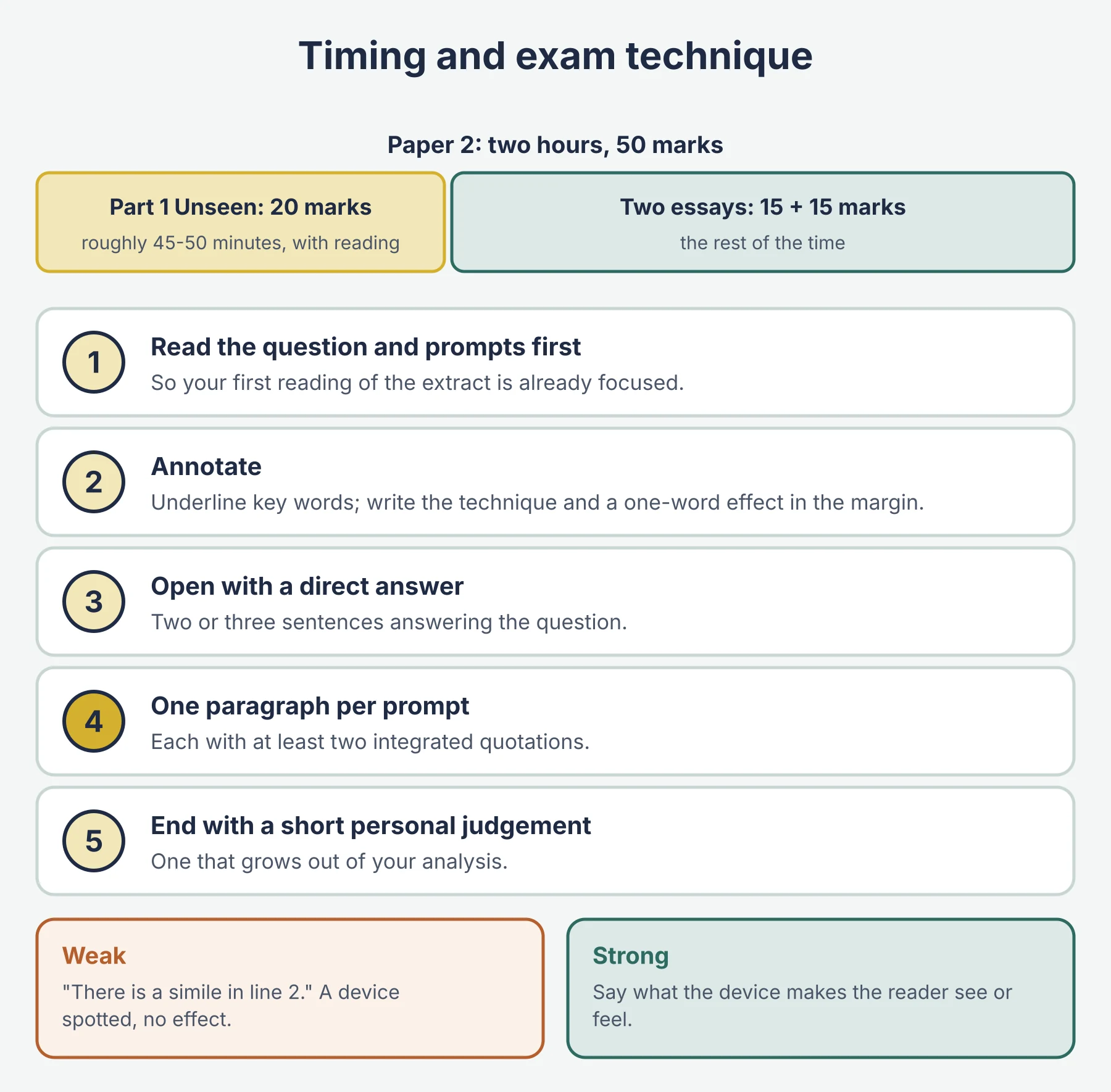
- 20 marks, the largest single part of Paper 2 (2 hours, 50 marks).
- One question, no choice, no set text.
- The extract may be poetry or prose.
- The question includes prompts suggesting aspects to consider.
- Marked on a six-level scheme, best fit, against AO3 Literature.
The levels ladder (key phrases)
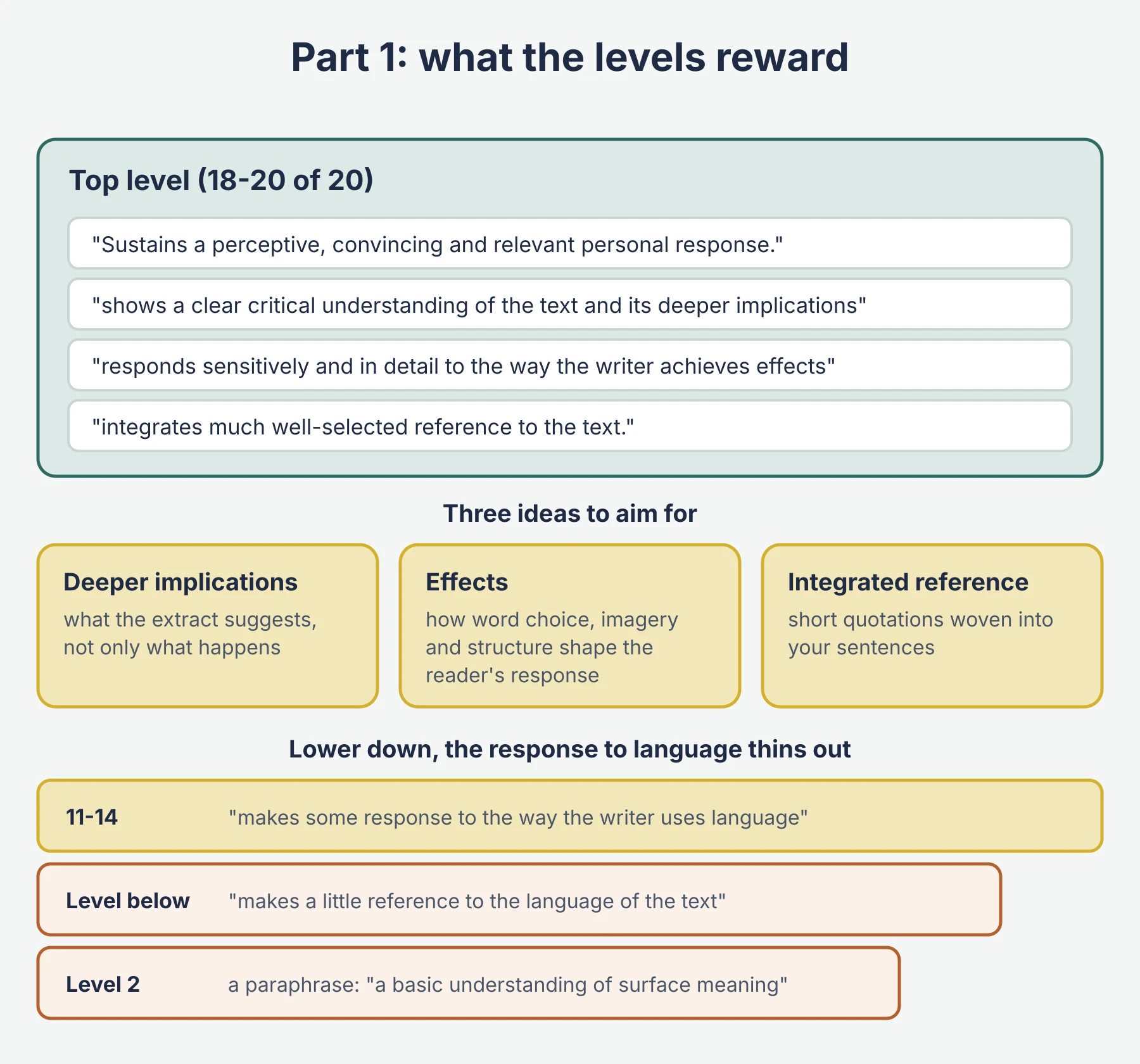
| Level | Marks | Key phrase |
|---|---|---|
| 6 | 18–20 | perceptive, convincing; deeper implications; responds sensitively and in detail to effects; integrates much well-selected reference |
| 5 | 15–17 | well-developed, detailed; some deeper implications; a developed response to effects; careful, relevant reference |
| 4 | 11–14 | reasonably developed; some response to the way the writer uses language; some thoroughness in evidence |
| 3 | 7–10 | begins to develop a response; a little reference to language; some supporting detail |
| 2 | 4–6 | basic response; surface meaning; a little supporting reference |
| 1 | 1–3 | a few straightforward comments |
The climb from Level 3 to Level 6 is the climb from what to how.
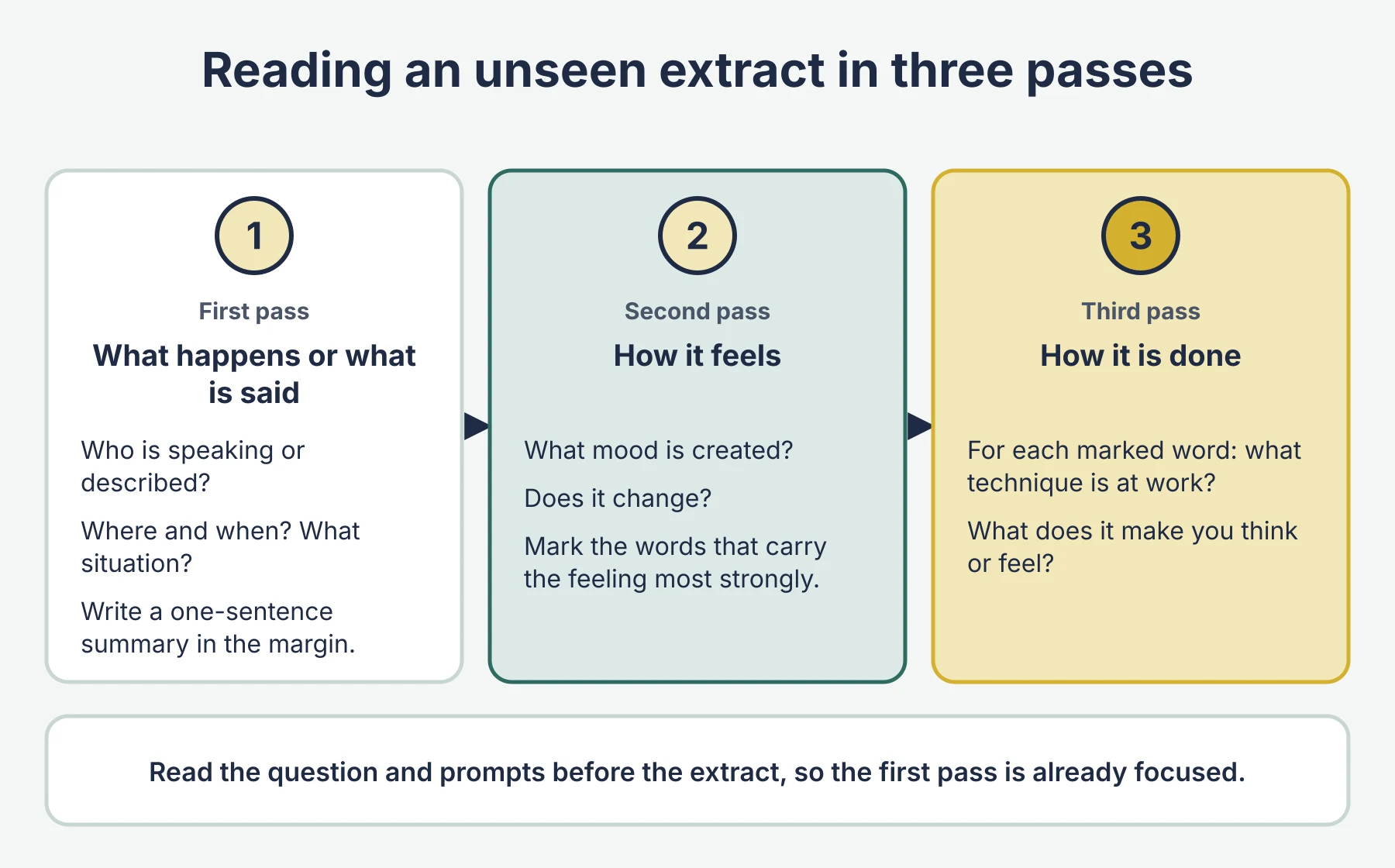
Three-pass reading
- What? situation, speaker, setting: one-line summary.
- How does it feel? mood and any shift in mood.
- How is it done? technique plus effect for each marked phrase.
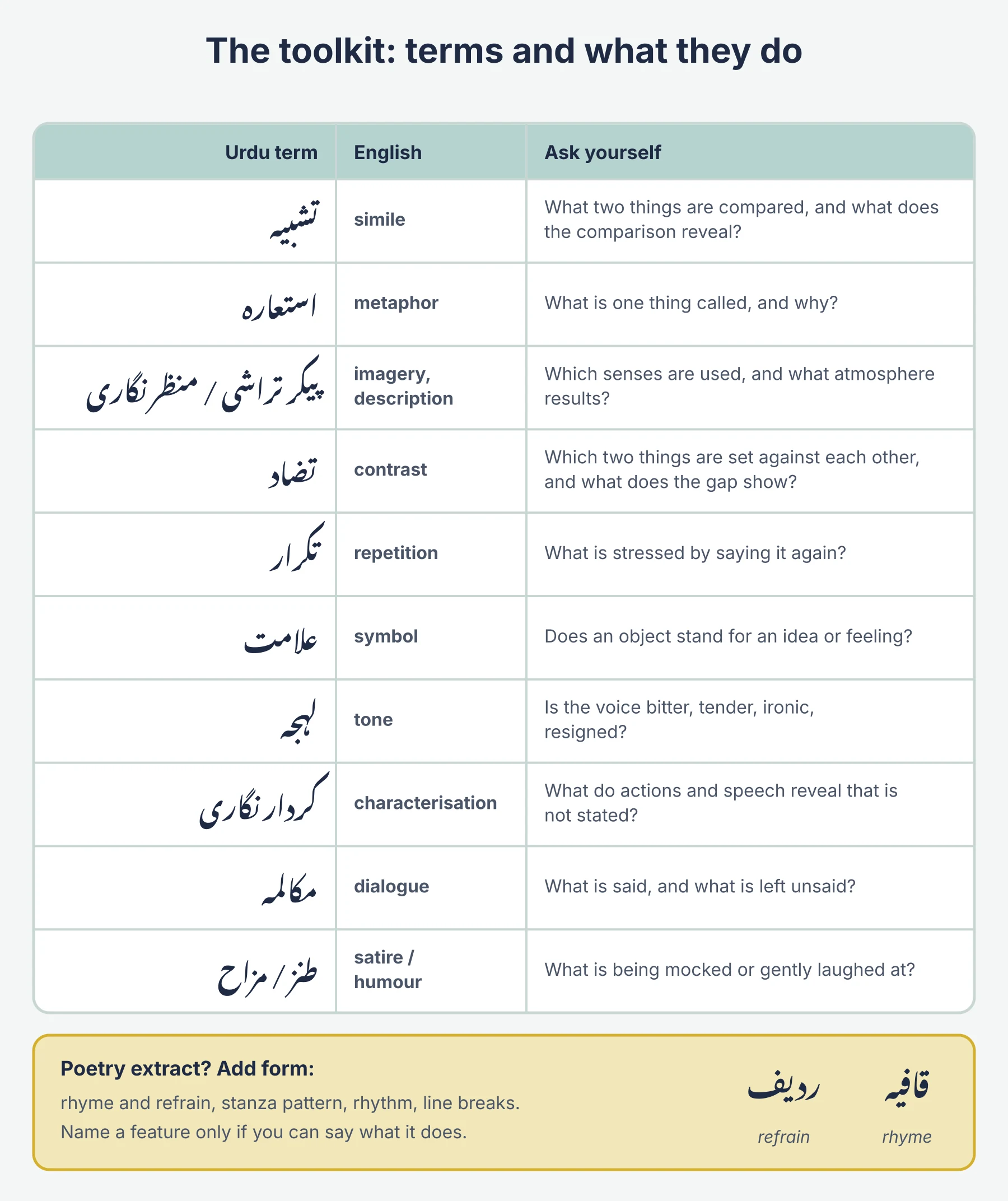
Terms and their jobs
| Term | Job in an answer |
|---|---|
| تشبیہ (simile) | reveals something by comparison: say what is revealed |
| استعارہ (metaphor) | fuses two things: say what the fusion suggests |
| پیکر تراشی (imagery) | creates a picture or sensation: name the sense and the mood |
| تضاد (contrast) | sets ideas side by side: say what the gap shows |
| تکرار (repetition) | stresses: say what is stressed and why |
| علامت (symbol) | an object carrying an idea: name the idea |
| لہجہ (tone) | the voice’s attitude: name it precisely |
| کردار نگاری (characterisation) | what actions and speech imply |
| طنز (satire) | what is criticised through mockery |
| ردیف / قافیہ (refrain / rhyme) | in verse: what the repeated sound binds together |
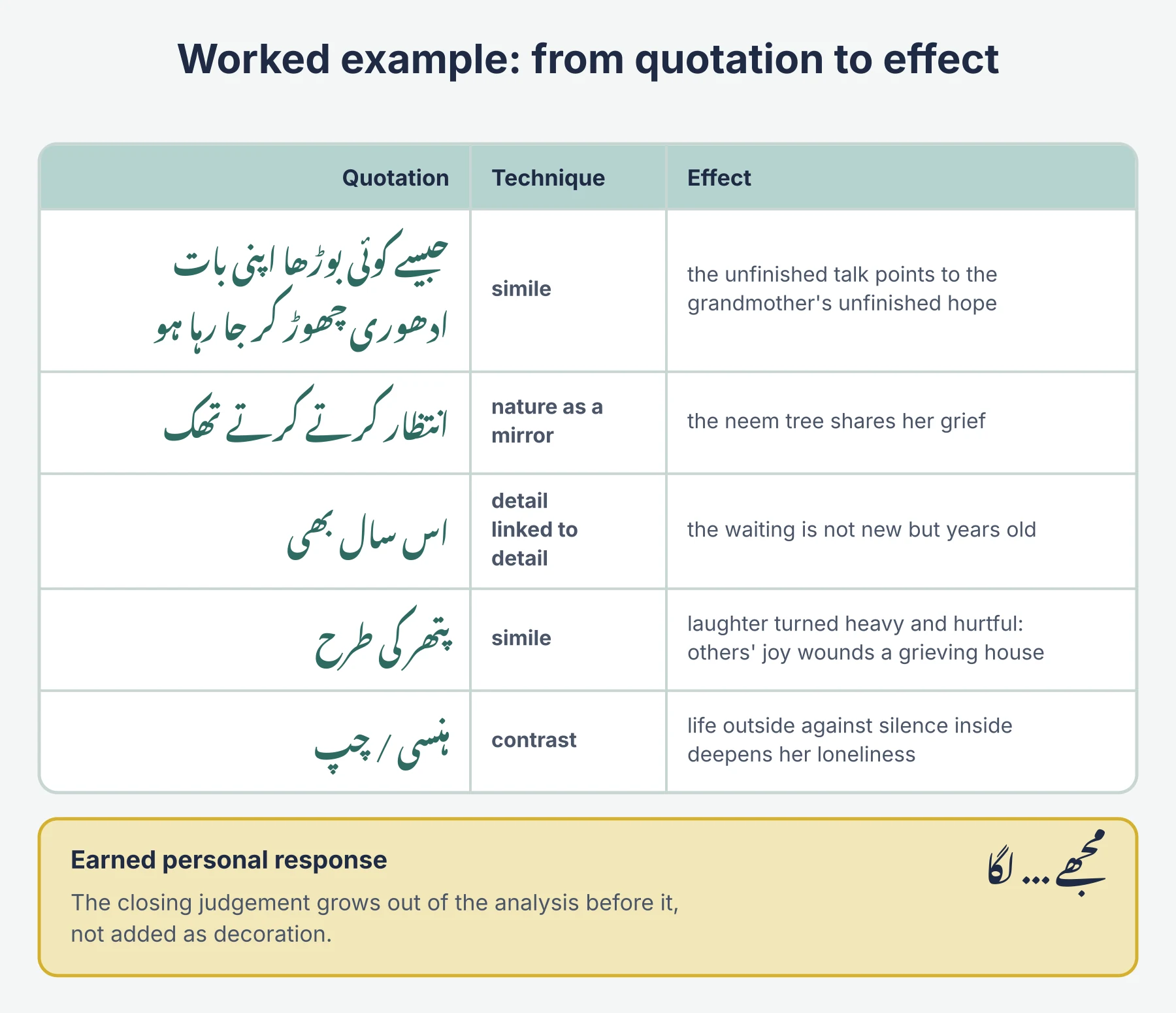
The analytical sentence
Point – short quotation – technique – effect on the reader – link to the question or a deeper implication.
دادی “دیوار سے” بات کرتی ہیں؛ یہ چھوٹی سی تفصیل بتاتی ہے کہ ان کی بات سننے والا کوئی نہیں، اور یوں ان کی تنہائی بغیر کہے نمایاں ہو جاتی ہے۔
Answer frame
- Opening (2–3 sentences): answer the question directly.
- One paragraph per prompt, two or more integrated quotations each.
- Closing judgement: a personal response grown from the analysis.
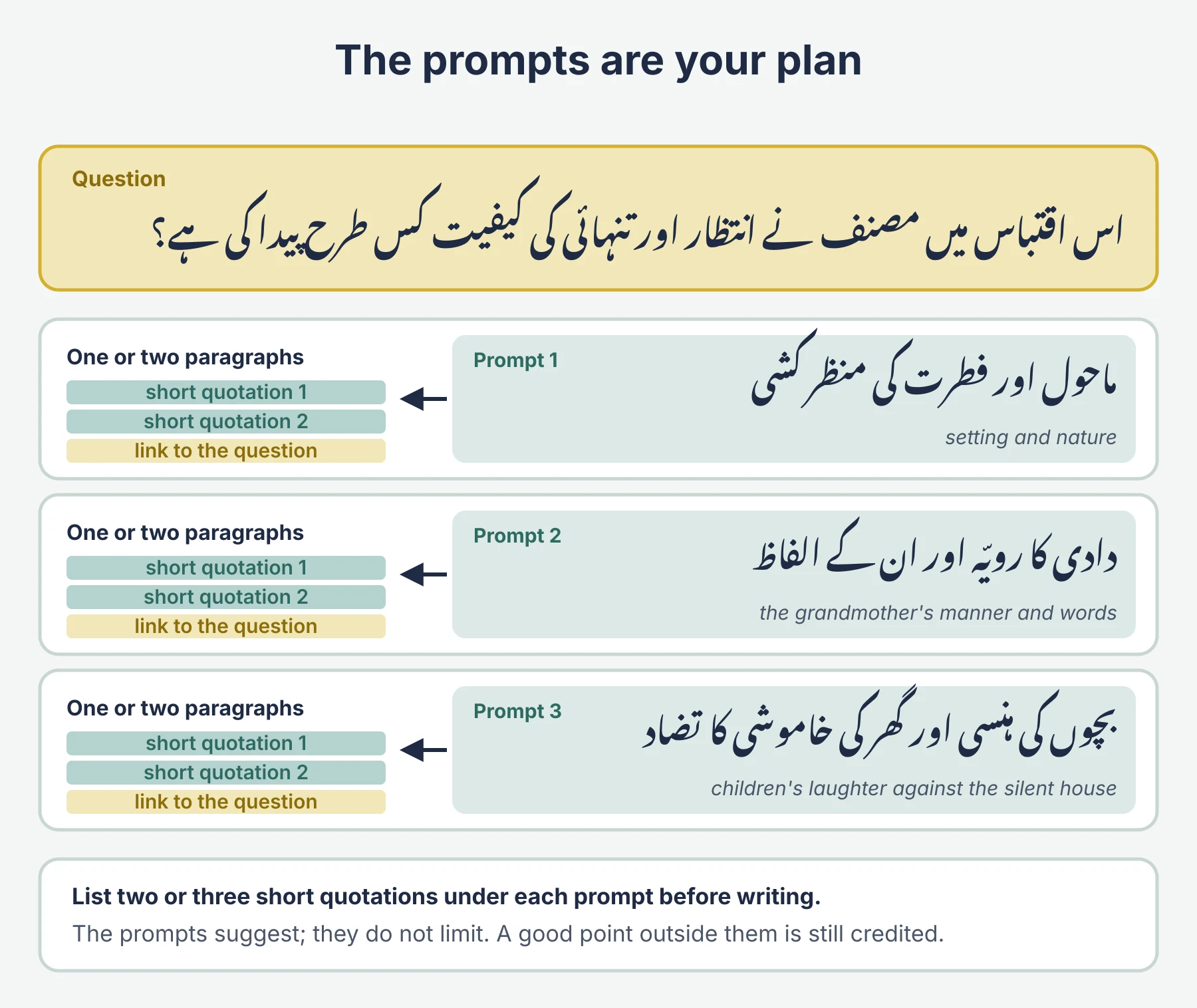
Precise tone words
Avoid “sad” and “happy” alone. Try: حسرت (longing), مایوسی (despair), یاس (hopelessness), طنزیہ (ironic, mocking), نرم و ملائم (tender), پُرسکون (calm), پُراسرار (mysterious), بے بسی (helplessness), شکوہ (complaint, reproach).
A 45-minute plan (practice timing)
| Minutes | Task |
|---|---|
| 0–3 | read the question and prompts; underline the focus |
| 3–13 | read the extract twice; annotate techniques and effects |
| 13–16 | plan: one paragraph per prompt, quotations listed |
| 16–42 | write |
| 42–45 | check spelling, agreement and that every paragraph answers the question |
Exam traps
- Retelling the story or paraphrasing the poem.
- Listing devices with no effect.
- Quoting whole lines instead of the key words.
- Ignoring a prompt, or treating the prompts as the only things you may discuss.
- “I liked it” with no reason drawn from the text.
- Writing about the writer’s life or other works you know: the extract is unseen and the answer must come from it.
- Overrunning: about 45–50 minutes is a fair share of a two-hour paper for 20 of 50 marks.
Self-test
- How many marks is the Unseen Passage worth, and how many questions are there?
- Can the extract be poetry?
- What does the question always include to guide you?
- Which level descriptor first asks for “deeper implications”?
- What separates a Level 3 answer from a Level 4 answer on language?
- Give the Urdu term for contrast and say what you should write about it.
- Turn this weak comment into an analytical sentence: “There is a simile about the old man.”
- Why are short quotations better than long ones here?
- Where should your personal response come from?
- Name two features of form you might comment on if the extract is a ghazal.
- Why should you not bring in the author’s biography?
- Give two precise Urdu words for tone that are better than “sad”.
Answers
- 20 marks; one question.
- Yes: the syllabus says the extract is “from poetry or prose”.
- Prompts suggesting aspects you may consider.
- Level 4 (“some of its deeper implications”); Level 6 asks for “a clear critical understanding of the text and its deeper implications”.
- Level 3 makes “a little reference to the language”; Level 4 “makes some response to the way the writer uses language”.
- تضاد: say which two things are set against each other and what the difference reveals.
- For example: the water “mutters like an old man leaving his words unfinished”, a simile that mirrors the grandmother’s unfinished hope.
- They show precise selection, take less time and keep the focus on your analysis.
- From your analysis of the text’s language and meaning.
- Two of: the ردیف (refrain), the قافیہ (rhyme), the opening couplet, the independence of each couplet, rhythm.
- The question tests response to the extract on the page; outside knowledge does not answer it.
- Two of حسرت، مایوسی، یاس، بے بسی، شکوہ.
More resources on this topic
Related resources
-
Study guides
Cambridge O-Level First Language Urdu: Paper 2 Texts (3247)
Unseen Passage, Poetry and Prose – the full structure of Paper 2 Texts for Cambridge O Level First Language Urdu 3247, 2027 series (Version 1), with its prescribed ghazal, nazm and prose set texts.
Urdu Language · Cambridge · O Level
Read guide -
Practice questions
Cambridge O-Level First Language Urdu: Paper 2 Texts — Practice Questions
Original exam-technique practice questions with full worked answers on Paper 2's three parts, the prescribed set-text list, and what the levels-based mark schemes reward, for Cambridge O Level First Language Urdu (3247).
Urdu Language · Cambridge · O Level
Try questions -
Revision notes
Cambridge O-Level First Language Urdu: Paper 2 Texts — Revision Notes
Condensed recall notes on Paper 2's Unseen Passage, Poetry and Prose parts, the prescribed set texts, and what the mark schemes actually reward for Cambridge O Level First Language Urdu (3247).
Urdu Language · Cambridge · O Level
Revise topic
Get free revision emails (optional)
Occasional emails with practice questions, worked explanations and links to free resources for the qualification and subjects you choose. No spam, and you can unsubscribe from any email. The free tools on this site never need an email.