
Study Guides
Cambridge O Level First Language Urdu (3247): Paper 2 Poetry Essay
Writing the 15-mark essay on the prescribed ghazals and nazms in 3247 Paper 2 Part 2: reading the question, ghazal and nazm form, using quotation and planning.
- Subject
- Urdu Language
- Level
- O LEVELS
- Topic
- Paper 2 – Texts
- Author
- Marlbridge Academic Team
- Updated
- Reviewed by
- Farheen Zehra (what this means)
Aligned to Cambridge O Level Urdu Language (3247), 2027. Official specification .
Syllabus page (what it covers and how it is assessed): Cambridge O Level Urdu Language.
Found an error? Report a correction.
Need help with this topic? Request a free trial class for O Level Urdu Language (3247 / 3248).
This guide covers Part 2 Poetry of Cambridge O Level First Language Urdu 3247 Paper 2 Texts: “Two essay questions based on the prescribed set texts listed in the syllabus. Candidates answer one question.” It is worth 15 marks. The set texts themselves, the paper’s three parts and the coverage targets are in the Paper 2 Texts study guide. This page is about turning knowledge of those poems into an essay that reaches the top level. Prescribed texts can change between syllabus years, so always check the list in the syllabus for your examination year.
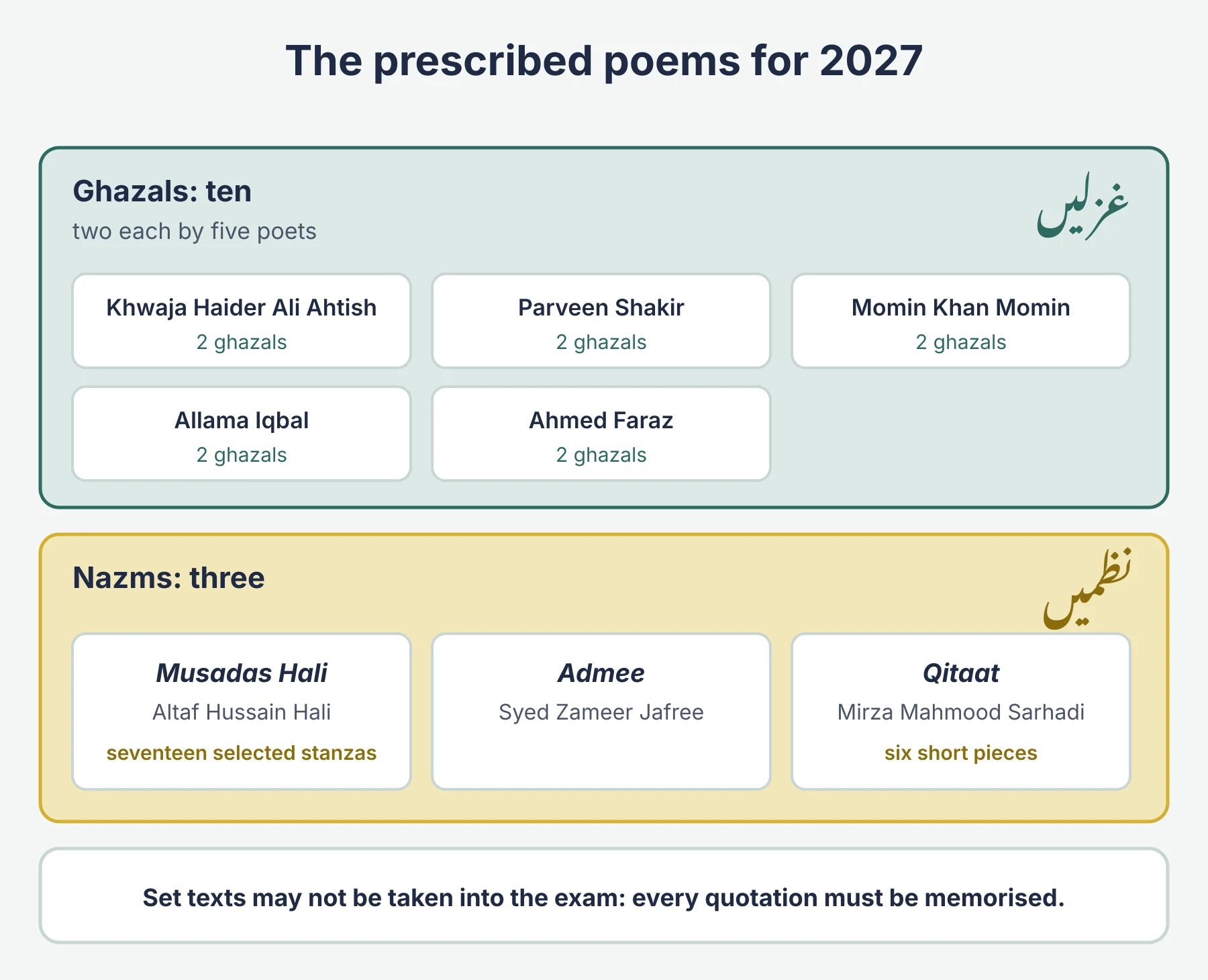
What the syllabus lists for 2027
- Ghazals (غزلیں): ten, two each by Khwaja Haider Ali Ahtish, Parveen Shakir, Momin Khan Momin, Allama Iqbal and Ahmed Faraz.
- Nazms (نظمیں): three: Altaf Hussain Hali’s Musadas Hali, in seventeen selected stanzas; Syed Zameer Jafree’s Admee; and Mirza Mahmood Sarhadi’s Qitaat, six short pieces.
Set texts “may not be taken into the examination”, so every quotation you use must be memorised.
What the mark scheme rewards
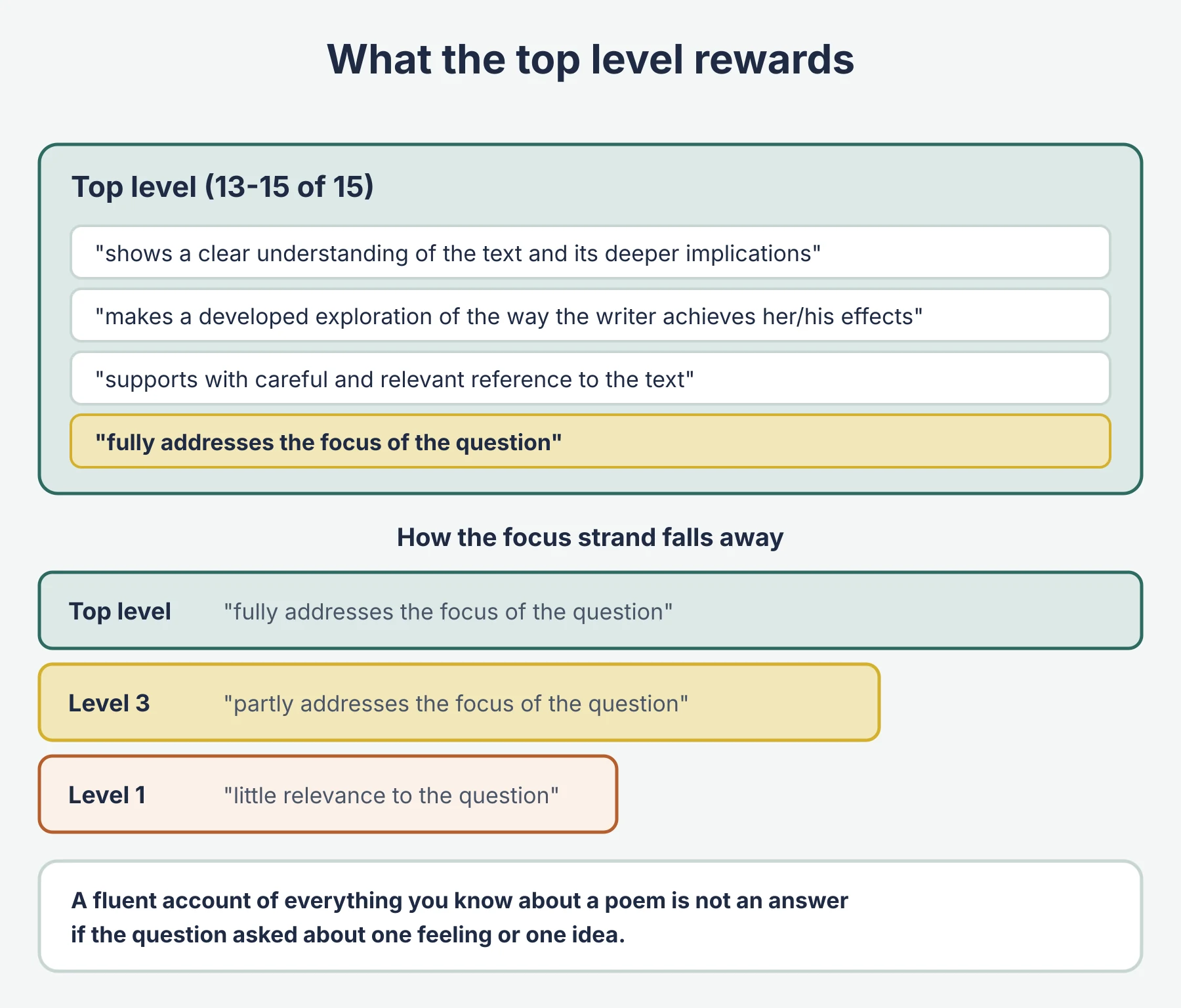
The Poetry and Prose essays share a five-level scheme. The top level (13–15) describes a response that:
- “shows a clear understanding of the text and its deeper implications”
- “makes a developed exploration of the way the writer achieves her/his effects”
- “supports with careful and relevant reference to the text”
- “fully addresses the focus of the question.”
The last phrase is the one candidates most often neglect. At Level 3 the response “partly addresses the focus of the question”; at Level 1 there is “little relevance to the question”. A fluent account of everything you know about a poem is not an answer if the question asked about one feeling or one idea.
Reading the question
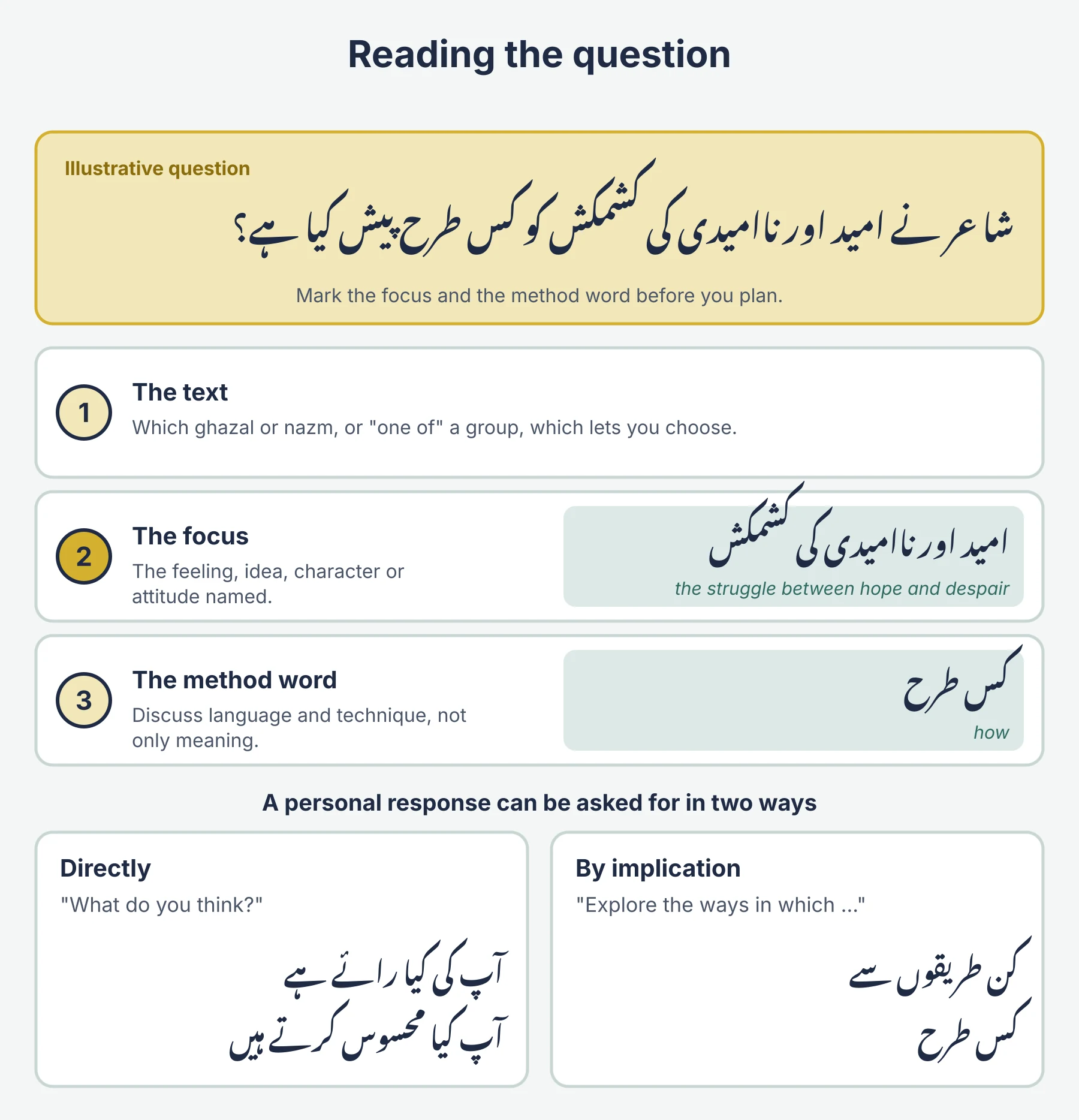
The syllabus gives the kinds of wording to expect. A personal response may be asked for “directly, for example, ‘What do you think?’, ‘What are your feelings about …?’”, or “by implication, ‘Explore the ways in which …’”. In Urdu these appear as phrases such as آپ کی کیا رائے ہے، آپ کیا محسوس کرتے ہیں، کن طریقوں سے or کس طرح.
Before planning, mark three things:
- The text: which ghazal or nazm, or “one of” a group, which lets you choose.
- The focus: the feeling, idea, character or attitude the question names.
- The method word: کس طرح or “explore the ways” means you must discuss language and technique, not only meaning.
Form: what to know and why it matters
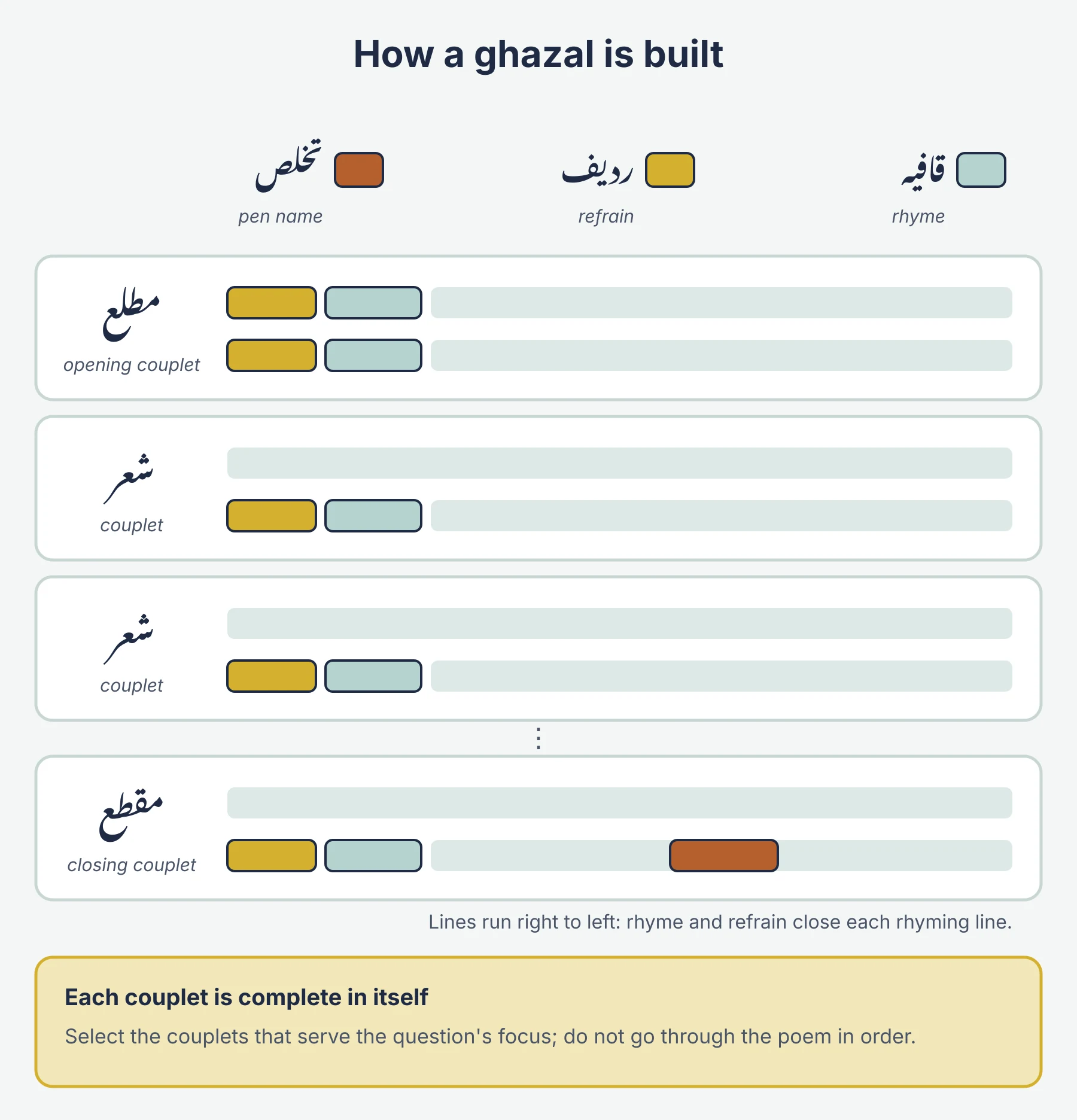
The ghazal. Each couplet (شعر) is complete in itself, and couplets in one ghazal may move between moods and ideas. The opening couplet (مطلع) rhymes in both lines; the closing couplet (مقطع) usually carries the poet’s pen name (تخلص). Every couplet ends with the same refrain (ردیف), preceded by the rhyme (قافیہ). Because couplets are independent, an essay on a ghazal is built by selecting the couplets that serve the question’s focus, not by going through the poem in order.
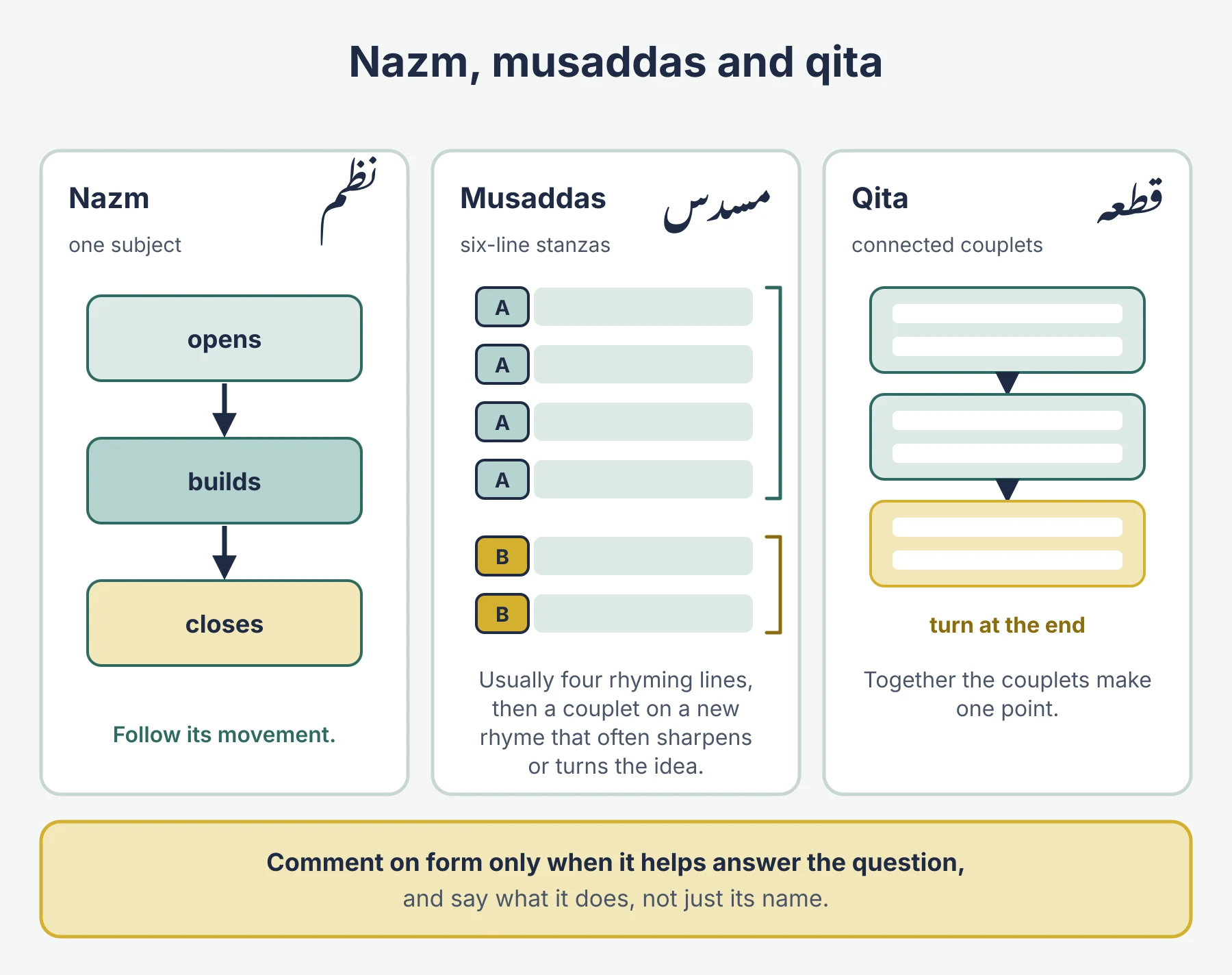
The nazm. A nazm develops one subject across the whole poem, so an essay can follow its movement: how it opens, builds and closes. The musaddas (مسدس) is a nazm in six-line stanzas, usually four rhyming lines followed by a couplet on a new rhyme, so the closing couplet of a stanza often sharpens or turns its idea. A qita (قطعہ) is a short poem of connected couplets that together make one point, often with a turn at the end.
Comment on form only when it helps answer the question: a refrain that keeps returning to an idea the question names, or a stanza’s final couplet that delivers the judgement.
Contexts, briefly
Ahtish and Momin wrote in the classical tradition of the nineteenth century; Iqbal, Faraz and Parveen Shakir are twentieth-century poets. Context can sharpen a point about attitude or language, but the mark scheme credits understanding of the text, so a paragraph of biography earns little.
Building the essay
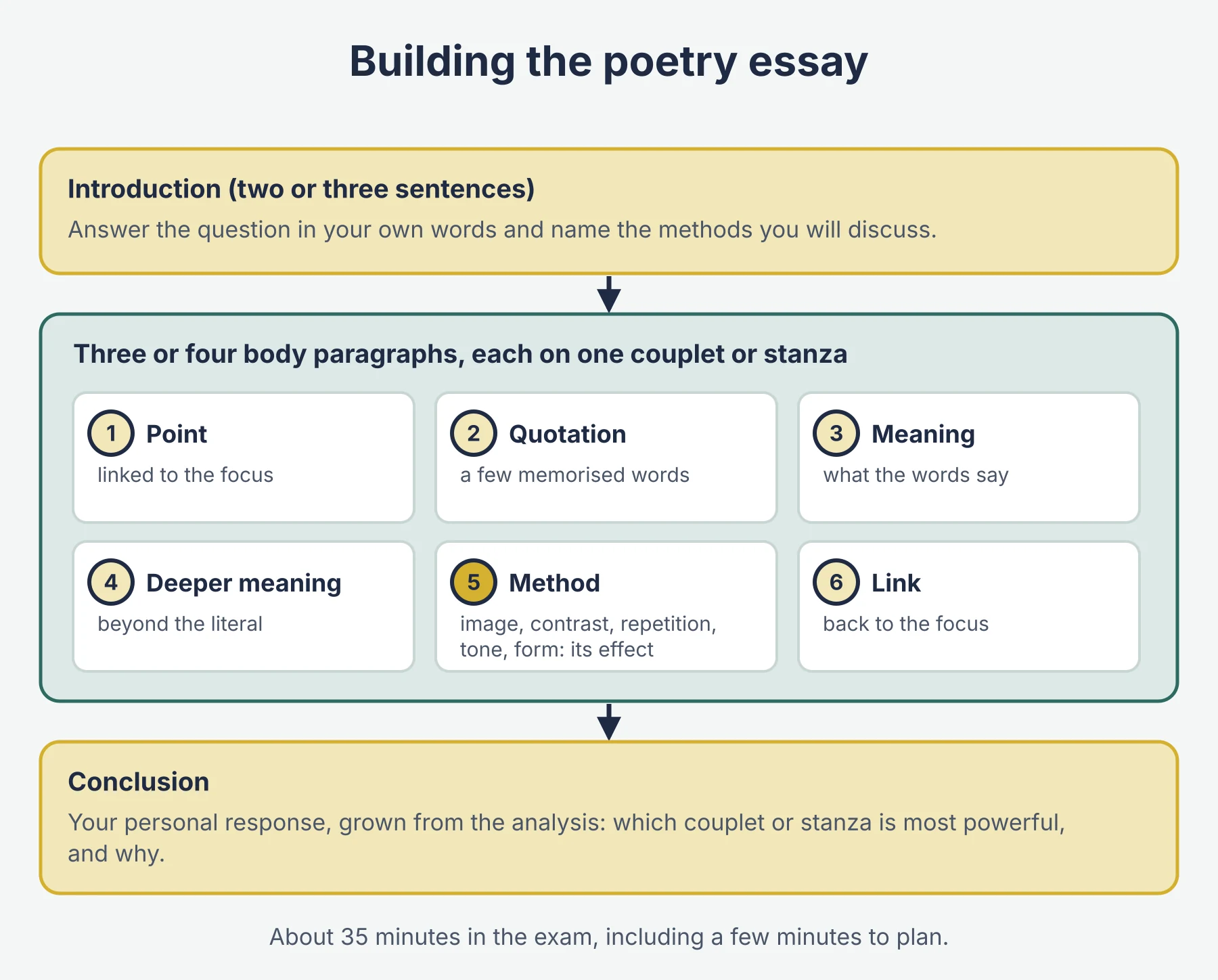
Introduction (two or three sentences). Answer the question in your own words and name the methods you will discuss.
Three or four body paragraphs. Each built on one couplet or stanza:
- Point linked to the focus.
- Quotation: a few memorised words, not the whole couplet unless it is short.
- Meaning: what the words say.
- Deeper meaning: what they suggest beyond the literal.
- Method: image, contrast, repetition, tone, form, and its effect.
- Link back to the focus.
Conclusion. Your personal response, grown from the analysis: which couplet or stanza you find most powerful, and why.
Worked example of the method
To show the method without reproducing a set text, here are two illustrative lines written for this guide. They are not from any prescribed poem.
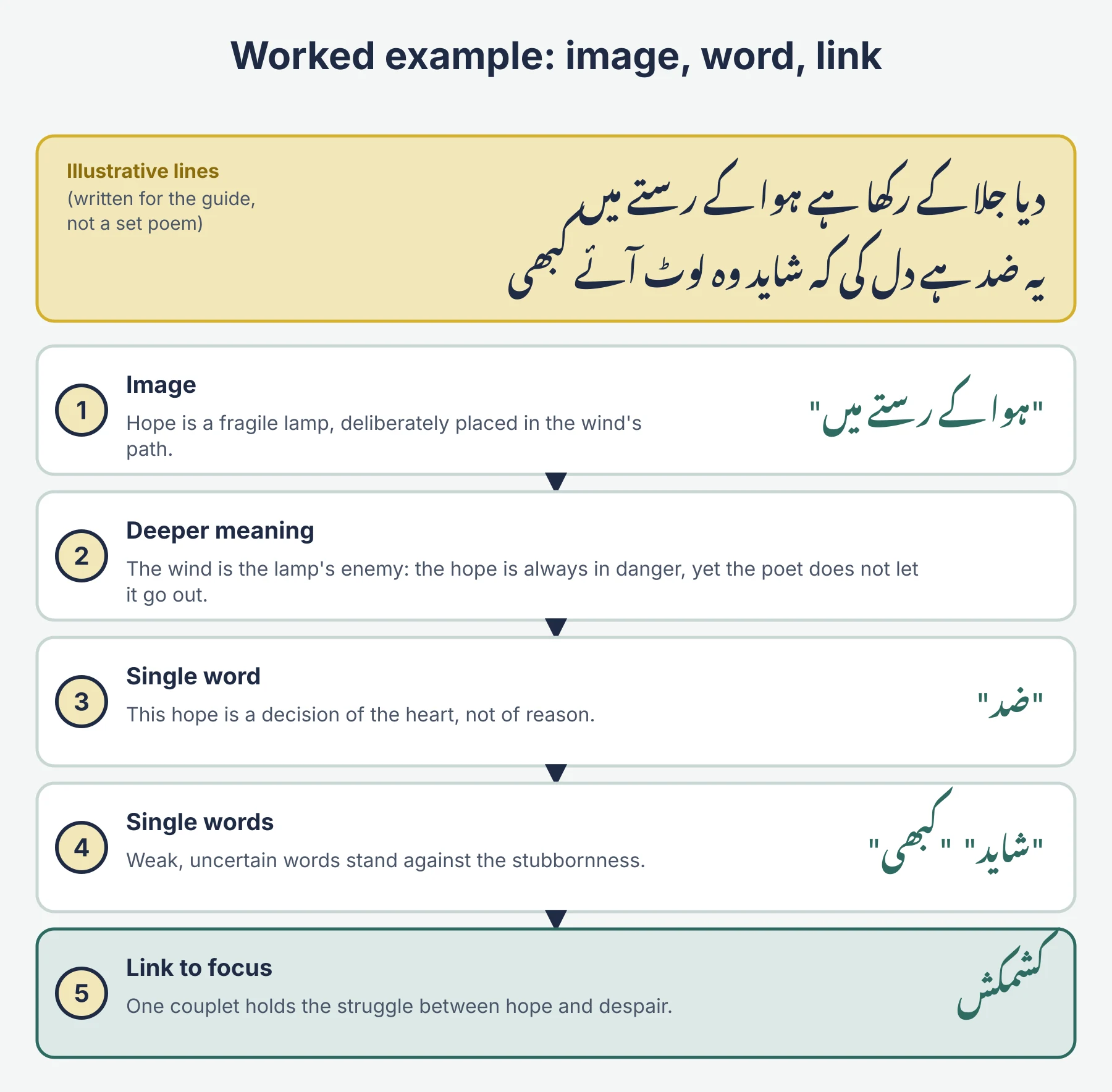
دیا جلا کے رکھا ہے ہوا کے رستے میں یہ ضد ہے دل کی کہ شاید وہ لوٹ آئے کبھی
Question focus (illustrative): شاعر نے امید اور ناامیدی کی کشمکش کو کس طرح پیش کیا ہے؟
Model paragraph:
اس شعر میں امید کو ایک نازک دیے کی صورت میں دکھایا گیا ہے، جو جان بوجھ کر “ہوا کے رستے میں” رکھا گیا ہے۔ یہ پیکر بڑا معنی خیز ہے: ہوا دیے کی دشمن ہے، اس لیے شاعر جانتا ہے کہ اس کی امید ہر لمحہ خطرے میں ہے، پھر بھی وہ اسے بجھنے کے لیے چھوڑ نہیں دیتا۔ دوسرے مصرعے میں لفظ “ضد” بتاتا ہے کہ یہ امید عقل کا نہیں، دل کا فیصلہ ہے۔ “شاید” اور “کبھی” جیسے کمزور، غیر یقینی الفاظ اس ضد کے بالکل مقابل کھڑے ہیں، اور یوں ایک ہی شعر میں امید اور ناامیدی کی کشمکش سمٹ آئی ہے۔
Commentary: every sentence serves the focus (کشمکش). The paragraph moves from image to deeper meaning to the effect of single words, uses only short quotations, and ends by linking back to the question. In the exam, the same moves are made with your memorised words from a prescribed poem.
Preparing each poem
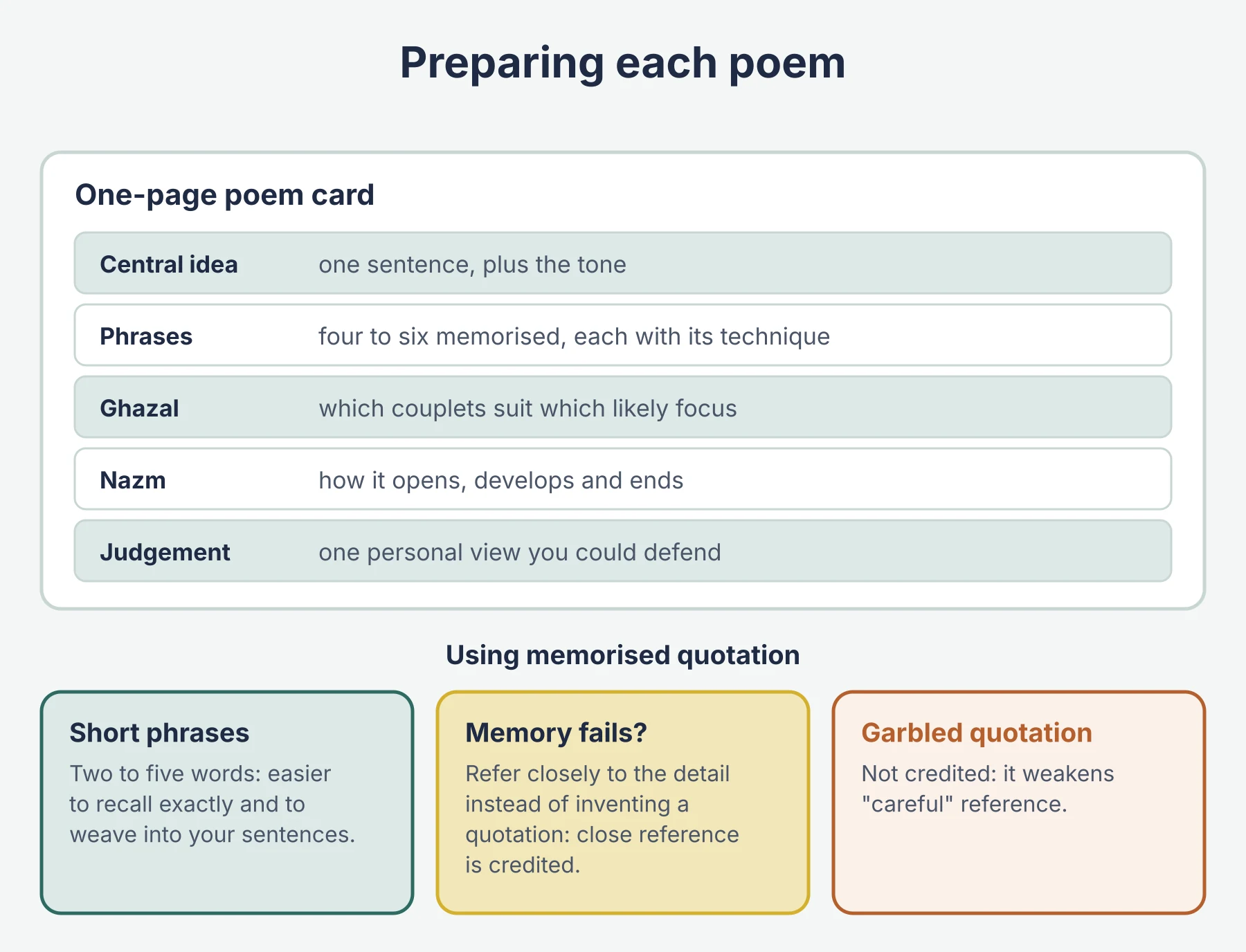
Make a one-page card for every poem you choose to know closely:
- The central idea in one sentence, and the tone.
- Four to six memorised phrases, each with a note of its technique.
- For a ghazal: which couplets suit which likely focus (love, separation, self-respect, time, faith, society).
- For a nazm: how it opens, develops and ends.
- One personal judgement you could defend.
Using memorised quotation well
Learn short phrases of two to five words rather than whole couplets: they are easier to recall exactly and easier to weave into your own sentences. Choose phrases that carry an image or a key word you can analyse. If memory fails, refer closely to the detail instead (“in the closing couplet the poet turns to address himself by name”) rather than inventing a quotation. Accurate close reference is still credited; a garbled quotation is not.
Common mistakes
- Summarising the poem couplet by couplet with no focus.
- Choosing couplets that do not fit the question because they are the ones you remember best.
- Quoting whole couplets and leaving no time to analyse them.
- Naming the form (radeef, matla) without saying what it does.
- Misquoting. Learn your phrases exactly; a garbled quotation weakens “careful” reference.
- Ignoring “what do you think?” when the question asks for your view.
- Unbalanced timing. Fifteen marks out of fifty in two hours is roughly 35 minutes, including a few minutes to plan.
More resources on this topic
Related resources
-
Practice questions
Cambridge O Level First Language Urdu (3247): Paper 2 Poetry Essay – Practice Questions
Original form, planning and paragraph tasks plus full 15-mark essays on the prescribed poems for 3247 Paper 2 Part 2, with model Urdu answers.
Urdu Language · Cambridge · O Level
Try questions -
Revision notes
Cambridge O Level First Language Urdu (3247): Paper 2 Poetry Essay – Revision Notes
Condensed notes for the 3247 Paper 2 Poetry essay: set poems, ghazal and nazm form terms, the five levels, paragraph method, traps and a self-test.
Urdu Language · Cambridge · O Level
Revise topic -
Study guides
Cambridge O Level First Language Urdu (3247): Paper 2 Prose Essay and Empathic Task
Answering the 15-mark prose question on the stories, essays and letters set for 3247 Paper 2 Part 3, including the empathic task in a character's voice.
Urdu Language · Cambridge · O Level
Read guide
Get free revision emails (optional)
Occasional emails with practice questions, worked explanations and links to free resources for the qualification and subjects you choose. No spam, and you can unsubscribe from any email. The free tools on this site never need an email.