
Study Guides
Cambridge O Level First Language Urdu (3247): Paper 2 Prose Essay and Empathic Task
Answering the 15-mark prose question on the stories, essays and letters set for 3247 Paper 2 Part 3, including the empathic task in a character's voice.
- Subject
- Urdu Language
- Level
- O LEVELS
- Topic
- Paper 2 – Texts
- Author
- Marlbridge Academic Team
- Updated
- Reviewed by
- Farheen Zehra (what this means)
Aligned to Cambridge O Level Urdu Language (3247), 2027. Official specification .
Syllabus page (what it covers and how it is assessed): Cambridge O Level Urdu Language.
Found an error? Report a correction.
Need help with this topic? Request a free trial class for O Level Urdu Language (3247 / 3248).
This guide covers Part 3 Prose of Cambridge O Level First Language Urdu 3247 Paper 2 Texts: “Two essay questions based on the prescribed set texts listed in the syllabus. Candidates answer one question.” It is worth 15 marks. The paper’s structure and the full set-text list are in the Paper 2 Texts study guide. Here we look at the kinds of prose question you may meet, including the empathic task that the mark scheme names, and how to answer each. Set texts can change between syllabus years, so check the list for your examination year.
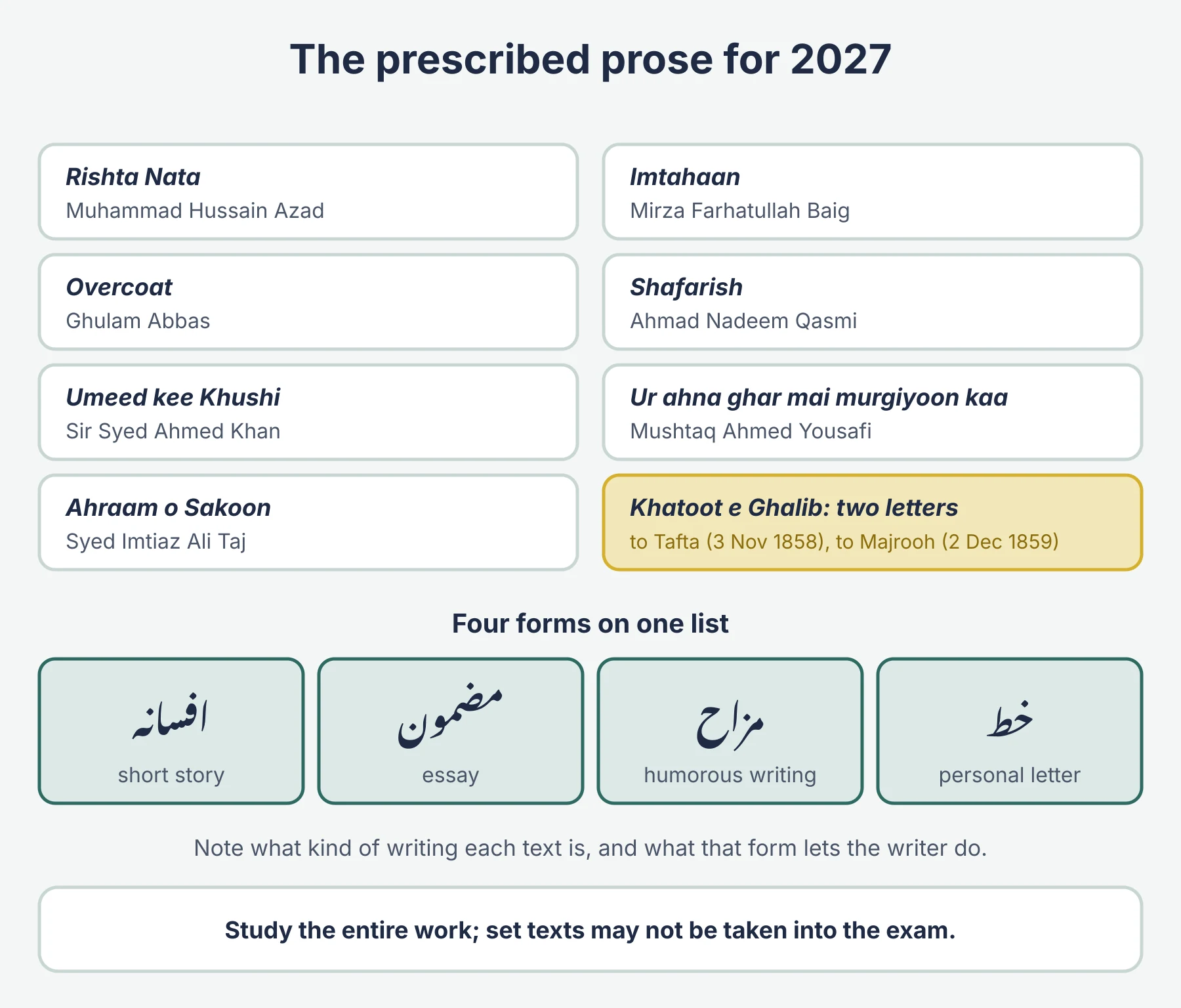
The prescribed prose for 2027
Eight items are listed: Muhammad Hussain Azad, Rishta Nata; Mirza Farhatullah Baig, Imtahaan; Ghulam Abbas, Overcoat; Ahmad Nadeem Qasmi, Shafarish; Sir Syed Ahmed Khan, Umeed kee Khushi; Mushtaq Ahmed Yousafi, Ur ahna ghar mai murgiyoon kaa; Syed Imtiaz Ali Taj, Ahraam o Sakoon; and two letters from Khatoot e Ghalib, to Har Gopal Tafta (3 November 1858) and to Mir Mahdi Majrooh (2 December 1859). The syllabus states that “the entire work should be studied” unless otherwise specified, and that set texts “may not be taken into the examination”.
The list mixes forms: short story (افسانہ), essay (مضمون), humorous writing (مزاح) and the personal letter (خط). Each form invites different questions, so your notes on each text should record what kind of writing it is and what that form allows the writer to do.
The question types
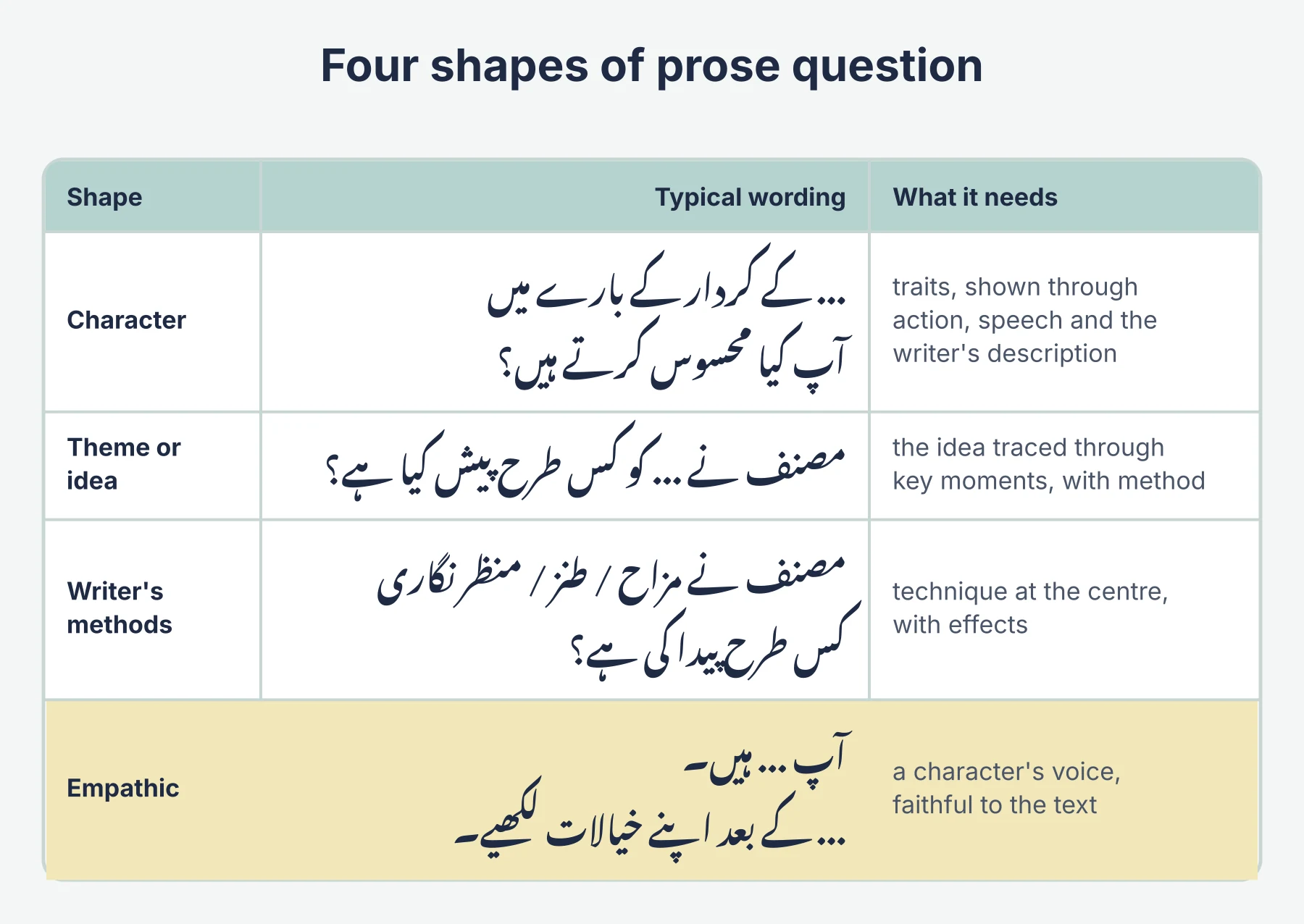
The syllabus says candidates will be asked to show “informed and appropriate personal response”, “knowledge of the text through the use of close reference to details and use of quotations”, “understanding of themes, characters, relationships, situations, issues and attitudes” and “understanding of the writer’s intentions and methods, including use of language”. In practice that gives four common shapes:
| Shape | Typical wording | What it needs |
|---|---|---|
| Character | … کے کردار کے بارے میں آپ کیا محسوس کرتے ہیں؟ | traits, shown through action, speech and the writer’s description |
| Theme or idea | مصنف نے … کو کس طرح پیش کیا ہے؟ | the idea traced through key moments, with method |
| Writer’s methods | مصنف نے مزاح / طنز / منظر نگاری کس طرح پیدا کی ہے؟ | technique at the centre, with effects |
| Empathic | آپ … ہیں۔ … کے بعد اپنے خیالات لکھیے۔ | a character’s voice, faithful to the text |
Prose methods to discuss
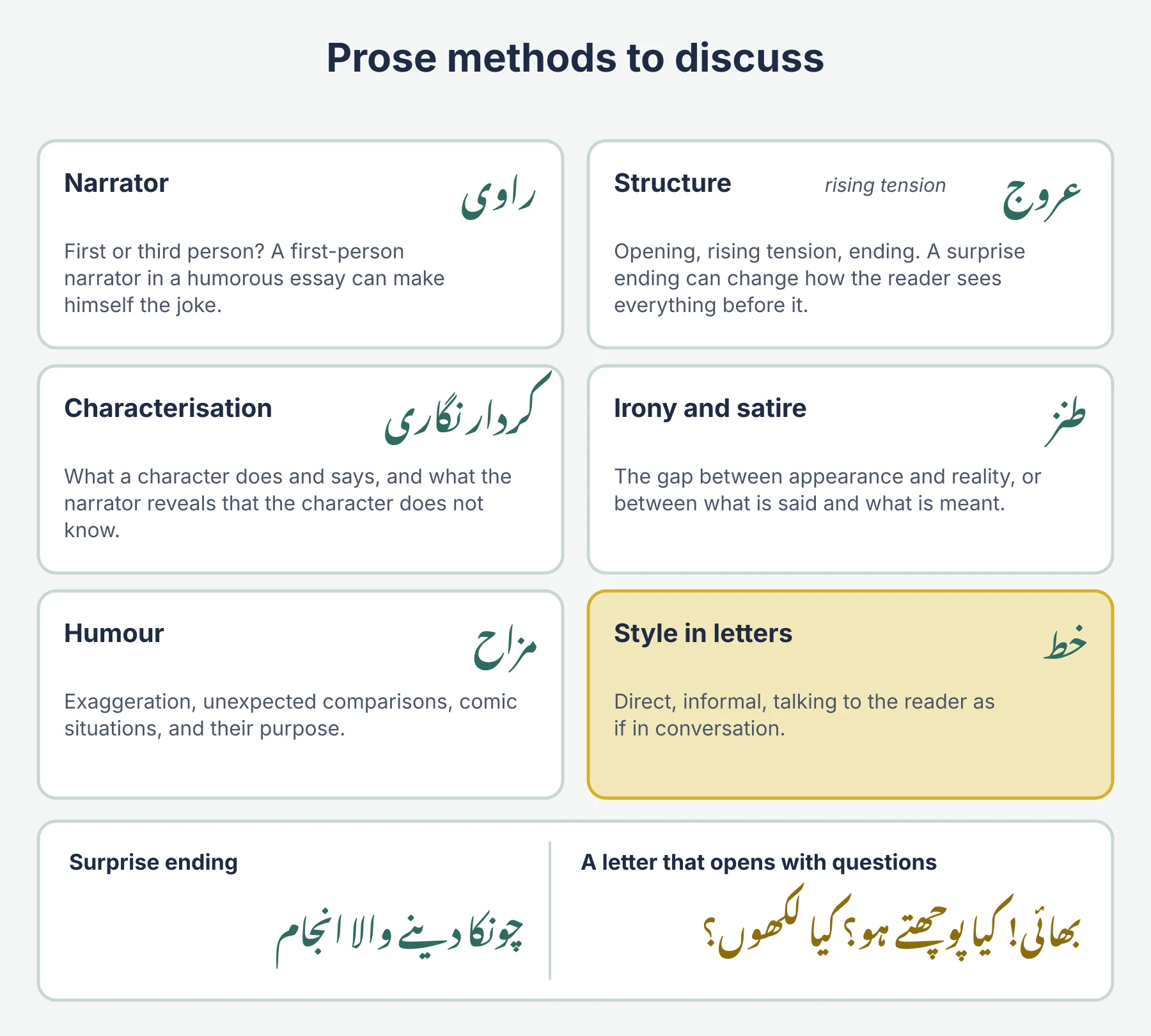
- Narrator (راوی): first person or third? A first-person narrator in a humorous essay can make himself the target of the joke.
- Structure: opening, rising tension (عروج), ending. A surprise ending (چونکا دینے والا انجام) can change how the reader sees everything before it.
- Characterisation (کردار نگاری): what a character does and says, and what the narrator reveals that the character does not know.
- Irony and satire (طنز): the gap between appearance and reality, or between what is said and what is meant.
- Humour (مزاح): exaggeration, unexpected comparisons, comic situations and their purpose.
- Style in letters: directness, informality, addressing the reader as if in conversation. The syllabus listing itself shows one letter opening with questions to its reader (بھائی! کیا پوچھتے ہو؟ کیا لکھوں؟), a sign of the conversational manner worth discussing.
Writing the analytical prose essay
The plan is the same as for poetry, but your evidence is key moments rather than couplets.
- Introduction: answer the question in two or three sentences and name your methods.
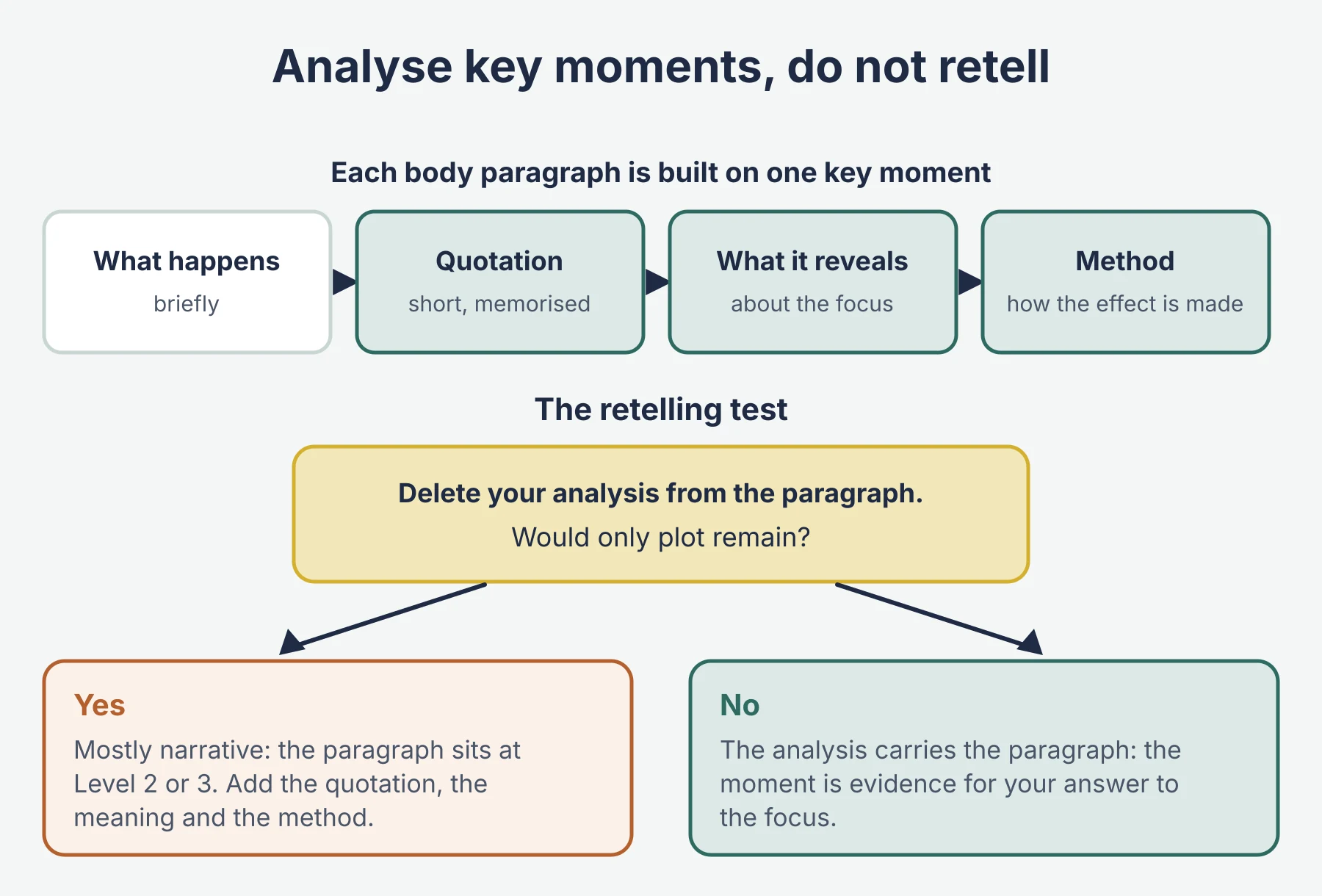
- Three or four paragraphs, each built on one moment in the text: what happens, a short memorised quotation, what it reveals about the focus, how the writer’s method creates that effect.
- Conclusion: a personal judgement that the essay has earned.
Because prose texts are longer than poems, the risk is retelling. Test every paragraph: if you deleted your analysis, would only plot remain? If so, the paragraph is mostly narrative and sits at Level 2 or 3.
The empathic task
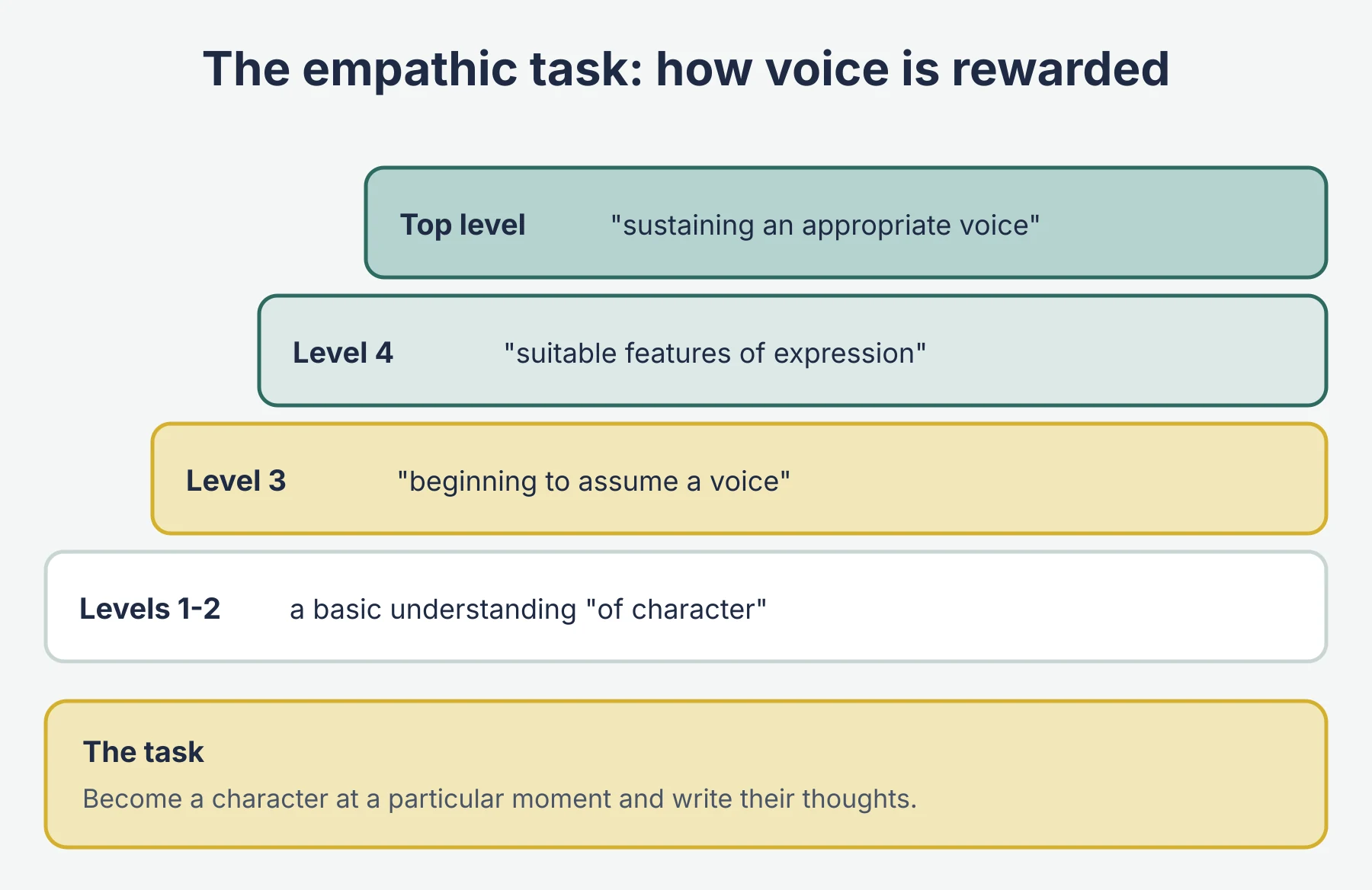
The mark scheme for Poetry and Prose includes a parallel set of descriptors for an empathic task. At the top level the response is “sustaining an appropriate voice”; at Level 4 it uses “suitable features of expression”; at Level 3 it is “beginning to assume a voice”; at Levels 1 and 2 it shows a basic understanding “of character”. The task asks you to become a character at a particular moment and write their thoughts.
What makes it a literature answer rather than creative writing:
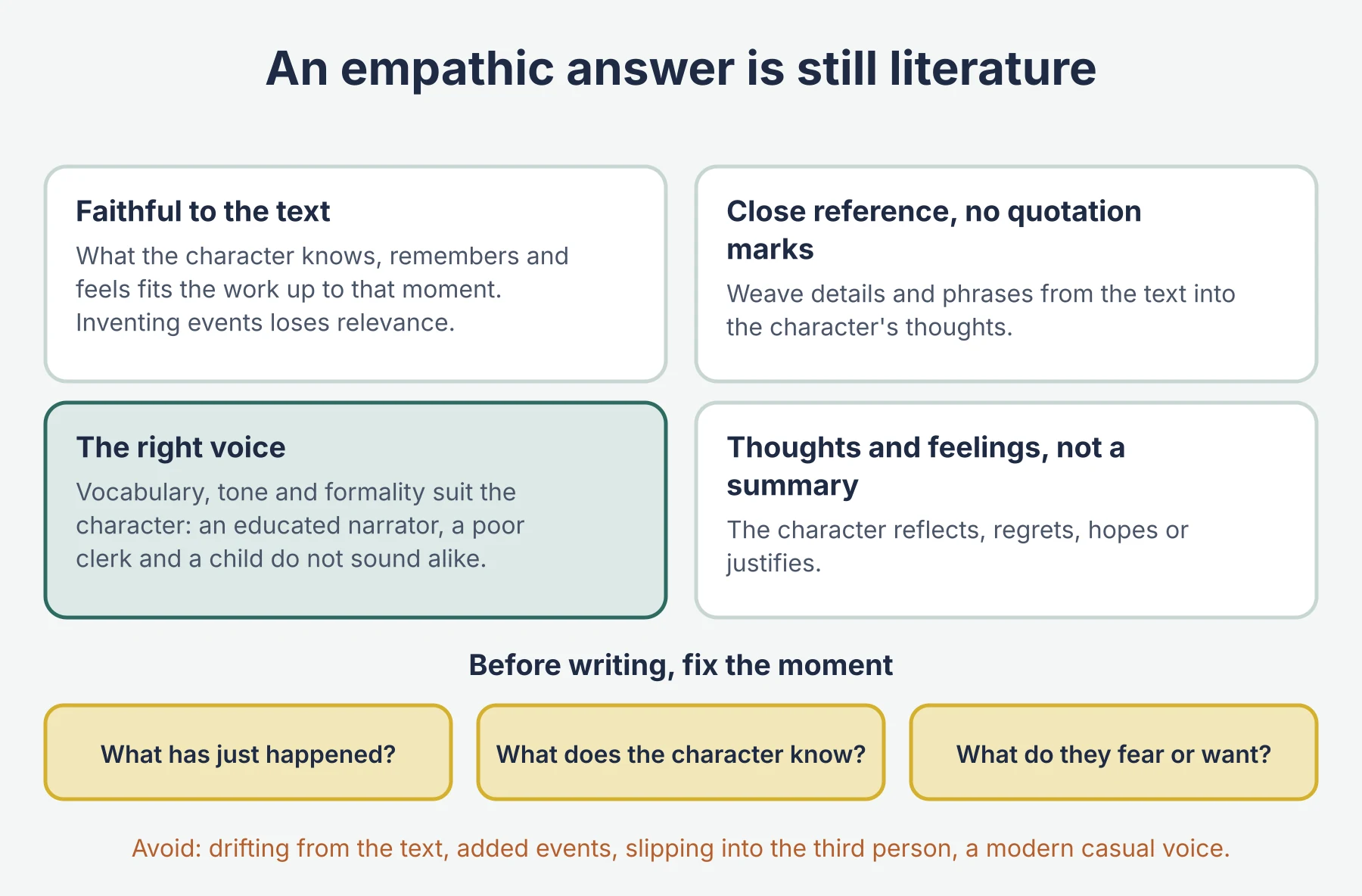
- Faithful to the text. Everything the character knows, remembers and feels must be consistent with what happens in the work up to that moment. Inventing events loses relevance.
- Close reference without quotation marks. Weave details and phrases from the text into the character’s thoughts.
- The right voice. Vocabulary, tone and level of formality must suit the character: an educated narrator, a poor clerk and a child do not sound alike.
- Thoughts and feelings, not a summary. The character reflects, regrets, hopes or justifies.
Illustrative example
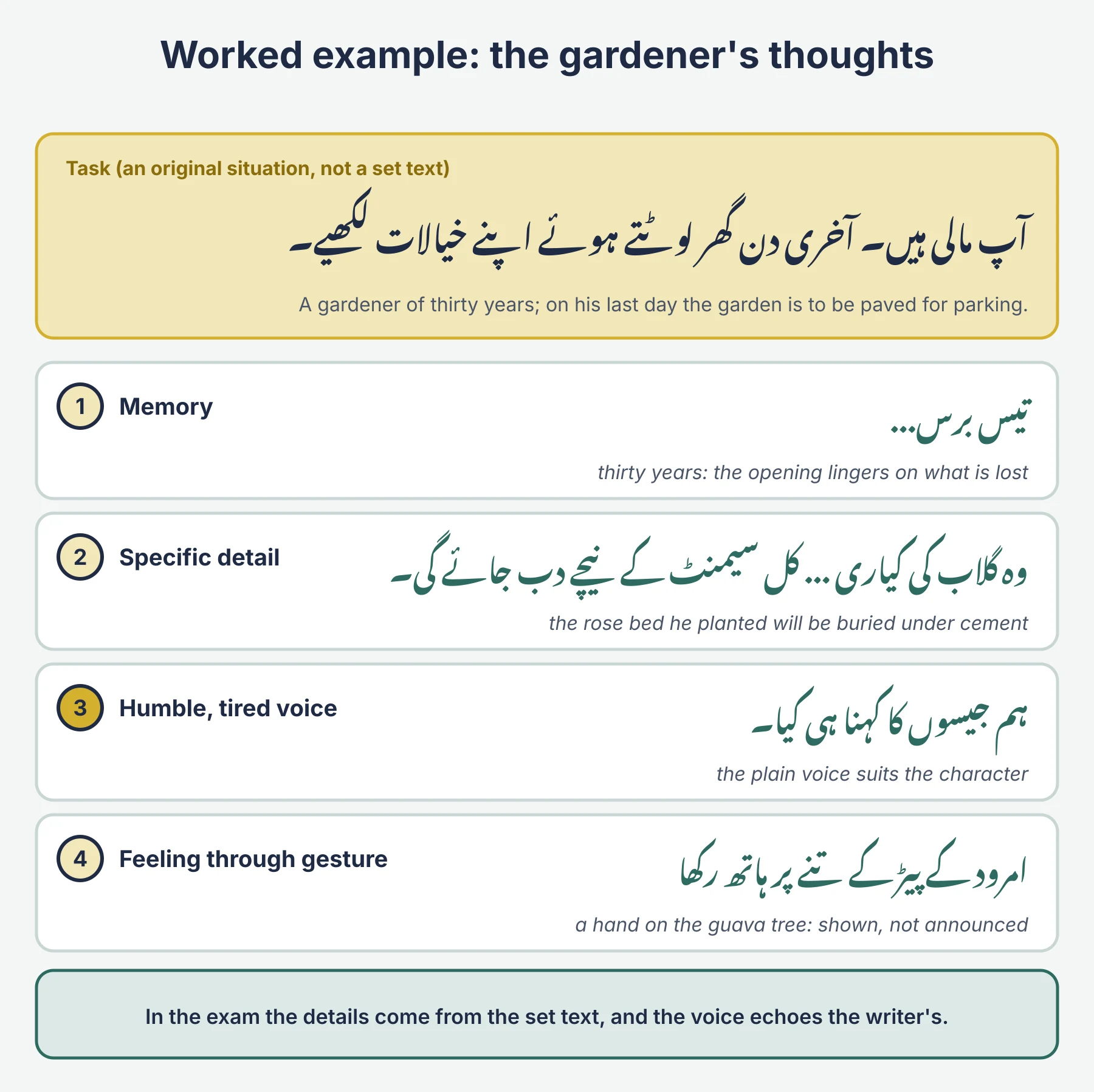
To show the method without using a set text, here is an original situation: a gardener has tended a large house’s garden for thirty years; on his last day, the new owners tell him the garden will be paved for parking. Task: آپ مالی ہیں۔ آخری دن گھر لوٹتے ہوئے اپنے خیالات لکھیے۔
Model opening:
تیس برس… اور آج صرف اتنا کہا گیا کہ “بابا، اب یہاں گاڑیاں کھڑی ہوں گی۔” وہ گلاب کی کیاری، جسے میں نے بیگم صاحبہ کے کہنے پر بارش میں بھیگتے ہوئے لگایا تھا، کل سیمنٹ کے نیچے دب جائے گی۔ میں نے تو کچھ نہیں کہا؛ ہم جیسوں کا کہنا ہی کیا۔ مگر جاتے جاتے امرود کے پیڑ کے تنے پر ہاتھ رکھا تو یوں لگا جیسے وہ بھی پوچھ رہا ہو کہ اب کون پانی دے گا۔
Commentary: the voice is plain, tired and humble (ہم جیسوں کا کہنا ہی کیا), which suits the character. Details are specific and consistent with the situation. Feelings are shown through memory and gesture rather than announced. In the exam, the details would come from the set text, and the voice would echo the way the writer presents that character.
Common mistakes
- Retelling the story instead of answering the focus.
- Choosing the text you remember best when the question’s focus suits the other text better.
- Generalising about humour (“this essay is very funny”) without showing how a moment is funny.
- Empathic answers that drift from the text, add events or slip into the third person.
- A modern, casual voice for a character whose world and speech are quite different.
- No quotations, or misquoted ones.
- Timing: about 35 minutes is a fair share of the two-hour paper for 15 of 50 marks.
Exam technique
- Read both questions; check which text each requires and which you know in greater depth.
- For an empathic task, fix the moment first: what has just happened, what the character knows, what they fear or want.
- Use short memorised phrases from the text in every paragraph.
- Keep the last few minutes to check spelling and agreement; accurate Urdu supports a clear response.
More resources on this topic
Related resources
-
Practice questions
Cambridge O Level First Language Urdu (3247): Paper 2 Prose Essay and Empathic Task – Practice Questions
Original prose and empathic tasks on an illustrative Urdu story, plus full 15-mark questions on the 3247 Paper 2 prescribed prose, with answers.
Urdu Language · Cambridge · O Level
Try questions -
Revision notes
Cambridge O Level First Language Urdu (3247): Paper 2 Prose Essay and Empathic Task – Revision Notes
Condensed notes for the 3247 Paper 2 Prose question: the eight set items, question shapes, prose methods, empathic voice rules and a self-test.
Urdu Language · Cambridge · O Level
Revise topic -
Study guides
Cambridge O Level First Language Urdu (3247): Paper 2 Unseen Passage
How to read and write about the unseen Urdu prose or poetry extract in 3247 Paper 2 Part 1: using the prompts, analysing effects and reaching the top levels.
Urdu Language · Cambridge · O Level
Read guide
Get free revision emails (optional)
Occasional emails with practice questions, worked explanations and links to free resources for the qualification and subjects you choose. No spam, and you can unsubscribe from any email. The free tools on this site never need an email.