
Revision Notes
Cambridge O Level First Language Urdu (3247): Paper 2 Prose Essay and Empathic Task – Revision Notes
Condensed notes for the 3247 Paper 2 Prose question: the eight set items, question shapes, prose methods, empathic voice rules and a self-test.
- Subject
- Urdu Language
- Level
- O LEVELS
- Topic
- Paper 2 – Texts
- Author
- Marlbridge Academic Team
- Updated
- Reviewed by
- Farheen Zehra (what this means)
Aligned to Cambridge O Level Urdu Language (3247), 2027. Official specification .
Syllabus page (what it covers and how it is assessed): Cambridge O Level Urdu Language.
Found an error? Report a correction.
Need help with this topic? Request a free trial class for O Level Urdu Language (3247 / 3248).
These notes cover Part 3 Prose of 3247 Paper 2 Texts: “Two essay questions based on the prescribed set texts listed in the syllabus. Candidates answer one question.” The paper overview is in the Paper 2 Texts study guide; the full explanation and an illustrative empathic answer are in the Prose essay study guide.
Core facts
- 15 marks; one question from two.
- Eight prescribed items for 2027, studied in full unless the syllabus specifies otherwise; texts may not be taken into the exam. Set texts can change, so check your year’s list.
- Same five-level scheme as Poetry, including descriptors for an empathic task.
The 2027 list
| Writer | Text (syllabus spelling) |
|---|---|
| Muhammad Hussain Azad | Rishta Nata |
| Mirza Farhatullah Baig | Imtahaan |
| Ghulam Abbas | Overcoat |
| Ahmad Nadeem Qasmi | Shafarish |
| Sir Syed Ahmed Khan | Umeed kee Khushi |
| Mushtaq Ahmed Yousafi | Ur ahna ghar mai murgiyoon kaa |
| Syed Imtiaz Ali Taj | Ahraam o Sakoon |
| Mirza Ghalib | two letters: to Har Gopal Tafta (3 November 1858) and to Mir Mahdi Majrooh (2 December 1859) |
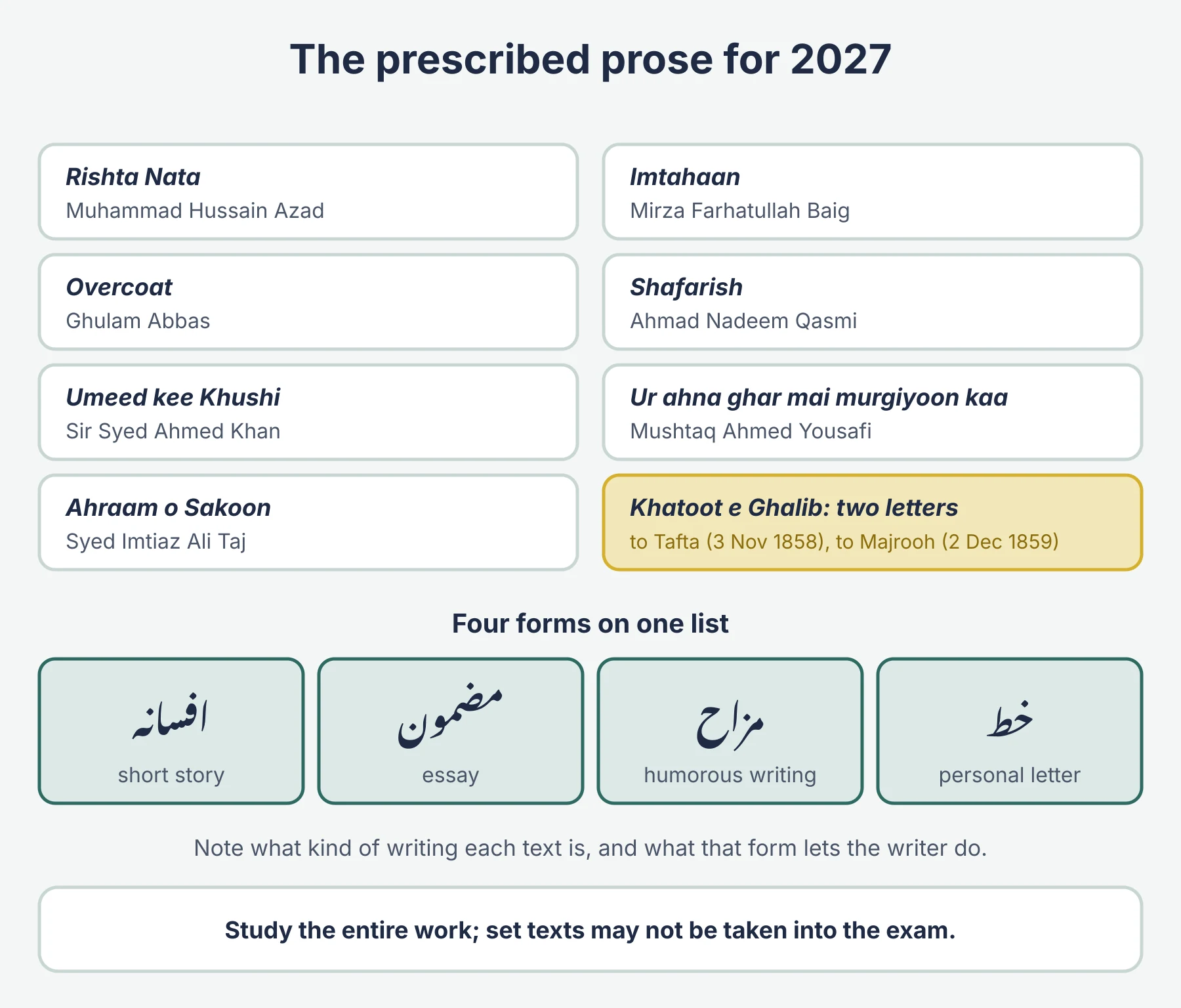
What the syllabus says you must show
- informed and appropriate personal response
- knowledge of the text through close reference and quotation
- understanding of themes, characters, relationships, situations, issues and attitudes
- understanding of the writer’s intentions and methods, including language
Four question shapes
| Shape | Build the answer on |
|---|---|
| Character | actions, speech, the narrator’s description, change over the text |
| Theme or idea | three or four key moments where the idea appears, each with method |
| Writer’s methods | the technique named (humour, satire, description) and its effects |
| Empathic | a character’s voice at a fixed moment, true to the text |
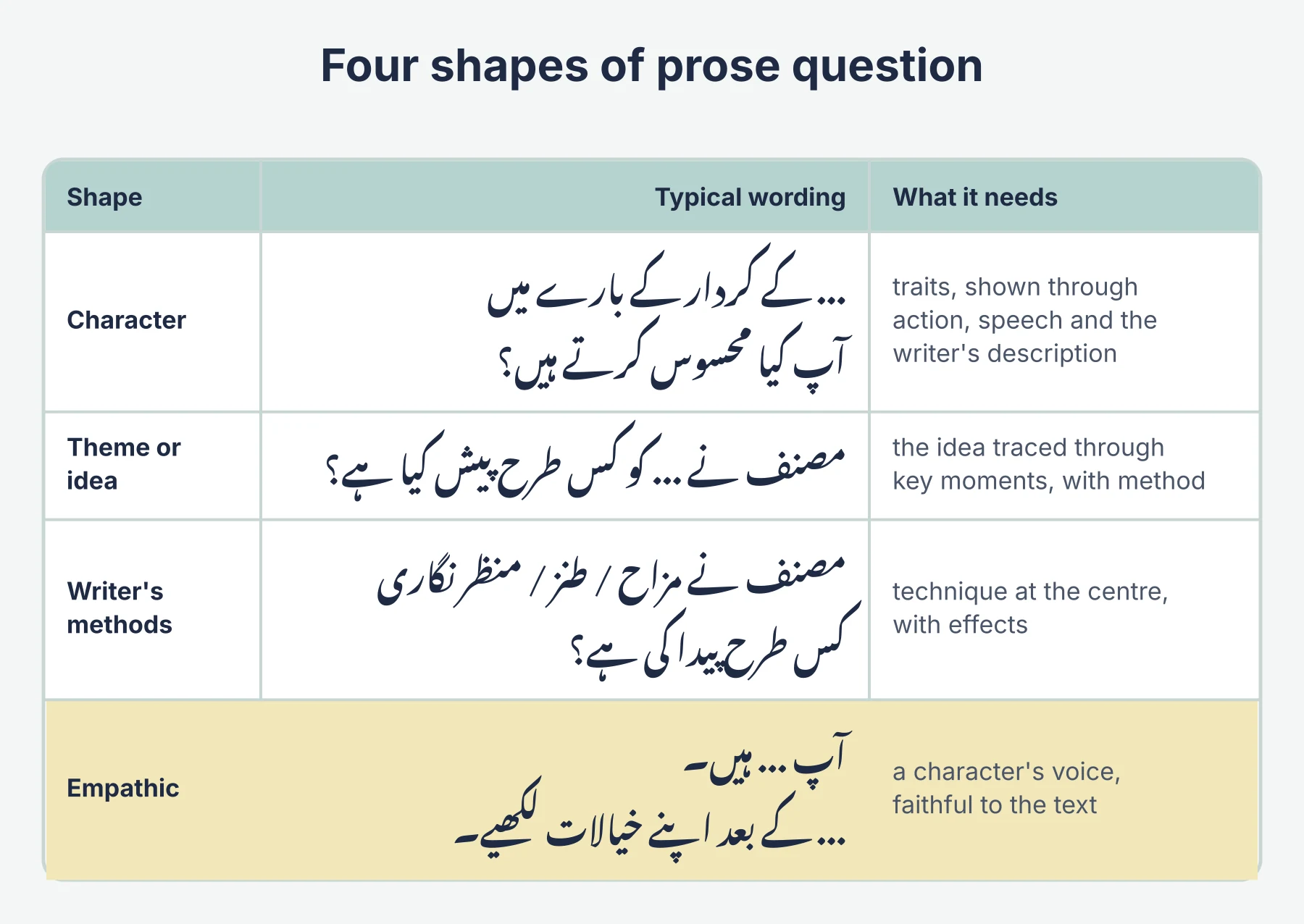
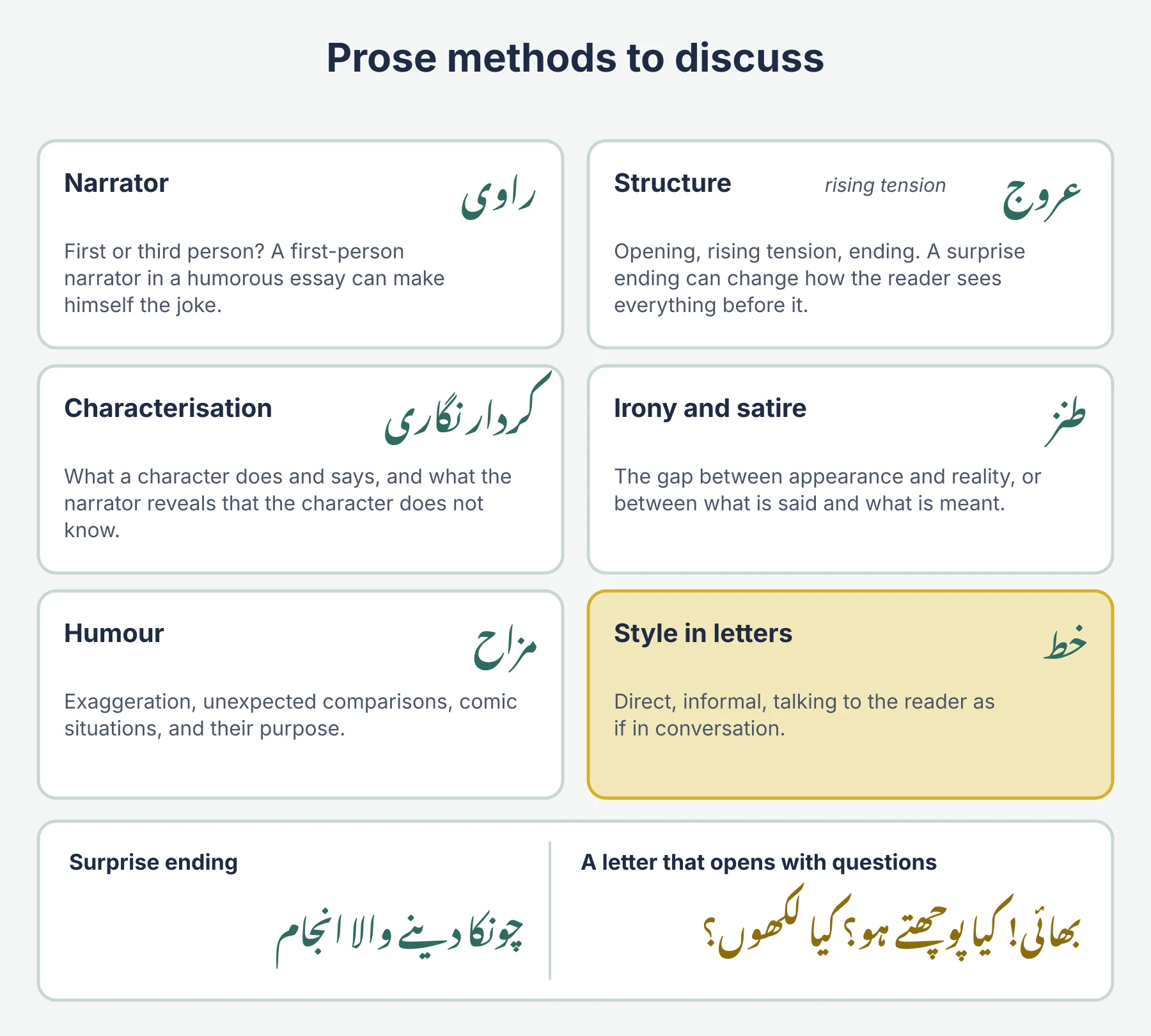
Prose methods: terms
| Term | Meaning | Ask |
|---|---|---|
| راوی | narrator | Who tells it, and how reliable or involved are they? |
| افسانہ / مضمون / خط | story / essay / letter | What does the form let the writer do? |
| عروج | climax | Where does tension peak? |
| چونکا دینے والا انجام | surprise ending | How does it change what came before? |
| کردار نگاری | characterisation | What is shown rather than told? |
| طنز | satire, irony | What gap between seeming and being is exposed? |
| مزاح | humour | What makes it funny, and what is its purpose? |
| منظر نگاری | description of setting | What mood or meaning does the setting carry? |
| مکالماتی انداز | conversational manner | How does direct address shape a letter? |
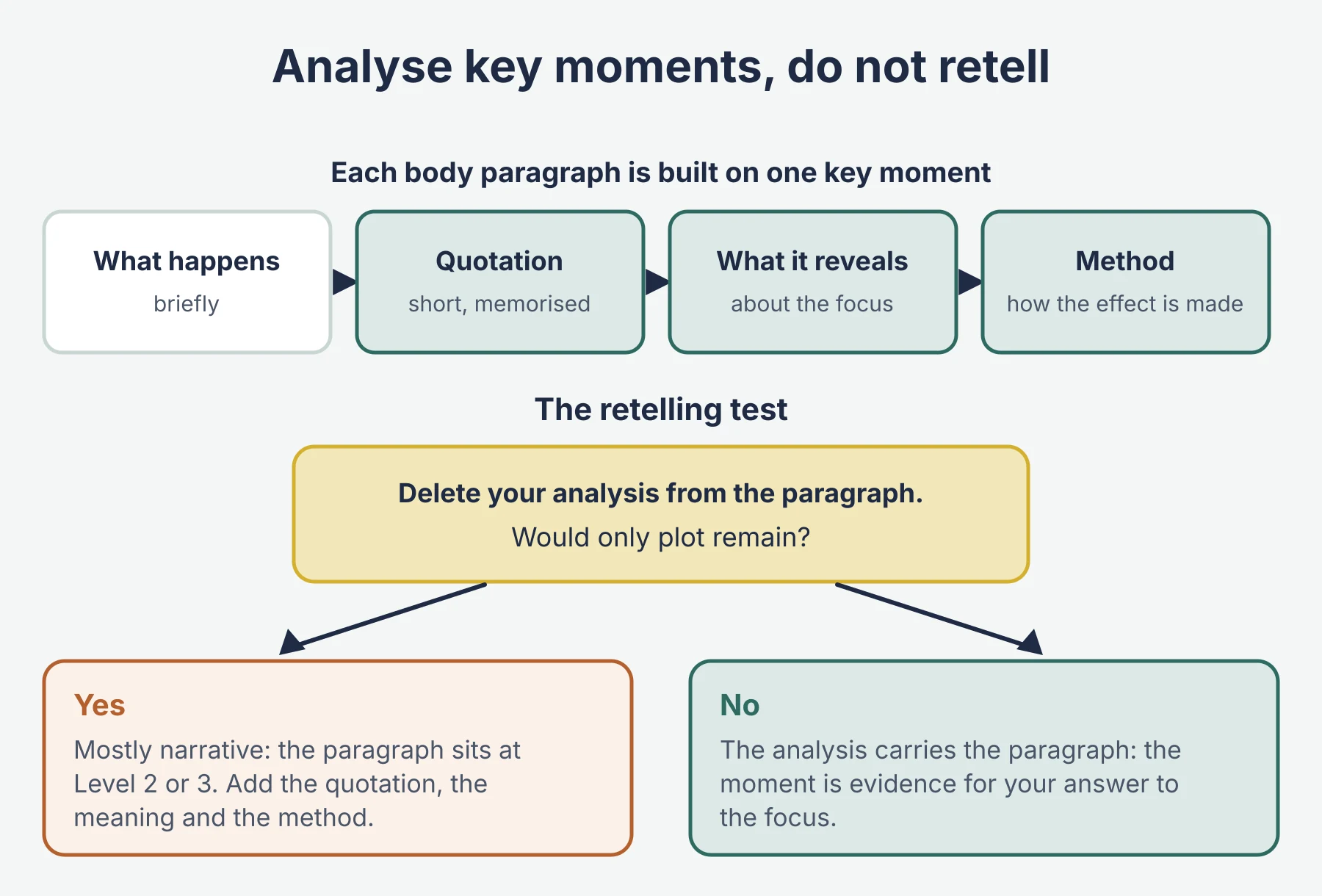
Analytical paragraph
Key moment – short quotation – what it reveals about the focus – method and effect – link back. The deletion test: remove your analysis; if only plot remains, rewrite.
Empathic task: the rules
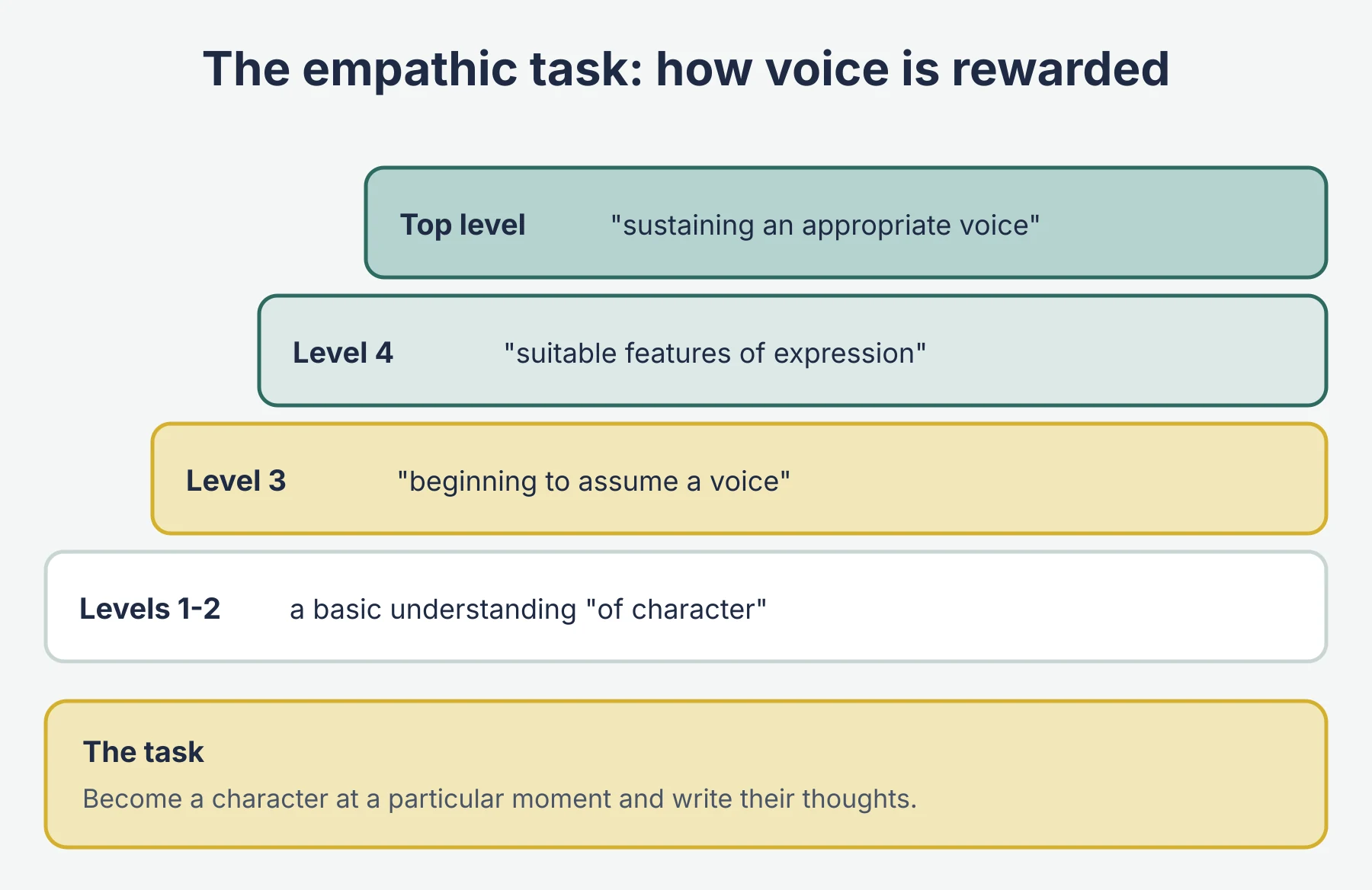
The mark scheme’s empathic wording climbs from understanding “of character” (Levels 1–2), to “beginning to assume a voice” (Level 3), to “suitable features of expression” (Level 4), to “sustaining an appropriate voice” (Level 5).
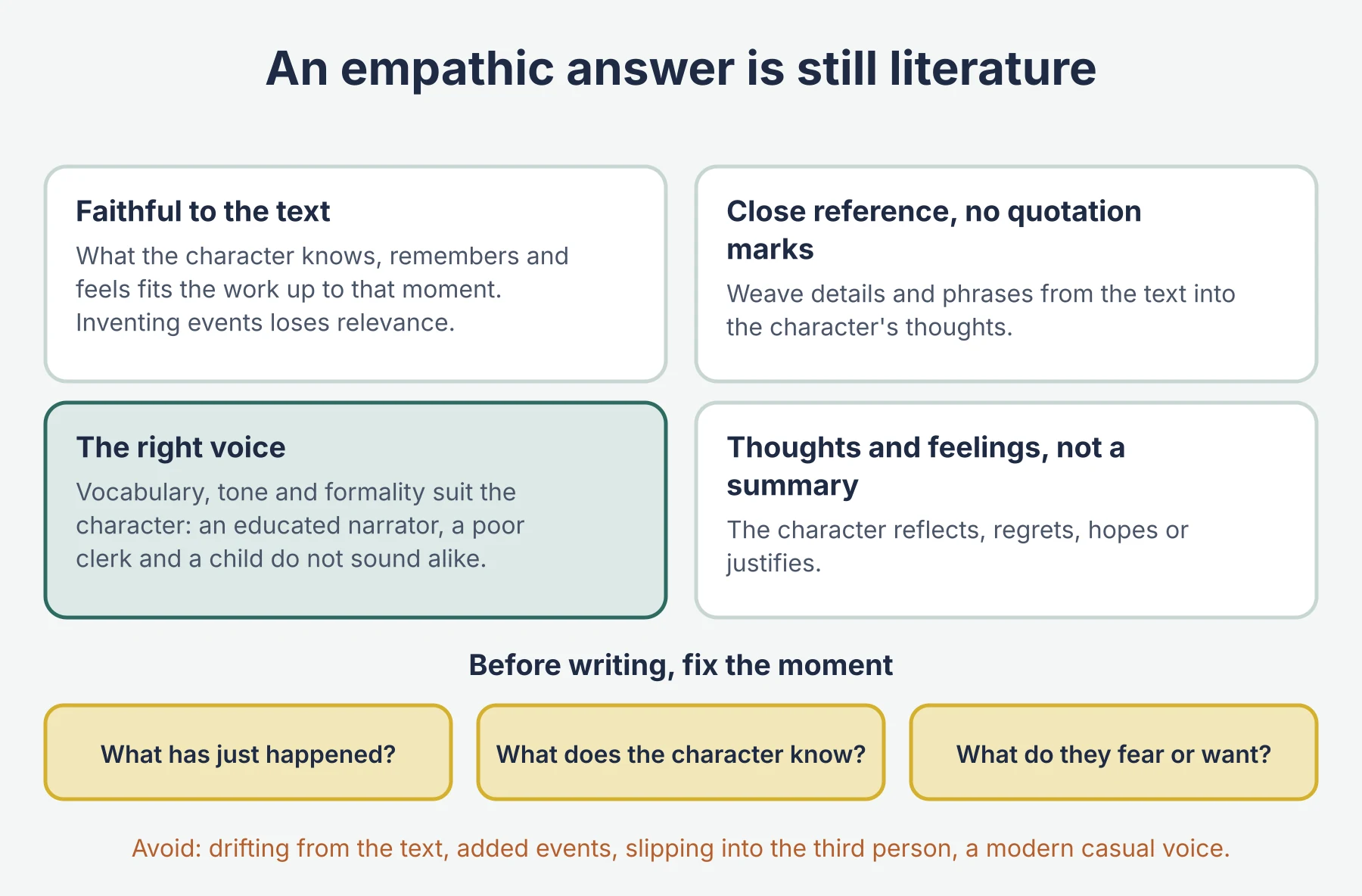
- Fix the moment: what has just happened; what the character knows and does not know.
- Stay faithful: no invented events; feelings consistent with the text.
- Find the voice: vocabulary, formality, rhythm that suit the character.
- Reflect: thoughts, memories, regrets, hopes; not a summary of the plot.
- Embed the text: details and phrases from the work inside the character’s thoughts.
- Stay in the first person from start to finish.
Choosing between the two questions
Check which text each question requires before reading the wording closely. Then ask: which focus can I support with at least three memorised references? Choose that one, even if the other question looks simpler. Depth of reference to the text decides the level; a simple-looking question on a text you know thinly will not reach Level 4.
Exam traps
- Retelling the plot.
- Picking the familiar text when the other question fits your knowledge better.
- “The essay is funny” with no analysis of how.
- Empathic answers that add events, leave the moment or switch to the third person.
- A voice that does not suit the character’s age, class or period.
- Biography of the writer in place of the text.
- No time left to check spelling and agreement.
Self-test
- How many prose items are prescribed for 2027, and how many questions do you answer in Part 3?
- Name the two Ghalib letters by recipient.
- Which four things does the syllabus say candidates must demonstrate?
- What is the top-level empathic descriptor?
- Give two rules for keeping an empathic answer a literature answer.
- What is the deletion test?
- What is a راوی, and why does it matter in a humorous essay?
- Name the four forms represented in the list.
- What should a character-question paragraph be built on?
- Can you write an empathic answer in the third person?
- What does the syllabus say about how much of each work should be studied?
Answers
- Eight; one question from a choice of two.
- Har Gopal Tafta and Mir Mahdi Majrooh.
- Personal response; knowledge of the text through reference and quotation; understanding of themes, characters, relationships, situations, issues and attitudes; understanding of the writer’s intentions and methods, including language.
- “Sustaining an appropriate voice in an empathic task.”
- Any two: stay faithful to events; fix the moment; embed details from the text; keep a voice that suits the character; reflect rather than summarise.
- Remove the analysis from a paragraph; if only plot remains, the paragraph is retelling.
- The narrator; a first-person narrator can be the target of the humour, which shapes its effect.
- Short story, essay, humorous writing, letter.
- The character’s actions, speech and the writer’s description at key moments.
- No: the task asks you to be the character, so stay in the first person.
- Unless otherwise specified, the entire work should be studied.
More resources on this topic
Related resources
-
Study guides
Cambridge O Level First Language Urdu (3247): Paper 2 Unseen Passage
How to read and write about the unseen Urdu prose or poetry extract in 3247 Paper 2 Part 1: using the prompts, analysing effects and reaching the top levels.
Urdu Language · Cambridge · O Level
Read guide -
Practice questions
Cambridge O Level First Language Urdu (3247): Paper 2 Unseen Passage – Practice Questions
Original unseen Urdu prose extracts with technique questions and a full 20-mark prompted question in the 3247 Paper 2 style, with model answers.
Urdu Language · Cambridge · O Level
Try questions -
Revision notes
Cambridge O Level First Language Urdu (3247): Paper 2 Unseen Passage – Revision Notes
Condensed notes on the 3247 Paper 2 Unseen Passage: the six levels, a reading method, Urdu literary terms and effects, traps and a self-test.
Urdu Language · Cambridge · O Level
Revise topic
Get free revision emails (optional)
Occasional emails with practice questions, worked explanations and links to free resources for the qualification and subjects you choose. No spam, and you can unsubscribe from any email. The free tools on this site never need an email.