
Revision Notes
Cambridge O Level First Language Urdu (3247): Paper 2 Poetry Essay – Revision Notes
Condensed notes for the 3247 Paper 2 Poetry essay: set poems, ghazal and nazm form terms, the five levels, paragraph method, traps and a self-test.
- Subject
- Urdu Language
- Level
- O LEVELS
- Topic
- Paper 2 – Texts
- Author
- Marlbridge Academic Team
- Updated
- Reviewed by
- Farheen Zehra (what this means)
Aligned to Cambridge O Level Urdu Language (3247), 2027. Official specification .
Syllabus page (what it covers and how it is assessed): Cambridge O Level Urdu Language.
Found an error? Report a correction.
Need help with this topic? Request a free trial class for O Level Urdu Language (3247 / 3248).
These notes cover Part 2 Poetry of 3247 Paper 2 Texts: “Two essay questions based on the prescribed set texts listed in the syllabus. Candidates answer one question.” For the paper and full set-text list see the Paper 2 Texts study guide; for the full method and a model paragraph see the Poetry essay study guide.
Core facts
- 15 marks; one essay from a choice of two.
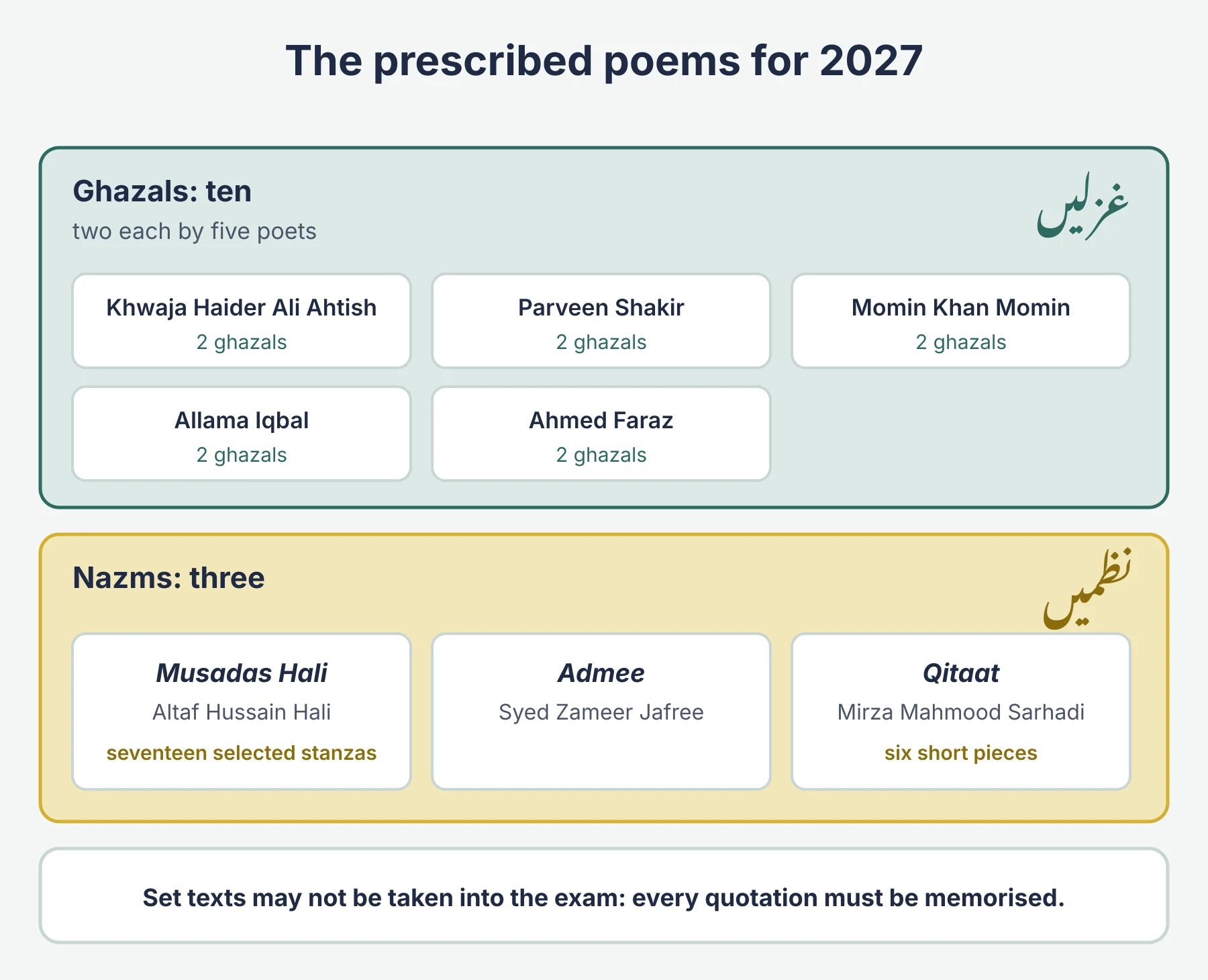
- Based on the prescribed poems only; set texts cannot be taken into the exam.
- 2027 list: ten ghazals (two each by Ahtish, Parveen Shakir, Momin, Iqbal, Faraz) and three nazms (Hali’s Musadas Hali, seventeen selected stanzas; Zameer Jafree’s Admee; Mahmood Sarhadi’s Qitaat). Check the syllabus for your year: set texts can change.
- Marked on a five-level scheme shared with the Prose essay.
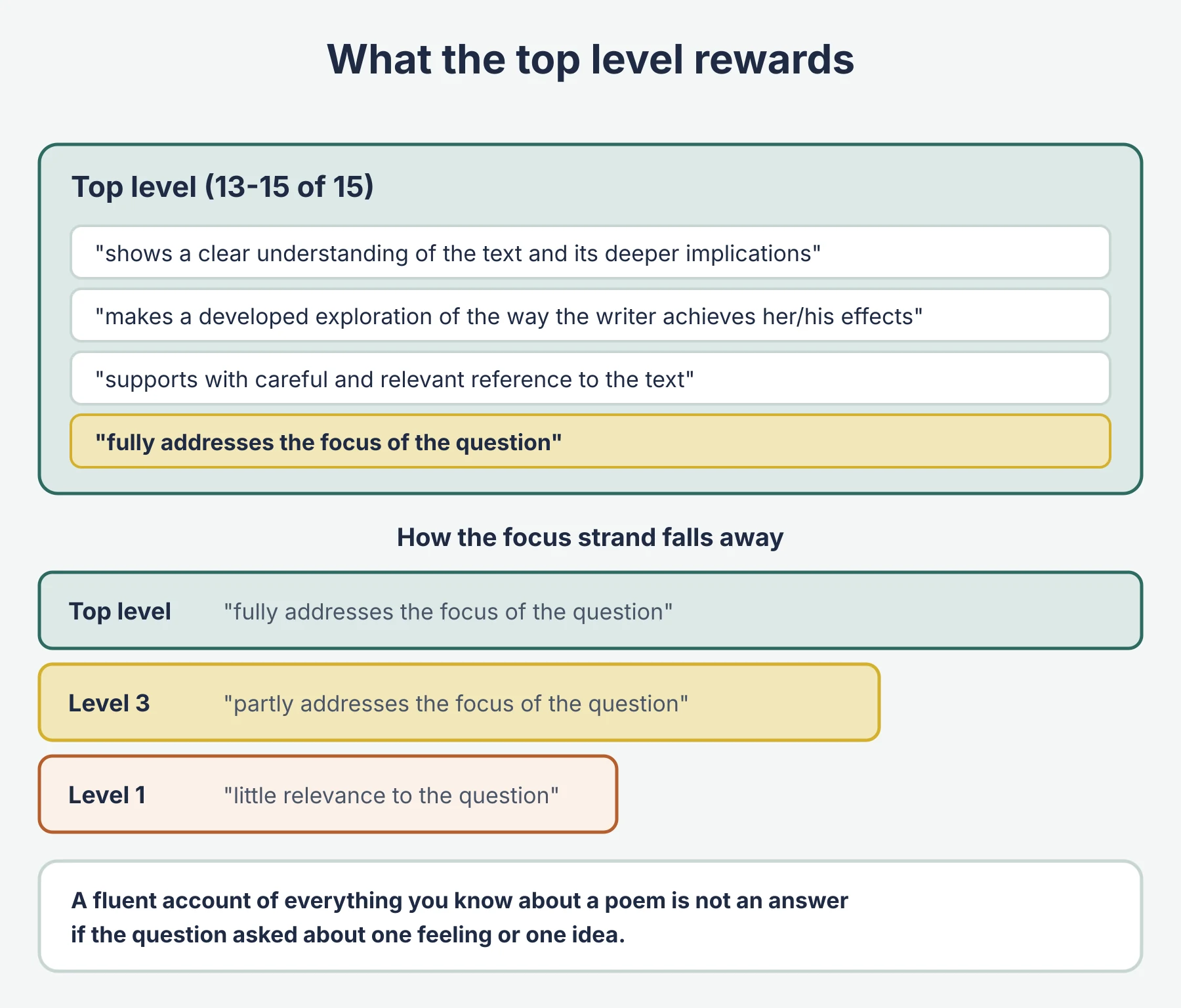
The five levels in key phrases
| Level | Marks | Key phrase |
|---|---|---|
| 5 | 13–15 | deeper implications; developed exploration of effects; careful, relevant reference; fully addresses the focus |
| 4 | 10–12 | some deeper implications; explores the way the writer uses language; some thoroughness of evidence; addresses the focus |
| 3 | 7–9 | some understanding; some reference to language; some detail; partly addresses the focus |
| 2 | 4–6 | basic surface meaning; a little reference; some attempt at the question |
| 1 | 1–3 | a few straightforward comments; little relevance |
Notice that “focus of the question” appears at every level.
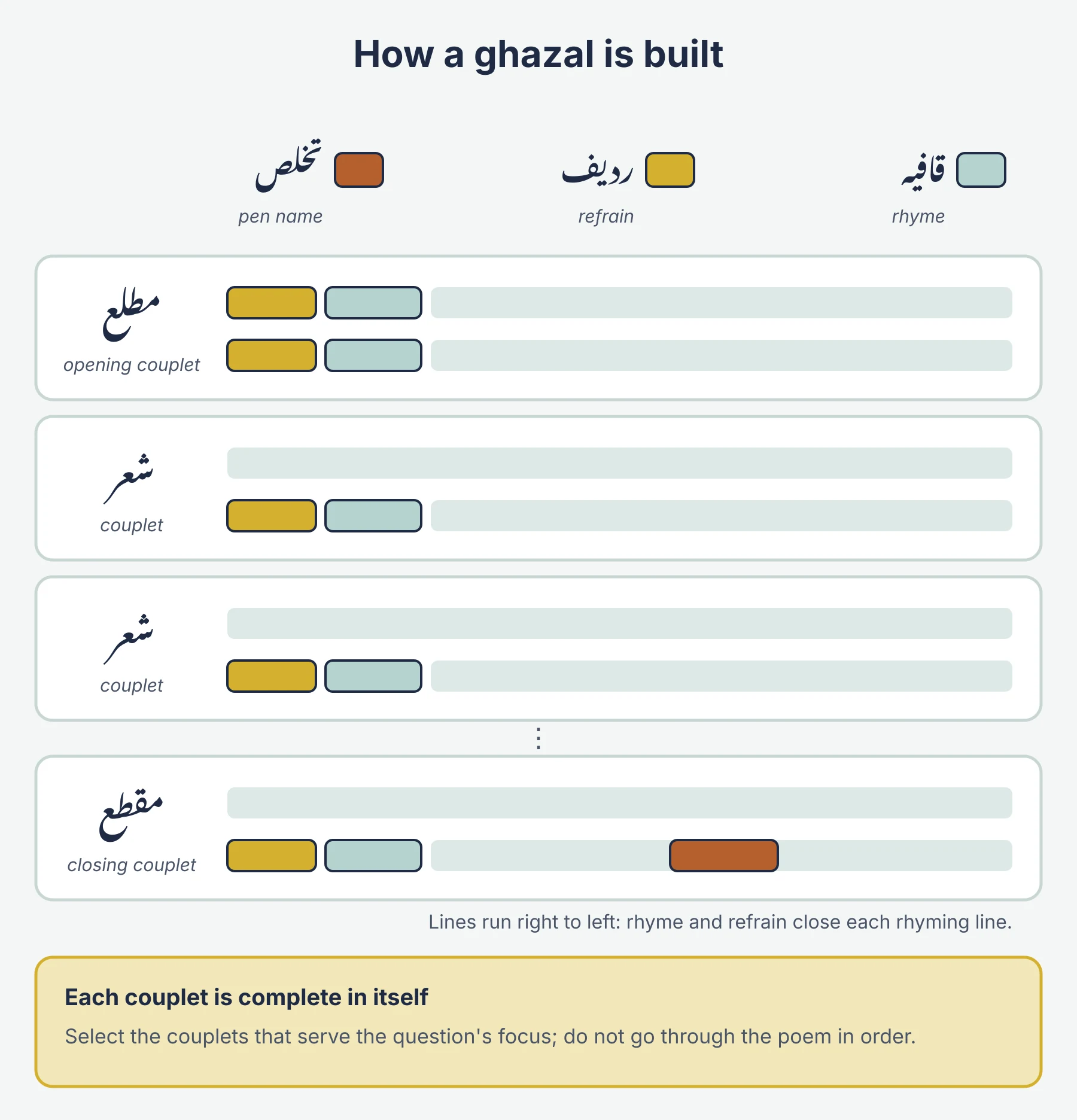
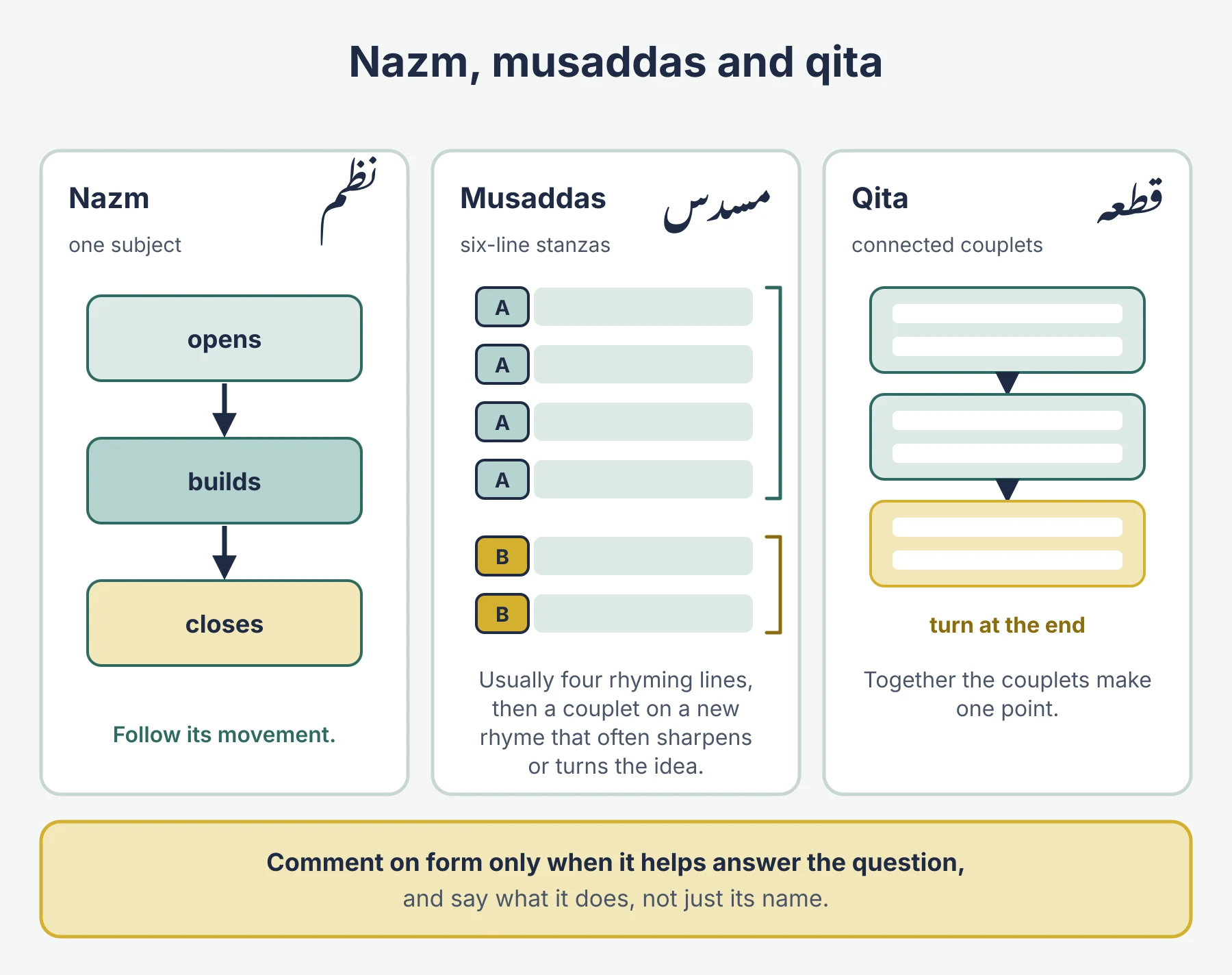
Form terms
| Term | Meaning | Use in an essay |
|---|---|---|
| شعر | couplet | the unit you analyse in a ghazal |
| مصرع | single line of a couplet | quote and compare the two lines |
| مطلع | opening couplet, both lines rhymed | how the ghazal announces its mood |
| مقطع | closing couplet with the pen name | the poet’s final stance |
| تخلص | pen name | the poet speaking of himself or herself |
| ردیف | refrain repeated at each couplet’s end | an idea the poem keeps returning to |
| قافیہ | rhyme before the refrain | sound that binds key words |
| نظم | poem developing one subject | follow its movement |
| مسدس | six-line stanza form | the closing couplet of each stanza turns or sharpens |
| قطعہ | short poem of connected couplets | one point, often a turn at the end |
Technique terms (with effect)
تشبیہ simile, استعارہ metaphor, تلمیح allusion, تضاد contrast, تکرار repetition, مبالغہ exaggeration, طنز satire, علامت symbol, لہجہ tone. Always add: what does it make the reader see, feel or think?
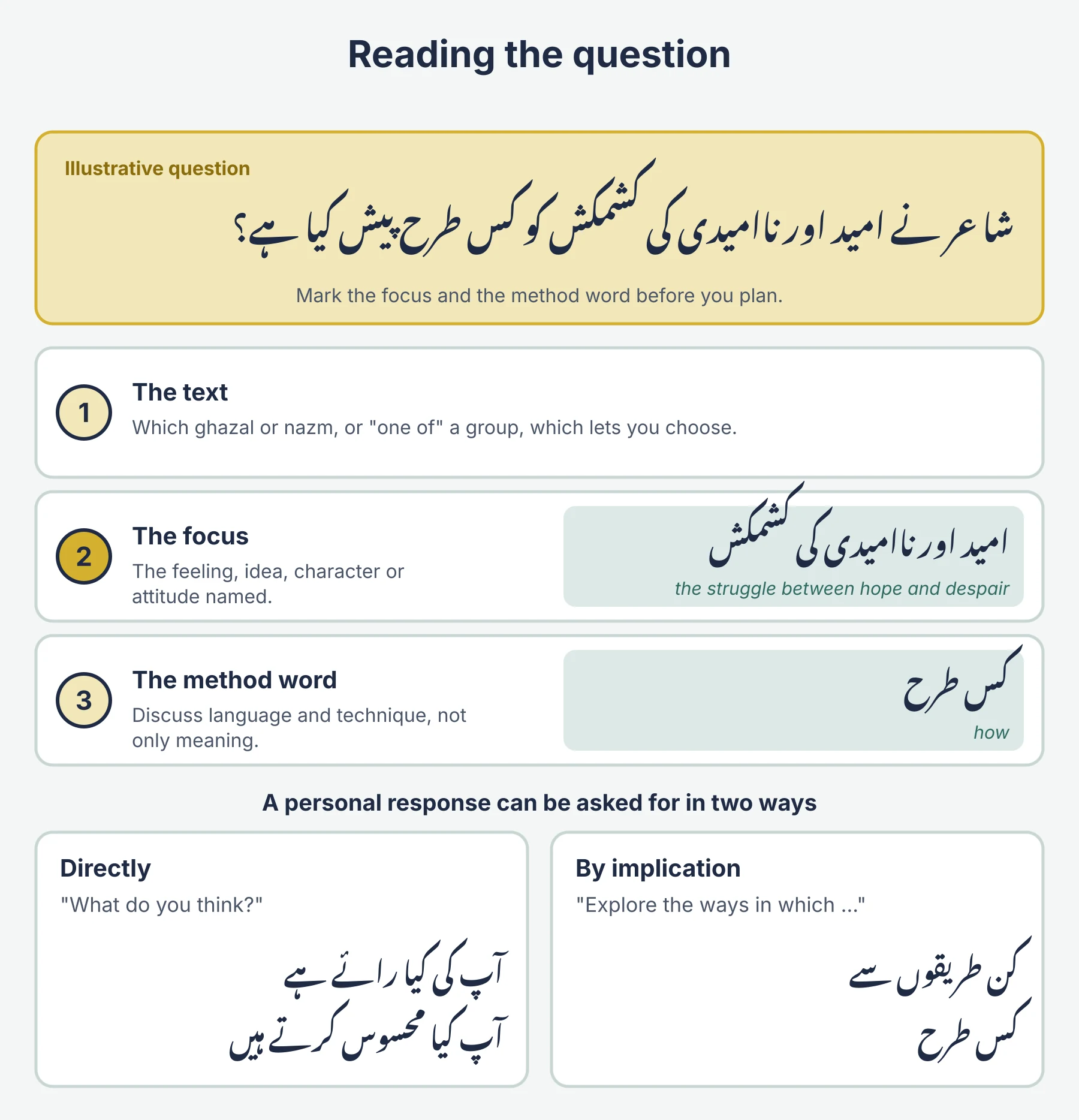
Question wording
- Direct: آپ کی کیا رائے ہے؟ / آپ کیا محسوس کرتے ہیں؟ (“What do you think?”, “What are your feelings about …?”)
- By implication: … کن طریقوں سے … / کس طرح (“Explore the ways in which …”)
- Mark: the text, the focus, the method word.
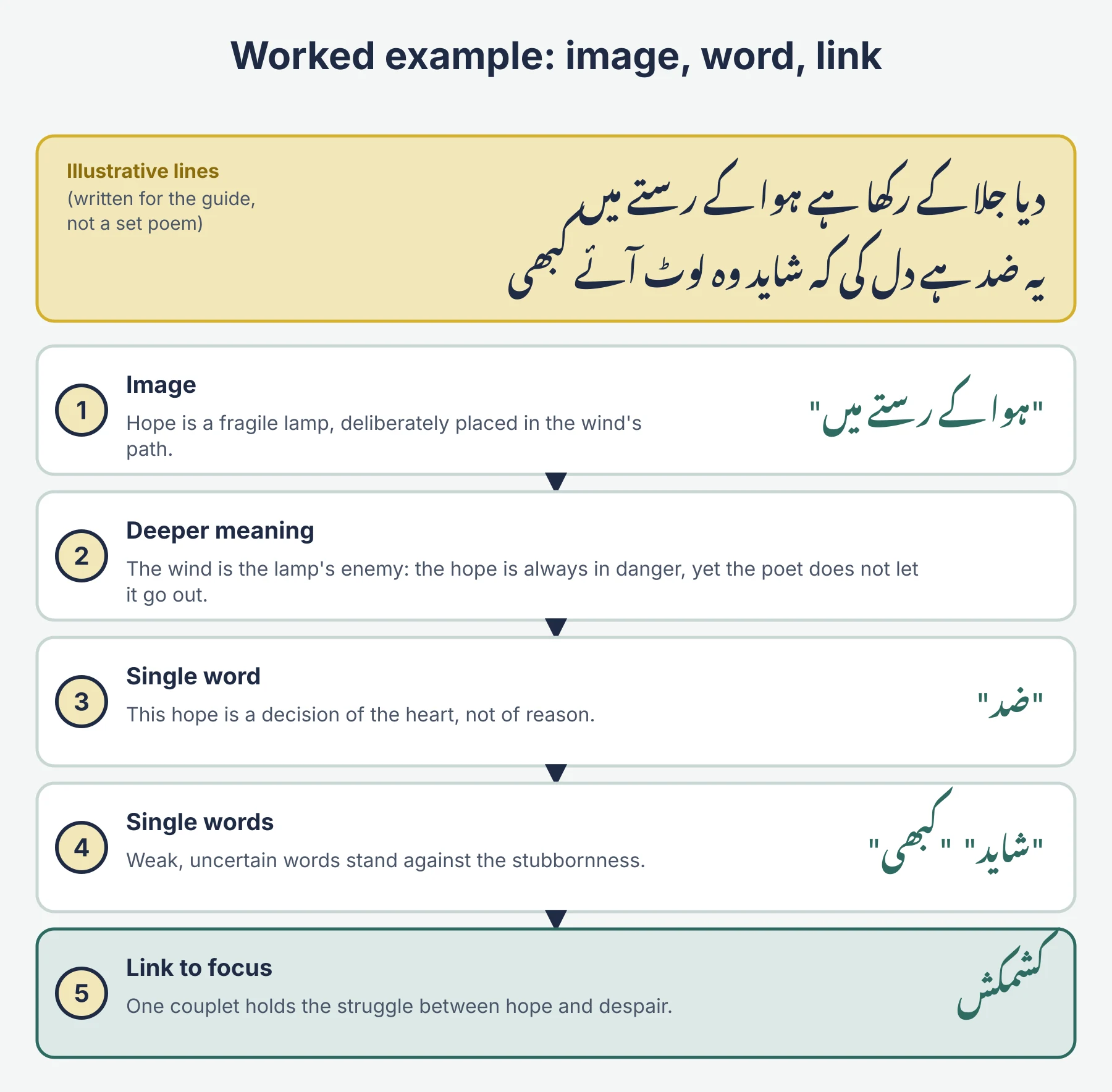
Paragraph method
Point (on the focus) – short quotation – literal meaning – deeper meaning – method and effect – link back.
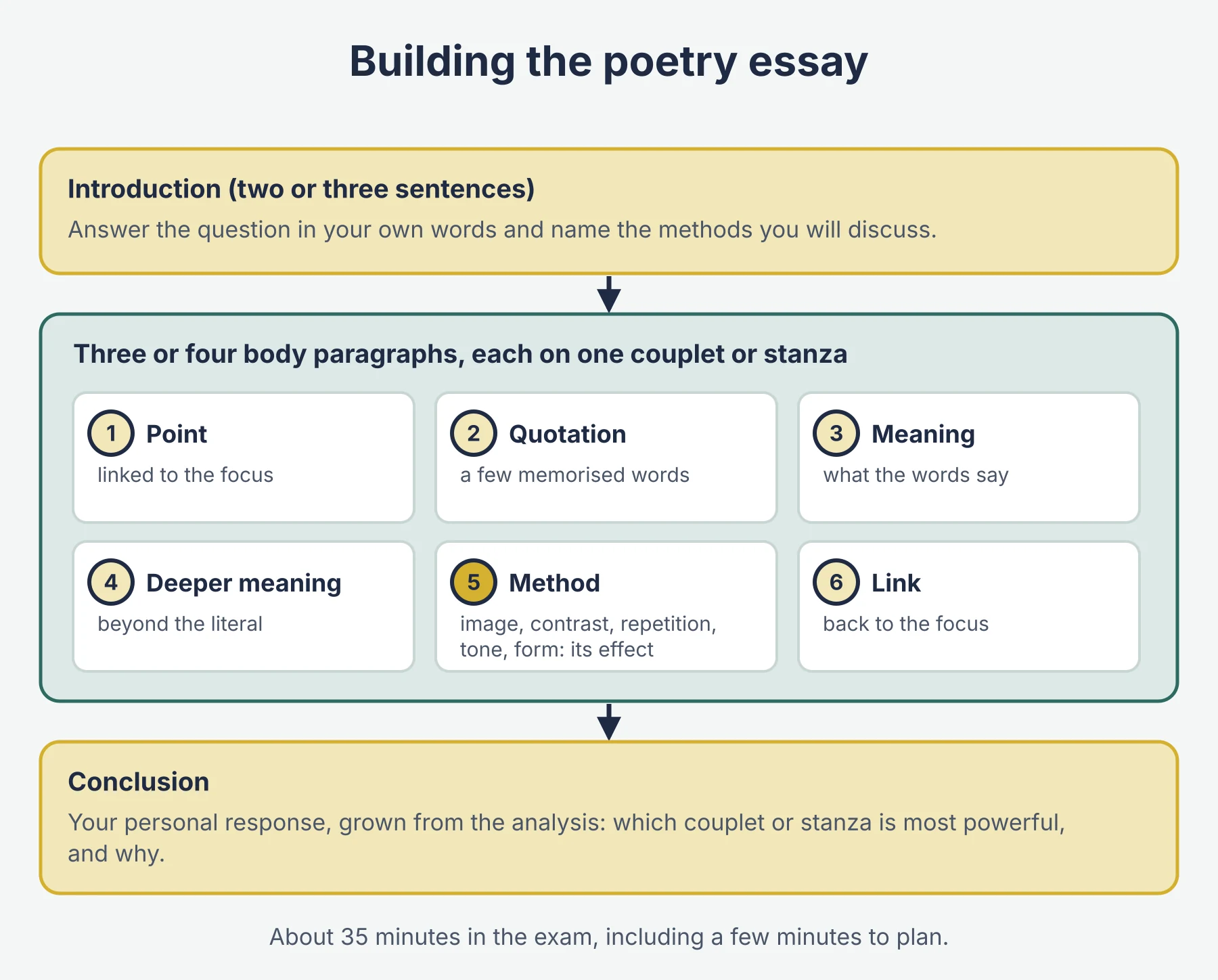
Ghazal vs nazm essay plan
| Ghazal | Nazm |
|---|---|
| select 3–4 couplets that fit the focus | follow opening, development and close |
| each couplet one paragraph | each stage one paragraph |
| comment on refrain if it carries the focus | comment on stanza endings and turns |
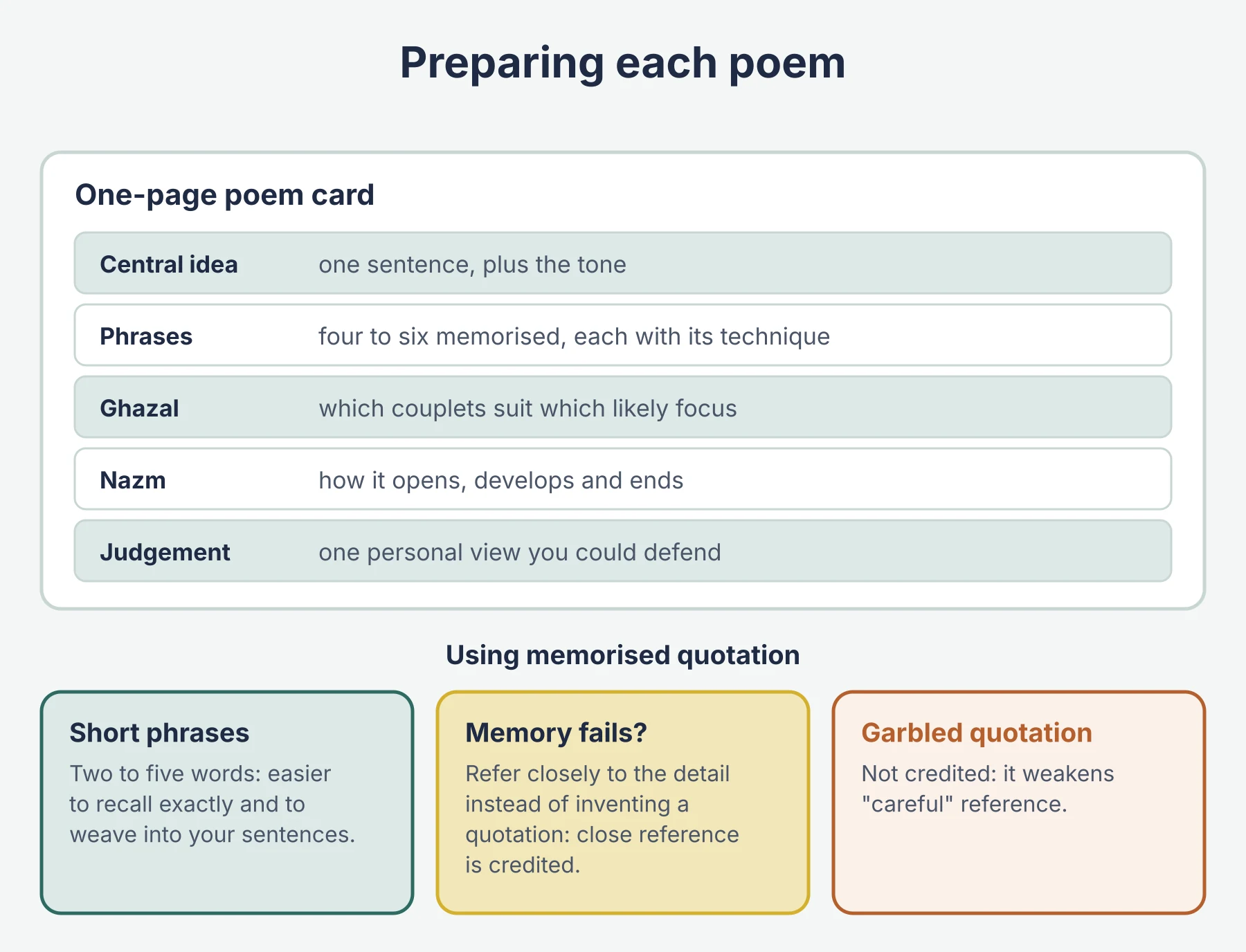
Poem card (one per poem)
Central idea · tone · 4–6 memorised phrases with techniques · likely focuses · one judgement.
Coverage
The Paper 2 study guide recommends knowing about six of the ten ghazals and two of the three nazms in close detail, so that both questions stay open on the day.
Exam traps
- Summary instead of argument.
- Couplets chosen for memory, not for the focus.
- Whole couplets copied, no analysis.
- Form named without effect.
- Biography in place of response.
- Misquotation.
- No personal view when the question asks for one.
- Overrunning: about 35 minutes is a fair share for 15 of 50 marks.
Self-test
- How many Poetry questions are set, and how many do you answer?
- Name the poets of the ten prescribed ghazals.
- What is a مقطع?
- Why is a ghazal essay built by selecting couplets rather than by working through in order?
- What is the stanza shape of a مسدس?
- Which phrase appears in every level of the mark scheme?
- What are the three things to mark in a question before planning?
- Give an Urdu wording that asks for a personal response directly.
- What is a ردیف, and when is it worth discussing?
- What does a poem card contain?
- Can you bring the text into the exam?
- How many of the ghazals and nazms does the Paper 2 guide suggest knowing closely?
Answers
- Two; one.
- Khwaja Haider Ali Ahtish, Parveen Shakir, Momin Khan Momin, Allama Iqbal, Ahmed Faraz.
- The closing couplet of a ghazal, usually containing the poet’s pen name.
- Each couplet is complete in itself and may treat a different mood, so only some couplets fit a given focus.
- Six lines, usually four rhyming lines followed by a couplet on a new rhyme.
- The focus of the question (fully, partly, little relevance).
- The text, the focus and the method word.
- آپ کی کیا رائے ہے؟ or آپ کیا محسوس کرتے ہیں؟
- The refrain repeated at the end of each couplet; worth discussing when the repeated words carry the idea the question asks about.
- Central idea, tone, memorised phrases with techniques, likely focuses, a judgement.
- No: set texts may not be taken into the examination.
- About six of the ten ghazals and two of the three nazms.
More resources on this topic
Related resources
-
Study guides
Cambridge O Level First Language Urdu (3247): Paper 2 Prose Essay and Empathic Task
Answering the 15-mark prose question on the stories, essays and letters set for 3247 Paper 2 Part 3, including the empathic task in a character's voice.
Urdu Language · Cambridge · O Level
Read guide -
Practice questions
Cambridge O Level First Language Urdu (3247): Paper 2 Prose Essay and Empathic Task – Practice Questions
Original prose and empathic tasks on an illustrative Urdu story, plus full 15-mark questions on the 3247 Paper 2 prescribed prose, with answers.
Urdu Language · Cambridge · O Level
Try questions -
Revision notes
Cambridge O Level First Language Urdu (3247): Paper 2 Prose Essay and Empathic Task – Revision Notes
Condensed notes for the 3247 Paper 2 Prose question: the eight set items, question shapes, prose methods, empathic voice rules and a self-test.
Urdu Language · Cambridge · O Level
Revise topic
Get free revision emails (optional)
Occasional emails with practice questions, worked explanations and links to free resources for the qualification and subjects you choose. No spam, and you can unsubscribe from any email. The free tools on this site never need an email.