
Study Guides
Cambridge O Level Second Language Urdu (3248): Exercise 2 Multiple-choice Cloze Passage
The grammar behind the 3248 Paper 2 Exercise 2 cloze: verb forms, agreement and ne, comparatives, postpositions and word choice, with a worked Urdu passage.
- Subject
- Urdu Language
- Level
- O LEVELS
- Topic
- Paper 2 – Grammar, Writing and Translation
- Author
- Marlbridge Academic Team
- Updated
- Reviewed by
- Farheen Zehra (what this means)
Aligned to Cambridge O Level Urdu Language (3248), 2027-2029. Official specification .
Syllabus page (what it covers and how it is assessed): Cambridge O Level Urdu Language.
Found an error? Report a correction.
Need help with this topic? Request a free trial class for O Level Urdu Language (3247 / 3248).
This guide covers Exercise 2 of Cambridge O Level Second Language Urdu 3248 Paper 2 Grammar, Writing and Translation: the Multiple-choice cloze passage. The syllabus says candidates “read a short text with gaps to be filled from multiple-choice options”, and that the exercise “tests the application of grammatical usage in context, such as conjugation of verbs, subject/verb agreement, comparatives, superlatives, parts of speech, nouns, prepositions, post positions, articles and vocabulary appropriate to the context”. It is worth 10 marks, tests R2, W3, W4 and W5, and is entirely in Urdu. For the whole paper, start with the Paper 2 Grammar, Writing and Translation study guide. This page works through the grammar points themselves.
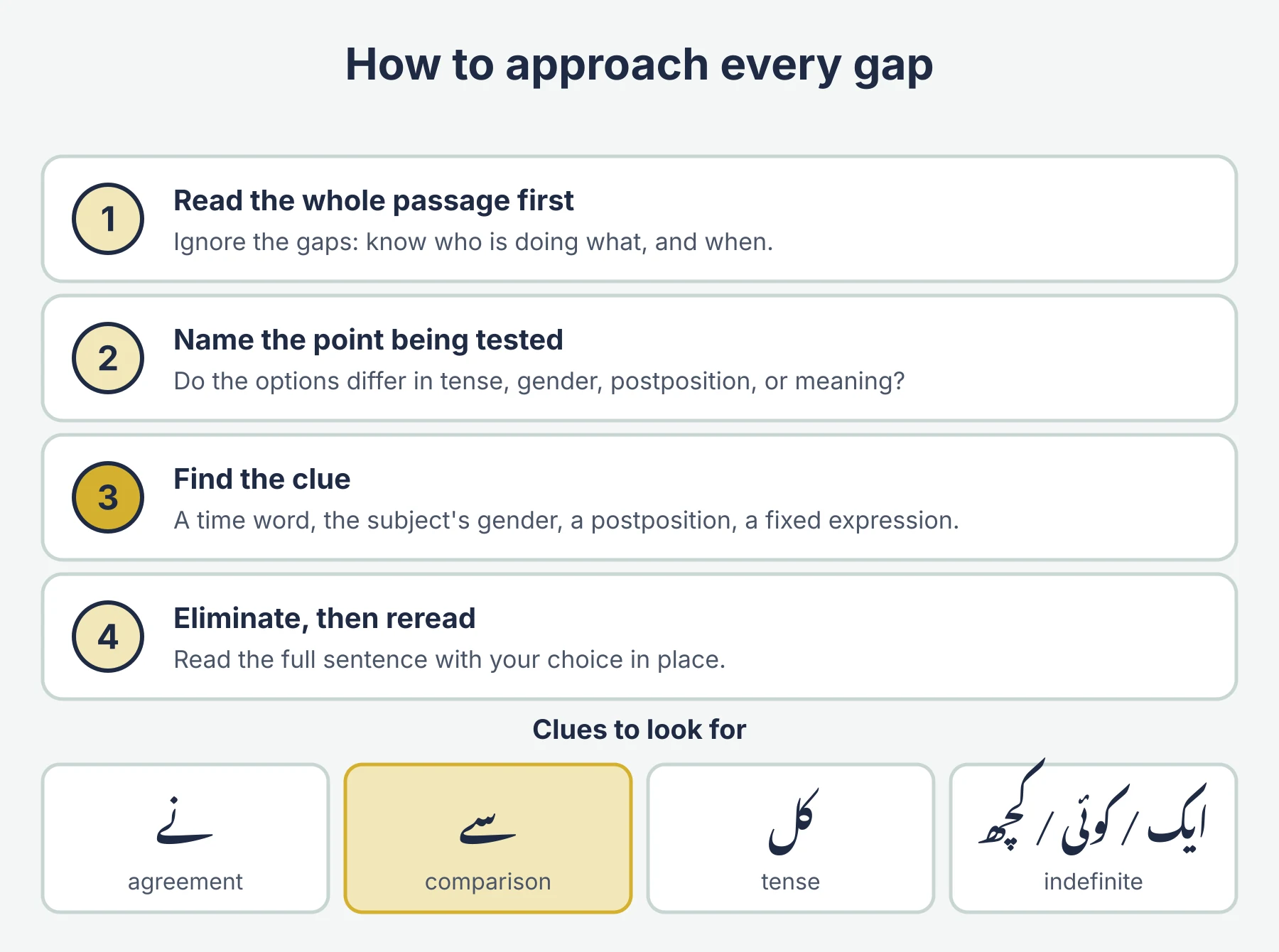
How to approach every gap
- Read the whole passage first, ignoring the gaps, to know who is doing what and when.
- Name the point being tested. Are the options different tenses? Different genders? Different postpositions? Different words with related meanings?
- Find the clue. A time word, the subject’s gender, a نے, a سے of comparison, a fixed expression.
- Eliminate, then read the full sentence with your choice in place.
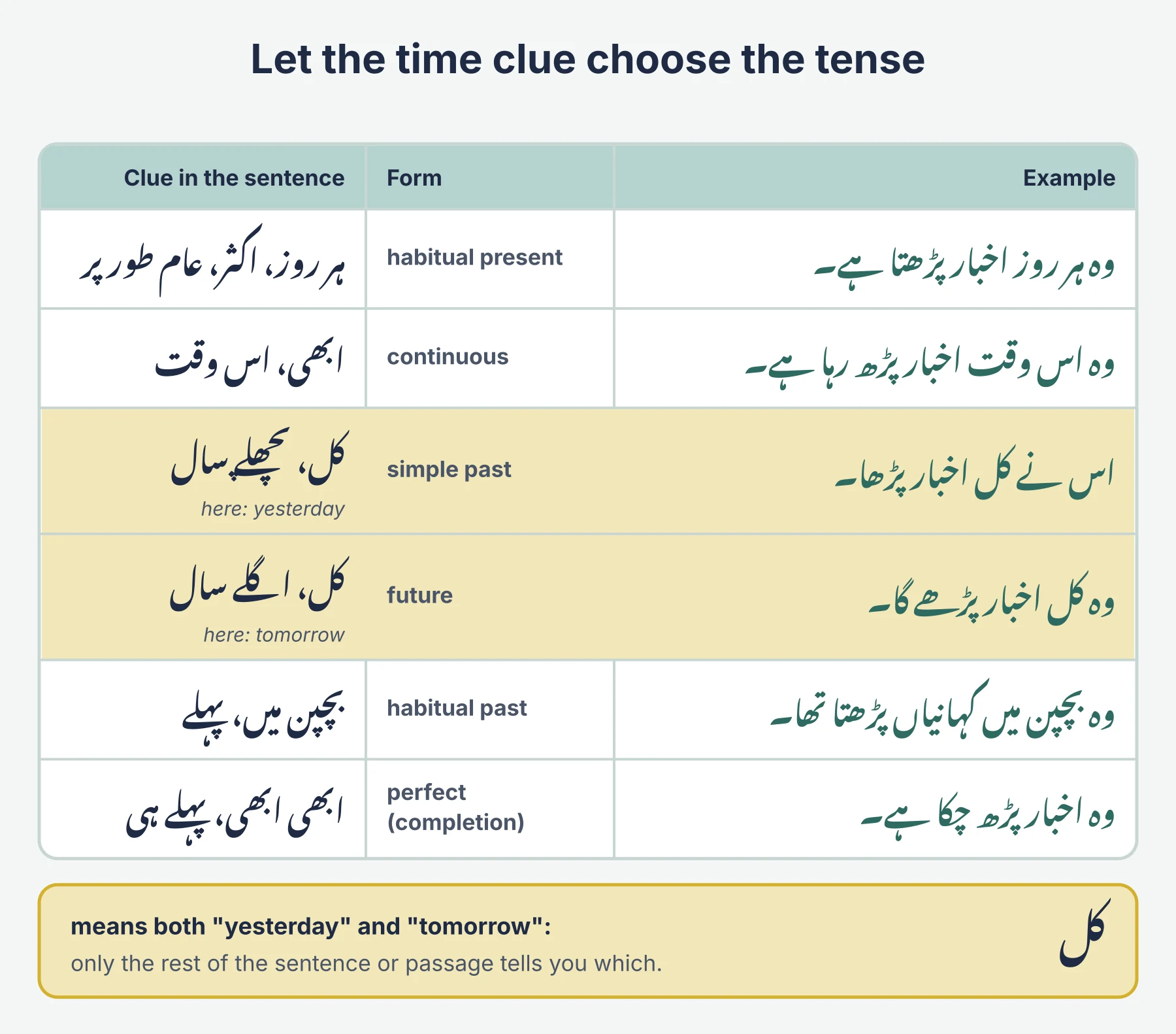
Verb conjugation: tense and aspect
| Clue in the sentence | Form | Example |
|---|---|---|
| ہر روز، اکثر، عام طور پر | habitual present | وہ ہر روز اخبار پڑھتا ہے۔ |
| ابھی، اس وقت | continuous | وہ اس وقت اخبار پڑھ رہا ہے۔ |
| کل (past), پچھلے سال | simple past | اس نے کل اخبار پڑھا۔ |
| کل (future), اگلے سال | future | وہ کل اخبار پڑھے گا۔ |
| بچپن میں، پہلے | habitual past | وہ بچپن میں کہانیاں پڑھتا تھا۔ |
| completion: ابھی ابھی، پہلے ہی | perfect with چکا | وہ اخبار پڑھ چکا ہے۔ |
Note that کل means both “yesterday” and “tomorrow”; only the rest of the sentence or passage tells you which, so the full-passage reading in step 1 matters.
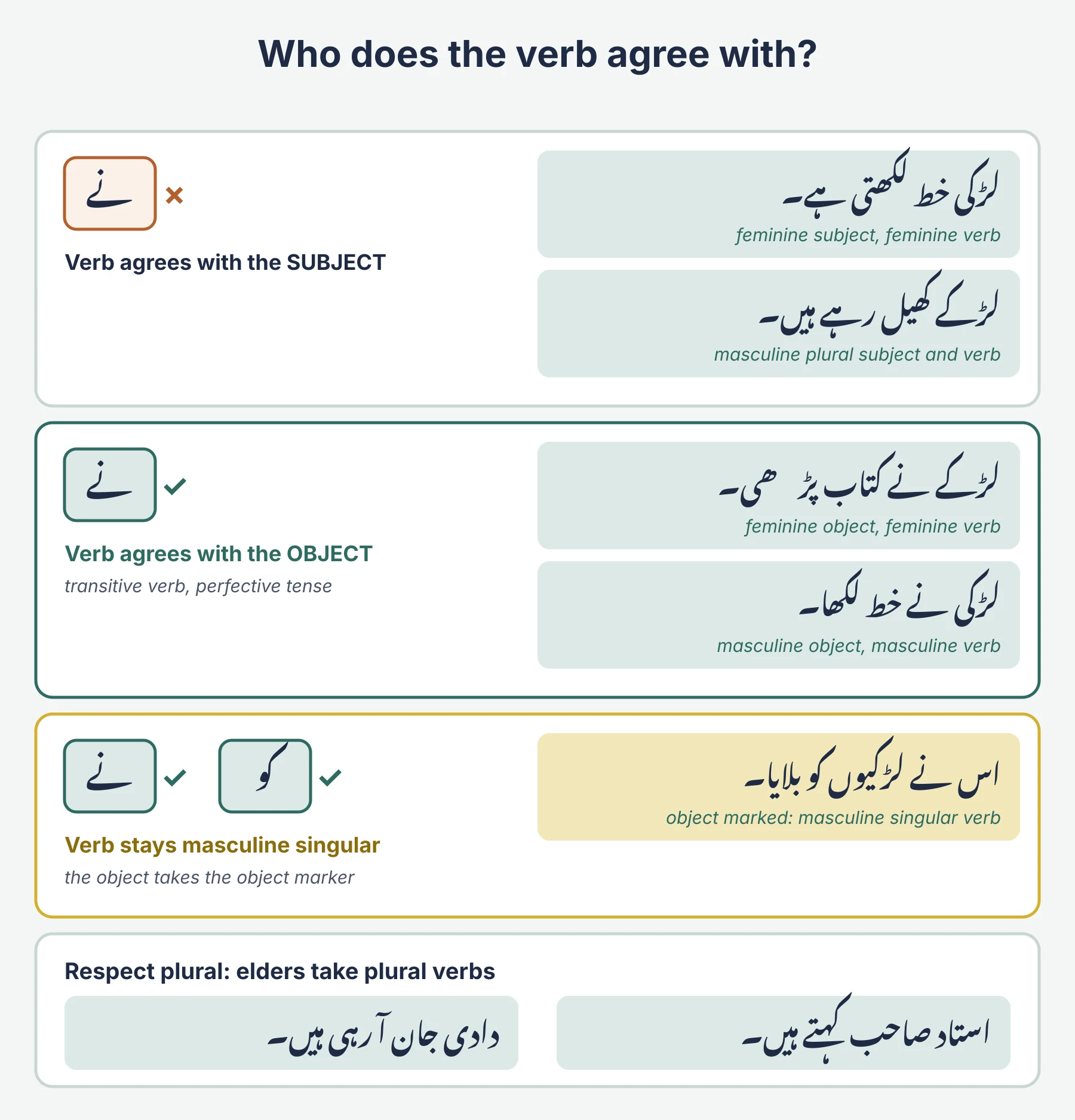
Subject/verb agreement and نے
Urdu verbs agree in gender and number.
- Without نے, the verb agrees with the subject: لڑکی خط لکھتی ہے۔ / لڑکے کھیل رہے ہیں۔
- With نے (transitive verb in a perfective tense), the verb agrees with the object: لڑکے نے کتاب پڑھی۔ (feminine کتاب) / لڑکی نے خط لکھا۔ (masculine خط).
- If the object takes کو, the verb stays masculine singular: اس نے لڑکیوں کو بلایا۔
A cloze option set such as پڑھا / پڑھی / پڑھے is almost always testing this rule. Look left for نے, then find the object.
Respect plural. Elders and people addressed with respect take plural verb forms: دادی جان آ رہی ہیں۔ / استاد صاحب کہتے ہیں۔ An option in the singular here is a register error as well as an agreement error.
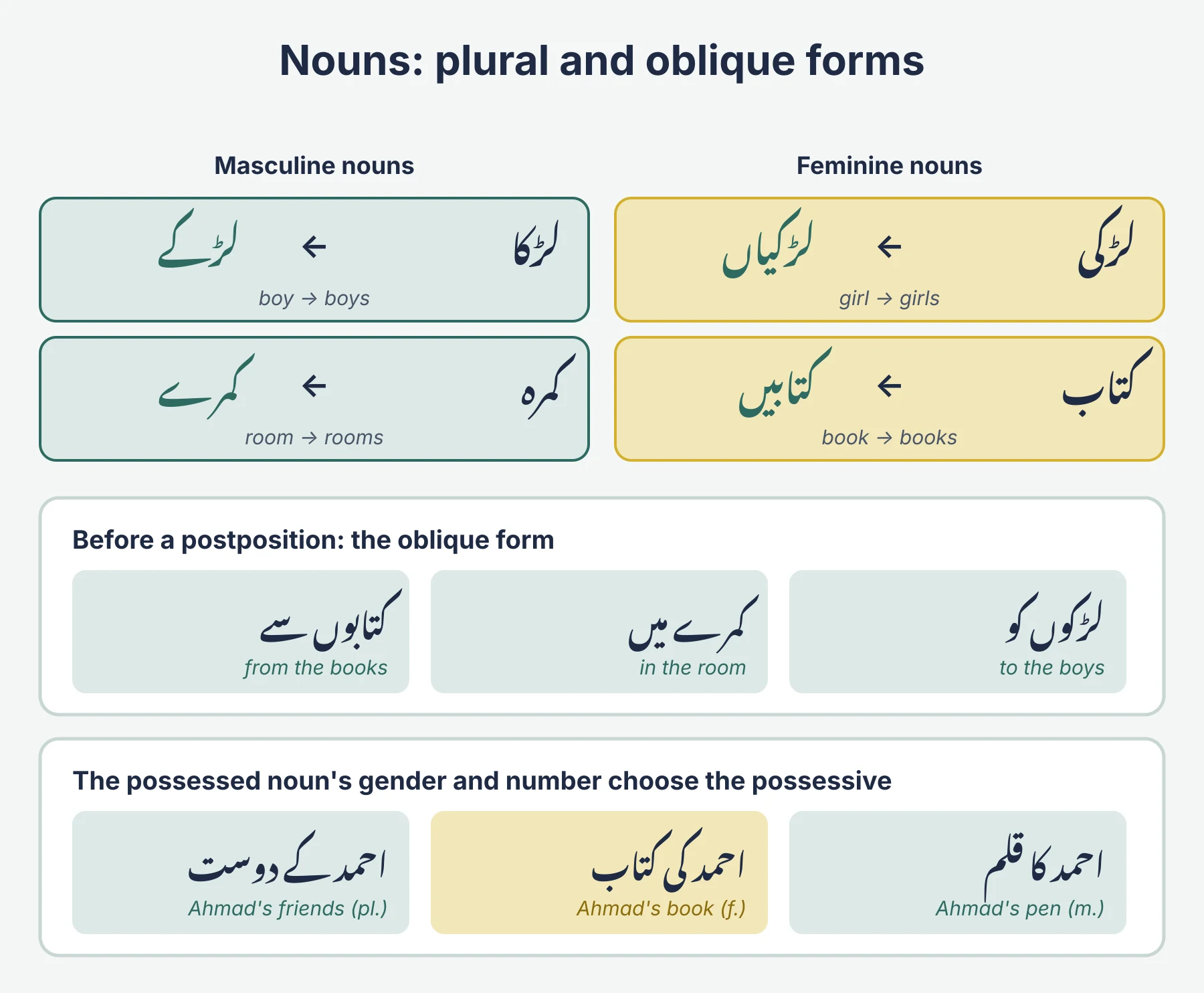
Nouns: gender, number and the oblique form
- Masculine nouns in ا or ہ change in the plural: لڑکا → لڑکے، کمرہ → کمرے.
- Feminine nouns in ی take اں: لڑکی → لڑکیاں; most others take یں: کتاب → کتابیں.
- Before a postposition, nouns take the oblique form: لڑکوں کو، کمرے میں، کتابوں سے.
Gender also governs کا / کی / کے: احمد کی کتاب، احمد کا قلم، احمد کے دوست.
Comparatives and superlatives
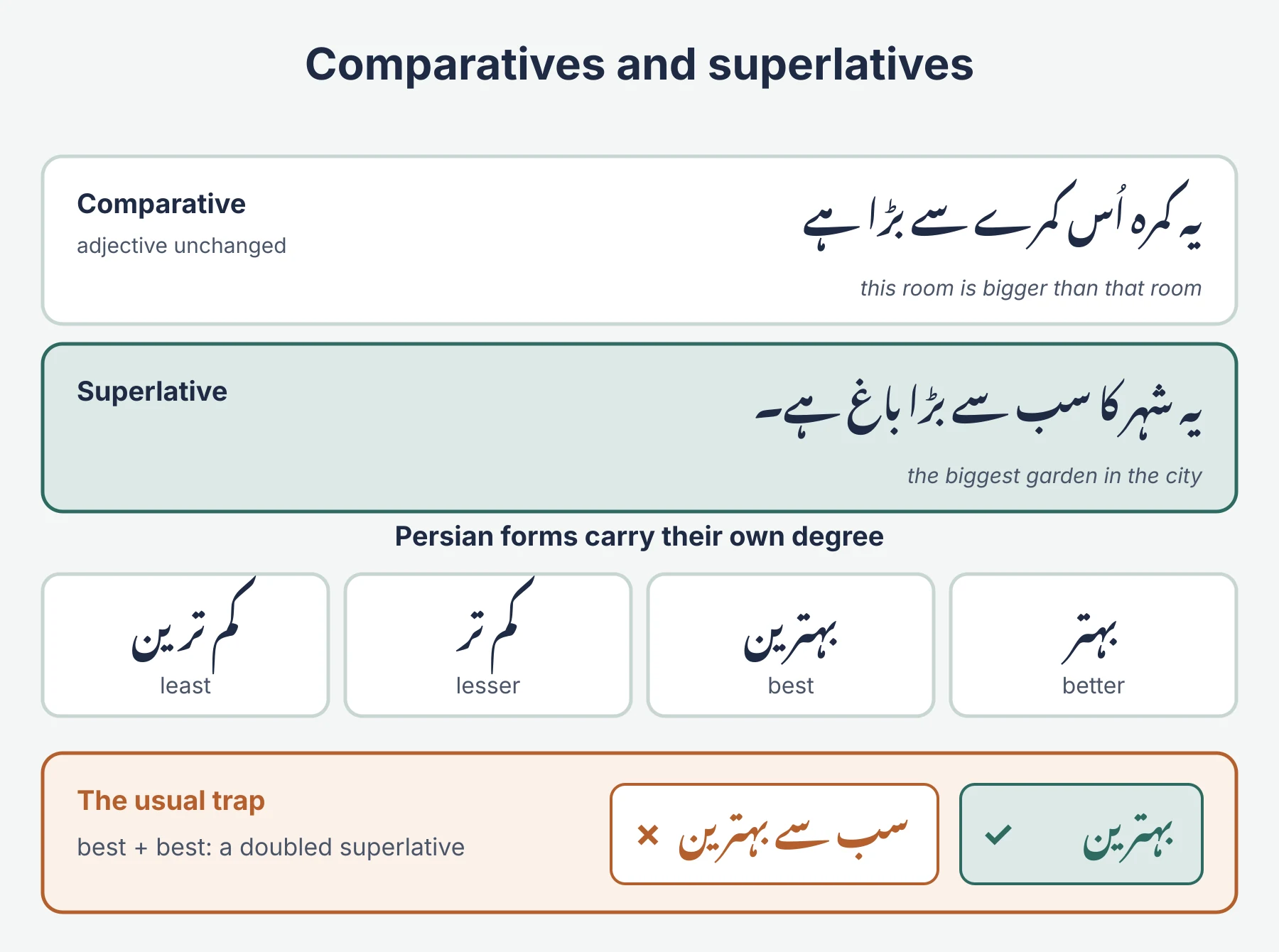
Urdu compares with سے placed after the thing compared against, and the adjective itself does not change: یہ کمرہ اُس کمرے سے بڑا ہے (this room is bigger than that room). So in a cloze, the gap after the second noun is usually سے, not میں or کو. Superlatives use سب سے: یہ شہر کا سب سے بڑا باغ ہے۔ زیادہ and کم also compare: یہ سوال زیادہ مشکل ہے۔
Persian forms carry their own degree: بہتر (better), بہترین (best), کم تر، کم ترین. Because بہترین already means “best”, careful writers avoid adding سب سے to it, so an option سب سے بہترین is usually the trap.
Feminine plural and respect forms
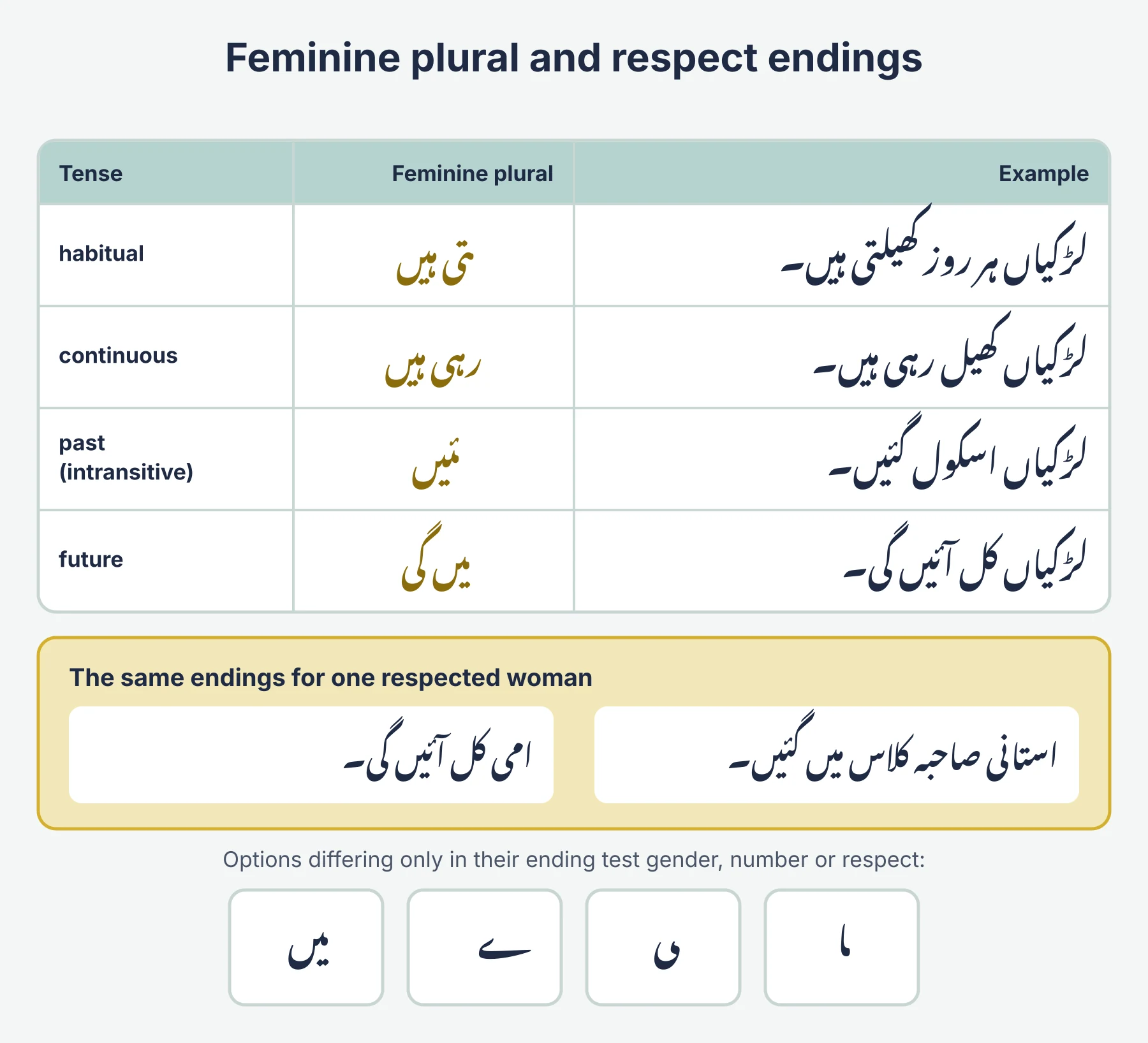
Feminine plural subjects change the verb ending, and so do respected feminine subjects:
| Tense | Feminine plural | Example |
|---|---|---|
| habitual | ـتی ہیں | لڑکیاں ہر روز کھیلتی ہیں۔ |
| continuous | رہی ہیں | لڑکیاں کھیل رہی ہیں۔ |
| past (intransitive) | ـئیں | لڑکیاں اسکول گئیں۔ |
| future | ـیں گی | لڑکیاں کل آئیں گی۔ |
The same endings appear for one respected woman: امی کل آئیں گی۔ / استانی صاحبہ کلاس میں گئیں۔ When four options differ only in ـا / ـی / ـے / ـیں, the question is about gender, number or respect.
Postpositions and prepositions
Urdu mainly uses postpositions after the noun: میں (in), پر (on), سے (from, with, than), کو (to, object marker), تک (until), and compounds such as کے بارے میں، کے ساتھ، کی طرف، کے بغیر، کی وجہ سے. A few words can come before the noun, such as بغیر (بغیر اجازت) and Persian بے (بے فکر).
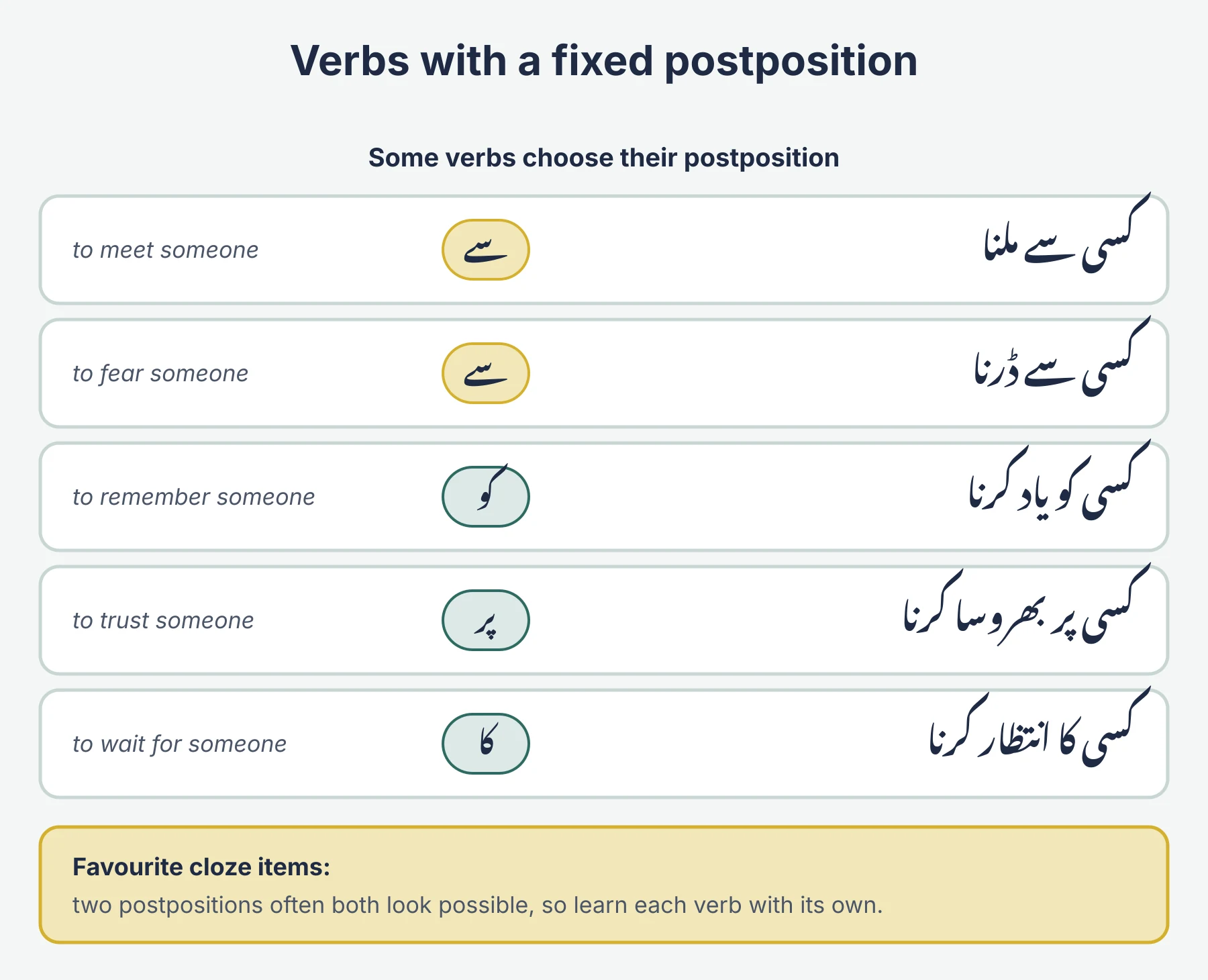
Some verbs choose a fixed postposition: کسی سے ملنا، کسی سے ڈرنا، کسی کو یاد کرنا، کسی پر بھروسا کرنا، کسی کا انتظار کرنا. These are favourite cloze items, because سے and کو both look possible.
Articles
Urdu has no word for “the”. Where the syllabus’s list mentions articles, the Urdu items in practice involve the indefinite words ایک، کوئی and کچھ: ایک for one specific but unnamed thing (ایک لڑکا آیا), کوئی for “any / some (person)” (کوئی آیا تھا؟), کچھ for “some” with quantities and uncountables (کچھ پانی، کچھ لوگ). An option set ایک / کوئی / کچھ tests exactly this.
Parts of speech and vocabulary in context
The gap may need a particular part of speech: an adjective (صفت) before a noun, an adverb (متعلق فعل) before a verb. خوب صورت تصویر but خوب صورتی سے بنائی گئی تصویر. For vocabulary, four options may all be real words; only one fits the collocation: فیصلہ کرنا، سوال پوچھنا، قدم اٹھانا، شکریہ ادا کرنا، امتحان دینا.
Worked example
Original passage with four gaps:
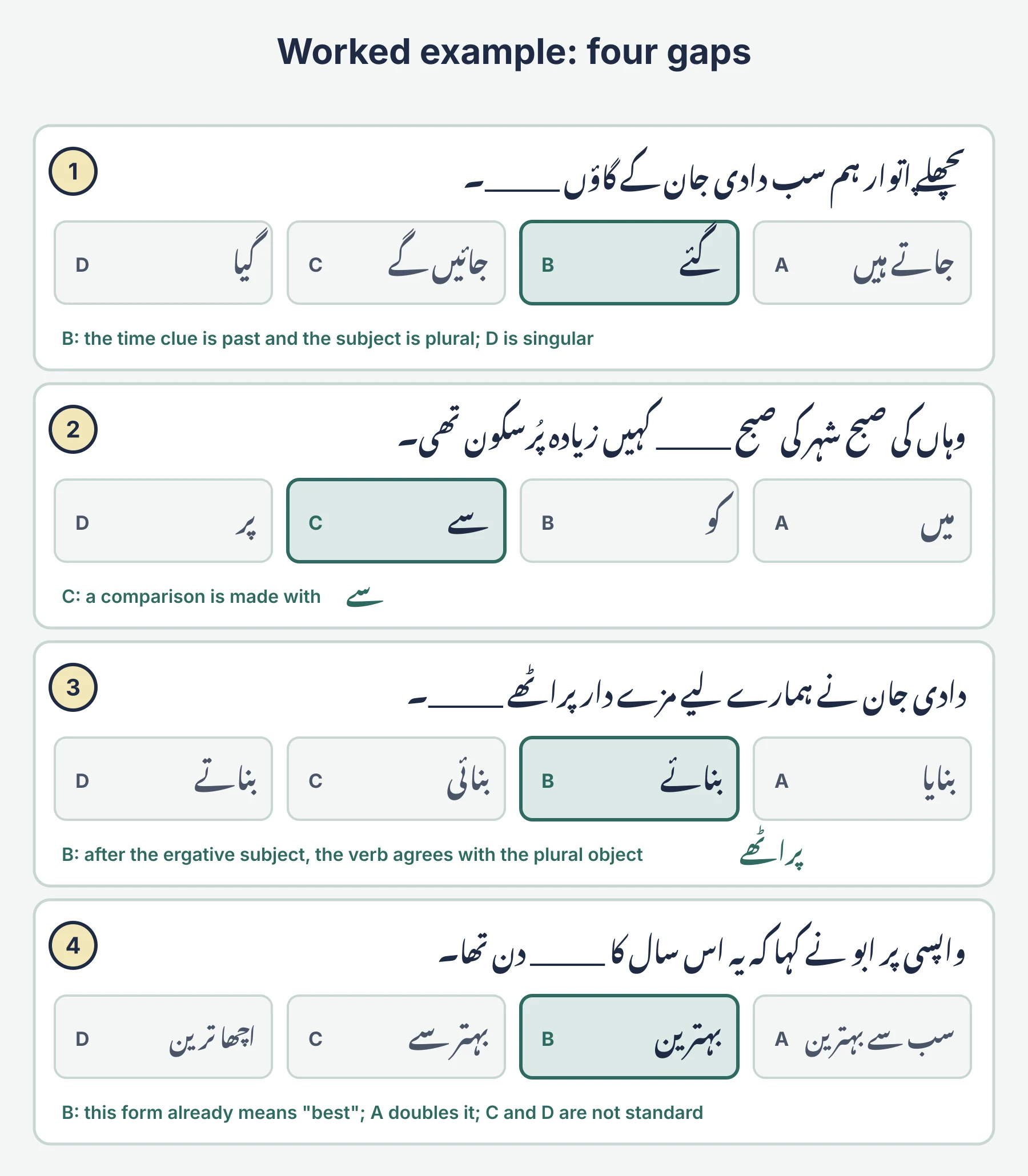
پچھلے اتوار ہم سب دادی جان کے گاؤں (1) ______۔ وہاں کی صبح شہر کی صبح (2) ______ کہیں زیادہ پُرسکون تھی۔ دادی جان نے ہمارے لیے مزے دار پراٹھے (3) ______۔ واپسی پر ابو نے کہا کہ یہ اس سال کا (4) ______ دن تھا۔
(1) A جاتے ہیں B گئے C جائیں گے D گیا (2) A میں B کو C سے D پر (3) A بنایا B بنائے C بنائی D بناتے (4) A سب سے بہترین B بہترین C بہتر سے D اچھا ترین
Answers and reasoning. (1) B: پچھلے اتوار is past, and ہم سب is plural; D is singular. (2) C: comparison uses سے. (3) B: with نے, the verb agrees with the object پراٹھے, masculine plural. (4) B: بہترین already means “best”; A doubles the superlative; C and D are not standard forms.
Common mistakes
- Choosing the tense that “sounds right” without checking the time clue.
- Agreeing the verb with the subject when نے is present.
- Forgetting the oblique form after a postposition (لڑکا کو for لڑکے کو).
- Missing respect plurals for elders and teachers.
- Picking a word with the right meaning but the wrong collocation.
- Reading only the words next to the gap.
More resources on this topic
Related resources
-
Practice questions
Cambridge O Level Second Language Urdu (3248): Exercise 2 Multiple-choice Cloze Passage – Practice Questions
Original multiple-choice grammar items and a full 10-gap Urdu cloze passage in the 3248 Paper 2 Exercise 2 style, with answers and the rule behind each choice.
Urdu Language · Cambridge · O Level
Try questions -
Revision notes
Cambridge O Level Second Language Urdu (3248): Exercise 2 Multiple-choice Cloze Passage – Revision Notes
Condensed grammar for the 3248 Paper 2 cloze: tense clues, agreement and ne, noun forms, comparison, postpositions, ek/koi/kuch, traps and a self-test.
Urdu Language · Cambridge · O Level
Revise topic -
Study guides
Cambridge O Level Second Language Urdu (3248): Exercise 3 Extended Writing Exercise
How to plan and write about 200 words of continuous Urdu in 3248 Paper 2 Exercise 3: purpose, format, audience, paragraphs, register and accuracy.
Urdu Language · Cambridge · O Level
Read guide
Get free revision emails (optional)
Occasional emails with practice questions, worked explanations and links to free resources for the qualification and subjects you choose. No spam, and you can unsubscribe from any email. The free tools on this site never need an email.