
Revision Notes
Pearson Edexcel International A Level Business (YBS11): Entrepreneurs and Leaders – Revision Notes
Revision notes for Edexcel IAL Business 1.3.5: entrepreneurs, intrapreneurship, barriers, motives, objectives, opportunity cost, trade-offs and a self-test.
- Subject
- Business
- Level
- AS LEVEL
- Topic
- Marketing and people
- Author
- Marlbridge Academic Team
- Updated
- Reviewed by
- Salman Ahmad (what this means)
Aligned to Pearson Edexcel A Level Business (WBS11/01), Issue 1, September 2017. Official specification .
Syllabus page (what it covers and how it is assessed): Pearson Edexcel A Level Business.
Found an error? Report a correction.
Need help with this topic? Request a free trial class for A Level Business (YBS11).
Condensed recall for section 1.3.5 of Unit 1. For explanations and worked examples, use the Entrepreneurs and Leaders study guide. Figures are invented.
The entrepreneur’s role
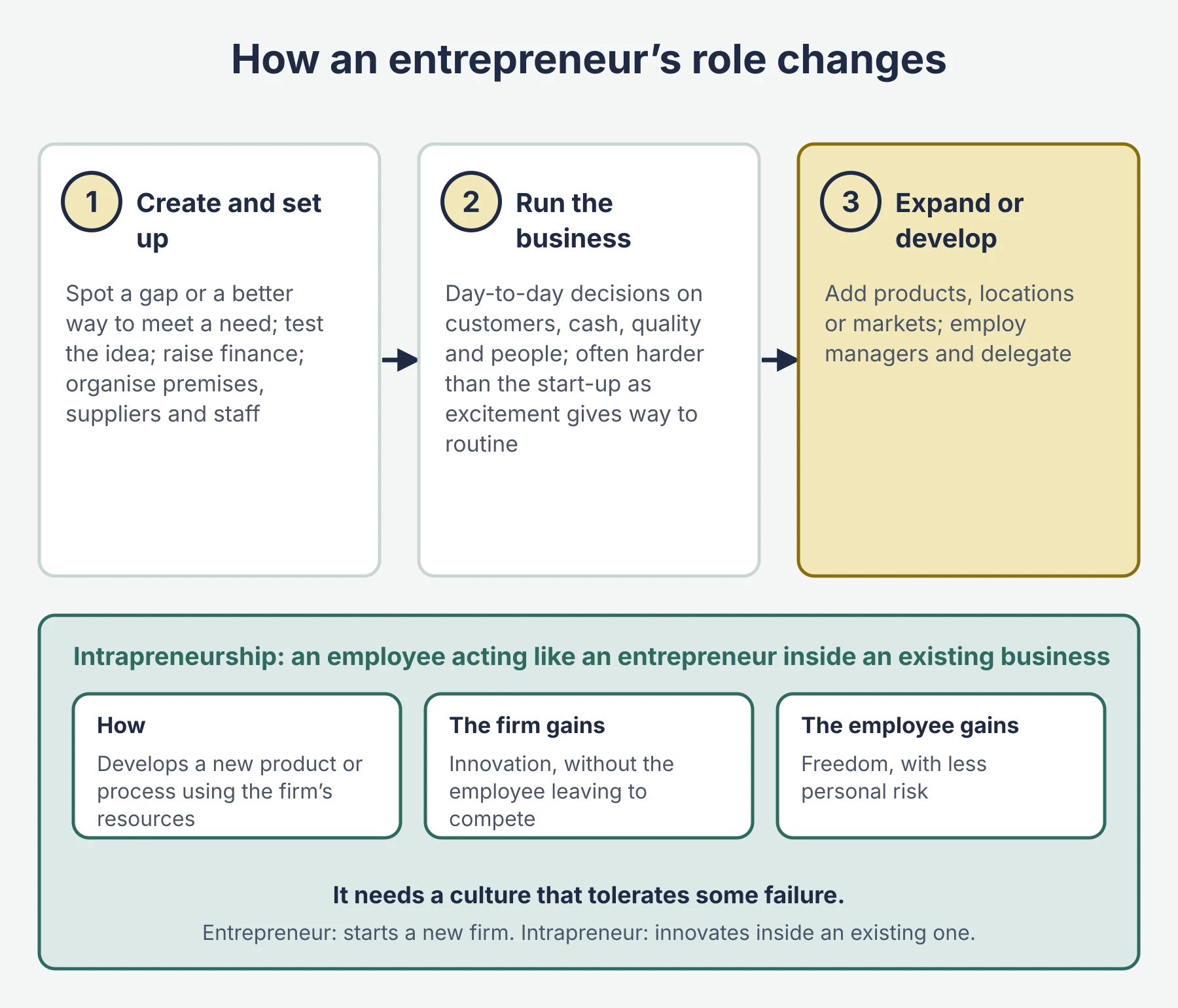
- Creating and setting up: spot the opportunity, test it, raise finance, organise resources.
- Running: daily decisions on customers, cash, quality and staff.
- Expanding or developing: new products, places or markets; hire managers; delegate.
- Intrapreneurship: entrepreneurial innovation by employees inside an existing business, using its resources and with less personal risk.
- Anticipating risk and uncertainty: research, plan, start small, test; keep reserves and flexibility because uncertainty cannot be removed.
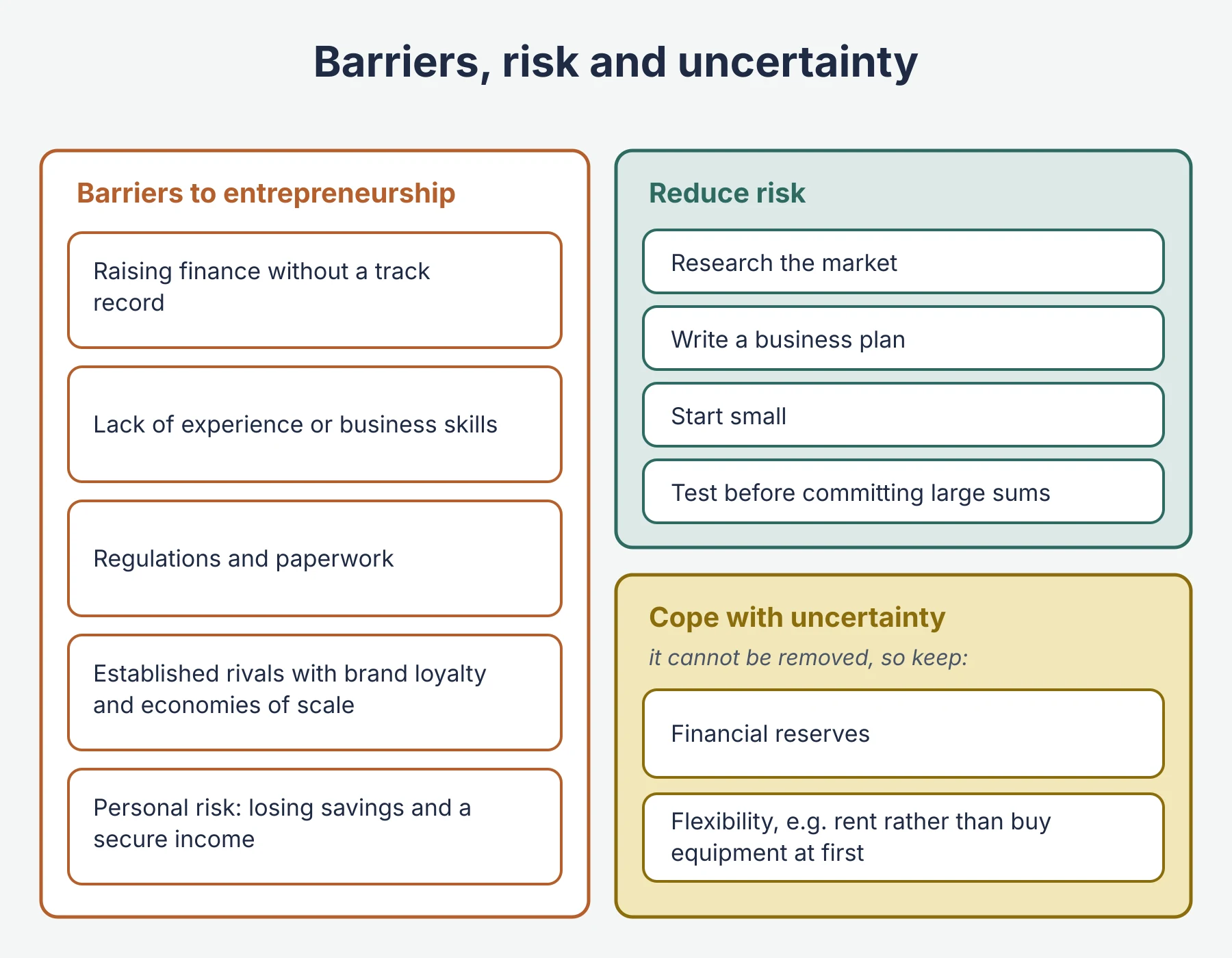
Barriers to entrepreneurship
| Barrier | Why it blocks a start-up |
|---|---|
| Finance | No track record or security, so lenders hesitate |
| Experience and skills | Gaps in finance, marketing or management lead to mistakes |
| Regulation | Registration, licences and tax paperwork take time and money |
| Established rivals | Brand loyalty and economies of scale make entry hard |
| Personal risk | Savings and a secure salary are put at stake |
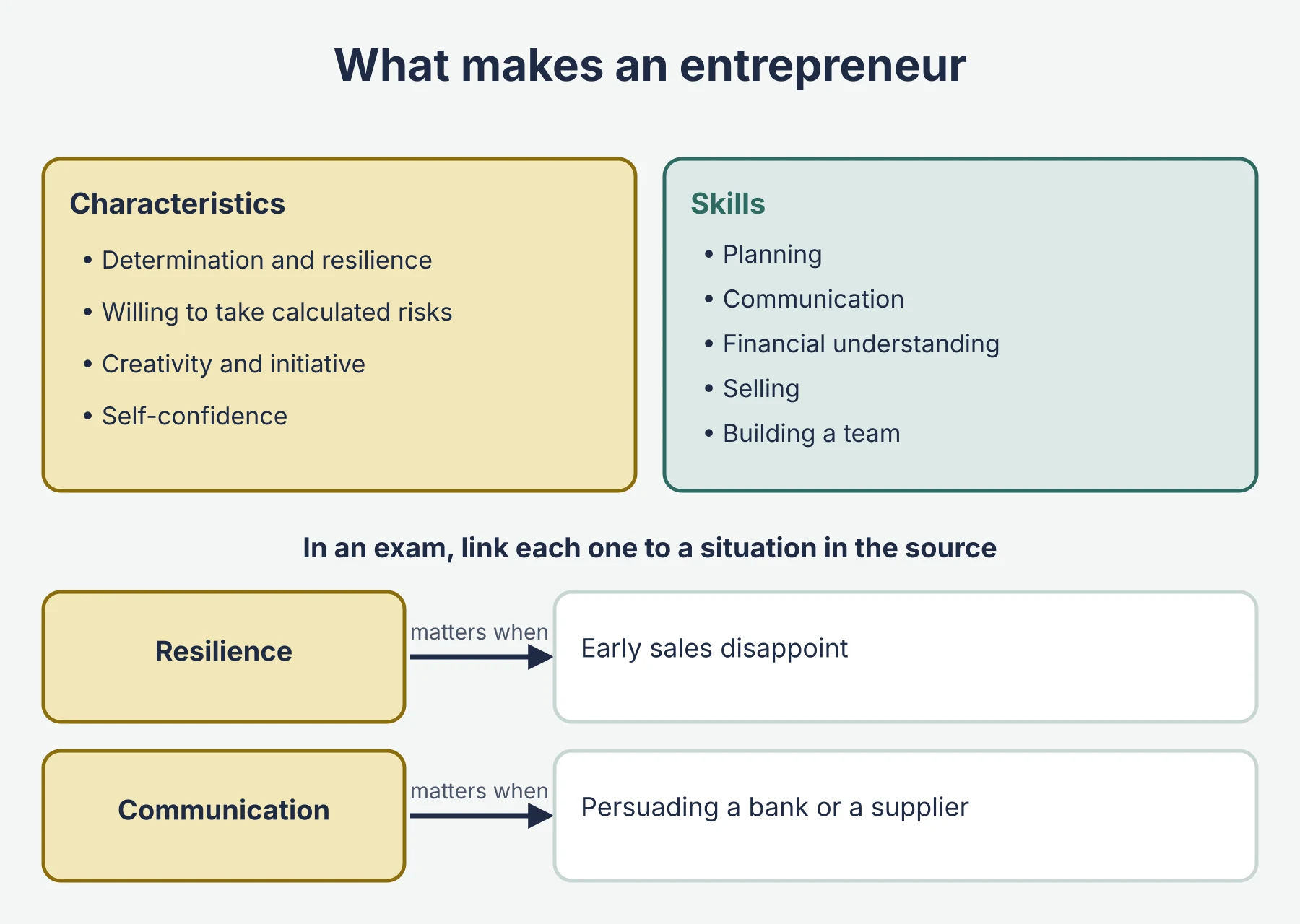
Characteristics and skills
Characteristics: determination, resilience, calculated risk-taking, creativity, initiative, self-confidence. Skills: planning, communication, financial understanding, selling, team building. Always tie them to a situation in the source.
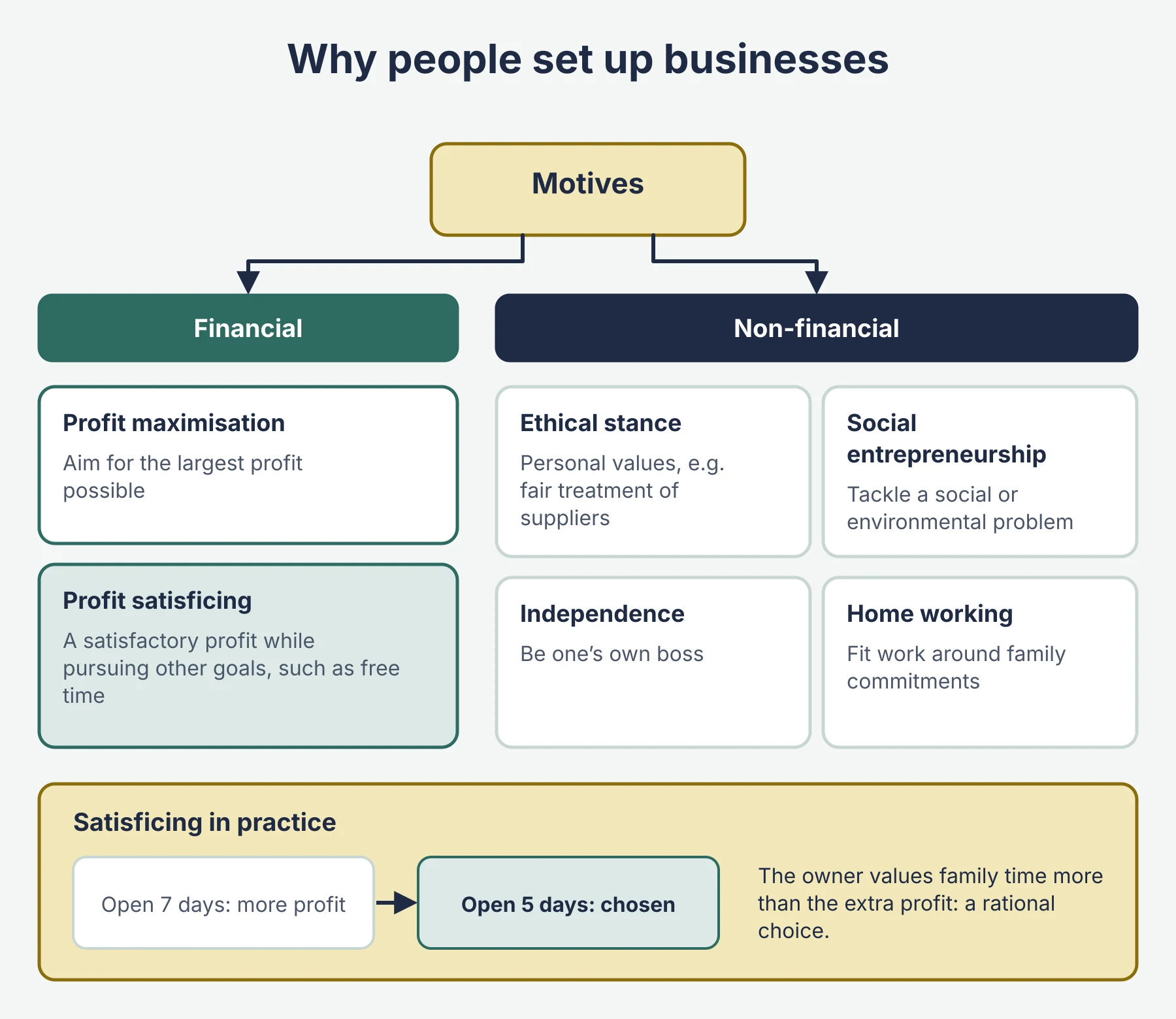
Motives
| Financial | Non-financial |
|---|---|
| Profit maximisation: the largest possible profit | Ethical stance: run the business by personal values |
| Profit satisficing: a satisfactory profit plus other goals | Social entrepreneurship: a business that tackles a social or environmental problem |
| Independence: be your own boss | |
| Home working: work from home, often around family |
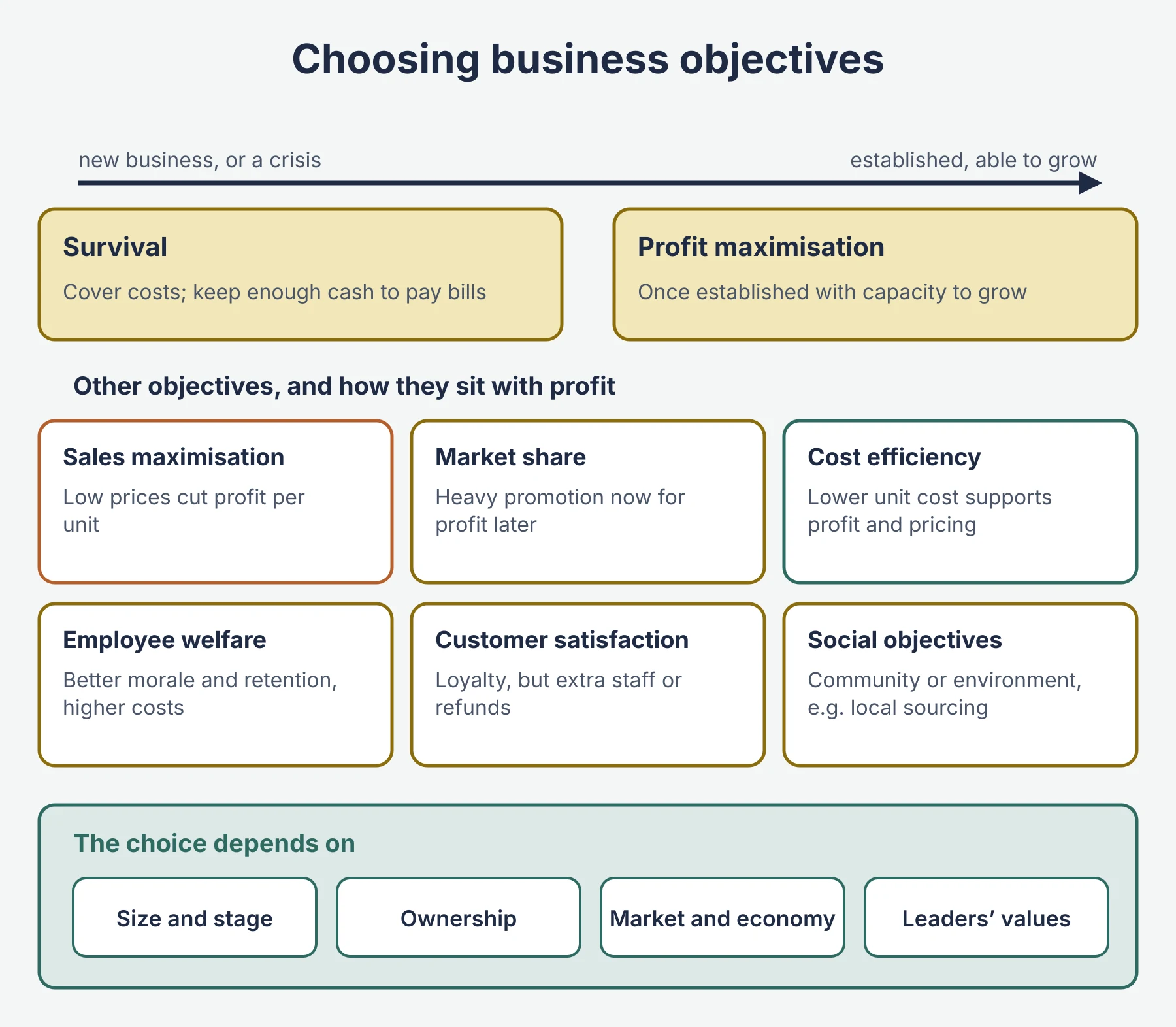
Business objectives
| Objective | Typical when | Possible conflict |
|---|---|---|
| Survival | Start-up, recession, crisis | Little room for other aims |
| Profit maximisation | Established, shareholder-owned | May conflict with welfare or social aims |
| Sales maximisation | Building volume | Low prices cut profit per unit |
| Market share | Entering or defending a market | Promotion spending now, profit later |
| Cost efficiency | Price-competitive markets | Cuts may harm quality or morale |
| Employee welfare | Skills-based firms | Higher costs |
| Customer satisfaction | Service businesses | Extra staff or refunds |
| Social objectives | Social enterprises, ethical brands | Higher input costs |
What shapes the choice: size and stage of development; ownership; market and economic conditions; leaders’ values.
Opportunity cost and trade-offs
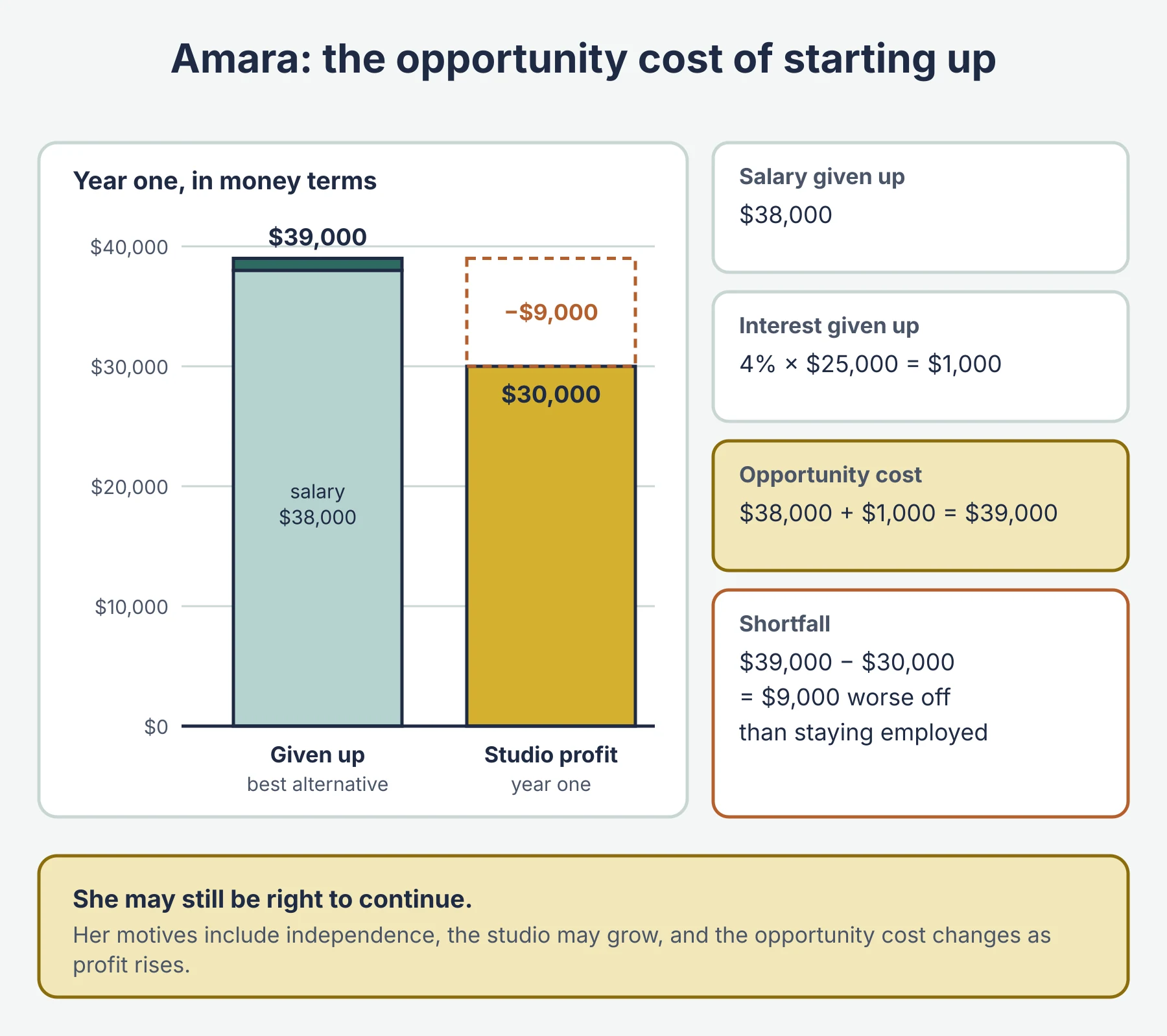
- Opportunity cost: the next best alternative given up.
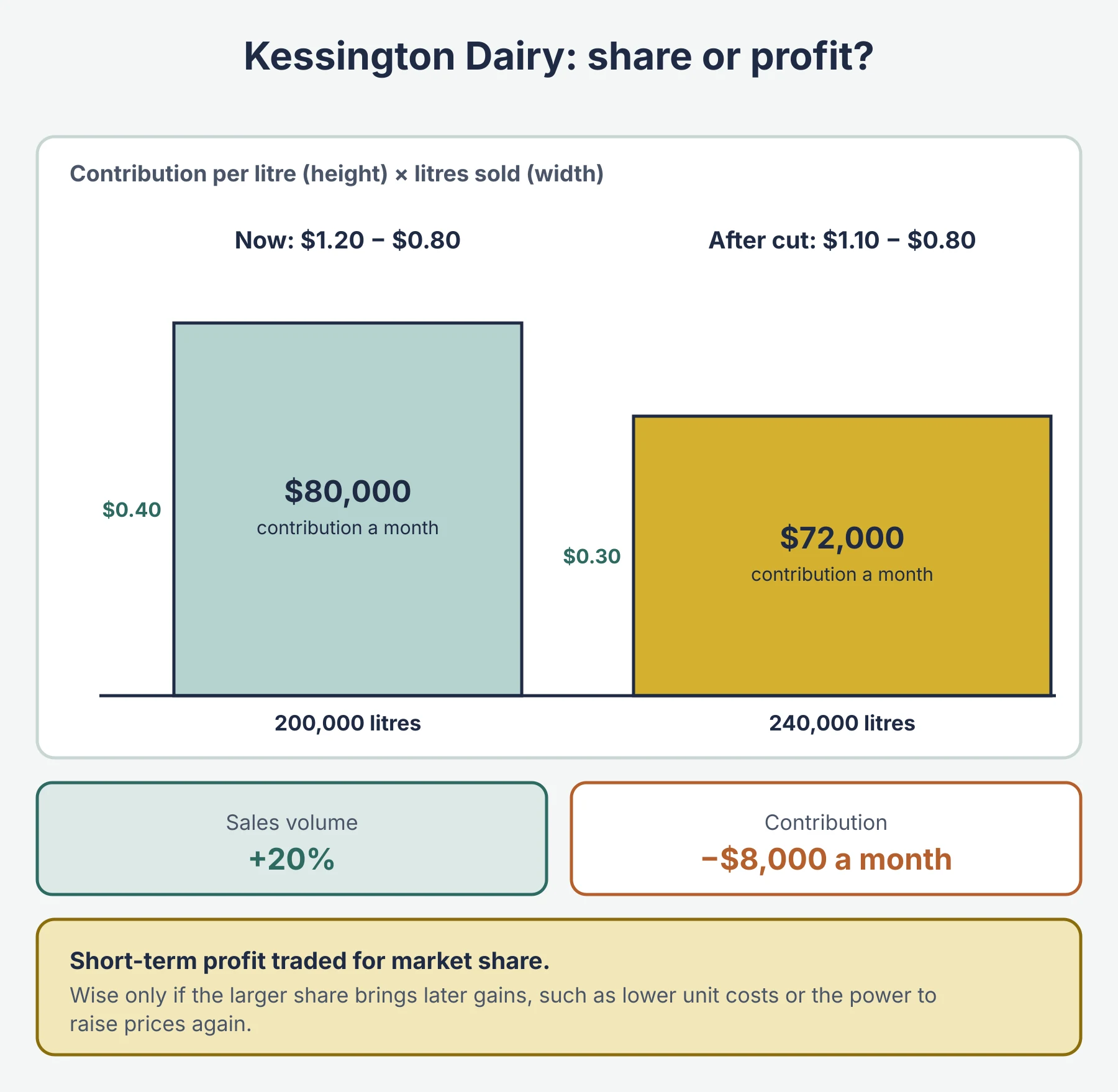
- Trade-off: a compromise between goals that cannot both be fully achieved.
- Opportunity cost of starting a business = salary forgone + return forgone on savings invested (+ any other benefit given up).
Spotting a trade-off in a source: look for two aims mentioned together, such as “grow quickly” and “keep prices low”, or “pay staff well” and “raise profit”. State what is gained, what is given up, and what would decide the choice, such as the stage of the business or the owner’s motive.
Key terms
| Term | Meaning |
|---|---|
| Entrepreneur | A person who organises resources to start and run a business and takes the risk |
| Intrapreneur | An employee who innovates within an existing business |
| Profit satisficing | Aiming for an acceptable profit rather than the maximum |
| Social entrepreneur | Someone who runs a business mainly to achieve a social aim |
| Survival | Continuing to trade by covering costs and paying bills |
| Sales maximisation | Aiming for the highest sales volume or revenue |
| Cost efficiency | Producing at the lowest cost per unit for a given quality |
| Opportunity cost | The value of the next best alternative forgone |
| Trade-off | Giving up some of one goal to gain more of another |
Exam traps
- Opportunity cost is the next best alternative, not all alternatives added together.
- Satisficing is a deliberate choice, not poor management.
- Intrapreneurs are employees; they do not own the business.
- Survival matters to established firms too, in a crisis.
- A rise in sales does not mean a rise in profit: check contribution or margin.
- Social enterprises still need a surplus to survive.
Self-test
- State two stages in the role of an entrepreneur.
- Define intrapreneurship.
- Give two barriers to entrepreneurship.
- Distinguish profit maximisation from profit satisficing.
- Give two non-financial motives for starting a business.
- Why is survival often the first objective of a new business?
- State two of the “other objectives” named in the specification.
- Define opportunity cost.
- A founder gives up a $30,000 salary and invests $20,000 of savings earning 5%. Calculate the opportunity cost for one year.
- A firm cuts its price from $10 to $9 to raise sales from 5,000 to 5,500 units; variable cost is $6. Calculate contribution before and after.
- Name the trade-off in question 10.
- Give one way an entrepreneur can reduce risk before launch.
Answers
- Any two: creating and setting up; running; expanding or developing.
- Innovation by employees within an existing business, acting like entrepreneurs with the firm’s resources.
- Any two: lack of finance, lack of experience, regulation, established rivals, personal financial risk.
- Maximisation aims for the largest possible profit; satisficing aims for a satisfactory profit while pursuing other goals.
- Any two: ethical stance, social entrepreneurship, independence, home working.
- It has no customer base or track record and limited cash, so it must cover its costs and pay its bills before it can pursue anything else.
- Any two: sales maximisation, market share, cost efficiency, employee welfare, customer satisfaction, social objectives.
- The value of the next best alternative given up when a choice is made.
- $30,000 + (5% × $20,000) = $30,000 + $1,000 = $31,000.
- Before: 5,000 × ($10 − $6) = $20,000. After: 5,500 × ($9 − $6) = $16,500.
- Higher sales volume (or market share) is gained at the cost of lower contribution, so lower short-term profit.
- Any one: market research, a business plan, starting small, test marketing, keeping cash reserves.
Related resources
-
Study guides
Pearson Edexcel International A Level Business (YBS11): Managing People
Study guide to Edexcel IAL Business 1.3.4 Managing people: staffing, recruitment and training, structure, motivation theory and methods, and leadership styles.
Business · Pearson Edexcel · AS Level
Read guide -
Practice questions
Pearson Edexcel International A Level Business (YBS11): Managing People – Practice Questions
Twelve original source-based questions with full answers on staffing, training, structure, motivation, pay and leadership for Edexcel IAL Business 1.3.4.
Business · Pearson Edexcel · AS Level
Try questions -
Revision notes
Pearson Edexcel International A Level Business (YBS11): Managing People – Revision Notes
Revision notes for Edexcel IAL Business 1.3.4: staffing, training, structures, motivation theories and methods, leadership styles, key terms and a self-test.
Business · Pearson Edexcel · AS Level
Revise topic
Get free revision emails (optional)
Occasional emails with practice questions, worked explanations and links to free resources for the qualification and subjects you choose. No spam, and you can unsubscribe from any email. The free tools on this site never need an email.