
Study Guides
Pearson Edexcel International A Level Business (YBS11): Entrepreneurs and Leaders
Study guide to Edexcel IAL Business 1.3.5: the entrepreneur's role, intrapreneurship, barriers, motives, business objectives, opportunity cost and trade-offs.
- Subject
- Business
- Level
- AS LEVEL
- Topic
- Marketing and people
- Author
- Marlbridge Academic Team
- Updated
- Reviewed by
- Salman Ahmad (what this means)
Aligned to Pearson Edexcel A Level Business (WBS11/01), Issue 1, September 2017. Official specification .
Syllabus page (what it covers and how it is assessed): Pearson Edexcel A Level Business.
Found an error? Report a correction.
Need help with this topic? Request a free trial class for A Level Business (YBS11).
This guide covers section 1.3.5 Entrepreneurs and leaders in Unit 1 (Marketing and people) of the Pearson Edexcel International Advanced Subsidiary/Advanced Level in Business, Issue 1. It asks what entrepreneurs do, why they do it, what objectives their businesses pursue and how every choice involves giving something up. All people, businesses and figures are invented.
For the unit as a whole, see the Marketing and People study guide. Condensed notes are in the Entrepreneurs and Leaders revision notes and questions in the Entrepreneurs and Leaders practice questions.
What the specification lists
- Role of an entrepreneur: creating and setting up a business; running and expanding or developing it; innovation within a business (intrapreneurship); barriers to entrepreneurship; anticipating risk and uncertainty in the business environment.
- Entrepreneurial motives and characteristics: characteristics and skills required; financial motives (profit maximisation and profit satisficing) and non-financial motives (ethical stance, social entrepreneurship, independence and home working).
- Business objectives: survival; profit maximisation; other objectives (sales maximisation, market share, cost efficiency, employee welfare, customer satisfaction, social objectives).
- Business choices: opportunity cost and trade-offs.
The role of an entrepreneur
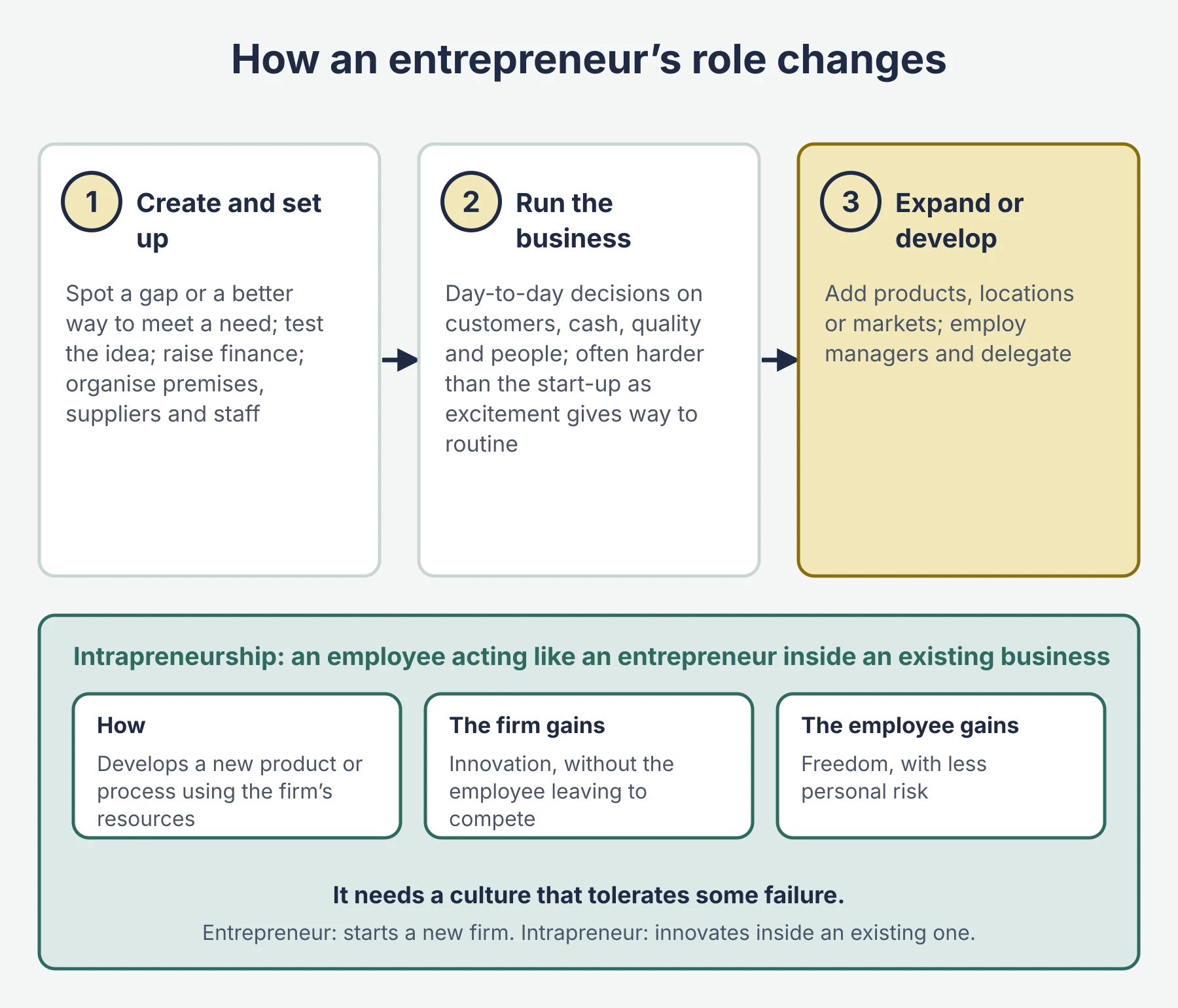
An entrepreneur spots an opportunity, organises the resources to exploit it and accepts the risk of failure. The role changes as the business develops.
- Creating and setting up: identifying a gap or a better way of meeting a need, testing the idea, raising finance and organising premises, suppliers and staff.
- Running the business: day-to-day decisions on customers, cash, quality and people. Many founders find this harder than the start-up, because the excitement of the idea gives way to routine.
- Expanding or developing: adding products, locations or markets, which brings the need to employ managers and delegate.
- Intrapreneurship: an employee inside an existing business acting like an entrepreneur, developing a new product or process with the firm’s resources. The firm gains innovation without the employee leaving to compete; the employee gains freedom with less personal risk. It needs a culture that tolerates some failure.
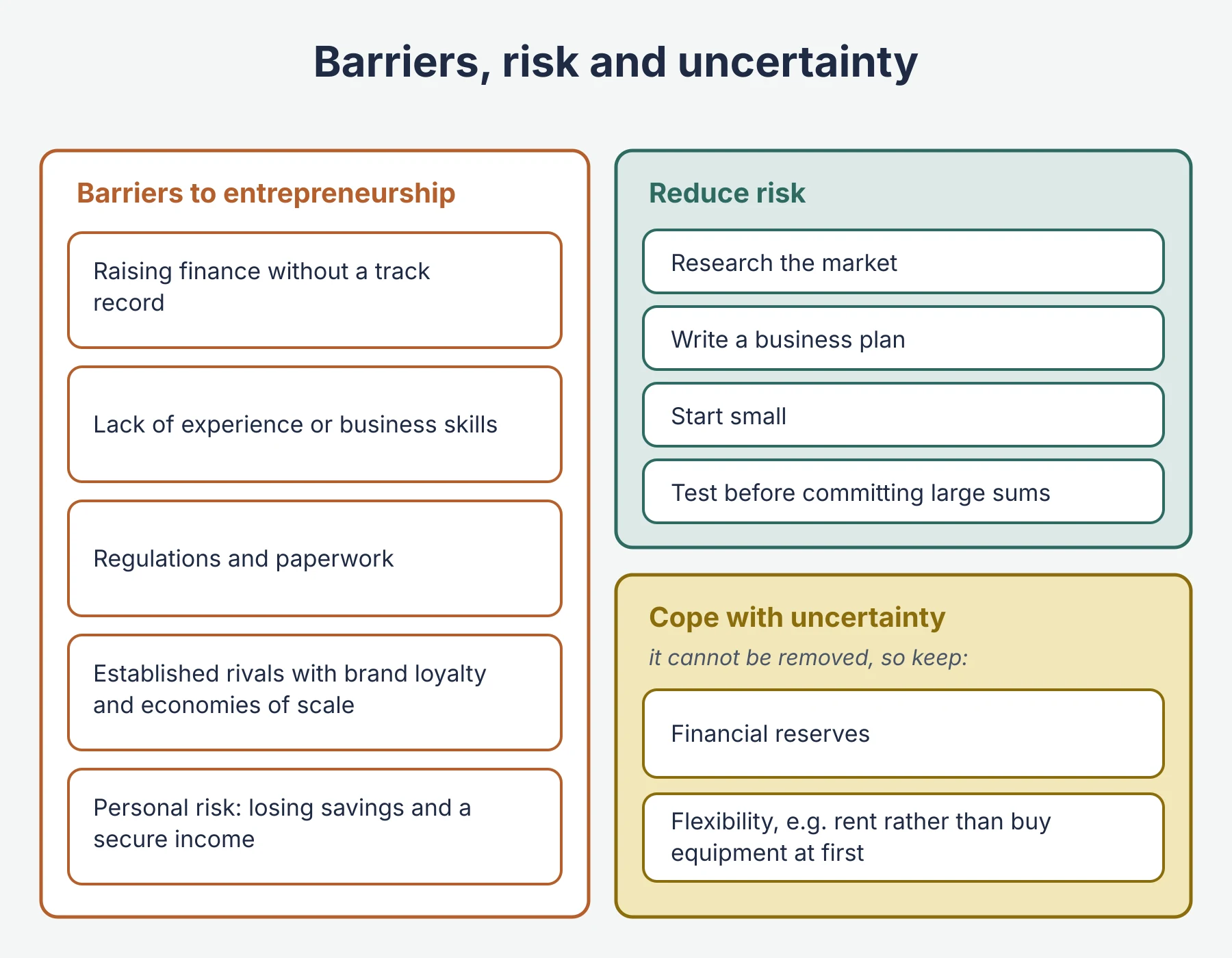
Barriers to entrepreneurship include difficulty raising finance without a track record; lack of experience or business skills; regulations and paperwork; established competitors with brand loyalty and economies of scale; and the personal risk of losing savings and a secure income.
Anticipating risk and uncertainty. Entrepreneurs reduce risk by researching the market, writing a business plan, starting small and testing before committing large sums. They cannot remove uncertainty, so they also need financial reserves and flexibility, such as renting rather than buying equipment at first.
Characteristics and skills
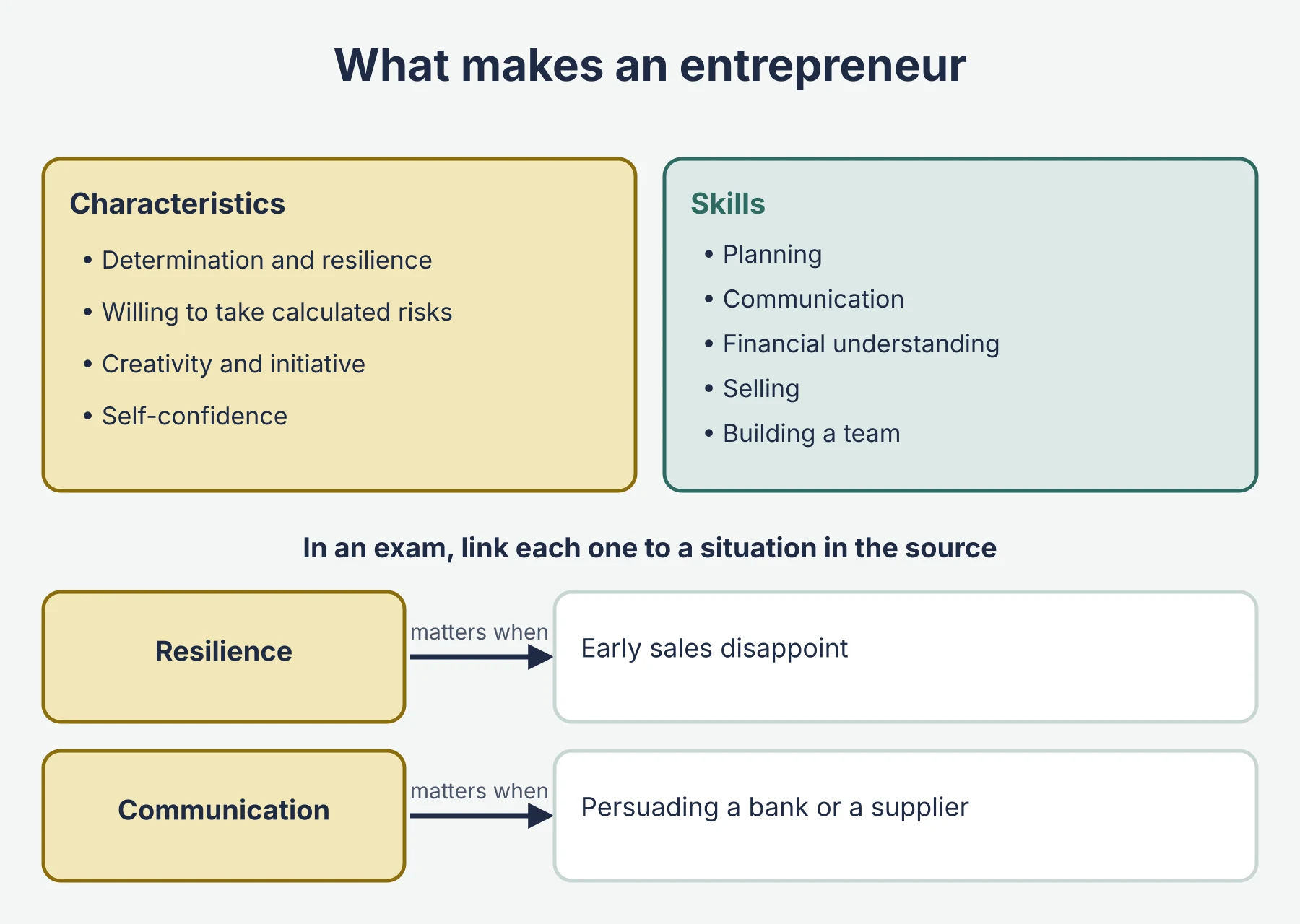
Commonly cited characteristics are determination and resilience, willingness to take calculated risks, creativity and initiative, and self-confidence. Useful skills include planning, communication, financial understanding, selling and the ability to build a team. In an exam, link a characteristic to a specific situation in the source: resilience matters when early sales disappoint; communication matters when persuading a bank or a supplier.
Why people set up businesses
| Motive | Type | Meaning |
|---|---|---|
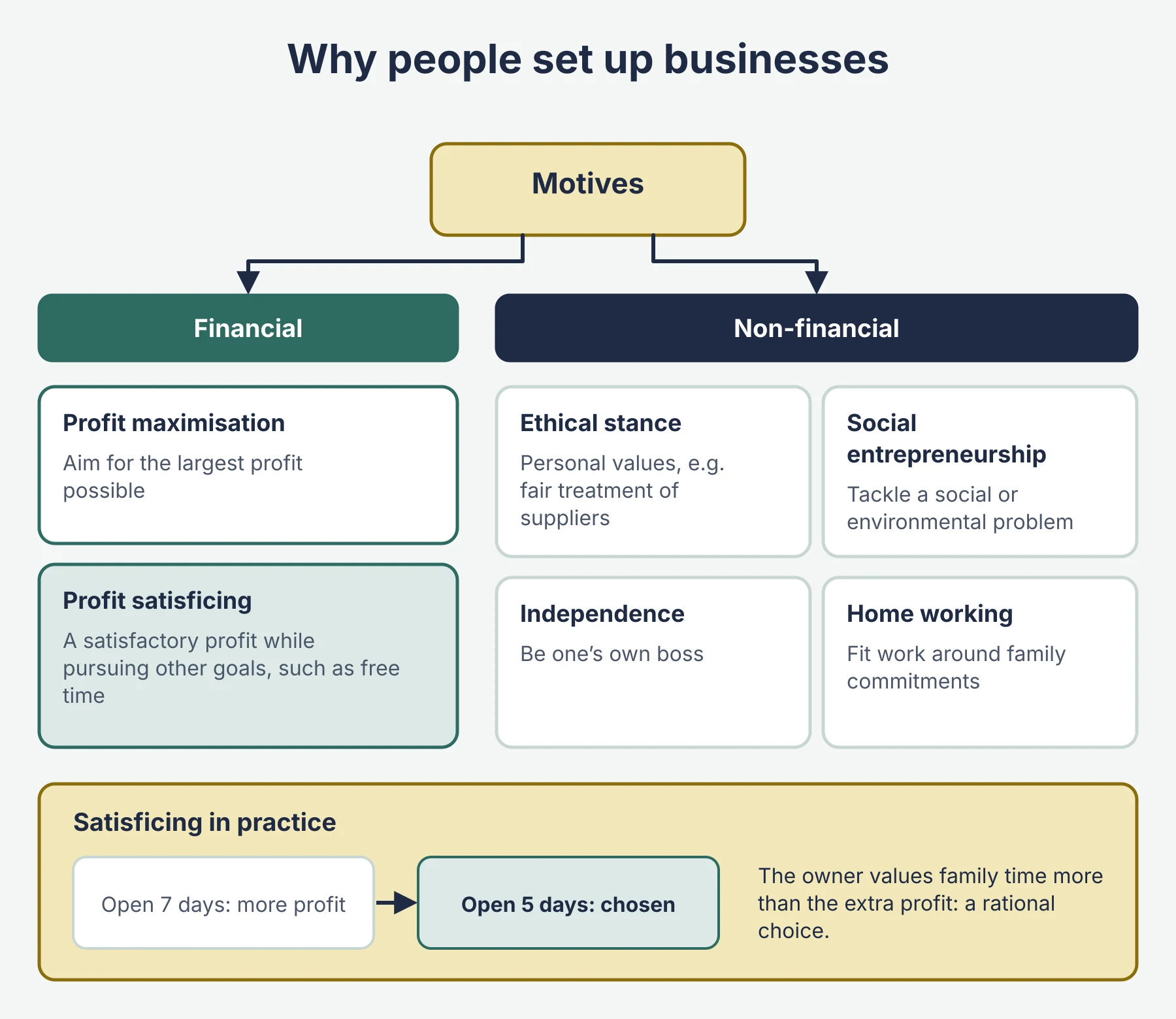
| Profit maximisation | Financial | Aim for the largest profit possible |
| Profit satisficing | Financial | Aim for a satisfactory profit while pursuing other goals, such as free time |
| Ethical stance | Non-financial | Run the business according to personal values, such as fair treatment of suppliers |
| Social entrepreneurship | Non-financial | Use a business to tackle a social or environmental problem, reinvesting most surplus in that aim |
| Independence | Non-financial | Be one’s own boss and control one’s own decisions |
| Home working | Non-financial | Work from home, often to fit around family commitments |
Satisficing is common in small businesses. An owner who could earn more by opening seven days a week, but chooses five to protect family time, is satisficing. This is a rational choice, not a failure: the owner values the time more than the extra profit.
Business objectives
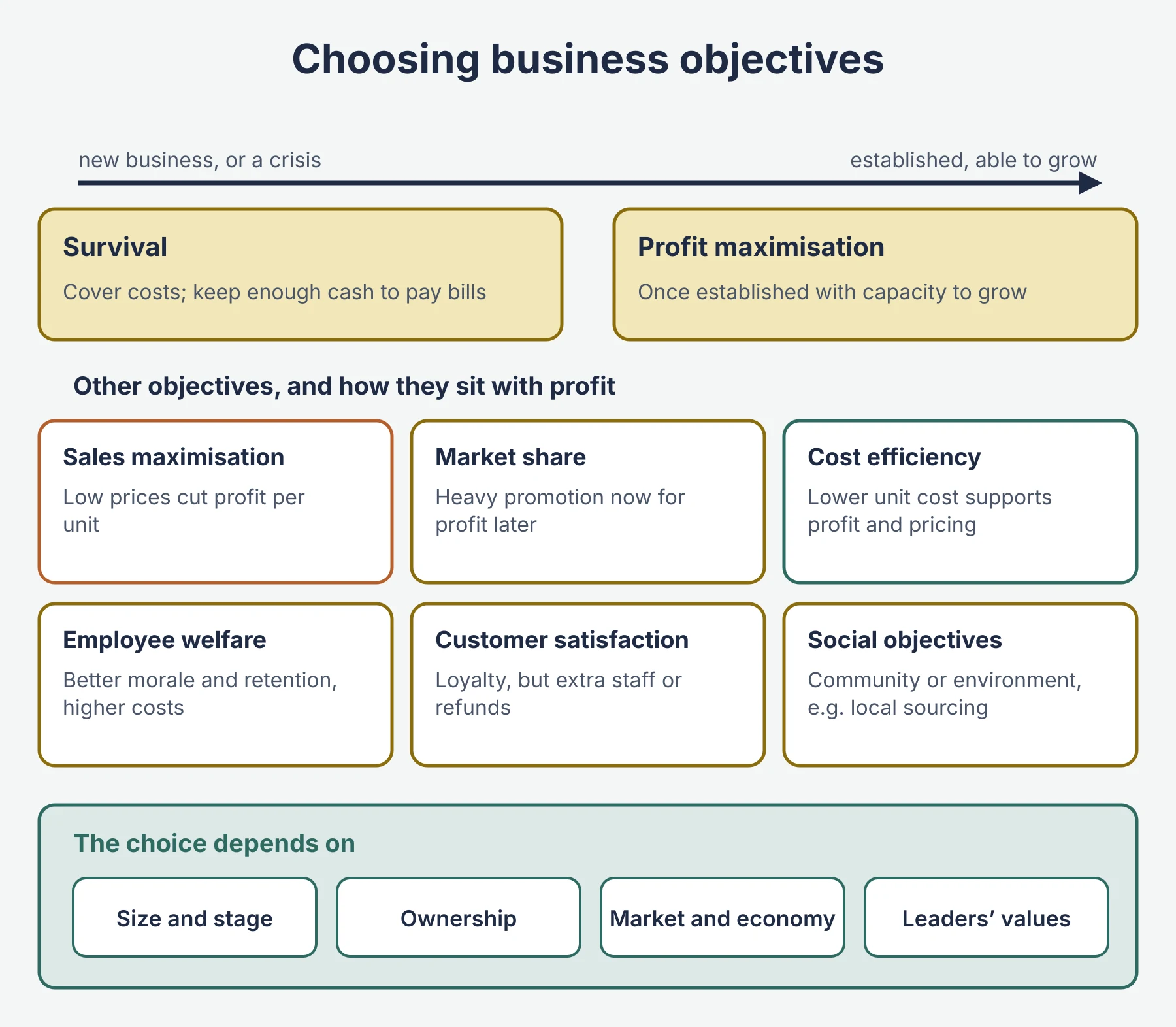
Survival is the main objective for a new business, or for any business in a crisis: covering costs and keeping enough cash to pay bills. Profit maximisation follows once a business is established and has the capacity to grow. The other objectives in the specification can compete with profit:
- Sales maximisation may mean low prices that cut the profit per unit.
- Market share targets may justify spending heavily on promotion now to gain profit later.
- Cost efficiency focuses on lowering cost per unit, which supports both profit and competitive pricing.
- Employee welfare improves morale and retention but raises costs.
- Customer satisfaction builds loyalty and repeat sales but may need extra staff or generous refunds.
- Social objectives address community or environmental aims, such as local sourcing.
Which objectives a business chooses depends on its size and stage of development, its ownership (a sole trader may satisfice, while shareholders may press for profit), the state of the market and the economy, and the values of its leaders.
Opportunity cost and trade-offs
Opportunity cost is the value of the next best alternative given up when a choice is made. A trade-off is a compromise between two goals that cannot both be fully met, so more of one means less of the other.
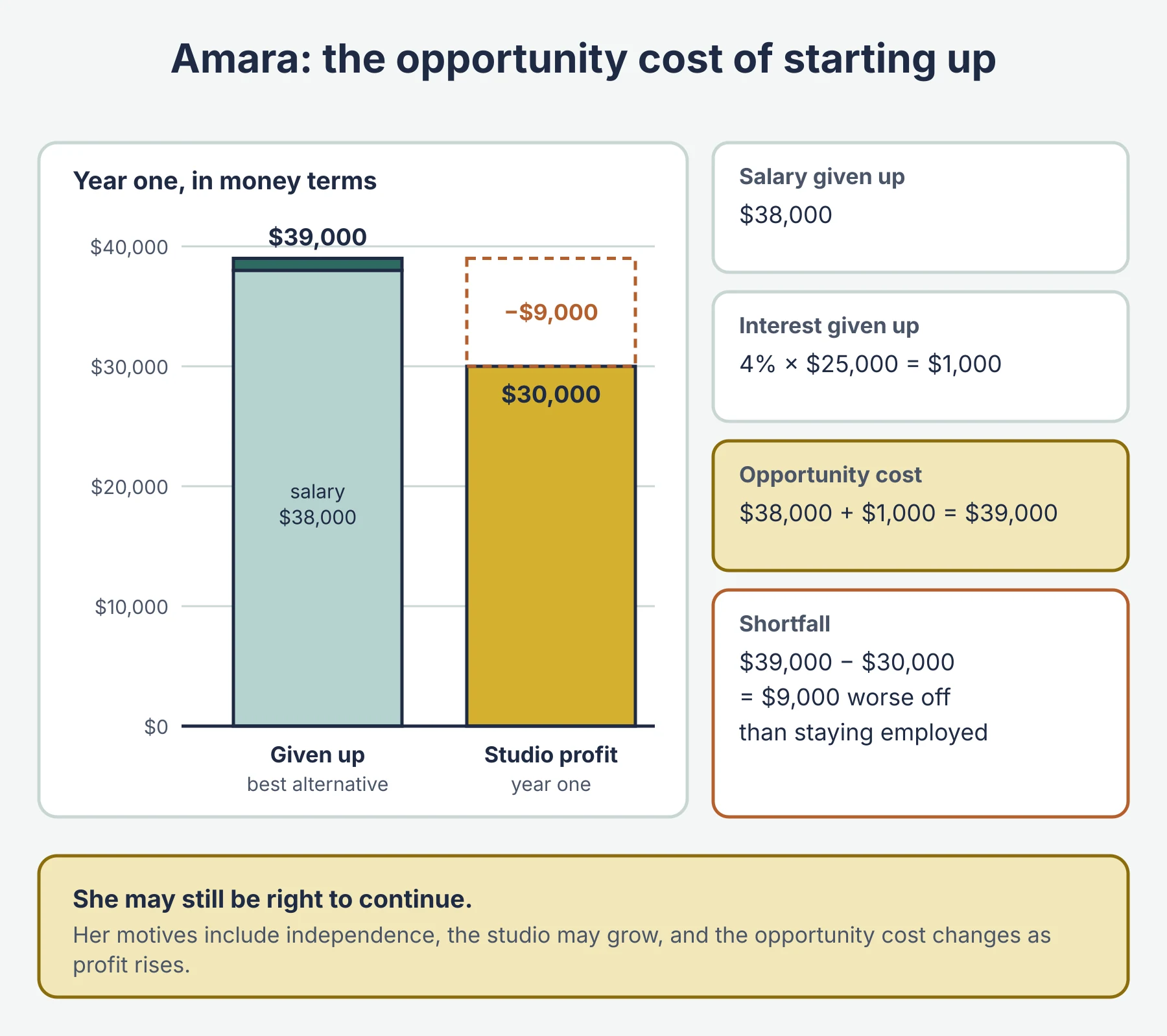
Worked example 1: the opportunity cost of starting up. Amara leaves a job paying $38,000 a year to open a design studio. She puts in $25,000 of savings that were earning 4% interest.
Salary given up                 = $38,000
Interest given up = 4% x $25,000 = $1,000
Opportunity cost in year one    = $39,000

Studio profit in year one       = $30,000
Shortfall against her best alternative = $39,000 - $30,000 = $9,000
In money terms Amara is $9,000 worse off than if she had stayed employed. She may still be right to continue: her motives include independence, the business may grow, and the opportunity cost will change as profit rises.
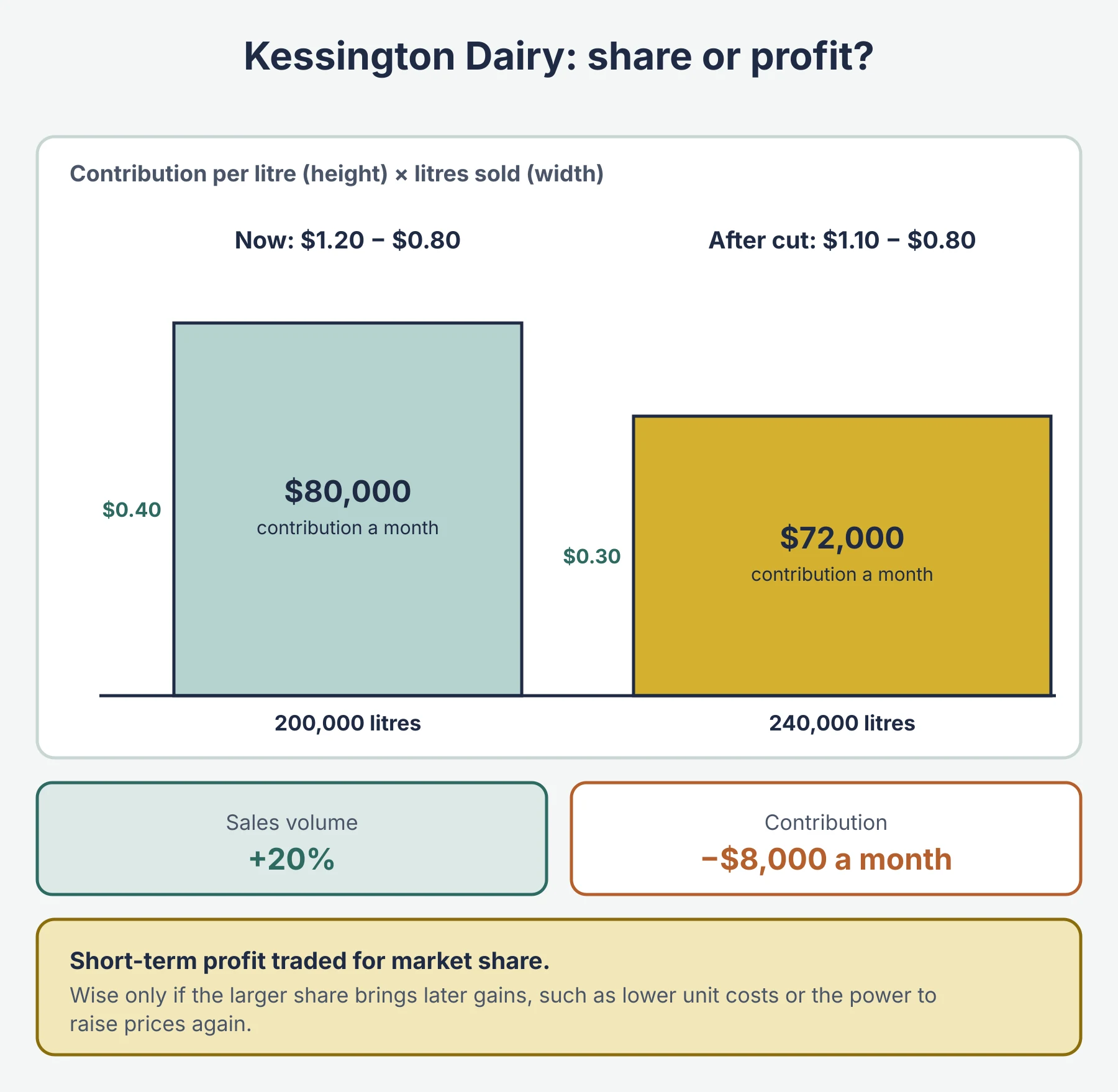
Worked example 2: a trade-off between objectives. Kessington Dairy sells 200,000 litres of milk a month at $1.20, with variable costs of $0.80 a litre. Its board wants to raise market share by cutting the price to $1.10, which it expects to raise sales to 240,000 litres.
Contribution now   = 200,000 x ($1.20 - $0.80) = $80,000 a month
Contribution after = 240,000 x ($1.10 - $0.80) = $72,000 a month
Sales volume rises by 20%, but contribution falls by $8,000 a month. The dairy is trading short-term profit for market share. Whether that is wise depends on whether the larger share brings later gains, such as lower unit costs or the power to raise prices again.
Common mistakes
- Defining opportunity cost as “the cost of an opportunity” instead of the next best alternative forgone.
- Treating every entrepreneur as a profit maximiser: the specification names satisficing and non-financial motives deliberately.
- Confusing intrapreneurship (inside an existing firm) with entrepreneurship (starting a new firm).
- Listing objectives without explaining why this business, at this stage, would choose one over another.
- Ignoring the conflict between objectives; most questions in this section reward identifying a trade-off.
Exam technique
Define questions here are often on opportunity cost, intrapreneurship or satisficing: give a precise meaning and a short example. In explain and analyse answers, use the motives and objectives stated or implied in the source, such as a founder who mentions family or community. In discuss and assess answers, the evaluation usually lies in a trade-off: show what is gained, what is given up and what the judgement depends on, such as the business’s stage of development or its owner’s motives.
More resources on this topic
Related resources
-
Practice questions
Pearson Edexcel International A Level Business (YBS11): Entrepreneurs and Leaders – Practice Questions
Twelve original source-based questions with answers on entrepreneurs, motives, intrapreneurship, objectives and opportunity cost for Edexcel IAL 1.3.5.
Business · Pearson Edexcel · AS Level
Try questions -
Revision notes
Pearson Edexcel International A Level Business (YBS11): Entrepreneurs and Leaders – Revision Notes
Revision notes for Edexcel IAL Business 1.3.5: entrepreneurs, intrapreneurship, barriers, motives, objectives, opportunity cost, trade-offs and a self-test.
Business · Pearson Edexcel · AS Level
Revise topic -
Study guides
Pearson Edexcel International A Level Business (YBS11): Managing People
Study guide to Edexcel IAL Business 1.3.4 Managing people: staffing, recruitment and training, structure, motivation theory and methods, and leadership styles.
Business · Pearson Edexcel · AS Level
Read guide
Get free revision emails (optional)
Occasional emails with practice questions, worked explanations and links to free resources for the qualification and subjects you choose. No spam, and you can unsubscribe from any email. The free tools on this site never need an email.