
Study Guides
Pearson Edexcel International A Level Business (YBS11): Managing People
Study guide to Edexcel IAL Business 1.3.4 Managing people: staffing, recruitment and training, structure, motivation theory and methods, and leadership styles.
- Subject
- Business
- Level
- AS LEVEL
- Topic
- Marketing and people
- Author
- Marlbridge Academic Team
- Updated
- Reviewed by
- Salman Ahmad (what this means)
Aligned to Pearson Edexcel A Level Business (WBS11/01), Issue 1, September 2017. Official specification .
Syllabus page (what it covers and how it is assessed): Pearson Edexcel A Level Business.
Found an error? Report a correction.
Need help with this topic? Request a free trial class for A Level Business (YBS11).
This guide covers section 1.3.4 Managing people in Unit 1 (Marketing and people) of the Pearson Edexcel International Advanced Subsidiary/Advanced Level in Business, Issue 1. It is the widest section in the unit, running from how a business views its staff to how it is led. All businesses and figures are invented.
For the unit as a whole, see the Marketing and People study guide. Condensed notes are in the Managing People revision notes and questions in the Managing People practice questions.
What the specification lists
- Approaches to staffing: staff as an asset or a cost; the flexible workforce (multi-skilling, part-time and temporary, zero-hour contracts, flexible hours and home working, outsourcing); dismissal and redundancy; individual approach and collective bargaining.
- Recruitment, selection and training: internal versus external recruitment; the costs of recruitment, selection and training; induction, on-the-job and off-the-job training.
- Organisational design: hierarchy, chain of command, span of control, centralised and decentralised; tall, flat and matrix structures; their impact on efficiency and motivation.
- Motivation in theory and practice: why motivation matters; Taylor, Mayo, Maslow and Herzberg; financial and non-financial methods.
- Leadership: management versus leadership; autocratic, paternalistic, democratic and laissez-faire styles; the difficulty of moving from entrepreneur to leader.
Approaches to staffing
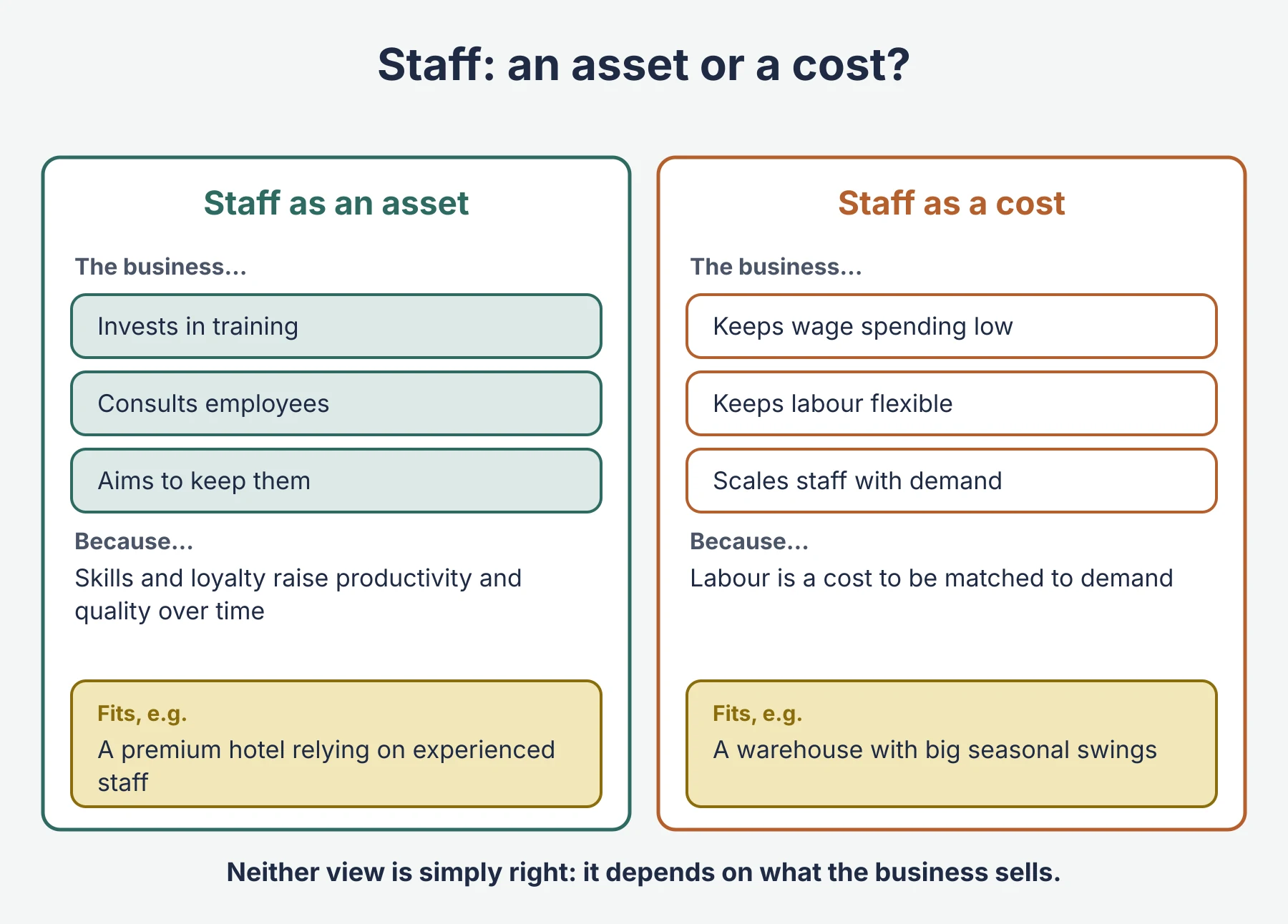
A business that sees staff as an asset invests in training, consults employees and aims to keep them, because skills and loyalty raise productivity and quality over time. A business that sees staff as a cost keeps wage spending as low and flexible as possible. Neither view is simply right: a premium hotel relies on experienced staff for its service reputation, while a warehouse facing big seasonal swings may need to treat labour as a cost it can scale.
| Flexible method | Benefit to the business | Risk to the business |
|---|---|---|
| Multi-skilling | Staff cover each other’s tasks, so absence causes less disruption | Training cost; staff may expect higher pay |
| Part-time and temporary | Labour matches demand peaks | Less commitment; repeated induction |
| Zero-hour contracts | Pay only for hours needed | Low loyalty, high turnover, reputational criticism |
| Flexible hours and home working | Attracts and keeps staff; saves office space | Harder to supervise and coordinate |
| Outsourcing | Specialists do non-core work, often more cheaply | Loss of control over quality; dependence on a supplier |
Dismissal ends employment for a reason connected with the individual, such as misconduct or persistent poor performance. Redundancy happens when the job itself is no longer needed, for example after a branch closes. The distinction matters because the cause, the process and the effect on remaining staff differ.
Under an individual approach, terms are agreed with each employee, which gives flexibility to reward individuals. Under collective bargaining, managers negotiate with representatives, usually a trade union, for a whole group. Collective bargaining takes longer to reach agreement, but one agreement covers many workers and can reduce conflict.
Recruitment, selection and training
Internal recruitment is cheaper and quicker, the candidate already knows the business, and promotion motivates others; but it brings no new ideas and leaves another vacancy to fill. External recruitment widens the pool and brings fresh skills, but costs more in advertising, agency fees and induction, and the appointee is less known.
The costs include advertising, agency fees, managers’ time on shortlisting and interviews, induction, and the lost output while a new employee learns the job. Induction introduces a new starter to the business; on-the-job training happens while working, often by watching an experienced colleague; off-the-job training takes place away from the workstation, such as at a college, and is more expensive but can teach broader skills.
Organisational design
Hierarchy is the levels of authority; the chain of command is the line through which instructions pass down; the span of control is the number of people reporting directly to one manager. The span determines how many levels a business needs.
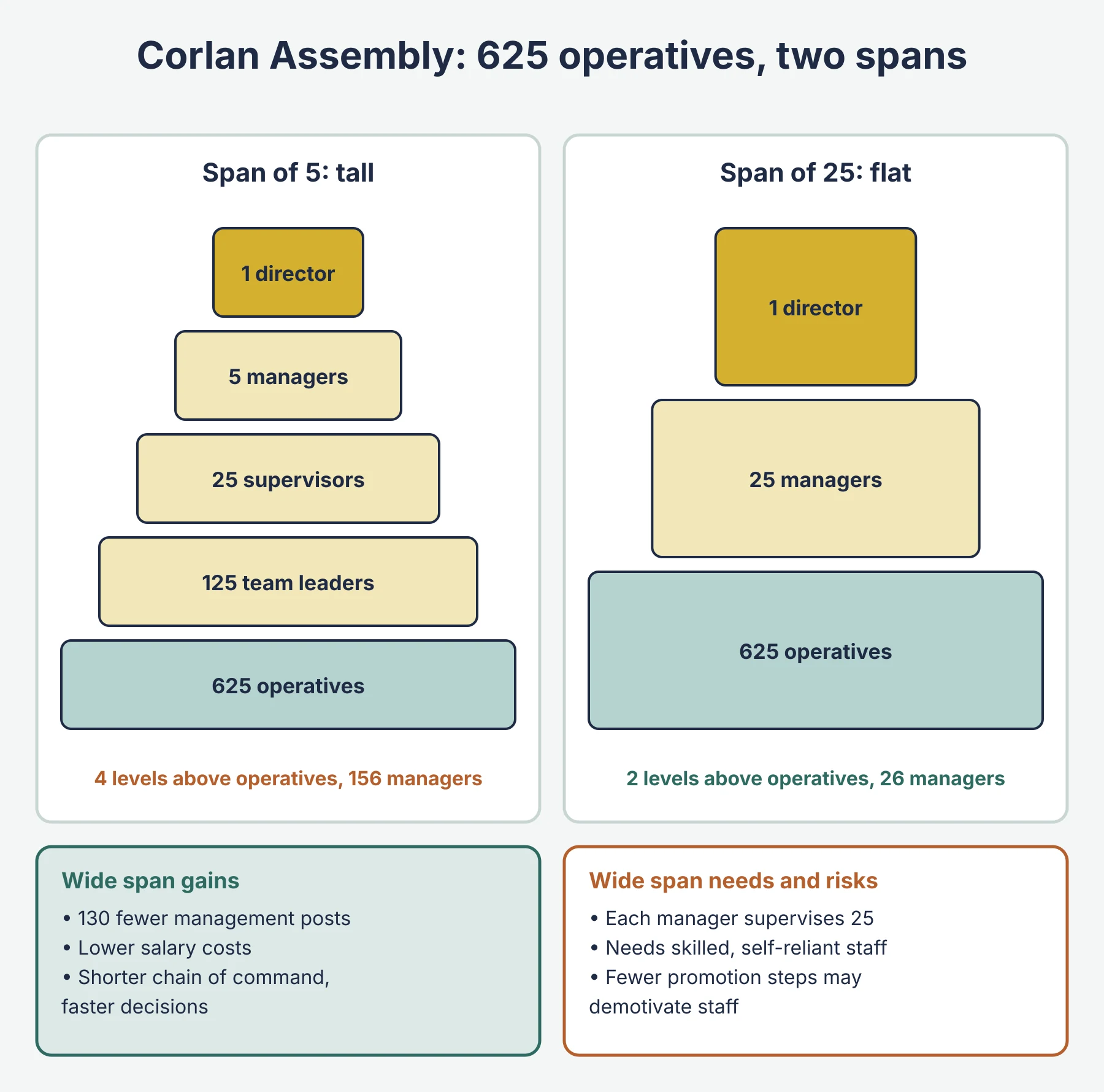
Worked example 1. Corlan Assembly employs 625 operatives.
Span of 5:   625 / 5 = 125 team leaders
             125 / 5 =  25 supervisors
              25 / 5 =   5 managers
               5 / 5 =   1 director   -> 4 levels above operatives, 156 managers

Span of 25:  625 / 25 = 25 managers
              25 / 25 =  1 director   -> 2 levels above operatives, 26 managers
The wide span removes 130 management posts, which saves salary costs and shortens the chain of command, so decisions travel faster. It also means each manager supervises 25 people, so Corlan needs skilled, self-reliant operatives, and there are far fewer promotion steps, which could demotivate staff who want to progress.
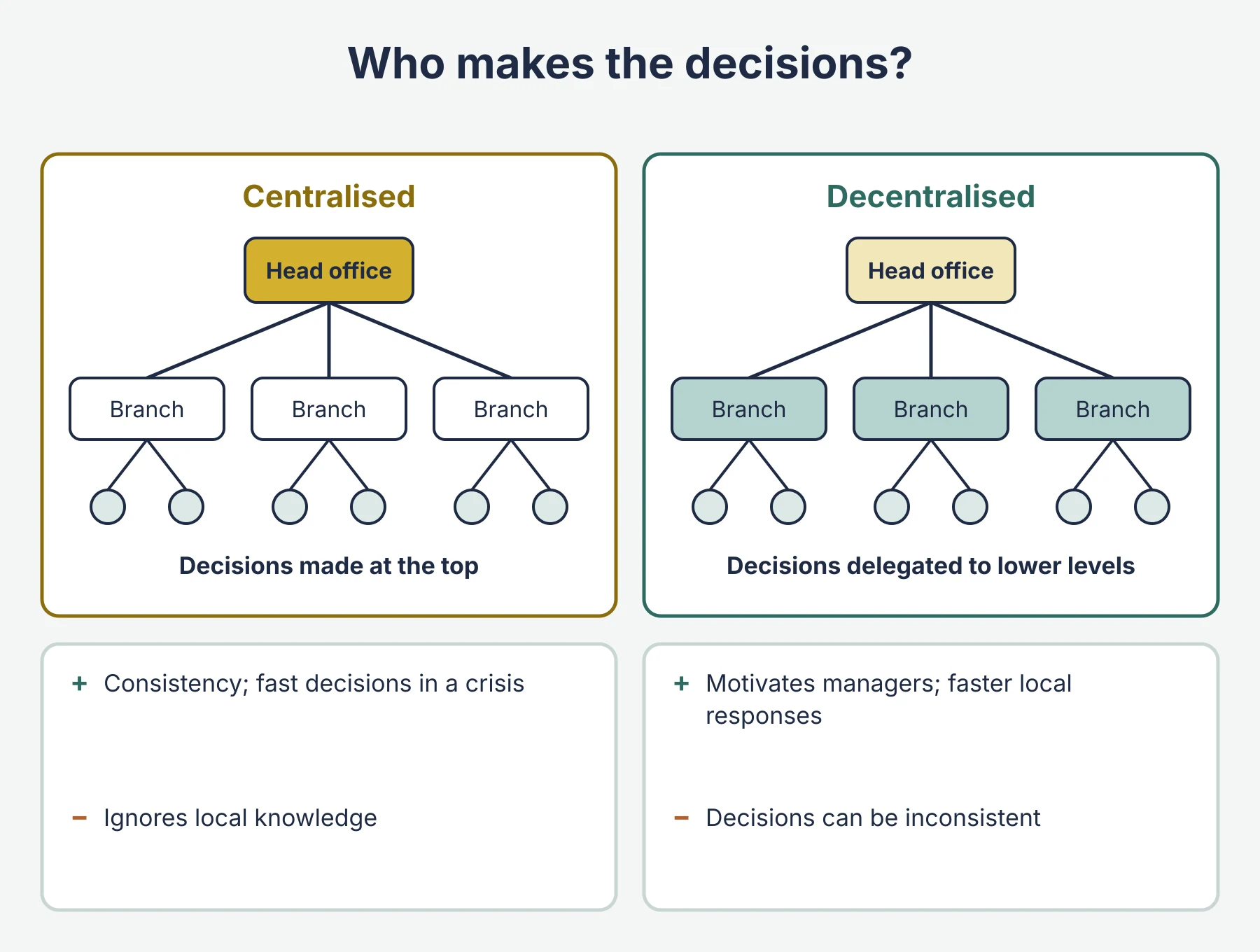
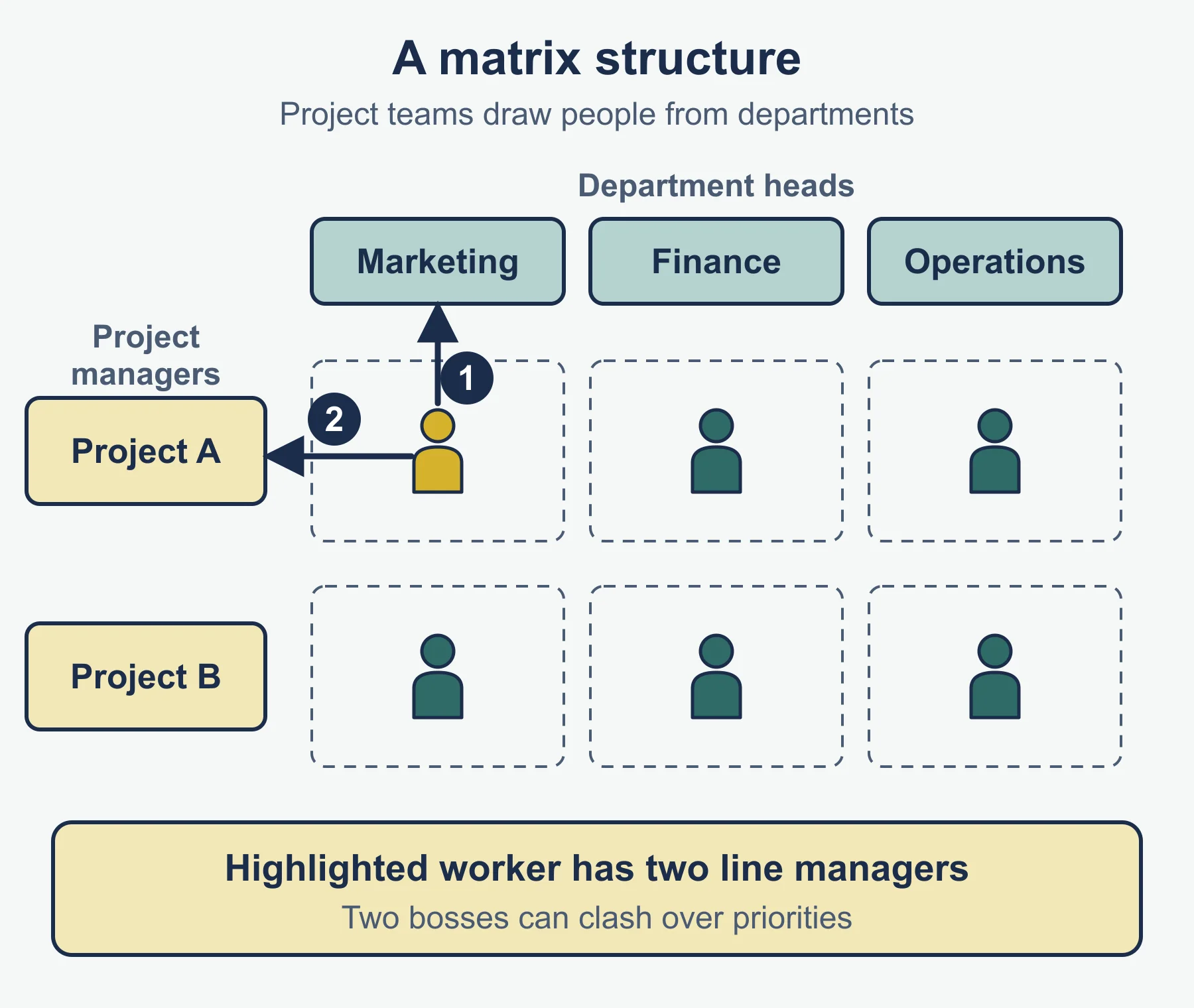
Centralised decision making keeps control at the top, which gives consistency and fast decisions in a crisis but ignores local knowledge. Decentralised decision making delegates to lower levels, which motivates managers and speeds up local responses but can lead to inconsistent decisions. A matrix structure places staff in project teams across departments, so each person reports to a functional manager and a project manager; it suits project-based work but can cause conflict over priorities.
Motivation in theory and practice
Motivated staff produce more, make fewer errors, are absent less often and are less likely to leave, which lowers recruitment costs. Each theory implies a different management approach.
| Theorist | Key idea | What a manager would do | Limitation |
|---|---|---|---|
| Taylor (scientific management) | Workers are motivated by money; there is one most efficient way to do each task | Break work into simple tasks, set targets, pay by piece rate | Ignores social needs; repetitive work can demotivate |
| Mayo (human relations) | Workers are motivated by social factors and by managers taking an interest in them | Build teams, consult staff, show interest | Groups may set their own norms that hold output down |
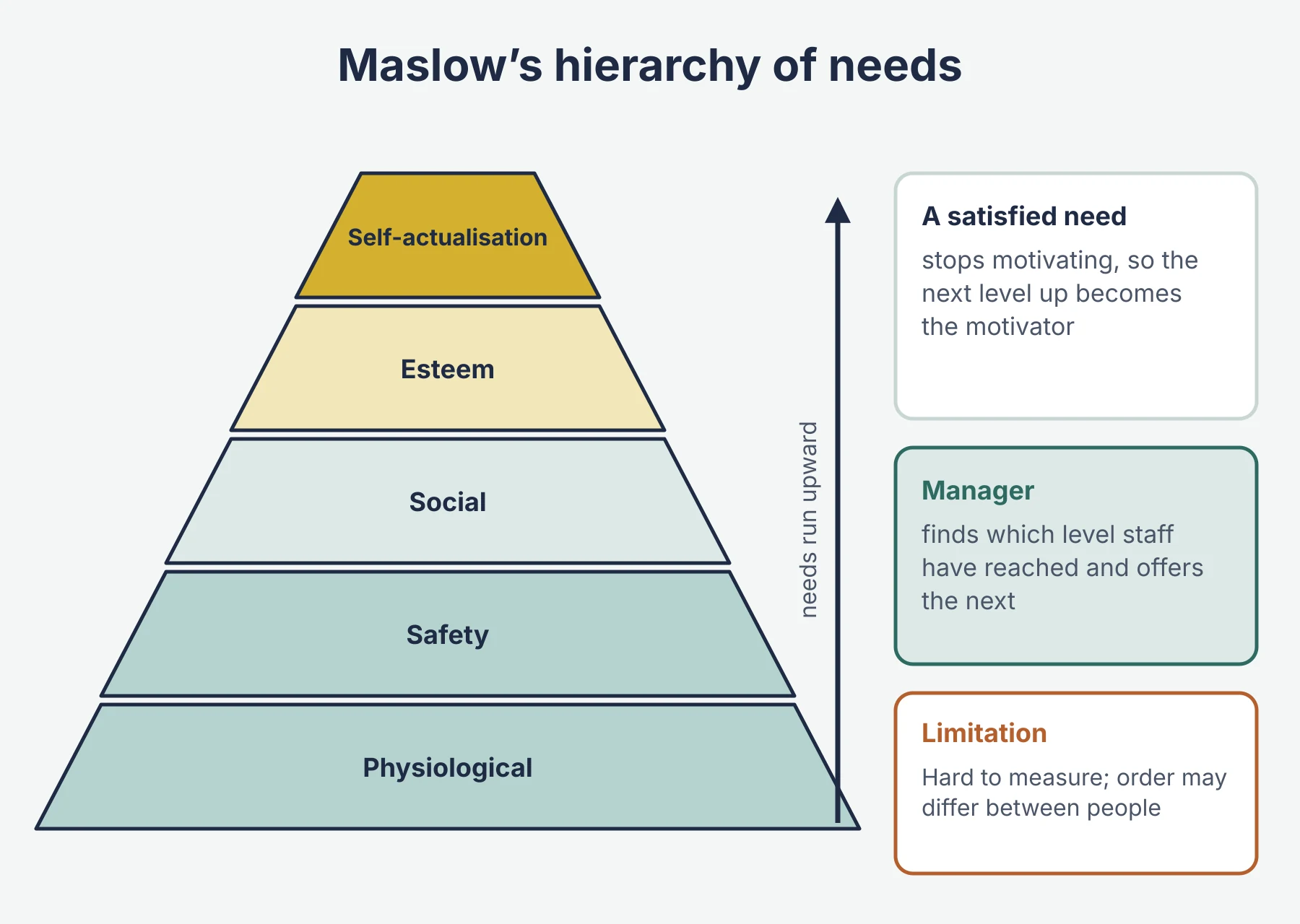
| Maslow (hierarchy of needs) | Needs run from physiological, safety, social and esteem to self-actualisation; a satisfied need stops motivating | Find which level staff have reached and offer the next | Hard to measure; order may differ between people |
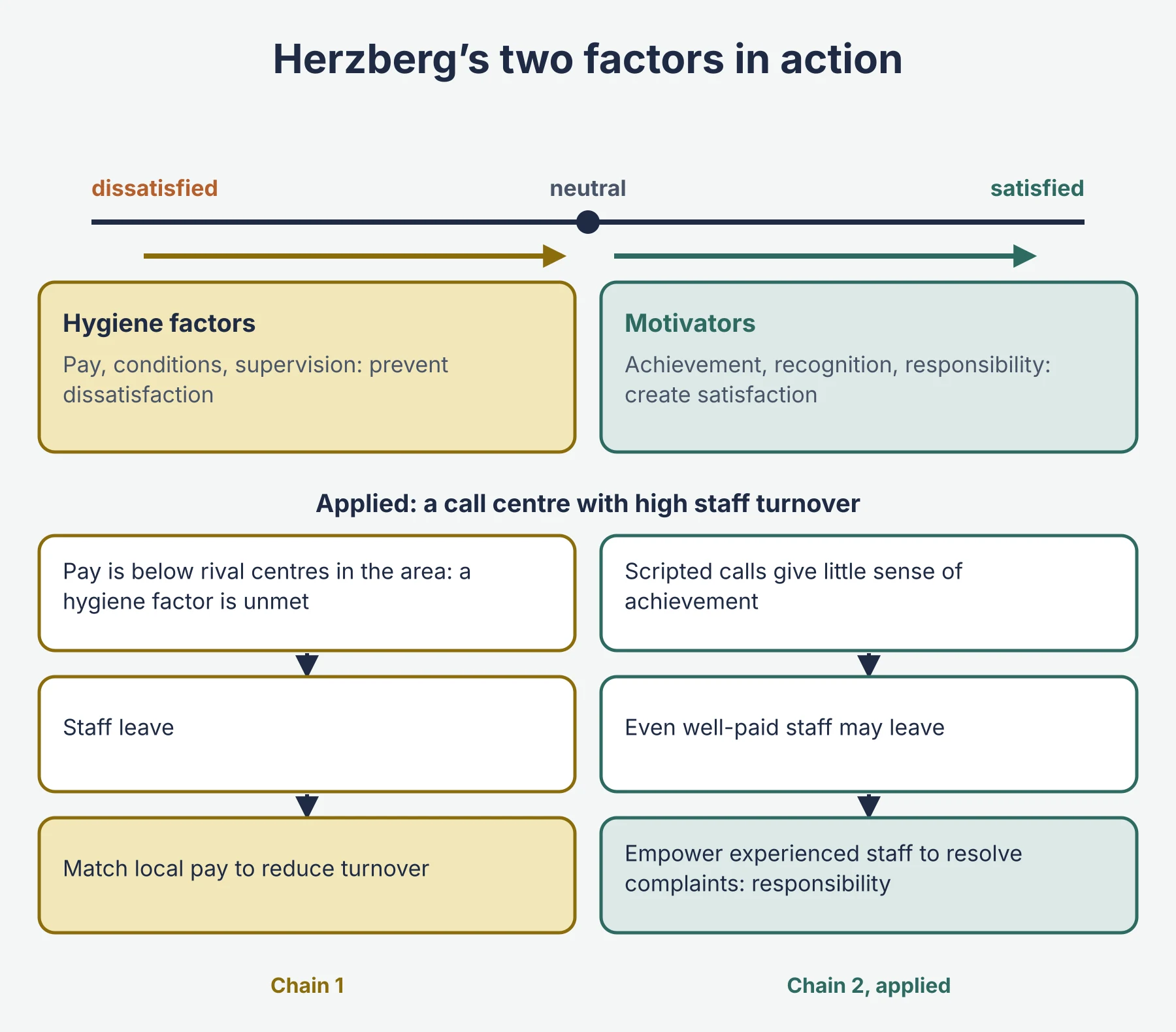
| Herzberg (two-factor theory) | Hygiene factors (pay, conditions, supervision) prevent dissatisfaction; motivators (achievement, recognition, responsibility) create satisfaction | Fix hygiene factors first, then enrich jobs | Based on a limited original sample |
Financial methods: piecework pays per unit produced; commission pays a percentage of sales; a bonus is a lump sum for meeting a target; profit share gives staff part of the profit; performance-related pay links pay rises to appraisal results. Each rewards what it measures, so piecework can encourage speed at the expense of quality.
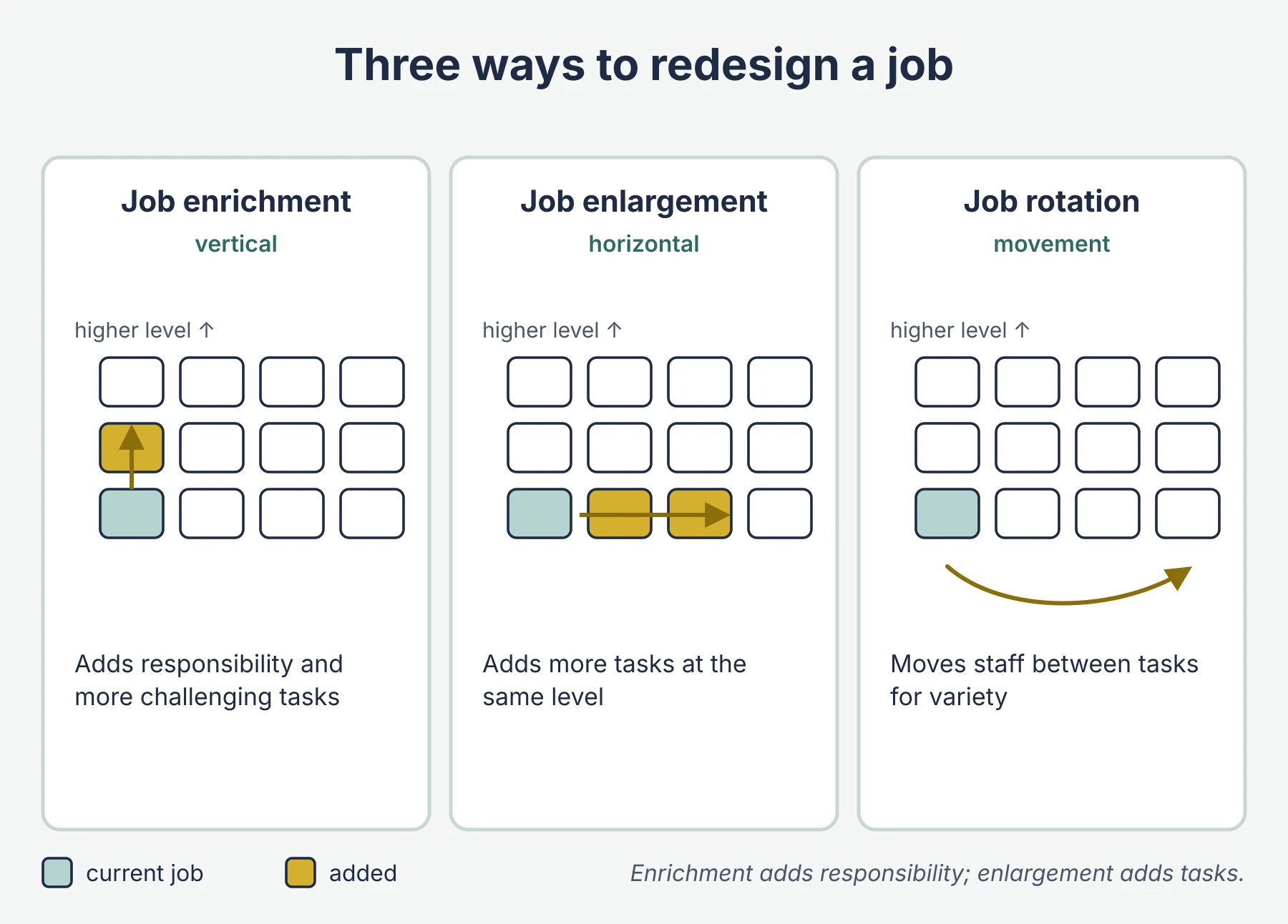
Non-financial methods: delegation passes authority for a task down; consultation asks staff for views before deciding; empowerment lets staff make decisions themselves; team working gives groups shared tasks; flexible working lets staff vary when or where they work. Job enrichment adds responsibility and more challenging tasks (vertical); job enlargement adds more tasks at the same level (horizontal); job rotation moves staff between tasks for variety.
Leadership
Management is about planning, organising and controlling resources to meet objectives; leadership is about setting direction and inspiring people to follow. A good manager is not always a good leader.
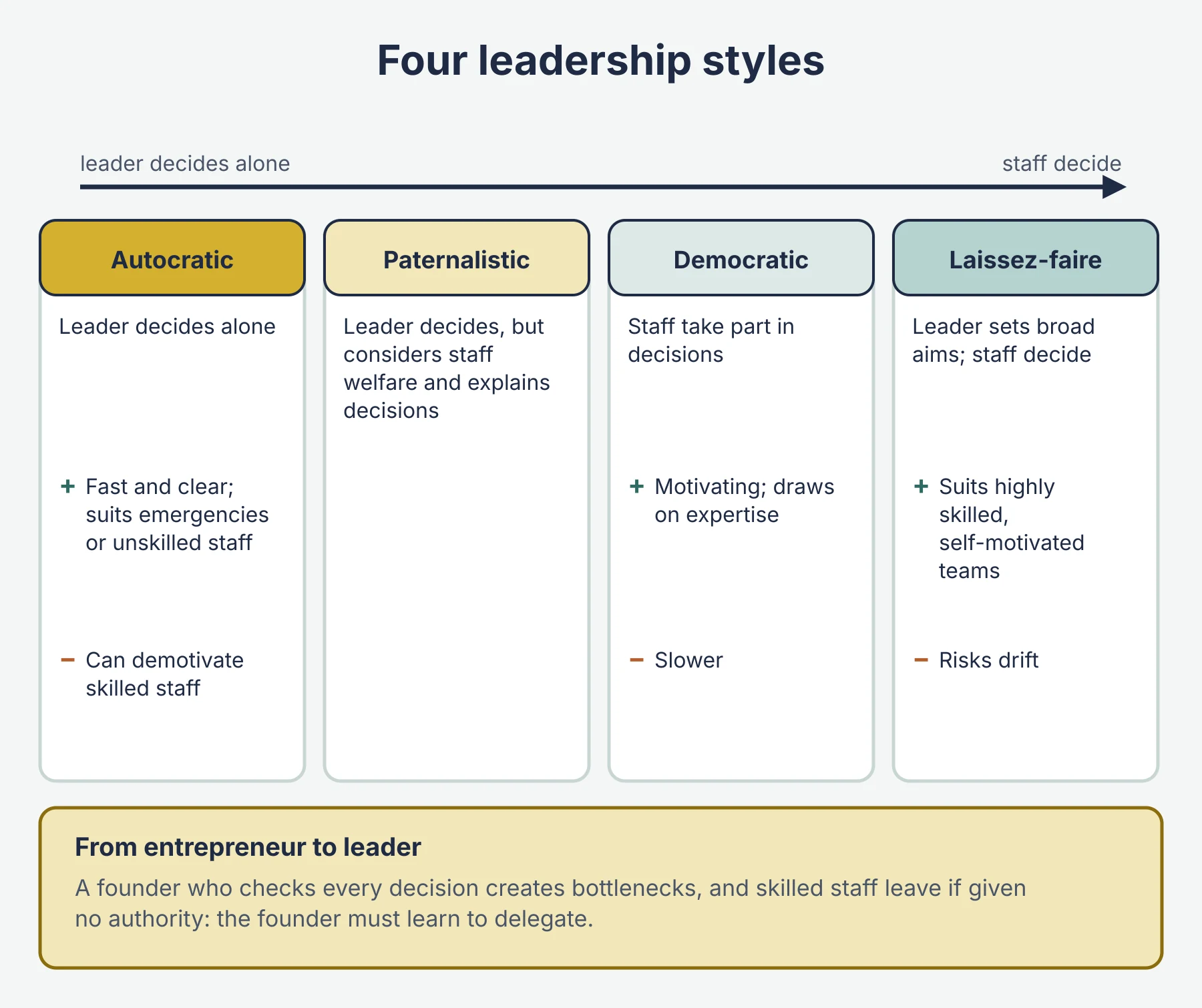
- Autocratic: the leader decides alone; fast and clear, suits emergencies or unskilled staff, but can demotivate skilled staff.
- Paternalistic: the leader decides but considers staff welfare and explains decisions.
- Democratic: staff take part in decisions; motivating and draws on expertise, but slower.
- Laissez-faire: the leader sets broad aims and leaves staff to decide; suits highly skilled, self-motivated teams, but risks drift.
From entrepreneur to leader. A founder who did everything personally must learn to delegate as the business grows. The difficulty is that the founder’s habits, such as checking every decision, create bottlenecks, and skilled staff leave if given no authority.
Worked example 2: an annotated answer
Question: Analyse how Herzberg’s two-factor theory could help a call centre with high staff turnover. (6 marks)
Herzberg argued that hygiene factors, such as pay and working conditions, only prevent dissatisfaction, while motivators, such as responsibility and recognition, create satisfaction [knowledge]. If the call centre’s pay is below rival centres in the area, staff will leave because a hygiene factor is unmet, so matching local pay should reduce turnover [chain 1]. But scripted calls give little sense of achievement, so even well-paid staff may leave; empowering experienced staff to resolve complaints without referral would add responsibility, a motivator, giving them a reason to stay [chain 2, applied].
Common mistakes
- Confusing job enrichment (more responsibility) with job enlargement (more tasks of the same kind).
- Describing redundancy as a punishment; it concerns the job, not the person.
- Saying a flat structure is always better: it depends on staff skills and the need for close supervision.
- Treating Herzberg’s hygiene factors as unimportant: their absence causes dissatisfaction.
- Naming a leadership style without linking it to the staff and situation in the source.
Exam technique
For explain (4 marks), give one point with two developed steps and a detail from the source. For analyse (6 marks), build two chains or one longer chain, linking the theory to a consequence for the named business. For discuss and assess, weigh a method against an alternative, using the source’s figures such as turnover, wage costs or spans of control, and state what your judgement depends on.
More resources on this topic
Related resources
-
Practice questions
Pearson Edexcel International A Level Business (YBS11): Managing People – Practice Questions
Twelve original source-based questions with full answers on staffing, training, structure, motivation, pay and leadership for Edexcel IAL Business 1.3.4.
Business · Pearson Edexcel · AS Level
Try questions -
Revision notes
Pearson Edexcel International A Level Business (YBS11): Managing People – Revision Notes
Revision notes for Edexcel IAL Business 1.3.4: staffing, training, structures, motivation theories and methods, leadership styles, key terms and a self-test.
Business · Pearson Edexcel · AS Level
Revise topic -
Study guides
Pearson Edexcel International A Level Business (YBS11): Meeting Customer Needs
Study guide to section 1.3.1 Meeting customer needs: mass and niche markets, dynamic markets, research and sampling, positioning and adding value.
Business · Pearson Edexcel · AS Level
Read guide
Get free revision emails (optional)
Occasional emails with practice questions, worked explanations and links to free resources for the qualification and subjects you choose. No spam, and you can unsubscribe from any email. The free tools on this site never need an email.