
Revision Notes
Pearson Edexcel International A Level Business (YBS11): Managing People – Revision Notes
Revision notes for Edexcel IAL Business 1.3.4: staffing, training, structures, motivation theories and methods, leadership styles, key terms and a self-test.
- Subject
- Business
- Level
- AS LEVEL
- Topic
- Marketing and people
- Author
- Marlbridge Academic Team
- Updated
- Reviewed by
- Salman Ahmad (what this means)
Aligned to Pearson Edexcel A Level Business (WBS11/01), Issue 1, September 2017. Official specification .
Syllabus page (what it covers and how it is assessed): Pearson Edexcel A Level Business.
Found an error? Report a correction.
Need help with this topic? Request a free trial class for A Level Business (YBS11).
Condensed recall for section 1.3.4 of Unit 1. For explanations and worked examples, use the Managing People study guide. Figures are invented.
Staffing in brief
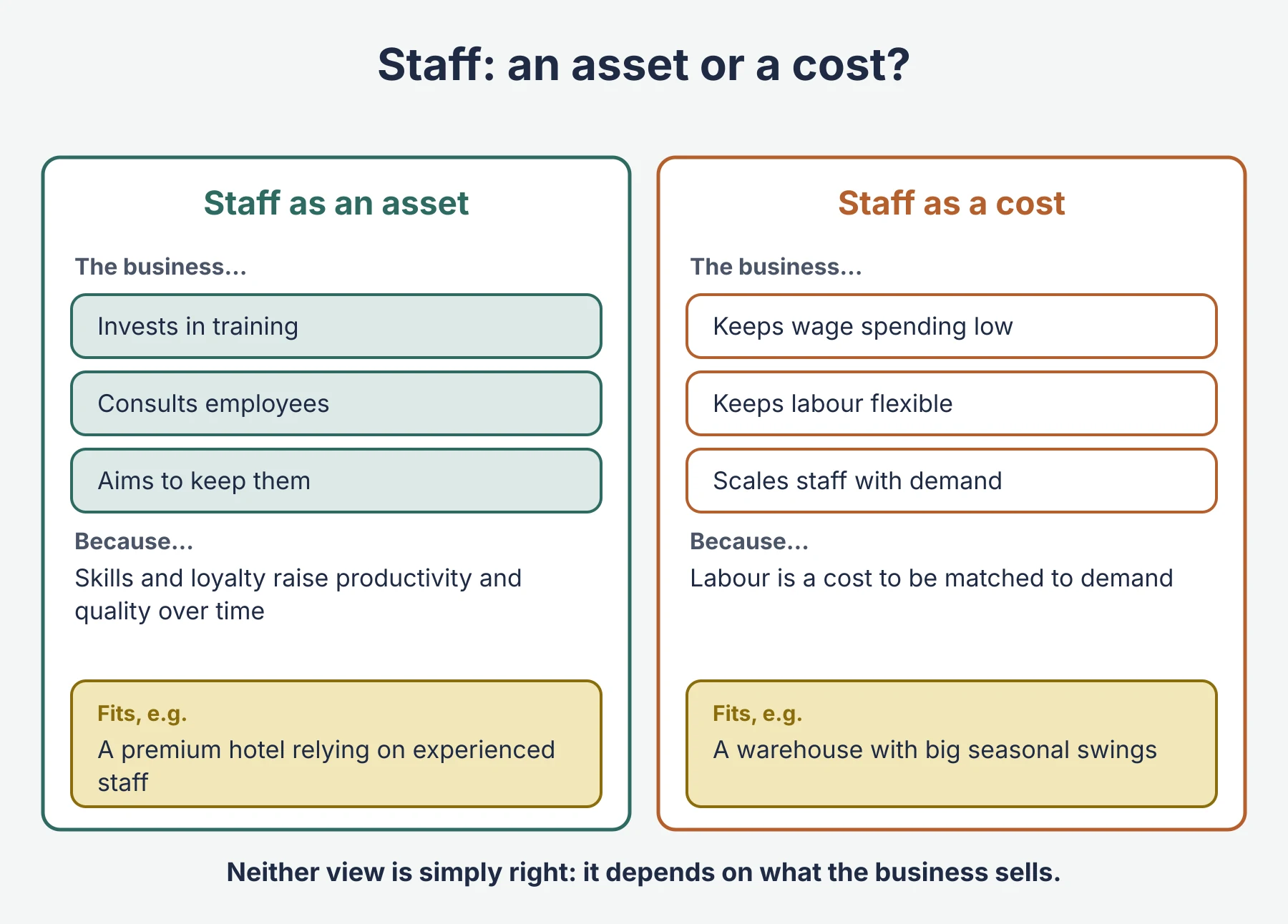
- Staff as an asset: invest in training and retention; suits firms where skills and service create advantage.
- Staff as a cost: minimise and flex wage spending; suits firms with volatile demand and simple tasks.
- Flexible workforce: multi-skilling; part-time and temporary; zero-hour contracts; flexible hours and home working; outsourcing.
- Dismissal: the employee’s conduct or capability ends the contract. Redundancy: the job disappears.
- Individual approach: terms agreed person by person. Collective bargaining: terms agreed with representatives for a group.
Recruitment and training
| Internal | External | |
|---|---|---|
| Cost and speed | Cheaper, faster | Dearer, slower |
| Knowledge of candidate | Known performance | Interview evidence only |
| New ideas | Few | More |
| Side effects | Creates another vacancy; motivates others | May upset internal candidates |
Costs: advertising, agency fees, managers’ time, induction, training courses, lost output while the newcomer learns.
Training: induction (introduction to the business); on-the-job (learning while working, cheap, specific); off-the-job (away from the workplace, dearer, broader).
Structure
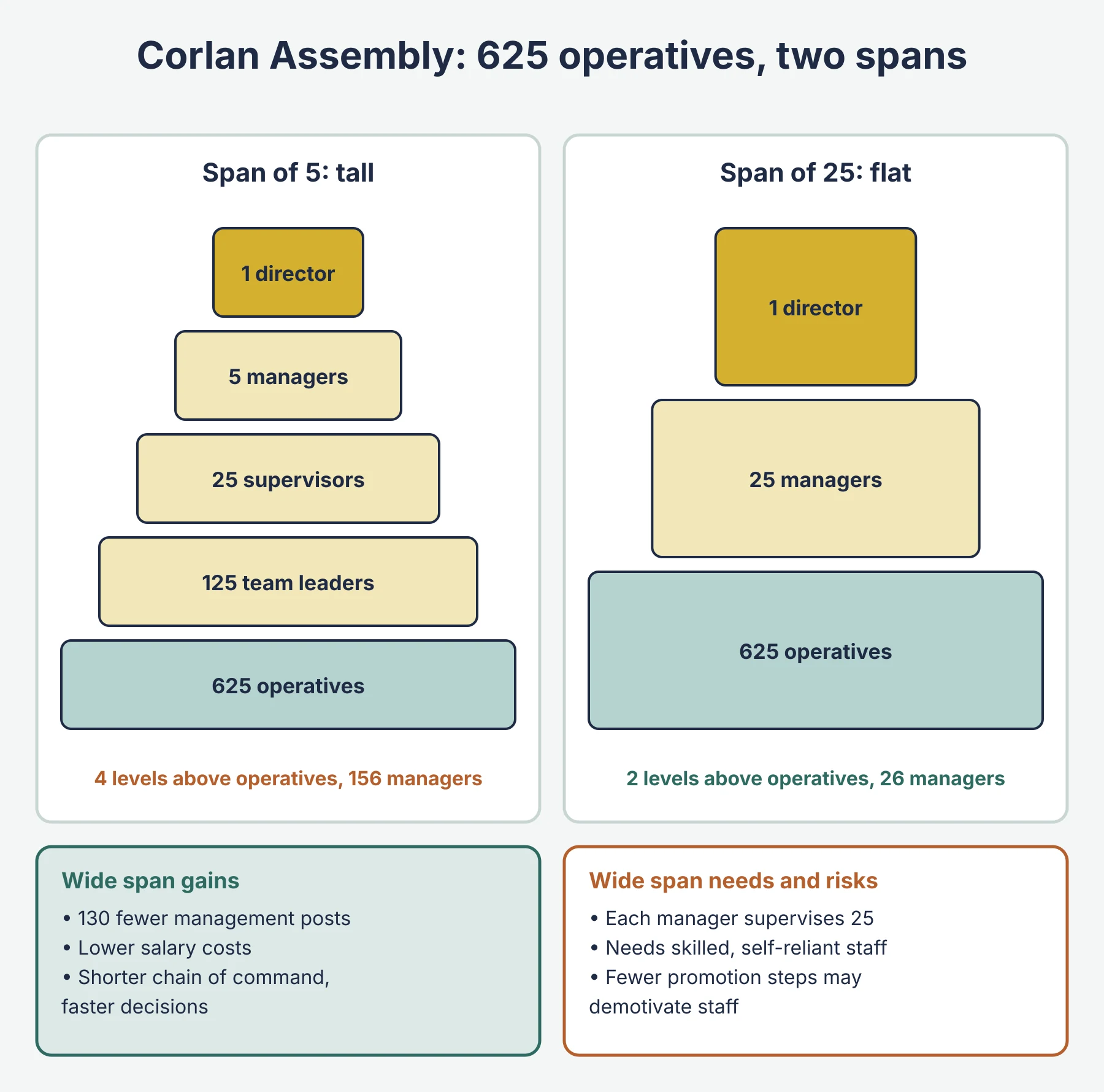
- Fewer levels ↔ wider spans. Number of managers at each level = people below ÷ span.
- Tall: narrow spans, close control, more promotion steps, slow communication, higher management cost.
- Flat: wide spans, faster communication, more autonomy, overstretched managers, fewer promotion steps.
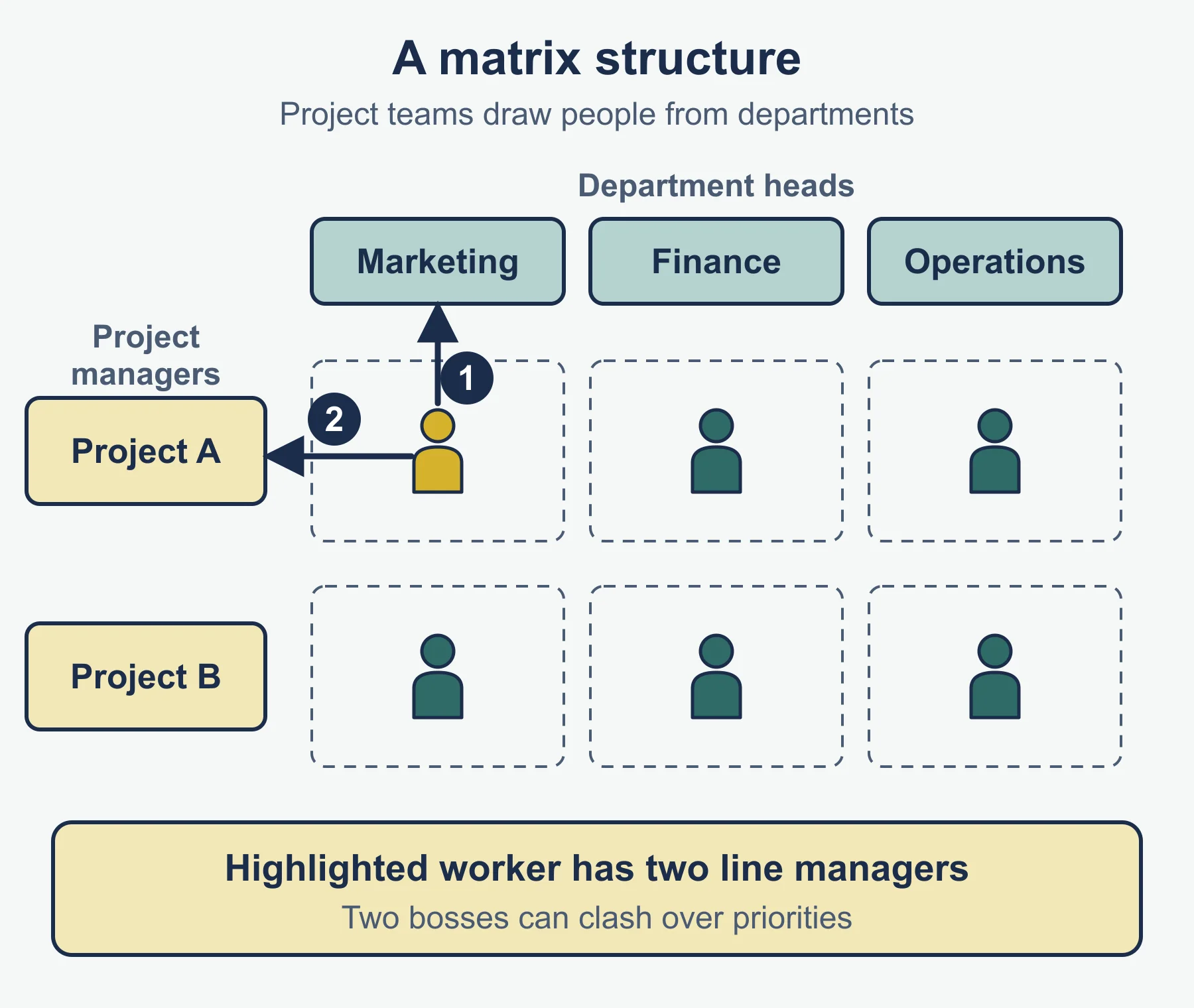
- Matrix: project teams across functions; two bosses; flexible but conflict-prone.
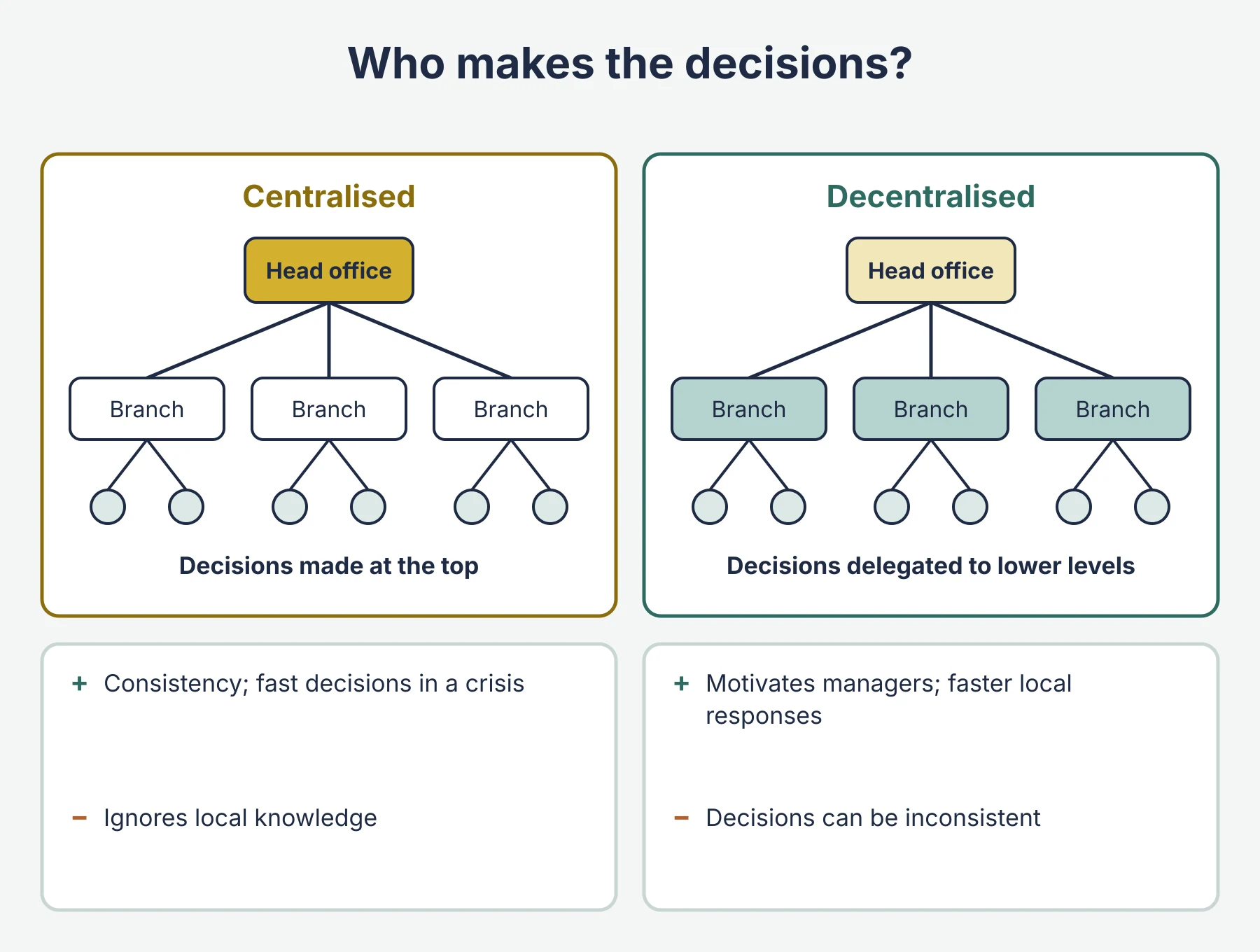
- Centralised: consistent, controlled, slow to respond locally. Decentralised: responsive and motivating, risk of inconsistency.
Motivation
| Theorist | One-line idea | Method it supports |
|---|---|---|
| Taylor | Money and efficient task design | Piecework, close supervision |
| Mayo | Social needs and attention | Team working, consultation |
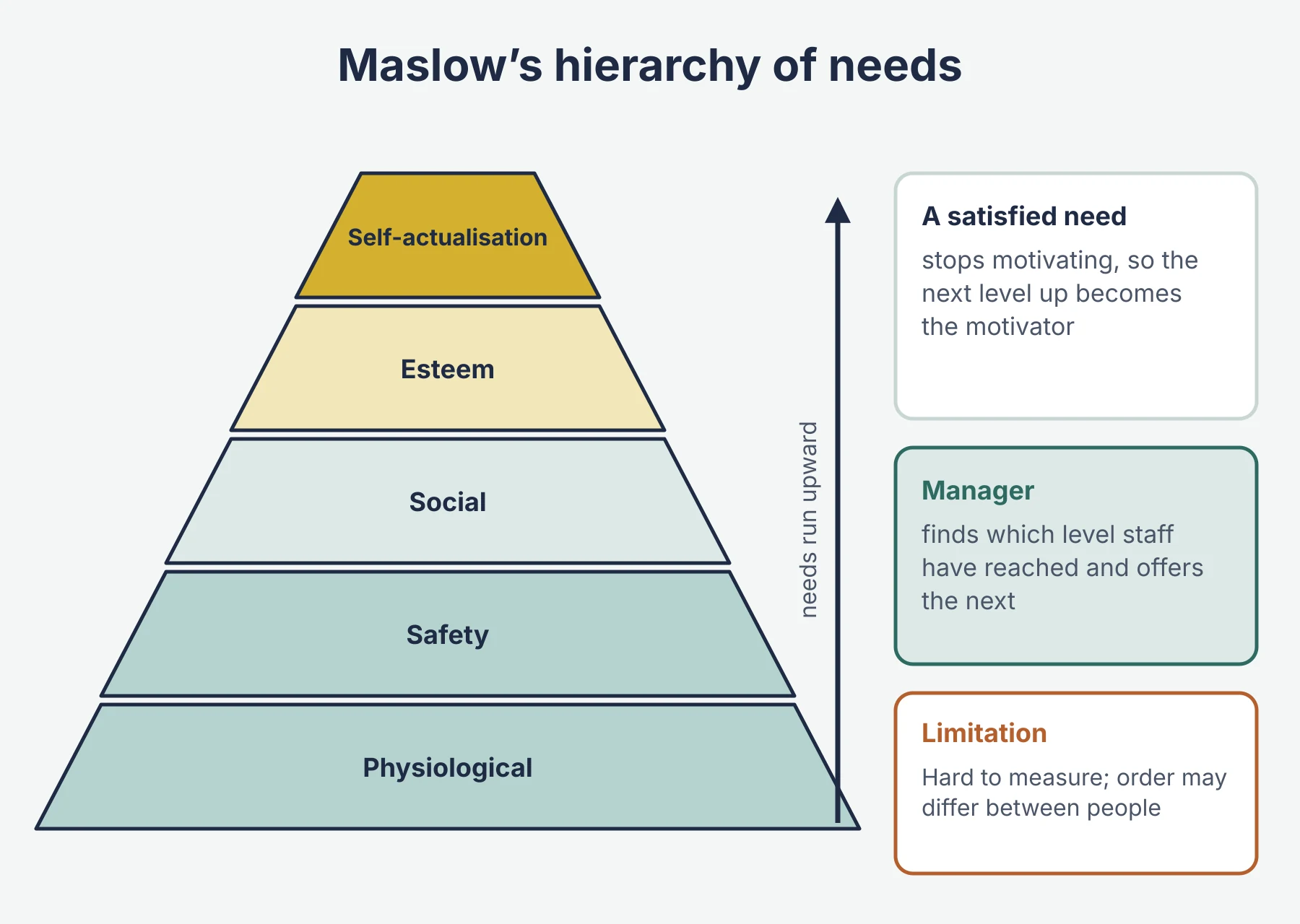
| Maslow | Hierarchy: physiological → safety → social → esteem → self-actualisation | Match rewards to the level reached |
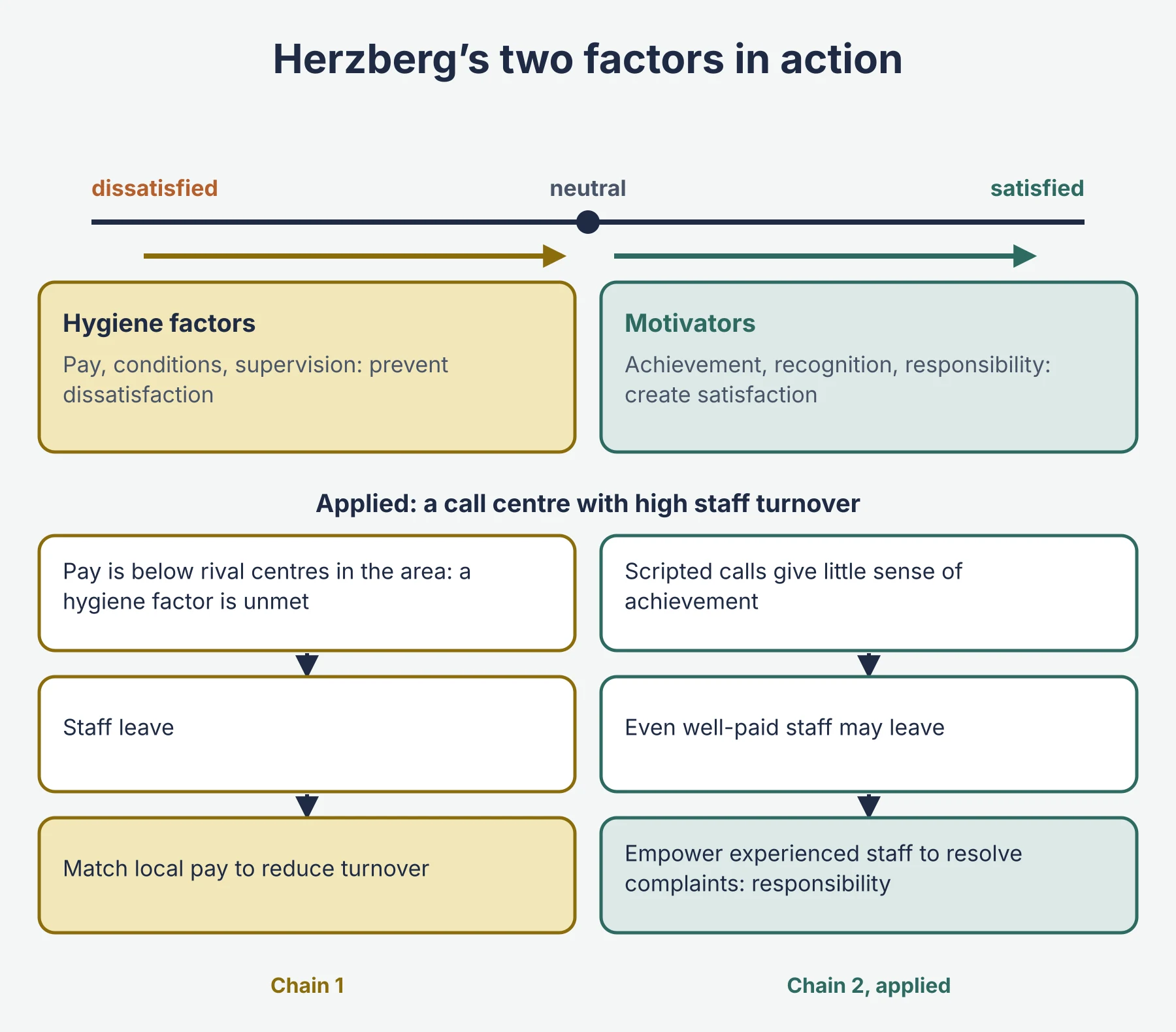
| Herzberg | Hygiene factors prevent dissatisfaction; motivators create satisfaction | Job enrichment, empowerment |
Financial: piecework (per unit), commission (% of sales), bonus (lump sum for a target), profit share, performance-related pay (linked to appraisal).
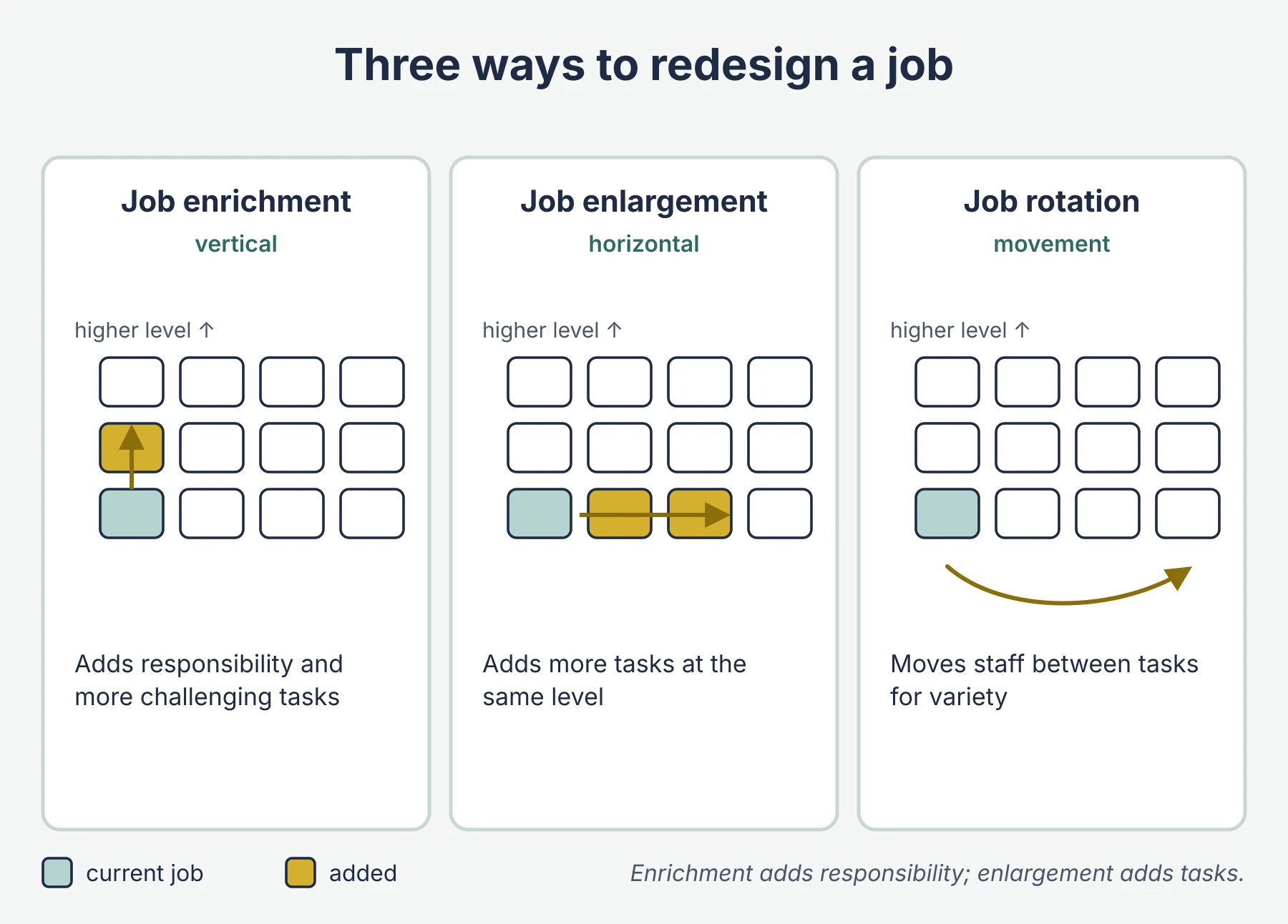
Non-financial: delegation, consultation, empowerment, team working, flexible working, job enrichment (more responsibility), job rotation (moving between tasks), job enlargement (more tasks at the same level).
Matching method to problem:
| Problem in the source | Likely cause | Method that targets it |
|---|---|---|
| Staff leave for rivals paying more | Unmet hygiene factor (Herzberg) | Review pay to the local rate |
| Repetitive work, boredom | Lack of motivators | Job rotation or enrichment |
| Isolated staff, weak team spirit | Unmet social needs (Mayo, Maslow) | Team working, consultation |
| Output too low on simple tasks | Little incentive per unit | Piecework or bonus (Taylor) |
| Skilled staff frustrated by slow approvals | Too little authority | Delegation, empowerment |
Leadership
- Management plans, organises and controls; leadership sets direction and inspires.
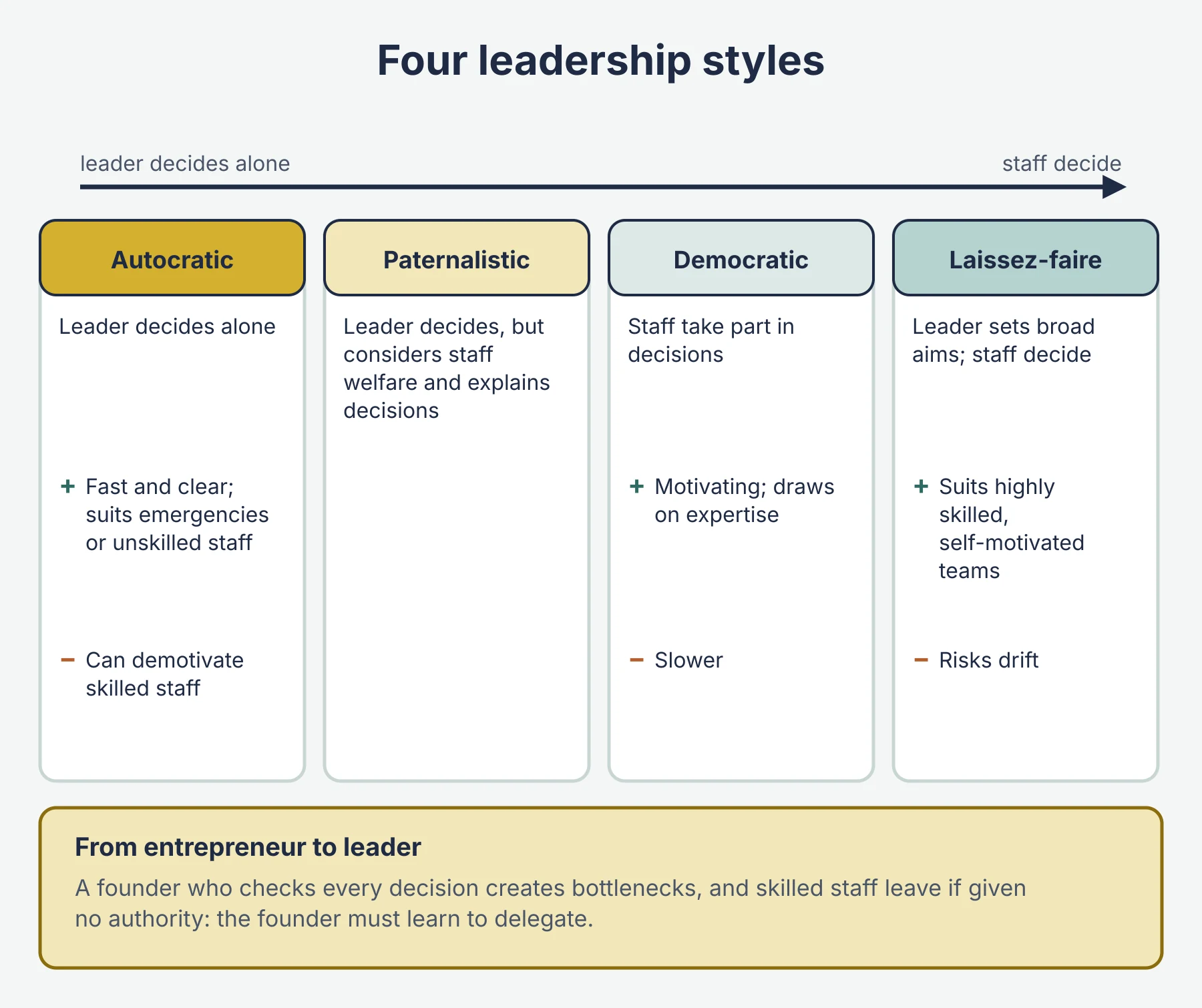
- Autocratic: leader decides alone. Paternalistic: leader decides in staff’s interests and explains. Democratic: staff take part. Laissez-faire: staff decide within broad aims.
- Entrepreneur to leader: the founder must delegate and trust others; failure to do so creates bottlenecks and loses talent.
Key terms
| Term | Meaning |
|---|---|
| Multi-skilling | Training staff to do several different jobs |
| Zero-hour contract | No guaranteed minimum hours; paid only for hours worked |
| Outsourcing | Paying another business to carry out a function |
| Collective bargaining | Negotiation between employers and employee representatives |
| Span of control | Number of subordinates reporting directly to one manager |
| Chain of command | The route through which instructions pass down a hierarchy |
| Delegation | Passing authority for a task to a subordinate |
| Empowerment | Giving staff the power to make decisions about their own work |
| Hygiene factor | A factor whose absence causes dissatisfaction (Herzberg) |
| Paternalistic leadership | Leader decides, but with staff welfare in mind |
Exam traps
- Enrichment adds responsibility; enlargement adds tasks; rotation moves people.
- Pay is a hygiene factor for Herzberg but the main motivator for Taylor: say which theory you are using.
- Redundancy is about the job, dismissal about the person.
- Flat is not automatically better than tall; it depends on staff skills and the work.
- Commission and piecework reward quantity, which may lower quality.
- Mayo’s work points to social needs, not to higher pay.
Self-test
- State two forms of flexible working named in the specification.
- Distinguish dismissal from redundancy.
- Give one advantage of internal recruitment.
- A business has 360 staff and a span of control of 12. How many first-line managers does it need?
- Halve that span to 6. How many first-line managers are now needed?
- Give one drawback of a matrix structure.
- State Herzberg’s two groups of factors, with one example each.
- Which theorist is linked to scientific management?
- Distinguish job enrichment from job enlargement.
- A salesperson earns 3% commission on sales of $240,000. Calculate the commission.
- Which leadership style suits a team of highly skilled researchers, and why?
- Why can moving from entrepreneur to leader be difficult?
Answers
- Any two: multi-skilling; part-time and temporary; zero-hour contracts; flexible hours and home working; outsourcing.
- Dismissal ends a contract for a reason linked to the employee; redundancy happens because the job is no longer needed.
- Cheaper and quicker, or the candidate’s performance is already known, or promotion motivates other staff.
- 360 ÷ 12 = 30.
- 360 ÷ 6 = 60.
- Two lines of authority can cause conflict over priorities and confusion about who to report to.
- Hygiene factors, such as pay or working conditions; motivators, such as recognition or responsibility.
- Taylor.
- Enrichment adds responsibility and more challenging work; enlargement adds more tasks at the same level.
- 3% × $240,000 = $7,200.
- Laissez-faire or democratic, because skilled, self-motivated staff work best with freedom and their expertise improves decisions.
- The founder is used to making every decision, so must learn to delegate and trust others; failure creates bottlenecks and frustrates skilled staff.
Related resources
-
Study guides
Pearson Edexcel International A Level Business (YBS11): Meeting Customer Needs
Study guide to section 1.3.1 Meeting customer needs: mass and niche markets, dynamic markets, research and sampling, positioning and adding value.
Business · Pearson Edexcel · AS Level
Read guide -
Practice questions
Pearson Edexcel International A Level Business (YBS11): Meeting Customer Needs – Practice Questions
Eleven original source-based questions with mark-scheme answers on markets, research, sampling, positioning and adding value for Edexcel IAL Business 1.3.1.
Business · Pearson Edexcel · AS Level
Try questions -
Revision notes
Pearson Edexcel International A Level Business (YBS11): Meeting Customer Needs – Revision Notes
Revision notes for Edexcel IAL Business 1.3.1: markets, research methods, sampling, positioning, key terms, exam traps and a self-test with answers.
Business · Pearson Edexcel · AS Level
Revise topic
Get free revision emails (optional)
Occasional emails with practice questions, worked explanations and links to free resources for the qualification and subjects you choose. No spam, and you can unsubscribe from any email. The free tools on this site never need an email.