
Revision Notes
Pearson Edexcel International A Level English Literature (YET01): Unit 4 Shakespeare – Revision Notes
Quick-recall notes for YET01 Unit 4 Section A: the four Shakespeare plays, dramatic terms, contexts, AO5 interpretations, the statement method and a self-test.
- Subject
- English Literature
- Level
- A LEVEL
- Topic
- Unit 4: Shakespeare and Pre-1900 Poetry
- Author
- Marlbridge Academic Team
- Updated
- Reviewed by
- Ammar Bilal (what this means)
Aligned to Pearson Edexcel A Level English Literature (YET01), For first teaching 2015 (units WET01–WET04). Official specification .
Syllabus page (what it covers and how it is assessed): Pearson Edexcel A Level English Literature.
Syllabus points this page covers
YET01 (A Level)
- 4.3 Shakespeare
Found an error? Report a correction.
Need help with this topic? Request a free trial class for A Level English Literature (YET01).
Condensed notes for the Shakespeare section of Unit 4 (WET04) in Pearson Edexcel International A Level English Literature (YET01). For the full method and a worked plan, use the Unit 4 Shakespeare study guide.
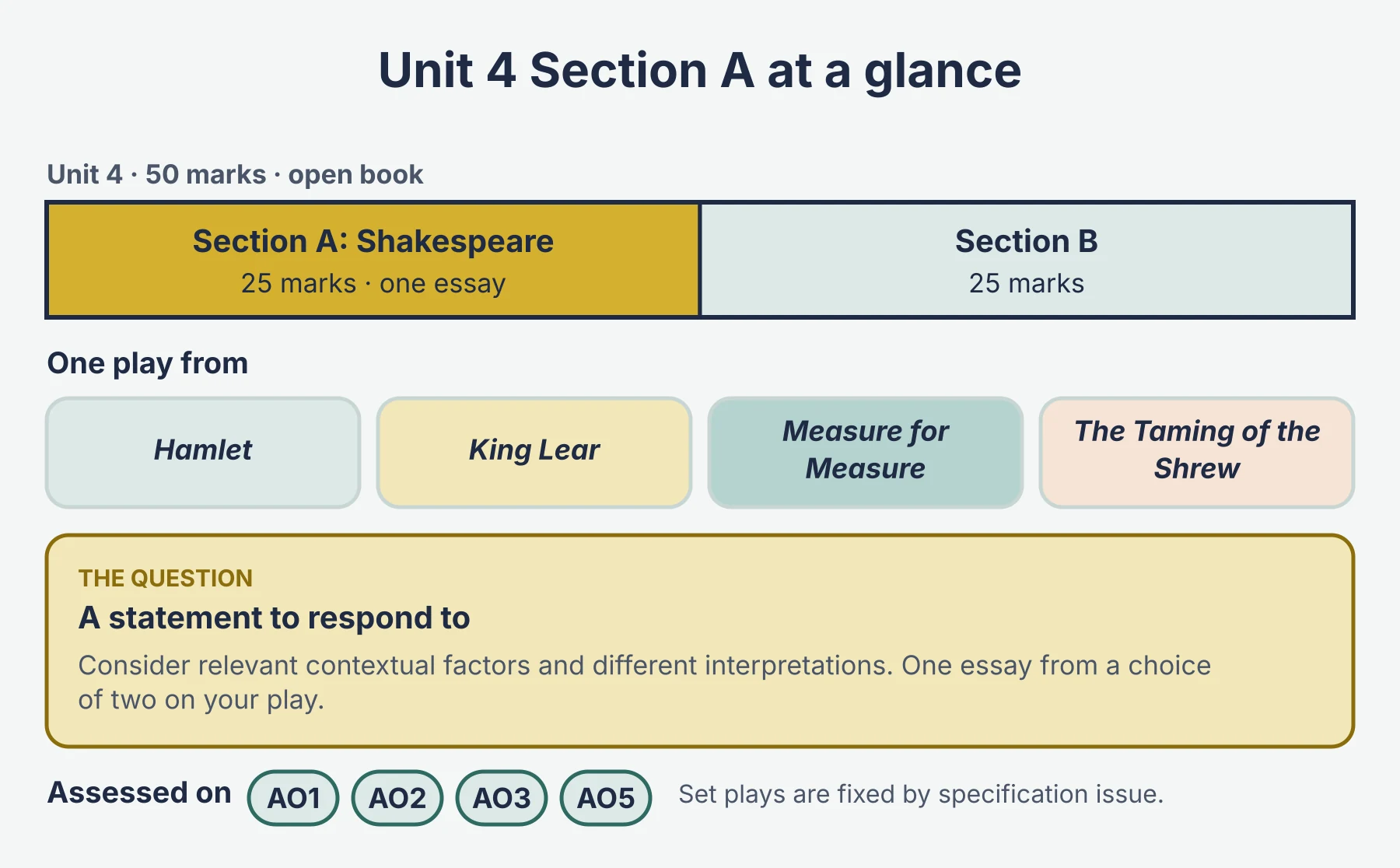
The task in one box
| Detail | Section A |
|---|---|
| Plays | Hamlet, King Lear, Measure for Measure, The Taming of the Shrew (study one) |
| Question | One from a choice of two; a statement to respond to |
| Must consider | Relevant contextual factors and different interpretations |
| Marks | 25 of 50 |
| AOs | AO1, AO2, AO3, AO5 (no AO4) |
| Format | Open book |
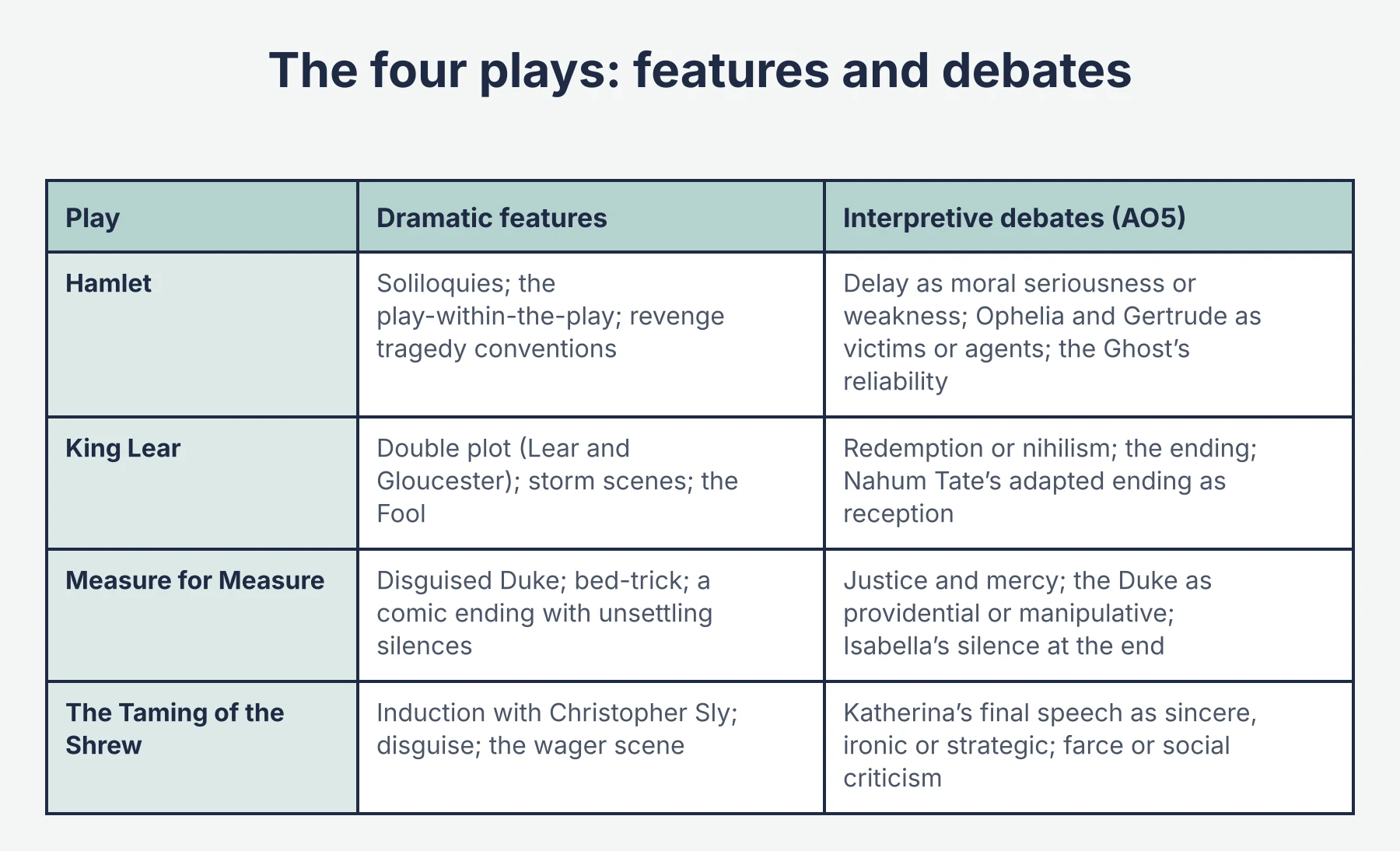
Play recall grid
| Play | Genre | Structural features | Lines worth knowing |
|---|---|---|---|
| Hamlet | Revenge tragedy | Ghost’s command; play-within-the-play; delay; final duel | “To be, or not to be, that is the question”; “The time is out of joint”; “The rest is silence” |
| King Lear | Tragedy | Love test; double plot; storm; Dover; deaths of Cordelia and Lear | “Nothing will come of nothing”; “I am a man / More sinned against than sinning”; “As flies to wanton boys are we to th’ gods” |
| Measure for Measure | Problem play / dark comedy | Duke’s disguise; Angelo’s bargain; bed-trick; final judgement scene | “Some rise by sin, and some by virtue fall”; “Ay, but to die, and go we know not where”; “More than our brother is our chastity” |
| The Taming of the Shrew | Comedy with a frame | Christopher Sly Induction; wooing; taming; wager scene | “Kiss me, Kate”; “Thy husband is thy lord, thy life, thy keeper” |
Quotations are open-book in the exam, but knowing where key lines sit saves time.
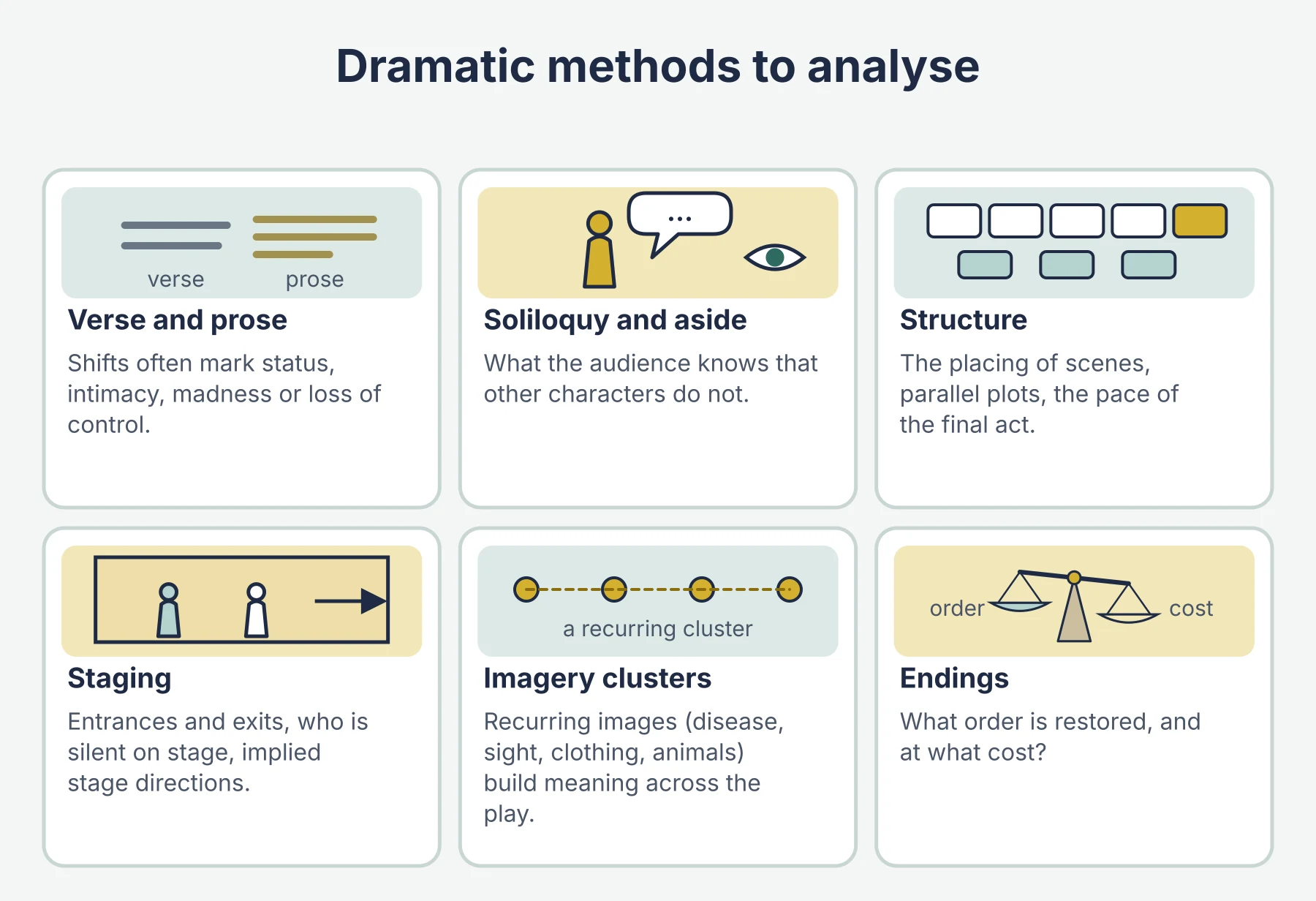
Dramatic terms
| Term | Meaning |
|---|---|
| Blank verse | Unrhymed iambic pentameter |
| Prose | Unmetred speech; often lower status, comedy, madness or intimacy |
| Soliloquy | A character alone, speaking thoughts to the audience |
| Aside | A remark heard by the audience but not by others on stage |
| Dramatic irony | The audience knows more than a character |
| Subplot | A secondary plot that mirrors or comments on the main plot |
| Induction | A framing scene before the main action (as in The Taming of the Shrew) |
| Foil | A character who contrasts with another |
| Hamartia | A tragic flaw or error |
| Anagnorisis | A moment of tragic recognition |
| Problem play | A play mixing comic and tragic elements that leaves moral questions unresolved |
AO3: contexts to have ready
| Play | Contexts |
|---|---|
| Hamlet | Revenge tragedy tradition; Protestant doubt about purgatory and ghosts; the duty of revenge versus Christian conscience |
| King Lear | Jacobean anxieties about the division of the kingdom; inheritance and legitimacy; reception through Tate’s adaptation with a surviving Cordelia |
| Measure for Measure | James I’s interest in kingship; regulation of sexuality; the problem-play label |
| The Taming of the Shrew | Early modern marriage and patriarchy; shrew-taming traditions; changing modern responses and adaptations |
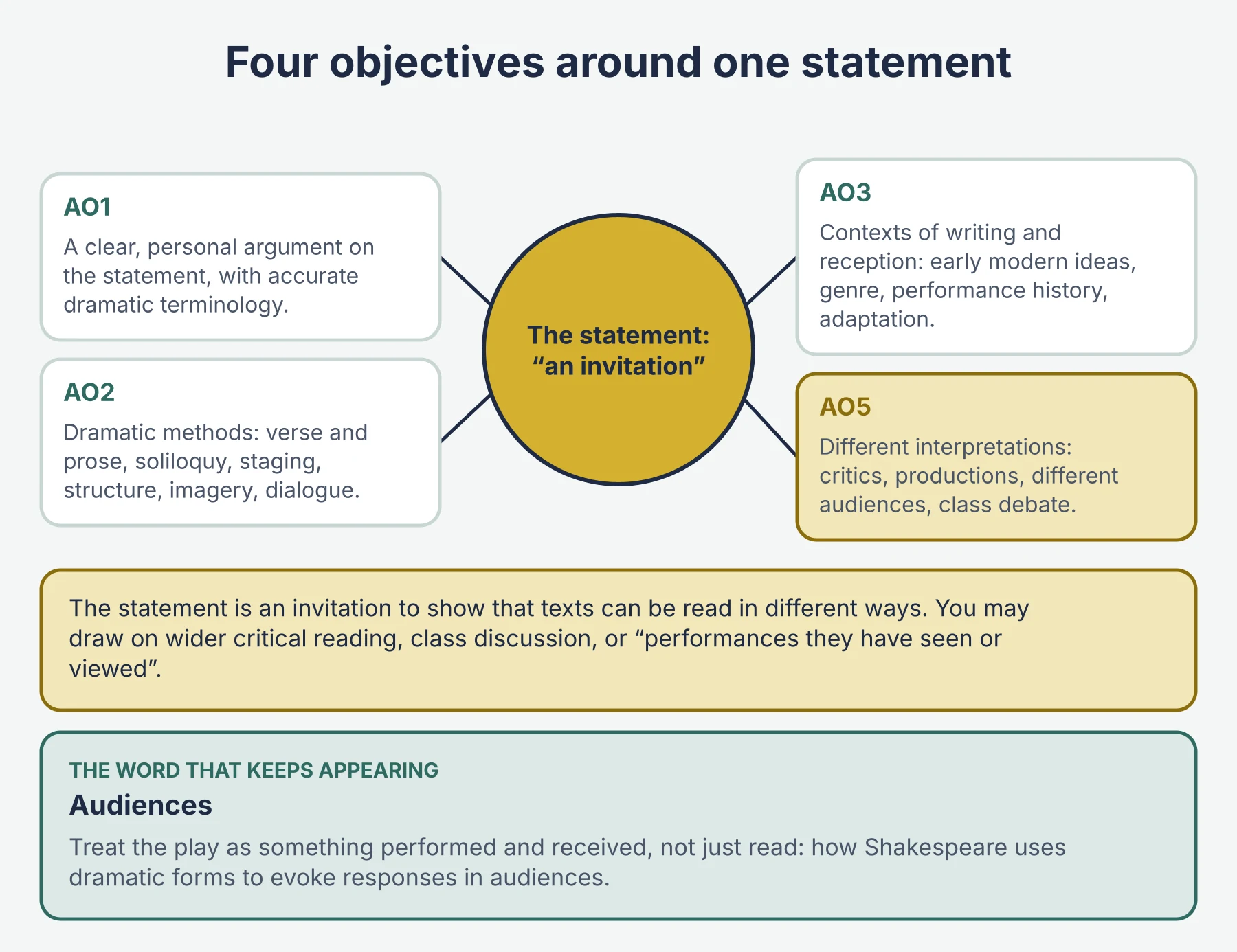
AO5: four sources of interpretation
- The statement itself.
- Critics, paraphrased or briefly quoted.
- Productions and adaptations you have seen or viewed.
- Class debate.
Weigh each view against the text. A view you reject still counts if you show why.
An AO5 sentence: weak to strong
Weak: “Some critics think Katherina is being ironic in her last speech.”
Strong: “Katherina’s final speech can be played as sincere submission, but its length and its exaggerated images of wifely duty allow a production to suggest performance; since the whole play is framed by the Induction as a show staged for Christopher Sly, an ironic reading has textual support, though it does not remove the speech’s discomfort for a modern audience.”
The strong version names an interpretation, tests it against dramatic evidence and reaches a judgement.
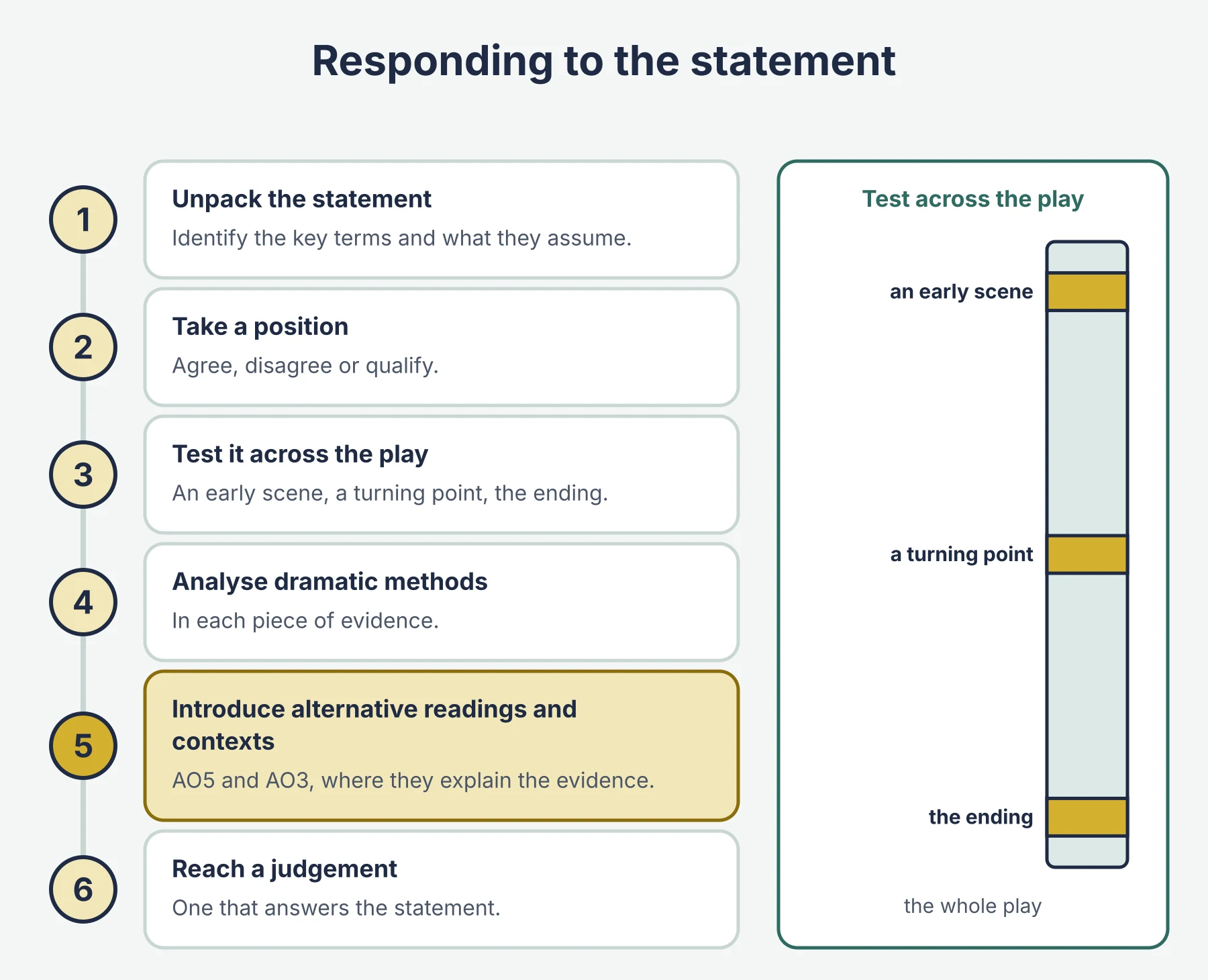
Statement method
- Unpack the key terms.
- Agree, disagree or qualify.
- Test with an early scene, a turning point and the ending.
- Analyse dramatic methods.
- Bring in context and alternative readings where they explain evidence.
- Judge.
Traps
- Retelling the play.
- Forgetting the audience and the stage.
- A context paragraph that never returns to the play.
- Critics listed but not evaluated.
- Ignoring the statement after the introduction.
- Comparing with other plays (AO4 is not assessed).
- Misquoting when the text is in front of you.
Self-test
- Which four AOs are assessed in Section A?
- Name the four set plays.
- What does each question give you to respond to?
- What does the specification call the statement in each question?
- Name three sources you can draw on for AO5.
- What is the difference between a soliloquy and an aside?
- What can a shift from verse to prose signal?
- Which play has an Induction, and with which character?
- What was Nahum Tate’s change to King Lear, and why is it useful for AO3?
- Why is Measure for Measure called a problem play?
- What is dramatic irony?
- Is comparison with another play rewarded?
Answers: 1. AO1, AO2, AO3, AO5. 2. Hamlet, King Lear, Measure for Measure, The Taming of the Shrew. 3. A statement. 4. An invitation to show that texts can be interpreted in different ways. 5. Any three: the statement, wider critical reading, productions seen or viewed, class debate. 6. A soliloquy is spoken alone; an aside is a brief remark to the audience while others are on stage. 7. Lower status, comedy, madness, intimacy or loss of control. 8. The Taming of the Shrew; Christopher Sly. 9. He gave the play a happy ending in which Cordelia survives; it is evidence of how audiences received the original ending. 10. It mixes comedy and tragedy and leaves moral questions about justice and mercy unresolved. 11. When the audience knows more than a character. 12. No; AO4 is not assessed in Unit 4.
Related pages
Related resources
-
Practice questions
Unit 4 Shakespeare and Pre-1900 Poetry (YET01): Practice Questions
Original statement-based essay questions for Edexcel IAL English Literature (YET01) Unit 4 on Shakespeare and three poetry movements, with AO-mapped answers.
English Literature · Pearson Edexcel · A Level
Try questions -
Revision notes
Unit 4 Shakespeare and Pre-1900 Poetry (YET01): Revision Notes
Revision notes for Edexcel IAL English Literature (YET01) Unit 4: statement-based essays on Shakespeare and pre-1900 poetry, AO1, AO2, AO3, AO5, set texts.
English Literature · Pearson Edexcel · A Level
Revise topic -
Study guides
Pearson Edexcel A Level English Literature (YET01): Unit 4 Shakespeare and Pre-1900 Poetry – Study Guide
How to analyse a Shakespeare play as drama and verse and to write about pre-1900 poetry, with a method for extracts, essays and short worked examples.
English Literature · Pearson Edexcel · A Level
Read guide
Get free revision emails (optional)
Occasional emails with practice questions, worked explanations and links to free resources for the qualification and subjects you choose. No spam, and you can unsubscribe from any email. The free tools on this site never need an email.