
Study Guides
Pearson Edexcel International A Level English Literature (YET01): Unit 4 Pre-1900 Poetry
How to write on a pre-1900 poetry movement in YET01 Unit 4 Section B: Metaphysical, Romantic and Victorian poets, AO3 and AO5, and a worked Romantic plan.
- Subject
- English Literature
- Level
- A LEVEL
- Topic
- Unit 4: Shakespeare and Pre-1900 Poetry
- Author
- Marlbridge Academic Team
- Updated
- Reviewed by
- Ammar Bilal (what this means)
Aligned to Pearson Edexcel A Level English Literature (YET01), For first teaching 2015 (units WET01–WET04). Official specification .
Syllabus page (what it covers and how it is assessed): Pearson Edexcel A Level English Literature.
Syllabus points this page covers
YET01 (A Level)
- 4.4 Poetry
Found an error? Report a correction.
Need help with this topic? Request a free trial class for A Level English Literature (YET01).
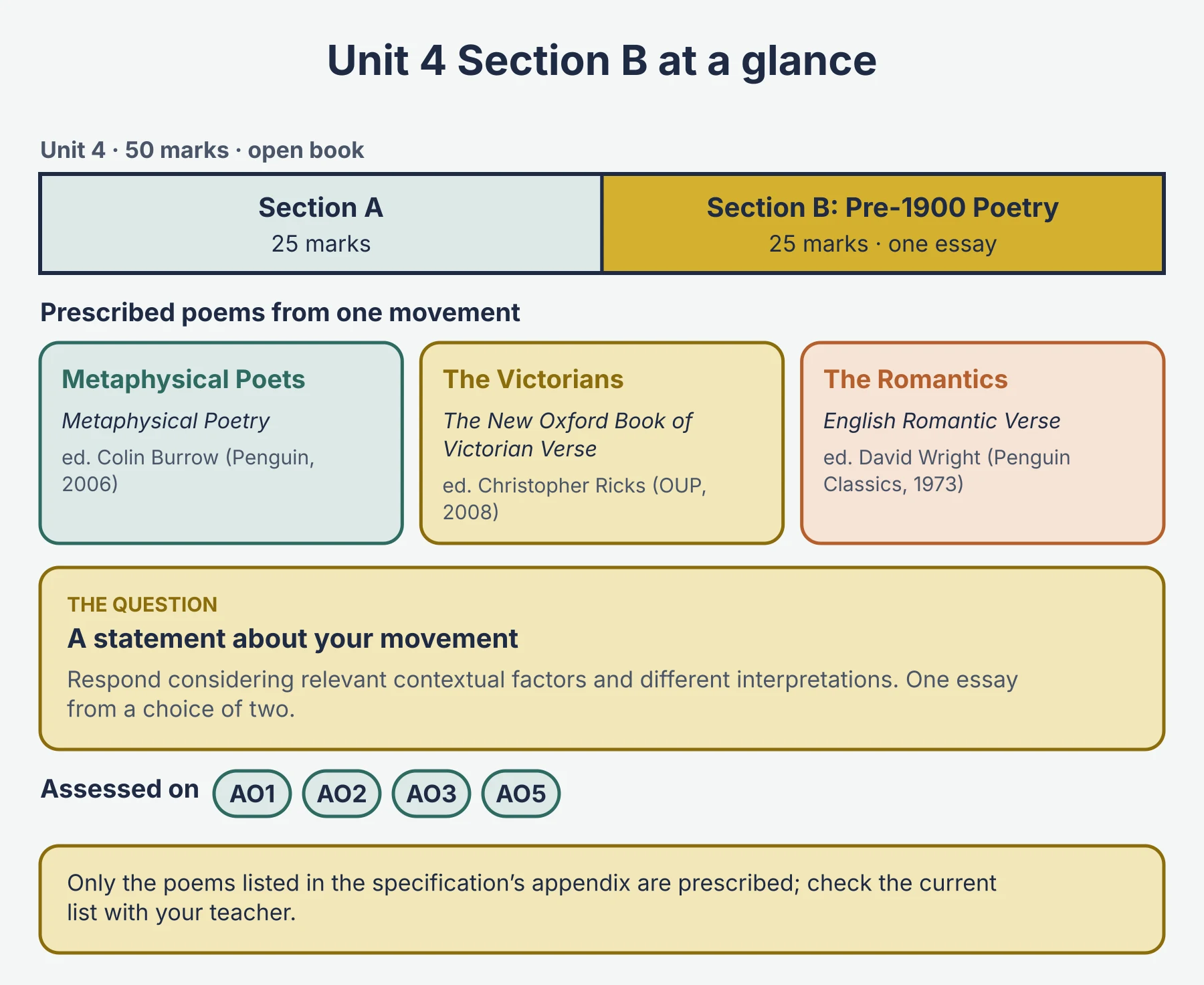
Section B of Unit 4 (WET04) is the only place in the International A Level where pre-1900 poetry is assessed. You study prescribed poems from one literary movement and answer an essay that responds to a statement about that movement. This guide explains what the specification asks, how to range across several poems without losing depth, and how to use literary context and critical views. The Unit 4 study guide covers the whole paper.
What Section B covers
| Detail | Section B: Pre-1900 Poetry |
|---|---|
| Texts | Prescribed poems from one movement: Metaphysical Poets, The Victorians or The Romantics |
| Task | One essay from a choice of two on your movement |
| Question style | A statement to respond to, considering relevant contextual factors and different interpretations |
| Marks | 25 of the paper’s 50 |
| AOs | AO1, AO2, AO3, AO5 |
| Format | Open book |
| Movement | Prescribed collection |
|---|---|
| Metaphysical Poets | Metaphysical Poetry, ed. Colin Burrow (Penguin, 2006) |
| The Victorians | The New Oxford Book of Victorian Verse, ed. Christopher Ricks (OUP, 2008) |
| The Romantics | English Romantic Verse, ed. David Wright (Penguin Classics, 1973) |
Only the poems listed in the specification’s appendix are prescribed; check the current list with your teacher.
What the learning outcomes ask
The 4.4 outcomes ask you to understand the function of key features in poetry; read for detail of how writers use and adapt language, form and structure; understand the contexts in which poetry has been written and how they influence meaning; explore attitudes and values; and interpret texts independently “in response to interpretations by different audiences”.
Because the question is set on a movement, the literary context of that movement is central to AO3 here in a way it is not elsewhere.
Ranging and depth
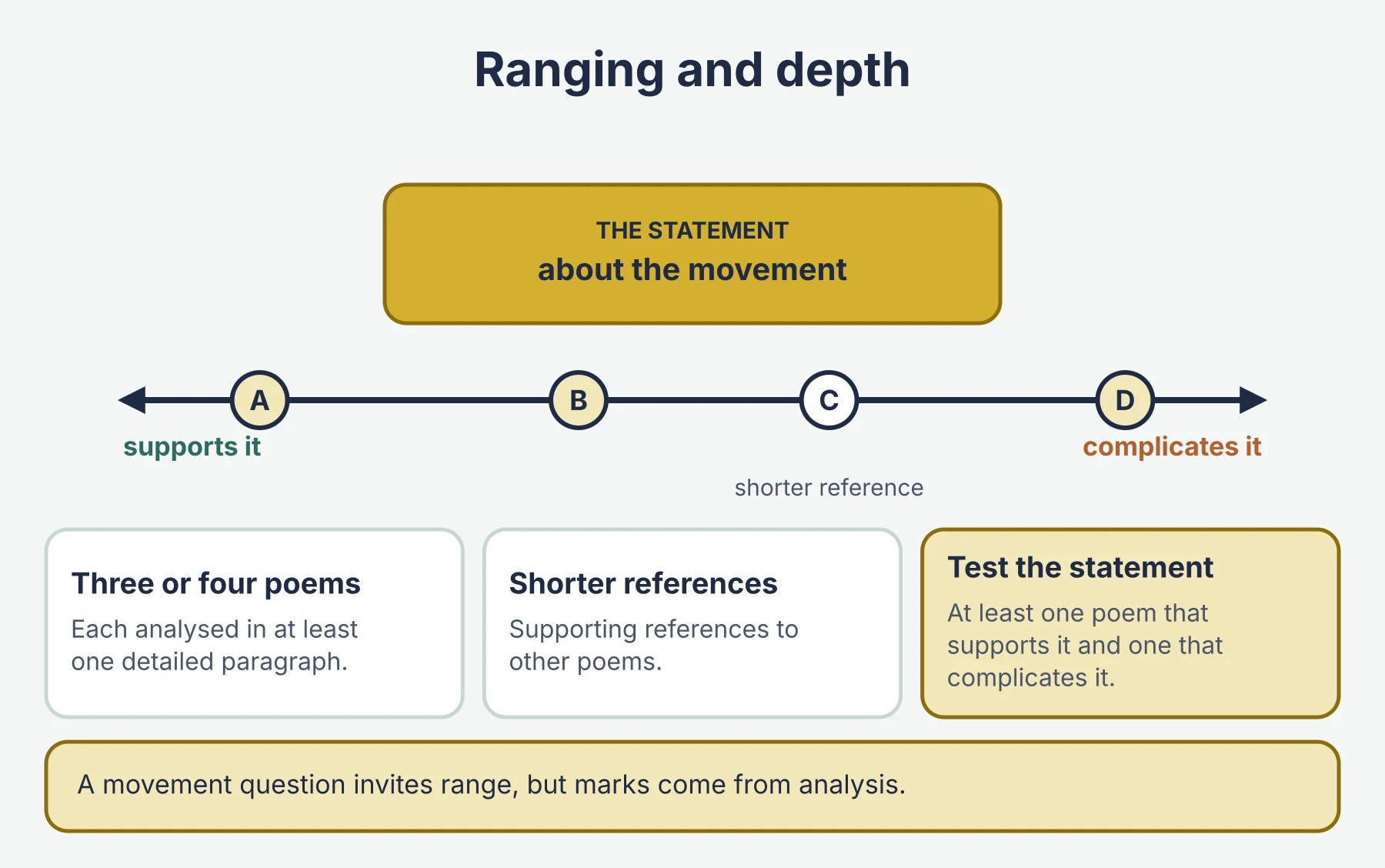
A movement question invites range, but marks come from analysis. A workable balance is three or four poems, each analysed in at least one detailed paragraph, with shorter supporting references to others. Choose poems that let you test the statement: at least one that supports it and one that complicates it.
Movement profiles
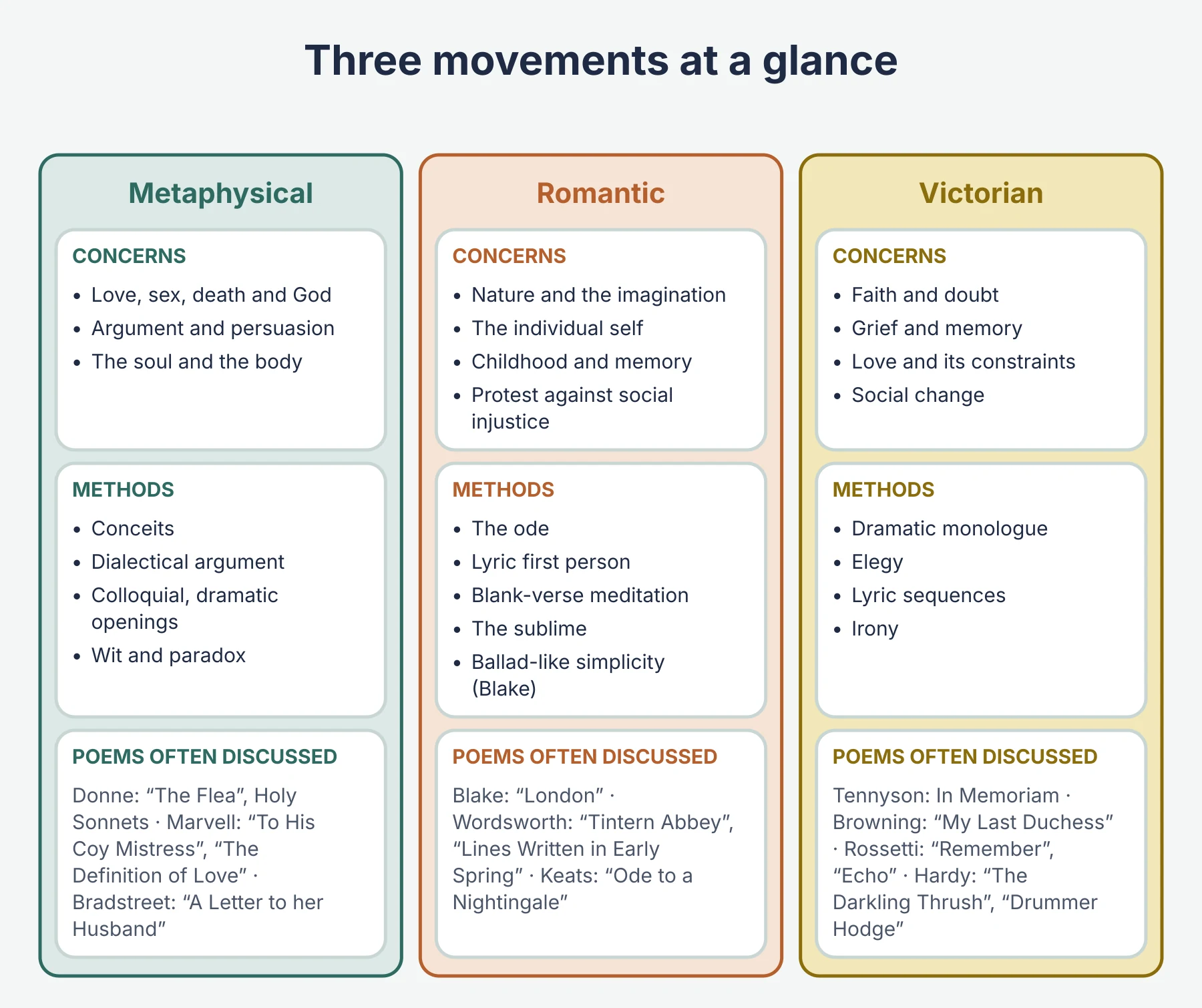
| Movement | Characteristic concerns | Characteristic methods | Prescribed poems often discussed |
|---|---|---|---|
| Metaphysical | Love, sex, death and God; argument and persuasion; the soul and the body | Conceits; dialectical argument; colloquial, dramatic openings; wit and paradox | Donne’s “The Flea” and Holy Sonnets; Marvell’s “To His Coy Mistress” and “The Definition of Love”; Bradstreet’s “A Letter to her Husband” |
| Romantic | Nature and the imagination; the individual self; childhood and memory; protest against social injustice | The ode; lyric first person; blank-verse meditation; the sublime; ballad-like simplicity (Blake) | Blake’s “London”; Wordsworth’s “Tintern Abbey” and “Lines Written in Early Spring”; Keats’s “Ode to a Nightingale” |
| Victorian | Faith and doubt; grief and memory; love and its constraints; social change | Dramatic monologue; elegy; lyric sequences; irony | Tennyson’s In Memoriam; Browning’s “My Last Duchess”; Rossetti’s “Remember” and “Echo”; Hardy’s “The Darkling Thrush” and “Drummer Hodge” |
AO3: literary context first
The specification’s guidance on context includes the literary context of movements and genres, as well as the writer’s life (only where relevant), historical and social contexts, and contexts of reception.
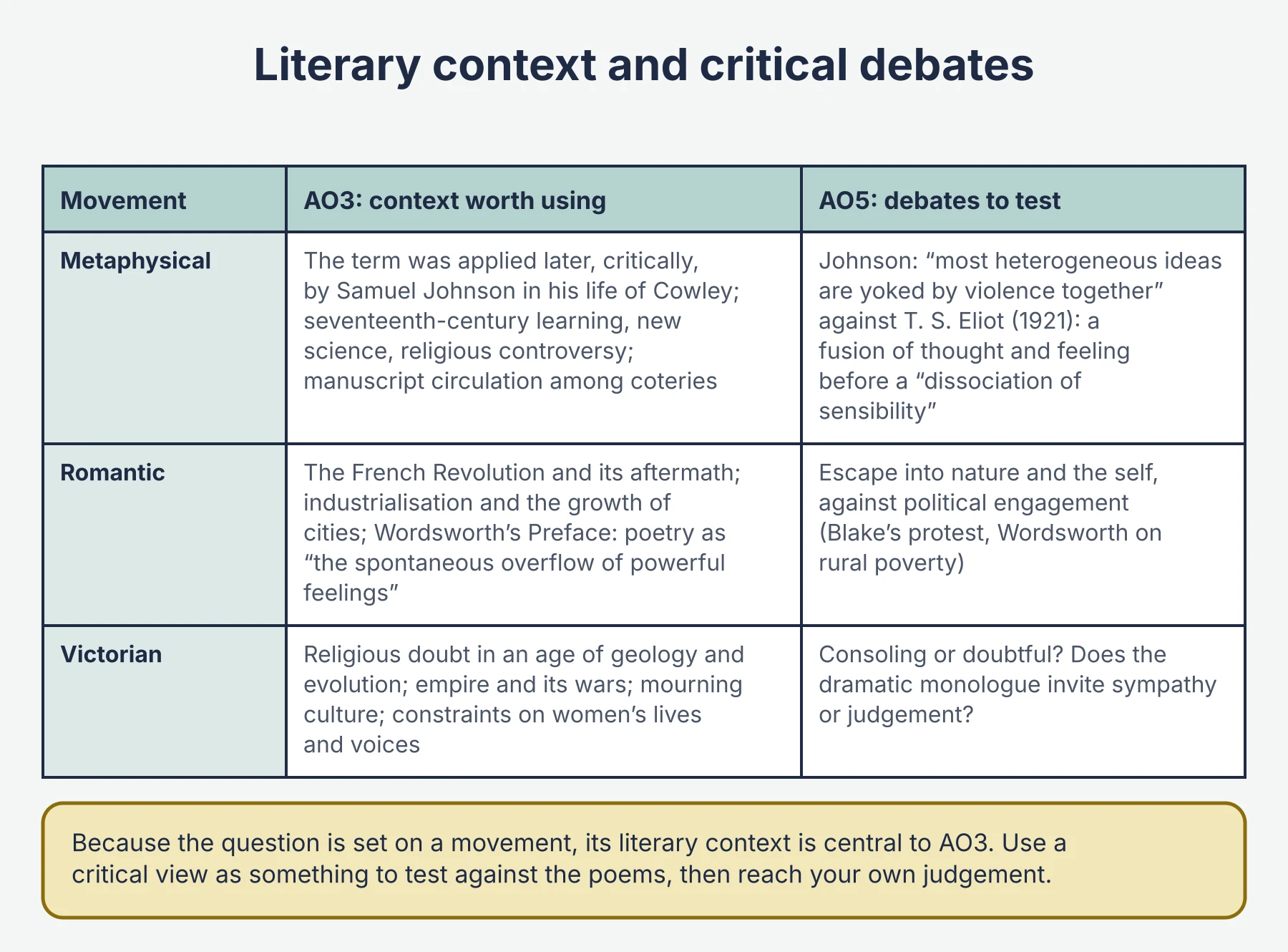
| Movement | Context worth using |
|---|---|
| Metaphysical | The term was applied later: Samuel Johnson used “metaphysical poets” critically in his life of Cowley; seventeenth-century learning, new science and religious controversy; manuscript circulation among coteries |
| Romantic | The French Revolution and its aftermath; industrialisation and the growth of cities; Wordsworth’s argument in the Preface to Lyrical Ballads that poetry is “the spontaneous overflow of powerful feelings” |
| Victorian | Religious doubt in an age of geology and evolution; the expansion of empire and its wars; mourning culture; constraints on women’s lives and voices |
AO5: interpretations of a movement
Critical debates about movements are especially useful:
- Metaphysical: Johnson complained that the poets’ “most heterogeneous ideas are yoked by violence together”; T. S. Eliot’s 1921 essay “The Metaphysical Poets” praised their fusion of thought and feeling, before what he called a “dissociation of sensibility”.
- Romantic: readings of Romanticism as escape into nature and the self, set against readings that stress its political engagement (Blake’s protest, Wordsworth’s attention to rural poverty).
- Victorian: whether Victorian poetry is consoling or doubtful; whether the dramatic monologue invites sympathy or judgement.
Use a view as something to test against the poems, then reach your own judgement.
Worked example: The Romantics
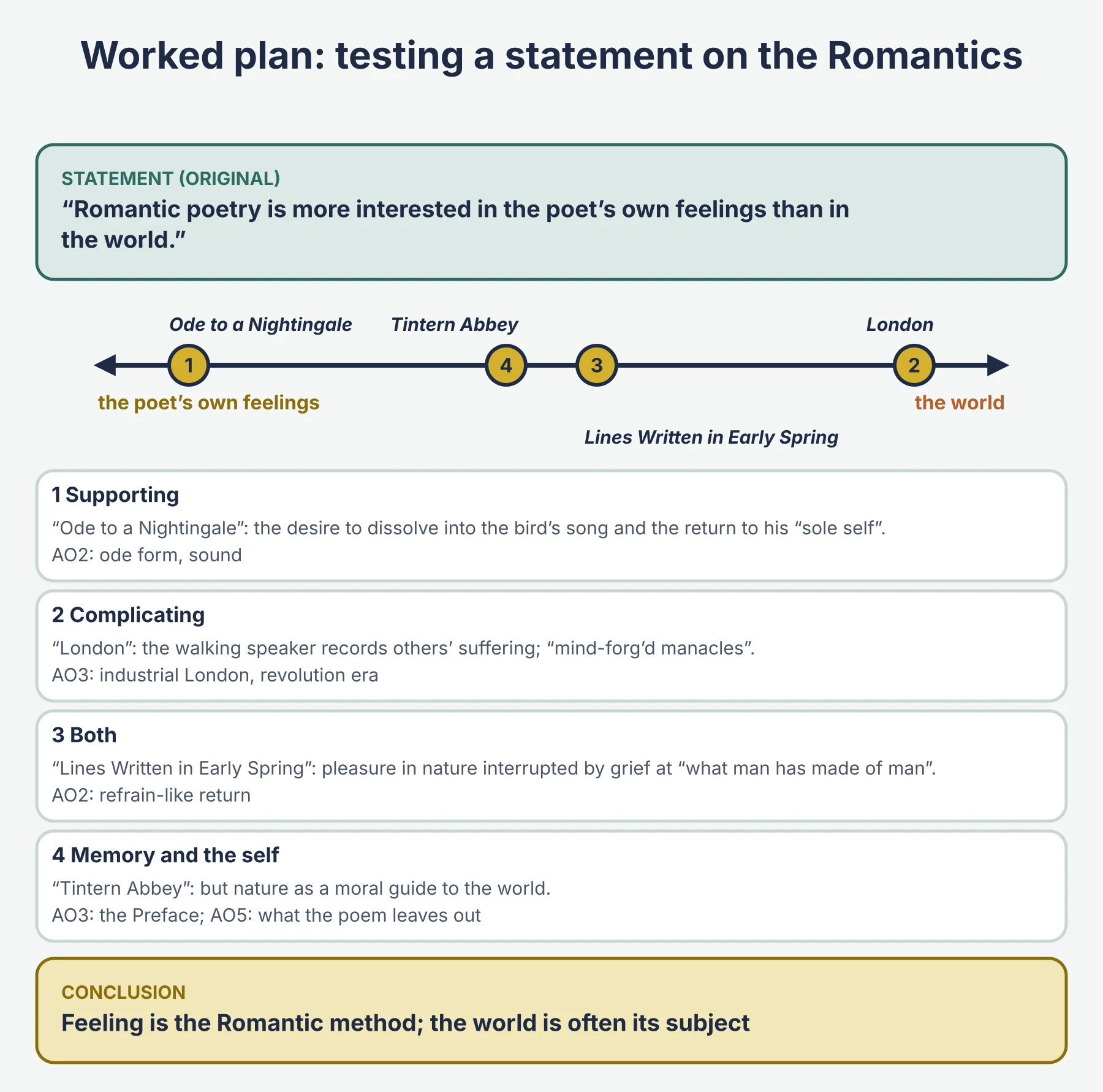
Statement (original): “Romantic poetry is more interested in the poet’s own feelings than in the world.” Explore this view.
Plan:
Thesis:   The statement fits Keats's odes and much of Wordsworth's meditative verse,
          but Blake, and Wordsworth at moments, turn feeling outward into protest,
          so the Romantic self is often a way of seeing the world, not escaping it.
Para 1:   Supporting - "Ode to a Nightingale": the speaker's desire to dissolve into
          the bird's song and his return to his "sole self" (AO2: ode form, sound)
Para 2:   Complicating - "London": the walking speaker records others' suffering;
          "mind-forg'd manacles" turn social oppression into a mental prison (AO3:
          industrial London, revolution era)
Para 3:   Both - "Lines Written in Early Spring": pleasure in nature is interrupted
          by grief at "what man has made of man" (AO2: refrain-like return)
Para 4:   "Tintern Abbey": memory and the self, but nature as a moral guide to the
          world (AO3: Wordsworth's Preface; AO5: critical readings of what the
          poem leaves out)
Conclusion: feeling is the Romantic method; the world is often its subject
Model paragraph (paragraph 2):
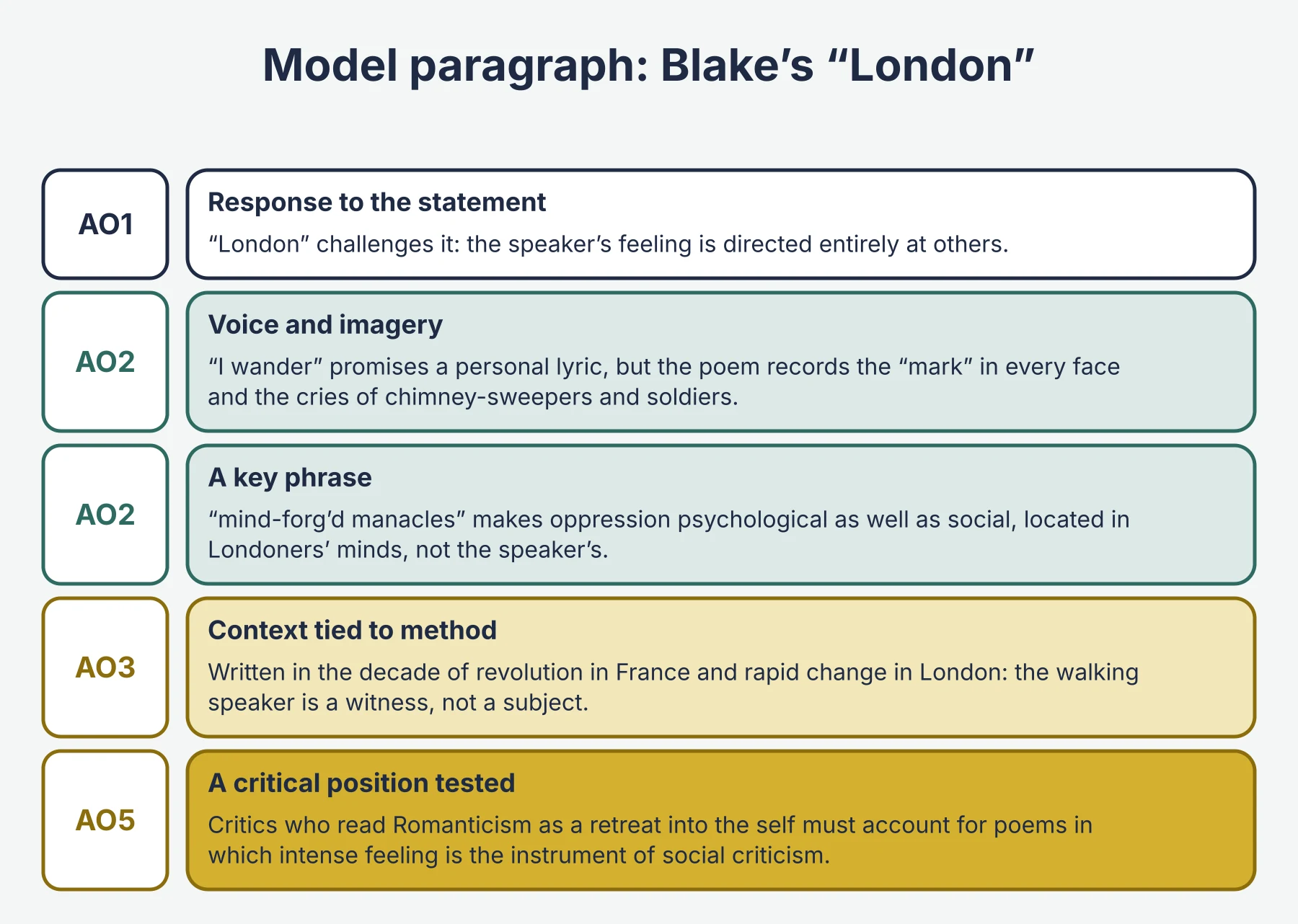
Blake’s “London” challenges the statement because its speaker’s feeling is directed entirely at others. The first-person “I wander” seems to promise a personal lyric, yet the poem becomes a record of what he hears and sees: the “mark” in every face, the cries of chimney-sweepers and soldiers. The phrase “mind-forg’d manacles” makes oppression psychological as well as social, locating it in the minds of Londoners rather than in the speaker’s own. Written in the decade of revolution in France and rapid change in London, the poem uses the walking speaker as a witness, not a subject. Critics who read Romanticism as a retreat into the self must account for poems like this, in which intense feeling is the instrument of social criticism.
What earns credit: a direct response to the statement (AO1); analysis of voice, imagery and a key phrase (AO2); historical context tied to the poem’s method (AO3); a critical position tested against the evidence (AO5).
Reading older language
- Paraphrase first, then analyse.
- Notice inverted syntax: the word moved to the line end often carries the stress.
- Check archaic meanings: “charter’d” in Blake carries the sense of legally owned and controlled.
- Read for the argument in Metaphysical poems: many are structured as a case being made.
Common mistakes
- Writing about one poem only when the question is on a movement.
- Ranging so widely that nothing is analysed in depth.
- Forcing every poem into the movement label: the best answers show where poems complicate it.
- Biography in place of context.
- Critics name-dropped, not evaluated.
- Writing about poems that are not prescribed.
Exam technique
- Read both questions; choose the statement you can test across three or four poems.
- Plan which poems support and which complicate the statement.
- Give Section B about an hour.
- Quote briefly from the open book; analyse each quotation.
- End with a judgement that answers the statement.
Where to go next
- Unit 4 Pre-1900 Poetry revision notes
- Unit 4 Pre-1900 Poetry practice questions
- Unit 4 Shakespeare study guide
Official specification
Pearson Edexcel International Advanced Subsidiary/Advanced Level in English Literature, Issue 7, Unit 4 and Appendix 5 — qualifications.pearson.com.
Related resources
-
Practice questions
Pearson Edexcel International A Level English Literature (YET01): Unit 4 Pre-1900 Poetry – Practice Questions
Short close-reading questions on prescribed pre-1900 poems and 25-mark statement essays for each YET01 Unit 4 movement, with indicative content by AO.
English Literature · Pearson Edexcel · A Level
Try questions -
Revision notes
Pearson Edexcel International A Level English Literature (YET01): Unit 4 Pre-1900 Poetry – Revision Notes
Quick-recall notes for YET01 Unit 4 Section B: the three pre-1900 movements, key poems and forms, literary context, critical views, traps and a self-test.
English Literature · Pearson Edexcel · A Level
Revise topic -
Study guides
Pearson Edexcel International A Level English Literature (YET01): Unit 4 Shakespeare
How to answer the statement-based Shakespeare essay in YET01 Unit 4 Section A: dramatic methods, AO3 context, AO5 interpretations and a worked Hamlet plan.
English Literature · Pearson Edexcel · A Level
Read guide
Get free revision emails (optional)
Occasional emails with practice questions, worked explanations and links to free resources for the qualification and subjects you choose. No spam, and you can unsubscribe from any email. The free tools on this site never need an email.