
Revision Notes
Pearson Edexcel International A Level English Literature (YET01): Unit 4 Pre-1900 Poetry – Revision Notes
Quick-recall notes for YET01 Unit 4 Section B: the three pre-1900 movements, key poems and forms, literary context, critical views, traps and a self-test.
- Subject
- English Literature
- Level
- A LEVEL
- Topic
- Unit 4: Shakespeare and Pre-1900 Poetry
- Author
- Marlbridge Academic Team
- Updated
- Reviewed by
- Ammar Bilal (what this means)
Aligned to Pearson Edexcel A Level English Literature (YET01), For first teaching 2015 (units WET01–WET04). Official specification .
Syllabus page (what it covers and how it is assessed): Pearson Edexcel A Level English Literature.
Syllabus points this page covers
YET01 (A Level)
- 4.4 Poetry
Found an error? Report a correction.
Need help with this topic? Request a free trial class for A Level English Literature (YET01).
Condensed notes for the poetry section of Unit 4 (WET04) in Pearson Edexcel International A Level English Literature (YET01). For the full method and a worked plan, use the Unit 4 Pre-1900 Poetry study guide.
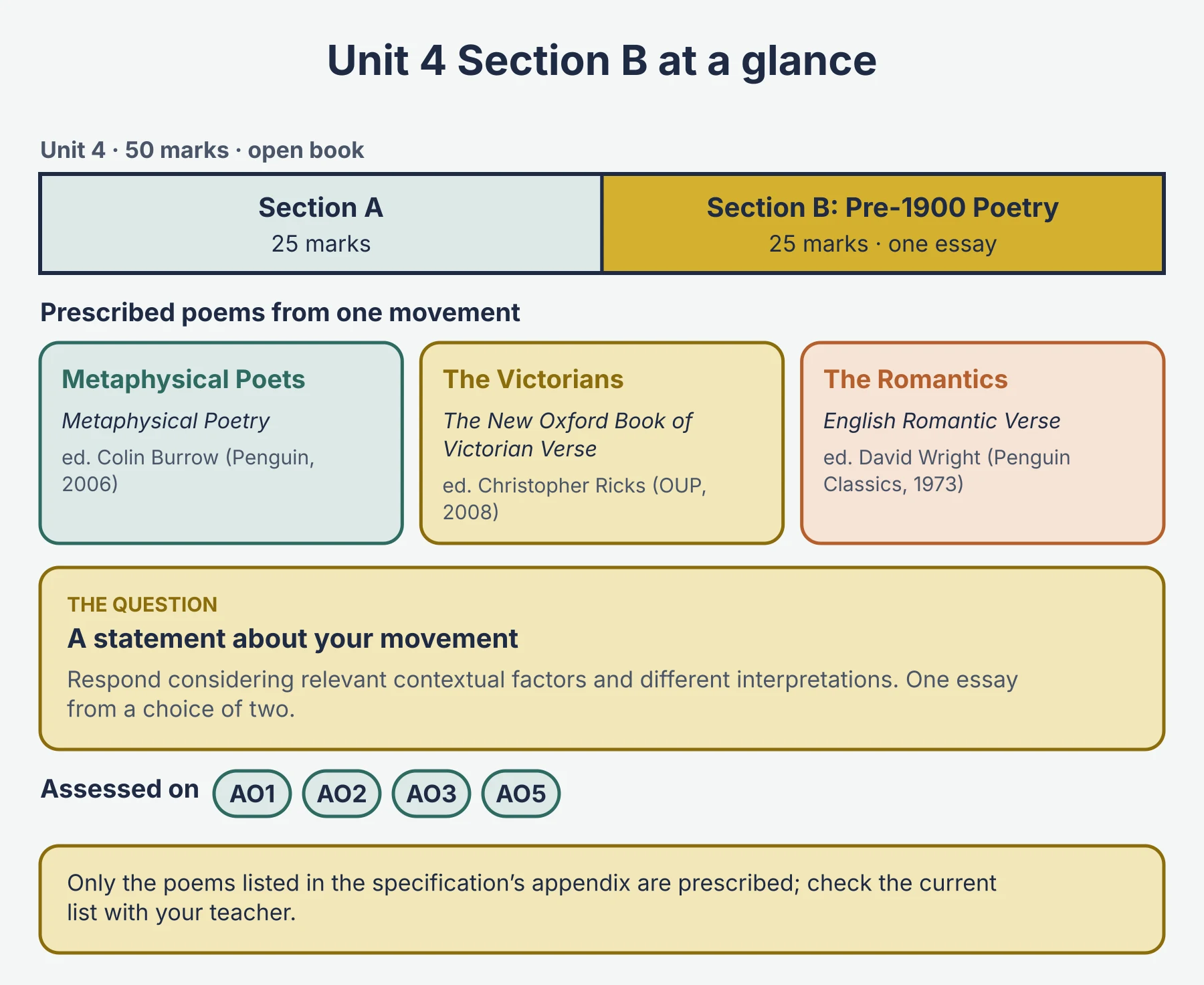
The task in one box
| Detail | Section B |
|---|---|
| Texts | Prescribed poems from one movement |
| Movements | Metaphysical Poets; The Victorians; The Romantics |
| Question | One from a choice of two; a statement to respond to |
| Must consider | Relevant contextual factors and different interpretations |
| Marks | 25 of 50 |
| AOs | AO1, AO2, AO3, AO5 (no AO4) |
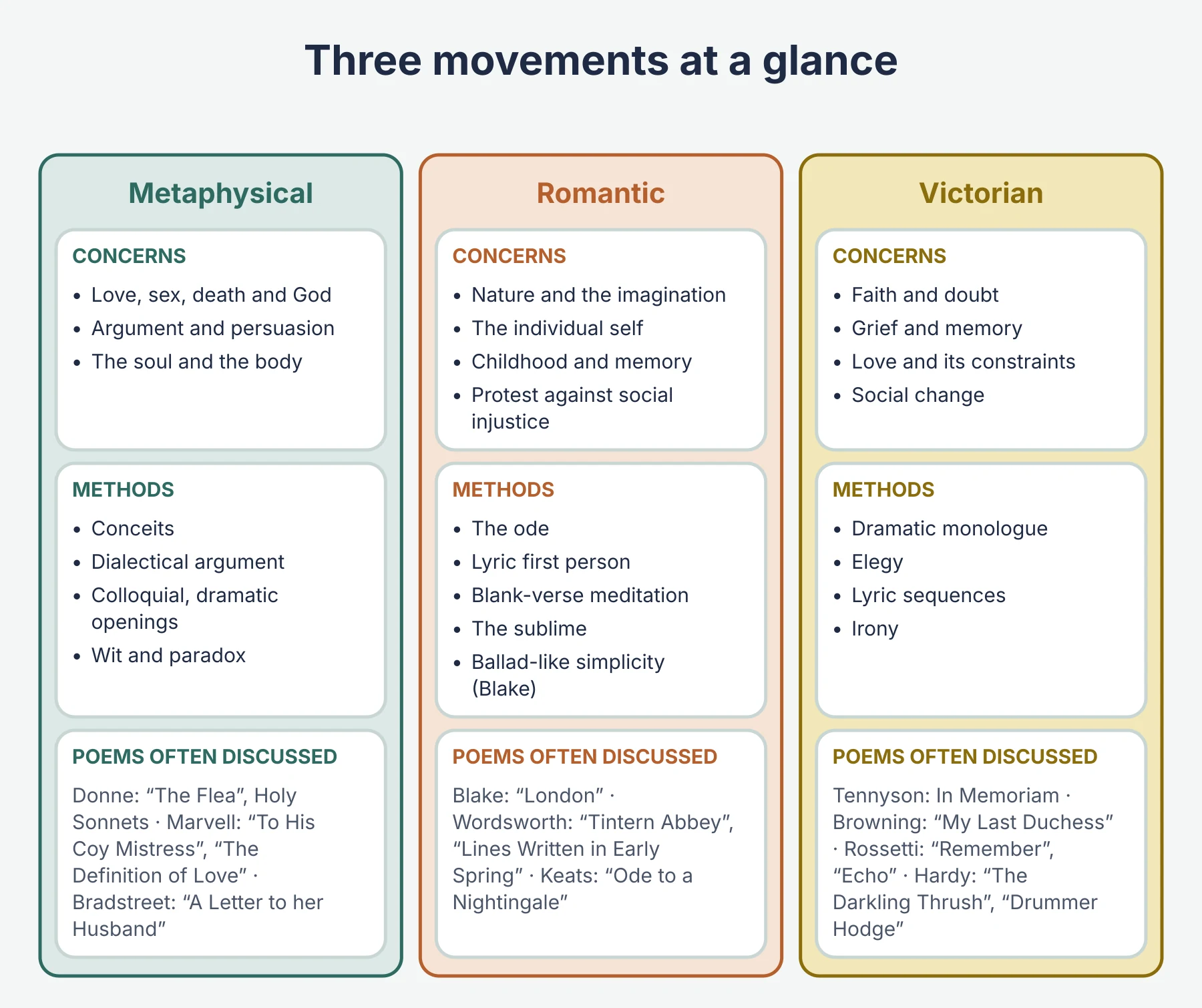
Metaphysical Poets: recall
| Poem | Poet | Remember |
|---|---|---|
| “The Flea” | John Donne | A seduction argument built on a conceit; the flea as marriage bed and temple |
| “A Valediction of Weeping” | John Donne | Parting lovers; tears as coins and worlds in an extended conceit |
| Holy Sonnets | John Donne | Religious sonnets that argue with God and with death |
| “To His Coy Mistress” | Andrew Marvell | Three-part argument (“Had we…”, “But…”, “Now therefore…”); carpe diem |
| “The Definition of Love” | Andrew Marvell | Love defined by impossibility; geometric conceits |
| “A Letter to her Husband, Absent upon Public Employment” | Anne Bradstreet | Married love expressed through the sun and seasons |
Romantics: recall
| Poem | Poet | Remember |
|---|---|---|
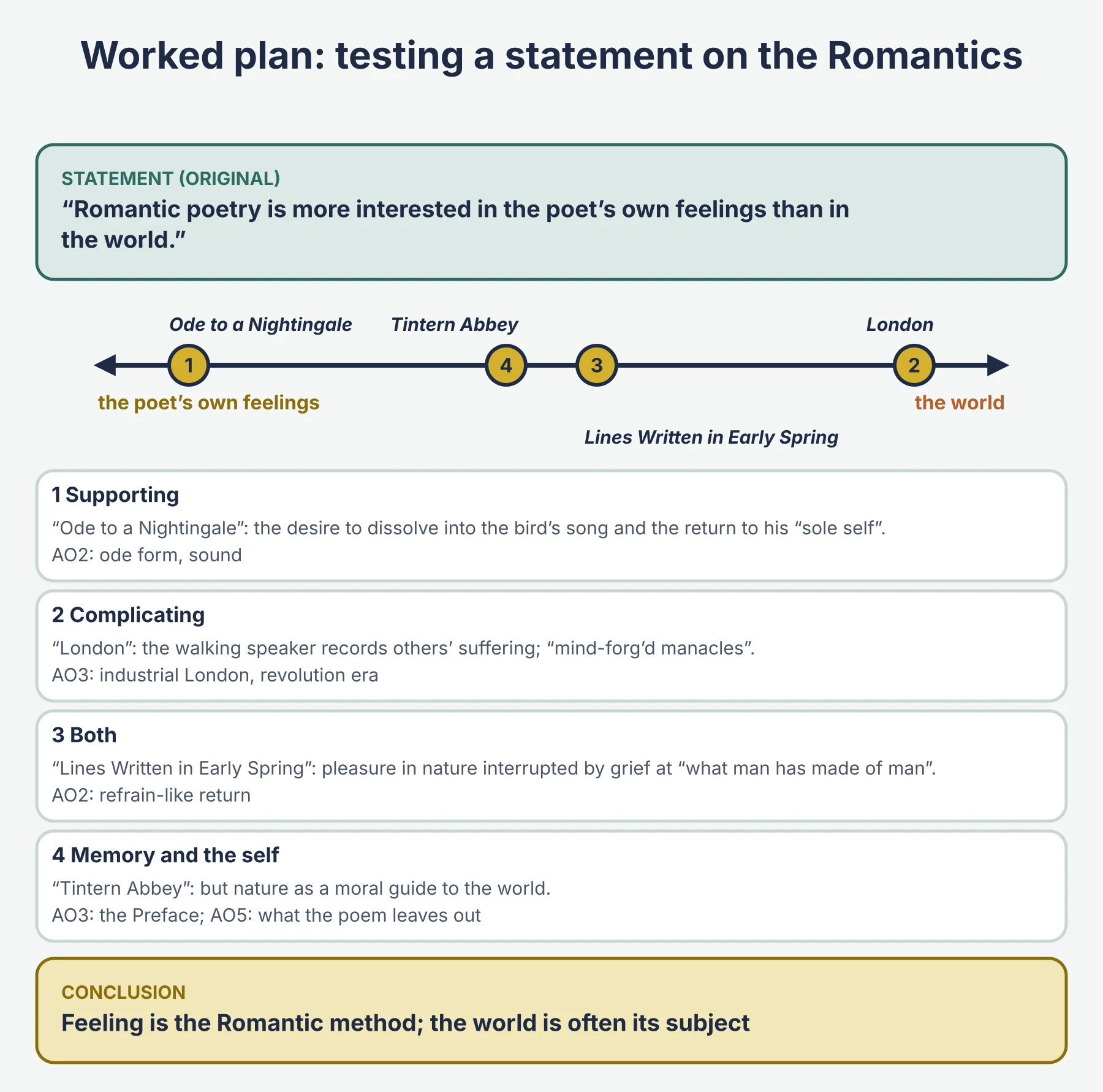
| “London” | William Blake | The walking witness; “charter’d”; “mind-forg’d manacles” |
| “Lines Written in Early Spring” | William Wordsworth | Joy in nature interrupted by grief at “what man has made of man” |
| “Tintern Abbey” | William Wordsworth | Blank-verse meditation; memory, nature and the moral self |
| “Ode to a Nightingale” | John Keats | Desire to escape into the bird’s song; return to the “sole self” |
Victorians: recall
| Poem | Poet | Remember |
|---|---|---|
| In Memoriam VII (“Dark house, by which once more I stand”) | Alfred Tennyson | Grief at the friend’s house; bleak dawn |
| “My Last Duchess” | Robert Browning | Dramatic monologue; the Duke reveals more than he intends |
| “Remember” | Christina Rossetti | Sonnet; the turn from “remember me” to “forget and smile” |
| “Echo” | Christina Rossetti | Longing for a lost love in dreams |
| “The Darkling Thrush” | Thomas Hardy | Bleak landscape at the century’s end; the thrush’s unexplained hope |
| “Drummer Hodge” | Thomas Hardy | A young soldier buried far from home in the Boer War |
These are examples, not complete lists; revise every prescribed poem for your movement.
Forms
| Form | Feature | Typical effect |
|---|---|---|
| Sonnet | Fourteen lines and a turn | Argument, then a shift |
| Ode | Elevated address to a subject | Praise, meditation, longing |
| Dramatic monologue | One speaker, an implied listener | Self-revelation; irony |
| Elegy | Lament | Grief moving towards or away from consolation |
| Conceit | Extended, surprising comparison | Wit and argument |
| Blank verse | Unrhymed iambic pentameter | Meditative, conversational seriousness |
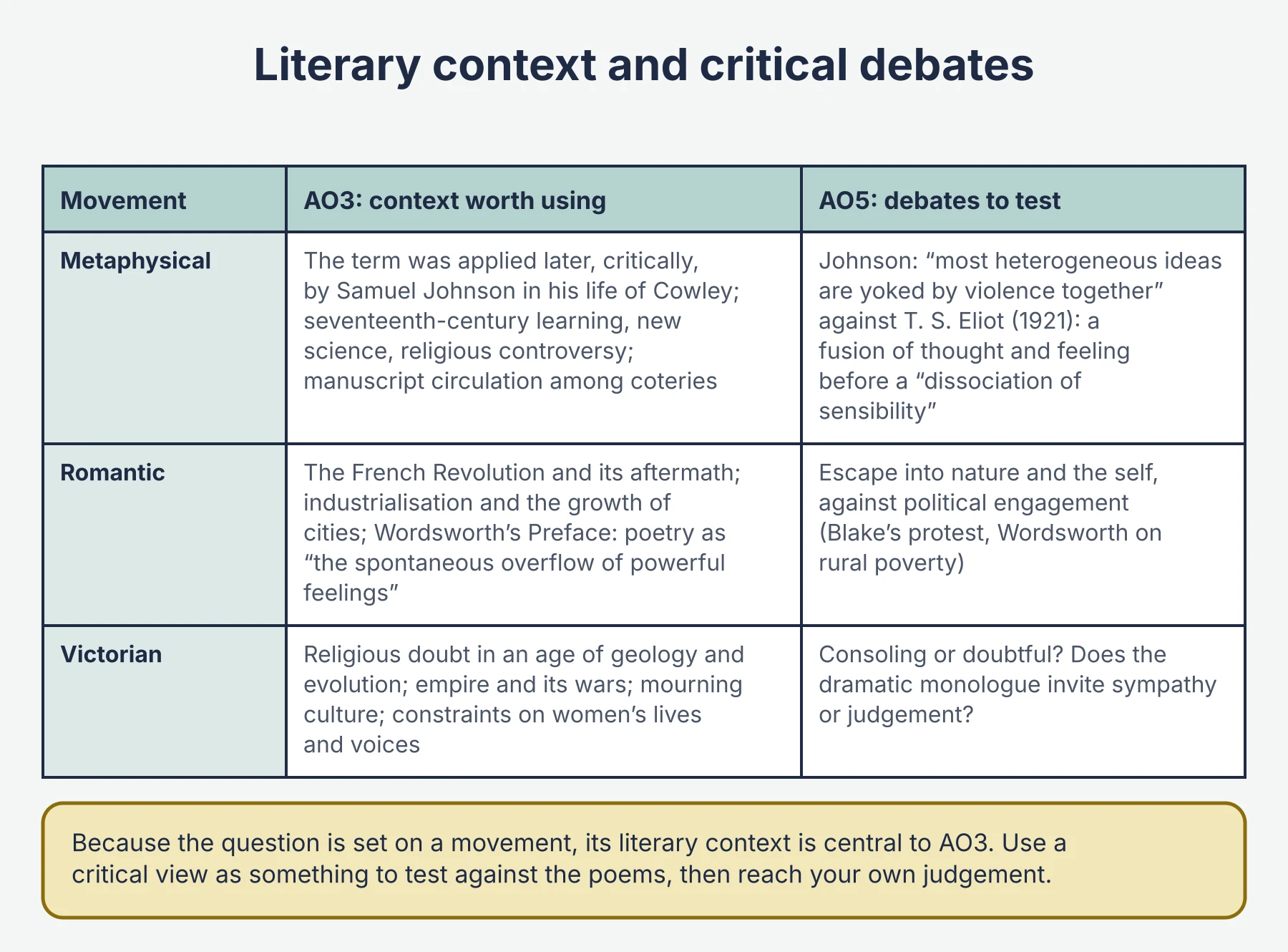
Critical views to test
- Samuel Johnson on the Metaphysicals: “heterogeneous ideas… yoked by violence together”.
- T. S. Eliot (1921): the Metaphysicals fused thought and feeling before a “dissociation of sensibility”.
- Wordsworth’s Preface to Lyrical Ballads: poetry as “the spontaneous overflow of powerful feelings”.
- Romanticism as retreat into self, or as political engagement.
- Victorian poetry as consolation, or as the poetry of doubt.
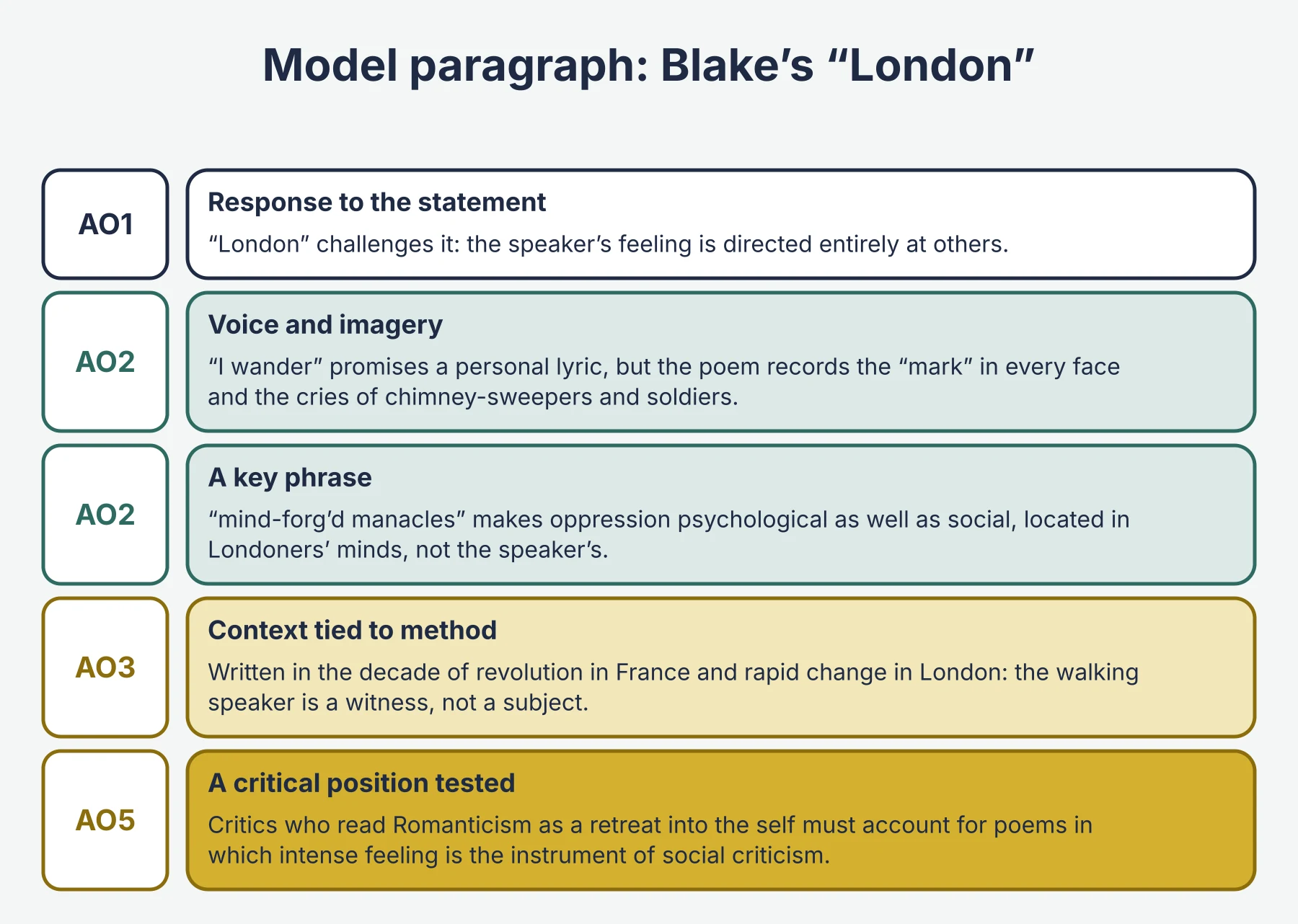
Paragraph frame for a movement essay
- Topic sentence that tests the statement.
- Main poem: short quotation, method, effect.
- Supporting or contrasting reference to a second prescribed poem.
- Context (often the movement itself) explaining the choice.
- Interpretation weighed: does a critical view or alternative reading hold?
- Link back to the statement.
Example topic sentence: “Keats’s ode seems to confirm that Romantic poets turn inward, yet its return to the ‘sole self’ is presented as loss, not triumph, which complicates the statement.”
Statement method
- Unpack key terms.
- Agree, disagree or qualify.
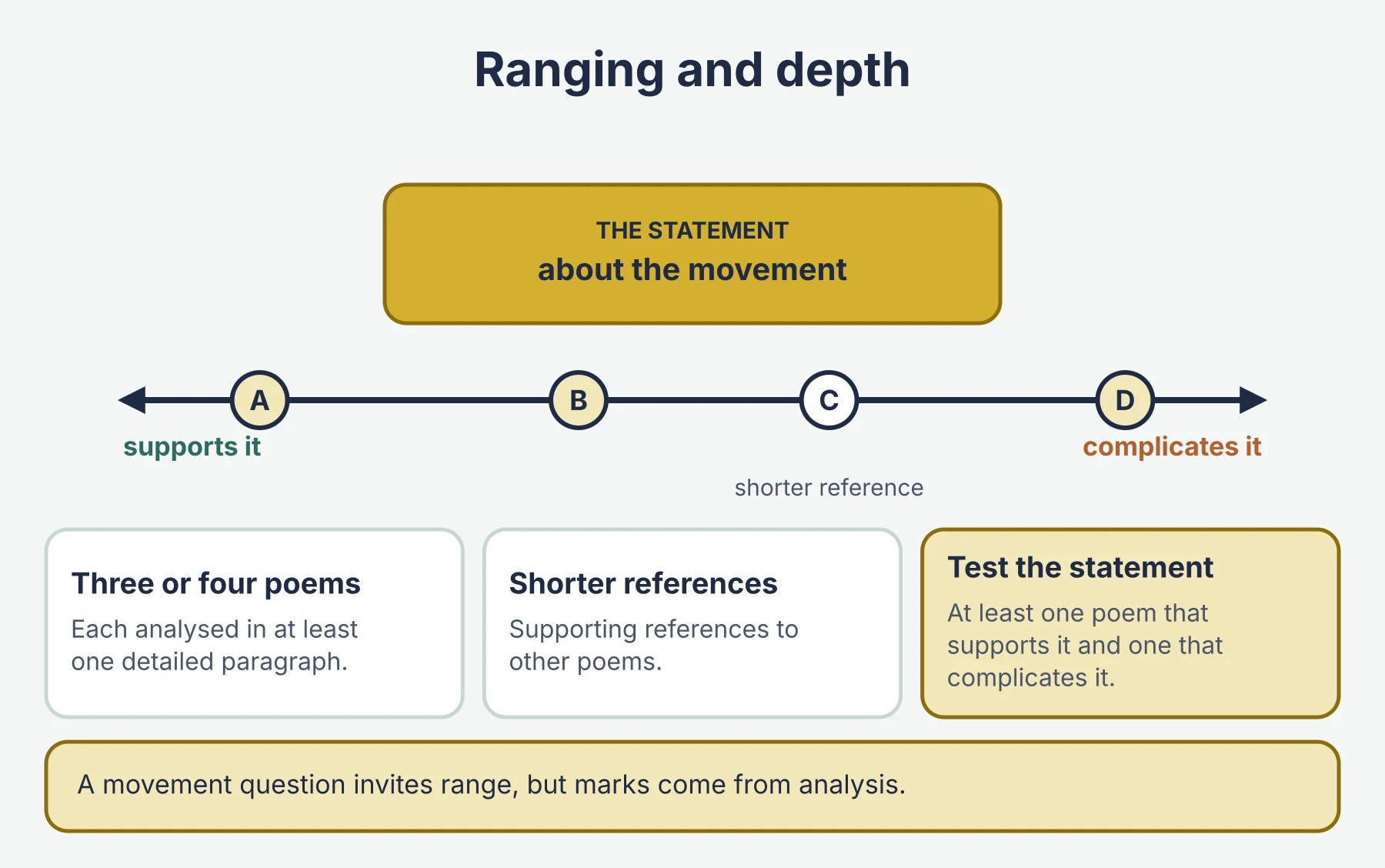
- Choose three or four poems: some supporting, some complicating.
- Analyse form and language in depth for each.
- Integrate literary and historical context and critical views.
- Judge.
Traps
- One poem only.
- Too many poems, none analysed closely.
- Forcing every poem to fit the movement label.
- Context as biography.
- Critics listed but not evaluated.
- Writing about non-prescribed poems.
- Paraphrase in place of analysis of older language.
Self-test
- Which four AOs are assessed in Section B?
- Name the three movements.
- Which editor’s collection is prescribed for the Romantics?
- What is a conceit? Give a Metaphysical example.
- What is the structure of the argument in “To His Coy Mistress”?
- What does “charter’d” suggest in Blake’s “London”?
- What is a dramatic monologue? Name a prescribed example.
- What did Johnson say about the Metaphysical poets?
- What did Wordsworth call poetry in the Preface to Lyrical Ballads?
- How many poems should you aim to discuss?
- Which type of context is especially central in Section B?
- Is comparison with Shakespeare or Unit 3 texts rewarded?
Answers: 1. AO1, AO2, AO3, AO5. 2. Metaphysical Poets, The Victorians, The Romantics. 3. David Wright (English Romantic Verse, Penguin Classics). 4. An extended, surprising comparison; for example the flea as marriage bed and temple in Donne’s “The Flea”. 5. Three parts: “Had we…”, “But…”, “Now therefore…”. 6. Legally owned and controlled, implying restriction. 7. A poem spoken by one character to an implied listener; “My Last Duchess”. 8. That their “heterogeneous ideas are yoked by violence together”. 9. “The spontaneous overflow of powerful feelings”. 10. Three or four, analysed in depth, with brief references to others. 11. Literary context: the movement itself. 12. No; AO4 is not assessed.
Related pages
Related resources
-
Study guides
Pearson Edexcel International A Level English Literature (YET01): Unit 4 Shakespeare
How to answer the statement-based Shakespeare essay in YET01 Unit 4 Section A: dramatic methods, AO3 context, AO5 interpretations and a worked Hamlet plan.
English Literature · Pearson Edexcel · A Level
Read guide -
Practice questions
Pearson Edexcel International A Level English Literature (YET01): Unit 4 Shakespeare – Practice Questions
Short dramatic-method and AO5 drills plus 25-mark statement essays on all four YET01 Unit 4 Shakespeare plays, with indicative content mapped to the AOs.
English Literature · Pearson Edexcel · A Level
Try questions -
Revision notes
Pearson Edexcel International A Level English Literature (YET01): Unit 4 Shakespeare – Revision Notes
Quick-recall notes for YET01 Unit 4 Section A: the four Shakespeare plays, dramatic terms, contexts, AO5 interpretations, the statement method and a self-test.
English Literature · Pearson Edexcel · A Level
Revise topic
Get free revision emails (optional)
Occasional emails with practice questions, worked explanations and links to free resources for the qualification and subjects you choose. No spam, and you can unsubscribe from any email. The free tools on this site never need an email.