
Study Guides
Pearson Edexcel International A Level English Literature (YET01): Unit 4 Shakespeare
How to answer the statement-based Shakespeare essay in YET01 Unit 4 Section A: dramatic methods, AO3 context, AO5 interpretations and a worked Hamlet plan.
- Subject
- English Literature
- Level
- A LEVEL
- Topic
- Unit 4: Shakespeare and Pre-1900 Poetry
- Author
- Marlbridge Academic Team
- Updated
- Reviewed by
- Ammar Bilal (what this means)
Aligned to Pearson Edexcel A Level English Literature (YET01), For first teaching 2015 (units WET01–WET04). Official specification .
Syllabus page (what it covers and how it is assessed): Pearson Edexcel A Level English Literature.
Syllabus points this page covers
YET01 (A Level)
- 4.3 Shakespeare
Found an error? Report a correction.
Need help with this topic? Request a free trial class for A Level English Literature (YET01).
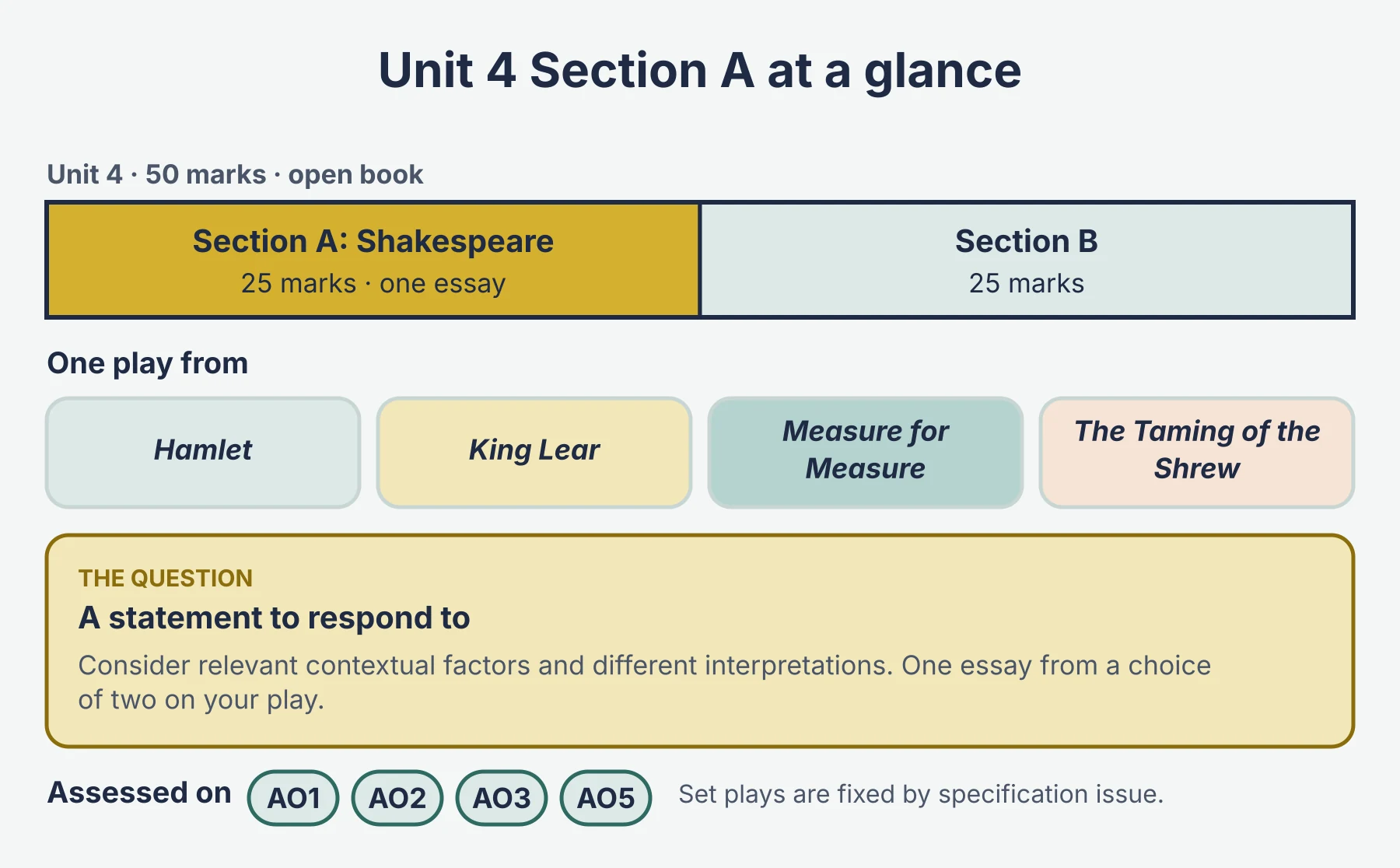
Section A of Unit 4 (WET04) asks for one essay on a Shakespeare play, responding to a statement. The specification asks you to apply “the drama learning from Unit 2 to a Shakespeare text”, and to interpret the play independently “in response to interpretations by different audiences/readers”. This guide explains how the four assessment objectives work together, what each set play offers, and how to build an argument from a statement. The Unit 4 study guide covers the whole paper, and the Unit 2 Drama guide covers the drama skills it builds on.
What Section A covers
| Detail | Section A: Shakespeare |
|---|---|
| Plays | One from Hamlet, King Lear, Measure for Measure, The Taming of the Shrew |
| Task | One essay from a choice of two on your play |
| Question style | A statement to respond to, considering relevant contextual factors and different interpretations |
| Marks | 25 of the paper’s 50 |
| AOs | AO1, AO2, AO3, AO5 |
| Format | Open book |
The set plays are fixed by specification issue; confirm them with your teacher.
What the learning outcomes ask
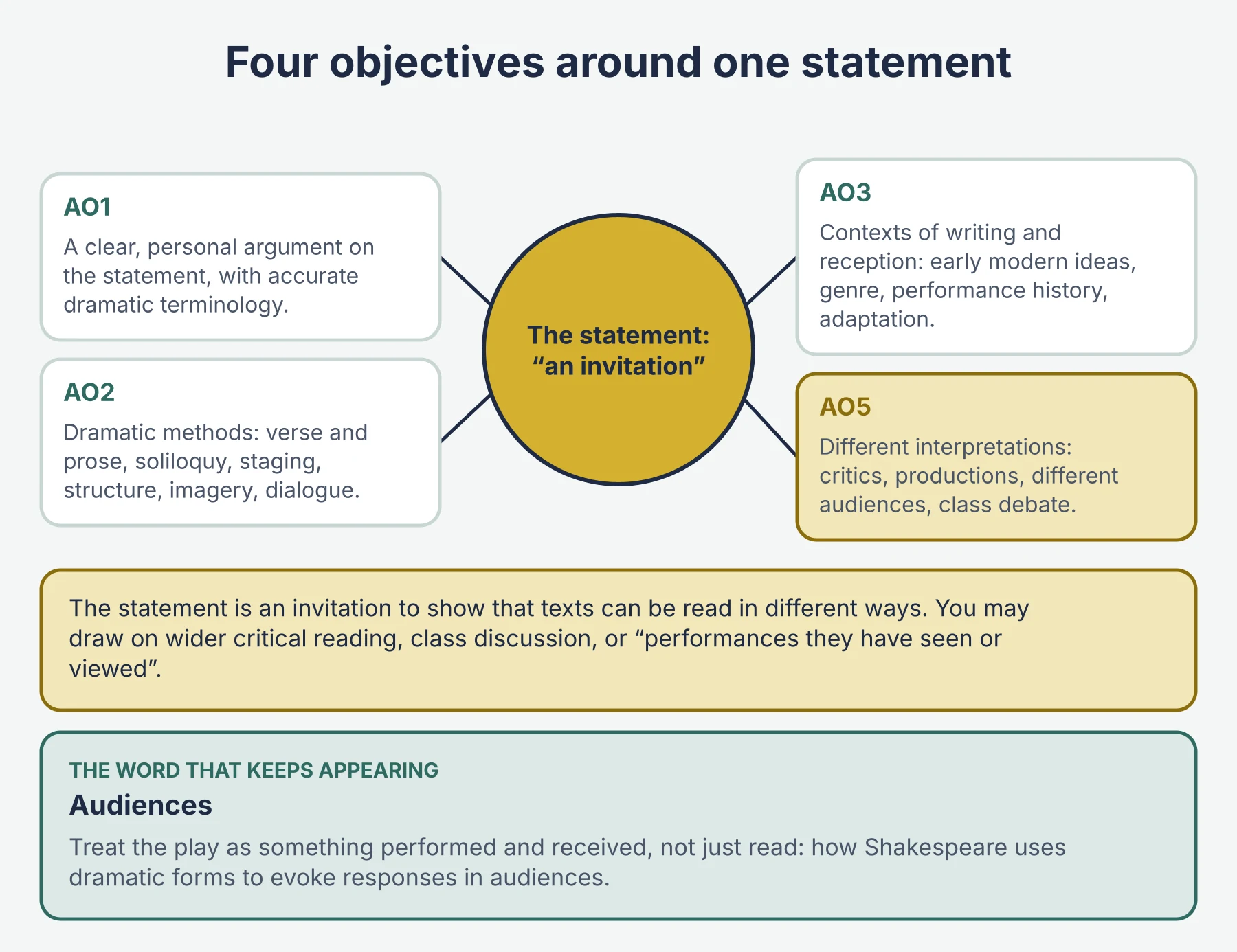
The 4.3 outcomes include understanding how Shakespeare uses dramatic forms to shape meaning and evoke responses in audiences; reading and experiencing drama texts; the contexts in which drama texts were written and how they influence meaning; and evaluating texts “drawing on their understanding of interpretations by different audiences/readers”.
The word audiences appears repeatedly. A strong answer treats the play as something performed and received, not just read.
The four AOs together
| AO | In a Shakespeare essay |
|---|---|
| AO1 | A clear, personal argument on the statement, with accurate dramatic terminology |
| AO2 | Analysis of dramatic methods: verse and prose, soliloquy, staging, structure, imagery, dialogue |
| AO3 | Contexts of writing and reception: early modern ideas, genre, performance history, adaptation |
| AO5 | Different interpretations: critics, productions, different audiences, class debate |
The specification describes each statement as “an invitation” to show that texts can be read in different ways, and says learners may also draw on wider critical reading, class discussion, or “performances they have seen or viewed”.
Dramatic methods to analyse
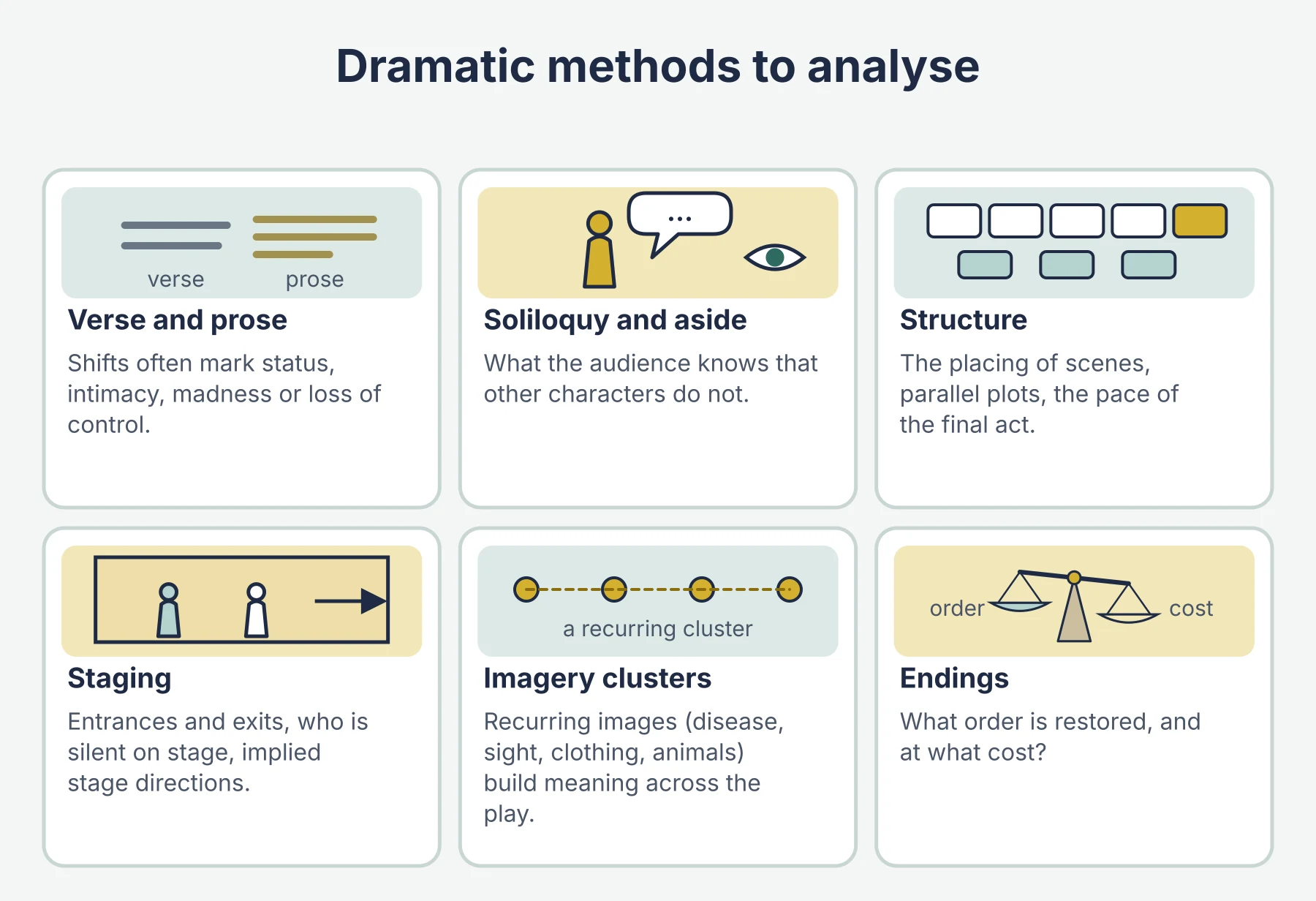
- Verse and prose: shifts between them often mark status, intimacy, madness or loss of control.
- Soliloquy and aside: what the audience knows that other characters do not.
- Structure: the placing of scenes, parallels between plots, the pace of the final act.
- Staging: entrances and exits, who is silent on stage, implied stage directions.
- Imagery clusters: recurring images (disease, sight, clothing, animals) that build meaning across the play.
- Endings: what order is restored, and at what cost.
The four plays: debates worth knowing
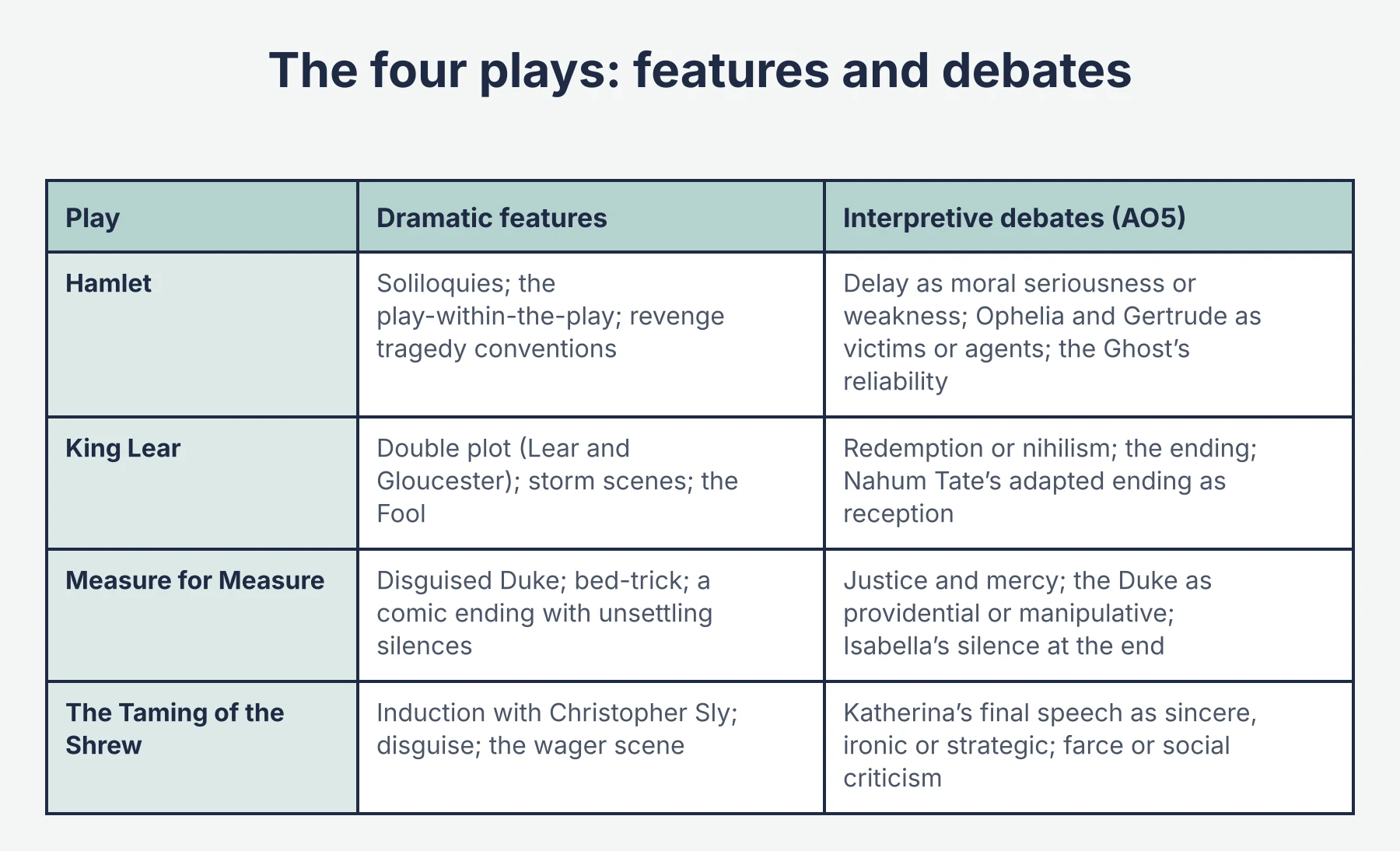
| Play | Dramatic features | Interpretive debates |
|---|---|---|
| Hamlet | Soliloquies; the play-within-the-play; revenge tragedy conventions | Delay as moral seriousness or weakness; Ophelia and Gertrude as victims or agents; the Ghost’s reliability |
| King Lear | Double plot (Lear and Gloucester); storm scenes; the Fool | Redemption or nihilism; the ending; Nahum Tate’s adapted ending as reception |
| Measure for Measure | Disguised Duke; bed-trick; a comic ending with unsettling silences | Justice and mercy; the Duke as providential or manipulative; Isabella’s silence at the end |
| The Taming of the Shrew | Induction with Christopher Sly; disguise; the wager scene | Katherina’s final speech as sincere, ironic or strategic; the play as farce or social criticism |
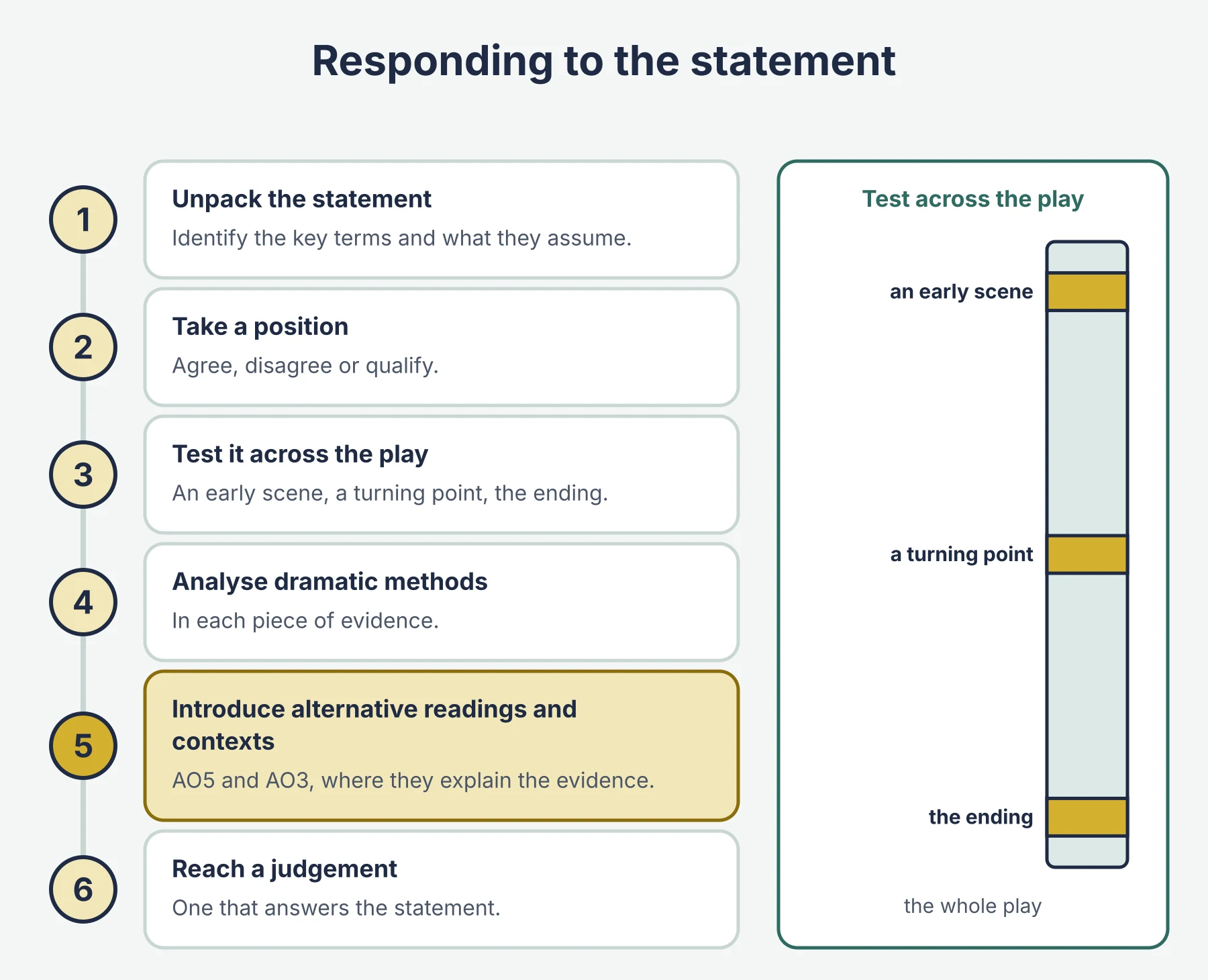
Responding to the statement
- Unpack the statement. Identify the key terms and what they assume.
- Take a position: agree, disagree or qualify.
- Test it across the play: an early scene, a turning point, the ending.
- Analyse dramatic methods in each piece of evidence.
- Introduce alternative readings (AO5) and contexts (AO3) where they explain the evidence.
- Reach a judgement that answers the statement.
Worked example: Hamlet
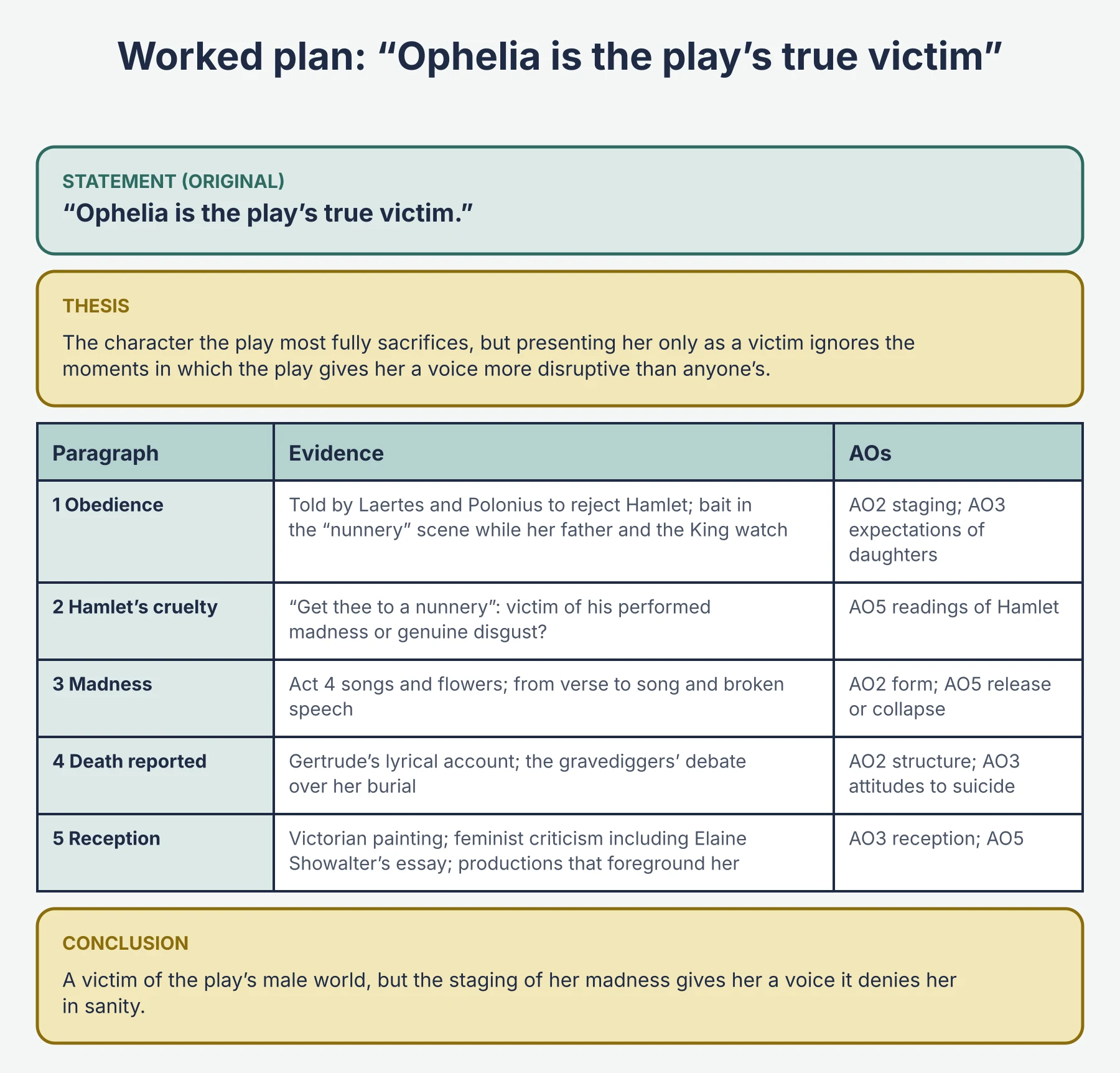
Statement (original): “Ophelia is the play’s true victim.” Explore this view.
Plan:
Thesis:   Ophelia is the character the play most fully sacrifices, but presenting her
          only as a victim ignores the moments in which the play gives her a voice
          more disruptive than anyone's.
Para 1:   Obedience - instructed by Laertes and Polonius to reject Hamlet; used as
          bait in the "nunnery" scene while her father and the King watch (AO2:
          staging, observation; AO3: early modern expectations of daughters)
Para 2:   Hamlet's cruelty - "Get thee to a nunnery"; is she the victim of his
          performance of madness or of his genuine disgust? (AO5: readings of Hamlet)
Para 3:   Madness - songs and flowers in Act 4; fragments that speak of sexuality
          and death; the shift from her earlier verse to song and broken speech
          (AO2: form; AO5: madness as release or as collapse)
Para 4:   Death reported, not seen - Gertrude's lyrical account; the gravediggers'
          debate over her burial (AO2: structure; AO3: attitudes to suicide)
Para 5:   Reception - Victorian painting and later feminist criticism, including
          Elaine Showalter's essay on representing Ophelia; productions that
          foreground her (AO3 reception; AO5)
Conclusion: a victim of the play's male world, but the play's staging of her
          madness gives her a voice it denies her in sanity
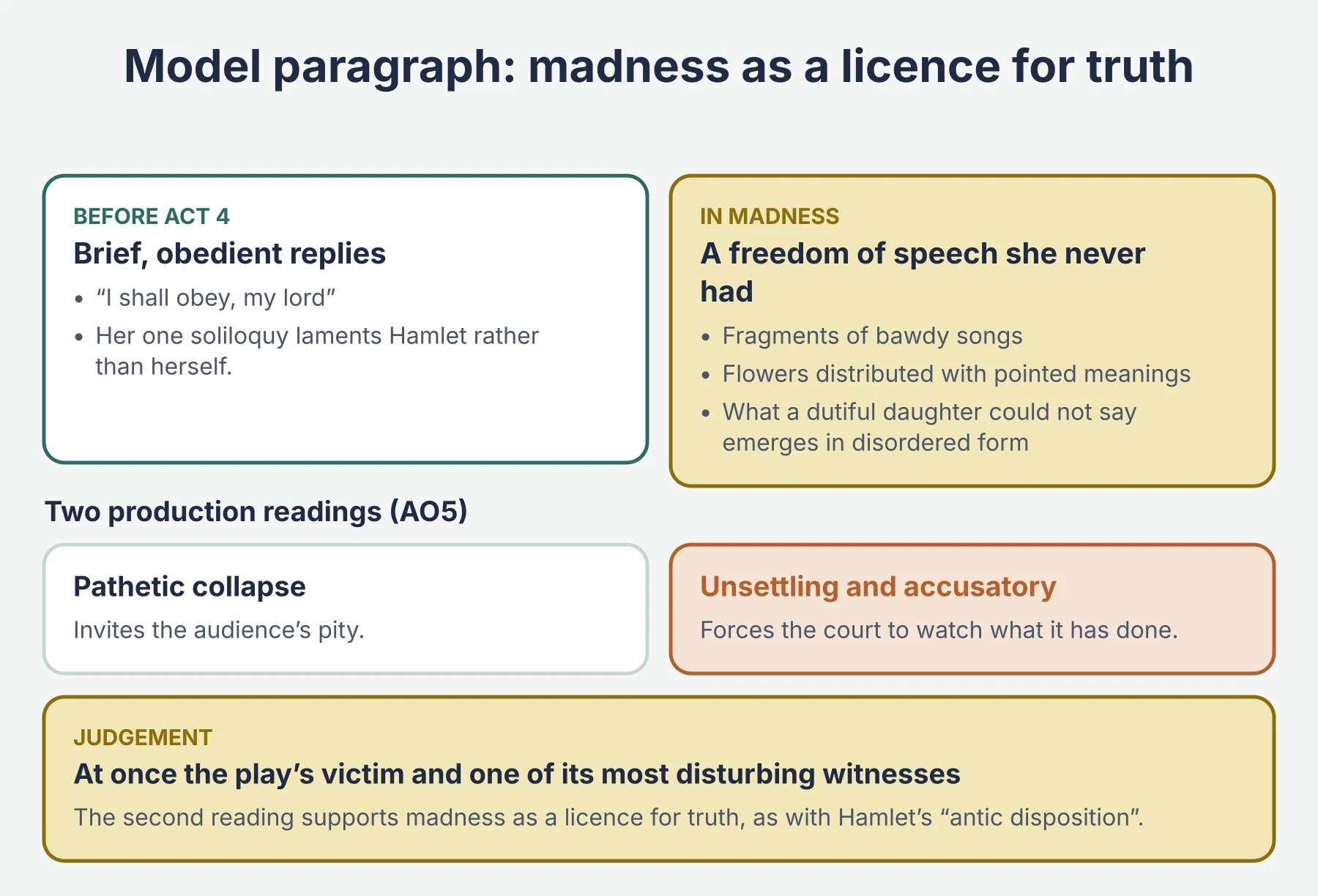
Model paragraph (paragraph 3):
If Ophelia is a victim, the mad scenes complicate the claim, because they give her a freedom of speech she has never had. Before Act 4 she mostly gives brief, obedient replies (“I shall obey, my lord”), and her one soliloquy laments Hamlet rather than herself; in madness she sings fragments of bawdy songs and distributes flowers with pointed meanings, so the things a dutiful daughter could not say emerge in disordered form. Some productions play these scenes as pathetic collapse, inviting the audience’s pity; others stage her as unsettling and accusatory, forcing the court to watch what it has done. The second reading supports the view that Shakespeare uses madness, as with Hamlet’s “antic disposition”, as a licence for truth, so that Ophelia is at once the play’s victim and one of its most disturbing witnesses.
What earns credit: an argued response to the statement (AO1); analysis of form (verse to song) and staging (AO2); alternative production readings weighed, not listed (AO5); early modern ideas of obedience and dramatic convention (AO3).
Using critics and productions well
- Paraphrase or quote briefly, then evaluate: does the evidence support the view?
- Productions count: say what a staging choice reveals about a line or scene.
- Avoid name-dropping: a critic’s view earns credit when it is tested against the text.
- Keep your own judgement at the centre; AO1 rewards a personal response.
Common mistakes
- Plot summary of the play.
- Ignoring the statement after the introduction.
- Treating the play as a novel, with no reference to staging or audience.
- Context as a history lecture about the Elizabethan or Jacobean period.
- AO5 as a list of critics at the end of the essay.
- Inaccurate quotation: the open book lets you check, so check.
Exam technique
- Read both questions; choose the statement you can test across the whole play.
- Plan for five to eight minutes: thesis, four or five points, alternative reading, conclusion.
- Give Section A about an hour.
- In each paragraph, include at least one precise reference and one dramatic method.
- End with a judgement on the statement.
Where to go next
- Unit 4 Shakespeare revision notes
- Unit 4 Shakespeare practice questions
- Unit 4 Pre-1900 Poetry study guide
Official specification
Pearson Edexcel International Advanced Subsidiary/Advanced Level in English Literature, Issue 7, Unit 4 — qualifications.pearson.com.
Related resources
-
Practice questions
Pearson Edexcel International A Level English Literature (YET01): Unit 4 Shakespeare – Practice Questions
Short dramatic-method and AO5 drills plus 25-mark statement essays on all four YET01 Unit 4 Shakespeare plays, with indicative content mapped to the AOs.
English Literature · Pearson Edexcel · A Level
Try questions -
Revision notes
Pearson Edexcel International A Level English Literature (YET01): Unit 4 Shakespeare – Revision Notes
Quick-recall notes for YET01 Unit 4 Section A: the four Shakespeare plays, dramatic terms, contexts, AO5 interpretations, the statement method and a self-test.
English Literature · Pearson Edexcel · A Level
Revise topic -
Practice questions
Unit 4 Shakespeare and Pre-1900 Poetry (YET01): Practice Questions
Original statement-based essay questions for Edexcel IAL English Literature (YET01) Unit 4 on Shakespeare and three poetry movements, with AO-mapped answers.
English Literature · Pearson Edexcel · A Level
Try questions
Get free revision emails (optional)
Occasional emails with practice questions, worked explanations and links to free resources for the qualification and subjects you choose. No spam, and you can unsubscribe from any email. The free tools on this site never need an email.