
Revision Notes
Edexcel International A Level Law (YLA1): The Doctrine of Precedent in the Court Hierarchy – Revision Notes
Condensed notes on stare decisis, ratio and obiter, the court hierarchy, appeals, Young v Bristol Aeroplane and the 1966 Practice Statement (YLA1 1.2.7).
- Subject
- Law
- Level
- A LEVELS
- Topic
- Paper 1 – Underlying Principles of Law and the English Legal System
- Author
- Marlbridge Academic Team
- Updated
- Reviewed by
- Aizaz Raoof Ali (what this means)
Aligned to Pearson Edexcel A Level Law (YLA1), Issue 4, November 2021. Official specification .
Syllabus page (what it covers and how it is assessed): Pearson Edexcel A Level Law.
Syllabus points this page covers
YLA1
- 1.2 The sources of English law, its enforcement and administration
Found an error? Report a correction.
Need help with this topic? Request a free trial class for A Level Law (YLA1).
Condensed for the final weeks. These notes cover content area 1.2.7, “The doctrine of precedent in the court hierarchy”: stare decisis, ratio decidendi, obiter dicta, court hierarchies, the process of appeal, which courts are bound by others, the 1966 House of Lords Practice Statement and relevant case law. For the full explanation, use the doctrine of precedent study guide; the wider section is condensed in the sources of English law revision notes.
Core terms
- Stare decisis: stand by what has been decided; like cases treated alike.
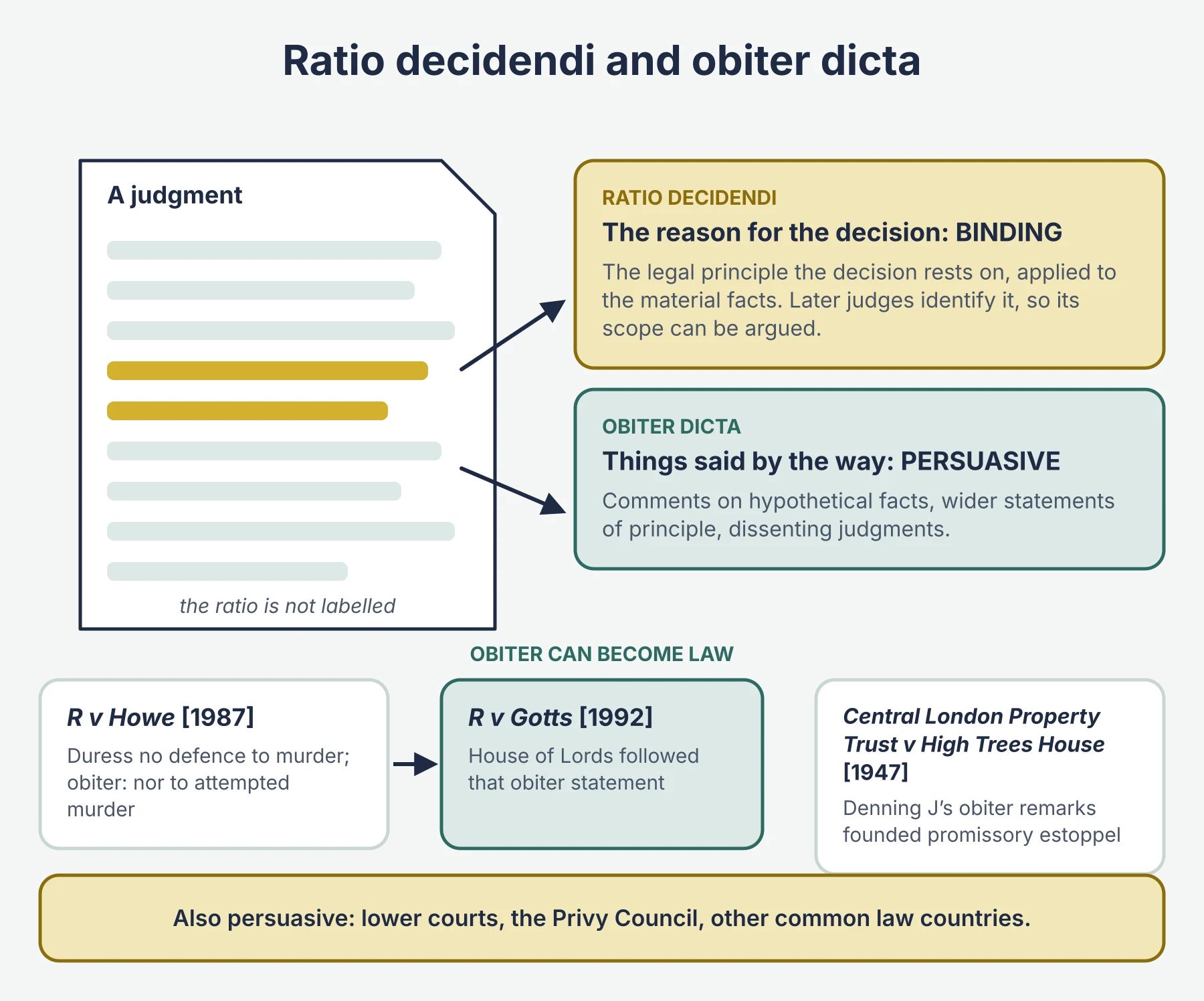
- Ratio decidendi: the legal principle needed for the decision on the material facts; binding.
- Obiter dicta: other statements, including hypotheticals and dissents; persuasive.
- Binding precedent: must be followed by courts lower in the hierarchy.
- Persuasive precedent: may be followed: obiter; lower courts; the Privy Council; other common law courts.
Obiter becoming law: R v Howe [1987] (obiter: no duress for attempted murder) → followed in R v Gotts [1992]. High Trees [1947] (promissory estoppel). Privy Council: AG for Jersey v Holley [2005] followed in R v James and Karimi [2006]; Willers v Joyce [2016] allows the Privy Council to direct English courts.
Who binds whom
Supreme Court ............ binds all below; may depart from itself (Practice Statement)
Court of Appeal .......... bound by SC; bound by itself (Young exceptions)
  Criminal Division ...... extra flexibility where liberty at stake
Divisional Courts ........ bound by SC and CA
High Court ............... bound by courts above; judges not bound by each other
Crown, County, magistrates bound by all above; create no binding precedent
ECtHR .................... "take into account" only (HRA 1998 s 2)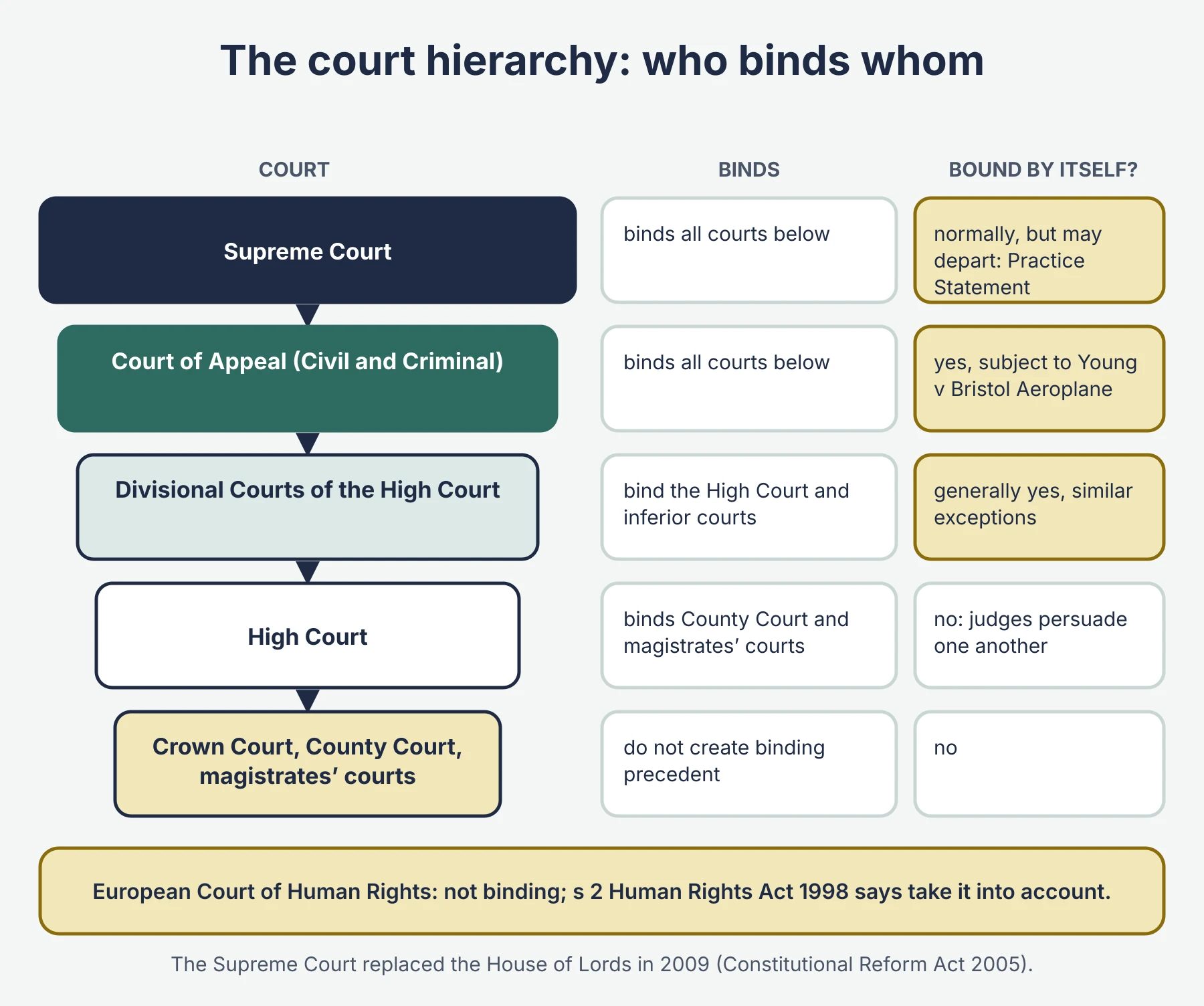
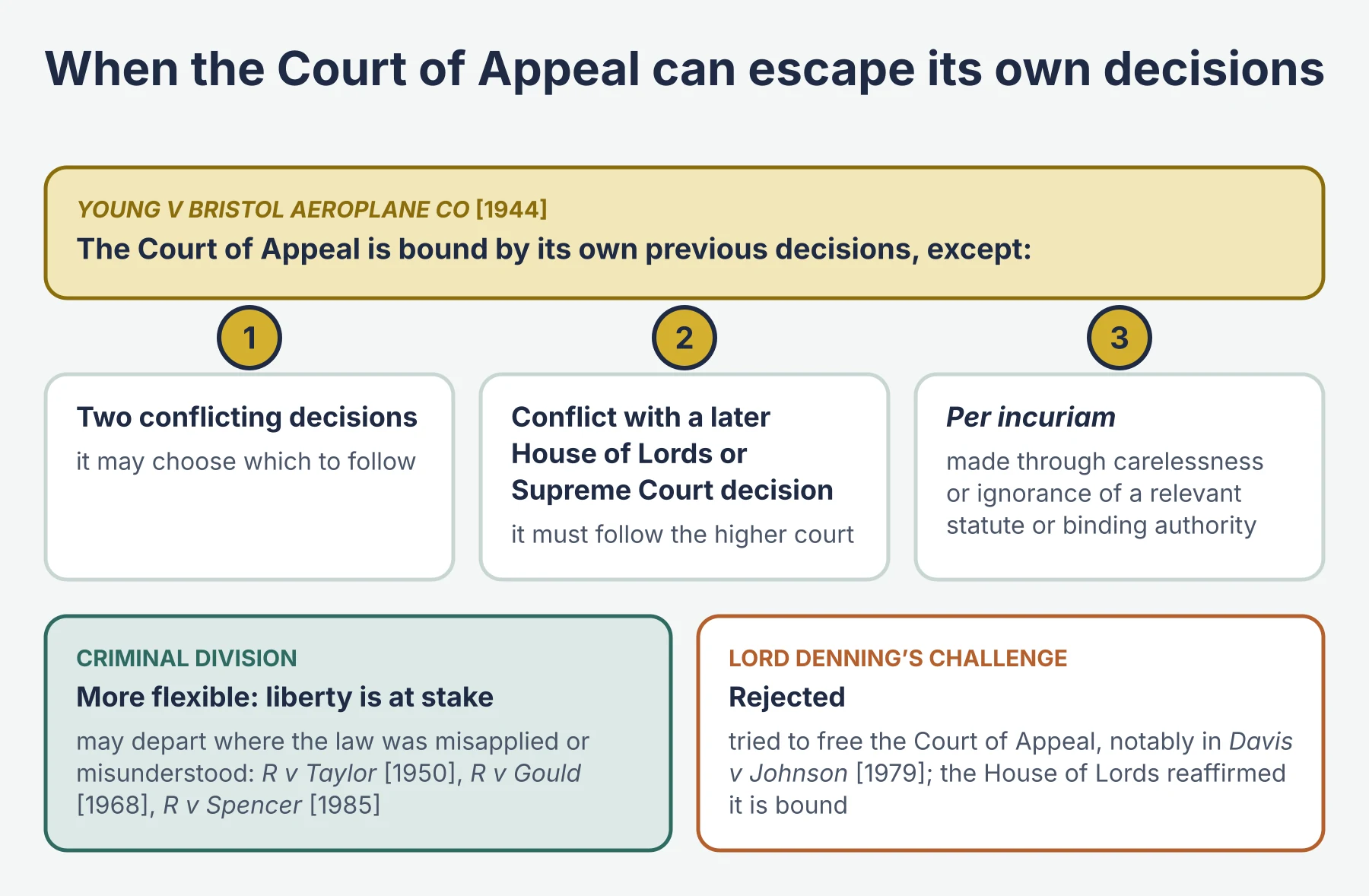
Young v Bristol Aeroplane [1944]: three exceptions
- Two conflicting Court of Appeal decisions: choose one.
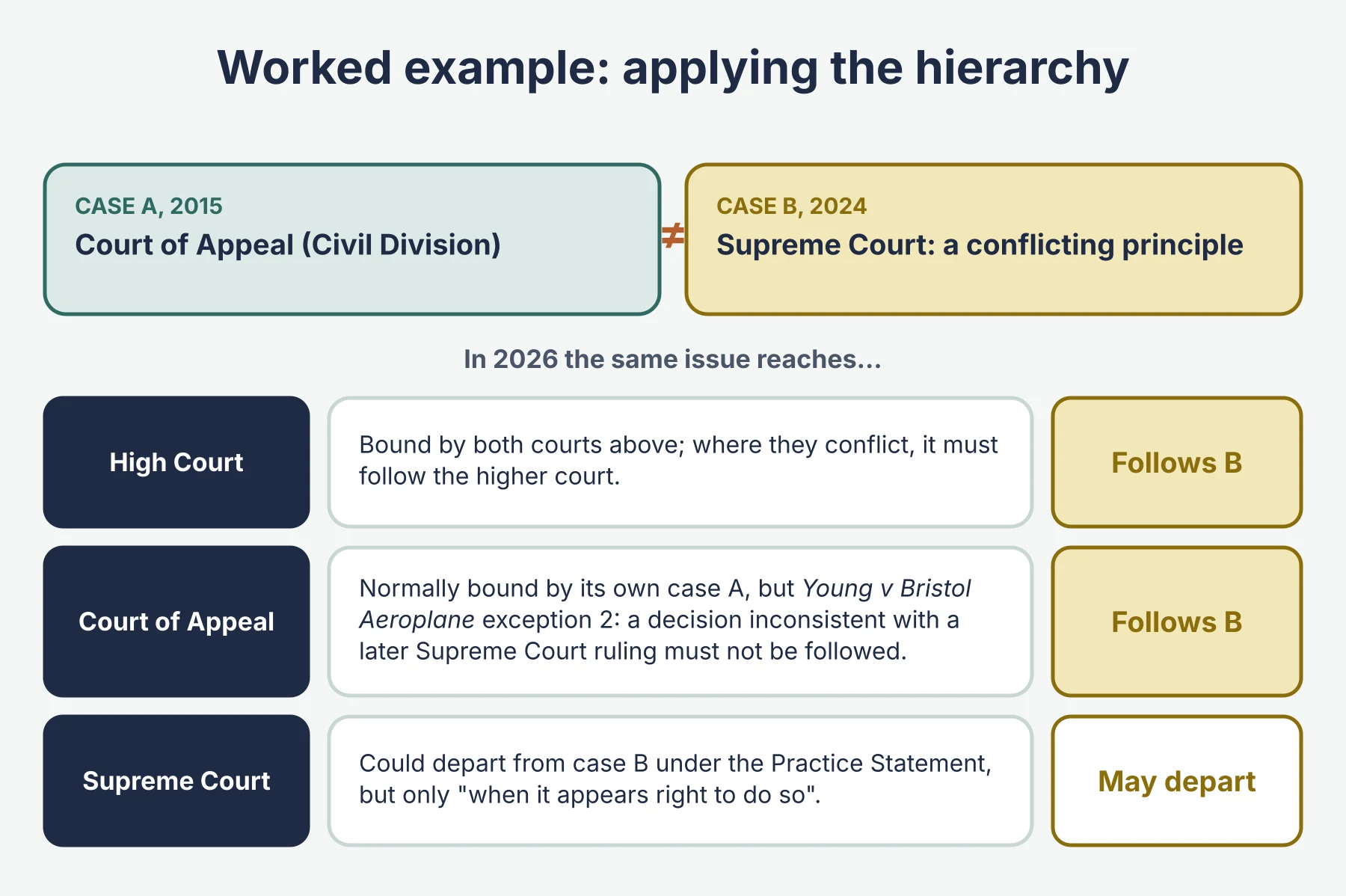
- Conflict with a later House of Lords or Supreme Court decision: follow the higher court.
- Decision made per incuriam.
Criminal Division extras: R v Taylor [1950]; R v Gould [1968]; R v Spencer [1985]. Denning’s challenge failed: Davis v Johnson [1979].
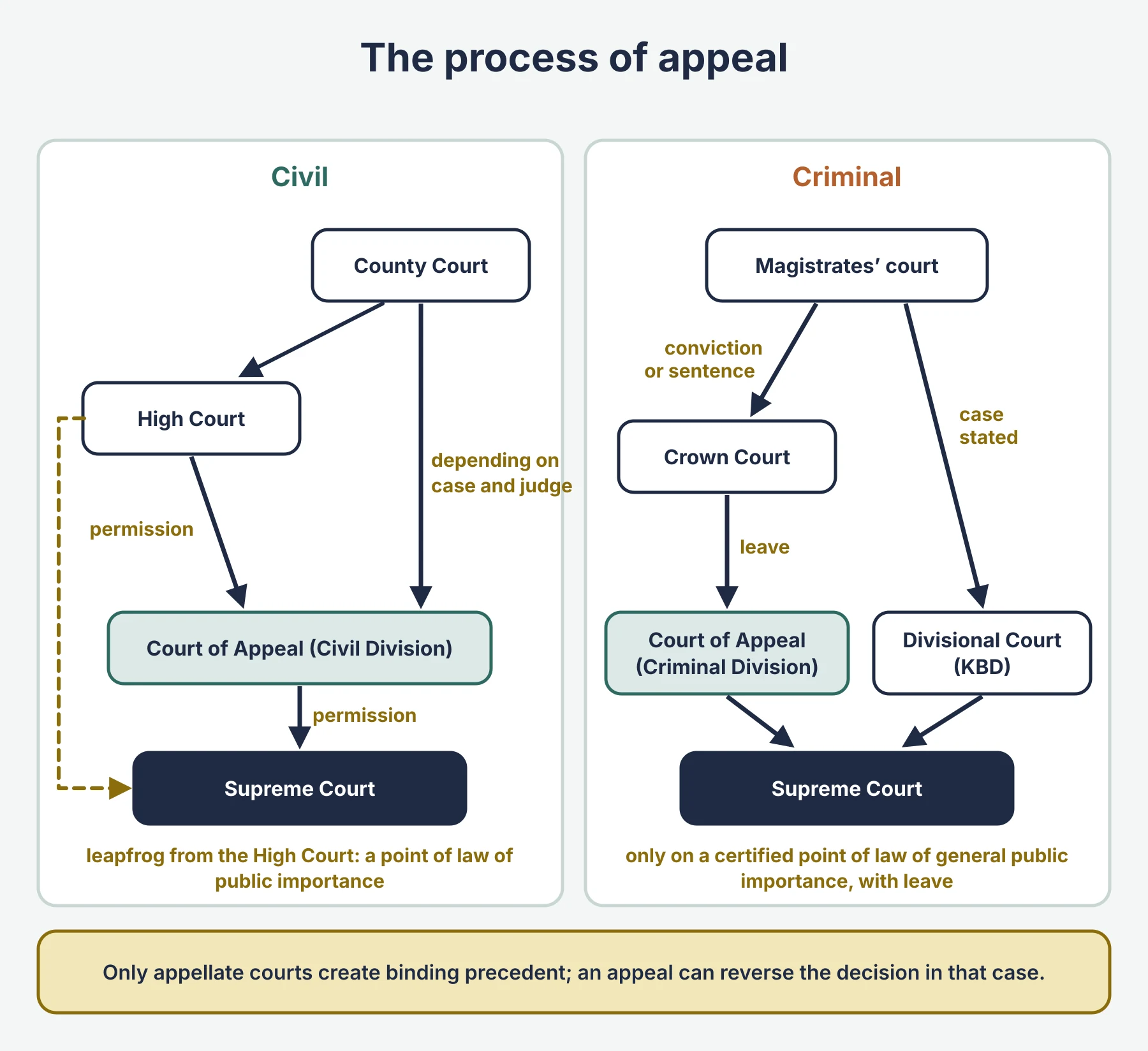
Appeal routes
| Civil | Criminal |
|---|---|
| County Court → High Court or Court of Appeal | Magistrates → Crown Court (conviction or sentence) |
| High Court → Court of Appeal → Supreme Court (permission) | Magistrates → Divisional Court by case stated (point of law) |
| Leapfrog: High Court → Supreme Court | Crown Court → Court of Appeal (Criminal Division), with leave |
| → Supreme Court on a certified point of law of general public importance |
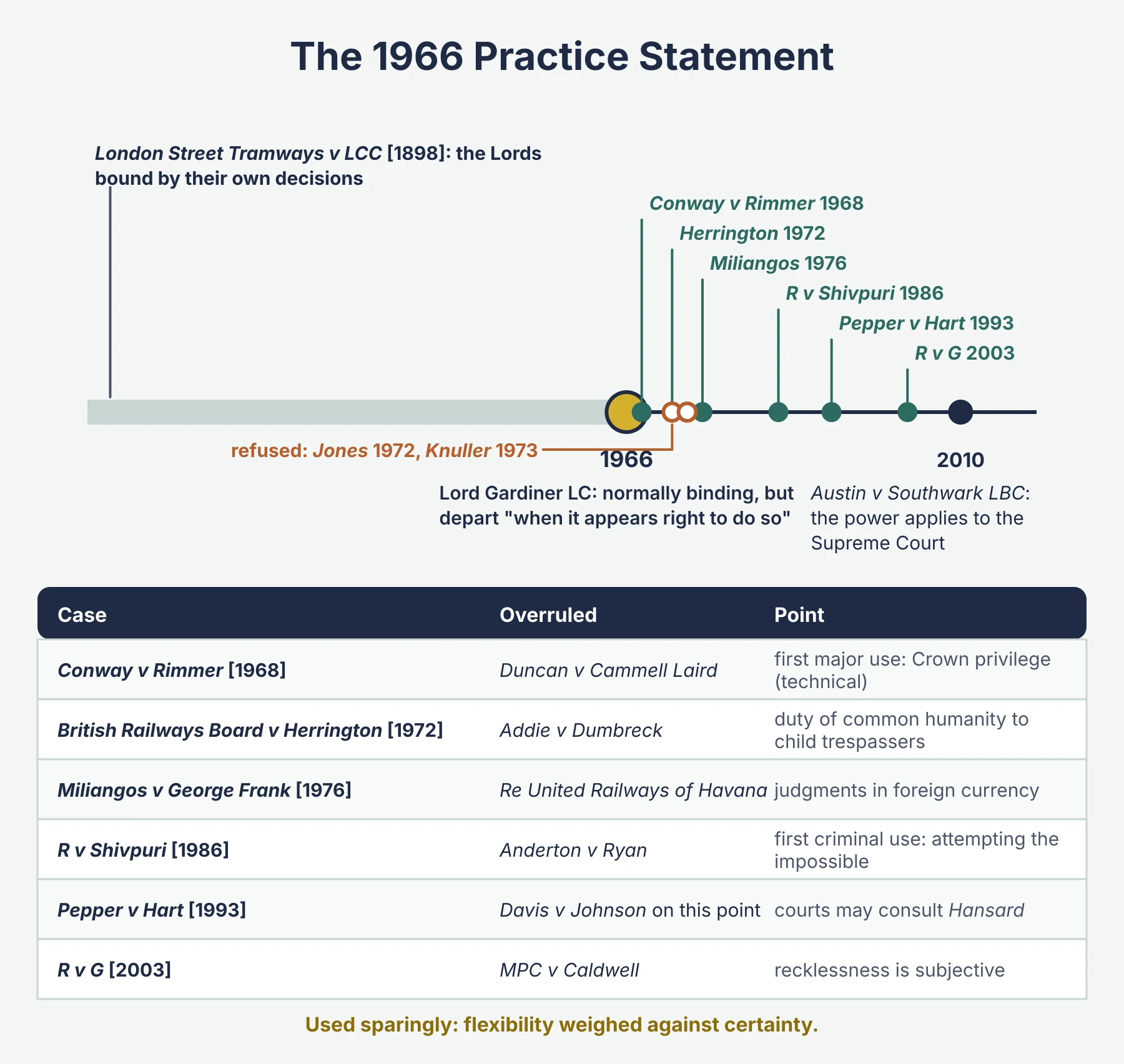
The 1966 Practice Statement
- Before: the House of Lords bound by itself (London Street Tramways [1898]).
- Lord Gardiner LC: depart “when it appears right to do so”; beware disturbing contracts, property and fiscal arrangements; special need for certainty in criminal law.
- Applies to the Supreme Court (Austin v Southwark [2010]).
| Used in | Overruling | Why |
|---|---|---|
| Conway v Rimmer [1968] | Duncan v Cammell Laird | Crown privilege; first major use |
| BRB v Herrington [1972] | Addie v Dumbreck | Child trespassers; social change |
| Miliangos [1976] | Havana Railways | Foreign-currency judgments |
| R v Shivpuri [1986] | Anderton v Ryan [1985] | Impossible attempts; first criminal use |
| Pepper v Hart [1993] | Davis v Johnson (on Hansard) | Use of Hansard |
| R v G [2003] | Caldwell [1982] | Subjective recklessness |
Not used: Jones v Secretary of State for Social Services [1972]; Knuller v DPP [1973] (refused to overrule Shaw). Correcting a wrong turn: R v Jogee [2016] (joint enterprise; Chan Wing-Siu [1985]).
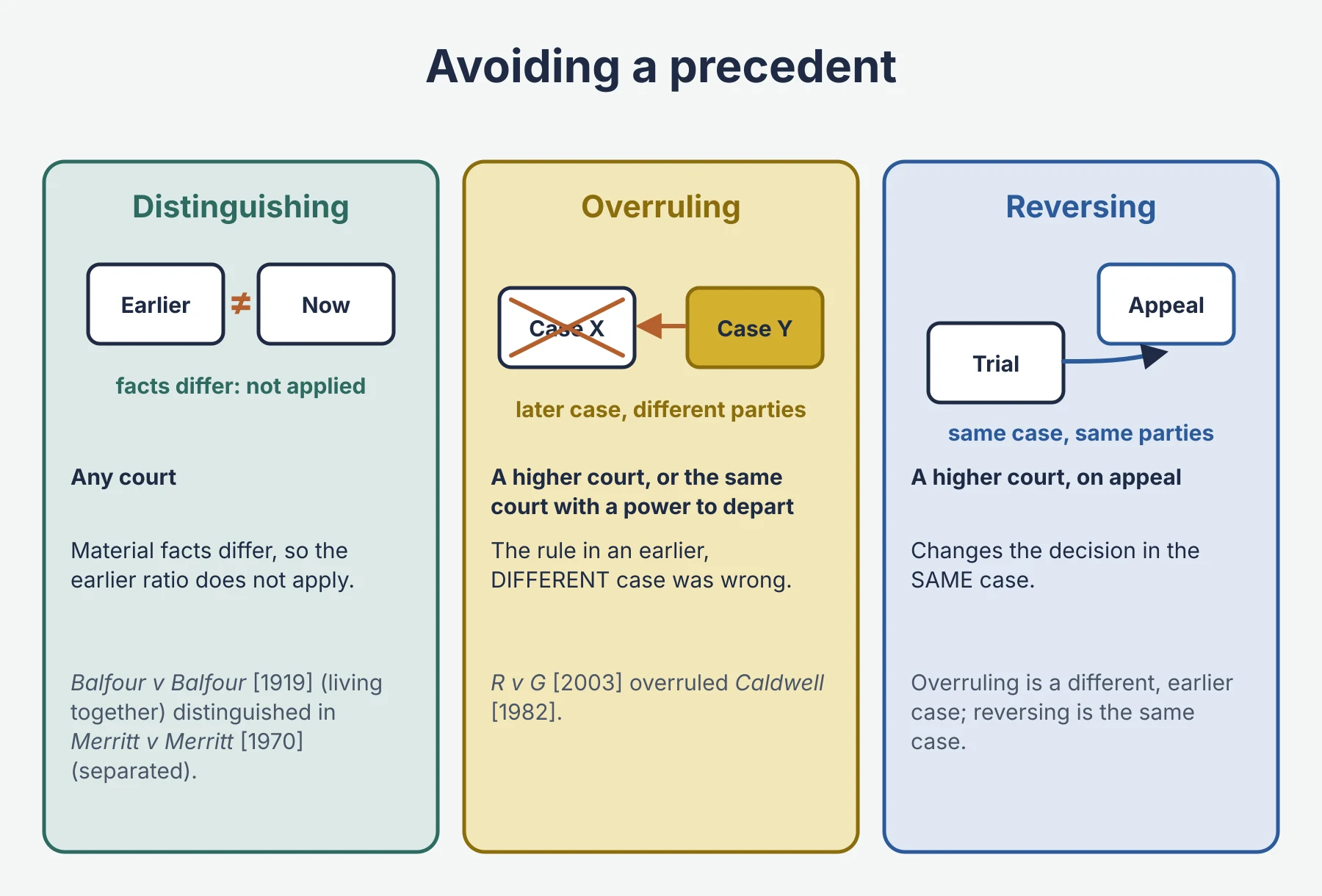
Avoiding precedent
| Method | Who can use it | Example |
|---|---|---|
| Distinguishing | Any court | Balfour v Balfour distinguished in Merritt v Merritt |
| Overruling | Higher court, or SC under the Practice Statement | R v G overruled Caldwell |
| Reversing | Higher court in the same case on appeal | Any successful appeal |
Model evaluation paragraph
The Practice Statement gives the Supreme Court flexibility to correct mistakes and respond to social change, as in Herrington*, where an outdated rule on child trespassers was overruled. However, the Lords used the power sparingly, refusing to overrule in* Jones and Knuller*, because frequent departures would undermine the certainty that is the main justification for precedent. The quick reversal of* Anderton v Ryan in Shivpuri shows that, used carefully, the power prevents an error from being entrenched. On balance it strikes a reasonable balance between certainty and justice.
Key terms
| Term | Meaning |
|---|---|
| Material facts | The facts legally relevant to the decision |
| Per incuriam | Made through carelessness, ignoring a relevant statute or binding case |
| Leapfrog appeal | An appeal from the High Court straight to the Supreme Court |
| Case stated | An appeal on a point of law from the magistrates to the Divisional Court |
| Practice Statement | The 1966 announcement allowing the Lords to depart from their own decisions |
| Distinguishing | Avoiding a precedent because material facts differ |
| Overruling | Declaring the rule in an earlier case wrong |
| Reversing | Changing the outcome of the same case on appeal |
Exam traps
- The Supreme Court is not bound by itself.
- The Court of Appeal cannot overrule the Supreme Court or House of Lords.
- Obiter is persuasive, never binding, until adopted as ratio.
- Overruling ≠ reversing.
- Name at least two Practice Statement cases and say why each was overruled.
Self-test
- What is the ratio decidendi?
- Give an example of obiter dicta later followed as law.
- Which court replaced the House of Lords, and under which Act?
- State the three Young v Bristol Aeroplane exceptions.
- Why does the Criminal Division have extra flexibility?
- What did Lord Gardiner say about when the Lords would depart from previous decisions?
- Which was the first criminal case in which the Practice Statement was used?
- Name a case in which the House of Lords refused to use the Practice Statement.
- What is the difference between overruling and reversing?
- Are High Court judges bound by each other’s decisions?
- What effect do decisions of the European Court of Human Rights have in English courts?
- Which case confirmed that the Privy Council can direct English courts to follow it?
Answers: 1. The legal principle on which the decision rests, applied to the material facts. 2. R v Howe obiter on attempted murder, followed in R v Gotts; or High Trees. 3. The Supreme Court, Constitutional Reform Act 2005 (sitting from 2009). 4. Conflicting Court of Appeal decisions; conflict with a later House of Lords or Supreme Court decision; per incuriam. 5. Because a person’s liberty is at stake (R v Taylor, R v Gould, R v Spencer). 6. When it appears right to do so, bearing in mind the danger of disturbing settled arrangements and the special need for certainty in criminal law. 7. R v Shivpuri [1986]. 8. Jones v Secretary of State for Social Services [1972] or Knuller v DPP [1973]. 9. Overruling declares the rule in an earlier, different case wrong; reversing changes the decision in the same case on appeal. 10. No; they are persuasive. 11. Courts must take them into account (HRA 1998 s 2) but are not bound. 12. Willers v Joyce [2016].
Test yourself further with the doctrine of precedent practice questions.
Related resources
-
Study guides
Edexcel International A Level Law (YLA1): Lay People in the Law: Magistrates and Jurors
The role, selection and appointment of magistrates and jurors, with the Juries Act 1974, key cases, and advantages and disadvantages, for YLA1 area 1.2.22.
Law · Pearson Edexcel · A Level
Read guide -
Practice questions
Edexcel International A Level Law (YLA1): Lay People in the Law: Magistrates and Jurors – Practice Questions
Original practice questions with full answers on the selection, role, advantages and disadvantages of magistrates and jurors, for YLA1 content area 1.2.22.
Law · Pearson Edexcel · A Level
Try questions -
Revision notes
Edexcel International A Level Law (YLA1): Lay People in the Law: Magistrates and Jurors – Revision Notes
Condensed notes on the selection, role, advantages and disadvantages of magistrates and jurors, with the Juries Act 1974, cases and a self-test (YLA1 1.2.22).
Law · Pearson Edexcel · A Level
Revise topic
Get free revision emails (optional)
Occasional emails with practice questions, worked explanations and links to free resources for the qualification and subjects you choose. No spam, and you can unsubscribe from any email. The free tools on this site never need an email.