
Revision Notes
Edexcel International A Level Law (YLA1): Lay People in the Law: Magistrates and Jurors – Revision Notes
Condensed notes on the selection, role, advantages and disadvantages of magistrates and jurors, with the Juries Act 1974, cases and a self-test (YLA1 1.2.22).
- Subject
- Law
- Level
- A LEVELS
- Topic
- Paper 1 – Underlying Principles of Law and the English Legal System
- Author
- Marlbridge Academic Team
- Updated
- Reviewed by
- Aizaz Raoof Ali (what this means)
Aligned to Pearson Edexcel A Level Law (YLA1), Issue 4, November 2021. Official specification .
Syllabus page (what it covers and how it is assessed): Pearson Edexcel A Level Law.
Syllabus points this page covers
YLA1
- 1.2 The sources of English law, its enforcement and administration
Found an error? Report a correction.
Need help with this topic? Request a free trial class for A Level Law (YLA1).
Condensed for the final weeks. These notes cover two bullets of content area 1.2.22, “Lay people in the law”: “magistrates, including the Justices of the Peace Act 1979” and “jurors, including the Juries Act 1974”, with their role, selection, appointment, advantages and disadvantages. For the full explanation, use the magistrates and jurors study guide.
Magistrates: the essentials
| Point | Detail |
|---|---|
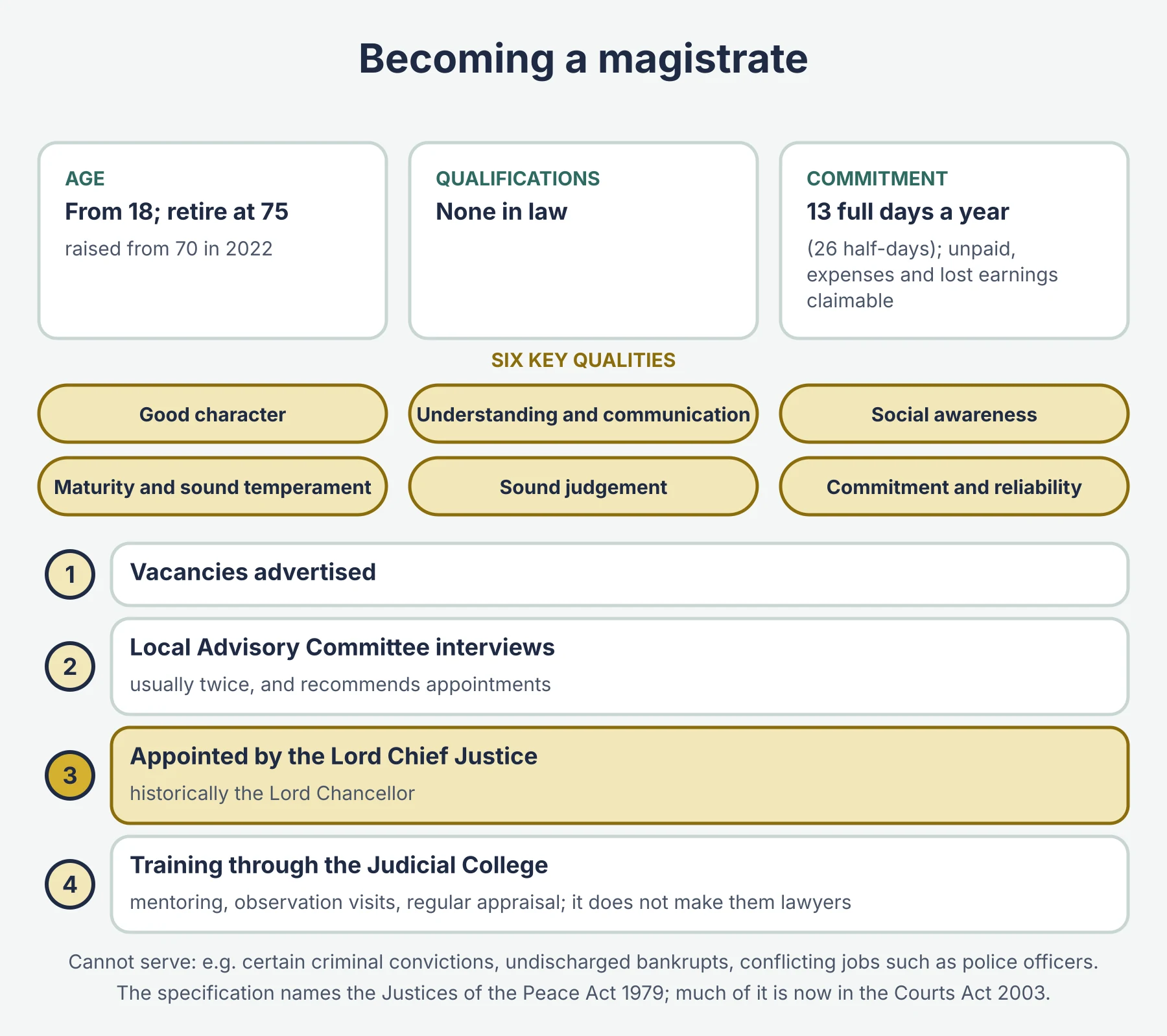
| Who | Unpaid lay justices; no legal qualification |
| Age | Appointed from 18; retire at 75 (raised from 70 in 2022) |
| Qualities | Good character; understanding and communication; social awareness; maturity and sound temperament; sound judgement; commitment and reliability |
| Commitment | At least 13 days (26 half-days) a year |
| Selection | Advertisement → local Advisory Committee interviews → appointment by the Lord Chief Justice |
| Statute | Justices of the Peace Act 1979 (named in the specification); much now in the Courts Act 2003 |
| Training | Judicial College, mentoring, appraisal |
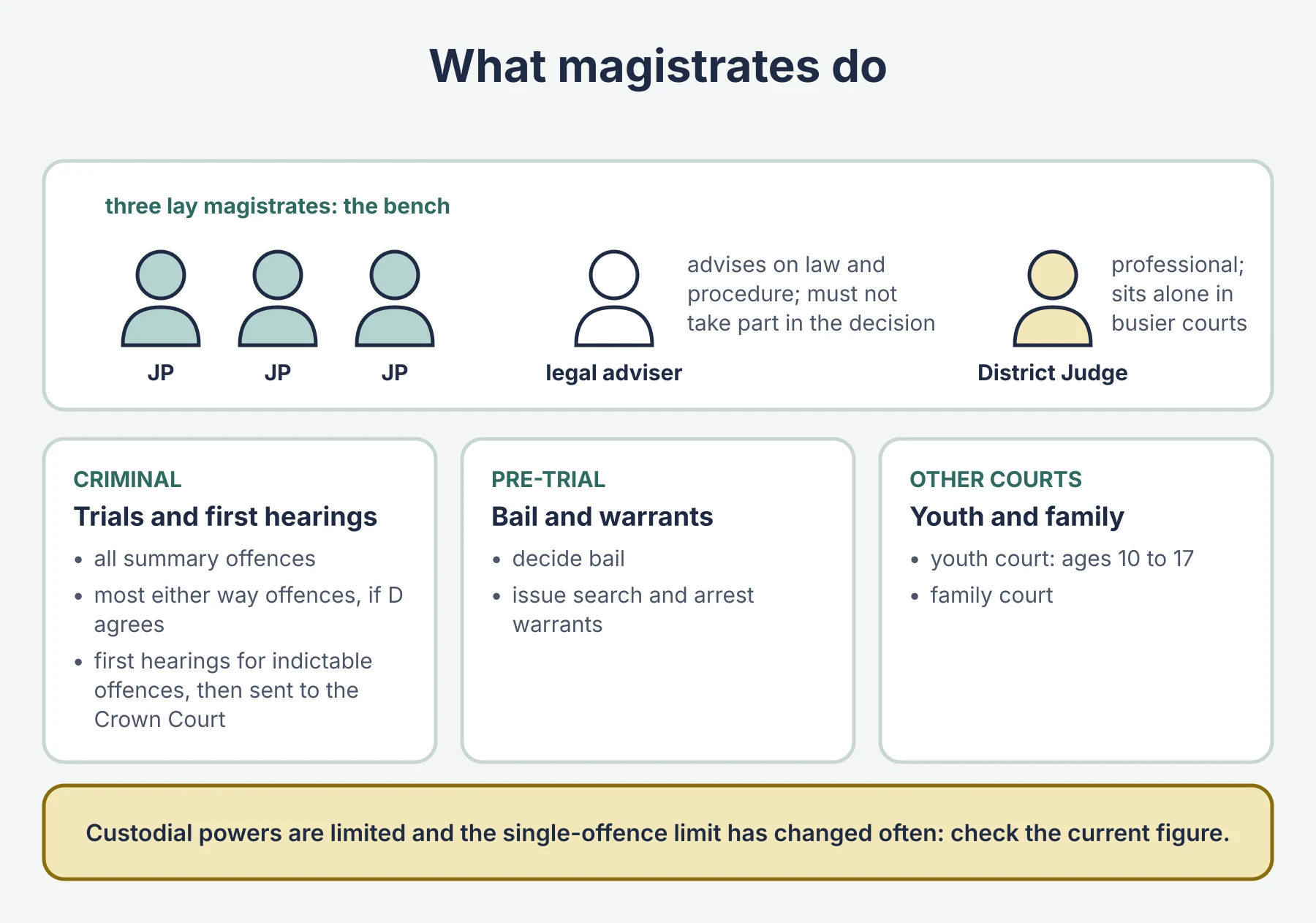
| Bench | Three, with a legal adviser on law and procedure |
| Work | Summary and most either-way trials; early hearings for indictable offences; bail; warrants; youth and family courts |
| Sentencing | Limited custodial powers (limit changed several times recently); most fines unlimited |
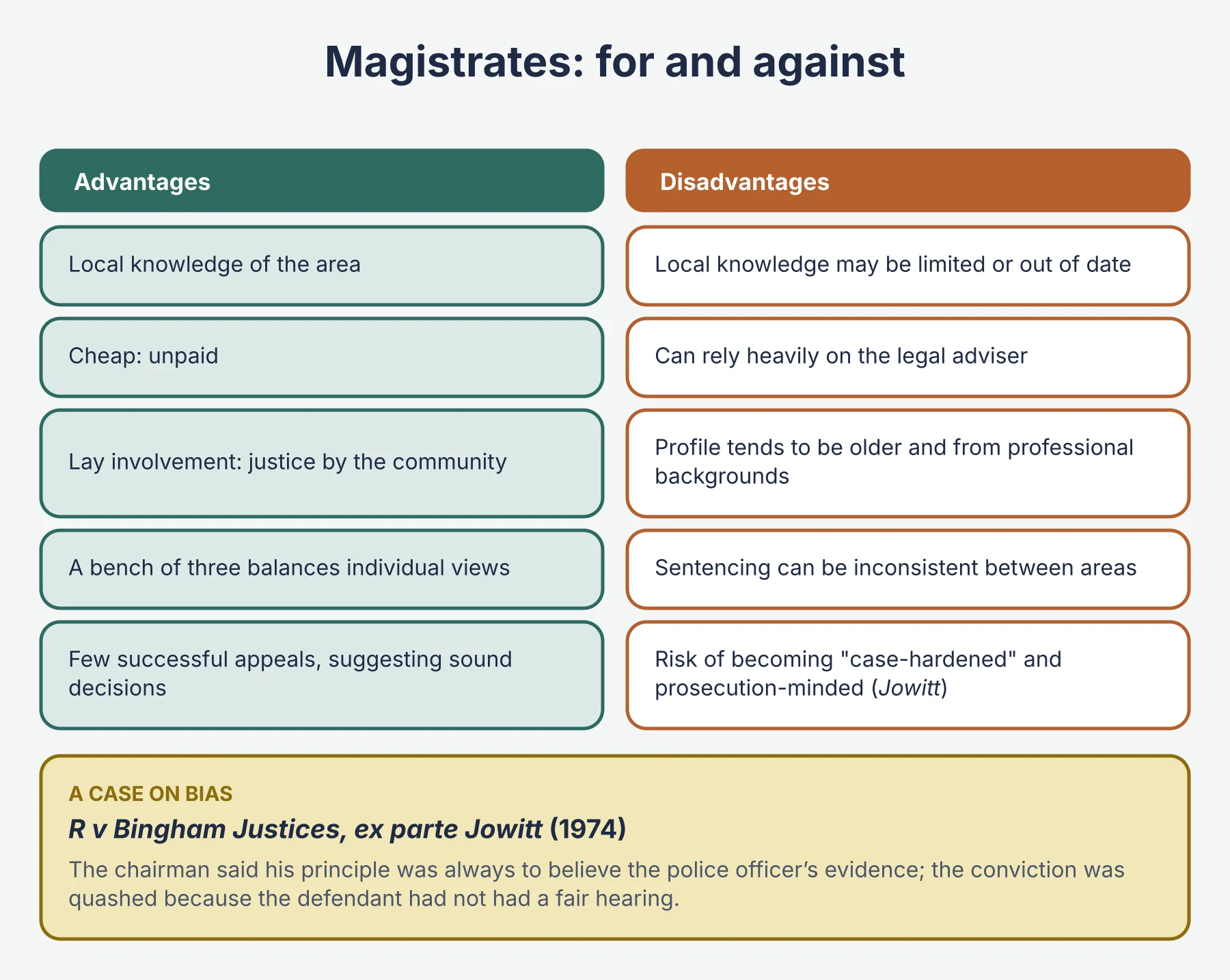
| Case | R v Bingham Justices, ex p Jowitt (1974): “always believe the police” → conviction quashed |
Jurors: the essentials
| Point | Detail |
|---|---|
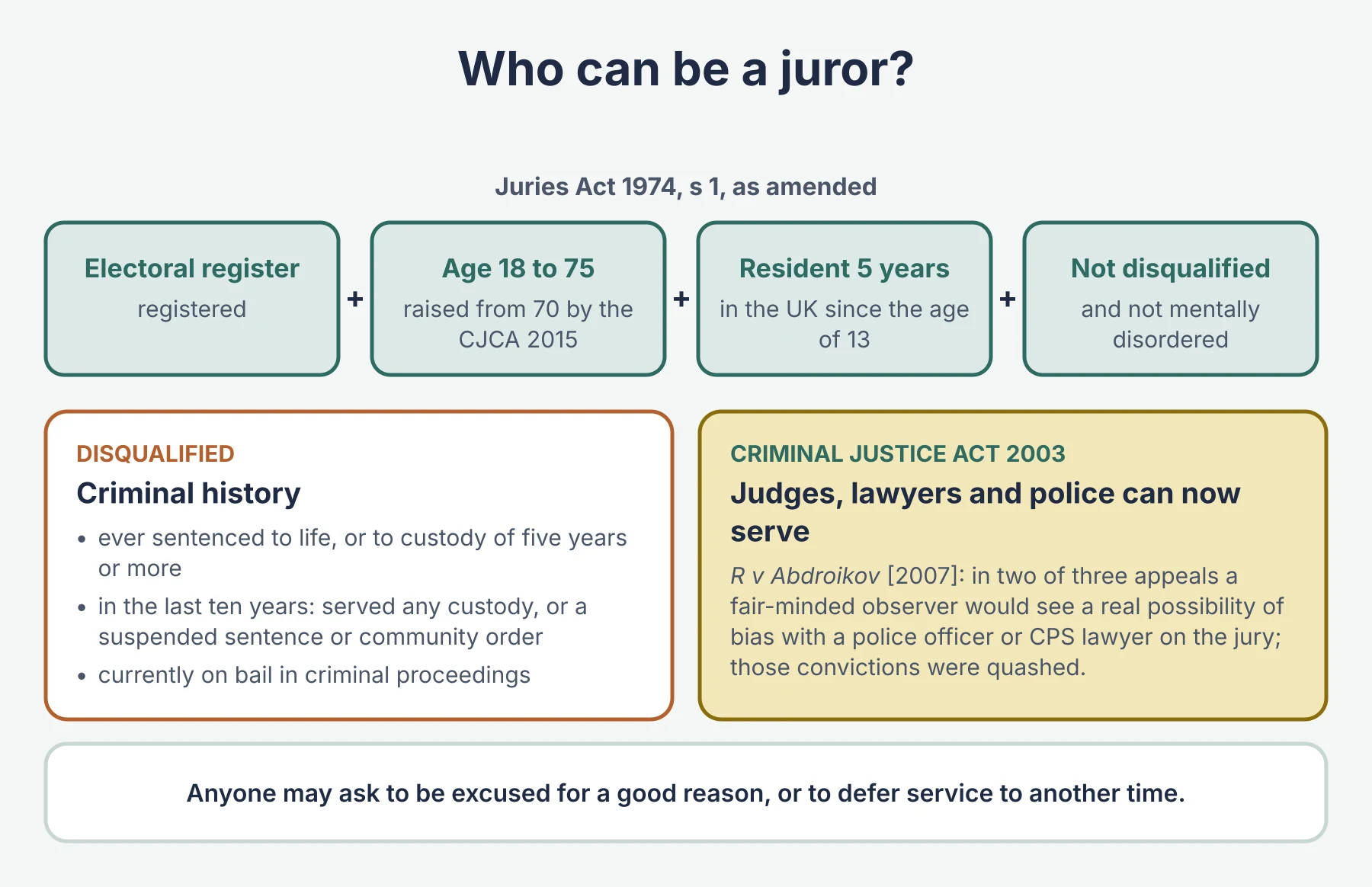
| Statute | Juries Act 1974, s 1 (as amended) |
| Eligible | On the electoral register; aged 18–75; resident in the UK for 5 years since age 13; not mentally disordered; not disqualified |
| Disqualified | Ever sentenced to life or 5+ years’ custody; in last 10 years served custody or had a suspended sentence or community order; on bail |
| CJA 2003 | Removed most ineligibility and excusal as of right: lawyers, judges and police can serve |
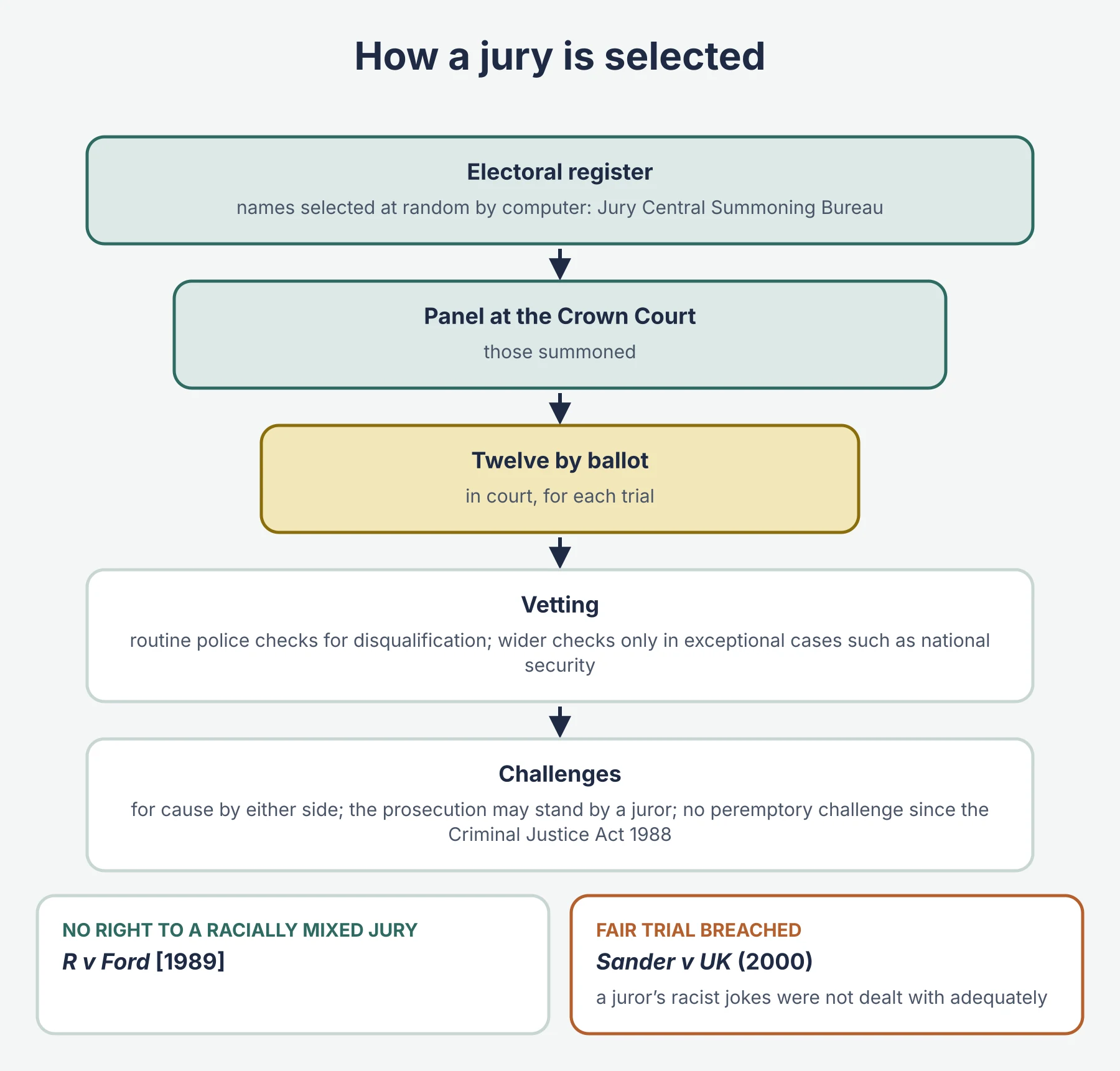
| Selection | Random computer selection by the Jury Central Summoning Bureau → panel → ballot of 12 |
| Vetting | Routine police checks; wider checks only in exceptional cases |
| Challenges | For cause (either side); prosecution stand-by; defence peremptory challenge abolished in 1988 |
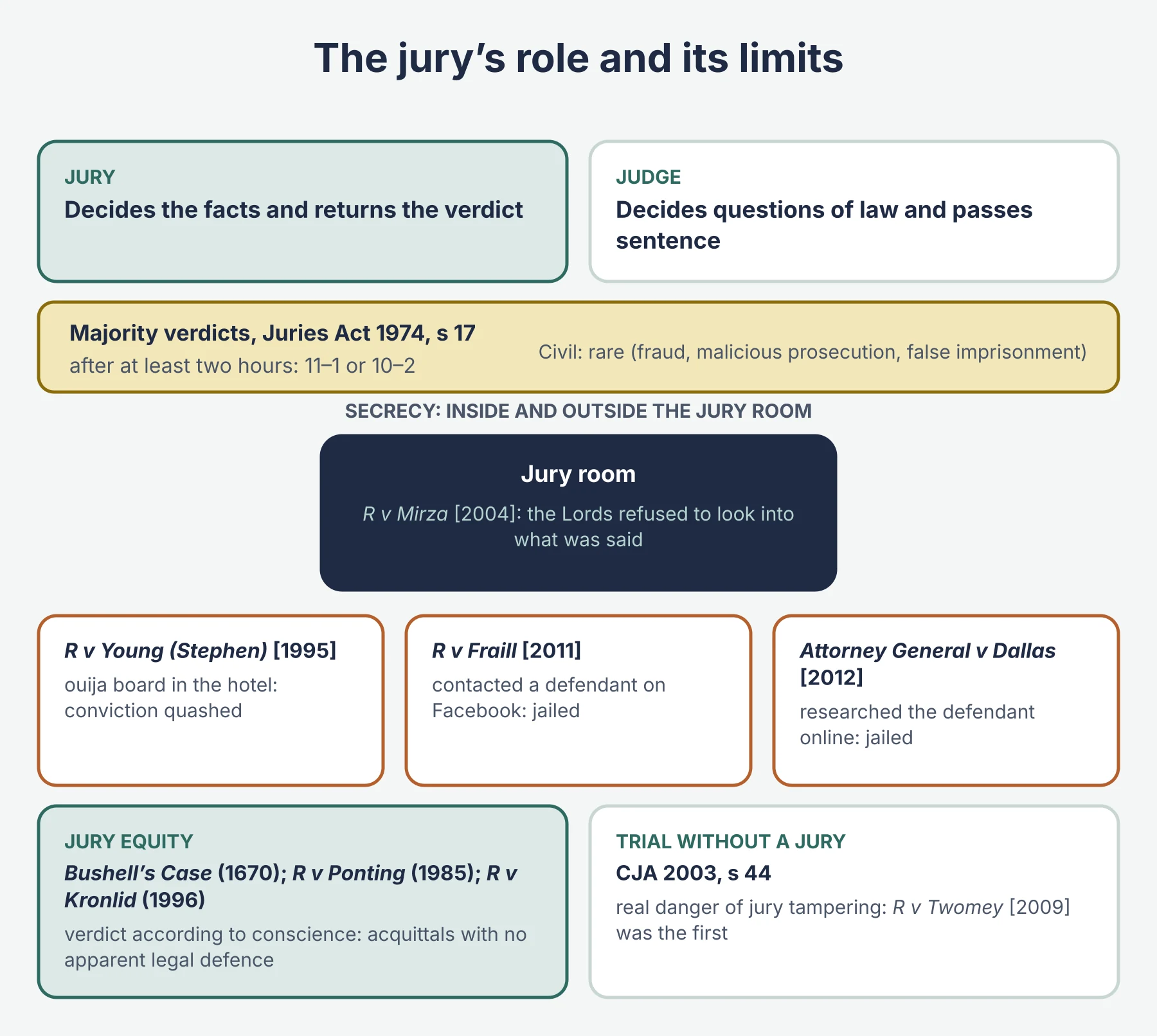
| Role | Decide facts and verdict in the Crown Court; judge decides law and sentence |
| Majority | 11–1 or 10–2 after at least two hours (s 17) |
| Secrecy | Deliberations secret; disclosure an offence (now s 20D) |
Jury cases by theme
- Independence / jury equity: Bushell’s Case (1670); R v Ponting (1985); R v Kronlid (1996).
- Bias: R v Abdroikov [2007] (police officer and CPS lawyer jurors; two convictions quashed); Sander v UK (2000) (racist jokes; Article 6 breach); R v Ford [1989] (no right to a multiracial jury).
- Secrecy and misconduct: R v Mirza [2004] (no inquiry into the jury room); R v Young (Stephen) [1995] (ouija board in hotel; retrial).
- Internet: R v Fraill [2011] (Facebook contact; jailed); AG v Dallas [2012] (online research; jailed); Criminal Justice and Courts Act 2015 offence.
- No jury: CJA 2003 s 44 tampering; R v Twomey [2009].
- Civil: rare; Ward v James [1966] (not for personal injury); Defamation Act 2013 removed the presumption of a jury.
Evaluation grid
| Magistrates | Juries | |
|---|---|---|
| For | Local knowledge; cheap; lay involvement; balanced bench; few appeals | Democratic; independent; cross-section; jury equity; secrecy protects |
| Against | Unrepresentative profile; inconsistent sentencing; reliance on adviser; prosecution-minded | No reasons; perverse verdicts; misconduct; bias; online research; cost |
Model evaluation paragraph
Random selection under the Juries Act 1974 is meant to produce a cross-section of society, which gives verdicts democratic legitimacy and public confidence. However, randomness does not guarantee a representative twelve, and because no reasons are given, bias can go undetected, as the racist jokes in Sander v UK show. Secrecy protects jurors from pressure but, as Mirza demonstrates, it also prevents courts examining what happened in the jury room. The 2015 offence of juror research shows that the system can be reformed to meet new threats, so the jury is best defended as valuable but imperfect.
Key terms
| Term | Meaning |
|---|---|
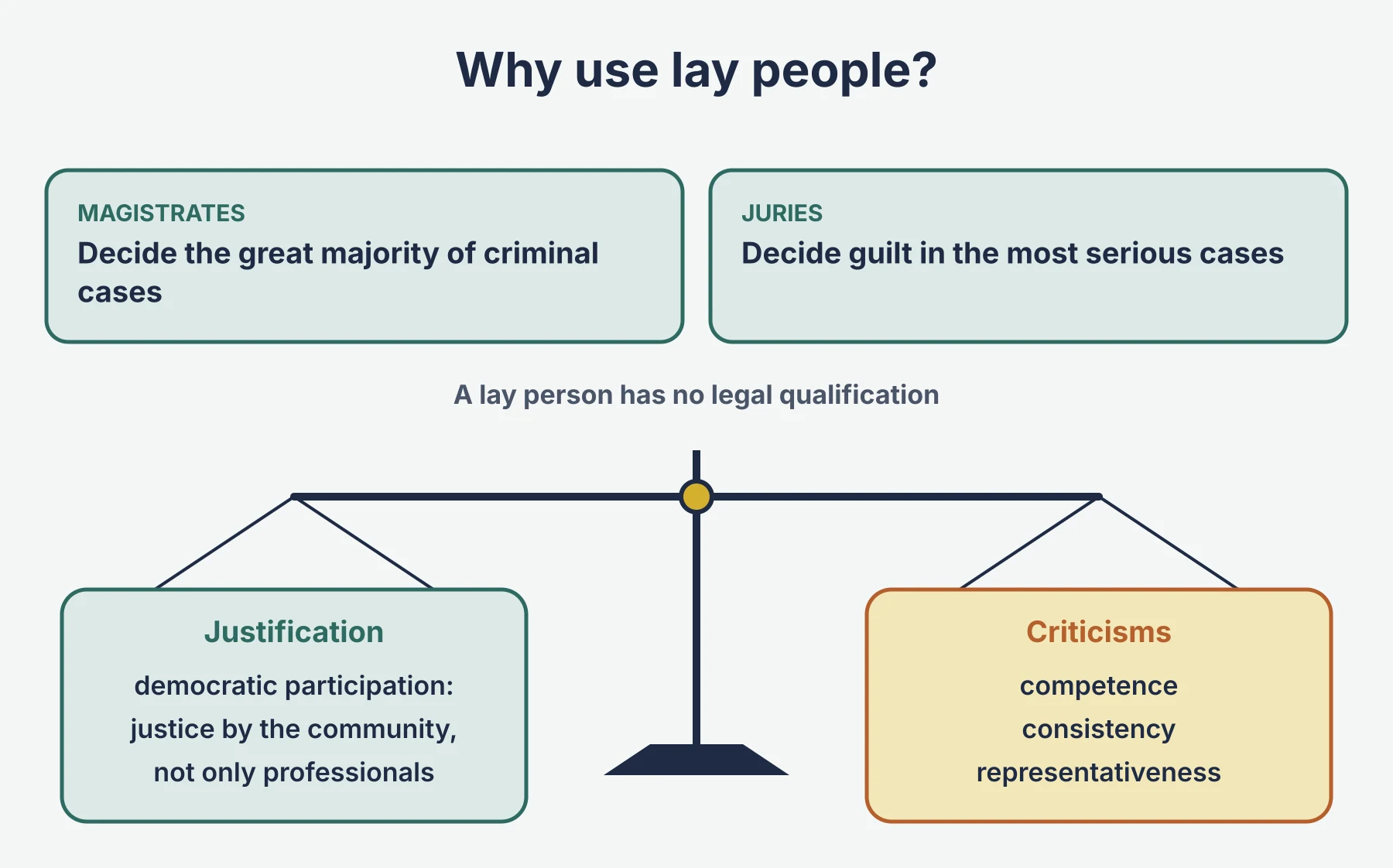
| Lay person | A person with no legal qualification |
| Justice of the Peace | A lay magistrate |
| Legal adviser | Qualified lawyer advising magistrates on law and procedure |
| District Judge (Magistrates’ Courts) | A professional judge who sits alone in a magistrates’ court |
| Summary offence | Minor offence tried only in the magistrates’ court |
| Either-way offence | Offence that can be tried in the magistrates’ court or the Crown Court |
| Vetting | Checking jurors’ backgrounds |
| Stand by | The prosecution’s power to put a juror to the end of the panel |
| Majority verdict | A verdict of 11–1 or 10–2 |
| Jury equity | A jury acquitting according to conscience despite the law |
Exam traps
- Magistrates are unpaid and lay; District Judges are professionals.
- Juries decide verdict only; judges sentence.
- After the CJA 2003, police and lawyers can serve, but Abdroikov limits this.
- Peremptory challenges by the defence no longer exist.
- Evaluation needs cases and a conclusion, not a list.
Self-test
- What is the minimum number of days a year a magistrate must sit?
- Who now appoints magistrates, and on whose recommendation?
- What was decided in ex p Jowitt?
- State the age limits for jury service.
- Give two grounds of disqualification from jury service.
- Which Act removed most ineligibility and excusal as of right?
- What did R v Abdroikov decide?
- When can a majority verdict be accepted?
- What did R v Mirza decide?
- Why was the conviction quashed in R v Young (Stephen)?
- What happened to the juror in R v Fraill?
- Under which provision can a trial take place without a jury where there is a risk of tampering?
Answers: 1. 13 days (26 half-days). 2. The Lord Chief Justice, on the recommendation of local Advisory Committees. 3. A conviction was quashed because the chairman said he always believed police evidence, showing bias. 4. 18 to 75. 5. Any two: ever sentenced to life or to five years or more in custody; in the last ten years served custody or had a suspended sentence or community order; currently on bail. 6. The Criminal Justice Act 2003. 7. A police officer or CPS lawyer on a jury can give an appearance of bias in some cases; two of the three convictions were quashed. 8. After at least two hours’ deliberation, by 11–1 or 10–2. 9. The court will not inquire into deliberations inside the jury room. 10. Jurors used a ouija board in their hotel, outside the jury room, so the court could investigate. 11. She was jailed for contempt for contacting a defendant on Facebook. 12. The Criminal Justice Act 2003, s 44.
Test yourself further with the magistrates and jurors practice questions.
Related resources
-
Study guides
Edexcel International A Level Law (YLA1): The Rules of Statutory Interpretation
Why statutes need interpreting, and the literal, golden and mischief rules and purposive approach, with leading cases, evaluation and an example (YLA1 1.2.3).
Law · Pearson Edexcel · A Level
Read guide -
Practice questions
Edexcel International A Level Law (YLA1): The Rules of Statutory Interpretation – Practice Questions
Original practice questions with full answers on why statutes need interpreting and the literal, golden, mischief and purposive approaches (YLA1 1.2.3).
Law · Pearson Edexcel · A Level
Try questions -
Revision notes
Edexcel International A Level Law (YLA1): The Rules of Statutory Interpretation – Revision Notes
Condensed notes on why statutes need interpreting and the literal, golden, mischief and purposive approaches, with cases, evaluation and a self-test (YLA1).
Law · Pearson Edexcel · A Level
Revise topic
Get free revision emails (optional)
Occasional emails with practice questions, worked explanations and links to free resources for the qualification and subjects you choose. No spam, and you can unsubscribe from any email. The free tools on this site never need an email.