
Revision Notes
Edexcel International A Level Law (YLA1): The Rules of Statutory Interpretation – Revision Notes
Condensed notes on why statutes need interpreting and the literal, golden, mischief and purposive approaches, with cases, evaluation and a self-test (YLA1).
- Subject
- Law
- Level
- A LEVELS
- Topic
- Paper 1 – Underlying Principles of Law and the English Legal System
- Author
- Marlbridge Academic Team
- Updated
- Reviewed by
- Aizaz Raoof Ali (what this means)
Aligned to Pearson Edexcel A Level Law (YLA1), Issue 4, November 2021. Official specification .
Syllabus page (what it covers and how it is assessed): Pearson Edexcel A Level Law.
Syllabus points this page covers
YLA1
- 1.2 The sources of English law, its enforcement and administration
Found an error? Report a correction.
Need help with this topic? Request a free trial class for A Level Law (YLA1).
Condensed for the final weeks. These notes cover part of content area 1.2.3: “Judicial interpretation of statutes – why there is a need for it” and the “rules of interpretation – literal, golden, mischief … – advantages and disadvantages of each together with specific relevant case law examples”, with the “purposive approach”. For the full explanation, use the rules of statutory interpretation study guide. Ejusdem generis, presumptions, aids and the Human Rights Act are in the sources of English law revision notes.
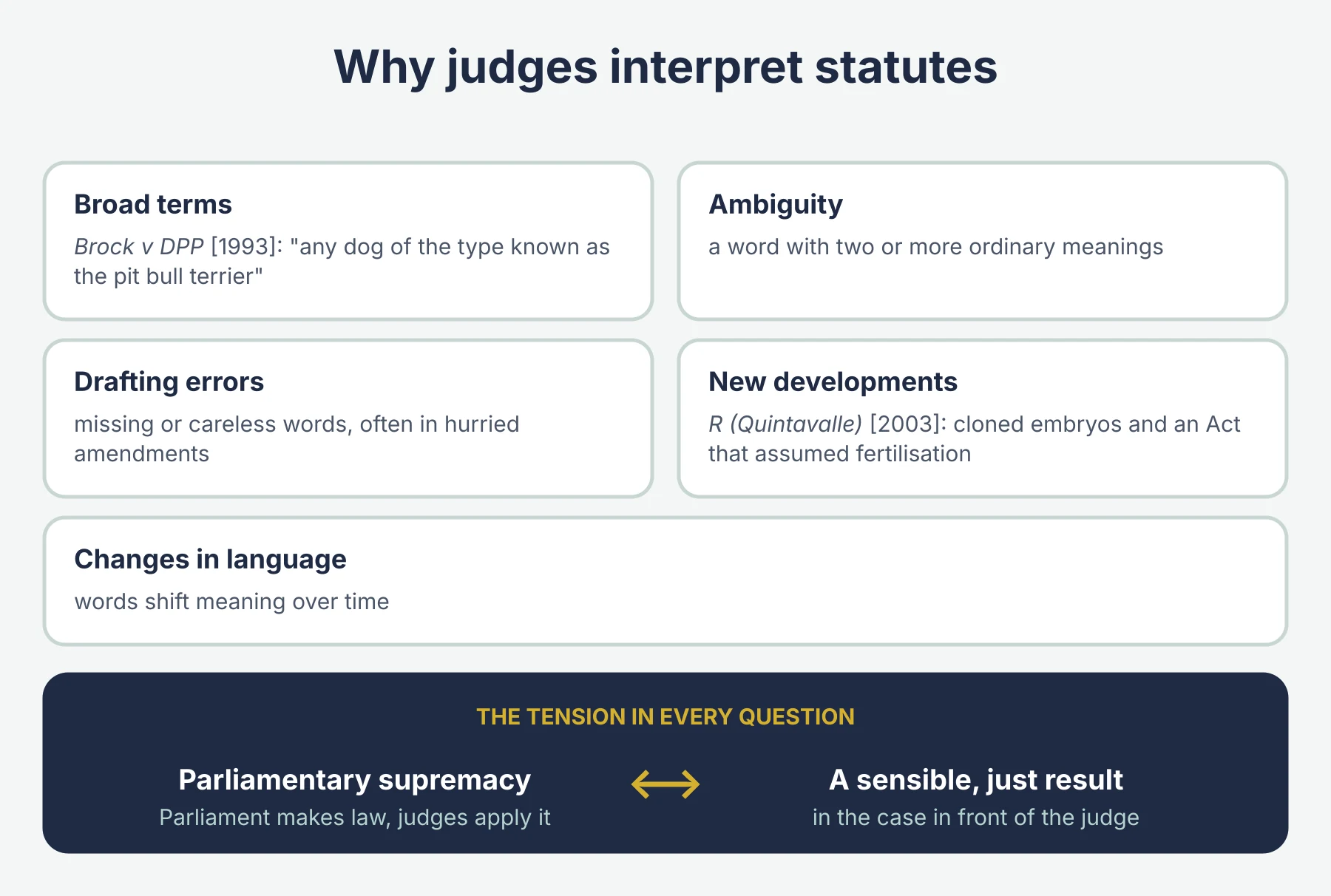
Why interpretation is needed (1.2.3)
- Broad terms: Brock v DPP [1993] (“type” of dog).
- Ambiguity: words with more than one meaning.
- Drafting errors: words omitted or misused.
- New developments: R (Quintavalle) v Secretary of State for Health [2003] (cloned embryos).
- Changing language: meanings shift over time.
The underlying tension: parliamentary supremacy versus a just and sensible result.
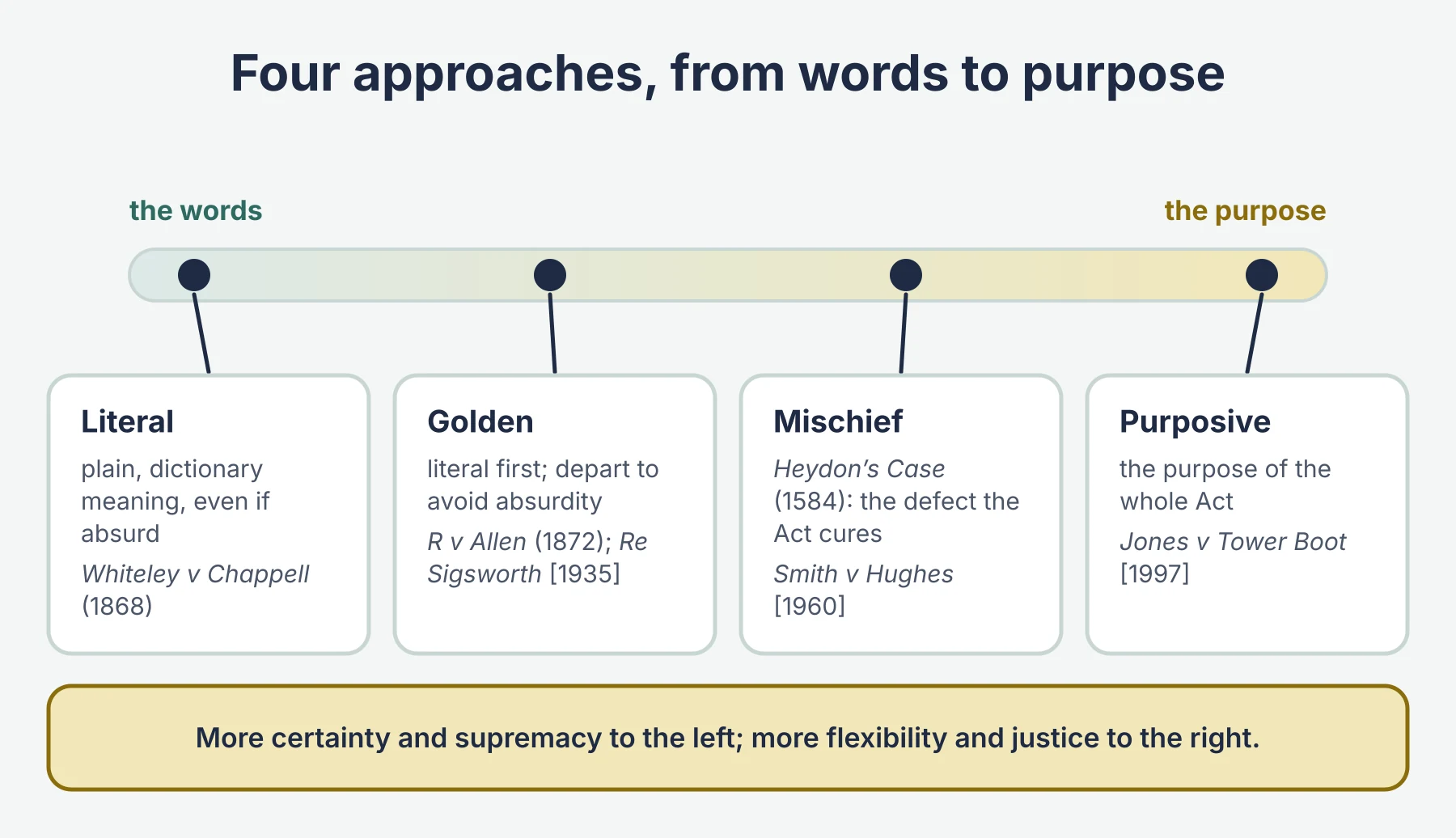
The four approaches at a glance
| Approach | Question the judge asks | Leading cases | Main strength | Main weakness |
|---|---|---|---|---|
| Literal | What do the words plainly mean? | Whiteley v Chappell; Fisher v Bell; LNER v Berriman | Respects Parliament; certainty | Absurd or unjust results |
| Golden | Does the literal meaning produce an absurdity? | Narrow: R v Allen; Adler v George. Broad: Re Sigsworth | Avoids absurdity, stays near the text | No test of absurdity; unpredictable |
| Mischief | What defect was the Act meant to cure? | Heydon’s Case; Smith v Hughes; Elliott v Grey; Royal College of Nursing v DHSS | Gives effect to Parliament’s aim | Judges may decide what Parliament “should” have meant |
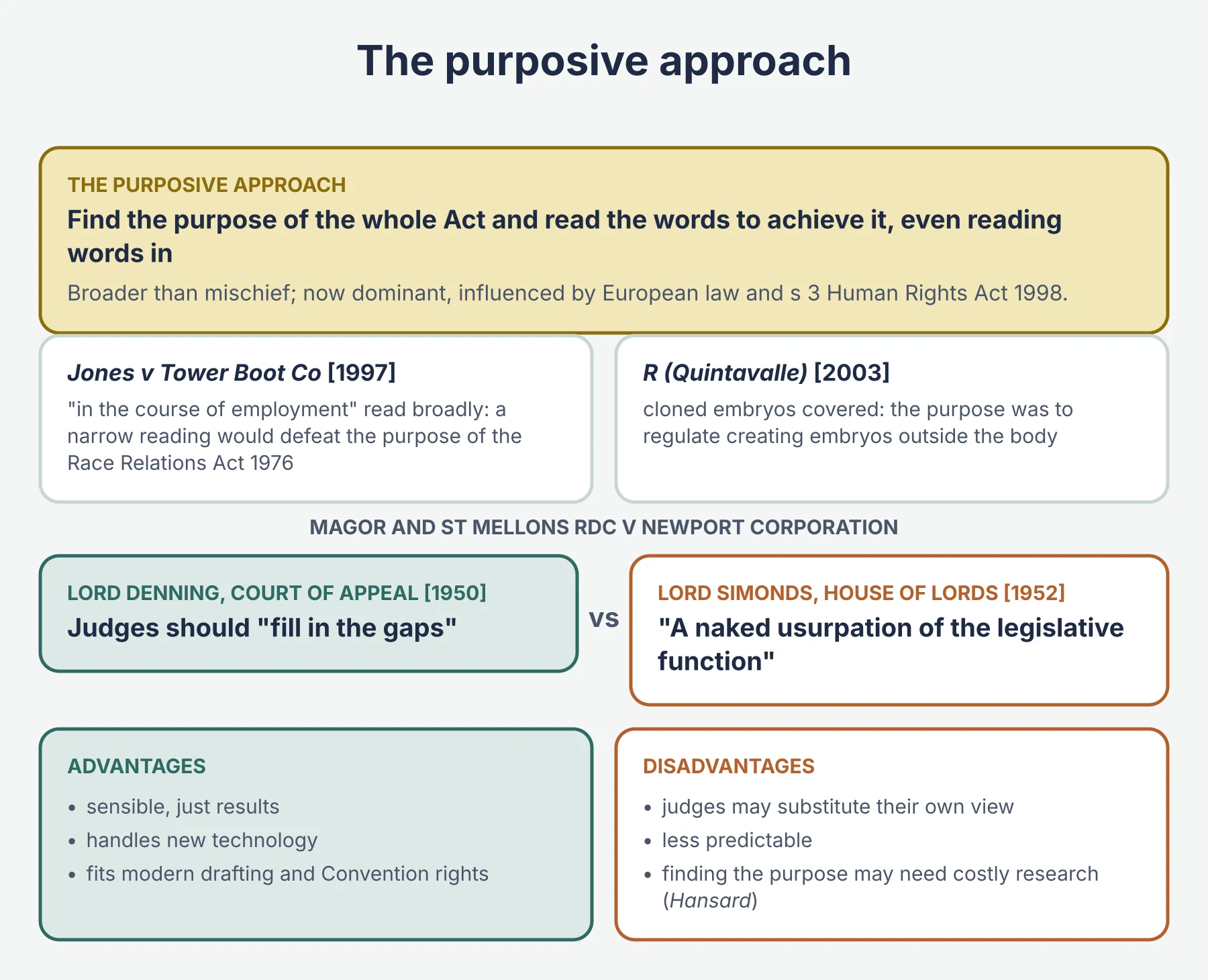
| Purposive | What is the Act’s overall purpose? | Jones v Tower Boot; R (Quintavalle) | Sensible results; handles new technology | Judicial law making; less certainty |
Case facts in one line each
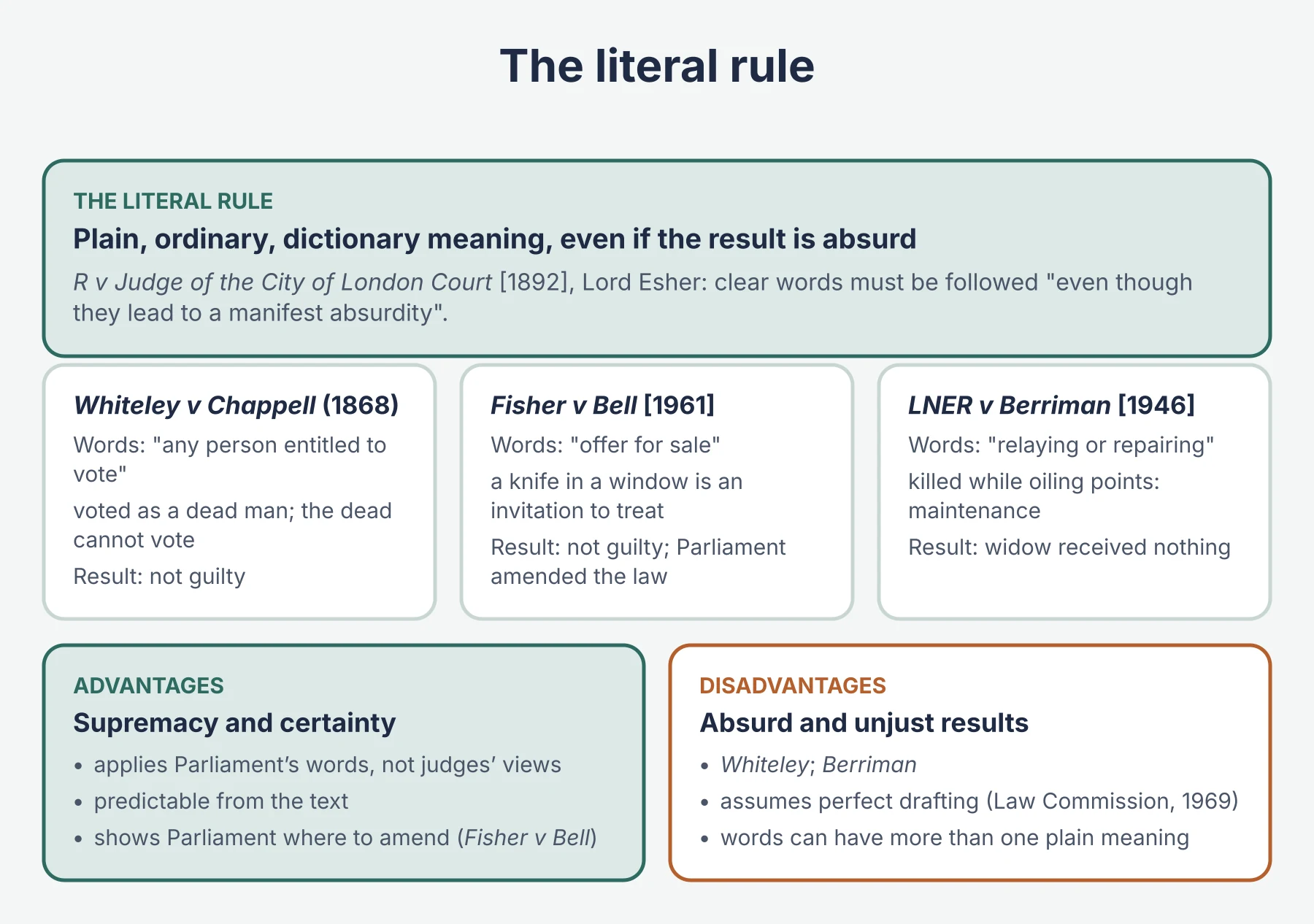
- Whiteley v Chappell (1868): impersonating a dead voter was not impersonating a person “entitled to vote”.
- Fisher v Bell [1961]: a flick knife in a window was not “offered for sale”; it was an invitation to treat.
- LNER v Berriman [1946]: oiling points was not “relaying or repairing”; no compensation for the widow.
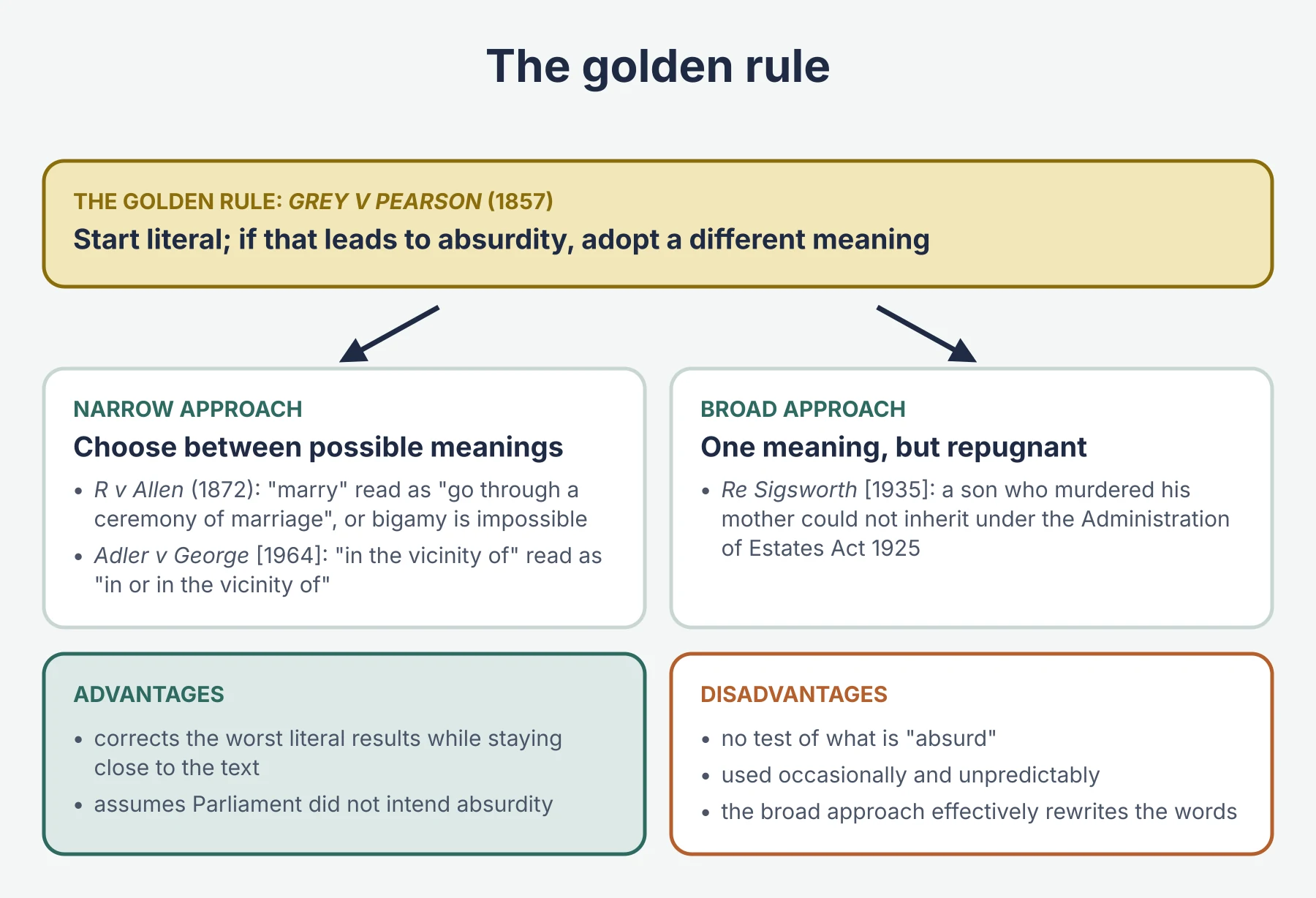
- R v Allen (1872): “marry” in bigamy means go through a ceremony of marriage.
- Adler v George [1964]: “in the vicinity of” read to include inside the base.
- Re Sigsworth [1935]: a son who murdered his mother could not inherit from her.
- Heydon’s Case (1584): the four questions of the mischief rule.
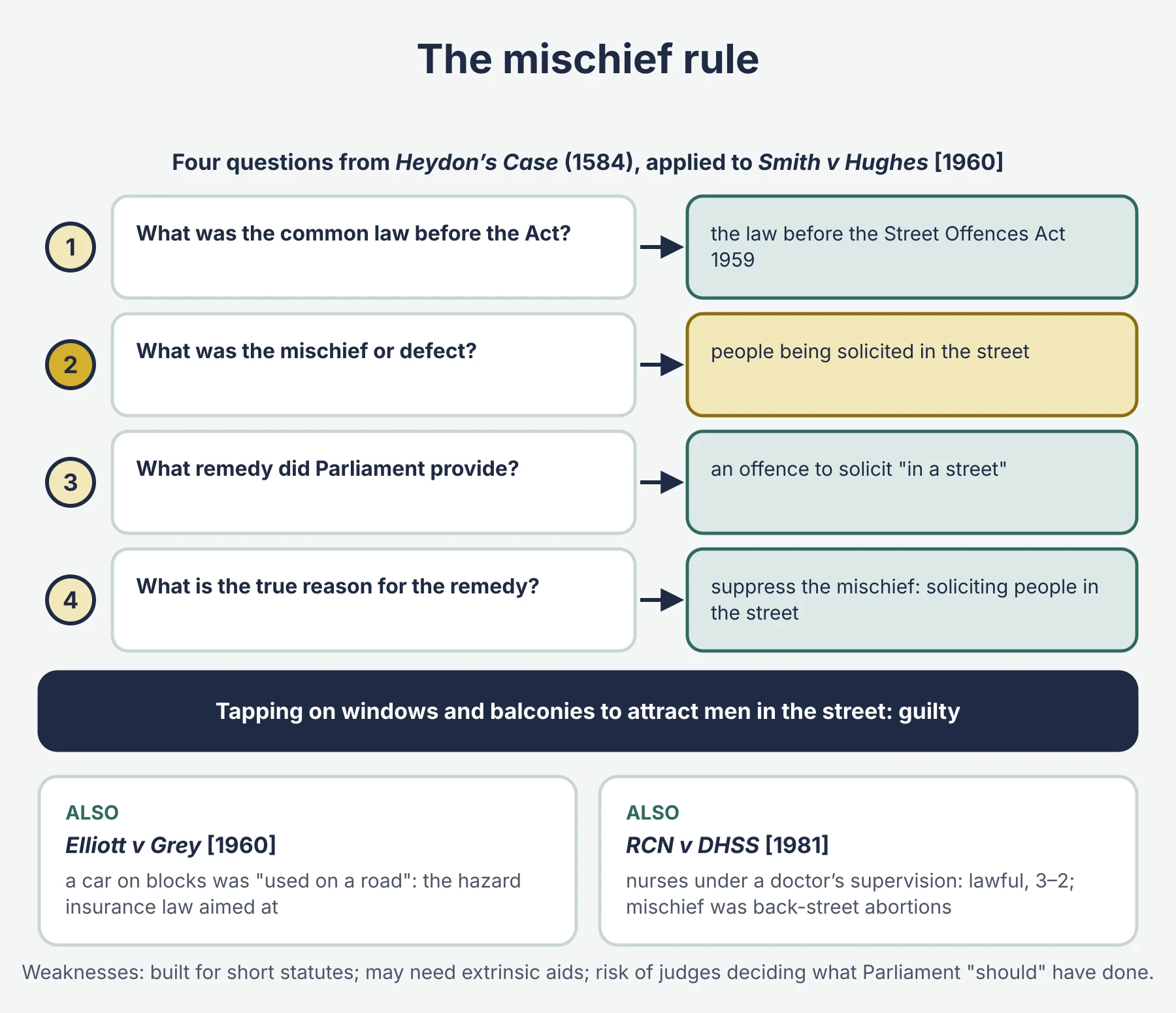
- Smith v Hughes [1960]: soliciting from a balcony was soliciting “in a street”.
- Elliott v Grey [1960]: a jacked-up car on a road was “used on a road”.
- Royal College of Nursing v DHSS [1981]: nurses performing medical induction under supervision acted lawfully (3:2).
- Jones v Tower Boot [1997]: “in the course of employment” covered racist harassment by co-workers.
- Magor and St Mellons v Newport [1950]/[1952]: Denning’s “fill in the gaps” versus Lord Simonds’s “naked usurpation of the legislative function”.
Heydon’s four questions
- What was the common law before the Act?
- What was the mischief and defect?
- What remedy did Parliament provide?
- What is the true reason for the remedy?
Golden rule: narrow versus broad
- Narrow: the word has more than one meaning; choose the one that avoids absurdity (Allen, Adler).
- Broad: the word has one meaning, but applying it is repugnant; modify it (Sigsworth).
Model evaluation paragraph
The literal rule respects parliamentary supremacy because judges apply only the words Parliament chose, and it promotes certainty. However, it can produce results Parliament cannot have intended, as in LNER v Berriman*, where a widow was denied compensation on a narrow reading of “repairing”. The purposive approach avoids such injustice, as in* Jones v Tower Boot*, but it allows unelected judges to decide what Parliament meant, the criticism Lord Simonds made in* Magor and St Mellons*. On balance, the modern purposive approach is preferable because it is still anchored to Parliament’s purpose, and Parliament can always legislate to correct a judicial reading.*
Key terms
| Term | Meaning |
|---|---|
| Statutory interpretation | The process by which judges decide the meaning of words in an Act |
| Parliamentary supremacy | Parliament’s power to make or unmake any law; judges apply, not make, statute |
| Literal rule | Plain, ordinary meaning, even if absurd |
| Golden rule | Literal meaning unless it produces absurdity |
| Mischief rule | Interpret to remedy the defect the Act targeted |
| Purposive approach | Interpret to achieve the Act’s overall purpose |
| Absurdity | A result so unreasonable Parliament cannot have intended it |
| Hansard | The official record of parliamentary debates, usable since Pepper v Hart [1993] |
Exam traps
- A rule with no case scores little: one case per rule at minimum.
- The golden rule starts from the literal meaning; it is not an alternative starting point.
- Mischief and purposive are different: the old defect versus the overall purpose.
- Fisher v Bell is a literal-rule case even though it uses contract law terms.
- In a problem question, apply each rule to the words in the scenario, then conclude.
Self-test
- Give two reasons why judges need to interpret statutes.
- State the literal rule.
- Why was the defendant in Whiteley v Chappell not guilty?
- Which judge stated the golden rule, and in which case?
- Distinguish the narrow and broad approaches to the golden rule, with a case for each.
- List Heydon’s four questions.
- What was the mischief in Smith v Hughes?
- Why was the Royal College of Nursing case controversial?
- How does the purposive approach differ from the mischief rule?
- What did Lord Simonds say about Lord Denning’s approach in Magor and St Mellons?
- Give one advantage and one disadvantage of the literal rule.
- Which case allowed courts to consult Hansard?
Answers: 1. Any two: broad terms; ambiguity; drafting errors; new developments such as technology; changes in language. 2. Words are given their plain, ordinary meaning even if the result is absurd. 3. A dead person is not “entitled to vote”, so impersonating one was not within the words of the Act. 4. Lord Wensleydale, Grey v Pearson (1857). 5. Narrow: choosing between meanings of an ambiguous word (R v Allen). Broad: modifying a word with one meaning to avoid a repugnant result (Re Sigsworth). 6. The common law before the Act; the mischief; the remedy Parliament provided; the true reason for the remedy. 7. Men in the street being solicited by prostitutes, wherever the prostitute was standing. 8. The majority read the Act widely to allow nurses to carry out terminations; the dissent said this rewrote the Act. 9. Mischief looks at the defect in the previous law; purposive looks at the purpose of the Act as a whole, and may read in words. 10. That it was “a naked usurpation of the legislative function”. 11. Advantage: certainty or respect for Parliament; disadvantage: absurd or unjust results. 12. Pepper v Hart [1993].
Test yourself further with the rules of statutory interpretation practice questions.
Related resources
-
Study guides
Edexcel International A Level Law (YLA1): The Nature, Purpose of and Liability in Law
A deep dive into section 1.1 of Edexcel IAL Law YLA1: rules and law, legal personality, civil and criminal liability, punishment, legal theory and morality.
Law · Pearson Edexcel · A Level
Read guide -
Revision notes
Edexcel International A Level Law (YLA1): The Nature, Purpose of and Liability in Law – Revision Notes
Condensed recall notes on YLA1 section 1.1: rules and law, civil and criminal liability, the seven theories of punishment, legal theory and law and morality.
Law · Pearson Edexcel · A Level
Revise topic -
Study guides
Edexcel International A Level Law (YLA1): The Sources of English Law, Its Enforcement and Administration
A deep dive into YLA1 section 1.2: the Parliament Acts, law reform, interpretation, EU law, civil courts and ADR, legal personnel, and the cost and funding of law.
Law · Pearson Edexcel · A Level
Read guide
Get free revision emails (optional)
Occasional emails with practice questions, worked explanations and links to free resources for the qualification and subjects you choose. No spam, and you can unsubscribe from any email. The free tools on this site never need an email.