
Study Guides
Edexcel International A Level Law (YLA1): The Rules of Statutory Interpretation
Why statutes need interpreting, and the literal, golden and mischief rules and purposive approach, with leading cases, evaluation and an example (YLA1 1.2.3).
- Subject
- Law
- Level
- A LEVELS
- Topic
- Paper 1 – Underlying Principles of Law and the English Legal System
- Author
- Marlbridge Academic Team
- Updated
- Reviewed by
- Aizaz Raoof Ali (what this means)
Aligned to Pearson Edexcel A Level Law (YLA1), Issue 4, November 2021. Official specification .
Syllabus page (what it covers and how it is assessed): Pearson Edexcel A Level Law.
Syllabus points this page covers
YLA1
- 1.2 The sources of English law, its enforcement and administration
Found an error? Report a correction.
Need help with this topic? Request a free trial class for A Level Law (YLA1).
This guide covers part of content area 1.2.3 of Pearson Edexcel International Advanced Level Law, Issue 4: “Judicial interpretation of statutes – why there is a need for it”, and the “rules of interpretation – literal, golden, mischief … – advantages and disadvantages of each together with specific relevant case law examples”, with the “purposive approach”. The sources of English law study guide already explains ejusdem generis, presumptions, intrinsic and extrinsic aids, the Interpretation Act 1978 and s 3 of the Human Rights Act 1998, and the underlying principles revision notes name the rules. This page teaches each rule through its cases, shows how to apply all four to one problem, and gives the evaluation points the specification asks for.
Why there is a need for interpretation
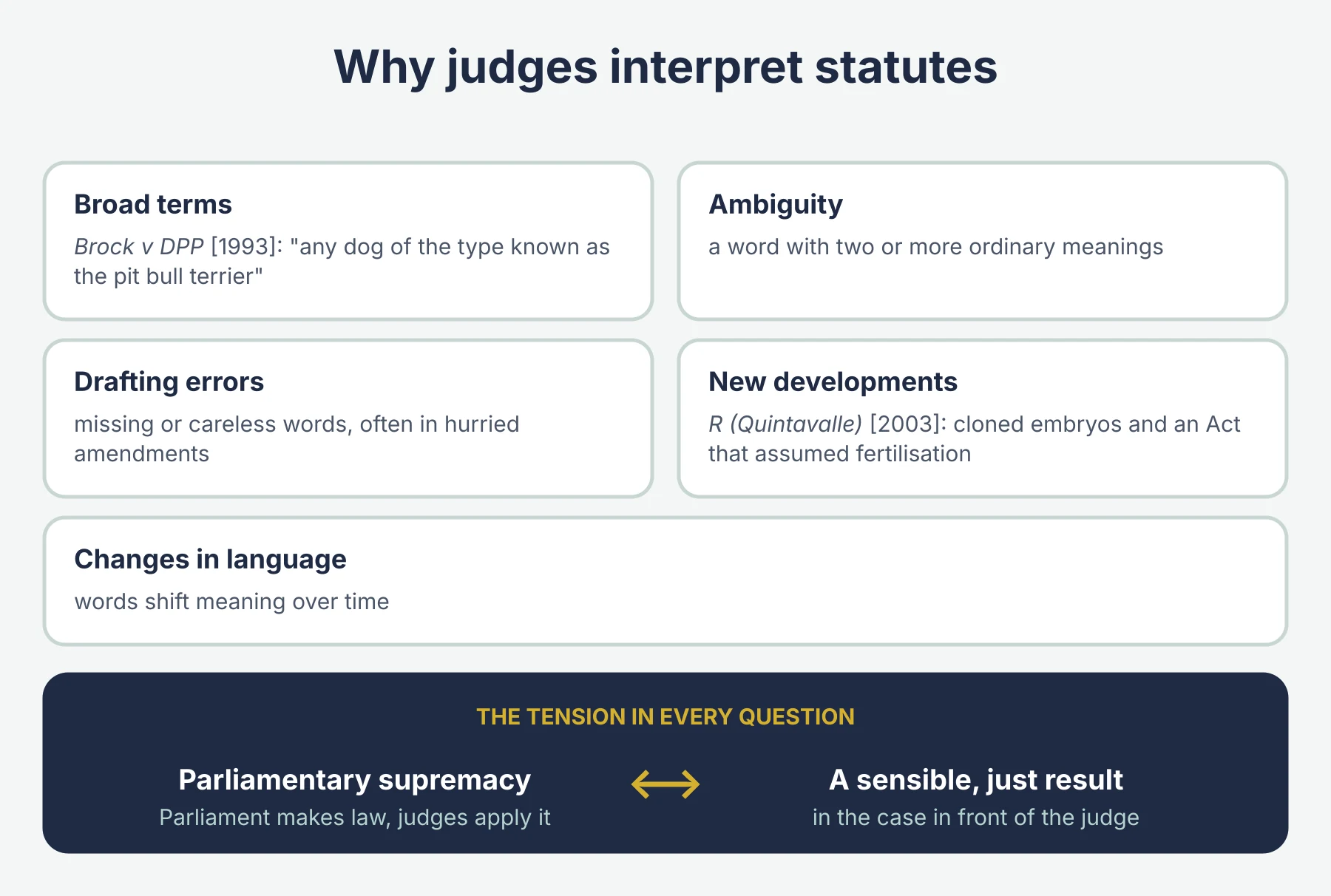
Parliament writes statutes in general words to cover future cases. Judges must then decide whether those words cover the facts in front of them. The need arises for several reasons:
- Broad terms. A word such as “type” or “vehicle” can be read narrowly or widely. In Brock v DPP [1993] the court had to decide what “any dog of the type known as the pit bull terrier” meant in the Dangerous Dogs Act 1991.
- Ambiguity. A word may have two or more ordinary meanings.
- Drafting errors. A word may be missing or used carelessly, especially in Bills amended in a hurry.
- New developments. Technology or social change produces situations Parliament did not foresee. In R (Quintavalle) v Secretary of State for Health [2003] the House of Lords had to decide whether embryos created by cell nuclear replacement (cloning) were covered by the Human Fertilisation and Embryology Act 1990, which assumed fertilisation.
- Changes in language. Words shift meaning over time.
Every interpretation question is about the same tension: judges must respect parliamentary supremacy (Parliament makes law, judges apply it) while producing a sensible and just result in the case.
The literal rule
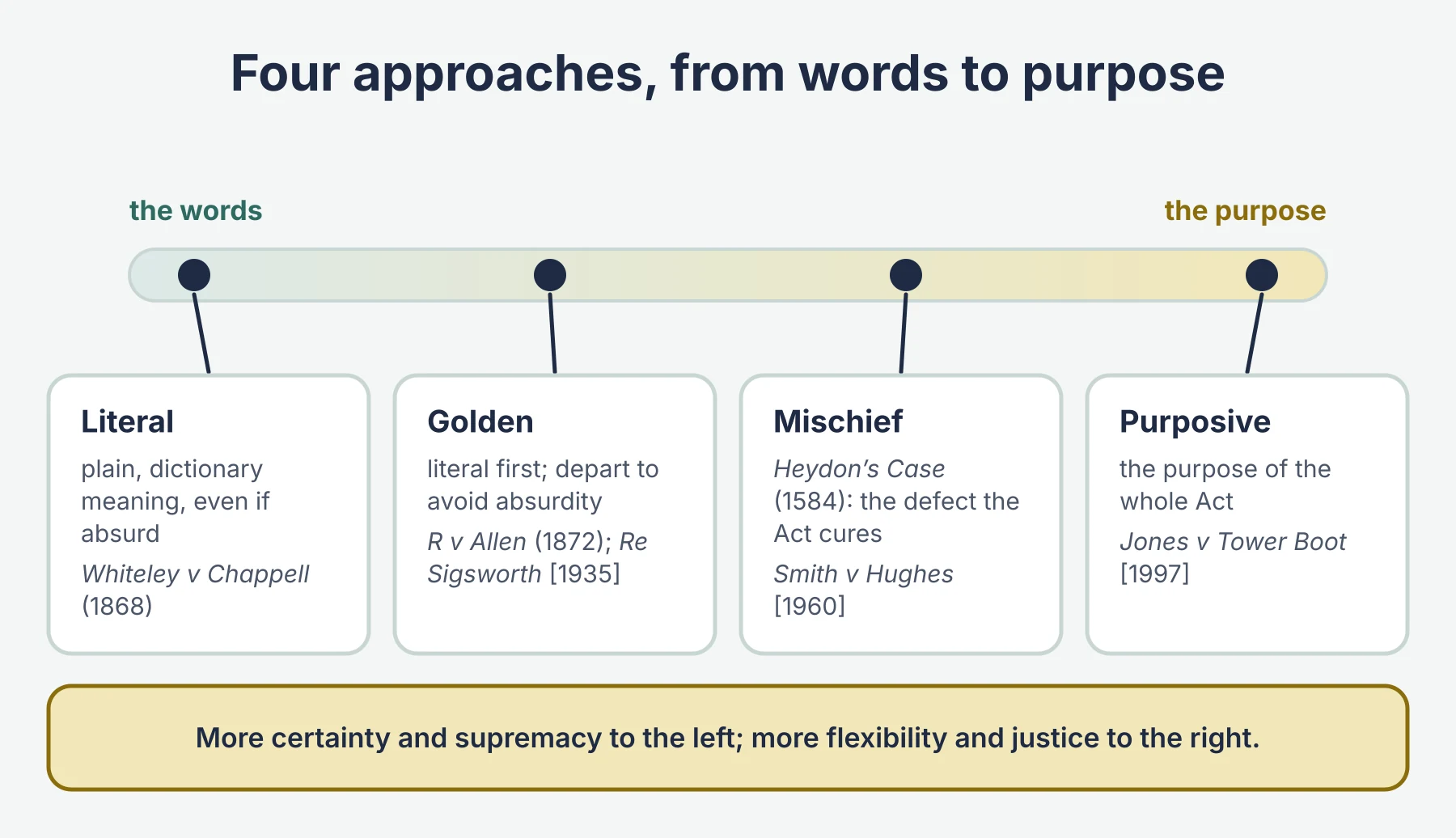
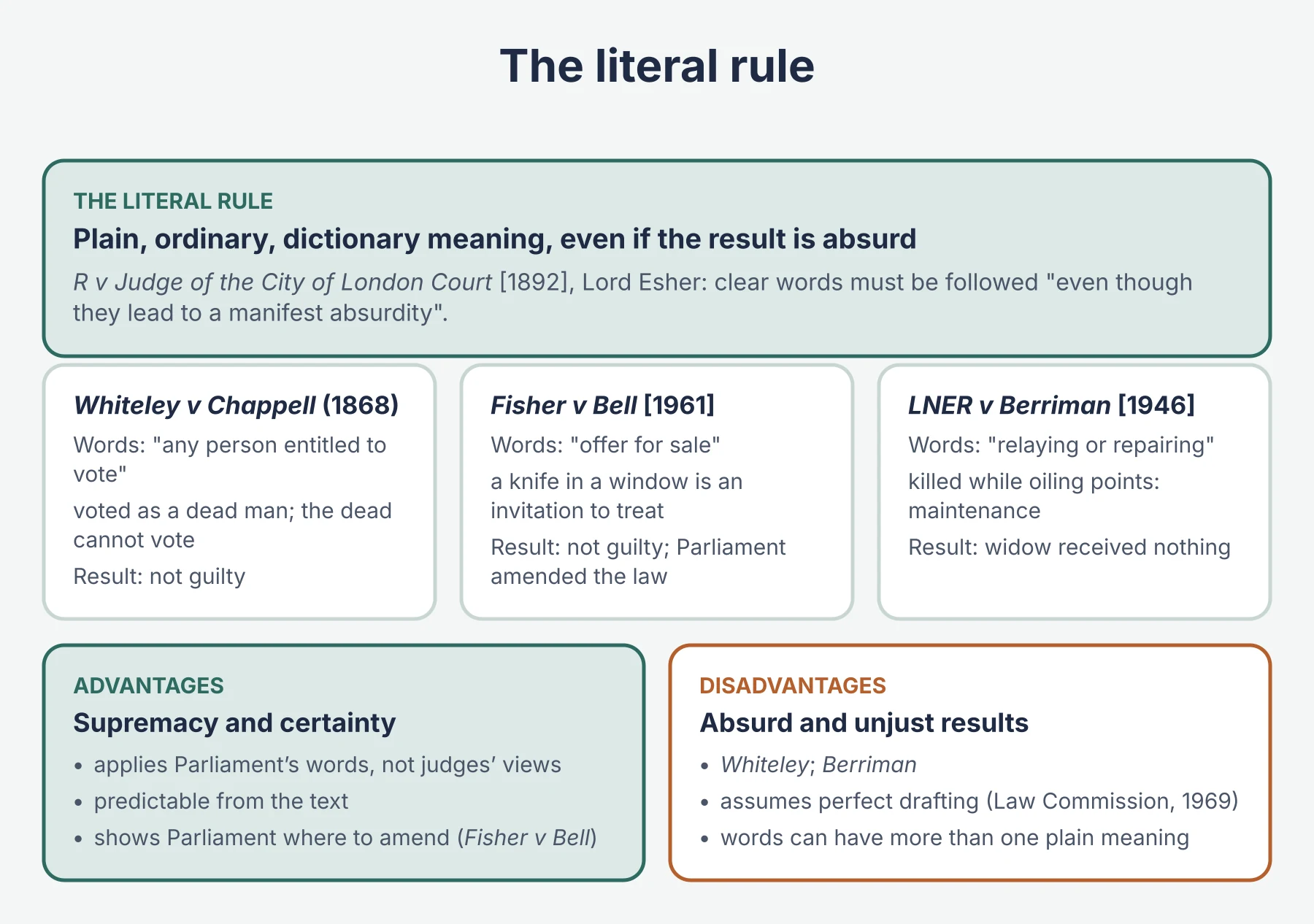
The rule. Give the words their plain, ordinary, dictionary meaning, even if the result is absurd. Lord Esher put it at its strongest in R v Judge of the City of London Court [1892]: if the words are clear, they must be followed “even though they lead to a manifest absurdity”.
Cases.
- Whiteley v Chappell (1868): it was an offence to impersonate “any person entitled to vote”. The defendant voted in the name of a dead man. A dead person is not entitled to vote, so he was not guilty.
- Fisher v Bell [1961]: a shopkeeper displayed a flick knife in his window. The Act made it an offence to “offer for sale” such a knife. In contract law a display is an invitation to treat, not an offer, so he was not guilty. Parliament quickly amended the law.
- London and North Eastern Railway v Berriman [1946]: compensation was payable for workers killed while “relaying or repairing” the track. Mr Berriman was killed while oiling points, which was maintenance, so his widow received nothing.
Advantages.
- Respects parliamentary supremacy: judges apply Parliament’s words, not their own views.
- Promotes certainty: lawyers and citizens can predict the result from the text.
- Encourages careful drafting, and shows Parliament where to amend, as after Fisher v Bell.
Disadvantages.
- Can produce absurd or unjust results, as in Whiteley and Berriman.
- Assumes perfect drafting; the Law Commission in 1969 criticised it for assuming an unattainable perfection in draftsmanship.
- Words often have more than one “plain” meaning, so the rule does not always give one answer.
The golden rule
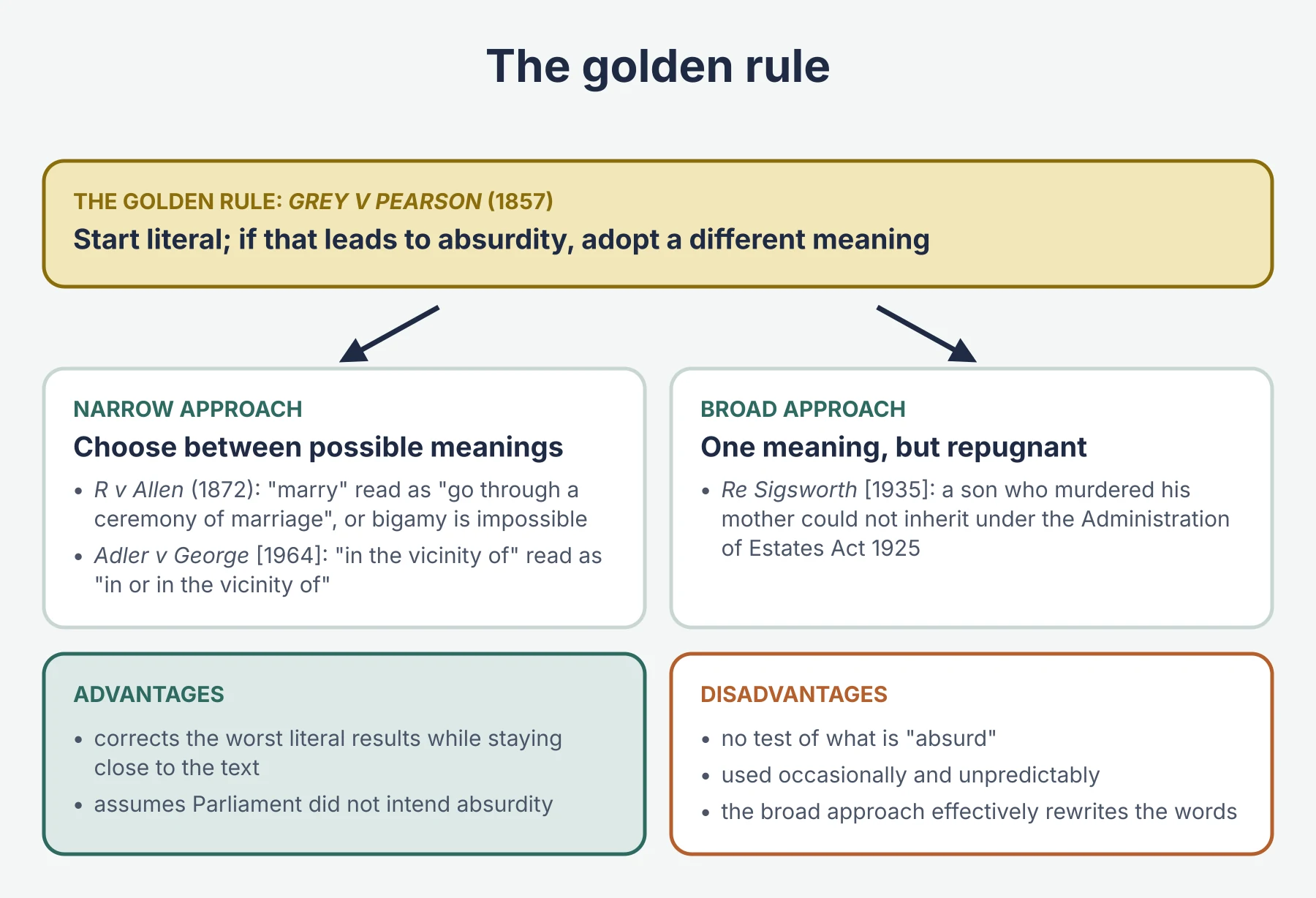
The rule. Start with the literal meaning, but if that leads to an absurdity or a result Parliament cannot have intended, the court may adopt a different meaning to avoid it. It comes from Lord Wensleydale in Grey v Pearson (1857).
The narrow approach chooses between possible meanings of an ambiguous word.
- R v Allen (1872): s 57 of the Offences Against the Person Act 1861 made it bigamy for a married person to “marry” again. Since a married person cannot legally marry, the literal reading would make the offence impossible. “Marry” was read as “go through a ceremony of marriage”.
- Adler v George [1964]: it was an offence to obstruct a member of the armed forces “in the vicinity of” a prohibited place. The defendant was inside the base. The court read the words as “in or in the vicinity of”.
The broad approach is used where the words have only one meaning but applying it would be repugnant.
- Re Sigsworth [1935]: a son murdered his mother, who died without a will. Under the Administration of Estates Act 1925 he was literally entitled to inherit. The court applied the golden rule so that a murderer could not profit from his crime.
Advantages. It corrects the worst results of the literal rule while staying close to the text; it respects Parliament by assuming it did not intend absurdity.
Disadvantages. There is no test of what counts as “absurd”, so outcomes depend on the judge; it is used only occasionally and unpredictably; in the broad approach judges are effectively rewriting the words.
The mischief rule
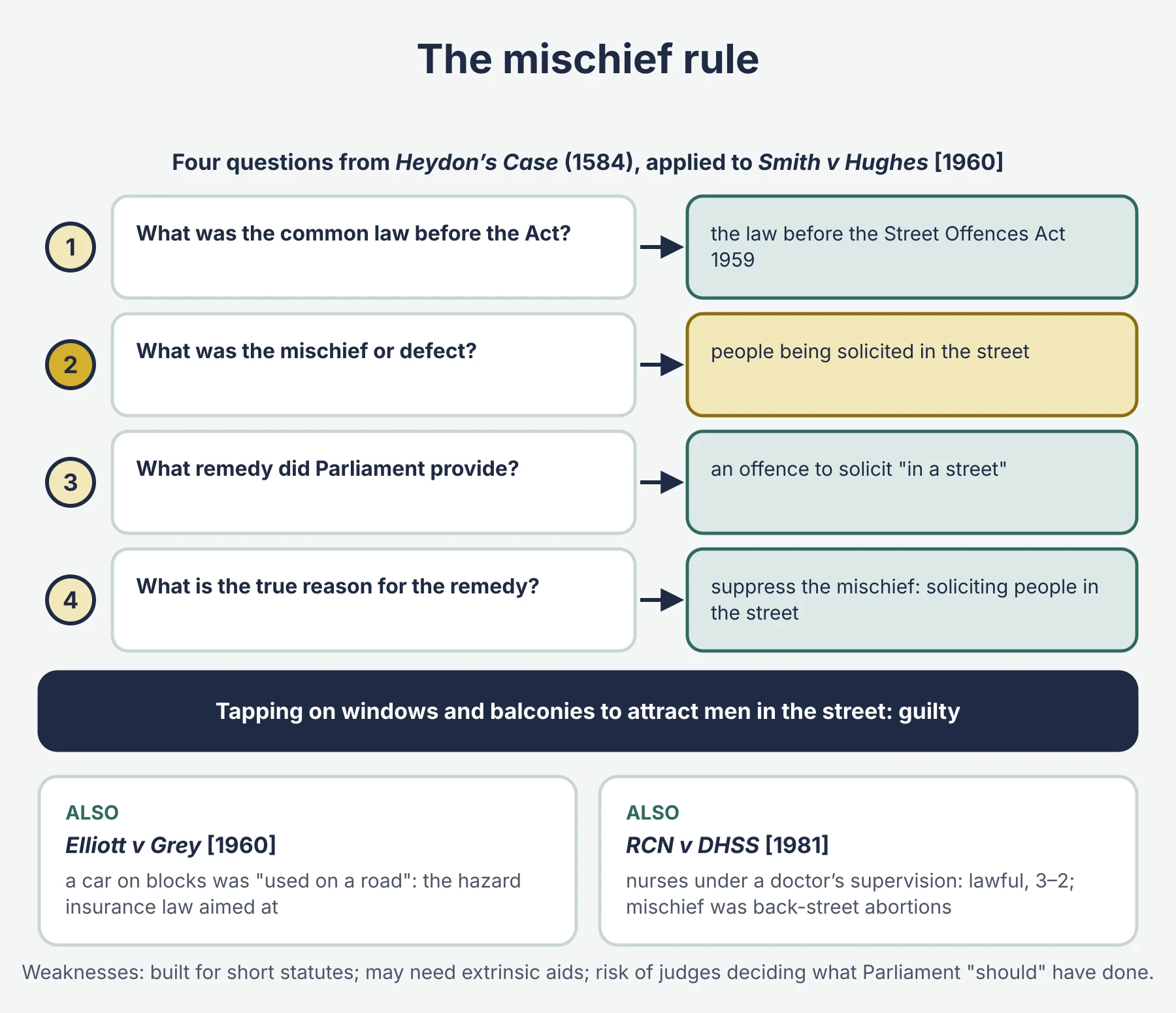
The rule. From Heydon’s Case (1584), the court asks four questions:
- What was the common law before the Act?
- What was the mischief or defect the common law did not cover?
- What remedy had Parliament resolved to provide?
- What is the true reason for the remedy?
The judge then interprets the Act to suppress the mischief and advance the remedy.
Cases.
- Smith v Hughes [1960]: the Street Offences Act 1959 made it an offence to solicit “in a street”. Prostitutes tapped on windows from balconies and windows to attract men in the street. The mischief was people being solicited in the street, so they were guilty.
- Elliott v Grey [1960]: a car with its wheels off the ground and no battery was parked on a road without insurance. It was held to be “used on a road” because it was a hazard the insurance law aimed at.
- Royal College of Nursing v DHSS [1981]: the Abortion Act 1967 required a termination to be carried out by a “registered medical practitioner”. With newer methods, nurses carried out much of the procedure under a doctor’s supervision. The House of Lords, by a majority of three to two, held this lawful, because the mischief was unsafe, back-street abortions.
Advantages. It gives effect to what Parliament was trying to achieve; it avoids absurdity; the Law Commission preferred it to the literal rule.
Disadvantages. It was designed when statutes were short and supplemented the common law; it relies on judges identifying the mischief, which may require extrinsic aids; it risks judges deciding what Parliament “should” have done, as the dissenting judges argued in the Royal College of Nursing case.
The purposive approach
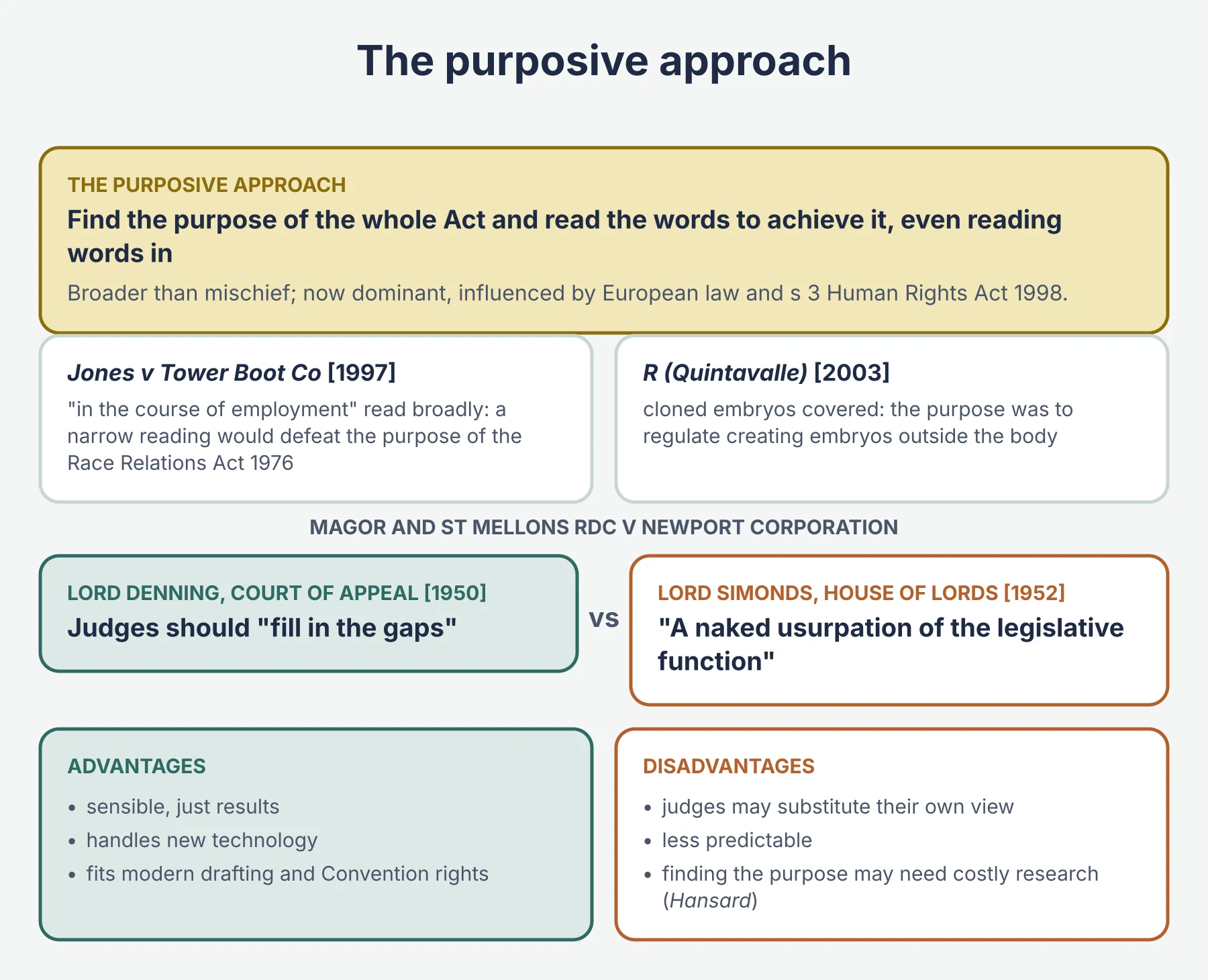
The approach. The court looks for the overall purpose of the legislation and interprets the words to achieve it, even if that means reading in words. It is broader than the mischief rule, which looks only at the defect in the old law, and it is now the dominant modern approach, influenced by European law and by s 3 of the Human Rights Act 1998.
Cases.
- Jones v Tower Boot Co [1997]: under the Race Relations Act 1976 an employer was liable for acts done by employees “in the course of employment”. The employer argued that racist assaults by co-workers were not part of their jobs. The Court of Appeal gave the phrase a broad meaning, because a narrow one would defeat the purpose of the Act.
- R (Quintavalle) [2003]: the House of Lords held that cloned embryos were covered, because Parliament’s purpose was to regulate the creation of embryos outside the body.
- The debate: in Magor and St Mellons RDC v Newport Corporation [1950] Lord Denning in the Court of Appeal said judges should “fill in the gaps”; in the House of Lords [1952] Lord Simonds called this “a naked usurpation of the legislative function”.
Advantages. It produces sensible, just results; it can handle new technology; it fits modern drafting and Convention rights.
Disadvantages. Judges may substitute their own view of the purpose; outcomes are less predictable; finding the purpose may require Hansard and other material that is costly to research.
Worked example: applying all four rules
A (fictional) Act provides: “No vehicle shall be taken into a public park.” Ruth rides a bicycle into the park; an ambulance enters to reach an injured child.
Literal   "vehicle" in its dictionary meaning includes both a bicycle
          and an ambulance: both are offences, which is absurd for
          the ambulance.
Golden    the court avoids the absurd result for the ambulance
          (narrow approach: "vehicle" read so as not to cover
          emergency vehicles).
Mischief  find the defect the Act targeted, e.g. danger and noise to
          park users: a bicycle may be caught; an ambulance saving
          life is not the mischief.
Purposive the purpose is safe enjoyment of parks: Ruth probably
          caught; the ambulance advances the purpose of safety.
Conclude  the rule chosen changes the outcome, which is the main
          criticism of having no single binding rule.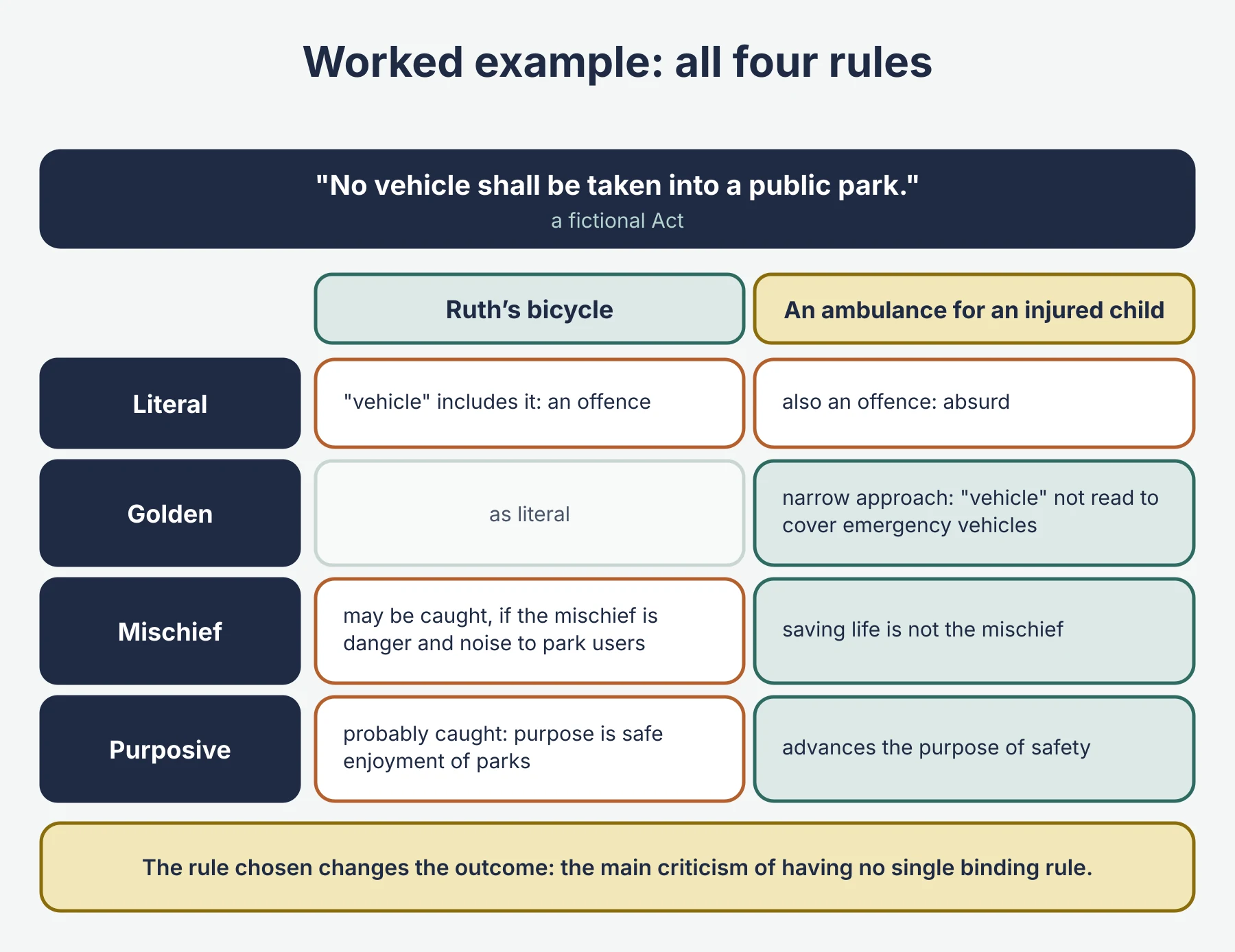
Common mistakes
- Naming the rules without cases. The specification requires “specific relevant case law examples” for each.
- Mixing up mischief and purposive. Mischief looks at the defect in the old law using Heydon’s four questions; purposive looks at the purpose of the whole Act.
- Calling the golden rule a separate starting point. It always begins with the literal meaning.
- Forgetting the need. Questions often begin “Explain why judges need to interpret statutes”: give reasons and examples first.
- Evaluation with no conclusion. For evaluate, decide which approach best balances supremacy and justice, and say why.
Exam technique
Describe questions want the rule in your own words plus a case. Explain wants a linked justification, such as why Whiteley shows the literal rule’s main weakness. Apply a rule to a scenario by stating the rule, using the words in the scenario, and concluding. Evaluate wants the advantages and disadvantages weighed with cases and a justified conclusion.
Condense this page with the rules of statutory interpretation revision notes, then test yourself with the rules of statutory interpretation practice questions.
Related resources
-
Practice questions
Edexcel International A Level Law (YLA1): The Rules of Statutory Interpretation – Practice Questions
Original practice questions with full answers on why statutes need interpreting and the literal, golden, mischief and purposive approaches (YLA1 1.2.3).
Law · Pearson Edexcel · A Level
Try questions -
Revision notes
Edexcel International A Level Law (YLA1): The Rules of Statutory Interpretation – Revision Notes
Condensed notes on why statutes need interpreting and the literal, golden, mischief and purposive approaches, with cases, evaluation and a self-test (YLA1).
Law · Pearson Edexcel · A Level
Revise topic -
Study guides
Edexcel International A Level Law (YLA1): The Nature, Purpose of and Liability in Law
A deep dive into section 1.1 of Edexcel IAL Law YLA1: rules and law, legal personality, civil and criminal liability, punishment, legal theory and morality.
Law · Pearson Edexcel · A Level
Read guide
Get free revision emails (optional)
Occasional emails with practice questions, worked explanations and links to free resources for the qualification and subjects you choose. No spam, and you can unsubscribe from any email. The free tools on this site never need an email.