
Study Guides
Edexcel International A Level Law (YLA1): The Doctrine of Precedent in the Court Hierarchy
Stare decisis, ratio and obiter, which courts bind which, appeal routes, Young v Bristol Aeroplane and the 1966 Practice Statement in use, for YLA1 1.2.7.
- Subject
- Law
- Level
- A LEVELS
- Topic
- Paper 1 – Underlying Principles of Law and the English Legal System
- Author
- Marlbridge Academic Team
- Updated
- Reviewed by
- Aizaz Raoof Ali (what this means)
Aligned to Pearson Edexcel A Level Law (YLA1), Issue 4, November 2021. Official specification .
Syllabus page (what it covers and how it is assessed): Pearson Edexcel A Level Law.
Syllabus points this page covers
YLA1
- 1.2 The sources of English law, its enforcement and administration
Found an error? Report a correction.
Need help with this topic? Request a free trial class for A Level Law (YLA1).
This guide covers content area 1.2.7 of Pearson Edexcel International Advanced Level Law, Issue 4: “The doctrine of precedent in the court hierarchy”, whose bullets are “stare decisis”, “ratio decidendi”, “obiter dicta”, “court hierarchies”, “process of appeal”, “which courts are bound by others”, the “1966 House of Lords Practice Statement” and “relevant case law decisions”. The underlying principles revision notes define the terms in one paragraph, and the sources of English law study guide does not cover precedent. This page works through each bullet with the cases an answer needs.
Stare decisis
Stare decisis means “let the decision stand”. Once a court has decided a point of law, courts lower in the hierarchy, and in some cases the same court, must follow it when the material facts are the same. This gives certainty, consistency and fairness (like cases treated alike), and it saves time because settled points need not be argued again.
Ratio decidendi and obiter dicta
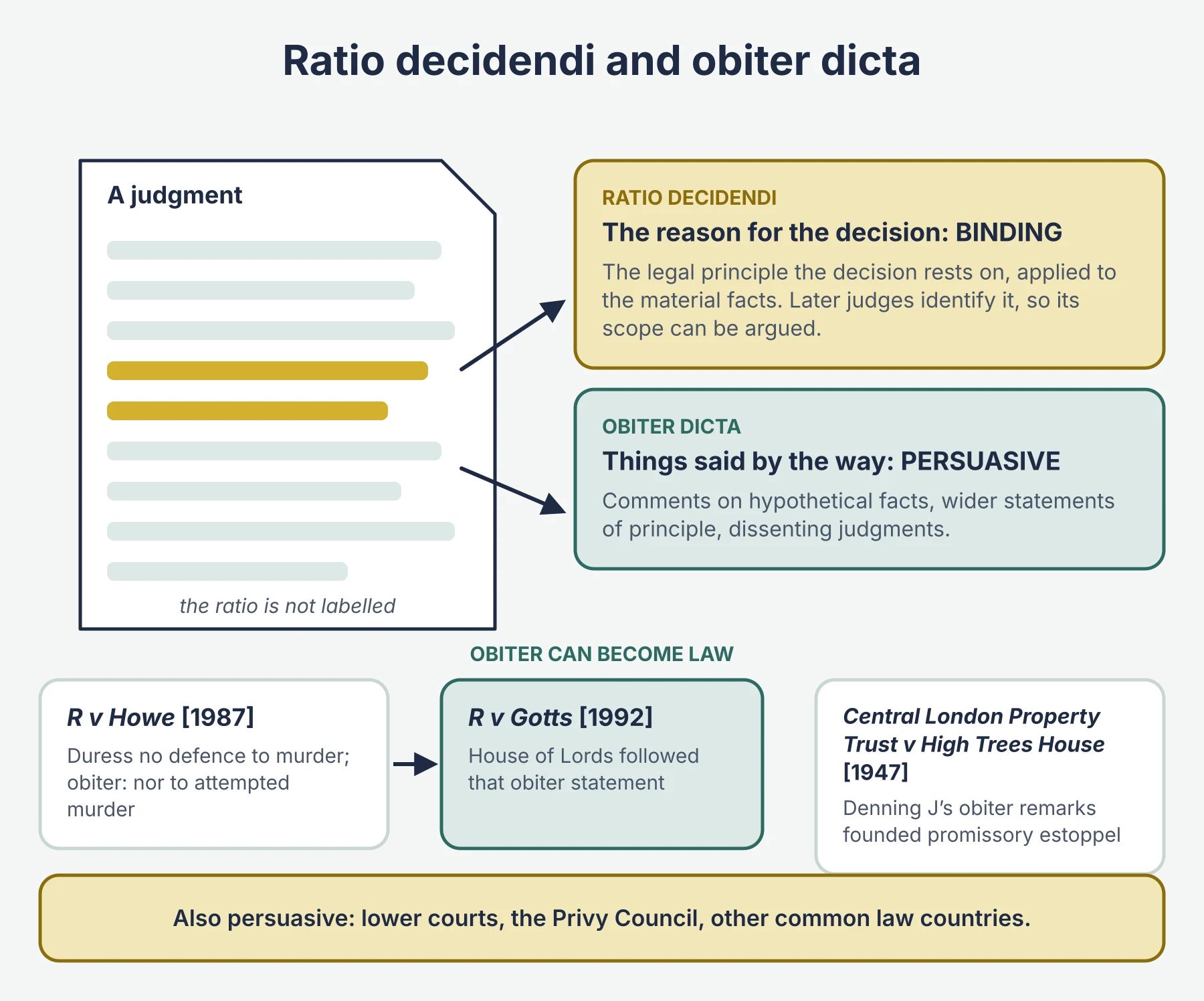
- Ratio decidendi (“the reason for the decision”) is the legal principle on which the decision rests, applied to the material facts. Only the ratio is binding. It is not labelled in the judgment; later judges identify it, which is why its scope can be argued.
- Obiter dicta (“things said by the way”) are everything else: comments on hypothetical facts, wider statements of principle, and dissenting judgments. They are persuasive only.
Obiter can become law. In R v Howe [1987] the House of Lords held that duress is no defence to murder and said, obiter, that it should not be a defence to attempted murder either. In R v Gotts [1992] the House of Lords followed that obiter statement. In Central London Property Trust v High Trees House [1947] Denning J’s obiter remarks laid the foundation of promissory estoppel.
Other persuasive precedent:
- Decisions of lower courts.
- Decisions of the Judicial Committee of the Privy Council. In Attorney General for Jersey v Holley [2005] the Privy Council’s view on provocation was followed by the Court of Appeal in R v James and Karimi [2006] instead of an earlier House of Lords decision. In Willers v Joyce [2016] the Supreme Court confirmed that the Privy Council may expressly direct English courts to follow its decision.
- Decisions of courts in other common law countries.
The court hierarchy and who binds whom
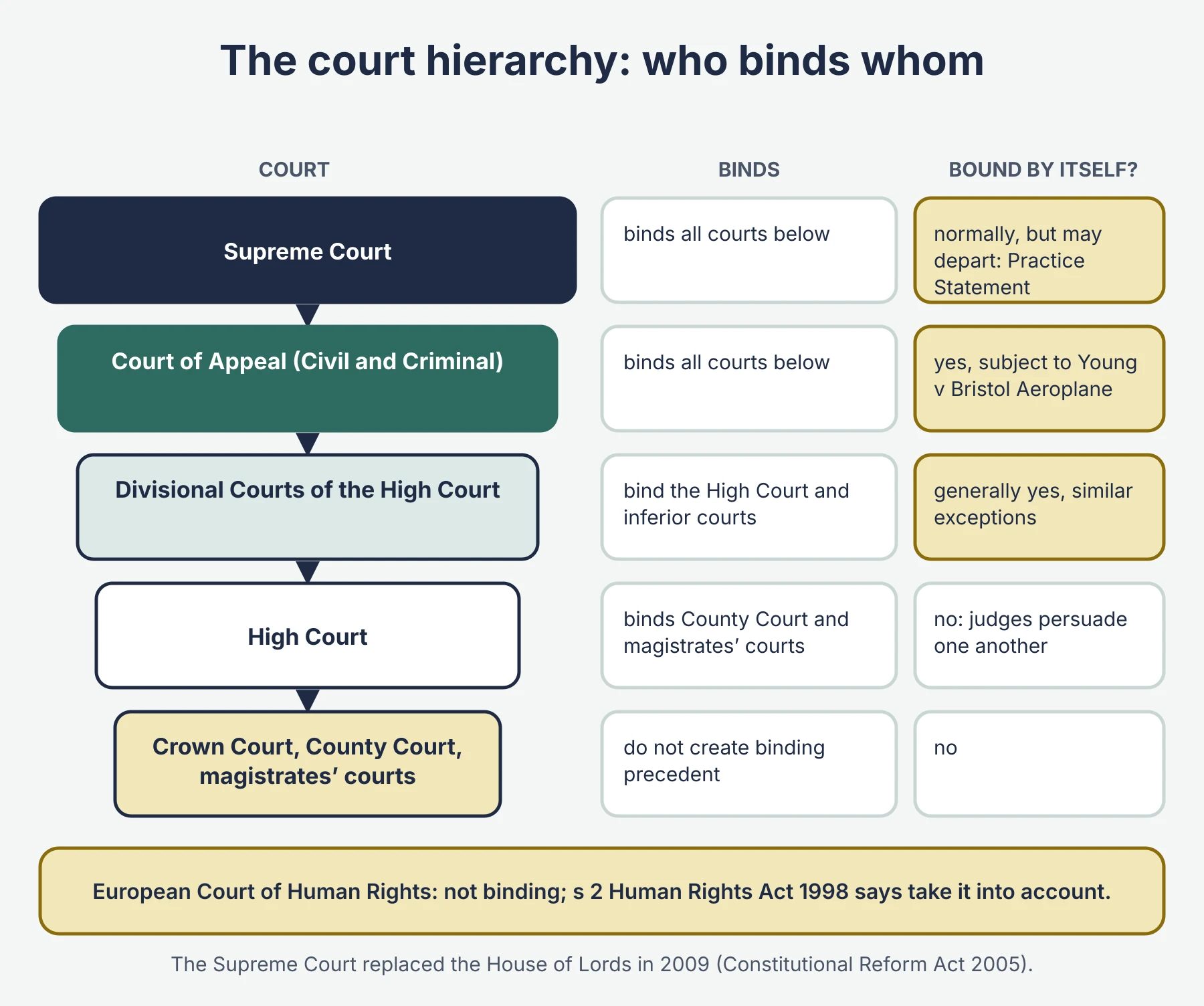
| Court | Bound by | Binds | Bound by its own past decisions? |
|---|---|---|---|
| Supreme Court (replaced the House of Lords in 2009 under the Constitutional Reform Act 2005) | No English court | All courts below | Normally, but may depart under the Practice Statement |
| Court of Appeal (Civil Division) | Supreme Court | All courts below | Yes, subject to the exceptions in Young v Bristol Aeroplane |
| Court of Appeal (Criminal Division) | Supreme Court | All criminal courts below | As above, with more flexibility where a person’s liberty is at stake |
| Divisional Courts of the High Court | Supreme Court, Court of Appeal | High Court and inferior courts | Generally yes, with similar exceptions |
| High Court | All courts above | County Court, magistrates’ courts | No: High Court judges’ decisions persuade one another |
| Crown Court, County Court, magistrates’ courts | All courts above | Do not create binding precedent | No |
The European Court of Human Rights does not bind English courts: under s 2 of the Human Rights Act 1998 they must take into account its decisions.
Young v Bristol Aeroplane Co [1944]
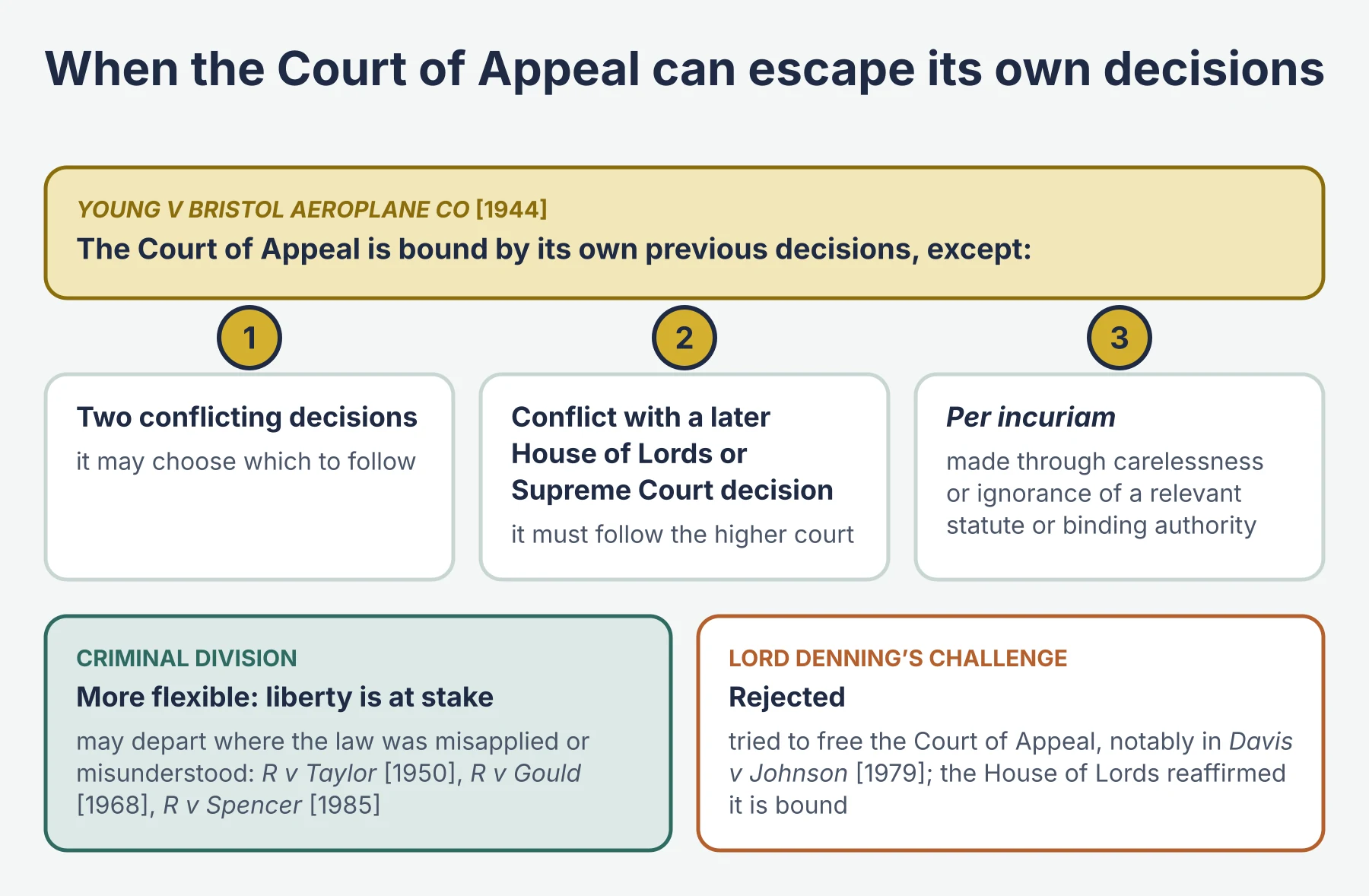
The Court of Appeal is bound by its own previous decisions, except where:
- there are two conflicting Court of Appeal decisions, when it may choose which to follow;
- a previous Court of Appeal decision conflicts with a later House of Lords or Supreme Court decision, when it must follow the higher court;
- the previous decision was made per incuriam, through carelessness or ignorance of a relevant statute or binding authority.
Lord Denning tried to free the Court of Appeal from this rule, notably in Davis v Johnson [1979], but the House of Lords reaffirmed that the Court of Appeal is bound by its own decisions.
Criminal Division. Because liberty is at stake, the Criminal Division may depart from a previous decision where the law was misapplied or misunderstood: R v Taylor [1950], R v Gould [1968] and R v Spencer [1985].
The process of appeal
Civil cases.
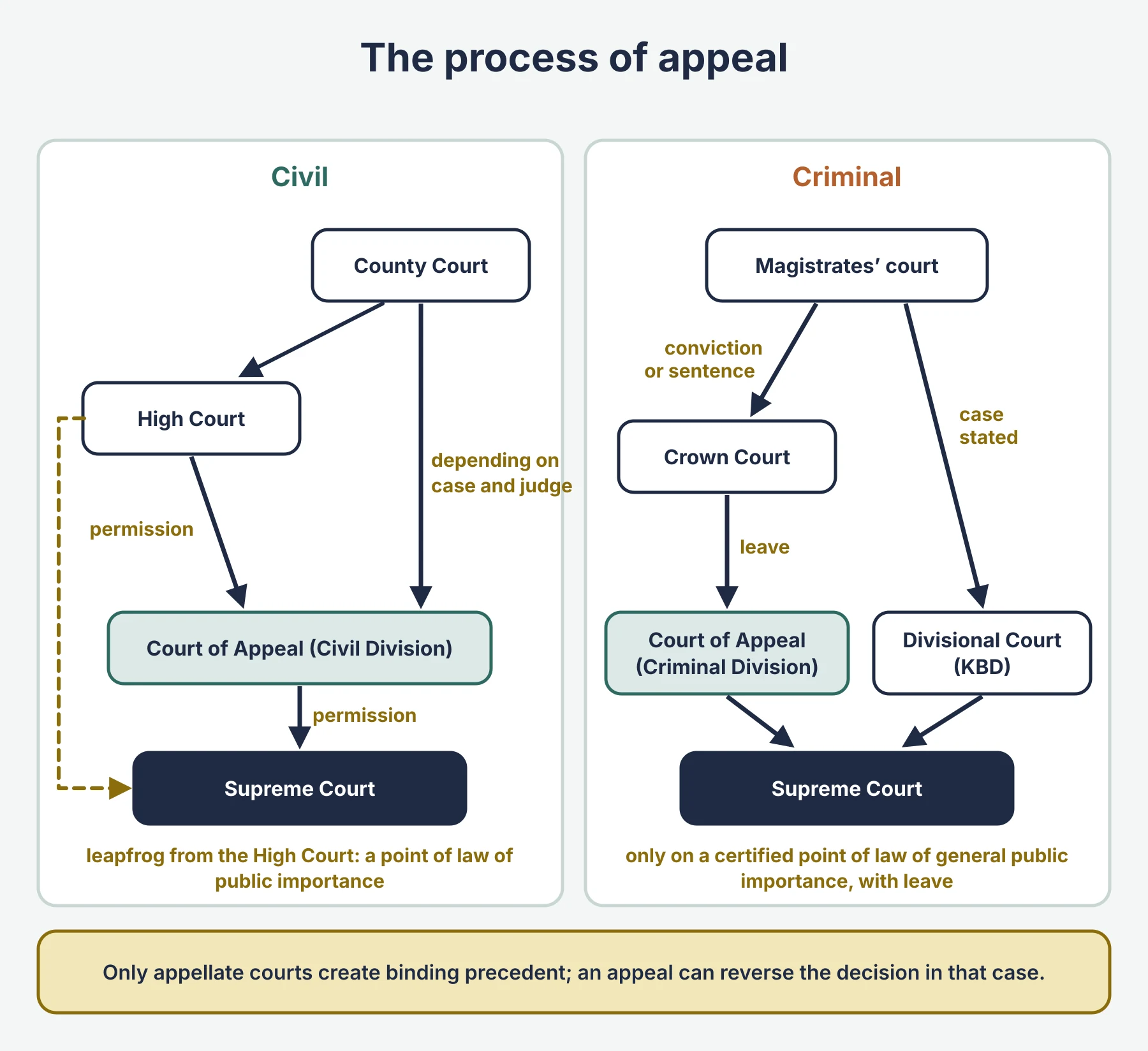
- County Court → High Court or Court of Appeal, depending on the type of case and judge.
- High Court → Court of Appeal (Civil Division) → Supreme Court, with permission at each stage.
- Leapfrog appeals from the High Court directly to the Supreme Court are possible on a point of law of public importance.
Criminal cases.
- Magistrates’ court → Crown Court (against conviction or sentence), or by way of case stated on a point of law to the Divisional Court of the King’s Bench Division.
- Crown Court → Court of Appeal (Criminal Division), with leave.
- Court of Appeal or Divisional Court → Supreme Court, only on a point of law of general public importance certified by the lower court, with leave.
Appeals matter for precedent because only appellate courts create binding precedents, and the outcome of an appeal can reverse the lower court’s decision in that case.
The 1966 Practice Statement
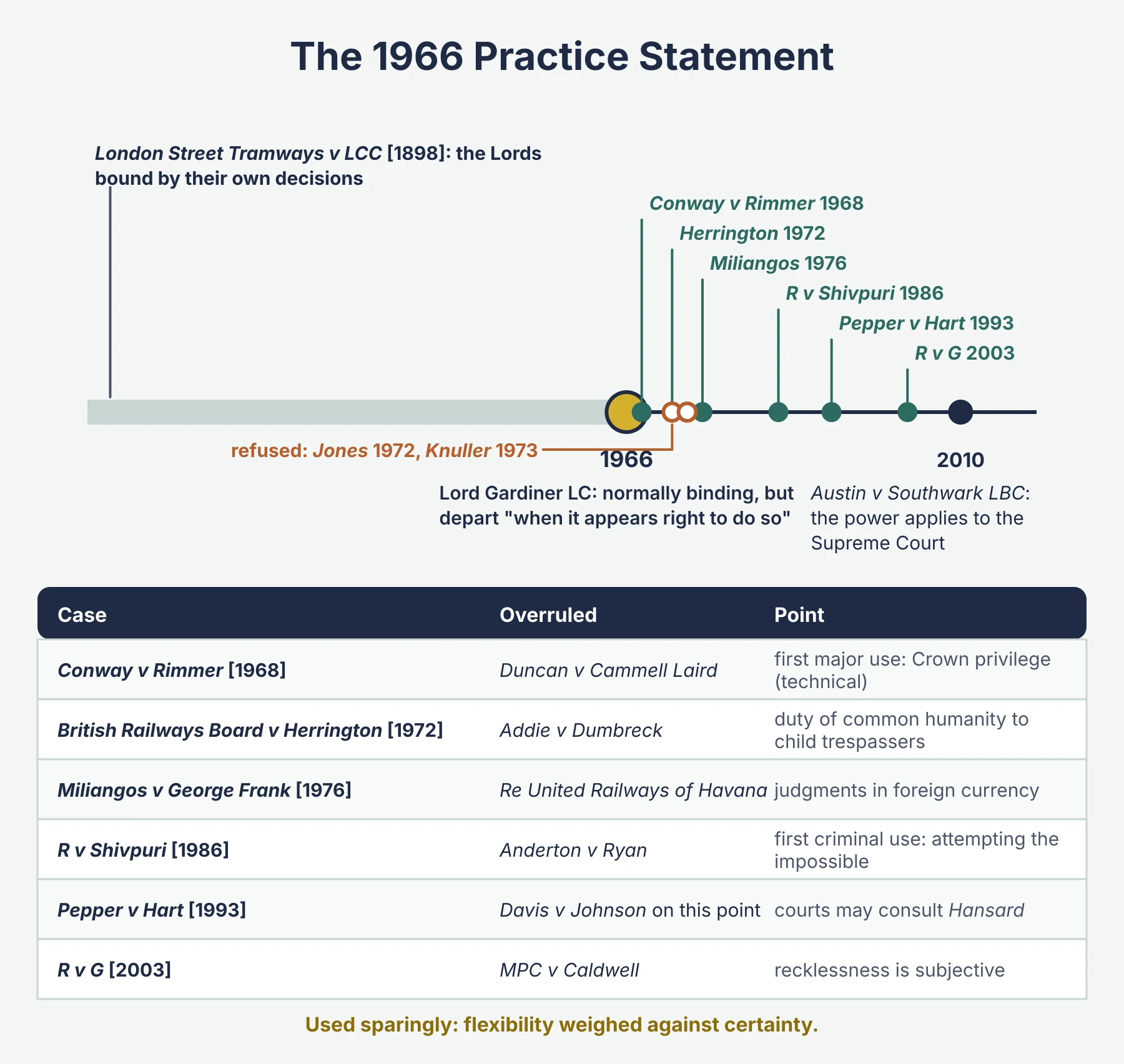
Before 1966 the House of Lords considered itself bound by its own decisions (London Street Tramways v London County Council [1898]). In 1966 Lord Gardiner LC announced that the Lords would treat former decisions as normally binding but would depart from them “when it appears right to do so”, bearing in mind the danger of disturbing contracts, property and fiscal arrangements, and the special need for certainty in the criminal law. In Austin v Southwark LBC [2010] the Supreme Court confirmed that the same power applies to it.
Cases where it was used:
| Case | Overruled | Point |
|---|---|---|
| Conway v Rimmer [1968] | Duncan v Cammell Laird [1942] | First major use: Crown privilege over documents (a technical point) |
| British Railways Board v Herrington [1972] | Addie v Dumbreck [1929] | Occupiers owe a duty of common humanity to child trespassers: social conditions had changed |
| Miliangos v George Frank [1976] | Re United Railways of Havana [1961] | Judgments could be given in foreign currency, reflecting changed currency markets |
| R v Shivpuri [1986] | Anderton v Ryan [1985] | Attempting the impossible is a crime: first use in criminal law, within a year of the earlier case |
| Pepper v Hart [1993] | Davis v Johnson [1979] on this point | Courts may consult Hansard |
| R v G [2003] | Metropolitan Police Commissioner v Caldwell [1982] | Recklessness in criminal damage is subjective |
Cases where it was not used: in Jones v Secretary of State for Social Services [1972] a majority thought an earlier decision wrong but refused to overrule it, for the sake of certainty; in Knuller v DPP [1973] the Lords refused to overrule Shaw v DPP [1962]. The power is used sparingly.
In R v Jogee [2016] the Supreme Court, sitting with the Privy Council, held that the law on joint enterprise had taken a “wrong turn” in Chan Wing-Siu v The Queen [1985] and later cases, and corrected it.
Avoiding a precedent
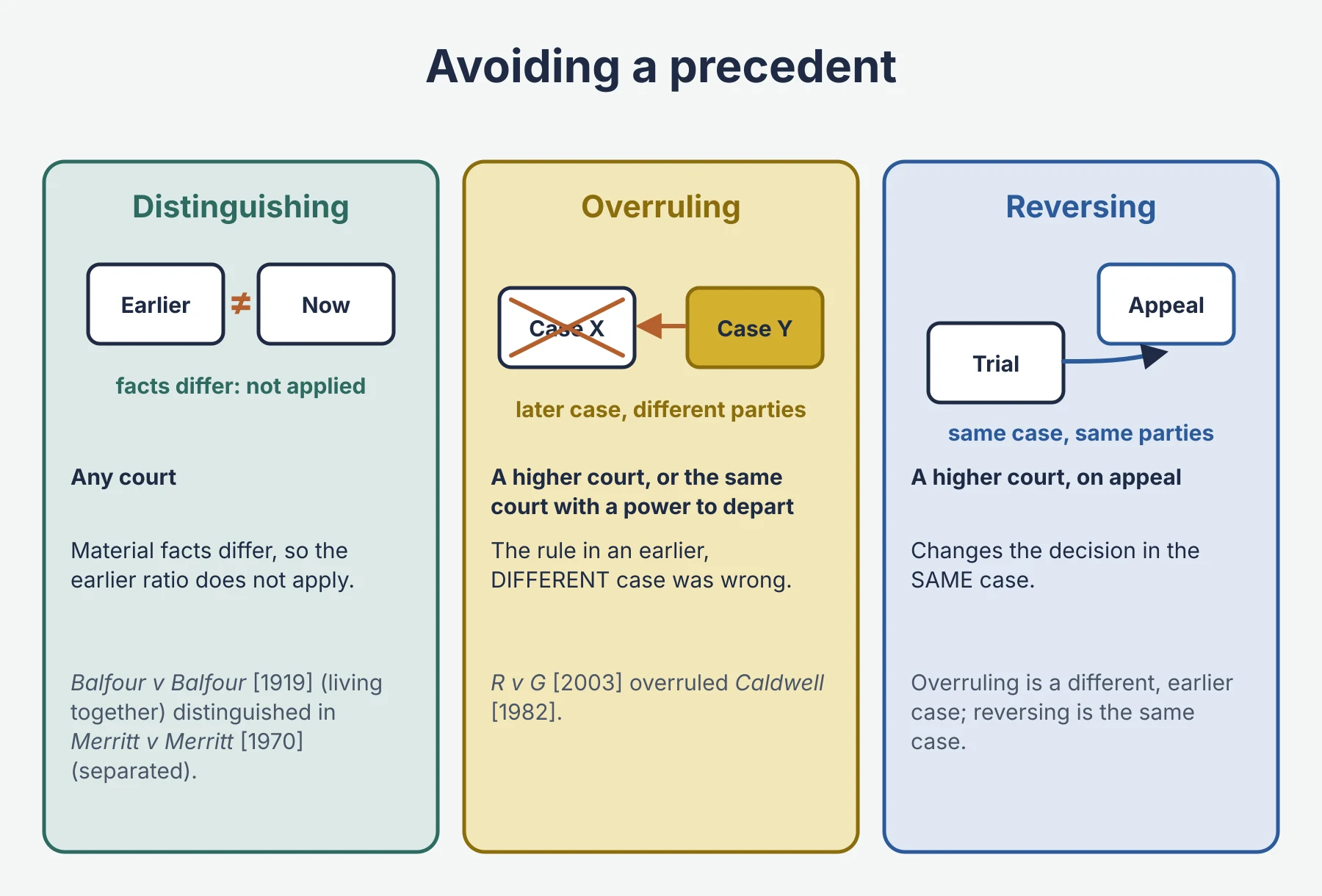
- Distinguishing: the material facts differ, so the earlier ratio does not apply. Balfour v Balfour [1919] (spouses living together: no intention to create legal relations) was distinguished in Merritt v Merritt [1970] (spouses separated). Any court can distinguish.
- Overruling: a higher court, or the same court using a power to depart, decides that the legal rule in an earlier, different case was wrong, as R v G overruled Caldwell.
- Reversing: a higher court changes the decision in the same case on appeal.
Worked example: applying the hierarchy
Suppose the Court of Appeal (Civil Division) decided case A in 2015. In 2024 a later Supreme Court decision, case B, lays down a conflicting principle. In 2026 the same issue reaches (i) the High Court and (ii) the Court of Appeal.
High Court       bound by both courts above; where they conflict, it
                 must follow the higher court: case B (Supreme Court).
Court of Appeal  normally bound by its own decision in case A, but
                 Young v Bristol Aeroplane exception 2 applies: a
                 decision inconsistent with a later Supreme Court
                 ruling must not be followed. It follows case B.
Supreme Court    could depart from case B under the Practice
                 Statement, but only "when it appears right to do so".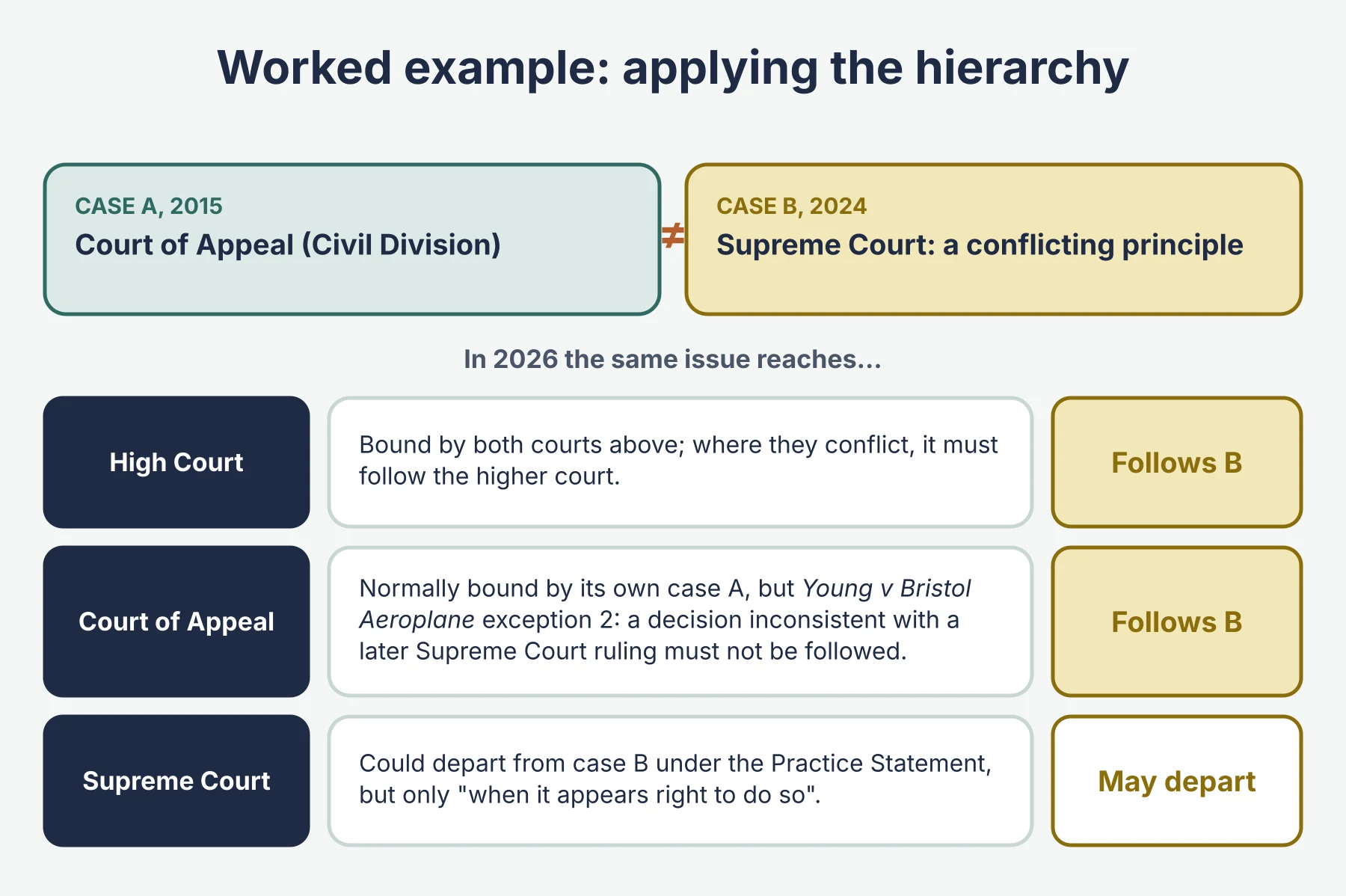
Common mistakes
- Saying the Supreme Court is bound by itself. It may depart under the Practice Statement.
- Saying the Court of Appeal can overrule the Supreme Court. It cannot; Lord Denning’s attempts failed.
- Calling obiter dicta binding.
- Confusing reversing with overruling. Reversing is the same case; overruling is a different, earlier case.
- Listing cases under the Practice Statement without saying why each was overruled.
Exam technique
Describe the hierarchy with the binding relationships, not just a list of courts. Explain a term with a case: ratio with Donoghue v Stevenson [1932], obiter with Howe and Gotts. Evaluate questions on the Practice Statement weigh flexibility (Herrington, R v G) against certainty (Jones, Knuller) and reach a judgement.
Condense this page with the doctrine of precedent revision notes, then test yourself with the doctrine of precedent practice questions.
Related resources
-
Practice questions
Edexcel International A Level Law (YLA1): The Doctrine of Precedent in the Court Hierarchy – Practice Questions
Original practice questions with full answers on stare decisis, ratio and obiter, the court hierarchy, appeals and the 1966 Practice Statement, for YLA1 1.2.7.
Law · Pearson Edexcel · A Level
Try questions -
Revision notes
Edexcel International A Level Law (YLA1): The Doctrine of Precedent in the Court Hierarchy – Revision Notes
Condensed notes on stare decisis, ratio and obiter, the court hierarchy, appeals, Young v Bristol Aeroplane and the 1966 Practice Statement (YLA1 1.2.7).
Law · Pearson Edexcel · A Level
Revise topic -
Study guides
Edexcel International A Level Law (YLA1): Lay People in the Law: Magistrates and Jurors
The role, selection and appointment of magistrates and jurors, with the Juries Act 1974, key cases, and advantages and disadvantages, for YLA1 area 1.2.22.
Law · Pearson Edexcel · A Level
Read guide
Get free revision emails (optional)
Occasional emails with practice questions, worked explanations and links to free resources for the qualification and subjects you choose. No spam, and you can unsubscribe from any email. The free tools on this site never need an email.