
Revision Notes
Edexcel A Level Urdu (9UR0): Bisaat (بساط) – Revision Notes
9UR0 notes on the prescribed play Bisaat (بساط) by Baseer Kazmi (1987): the title, reading a play, an essay frame and a self-test.
- Subject
- Urdu Language
- Level
- A LEVELS
- Topic
- Prescribed literary texts and films
- Author
- Marlbridge Academic Team
- Updated
- Reviewed by
- Farheen Zehra (what this means)
Aligned to Pearson Edexcel A Level Urdu Language (9UR0), 2018. Official specification .
Syllabus page (what it covers and how it is assessed): Pearson Edexcel A Level Urdu Language.
Syllabus points this page covers
9UR0
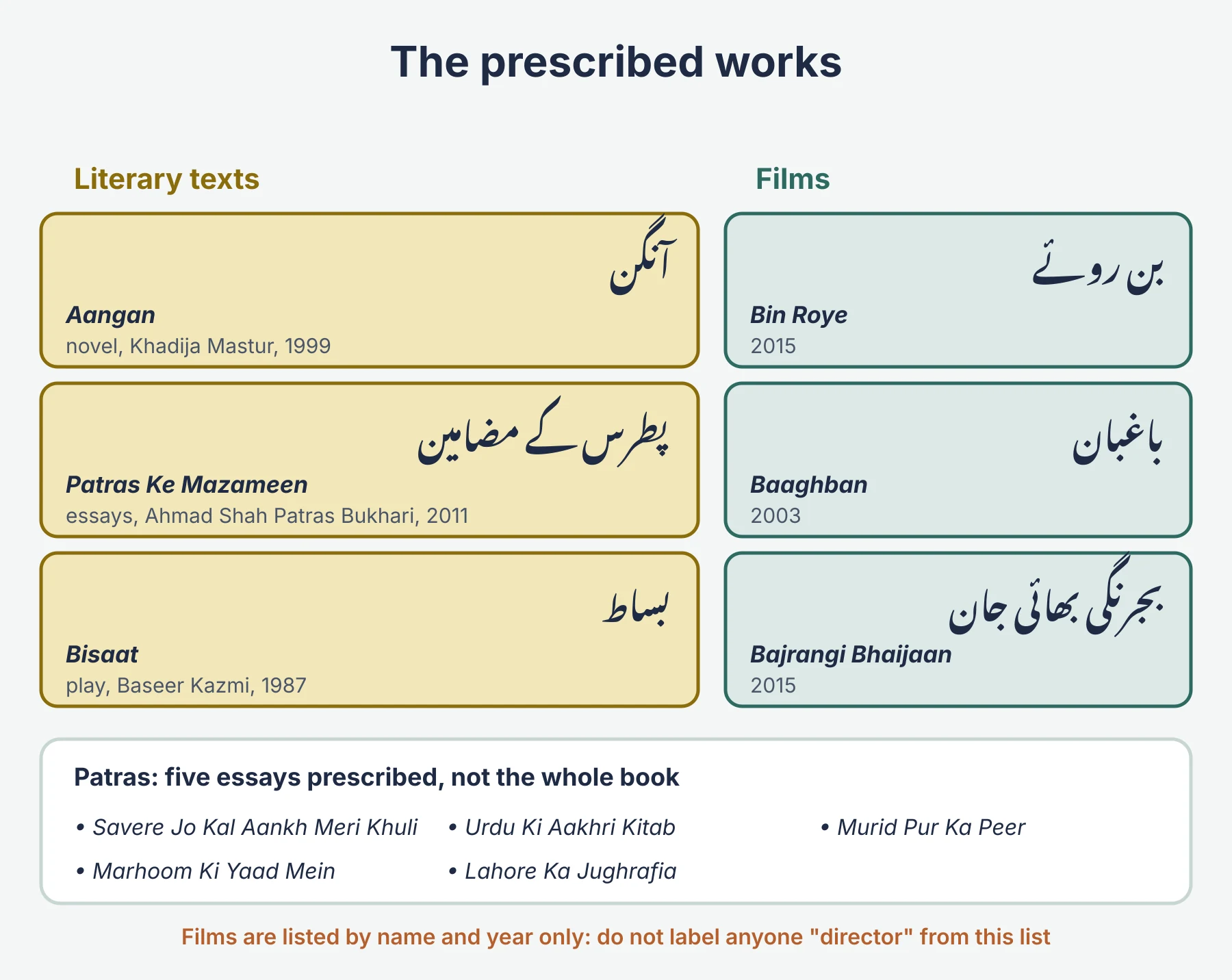
- 5.3 بساط — باصر کاظمی (1987) play
Found an error? Report a correction.
Need help with this topic? Request a free trial class for A Level Urdu Language (9UR0).
Revision notes for 5.3 in the prescribed literary texts and films of Pearson Edexcel A Level Urdu (9UR0), Paper 2. For the full explanation of the paper, read the Translation into Urdu and Written Response to Works study guide and the Paper 2 revision notes.
The work
- Title: بساط (Bisaat)
- Author: باصر کاظمی (Baseer Kazmi)
- Year: 1987
- Form: play; a prescribed literary text in Appendix 1.
As a play, comment on how ideas are presented through its form: structure, scenes and dialogue. Link each point to a theme and give specific evidence.
The author, Baseer Kazmi (full name باصر سلطان کاظمی, Basir Sultan Kazmi), is a poet and playwright and the son of the celebrated Urdu poet Nasir Kazmi. He has lived and worked in Britain for many years, so the play belongs to the wider world of Urdu writing beyond South Asia.
The title
بساط has several meanings in Urdu: a spread cloth or carpet, a chessboard (شطرنج کی بساط), and, figuratively, one’s means or capacity (as in اپنی بساط کے مطابق, according to one’s means). As you read, decide which of these meanings the play brings into play and how. A title that suggests a chessboard, for instance, invites you to think about moves, strategy, power and who controls whom; one that suggests ‘means’ invites you to think about what characters can and cannot do. Support any reading of the title with specific scenes.
How to read a play
A play is written to be performed. In an essay on Bisaat, show that you understand what drama can do that a novel cannot.
- Dialogue (مکالمہ): in a play, almost everything the audience learns comes through what characters say. Ask what each character’s way of speaking reveals: formal or informal, direct or evasive, poetic or plain.
- Stage directions (اسٹیج کی ہدایات): the writer’s notes on setting, movement and silence can be as revealing as the words.
- Structure (ساخت): how the play is divided into acts and scenes (ایکٹ and منظر), where the turning points come, and how tension builds to a climax (نقطۂ عروج).
- Conflict (کشمکش، تصادم): drama depends on conflict, between characters, between a character and society, or within one character. Identify the central conflict and how it is resolved or left open.
- Setting: where and when the action takes place, and whether the setting limits or shapes what the characters can do.
- Audience (ناظرین، حاضرین): think about how an audience watching the play would react at key moments, and what the writer wants them to feel or question.
Building your own notes
Because this page does not replace the text, build a one-page sheet for the play under these headings:
- The central conflict in one sentence of Urdu.
- Each main character: what they want, what stands in their way, and one short phrase (a few words) they say that sums them up.
- Three key scenes: what happens, why it matters, and which theme it supports.
- Two techniques of drama the writer uses, with an example of each.
- The social and cultural setting, and one link to a theme of the qualification (for example family, migration or identity).
How it is examined
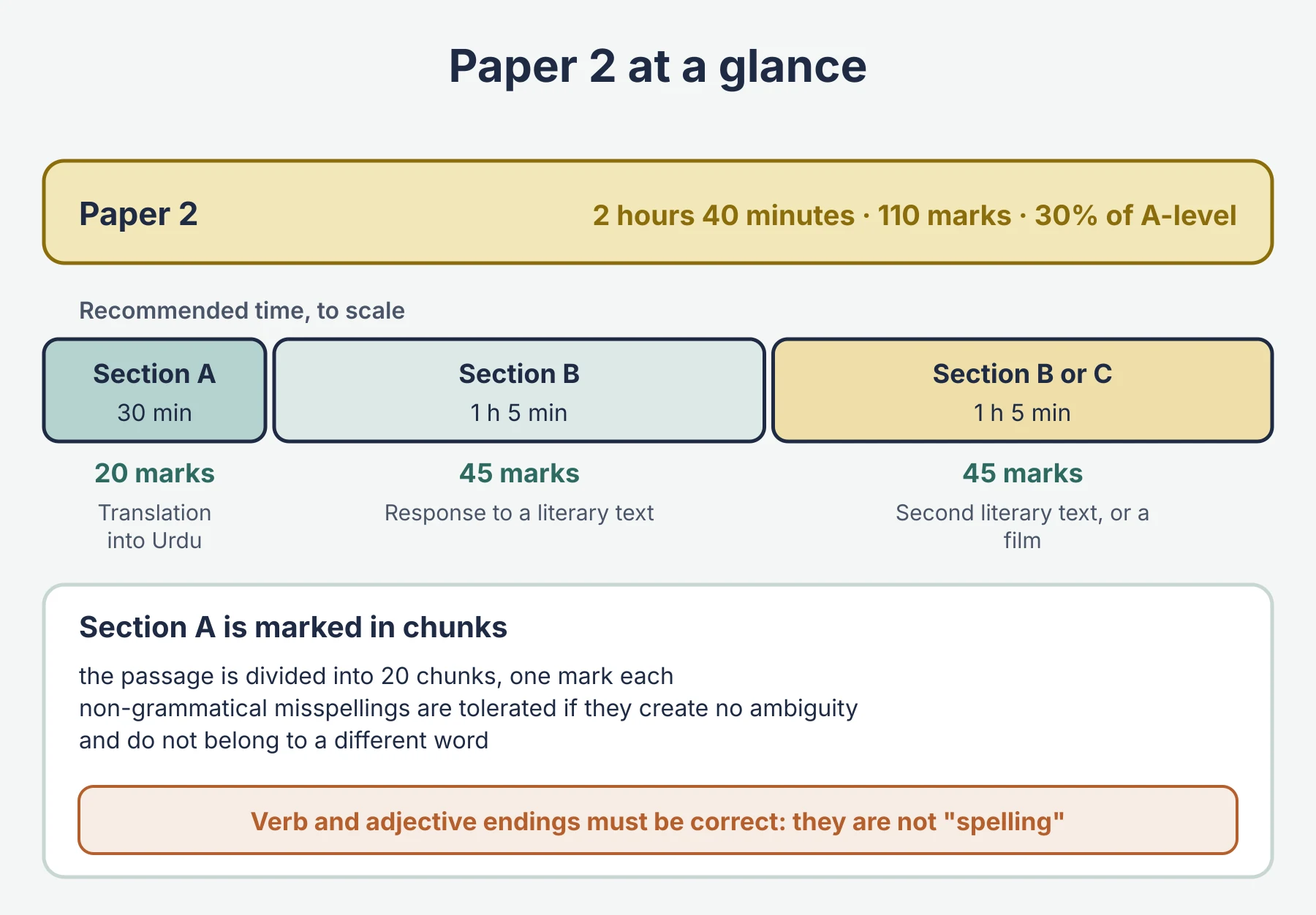
- Paper 2 is 2 hours 40 minutes, 110 marks, 30% of the A Level.
- Section B (literary text) is worth 45 marks and about 1 hour 5 minutes; you choose from two questions.
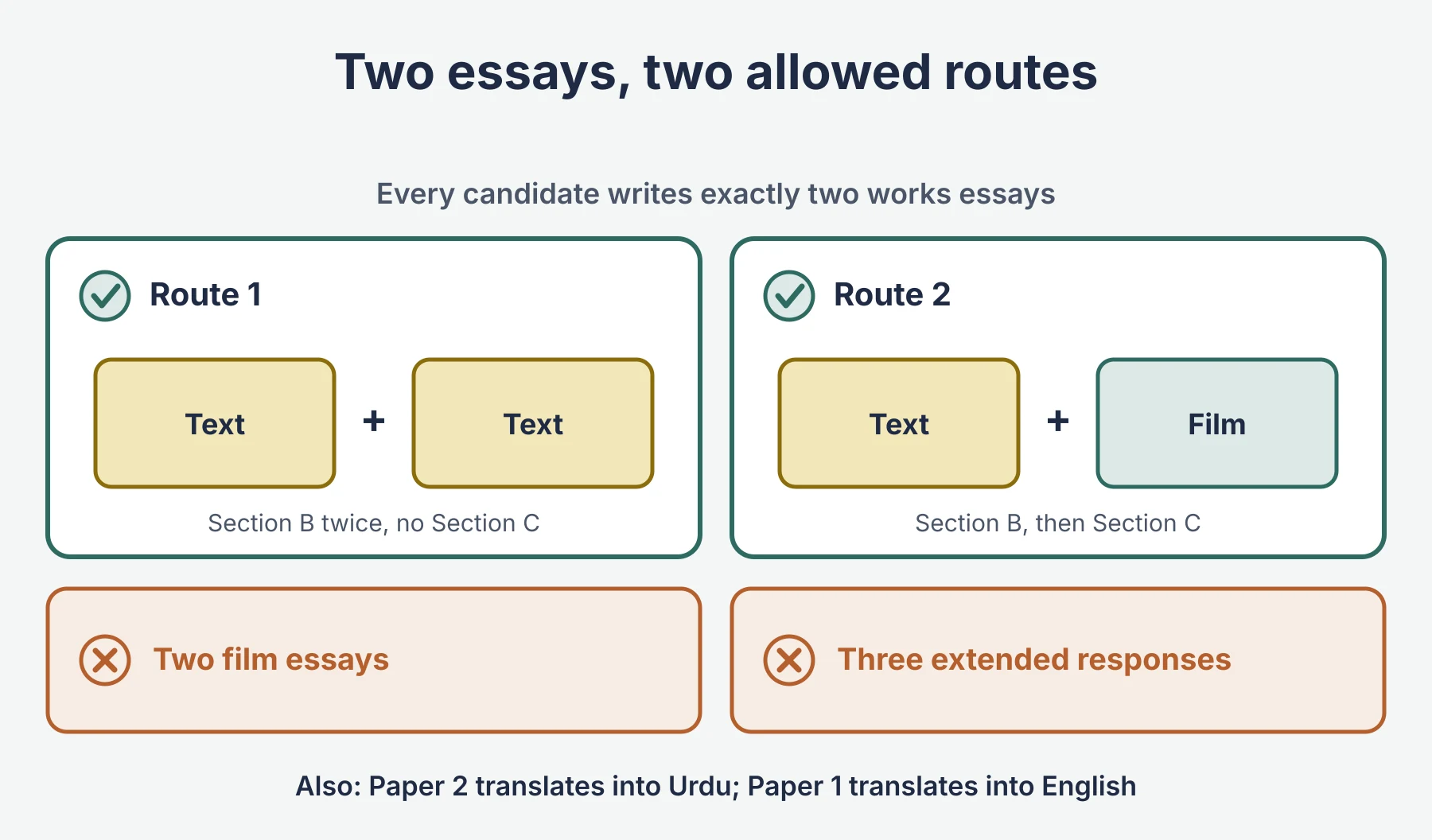
- You write exactly two extended responses: two literary texts, or one literary text and one film. Two films is never allowed.
- Marking criteria: critical and analytical response with cultural or social insight (AO4), range of grammatical structures and vocabulary (AO3), and accuracy of language (AO3). There are no AO1 or AO2 marks on Paper 2.
Approach and skills
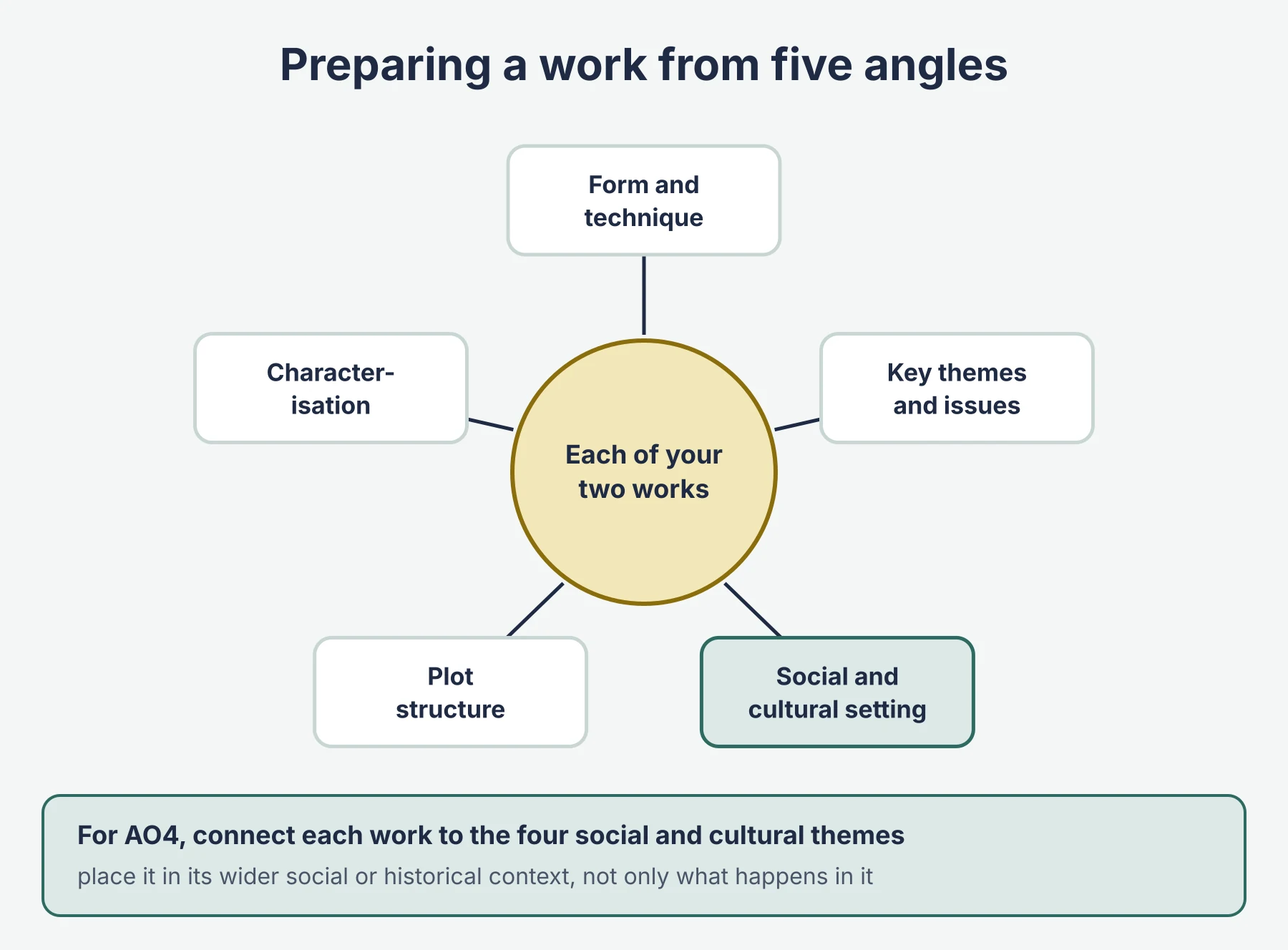
- Prepare against five angles: form and technique, key themes and issues, characterisation, plot structure, social and cultural setting.
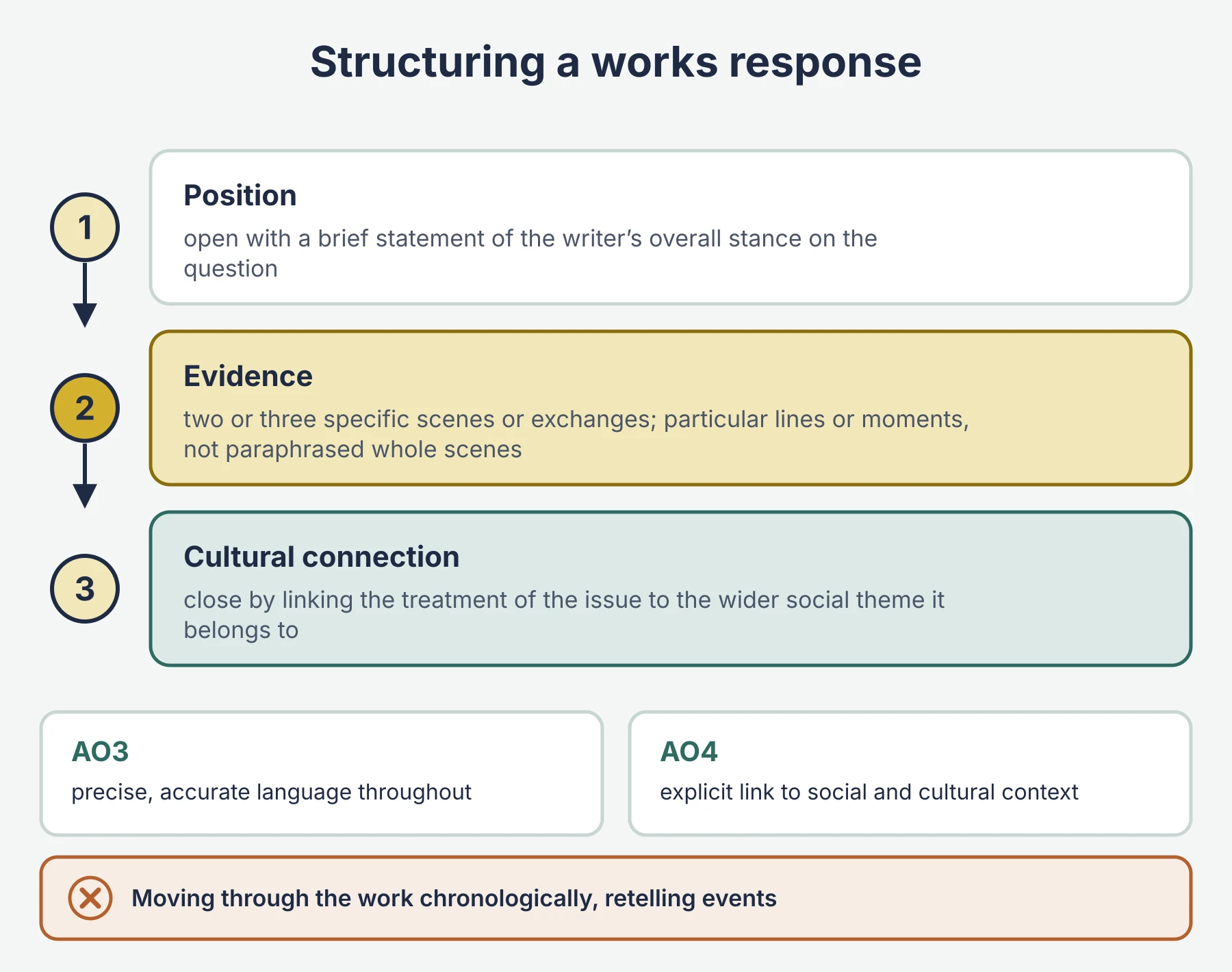
- Structure each answer as position, evidence, cultural connection: state your stance, support it with two or three specific points (not a retelling), then link the writer’s or film’s treatment of an issue to a broader social or cultural theme.
- Write in controlled Urdu with correct agreement, tense and spelling, and plan before you write.
- Use your own prepared references from the work; this page does not replace studying it.
Vocabulary for writing about a play
| Urdu | Meaning |
|---|---|
| ڈراما | play, drama |
| ڈراما نگار | playwright |
| کردار | character |
| مرکزی کردار | main character |
| مکالمہ / مکالمے | dialogue / lines of dialogue |
| منظر | scene |
| ایکٹ | act |
| اسٹیج | stage |
| اسٹیج کی ہدایات | stage directions |
| کشمکش | conflict, struggle |
| تصادم | clash, confrontation |
| نقطۂ عروج | climax |
| انجام | ending, outcome |
| خود کلامی | soliloquy, speaking to oneself |
| ناظرین | audience, viewers |
| ساخت | structure |
| علامت | symbol |
| پیغام | message |
| شطرنج | chess |
Useful sentences with grammar notes
- ڈراما نگار کرداروں کے مکالموں کے ذریعے ان کی سوچ کو سامنے لاتا ہے۔ (The playwright brings the characters’ thinking to light through their dialogue.) کے ذریعے (by means of) is essential for analysing technique.
- اس منظر میں کشمکش اپنے عروج پر پہنچ جاتی ہے۔ (In this scene the conflict reaches its peak.) کشمکش is feminine, so پہنچ جاتی ہے.
- عنوان “بساط” کو شطرنج کی علامت کے طور پر بھی پڑھا جا سکتا ہے۔ (The title Bisaat can also be read as a symbol of chess.) Passive with سکنا; کے طور پر means ‘as’.
- ناظرین کو اس لمحے کردار کی بے بسی کا احساس ہوتا ہے۔ (At this moment the audience feels the character’s helplessness.) Dative construction with احساس ہونا (to feel, realise); احساس is masculine.
Model paragraph frame
Task: how does the playwright use dialogue to present the main conflict?
ڈرامے میں کہانی زیادہ تر مکالموں کے ذریعے آگے بڑھتی ہے، اور باصر کاظمی کے ڈرامے “بساط” میں بھی یہی صورتِ حال ہے۔ ڈراما نگار کرداروں کی گفتگو کے ذریعے ان کی سوچ، ان کی خواہشات اور ان کے باہمی تعلقات کو سامنے لاتا ہے۔ مثال کے طور پر … [ایک منظر اور ایک مختصر جملہ]۔ اس سے ناظرین کو اندازہ ہوتا ہے کہ … [اثر]۔ میرے خیال میں یہ طریقہ مؤثر ہے، کیونکہ ناظرین خود کرداروں کی باتوں سے نتیجہ نکالتے ہیں، اور یوں ڈراما … [موضوع] پر سوچنے کی دعوت دیتا ہے۔
Translation: In a play the story moves forward mostly through dialogue, and this is also the case in Basir Kazmi’s play Bisaat. Through the characters’ conversation, the playwright brings their thinking, their desires and their relationships with each other to light. For example … [a scene and a short line]. From this the audience realises that … [effect]. In my view this method is effective, because the audience draws its own conclusions from what the characters say, and in this way the play invites us to think about … [theme].
How to use it: the frame gives you the position and the technique; the bracketed gaps are where your own evidence from the play must go. An answer that leaves the evidence general will not reach the higher marks for AO4.
Essay prompts to prepare
- «ڈرامے “بساط” میں مکالمے کے استعمال کا تجزیہ کیجیے۔» (Analyse the use of dialogue in Bisaat.)
- «عنوان “بساط” ڈرامے کے مرکزی خیال کی کس طرح عکاسی کرتا ہے؟» (How does the title Bisaat reflect the central idea of the play?)
- Examine how the play presents conflict between its main characters.
- How does the social and cultural setting shape the characters’ choices?
Exam traps
- Retelling the story without connecting it to a theme weakens the AO4 mark.
- Attempting three responses, or choosing two films.
- Running over time on the first response and squeezing the second.
- Writing about the play as if it were a novel; refer to scenes, dialogue, staging and audience.
- Interpreting the title without evidence from the play.
- Confusing the author with his father, the poet Nasir Kazmi.
Self-test
- Who wrote بساط, in what year, and what is its form?
- Which section covers it?
- What should you comment on for form and technique in a play?
- Can you pair it with a film?
- Can you answer on two films instead?
- Give three meanings of the word بساط.
- What is the relationship between the author and the poet Nasir Kazmi?
- Give the Urdu for ‘playwright’, ‘stage directions’ and ‘climax’.
- Name two things a play can do that a novel cannot.
- In اس منظر میں کشمکش اپنے عروج پر پہنچ جاتی ہے, why is the verb feminine?
- What must go in the bracketed gaps of the model paragraph frame?
Answers: 1. باصر کاظمی, 1987, a play. 2. Section B, a literary-text response. 3. Structure, scenes and dialogue, linked to a theme with specific evidence. 4. Yes: one literary text and one film is allowed. 5. No. 6. A spread cloth or carpet, a chessboard, and one’s means or capacity. 7. He is Nasir Kazmi’s son. 8. ڈراما نگار, اسٹیج کی ہدایات and نقطۂ عروج. 9. For example, reveal character almost entirely through dialogue, and use staging, movement and silence in front of a live audience. 10. It agrees with کشمکش, which is feminine. 11. Your own specific evidence from the play: a scene, a short line, its effect and the theme it supports.
Related resources
-
Revision notes
Edexcel A Level Urdu (9UR0): Patras Ke Mazameen (پطرس کے مضامین) – Revision Notes
9UR0 notes on Patras Ke Mazameen (پطرس کے مضامین): the five set essays, humour techniques, a model paragraph and a self-test.
Urdu Language · Pearson Edexcel · A Level
Revise topic -
Study guides
Edexcel A Level Urdu (9UR0): Aangan (آنگن) by Khadija Mastur
9UR0 study guide to Aangan (آنگن): the five features examiners reward, the essay grids, an annotated model introduction and a 45-mark Section B plan.
Urdu Language · Pearson Edexcel · A Level
Read guide -
Practice questions
Edexcel A Level Urdu (9UR0): Aangan (آنگن) by Khadija Mastur – Practice Questions
Eleven original 9UR0 practice questions on Aangan: facts, literary terms, analytical Urdu, paragraph repair and a full 45-mark essay with indicative content.
Urdu Language · Pearson Edexcel · A Level
Try questions
Get free revision emails (optional)
Occasional emails with practice questions, worked explanations and links to free resources for the qualification and subjects you choose. No spam, and you can unsubscribe from any email. The free tools on this site never need an email.