
Revision Notes
Edexcel A Level Urdu (9UR0): The Feudal System (جاگیرداری نظام) – Revision Notes
9UR0 Theme 4.2 notes on the feudal system (جاگیرداری نظام): history, criticisms, reform, key terms, a model paragraph and a self-test.
- Subject
- Urdu Language
- Level
- A LEVELS
- Topic
- Theme 4: Aspects of Pakistani politics (پاکستانی سیاست کے رُخ)
- Author
- Marlbridge Academic Team
- Updated
- Reviewed by
- Farheen Zehra (what this means)
Aligned to Pearson Edexcel A Level Urdu Language (9UR0), 2018. Official specification .
Syllabus page (what it covers and how it is assessed): Pearson Edexcel A Level Urdu Language.
Syllabus points this page covers
9UR0
- 4.2 جاگیرداری نظام
Found an error? Report a correction.
Need help with this topic? Request a free trial class for A Level Urdu Language (9UR0).
Revision notes for sub-theme 4.2 of Theme 4 in Pearson Edexcel A Level Urdu (9UR0): the feudal system (جاگیرداری نظام). For the wider theme, read the 9UR0 subject guide and the Paper 1 study guide.
Key idea
جاگیرداری نظام is the feudal (landholding) system, in which large areas of land are held by a few landowners and worked by tenants and labourers.
This sub-theme is not the research subject for Theme 4 (that is 4.3, environmental issues), but it can supply the topic of reading, listening and translation passages, so you need the vocabulary and the arguments ready in Urdu.
Issues and perspectives
Where the system comes from. The word جاگیر originally meant a grant of land, or of the right to collect its revenue, made by a ruler to a supporter. Under Mughal and later British rule, many families received such grants, and the British in particular relied on large landed families as local allies. At independence in 1947, much farmland in the regions that became Pakistan was therefore concentrated in relatively few hands. Learn the distinction between جاگیردار (a holder of a very large estate, often with local political power) and زمیندار (any landowner, who may own only a modest farm).
How it works in daily life. On a large estate the land is often farmed by مزارع (tenant farmers) under بٹائی (sharecropping), where the crop is divided between tenant and owner. In Sindh the landless peasant is commonly called a ہاری, and a powerful rural landlord a وڈیرا. Critics describe tenants who borrow from the landlord and cannot repay, so that the family is tied to the land; the most serious cases involve جبری مشقت (forced labour).
The main criticisms.
- Economic: land concentration keeps rural families poor, and tenants have little reason to invest in land they do not own.
- Political: critics argue that large landlords can influence how their tenants vote and so dominate local and national assemblies, which slows reform.
- Social: unequal power is linked to weak rural schooling, little say for women and the poor, and private settlement of disputes outside the courts.
Reform attempts. Pakistan introduced land reforms that set ceilings on how much land one person could hold, for example under Ayub Khan in 1959 and under Zulfikar Ali Bhutto in 1972. A common argument is that loopholes, such as transferring land to relatives, limited their effect. Check the details in your own sources before using them.
Other perspectives, for balance.
- Some argue that large farms can be efficient and that landlords provide employment and stability in villages.
- Others point out that inheritance divides holdings over generations, and that urbanisation, education and work abroad are already weakening the landlord’s hold.
- A middle view: the problem is less the size of farms than accountability, so education, fair tenancy law and rural services matter as much as redistribution.
Vocabulary
| Urdu | Meaning |
|---|---|
| جاگیردار | large landholder |
| زمیندار | landowner |
| کسان | farmer, peasant |
| زمین | land (feminine) |
| غربت | poverty |
| استحصال | exploitation |
| زرعی اصلاحات | land (agrarian) reforms (feminine plural) |
| جاگیر | estate; historically a land grant |
| جاگیرداری | feudalism |
| مزارع | tenant farmer |
| ہاری | landless peasant (especially in Sindh) |
| وڈیرا | powerful rural landlord (especially in Sindh) |
| بٹائی | sharecropping, crop-sharing |
| جبری مشقت | forced labour |
| قرض | debt, loan |
| زمین کی ملکیت | land ownership |
| پیداوار | produce, yield |
| اثر و رسوخ | influence |
| عدم مساوات | inequality |
| انتخابات | elections |
| دیہات | villages, the countryside |
| حقوق | rights |
| خوش حالی | prosperity |
Sentence to learn
زمین چند لوگوں کے پاس ہوتی ہے۔ (Land is held by a few people.) زمین is feminine, so the verb is ہوتی.
Useful sentences with grammar notes
- جاگیرداری نظام نے دیہی علاقوں میں غربت کو بڑھایا ہے۔ (The feudal system has increased poverty in rural areas.) Perfective transitive verb, so the subject takes نے. Because the object غربت is marked with کو, the verb takes the default masculine singular form بڑھایا.
- بہت سے کسانوں کو اپنی زمین کبھی نصیب نہیں ہوتی۔ (Many farmers never get land of their own.) نصیب ہونا takes the person in the dative with کو; the verb agrees with زمین (feminine), so ہوتی.
- زرعی اصلاحات نافذ کی گئیں، لیکن ان پر پوری طرح عمل نہیں ہوا۔ (Land reforms were introduced, but they were not fully implemented.) The passive کی گئیں agrees with اصلاحات (feminine plural); in عمل ہونا the noun عمل is masculine, so ہوا.
- اگر کسانوں کو زمین کا حق ملے تو دیہات میں خوش حالی آ سکتی ہے۔ (If farmers got the right to land, prosperity could come to the villages.) Conditional with اگر … تو and a subjunctive (ملے, agreeing with حق); آ سکتی ہے agrees with خوش حالی (feminine).
- بعض لوگوں کا کہنا ہے کہ بڑے زمیندار روزگار بھی فراہم کرتے ہیں۔ (Some people say that large landowners also provide employment.) A neat way to report a view you do not necessarily share.
Model paragraph
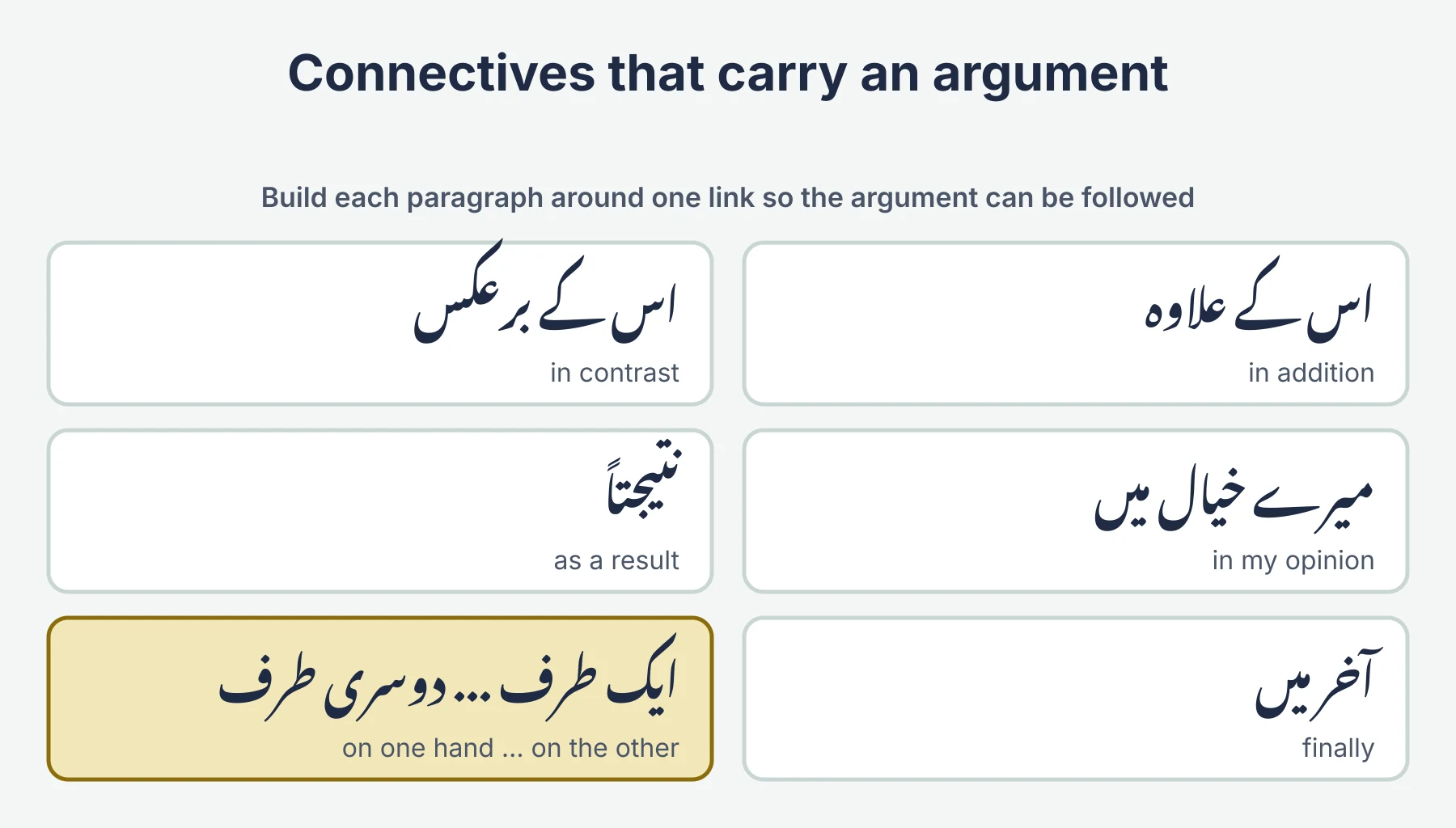
پاکستان کے کئی دیہی علاقوں میں آج بھی زمین کا بڑا حصہ چند خاندانوں کے پاس ہے۔ ناقدین کا کہنا ہے کہ اس نظام کی وجہ سے مزارع اور ہاری غربت اور قرض کے جال میں پھنسے رہتے ہیں، اور جاگیردار اپنے اثر و رسوخ سے انتخابات پر بھی اثر انداز ہوتے ہیں۔ اس کے برعکس بعض لوگ کہتے ہیں کہ بڑے زمیندار دیہات میں روزگار فراہم کرتے ہیں اور زرعی پیداوار کو برقرار رکھتے ہیں۔ میرے خیال میں اصل مسئلہ زمین کی تقسیم کے ساتھ ساتھ تعلیم کی کمی بھی ہے، کیونکہ تعلیم یافتہ کسان اپنے حقوق کے لیے بہتر طریقے سے آواز اٹھا سکتا ہے۔ نتیجتاً زرعی اصلاحات کے ساتھ دیہی تعلیم پر توجہ دینا بھی ضروری ہے۔
Translation: In many rural areas of Pakistan, a large share of the land is still held by a few families. Critics say that because of this system tenants and landless peasants remain trapped in poverty and debt, and that landlords also use their influence to affect elections. In contrast, some people say that large landowners provide employment in the villages and keep agricultural output going. In my view the real problem is not only the distribution of land but also the lack of education, because an educated farmer can speak up for his rights more effectively. As a result, alongside land reform it is also necessary to pay attention to rural education.
Why it works: each side is attributed (ناقدین کا کہنا ہے, بعض لوگ کہتے ہیں) rather than stated as fact; the opinion is signposted with میرے خیال میں and backed by a reason with کیونکہ; the conclusion opens with نتیجتاً.
Writing a balanced response
Give the criticisms (for example poverty and exploitation) and the arguments for reform, each with reasons and sourced evidence, then say which you find more convincing. Avoid unsupported statistics and sweeping claims. Link ideas with connectives such as اس کے برعکس and نتیجتاً.
Discussion and essay prompts
- «جاگیرداری نظام پاکستان کی ترقی میں سب سے بڑی رکاوٹ ہے۔» (The feudal system is the biggest obstacle to Pakistan’s progress.) Do you agree? Weigh it against other factors, such as education or governance.
- «زرعی اصلاحات کامیاب نہیں ہو سکیں۔» (Land reforms have not been able to succeed.) Why might reform be difficult to carry out?
- «تعلیم جاگیرداری نظام کا بہترین علاج ہے۔» (Education is the best cure for the feudal system.) Discuss.
- How does the system affect women and children in rural families differently from men?
Exam traps
- Quoting statistics you cannot trace to a source.
- One-sided answers that only criticise or only defend the system.
- Wrong agreement: check the gender of the noun before choosing the verb ending.
- Treating جاگیردار and زمیندار as exact synonyms: every جاگیردار is a landowner, but not every زمیندار is a feudal lord.
- Forgetting that اصلاحات is feminine plural (اصلاحات کی گئیں, not کیے گئے) and that نظام is masculine (نظام بدل رہا ہے).
- Describing whole groups as villains; attribute criticisms to critics and support them with evidence.
Self-test
- What does جاگیرداری نظام mean?
- Give the Urdu for ‘land reforms’ and ‘exploitation’.
- Translate: ‘land is held by a few people’.
- Why is the verb ہوتی in that sentence?
- What makes a response on this topic balanced?
- What is the difference between جاگیردار and زمیندار?
- What do مزارع and بٹائی mean?
- Give one political criticism of the feudal system.
- Name one argument sometimes made in defence of large landholdings.
- In زرعی اصلاحات نافذ کی گئیں, why is the verb ending گئیں?
- Translate: ‘If farmers got the right to land, prosperity could come to the villages.’
- Which sub-theme, not this one, is the Theme 4 research subject?
Answers: 1. The feudal (landholding) system. 2. زرعی اصلاحات and استحصال. 3. زمین چند لوگوں کے پاس ہوتی ہے۔ 4. Because زمین is feminine. 5. Criticisms and arguments for reform, each with reasons and sourced evidence, and a judgement. 6. A جاگیردار holds a very large estate, often with local power; a زمیندار is any landowner, large or small. 7. A tenant farmer, and sharecropping (dividing the crop between tenant and owner). 8. For example, critics argue that landlords influence how tenants vote and so dominate assemblies, slowing reform. 9. For example, that large farms can be efficient and provide employment and stability. 10. It agrees with اصلاحات, which is feminine plural. 11. اگر کسانوں کو زمین کا حق ملے تو دیہات میں خوش حالی آ سکتی ہے۔ 12. Sub-theme 4.3, environmental issues in Pakistan.
Related resources
-
Study guides
Edexcel A Level Urdu (9UR0): Environmental Issues in Pakistan
9UR0 research subject 4.3: government action on climate and pollution, disaster measures and foreign aid agencies, with Section C research planning.
Urdu Language · Pearson Edexcel · A Level
Read guide -
Study guides
Edexcel A Level Urdu (9UR0): The Feudal System (جاگیرداری نظام)
9UR0 sub-theme 4.2 study guide: the feudal system's political and social effects in rural Pakistan and urban-rural contrasts, with comparison language.
Urdu Language · Pearson Edexcel · A Level
Read guide -
Practice questions
Edexcel A Level Urdu (9UR0): The Feudal System (جاگیرداری نظام) – Practice Questions
Twelve original 9UR0 practice questions on the feudal system's political and social effects and on urban and rural politics, with full marked answers.
Urdu Language · Pearson Edexcel · A Level
Try questions
Get free revision emails (optional)
Occasional emails with practice questions, worked explanations and links to free resources for the qualification and subjects you choose. No spam, and you can unsubscribe from any email. The free tools on this site never need an email.