
Revision Notes
Edexcel GCSE Business: Business calculations (1BS0) – Revision Notes
Condensed revision notes on gross profit, net profit, profit margins and average rate of return for Pearson Edexcel GCSE Business 1BS0, with a self-test.
- Subject
- Business
- Level
- GCSE
- Topic
- Making financial decisions
- Author
- Marlbridge Academic Team
- Updated
- Reviewed by
- Asif Iqbal (what this means)
Aligned to Pearson Edexcel GCSE Business (1BS0), Issue 2, July 2022. Official specification .
Syllabus page (what it covers and how it is assessed): Pearson Edexcel GCSE Business.
Syllabus points this page covers
1BS0
- 2.4 Making financial decisions (whole topic)
- 2.4.1 Business calculations
Found an error? Report a correction.
Want a teacher for this? Marlbridge teaches Business online. Request a free trial class.
These notes condense content item 2.4.1, Business calculations, from Topic 2.4 Making financial decisions in Theme 2, Building a business, of the Pearson Edexcel Level 1/Level 2 GCSE (9-1) in Business (1BS0) specification, Issue 2, July 2022. For full explanations and worked examples, read the study guide first. Then test yourself with the practice questions.
Course links: Edexcel GCSE Business hub, the printable checklist and the free 10-minute diagnostics. The specification sets two written papers, Theme 1 (1BS0/01) and Theme 2 (1BS0/02), each 1 hour 45 minutes, 90 marks and 50% of the qualification. Calculators may be used. The formulae are listed in the specification (Appendix 3) and are not provided in the examinations, so learn the ones below. All businesses in these notes are invented.
What 2.4.1 covers
| Content point | Skill |
|---|---|
| Gross profit | Concept and calculation |
| Net profit | Concept and calculation |
| Gross profit margin | Calculation and interpretation |
| Net profit margin | Calculation and interpretation |
| Average rate of return | Calculation and interpretation |
Formulae (Appendix 3 forms)
| Item | Formula |
|---|---|
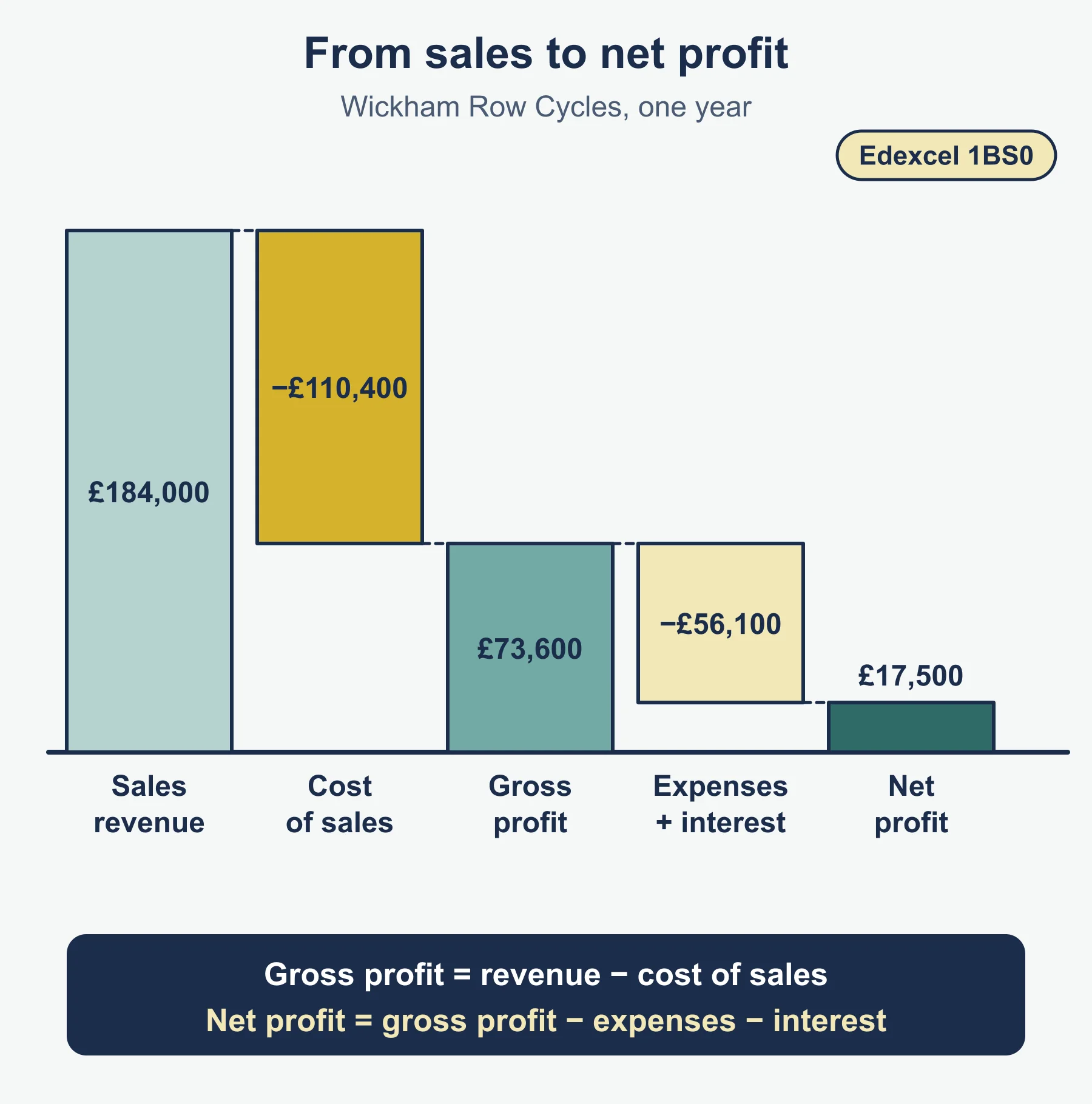
| Gross profit | sales revenue − cost of sales |
| Gross profit margin (%) | gross profit ÷ sales revenue × 100 |
| Net profit | gross profit − other operating expenses and interest |
| Net profit margin (%) | net profit ÷ sales revenue × 100 |
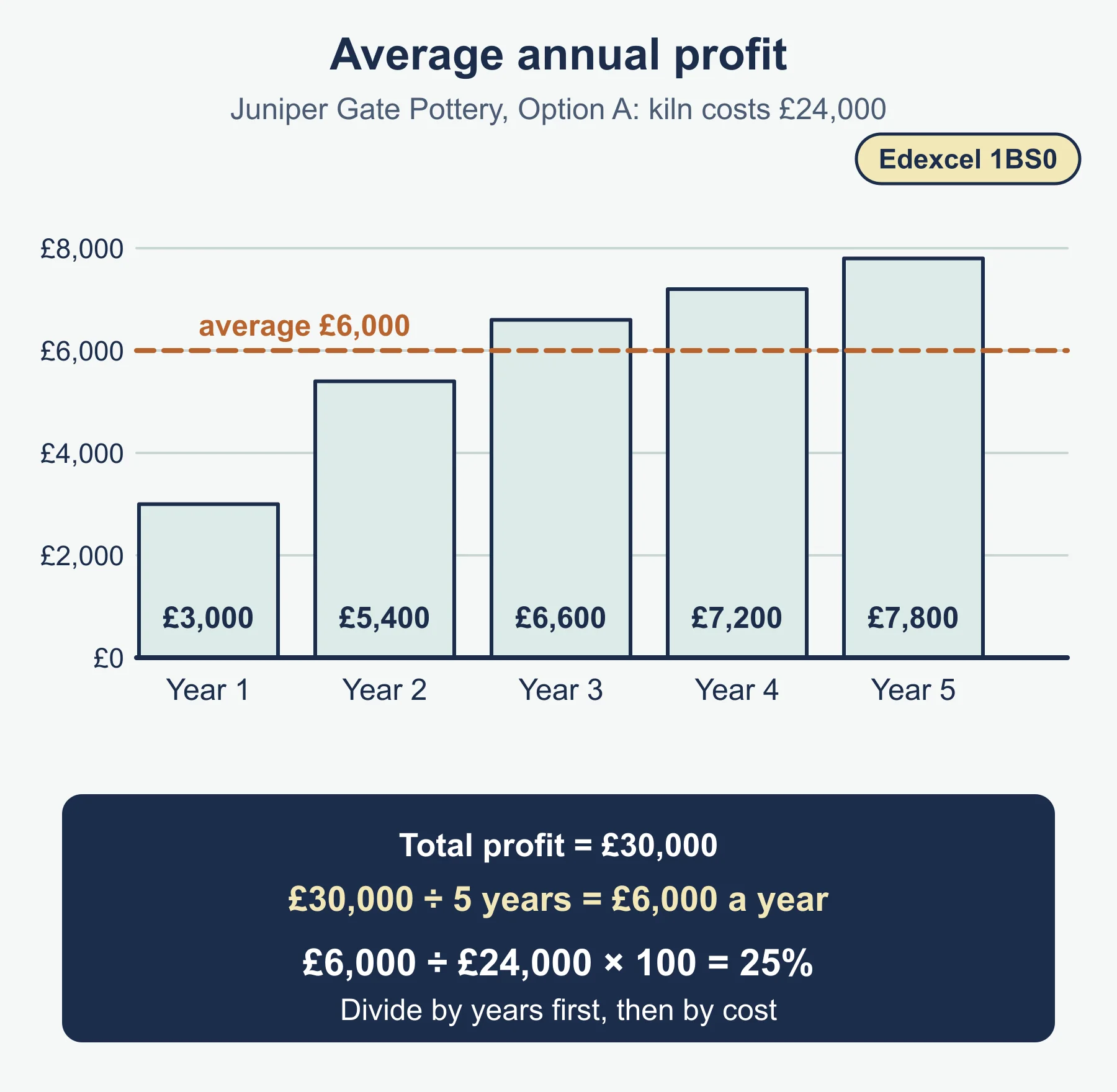
| Average annual profit | total profit ÷ number of years |
| Average rate of return (%) | average annual profit ÷ cost of investment × 100 |
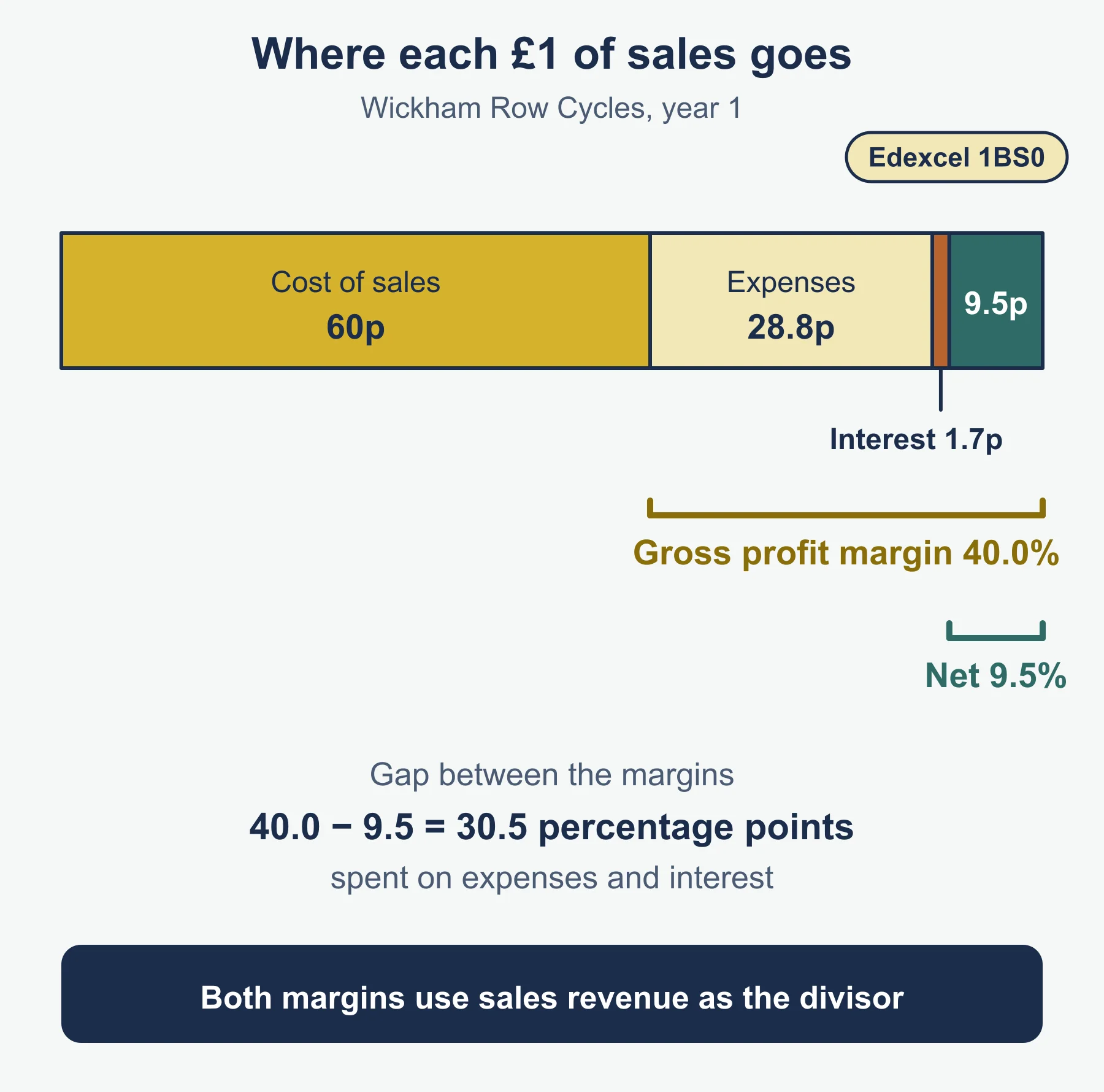
Both margins divide by sales revenue. The rate of return divides by the cost of the investment. Sales revenue is price × quantity, also from Appendix 3.
Key terms (standard meanings)
The specification does not define these, so they are the standard meanings.
- Cost of sales: the direct cost of the goods or services sold, such as stock bought to resell or materials used to make the product.
- Other operating expenses: running costs that are not cost of sales, such as rent, advertising, utilities and shop wages.
- Interest: the cost of borrowing money.
- Gross profit: what is left of sales revenue after paying for what was sold.
- Net profit: what is left after all other operating expenses and interest.
- Profit margin: profit as a percentage of sales revenue.
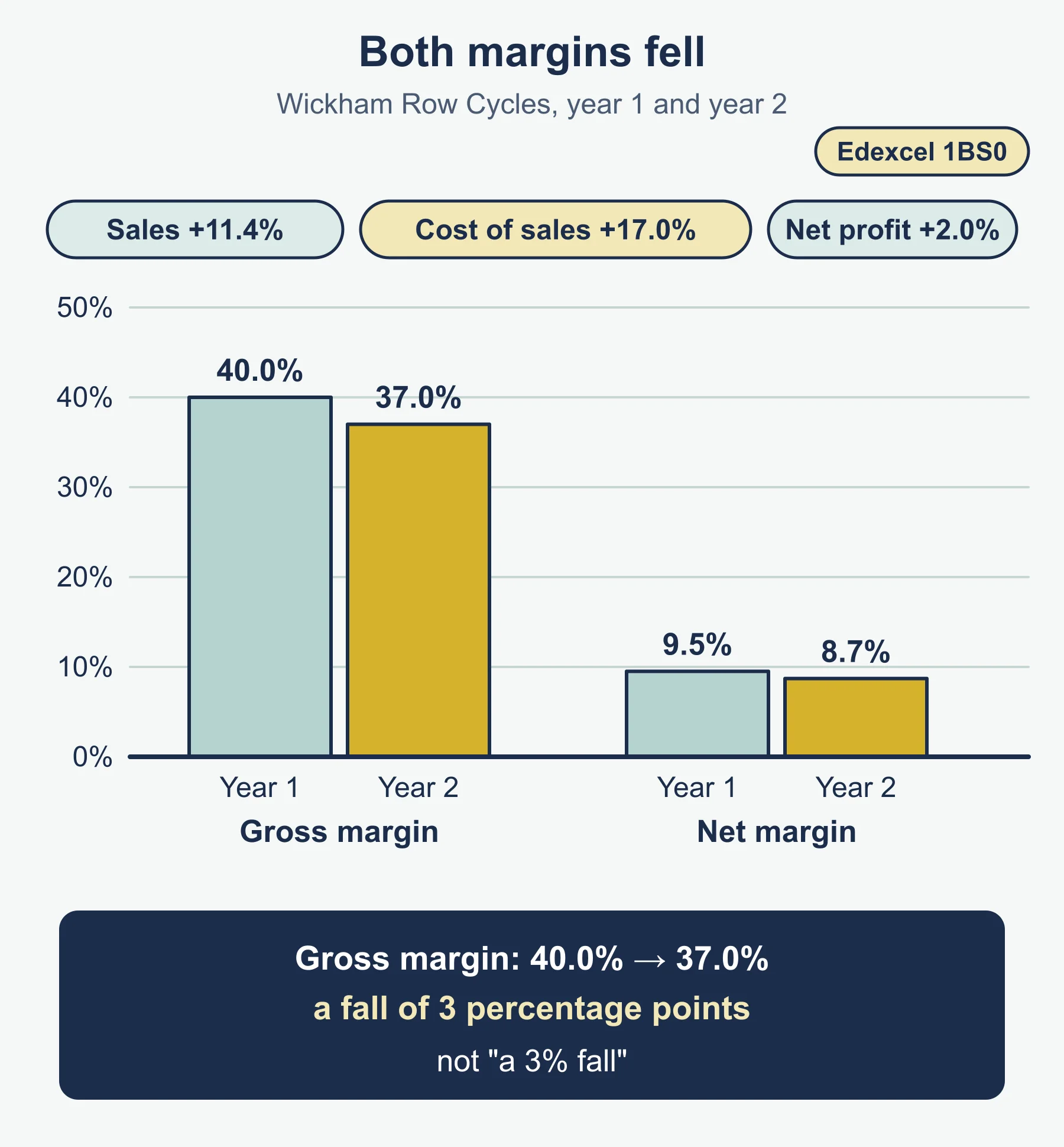
- Percentage point: the difference between two percentages. Margins moving from 36% to 33% fell by 3 percentage points.
Method in steps
Gross profit and net profit
- Write down sales revenue and cost of sales. Subtract to get gross profit.
- Add other operating expenses and interest together.
- Subtract that total from gross profit to get net profit.
- A negative result means a loss. Say so.
Margins
- Find the profit figure you need (gross or net).
- Divide by sales revenue, not by the other profit figure.
- Multiply by 100 and add the percentage sign.
- Round only at the end, to the accuracy the question asks for.
Average rate of return
- Add up the profits from every year to get total profit.
- Divide by the number of years to get average annual profit.
- Divide by the cost of the investment and multiply by 100.
- Compare the result with an alternative, a target or the cost of borrowing.
Worked reminder: Harbour Lane Coffee Roasters
Sales revenue is £96,000 and cost of sales is £52,800. Other operating expenses are £31,200 and interest is £1,800.
| Step | Working | Result |
|---|---|---|
| Gross profit | £96,000 − £52,800 | £43,200 |
| Gross profit margin | £43,200 ÷ £96,000 × 100 | 45.0% |
| Costs to deduct | £31,200 + £1,800 | £33,000 |
| Net profit | £43,200 − £33,000 | £10,200 |
| Net profit margin | £10,200 ÷ £96,000 × 100 | 10.6% (10.625 to 3 d.p.) |
The roaster buys a new machine for £15,000. It expects profits of £2,700, £3,600, £4,500 and £4,800 in four years.
| Step | Working | Result |
|---|---|---|
| Total profit | 2,700 + 3,600 + 4,500 + 4,800 | £15,600 |
| Average annual profit | £15,600 ÷ 4 | £3,900 |
| Average rate of return | £3,900 ÷ £15,000 × 100 | 26% |
Interpreting margins
| What you see | Likely place to look |
|---|---|
| Gross margin falls | Selling prices (discounts) or cost of sales (supplier price rises, a shift towards lower-margin goods) |
| Gross margin steady, net margin falls | Other operating expenses or interest |
| Both margins rise | Higher prices, lower costs, or both. Check sales revenue has not fallen |
| Net profit rises but net margin falls | Costs grew faster than sales revenue |
Compare a margin with last year, with a competitor or with the owner’s target. A margin of 10% does not mean the business is large or profitable in pounds. A small shop can have a higher margin than a large one and still earn less profit.
Ways to improve margins
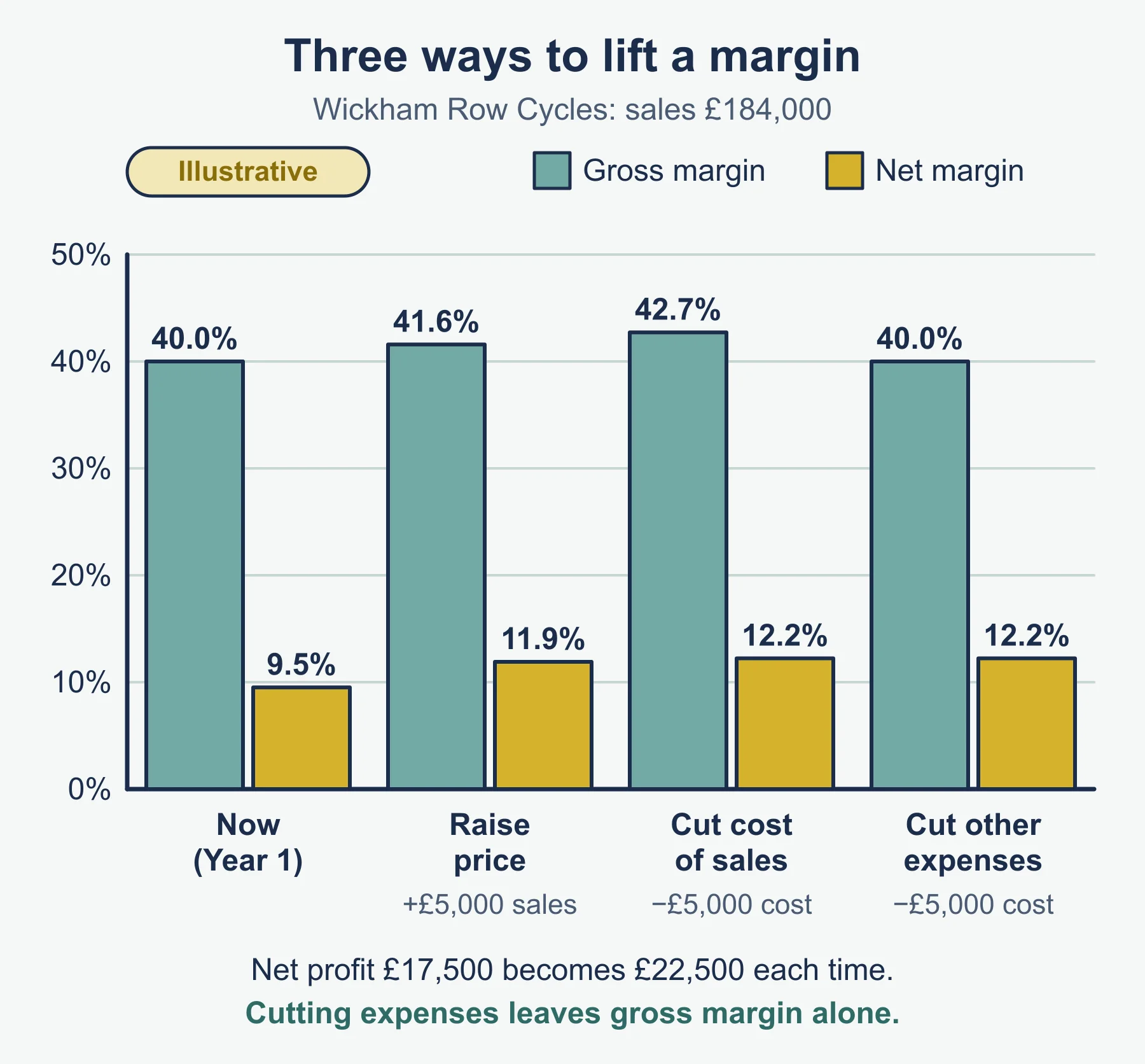
- Raise prices (risk: customers may buy less).
- Cut cost of sales, for example by changing supplier (risk: lower quality or reliability).
- Reduce other operating expenses or interest (this affects only the net margin).
Interpreting average rate of return
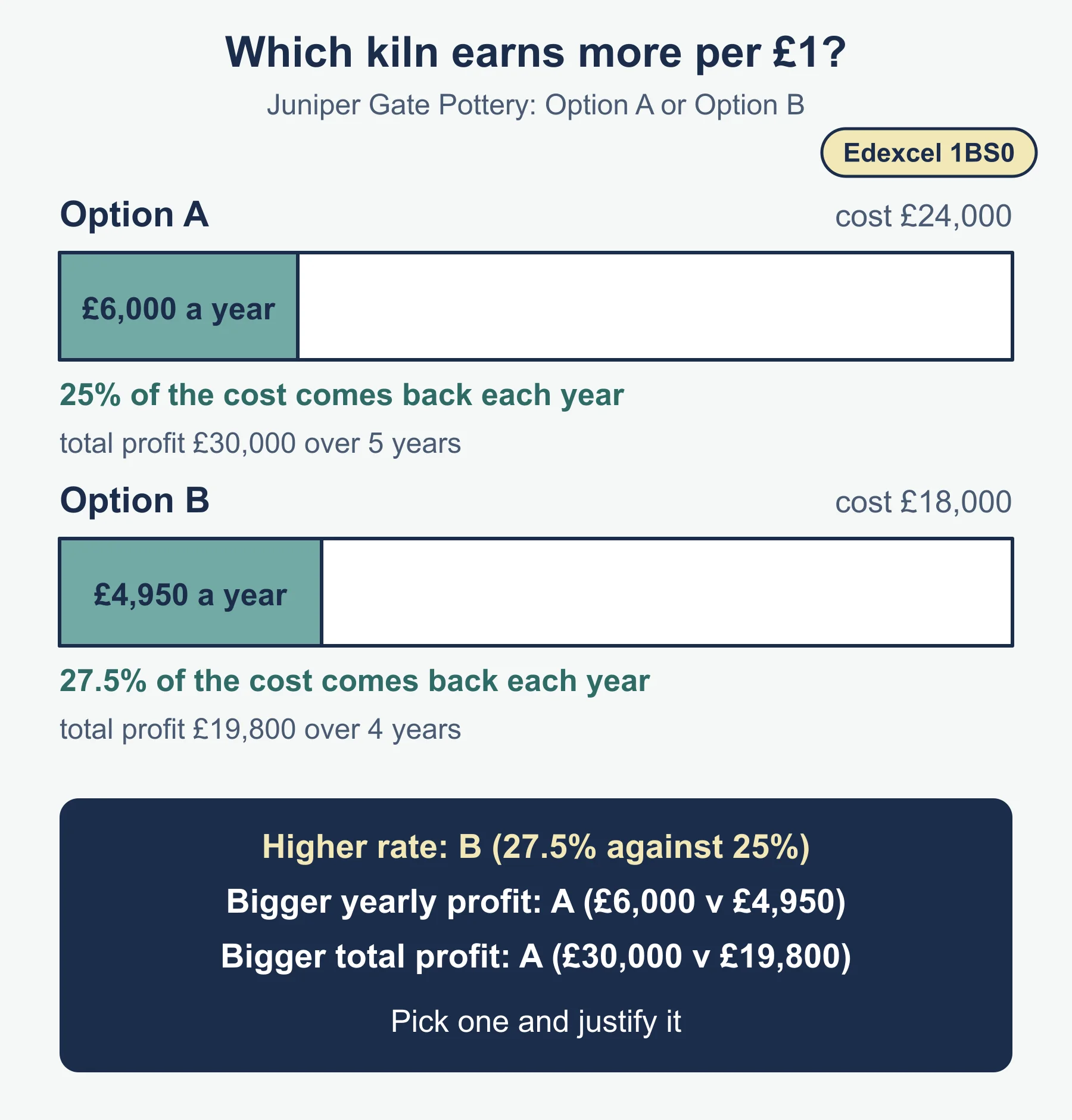
- Higher is better when you compare two options of any size, because it measures profit per £1 spent.
- Compare it with the interest rate on savings or on a loan to see if the investment is worth the money.
- Compare it with the owner’s target, if one is given.
Limitations to quote in evaluate answers (standard points, not specification wording):
- The profits are forecasts, so the result may not happen.
- An average does not show when the profits arrive, or how uneven they are.
- A high rate on a small or short investment can give less total profit than a lower rate on a larger one.
- It ignores non-financial factors.
Using the command words
The specification’s Appendix 1 sets out what each command word asks for. For this topic, these are the useful ones.
- Define: give the meaning of a term from the content.
- Give: an answer that tests recall of the content.
- State: an answer no longer than a sentence, selected from contextual information in the question.
- Identify: select the answer by reading a graph or table of data.
- Calculate: use the data given. Calculators may be used and workings should be given.
- Complete the table: work out the missing values in a table.
- Outline: two linked points, placed in context.
- Explain: a statement of fact with two further expansion points, no context.
- Analyse: an extended answer placed in context.
- Justify: use the information to recommend one of two options.
- Evaluate: an extended answer reaching a supported conclusion.
Sentence starters
These are the writer’s suggestions, not specification wording.
- “The gross profit margin fell from … to …, a fall of … percentage points, which suggests that …”
- “Net profit margin fell although gross profit margin was steady, so the extra cost is probably in other operating expenses or interest.”
- “Option … has the higher average rate of return, but Option … gives the larger total profit.”
- “This relies on forecast profits, so the owner should treat the figure with care.”
Quick self-test
- Define the term gross profit.
- A shop has sales revenue of £42,000 and cost of sales of £27,300. Calculate its gross profit.
- Calculate the gross profit margin for the shop in question 2.
- The shop’s other operating expenses are £9,600 and its interest is £500. Calculate its net profit.
- Calculate the net profit margin for the shop, to one decimal place.
- A business has gross profit of £28,000 on sales revenue of £80,000. Calculate the gross profit margin.
- A business has net profit of £6,300 on sales revenue of £90,000. Calculate the net profit margin.
- An investment costing £20,000 gives profits of £3,000, £4,500, £5,500 and £7,000 over four years. Calculate the average rate of return.
- A business has a gross profit margin of 40% and sales revenue of £55,000. Calculate its gross profit.
- A business has a net profit margin of 12% and sales revenue of £75,000. Calculate its net profit.
- A gross profit margin falls from 36% to 33%. State the fall in percentage points.
- Explain one reason why a business’s net profit margin could fall while its gross profit margin stays the same.
Answers
- Gross profit is sales revenue minus cost of sales: what is left after paying for the goods or services sold.
- £42,000 − £27,300 = £14,700.
- £14,700 ÷ £42,000 × 100 = 35.0%.
- £14,700 − £9,600 − £500 = £4,600.
- £4,600 ÷ £42,000 × 100 = 10.95%, which is 11.0% to one decimal place.
- £28,000 ÷ £80,000 × 100 = 35%.
- £6,300 ÷ £90,000 × 100 = 7%.
- Total profit = £20,000. Average annual profit = £20,000 ÷ 4 = £5,000. Rate = £5,000 ÷ £20,000 × 100 = 25%.
- 40% of £55,000 = £22,000.
- 12% of £75,000 = £9,000.
- 36 − 33 = 3 percentage points.
- Gross profit margin is not affected by other operating expenses or interest. If rent, advertising or interest rises, net profit falls while gross profit stays the same, so the net profit margin falls.
Where marks are usually lost
- Dividing a net profit by gross profit, not by sales revenue.
- Forgetting to take interest off, or taking it off twice.
- Using cost of sales where other operating expenses belong, and the reverse.
- Dividing total profit, not average annual profit, by the investment cost.
- Using the wrong number of years when averaging.
- Giving a margin without the percentage sign, or rounding too early.
- Describing a change in margin as a percentage when it is a number of percentage points.
- Stating that a rate or margin is “good” with no comparison.
- Answering an analyse or evaluate question with calculations only, and not saying what they mean for the business.
- Leaving out workings on a Calculate question.
Frequently asked questions
What is the difference between gross profit and net profit? Gross profit is sales revenue minus cost of sales. Net profit is gross profit minus other operating expenses and interest, so it shows what is left after all running costs.
How do you calculate average rate of return in Edexcel GCSE Business (1BS0)? Add the profits from every year, divide by the number of years to get average annual profit, then divide by the cost of the investment and multiply by 100.
What does it mean if gross margin is steady but net margin falls? Cost of sales is under control, so the cause is likely to be other operating expenses or interest growing faster than sales revenue.
What are the limitations of average rate of return? The profits are forecasts, an average hides when the profits arrive, a high rate on a small or short investment can give less total profit, and it ignores non-financial factors.
Official syllabus
Pearson Edexcel Level 1/Level 2 GCSE (9-1) in Business (1BS0), Specification, Issue 2, July 2022, published by Pearson Education Limited. Theme 2: Building a business, Topic 2.4 Making financial decisions, content item 2.4.1 Business calculations.
Get free revision emails (optional)
Occasional emails with practice questions, worked explanations and links to free resources for the qualification and subjects you choose. No spam, and you can unsubscribe from any email. The free tools on this site never need an email.
Related resources
-
Study guides
Edexcel GCSE Business: Interpreting quantitative business data (1BS0)
Study guide to reading graphs, financial, marketing and market data and the limits of financial information, for Pearson Edexcel GCSE Business.
Business · Pearson Edexcel · GCSE
Read guide -
Practice questions
Edexcel GCSE Business: Interpreting quantitative business data (1BS0) – Practice Questions
Original practice questions with worked answers on graphs, financial, marketing and market data and the limits of financial information.
Business · Pearson Edexcel · GCSE
Try questions -
Revision notes
Edexcel GCSE Business: Interpreting quantitative business data (1BS0) – Revision Notes
Condensed revision notes on graphs, financial, marketing and market data and the limits of financial information, for Edexcel GCSE Business.
Business · Pearson Edexcel · GCSE
Revise topic
Related articles
-
teaching
A Level tuition in Dubai: Cambridge or Pearson Edexcel International A Level?
Schools in Dubai and Abu Dhabi teach either Cambridge International AS & A Level or Pearson Edexcel International A Level. How the two are structured, why it matters for tuition, and how online classes from Lahore work.
9 October 2026
-
curriculum guides
Choosing subjects at IGCSE and A Level
How subject choices at 14 and 16 affect university options later, and how to keep pathways open without overloading a timetable.
28 July 2026
Studying this with a teacher
Working through Business GCSE?
This page is free and stays free. If you would rather be taught it, Marlbridge runs Business classes one-to-one and in small groups of up to 15, online in your own time zone. The first trial class is free. WhatsApp replies within an hour (8am–11pm Pakistan time, every day); email the same day.
Pearson Edexcel Business teachers at Marlbridge

