
Revision Notes
Edexcel GCSE Business: Business operations and managing stock (1BS0) – Revision Notes
Condensed revision notes on job, batch and flow production, technology, bar gate stock graphs, JIT and suppliers for Edexcel GCSE Business.
- Subject
- Business
- Level
- GCSE
- Topic
- Making operational decisions
- Author
- Marlbridge Academic Team
- Updated
- Reviewed by
- Asif Iqbal (what this means)
Aligned to Pearson Edexcel GCSE Business (1BS0), Issue 2, July 2022. Official specification .
Syllabus page (what it covers and how it is assessed): Pearson Edexcel GCSE Business.
Syllabus points this page covers
1BS0
- 2.3 Making operational decisions (whole topic)
- 2.3.1 Business operations
- 2.3.2 Managing stock and working with suppliers
Found an error? Report a correction.
Want a teacher for this? Marlbridge teaches Business online. Request a free trial class.
These notes condense Pearson Edexcel Level 1/Level 2 GCSE (9-1) Business (1BS0), Issue 2, July 2022, Theme 2, Topic 2.3 Making operational decisions, items 2.3.1 Business operations and 2.3.2 Managing stock. For full explanations and longer worked examples, read the study guide first. The specification says formulae are listed in Appendix 3 and are not provided in the examinations; productivity and unit cost are not in that list, so the forms below are standard forms to learn.
Links: the Business hub, the printable checklist, the practice questions and the free diagnostics.
Definitions to know
| Term | Meaning |
|---|---|
| Business operations | The activity that produces goods or provides services |
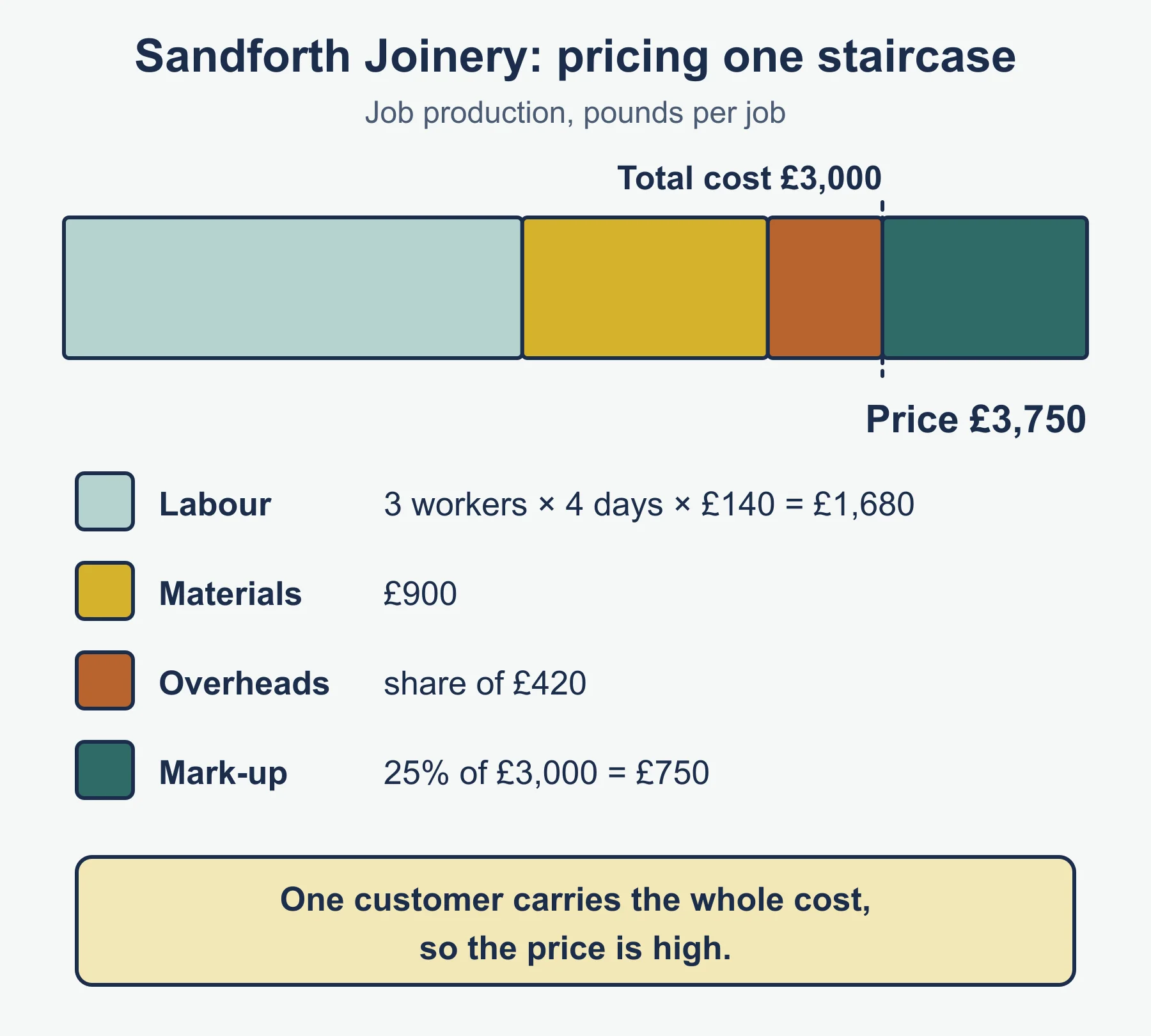
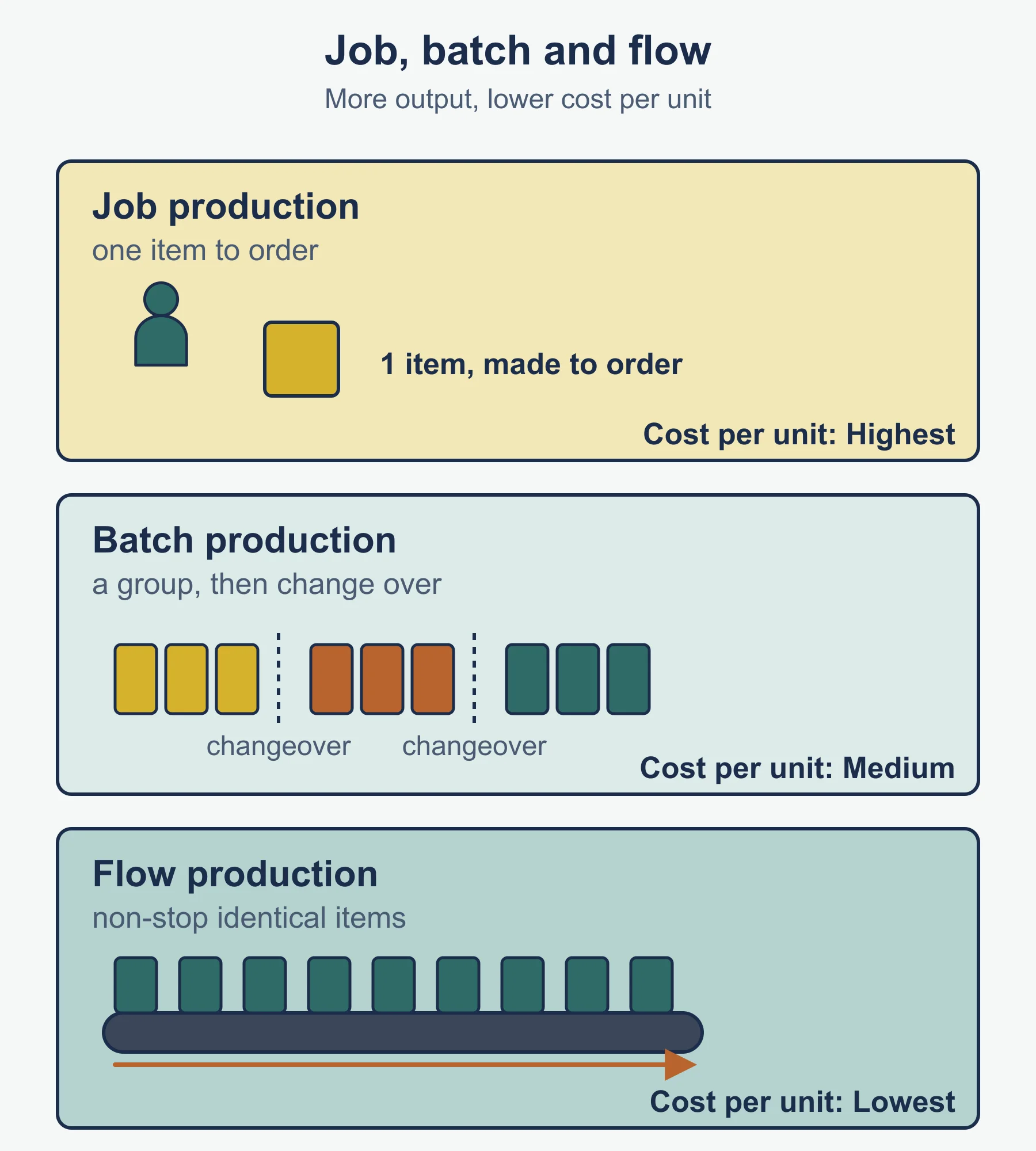
| Job production | One item made to a customer’s own specification |
| Batch production | A group of identical items made together, then equipment changes for the next group |
| Flow production | Items move continuously along a line |
| Productivity | Output per unit of input, usually output per worker (standard form) |
| Unit cost | Total cost divided by the number of units made (standard form) |
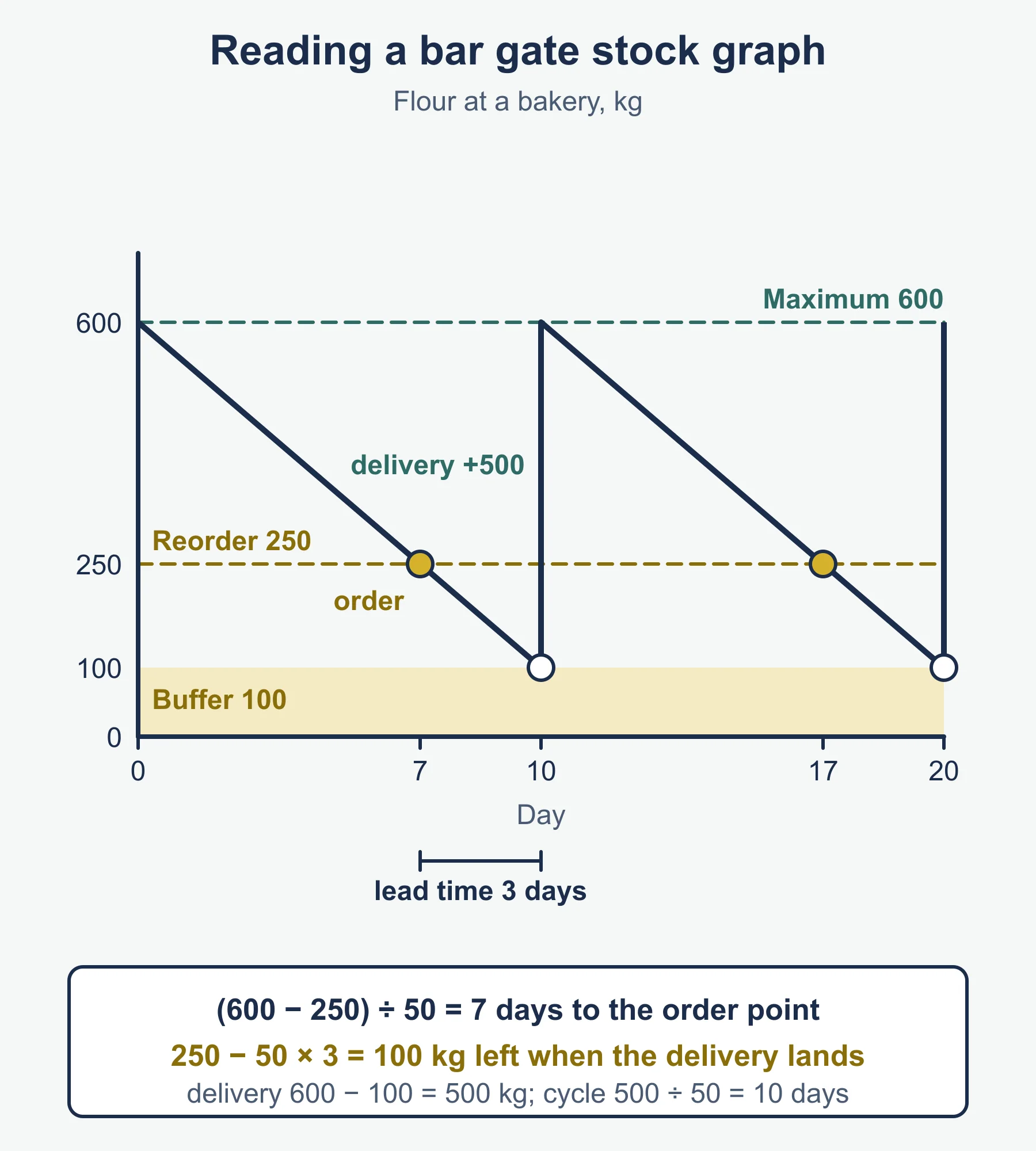
| Bar gate stock graph | A graph of stock level over time: the line falls as stock is used and jumps up when a delivery arrives |
| Just in time (JIT) | Stock arrives only when needed, so very little is held |
| Procurement | Buying the goods and services a business needs from suppliers |
| Logistics | Moving and storing goods, to the business and to customers |
| Lead time | The wait from placing an order until the goods arrive (standard term) |
| Buffer stock | Minimum stock kept as protection against delay or higher use (standard term) |
Operations: goods and services (2.3.1)
- Goods are physical and can be stocked. Services happen when the customer asks and cannot be stored.
- A business may do both, such as a shop that sells and installs.
Production processes at a glance (2.3.1)
| Job | Batch | Flow | |
|---|---|---|---|
| Output | One-off | Groups | Continuous |
| Productivity | Low | Medium | High |
| Unit cost | High | Medium | Low if the line is kept busy |
| Price | High | Moderate | Can be competitive |
| Flexibility | Very high | Medium | Low |
| Main risk | Slow, costly | Time lost on changeovers | Breakdown halts the line; heavy set-up cost |
Method for an explain answer: state the point, then add two expansion points. For example, “flow production keeps unit cost low. Fixed costs are spread over a very large number of units, so each unit carries little. The business can then charge a competitive price.”
Technology: four things to balance (2.3.1)
| Factor | Plus | Minus |
|---|---|---|
| Cost | Less labour per unit | Machines and training cost money |
| Productivity | More output per hour | Faults can stop output |
| Quality | Consistent results | A fault is repeated until noticed |
| Flexibility | Programmable change | Some machines are fixed to one job |
Always finish with a judgement about the business in the question: its size, how steady demand is, and whether it makes standard or made-to-order products. A small business with uncertain sales may gain more from flexibility than from a faster machine.
Productivity and unit cost: method
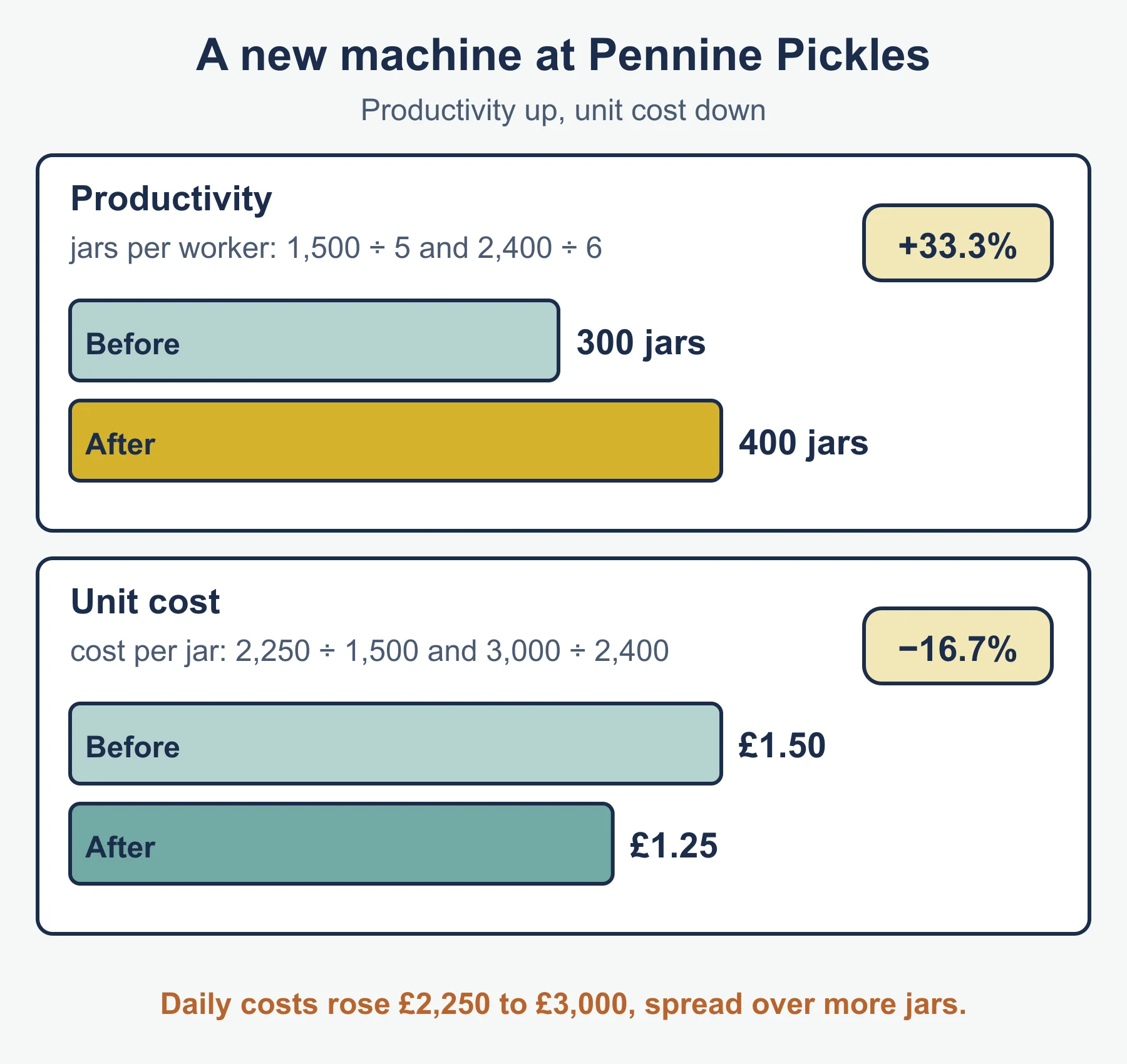
- Productivity = output ÷ number of workers (in the same time).
- Unit cost = total cost ÷ units produced.
- Percentage change = (new − old) ÷ old × 100.
Worked reminder: Kirkdale Textiles
Last month 840 metres of cloth with 7 weavers. This month 1,050 metres with 7 weavers.
Before = 840 ÷ 7 = 120 metres each. After = 1,050 ÷ 7 = 150 metres each.
Change = (150 − 120) ÷ 120 × 100 = 25%.
Worked reminder: batch against flow
A batch workshop spends £18,000 to make 6,000 units: 18,000 ÷ 6,000 = £3.00 each. A flow line spends £60,000 to make 24,000 units: 60,000 ÷ 24,000 = £2.50 each. The flow line is 50p cheaper only because it makes four times as many units.
Bar gate stock graphs: method (2.3.2)
- Maximum stock is the top of the gate.
- Reorder level is where an order is placed.
- Use per day = fall in stock ÷ days.
- Days from full to reorder level = (maximum − reorder level) ÷ daily use.
- Buffer on arrival = reorder level − (daily use × lead time).
- Delivery size = maximum − buffer.
- Cycle length = delivery size ÷ daily use.
Worked reminder: tyres at a garage
Maximum 400, reorder level 160, use 40 a day, lead time 2 days.
- Days to the reorder level = (400 − 160) ÷ 40 = 6 days.
- Buffer on arrival = 160 − 40 × 2 = 80 tyres.
- Delivery size = 400 − 80 = 320 tyres.
- Cycle = 320 ÷ 40 = 8 days.
Check the shape: if the line ever touches zero before the jump, the lead time is too long or the reorder level too low. A steeper fall means faster use, so a firm with rising sales may need a higher reorder level or a larger buffer.
JIT in brief (2.3.2)
| Advantages | Disadvantages |
|---|---|
| Less cash tied up in stock | A late delivery can stop production |
| Lower storage and insurance cost | More frequent orders, with possible higher delivery cost |
| Less waste and damage | Smaller orders may lose discounts |
| Less space needed | Needs reliable suppliers and good planning |
Worked reminder: Marsh Paints
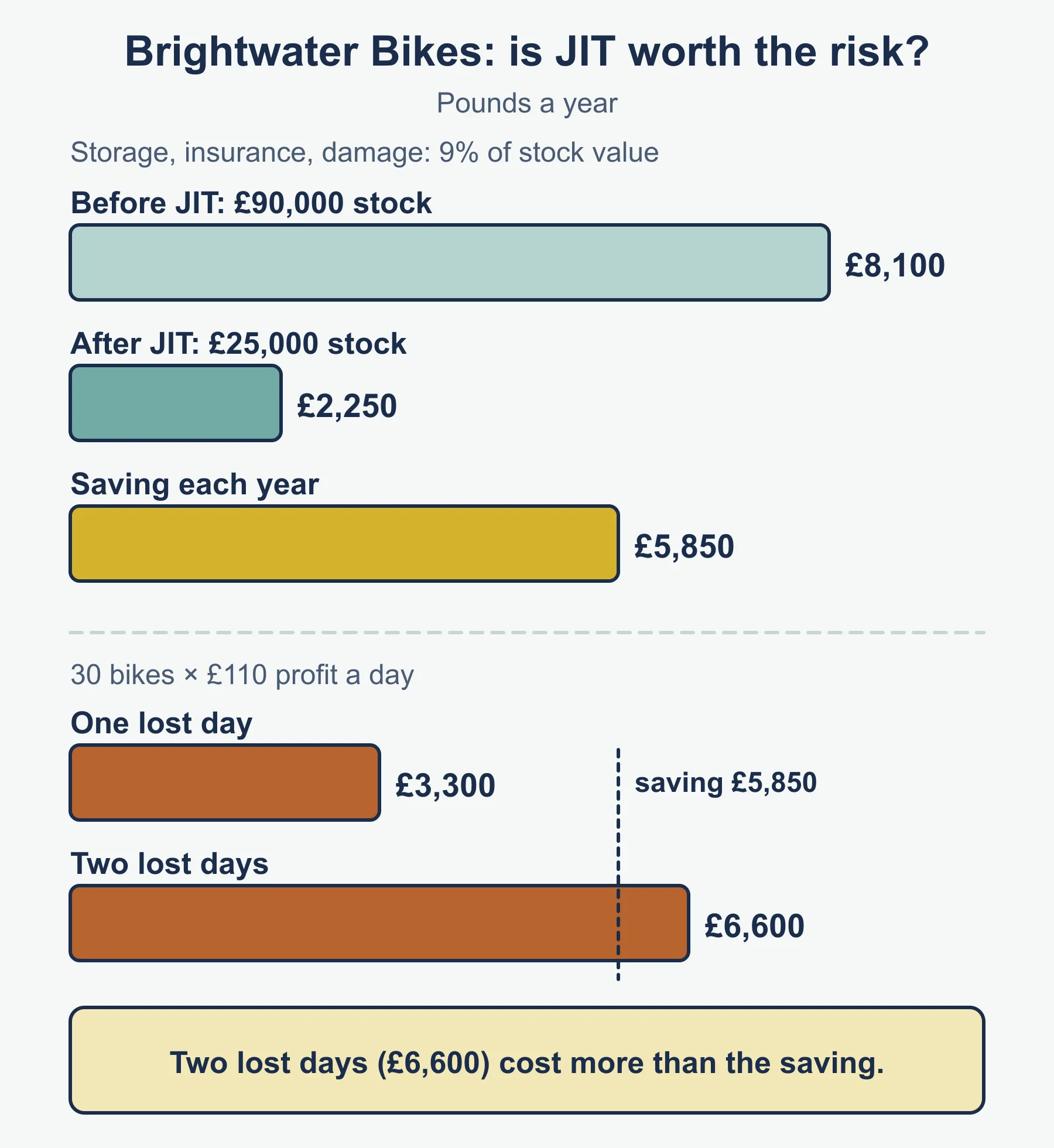
Stock falls from £48,000 to £12,000 on average. Holding costs are 5% a year. Reduction in stock = £36,000. Saving = 36,000 × 0.05 = £1,800 a year. One lost day of production could cost more than this, so the answer depends on supplier reliability.
Suppliers and procurement (2.3.2)
The specification lists five features of a supplier relationship.
- Quality. Poor materials mean poor products.
- Delivery. Cost, speed and reliability.
- Availability. Stock is there when needed.
- Cost. Price paid per unit.
- Trust. Promises are kept; problems are reported honestly.
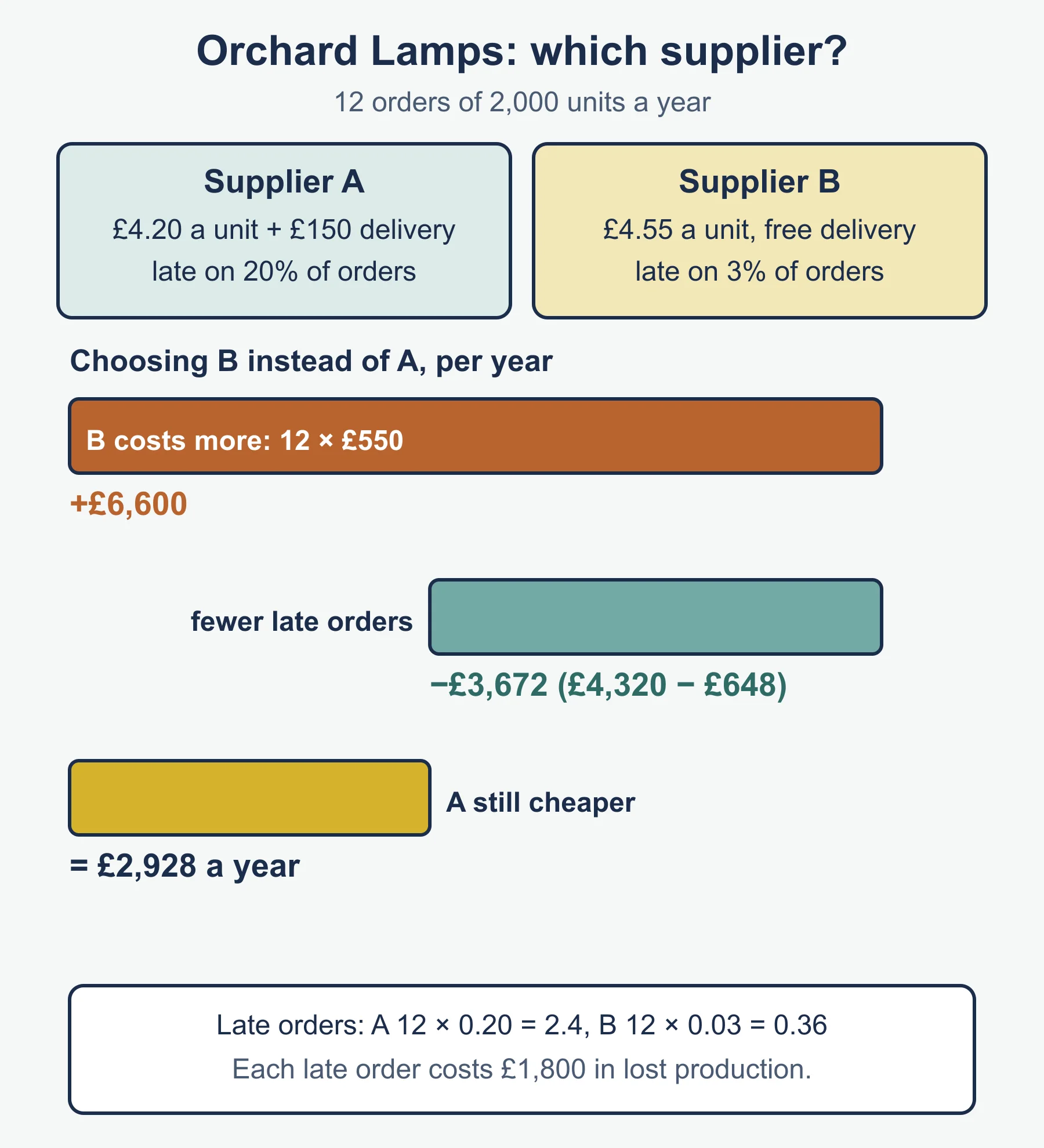
Total cost of a supplier = price × quantity + delivery + cost of problems (late orders, faulty goods).
Worked reminder: two suppliers
An order of 5,000 units. Supplier X £2.80 a unit = £14,000. Supplier Y £3.10 a unit = £15,500. Y is £1,500 dearer, which is 10.7% more (1,500 ÷ 14,000 × 100). If Y is reliable and X is often late, the extra may be worth paying.
Logistics and supply decisions (2.3.2)
| Impact on | Good decisions | Poor decisions |
|---|---|---|
| Costs | Right order size, sensible delivery routes | Frequent small orders, empty transport, large unused stock |
| Reputation | On-time, undamaged goods build a name | Late or damaged goods spread through reviews |
| Customer satisfaction | Right item, right time, right condition | Stock-outs, delays and complaints |
Must-know distinctions
- Productivity against output. Output is the total made. Productivity is output per worker.
- Unit cost against total cost. Total cost can rise while unit cost falls.
- Buffer stock against reorder level. Reorder level is when you order. Buffer is what is left when the delivery arrives.
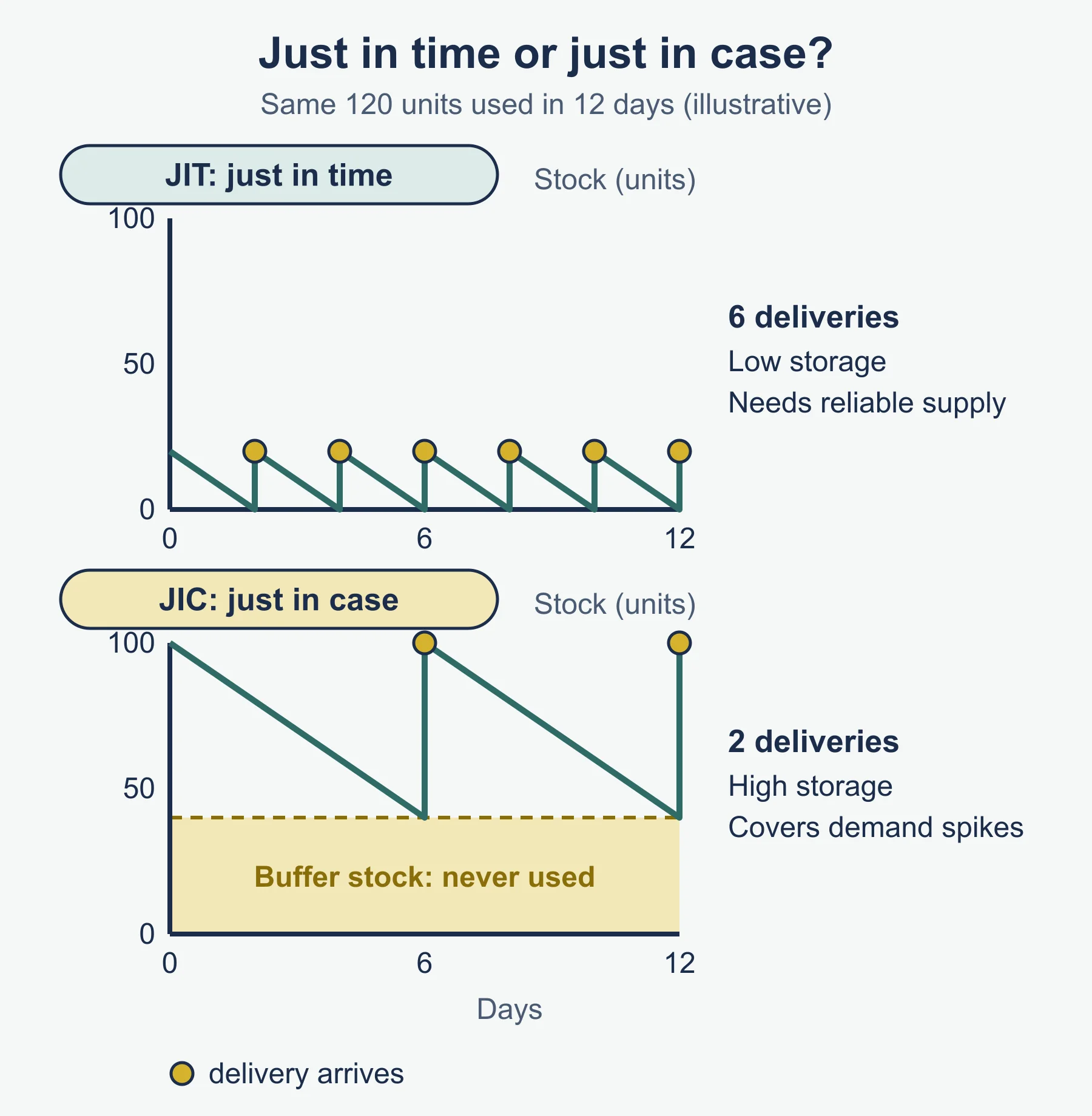
- JIT against bar gate holding. JIT aims for minimal stock. A bar gate approach holds a buffer on purpose.
- Job against batch. Job means one customer’s special item. Batch means many identical items made together.
Quick self-test
- State the two purposes of business operations given in the specification.
- Which process makes one item to a customer’s own specification?
- Give one disadvantage of flow production.
- A bakery makes 1,350 buns with 9 staff. Calculate productivity.
- Calculate the unit cost when £7,200 makes 2,400 units.
- On a bar gate graph, what does the vertical jump show?
- Maximum stock 300, reorder level 120, use 30 a day. How many days from full to the reorder level?
- With lead time 2 days in the same example, calculate the buffer on arrival.
- State one advantage and one disadvantage of JIT.
- Name two features of a supplier relationship from the specification.
- Explain one way a late supplier delivery can harm customer satisfaction.
- Give one reason why the cheapest supplier may not be the best choice.
Answers
- To produce goods and to provide services.
- Job production.
- High set-up cost, low flexibility, or a breakdown halting the line.
- 1,350 ÷ 9 = 150 buns per worker.
- 7,200 ÷ 2,400 = £3.00.
- A delivery arriving, so stock rises at once.
- (300 − 120) ÷ 30 = 6 days.
- 120 − (30 × 2) = 60.
- Advantage: lower storage costs. Disadvantage: production may stop if a delivery is late.
- Any two of quality, delivery, availability, cost, trust.
- The business cannot fill orders on time, so customers wait or leave, and may complain.
- It may be unreliable or poor quality, so late orders and faulty goods cost more than the price saving.
Where marks are usually lost
- Writing “flow is cheaper” with no mention of volume or unit cost.
- Dividing by the wrong number when working out productivity.
- Quoting total cost when the question asks for unit cost.
- Reading the reorder level as the buffer stock.
- Ignoring the lead time in a bar gate calculation.
- Calling JIT “no stock at all” instead of very little stock.
- Listing supplier factors with no link to the business in the stem.
- Giving only advantages of technology, with no balance.
- Leaving an evaluate or justify answer without a decision.
Frequently asked questions
What is the difference between job, batch and flow production? Job production makes one item to a customer’s own specification, batch production makes a group of identical items before the equipment is changed for the next group, and flow production moves items continuously along a line. Job has the highest unit costs and flow the lowest, provided sales are high enough to keep the line busy.
How do you find the buffer stock on a bar gate stock graph? Multiply the daily usage by the lead time and subtract this from the reorder level. For example, a reorder level of 250 kg, use of 50 kg a day and a 3-day lead time give 250 − 150 = 100 kg of buffer stock when the delivery arrives.
What are the advantages and disadvantages of just in time stock control? JIT means less money tied up in stock, lower storage and insurance costs and less waste. The drawback is little protection against late or wrong deliveries, so production can stop and the business depends on reliable suppliers.
What does the Edexcel GCSE Business specification say makes a good supplier relationship? The 1BS0 specification lists quality; delivery cost, speed and reliability; availability; cost; and trust. The cheapest supplier is not always the best once delivery and late-delivery costs are included.
Official syllabus
Pearson Edexcel Level 1/Level 2 GCSE (9-1) in Business (1BS0), Specification, Issue 2, July 2022, published by Pearson Education Limited. Theme 2, Topic 2.3 Making operational decisions, items 2.3.1 Business operations and 2.3.2 Managing stock (working with suppliers).
Get free revision emails (optional)
Occasional emails with practice questions, worked explanations and links to free resources for the qualification and subjects you choose. No spam, and you can unsubscribe from any email. The free tools on this site never need an email.
Related resources
-
Study guides
Edexcel GCSE Business: Quality and the sales process (1BS0)
Study guide to quality control, quality assurance, costs, competitive advantage, the sales process and customer service for Edexcel GCSE Business.
Business · Pearson Edexcel · GCSE
Read guide -
Practice questions
Edexcel GCSE Business: Quality and the sales process (1BS0) – Practice Questions
Original practice questions with worked answers on quality control, quality assurance, the sales process and customer service for Edexcel GCSE Business.
Business · Pearson Edexcel · GCSE
Try questions -
Revision notes
Edexcel GCSE Business: Quality and the sales process (1BS0) – Revision Notes
Condensed revision notes on quality control, quality assurance, quality and costs, the sales process and customer service for Edexcel GCSE Business.
Business · Pearson Edexcel · GCSE
Revise topic
Related articles
-
teaching
A Level tuition in Dubai: Cambridge or Pearson Edexcel International A Level?
Schools in Dubai and Abu Dhabi teach either Cambridge International AS & A Level or Pearson Edexcel International A Level. How the two are structured, why it matters for tuition, and how online classes from Lahore work.
9 October 2026
-
curriculum guides
Choosing subjects at IGCSE and A Level
How subject choices at 14 and 16 affect university options later, and how to keep pathways open without overloading a timetable.
28 July 2026
Studying this with a teacher
Working through Business GCSE?
This page is free and stays free. If you would rather be taught it, Marlbridge runs Business classes one-to-one and in small groups of up to 15, online in your own time zone. The first trial class is free. WhatsApp replies within an hour (8am–11pm Pakistan time, every day); email the same day.
Pearson Edexcel Business teachers at Marlbridge

