
Study Guides
Edexcel GCSE Business: Quality and the sales process (1BS0)
Study guide to quality control, quality assurance, costs, competitive advantage, the sales process and customer service for Edexcel GCSE Business.
- Subject
- Business
- Level
- GCSE
- Topic
- Making operational decisions
- Author
- Marlbridge Academic Team
- Updated
- Reviewed by
- Asif Iqbal (what this means)
Aligned to Pearson Edexcel GCSE Business (1BS0), Issue 2, July 2022. Official specification .
Syllabus page (what it covers and how it is assessed): Pearson Edexcel GCSE Business.
Syllabus points this page covers
1BS0
- 2.3 Making operational decisions (whole topic)
- 2.3.3 Managing quality
- 2.3.4 The sales process
Found an error? Report a correction.
Want a teacher for this? Marlbridge teaches Business online. Request a free trial class.
This guide follows the Pearson Edexcel Level 1/Level 2 GCSE (9-1) in Business (1BS0) specification, Issue 2, July 2022. It covers Theme 2, Topic 2.3 Making operational decisions, content items 2.3.3 (managing quality) and 2.3.4 (the sales process). Formulae are listed in Appendix 3 of the specification and are not provided in the examinations, so any calculation here is worth practising from memory.
Course links: the Business hub, the printable checklist and the free diagnostics. Companion pages: the revision notes and the practice questions. For the Theme 1 idea that quality is a customer need, see the study guide on spotting a business opportunity and customer needs.
What the specification asks for
| Item | You must be able to | Section |
|---|---|---|
| 2.3.3 | Explain the concept of quality | 1 |
| 2.3.3 | Explain quality control and quality assurance in producing goods and in providing services | 2 and 3 |
| 2.3.3 | Explain how quality lets a business control costs | 4 |
| 2.3.3 | Explain how quality helps a business gain a competitive advantage | 4 |
| 2.3.4 | Explain the stages of the sales process: product knowledge, speed and efficiency of service, customer engagement, responses to customer feedback, post-sales service | 5 |
| 2.3.4 | Explain the importance to businesses of providing good customer service | 6 |
1. The concept of quality
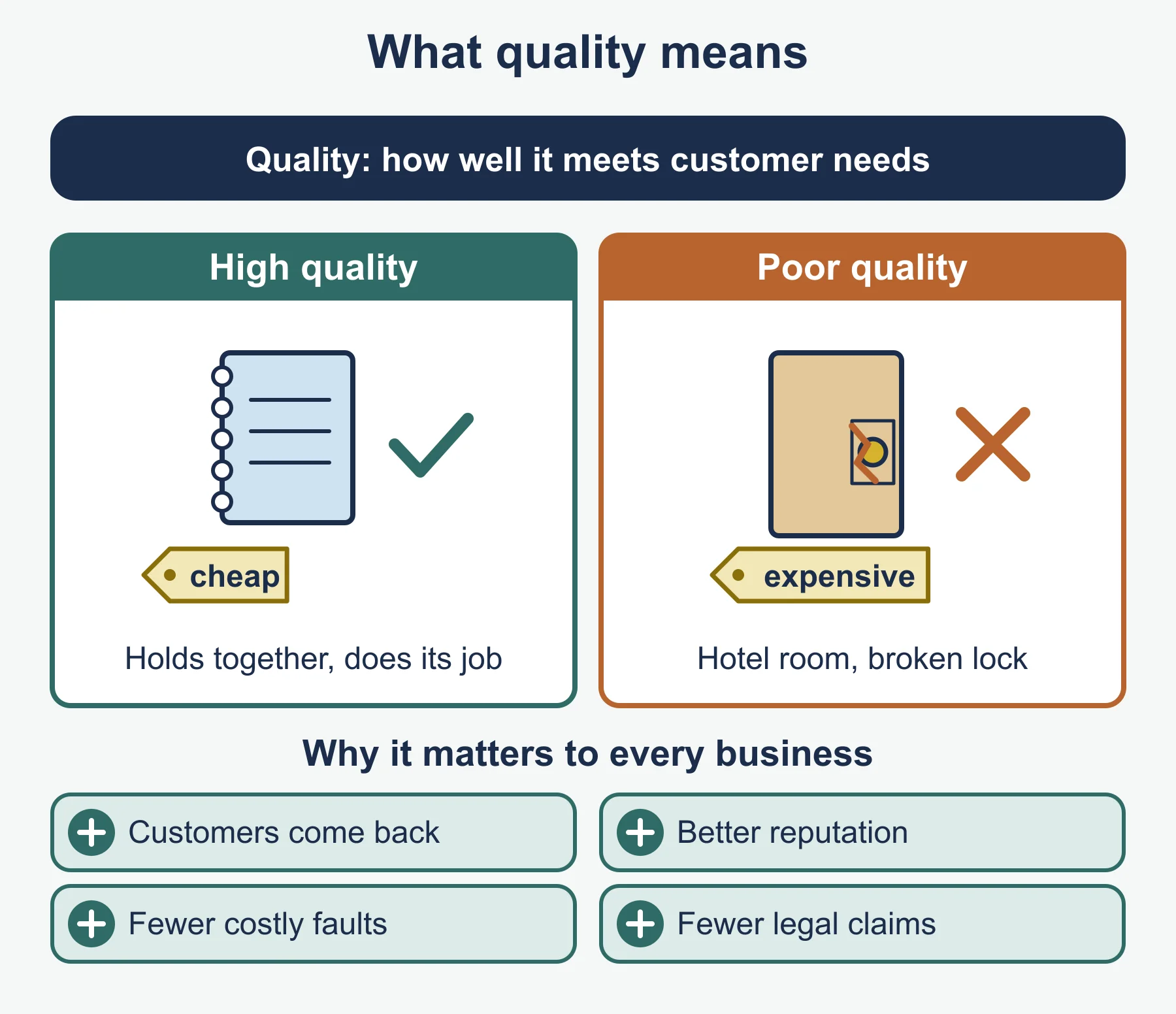
Quality is how well a product meets the needs and expectations of the customer who buys it. Theme 1 lists quality as one of the customer needs, next to price, choice and convenience. A product with high quality does what it promises, lasts as long as customers expect and is safe to use.
Quality means different things for goods and for services:
- Goods are physical items. Quality shows in the materials, the finish, how reliably the item works and how long it lasts.
- Services have no physical form. Quality shows in accuracy, courtesy, reliability and the time taken. A service cannot be returned once it has been delivered, so getting it right first time matters.
High quality is not the same as high price. A cheap product can be good quality if it is made well and does what a customer wants for that price. A business decides what level of quality its target customers expect and then aims to deliver it every time.
2. Quality control
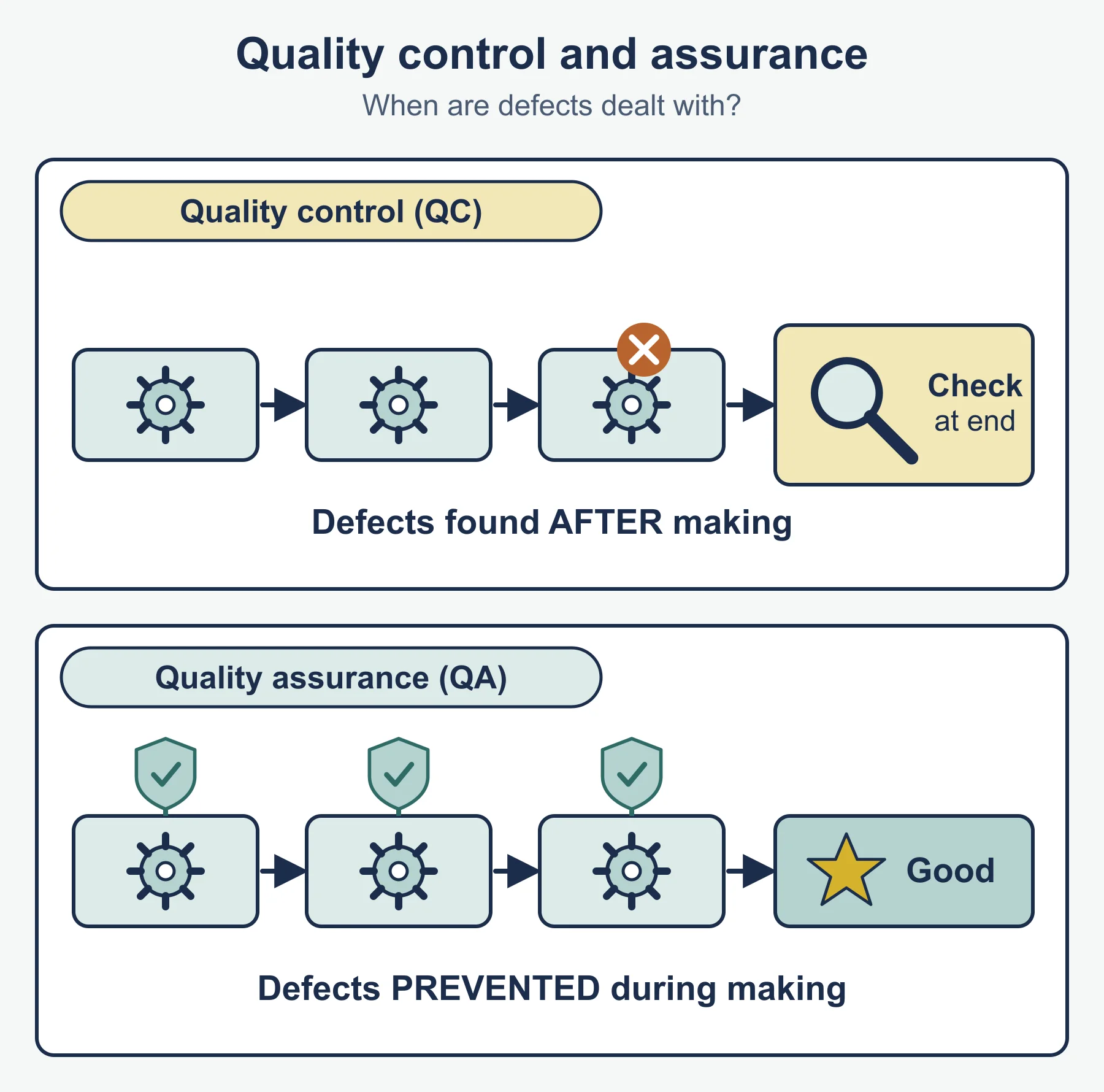
Quality control means checking products, or the parts of them, to find faults. The standard definition is inspection and testing at one or more points, usually during or at the end of production, so that faulty items are removed or put right before they reach the customer. The specification names quality control and quality assurance without defining them, so learn these standard forms.
Examples:
- Goods: a candle maker weighs, measures and looks over each batch, rejecting any that are cracked or uneven.
- Services: a phone-repair shop has a second technician test every repaired phone before handing it back.
Points to know:
- It finds faults after they have happened, so the materials and time spent on a faulty item are already lost.
- It needs inspectors, testing equipment and time, which add to costs.
- It protects the customer and the business reputation, because most faults are caught before sale.
- Checking only a sample is cheaper than checking every item, but some faults can be missed.
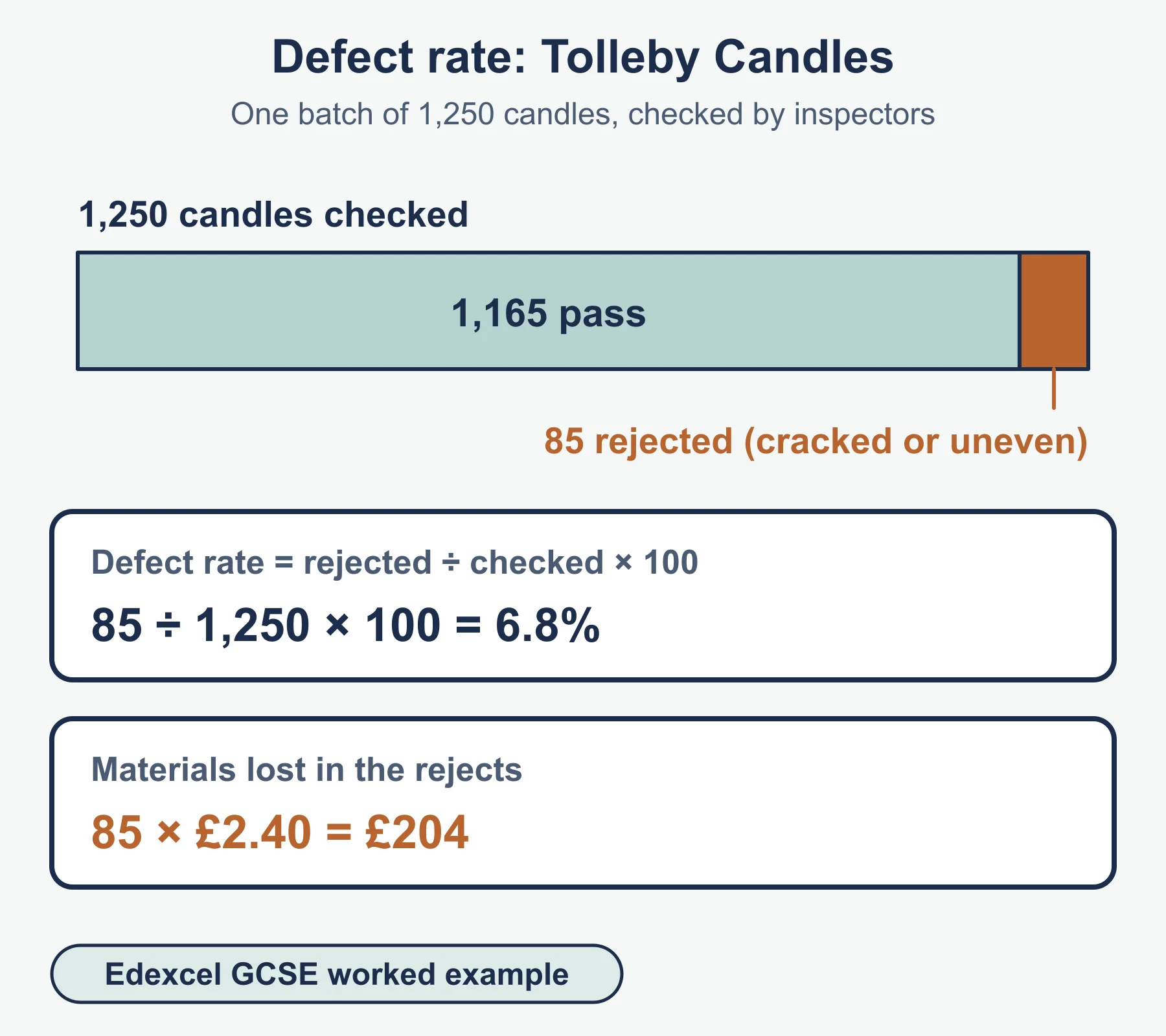
Worked example 1. Tolleby Candles pours a batch of 1,250 candles. Inspectors reject 85 as cracked or uneven. Each candle costs £2.40 in materials.
Defect rate = rejected / total checked x 100
            = 85 / 1,250 x 100
            = 6.8%
Materials in rejected candles = 85 x £2.40 = £204
The defect rate is the standard form for this calculation. The inspection protected customers, but the business still lost £204 of materials.
3. Quality assurance
Quality assurance means putting systems and standards in place across the whole process so that faults are prevented, rather than found afterwards. Standard features:
- agreed standards that every item or service must meet
- staff training, so that people know how to do the job correctly
- checking the quality of materials and supplies before they are used
- clear, written procedures and checklists
- responsibility given to every worker, not only to inspectors.
Examples:
- Goods: the candle maker agrees a wax specification with its supplier, trains staff to pour at the right temperature and keeps a checklist at every workstation.
- Services: the repair shop trains technicians to follow a step-by-step repair checklist and gives all staff the same customer-handling guidelines.
| Quality control | Quality assurance | |
|---|---|---|
| Main aim | Find and remove faults | Prevent faults happening |
| When | At the end or at set points of the process | Throughout the whole process |
| Who | Mainly inspectors or testers | All staff, suppliers and managers |
| Typical cost | Inspectors, testing equipment, wasted output | Training, procedures, supplier checks |
| Weakness | Waste has already occurred | Takes time and money to set up, and needs staff commitment |
Many businesses use both: assurance to reduce faults and control to catch any that remain.
4. Quality, costs and competitive advantage
Controlling costs
Faults cost money. A faulty item may need to be scrapped, reworked, replaced or refunded, and staff time is spent on complaints. Good quality reduces these costs. There is a balance, because quality systems cost money too.
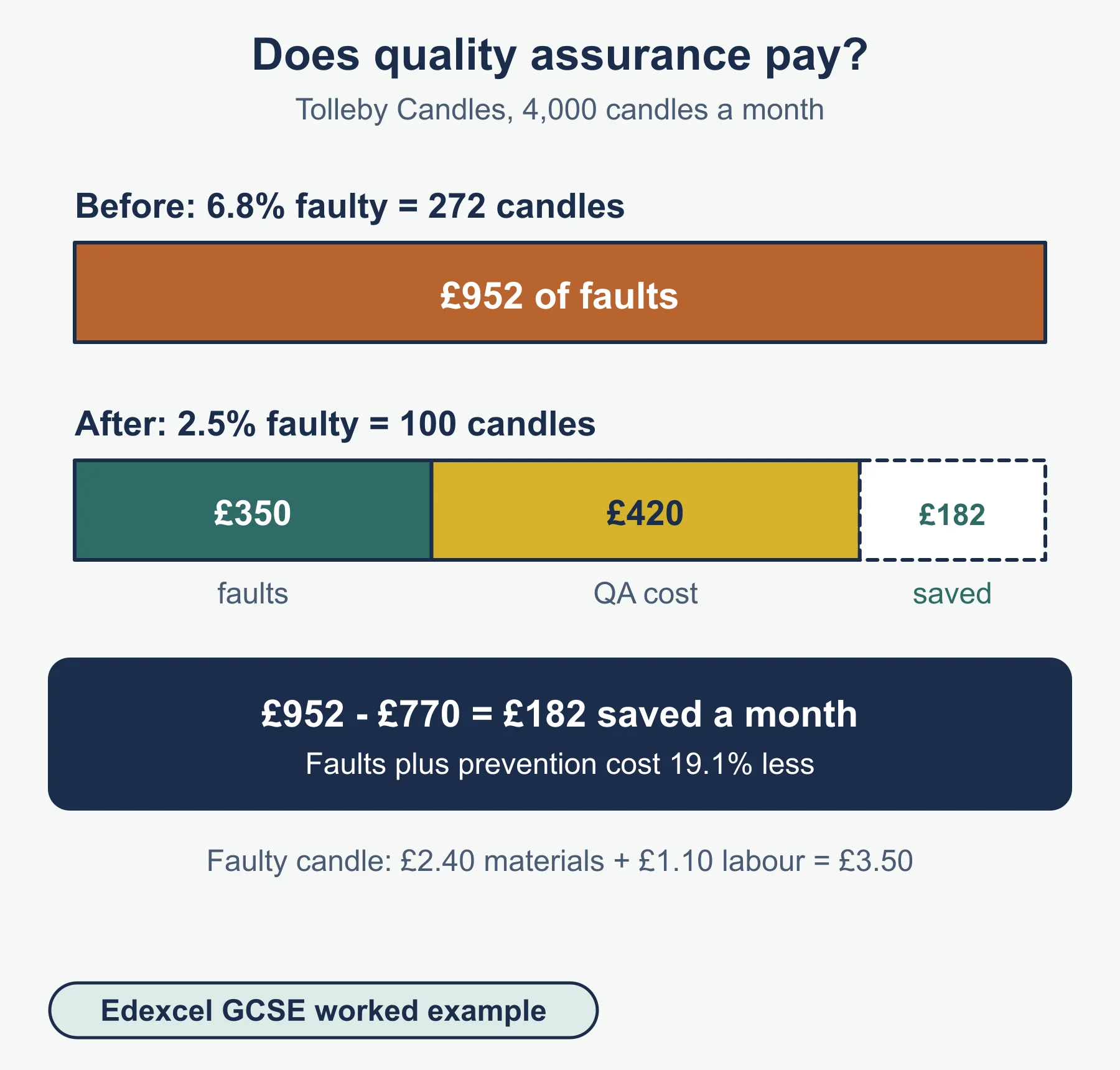
Worked example 2. Tolleby Candles makes 4,000 candles a month. A faulty candle costs £2.40 in materials and £1.10 in labour, £3.50 in total, and is thrown away. At present 6.8% of candles are faulty. A quality assurance programme of training and supplier checks costs £420 a month and cuts the fault rate to 2.5%.
Before: faulty = 4,000 x 6.8% = 272     cost = 272 x £3.50 = £952
After:  faulty = 4,000 x 2.5% = 100     cost = 100 x £3.50 = £350
Total after = £350 + £420 = £770
Saving = £952 - £770 = £182 a month
The programme pays for itself, saving £182 a month, a fall of 19.1% in the cost of faults and prevention together. A fuller judgement would also consider fewer returns and complaints, which the figures do not show.
Other ways quality can lower costs: less wasted material, fewer refunds and replacements, less time spent dealing with complaints, and less need for heavy inspection.
Gaining a competitive advantage
A competitive advantage is something that makes a business more attractive to customers than its rivals. Consistent quality can provide one:
- customers who are satisfied buy again and recommend the business
- a reputation for quality can support a higher price or make customers choose it over a similar product
- fewer faults protect the brand, so less is spent on repairing reputation
- quality is hard for a rival to copy quickly, because it comes from training, supplier relationships and habits.
A competitor may match your price fast, but matching reputation takes longer. The limits: customers must notice and value the quality, and the cost of reaching a very high standard must not push the price beyond what the target market will pay.
5. The sales process
The specification lists five parts of the sales process. Think of them as the steps a customer meets before, during and after a purchase.
| Part | What it means | Example |
|---|---|---|
| Product knowledge | Staff understand what they sell and can advise accurately | A lamp seller explains bulb types and fittings |
| Speed and efficiency of service | Customers are served quickly and accurately with few mistakes | An order is picked, packed and sent the same day |
| Customer engagement | Staff show interest in the customer, listen and build a relationship | A shop assistant asks what the lamp is for before recommending one |
| Responses to customer feedback | The business gathers views and acts on them | A survey shows slow delivery, so a faster courier is chosen |
| Post-sales service | Help after the sale | Returns, repairs, guarantees, follow-up emails |
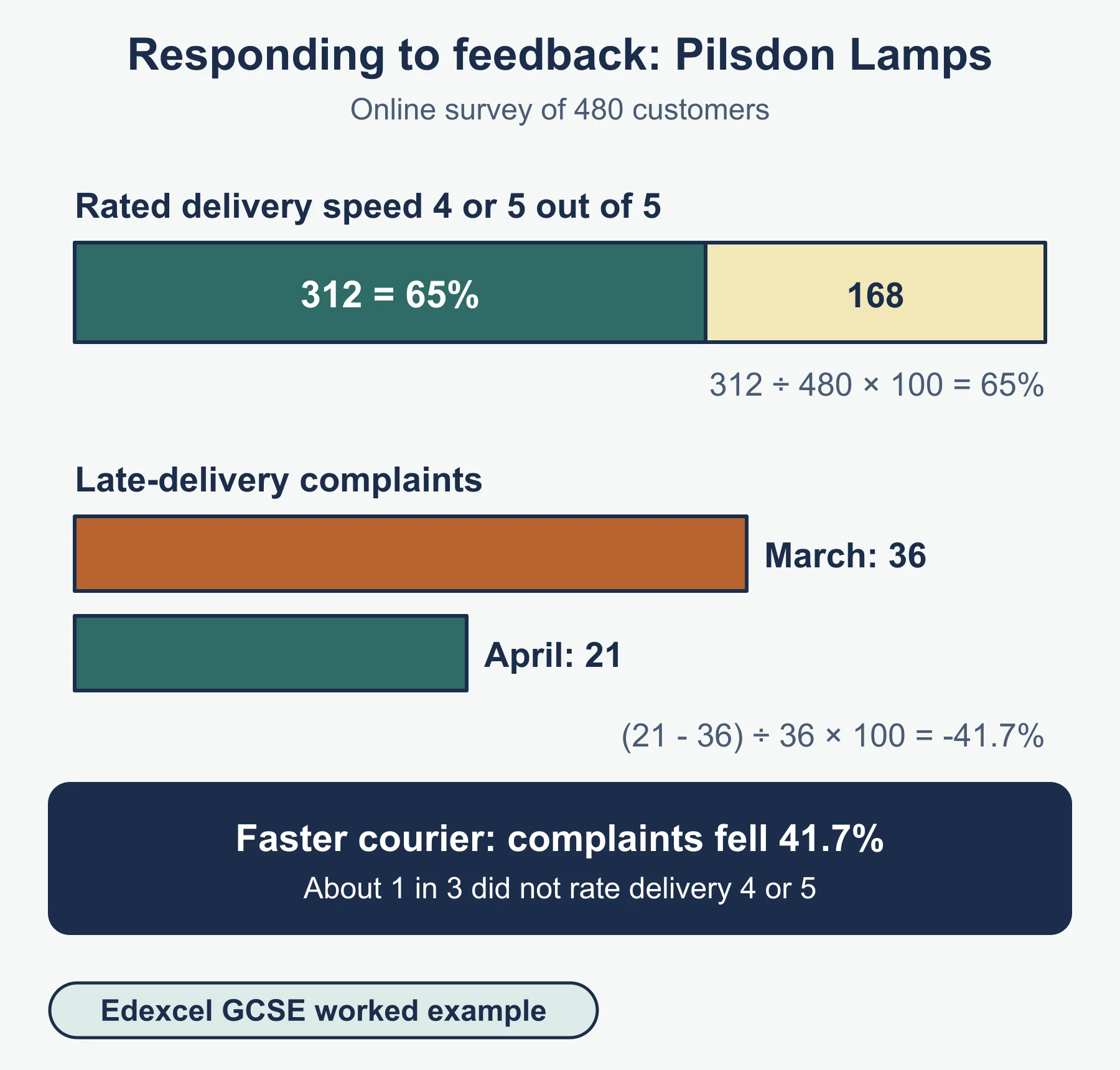
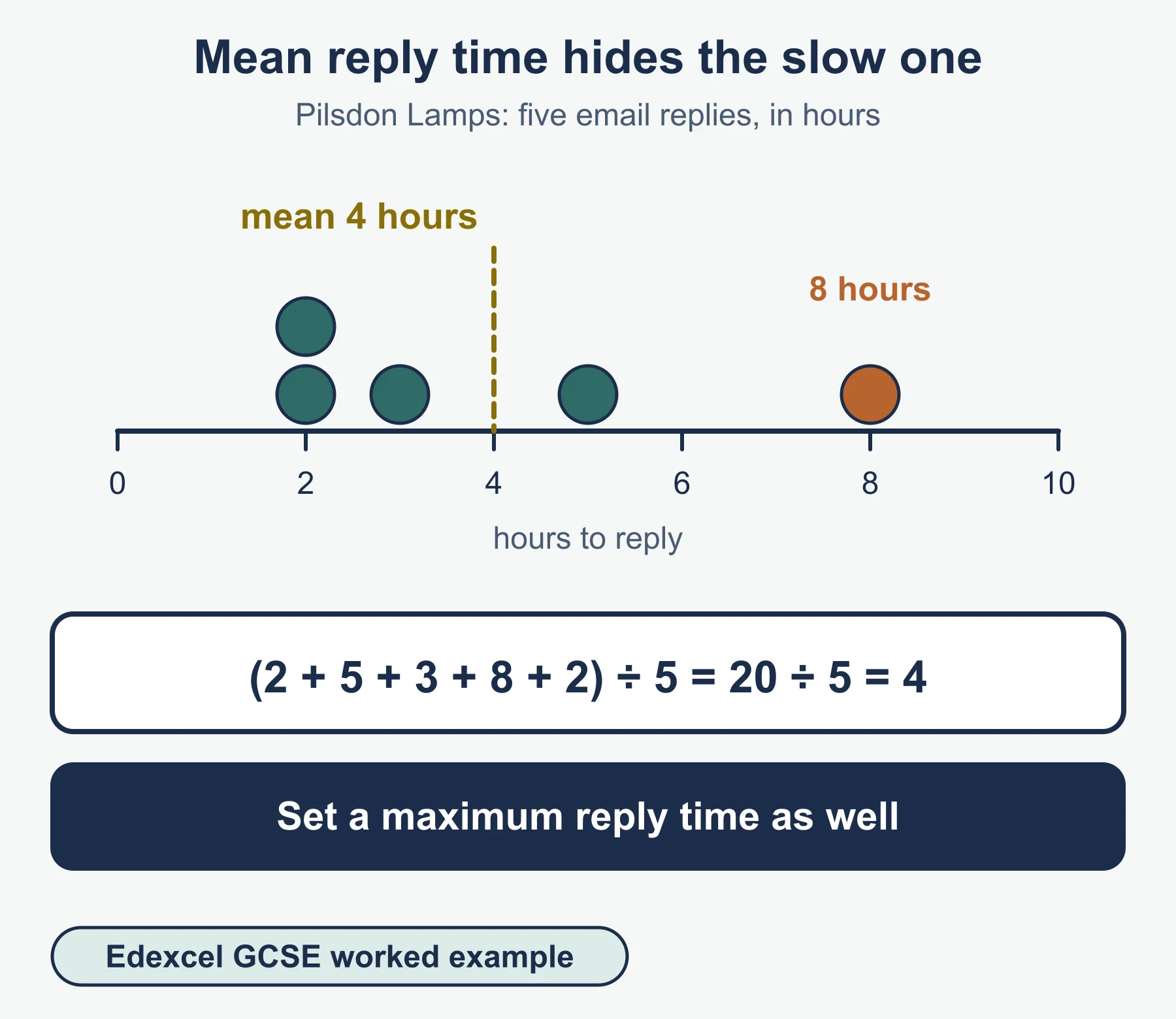
Worked example 3. Pilsdon Lamps sells online. In one month 480 customers answer its survey and 312 rate delivery speed 4 or 5 out of 5. Complaints about late delivery were 36 in March and 21 in April. Five email replies took 2, 5, 3, 8 and 2 hours.
Satisfied with delivery = 312 / 480 x 100 = 65%
Change in complaints = (21 - 36) / 36 x 100 = -41.7%
Mean reply time = (2 + 5 + 3 + 8 + 2) / 5 = 20 / 5 = 4 hours
Complaints fell by 41.7%, which suggests the faster courier worked. About one customer in three did not rate delivery highly, so the business should keep acting on feedback. The mean reply time of 4 hours hides an 8-hour wait, so the business might set a maximum time as well.
Percentages, percentage changes and averages appear in the specification’s quantitative skills (Appendix 2). The percentage-change formula above is the standard form.
6. Why good customer service matters
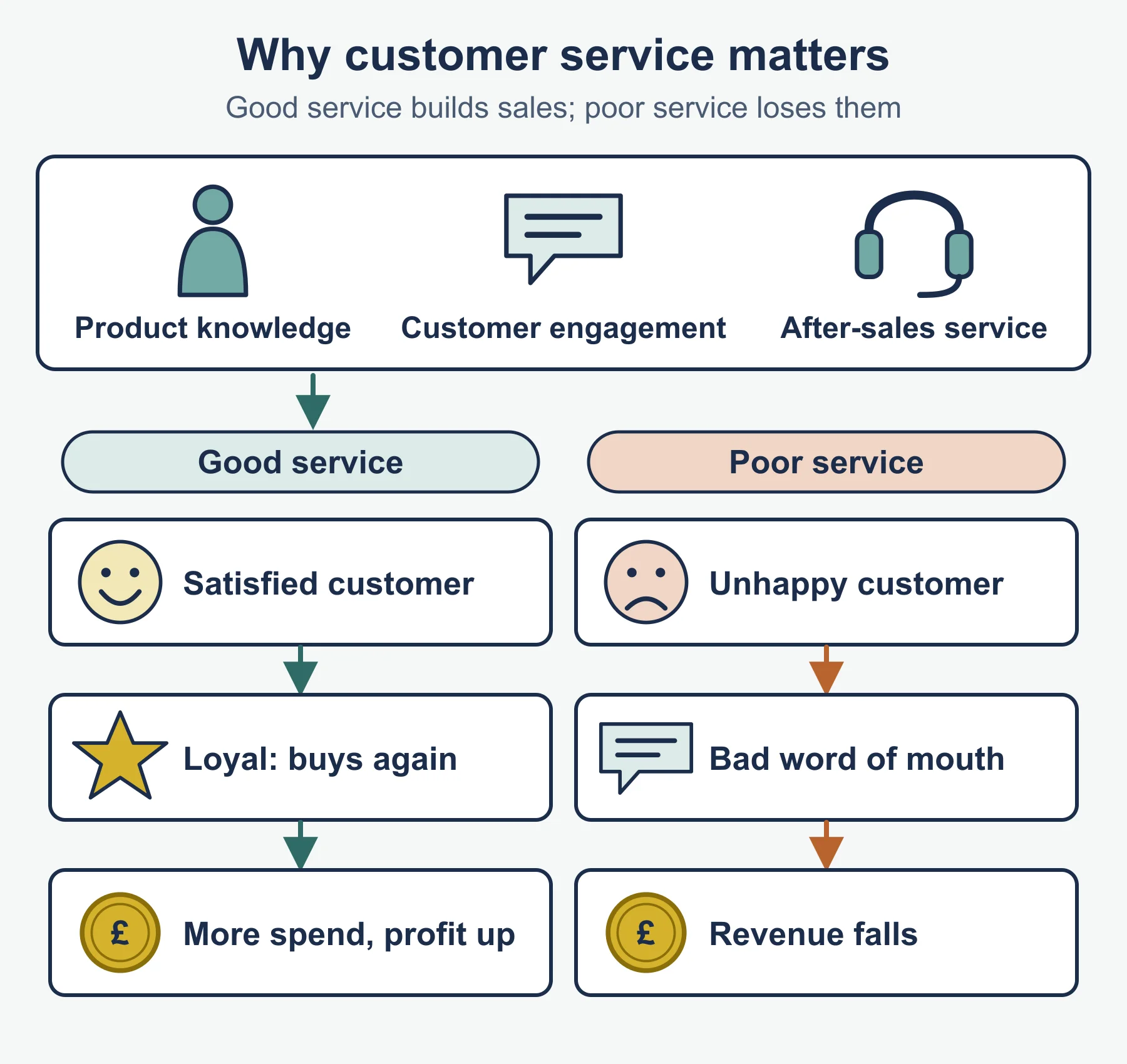
Customer service is the help and attention a business gives customers before, during and after a sale. Good service:
- encourages repeat purchases, which cost less than finding new customers
- builds a reputation through word of mouth and online reviews
- helps keep customers when rivals sell similar products
- helps a business gain a competitive advantage, as in section 4
- can support a higher price if customers value being looked after.
Poor service has the opposite effect. Customers leave, say so publicly and may not return. Good service has costs, such as training, extra staff and returns policies, so a business should compare these with the likely gain.
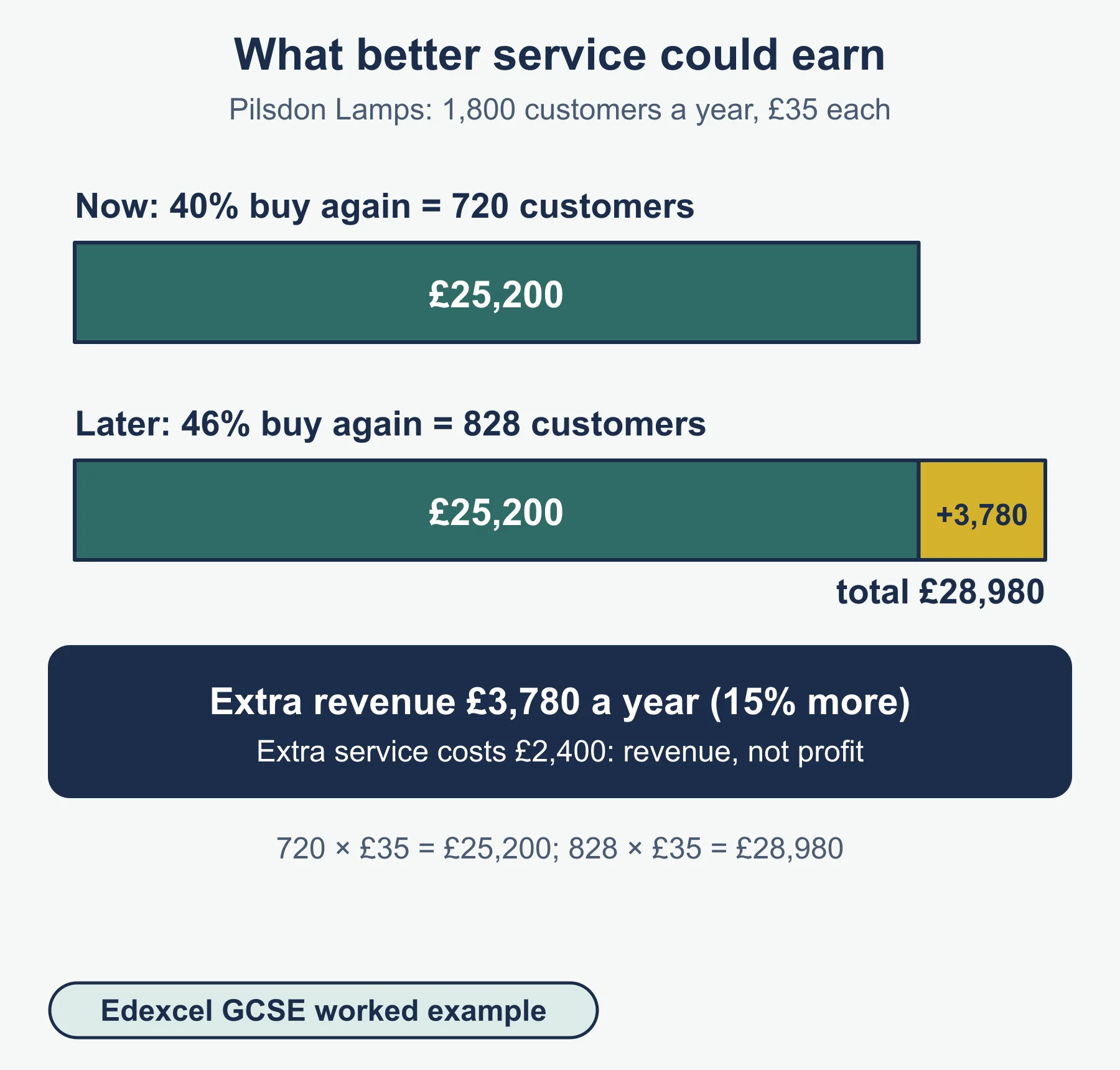
Worked example 4. Pilsdon Lamps has 1,800 customers a year, of whom 40% buy again, spending an average of £35 each. Better service is expected to lift the repeat rate to 46%.
Now:   1,800 x 40% = 720 repeat customers   x £35 = £25,200
Later: 1,800 x 46% = 828 repeat customers   x £35 = £28,980
Extra sales revenue = £28,980 - £25,200 = £3,780   (15% more)
If the extra service costs £2,400 a year, the extra revenue exceeds the cost, but profit also depends on the cost of the lamps sold. The decision depends on how reliable the forecast is.
Common errors
- Describing quality control and quality assurance as the same thing.
- Saying quality assurance guarantees no faults at all.
- Writing that high quality is always expensive, without weighing the savings from fewer faults.
- Naming all five parts of the sales process but not applying them to the business in the question.
- Explaining customer service benefits without linking them to repeat custom, reputation or competitive advantage.
- Giving percentage changes the wrong way round, so that a fall shows as a rise.
- Ending an evaluation with a list of points and no judgement.
Frequently asked questions
What is quality in GCSE Business? Quality is how well a product meets the needs and expectations of the customer who buys it. For goods it shows in materials, finish and reliability; for services it shows in accuracy, courtesy, reliability and the time taken.
How does quality give a business a competitive advantage? Satisfied customers buy again and recommend the business, a reputation for quality can support a higher price, and quality is hard for rivals to copy quickly because it comes from training and supplier relationships.
What is post-sales service? Post-sales service is help given after the sale, such as returns, repairs, guarantees and follow-up emails. It is one of the five parts of the sales process in the Edexcel GCSE Business (1BS0) specification.
Does quality assurance guarantee there will be no faults? No. Quality assurance reduces faults by preventing them, but it does not remove them all, which is why many businesses also use quality control to catch any that remain.
Official syllabus
Pearson Edexcel Level 1/Level 2 GCSE (9-1) in Business (1BS0), Specification, Issue 2, July 2022, published by Pearson Education Limited. Theme 2, Topic 2.3 Making operational decisions, content items 2.3.3 and 2.3.4.
Get free revision emails (optional)
Occasional emails with practice questions, worked explanations and links to free resources for the qualification and subjects you choose. No spam, and you can unsubscribe from any email. The free tools on this site never need an email.
Related resources
-
Practice questions
Edexcel GCSE Business: Quality and the sales process (1BS0) – Practice Questions
Original practice questions with worked answers on quality control, quality assurance, the sales process and customer service for Edexcel GCSE Business.
Business · Pearson Edexcel · GCSE
Try questions -
Revision notes
Edexcel GCSE Business: Quality and the sales process (1BS0) – Revision Notes
Condensed revision notes on quality control, quality assurance, quality and costs, the sales process and customer service for Edexcel GCSE Business.
Business · Pearson Edexcel · GCSE
Revise topic -
Study guides
Edexcel GCSE Business: Business operations and managing stock (1BS0)
Study guide to production processes, technology, bar gate stock graphs, just in time and working with suppliers, for Pearson Edexcel GCSE Business.
Business · Pearson Edexcel · GCSE
Read guide
Related articles
-
teaching
A Level tuition in Dubai: Cambridge or Pearson Edexcel International A Level?
Schools in Dubai and Abu Dhabi teach either Cambridge International AS & A Level or Pearson Edexcel International A Level. How the two are structured, why it matters for tuition, and how online classes from Lahore work.
9 October 2026
-
curriculum guides
Choosing subjects at IGCSE and A Level
How subject choices at 14 and 16 affect university options later, and how to keep pathways open without overloading a timetable.
28 July 2026
Studying this with a teacher
Working through Business GCSE?
This page is free and stays free. If you would rather be taught it, Marlbridge runs Business classes one-to-one and in small groups of up to 15, online in your own time zone. The first trial class is free. WhatsApp replies within an hour (8am–11pm Pakistan time, every day); email the same day.
Pearson Edexcel Business teachers at Marlbridge

