
Revision Notes
Edexcel GCSE Business: Quality and the sales process (1BS0) – Revision Notes
Condensed revision notes on quality control, quality assurance, quality and costs, the sales process and customer service for Edexcel GCSE Business.
- Subject
- Business
- Level
- GCSE
- Topic
- Making operational decisions
- Author
- Marlbridge Academic Team
- Updated
- Reviewed by
- Asif Iqbal (what this means)
Aligned to Pearson Edexcel GCSE Business (1BS0), Issue 2, July 2022. Official specification .
Syllabus page (what it covers and how it is assessed): Pearson Edexcel GCSE Business.
Syllabus points this page covers
1BS0
- 2.3 Making operational decisions (whole topic)
- 2.3.3 Managing quality
- 2.3.4 The sales process
Found an error? Report a correction.
Want a teacher for this? Marlbridge teaches Business online. Request a free trial class.
These notes condense Theme 2, Topic 2.3 items 2.3.3 (managing quality) and 2.3.4 (the sales process) of the Pearson Edexcel Level 1/Level 2 GCSE (9-1) in Business (1BS0) specification, Issue 2, July 2022. For full explanations and worked examples, read the study guide. Then test yourself with the practice questions.
Course links: the Business hub, the printable checklist and the free diagnostics. The specification says formulae are not provided in the examinations, so learn the forms below.
Specification checklist
| Item | Content point | Where in these notes |
|---|---|---|
| 2.3.3 | Concept of quality in goods and in services | Key terms |
| 2.3.3 | Quality control and quality assurance | Key terms; Must-know distinctions |
| 2.3.3 | Controlling costs and gaining a competitive advantage | Quality, costs and advantage |
| 2.3.4 | Product knowledge, speed and efficiency of service, customer engagement, responses to customer feedback, post-sales service | The five parts |
| 2.3.4 | Importance of good customer service | Customer service |
Key terms
| Term | Meaning |
|---|---|
| Quality | How well a product meets the needs and expectations of customers |
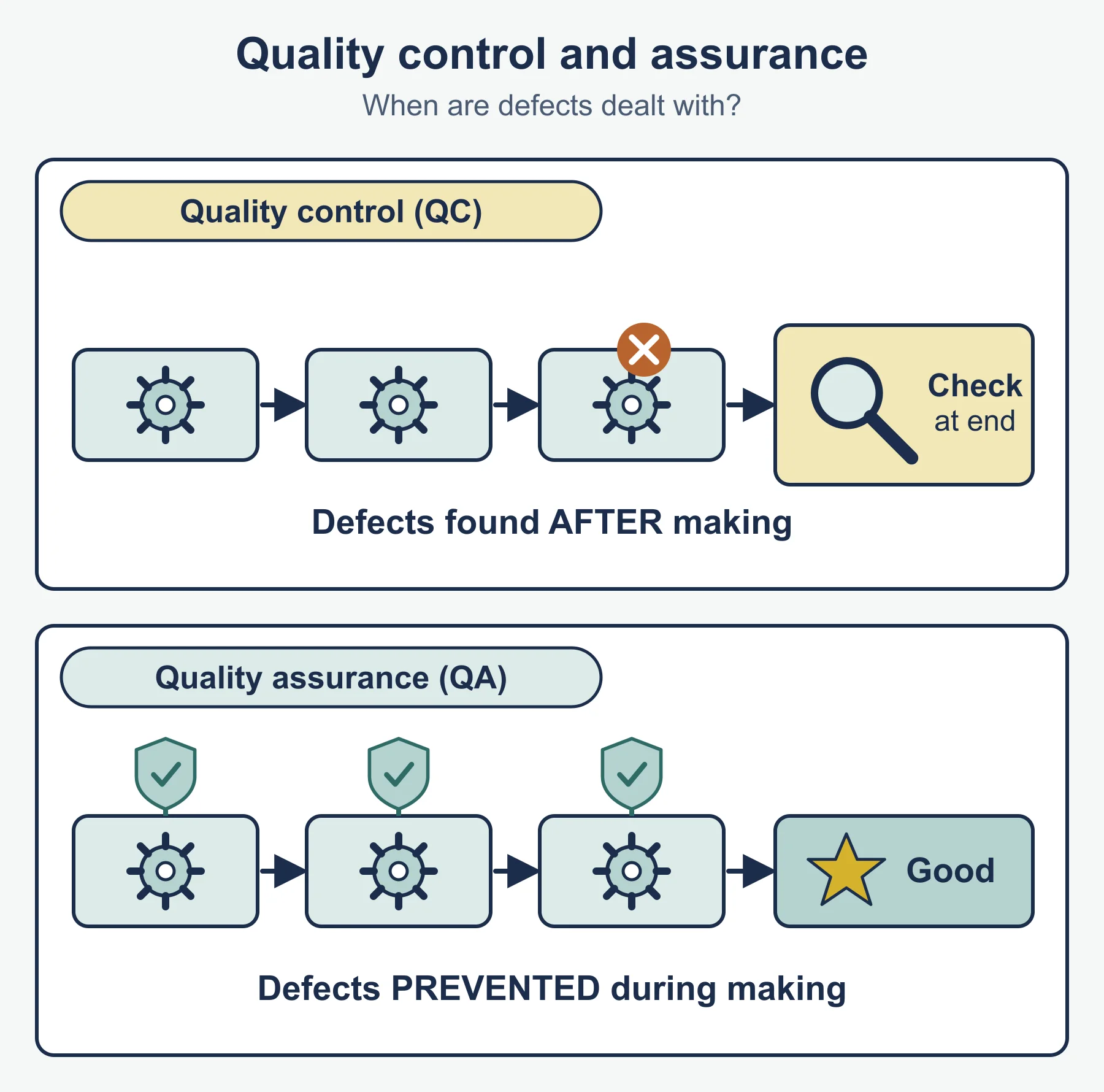
| Quality control | Inspecting and testing to find faults, so faulty items are removed or put right before reaching customers |
| Quality assurance | Systems and standards across the whole process that prevent faults |
| Competitive advantage | Something that makes customers prefer a business to its rivals |
| Sales process | The contact between business and customer before, during and after a sale |
| Customer service | The help and attention given to customers |
| Post-sales service | Support after purchase, such as repairs, returns and guarantees |
The specification names quality control and quality assurance without defining them. The wording above is the standard form.
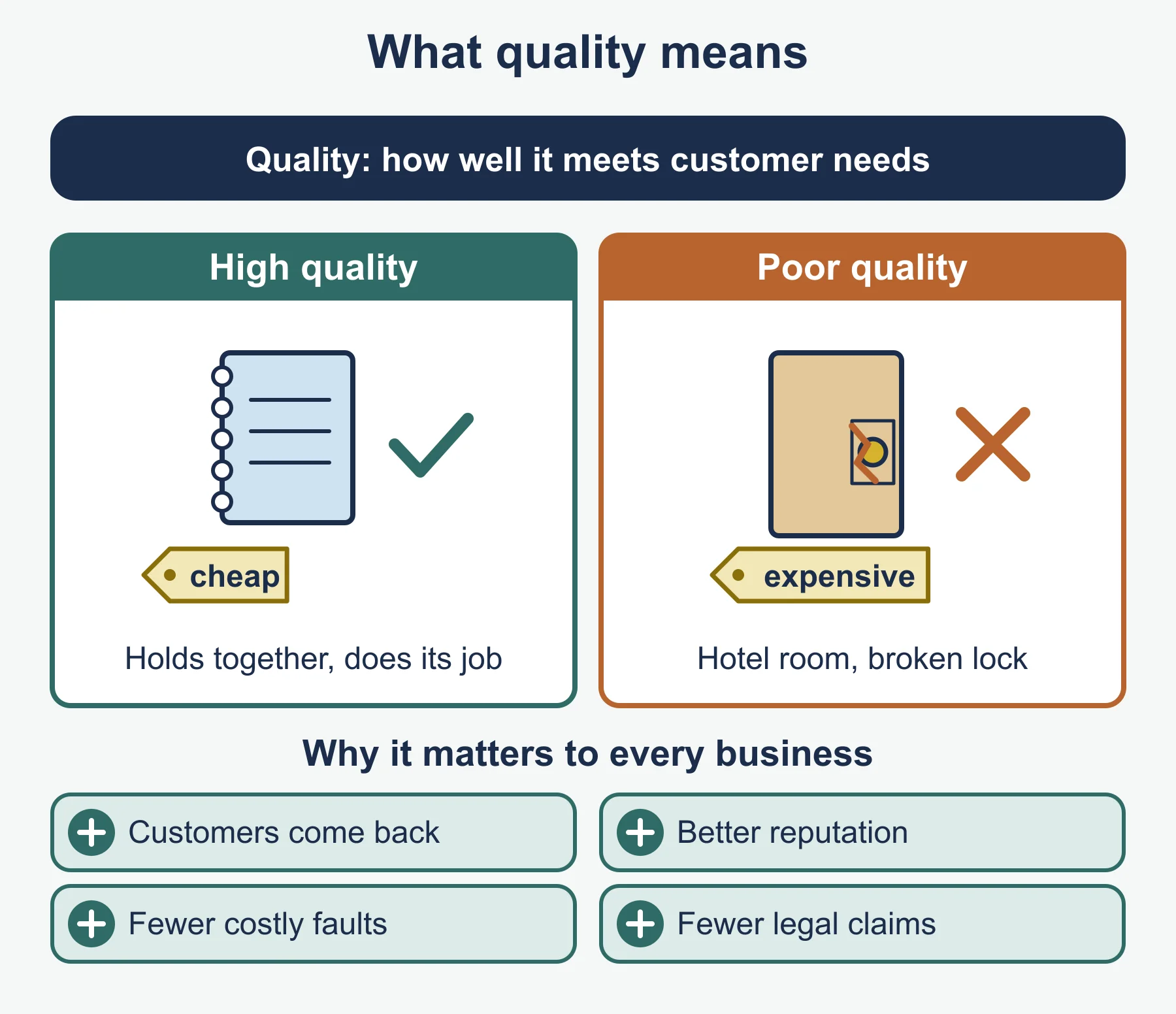
Quality in goods and services
- Goods: materials, finish, reliability, durability, safety.
- Services: accuracy, courtesy, reliability, speed. A service is used up as it is delivered, so errors are hard to take back.
- Quality is not the same as price. It means meeting what the target customer expects.
- Theme 1 lists quality as a customer need, next to price, choice and convenience.
Must-know distinctions
| Quality control | Quality assurance | |
|---|---|---|
| Idea | Find faults | Prevent faults |
| Timing | End or set points | Whole process |
| People | Inspectors or testers | Everyone, plus suppliers |
| Goods example | Testing each sample from a batch of kettles | Agreeing material standards with the supplier and training assemblers |
| Services example | A supervisor listening to a call before it is closed | Training advisers and giving them a call checklist |
| Downside | Waste has already happened | Slow to set up; relies on staff commitment |
Do not confuse these with the customer-facing parts of the sales process. Quality control and assurance are about the product. The sales process is about how the customer is treated.
Quality, costs and advantage
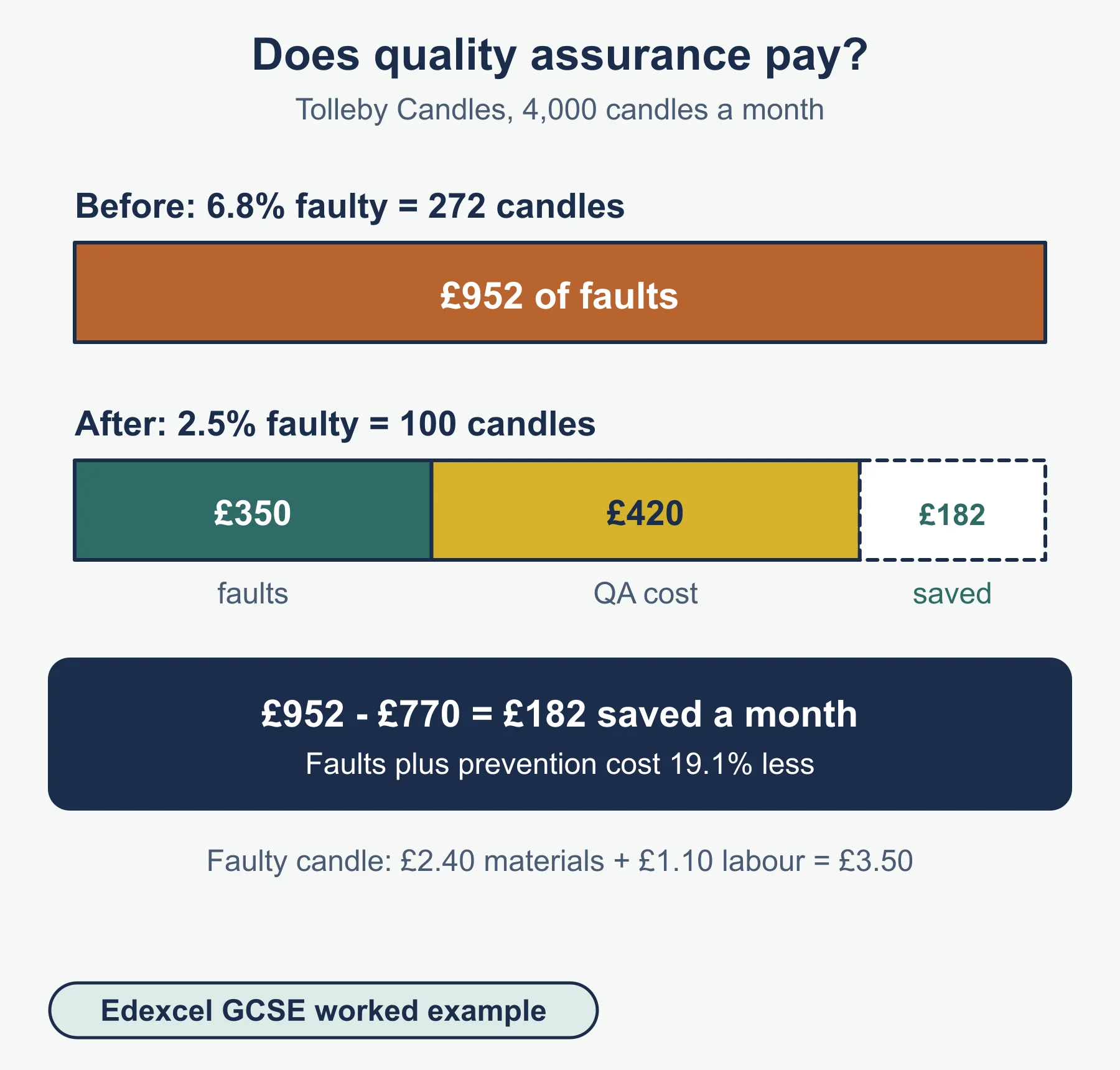
Controlling costs:
- fewer faults means less scrapped material and rework
- fewer refunds, replacements and returns
- less staff time on complaints
- but quality systems cost money (training, inspectors, testing equipment), so compare cost with saving.
Gaining a competitive advantage:
- satisfied customers repeat-buy and recommend
- a reputation for quality supports a higher price or wins customers from rivals
- quality built into a business is slower for rivals to copy than a price cut
- the advantage only works if customers notice and value the quality.
The five parts of the sales process
| Part | One-line test | Quick example |
|---|---|---|
| Product knowledge | Can staff answer questions accurately? | A bike-shop worker explains gears correctly |
| Speed and efficiency of service | Is the customer served quickly and with few errors? | Orders leave the warehouse on the day they are placed |
| Customer engagement | Does staff interest build a relationship? | Asking what a customer needs before recommending |
| Responses to customer feedback | Does the business listen and act? | Changing the opening hours after a survey |
| Post-sales service | Is help available after the sale? | A free repair under guarantee |
Why customer service matters
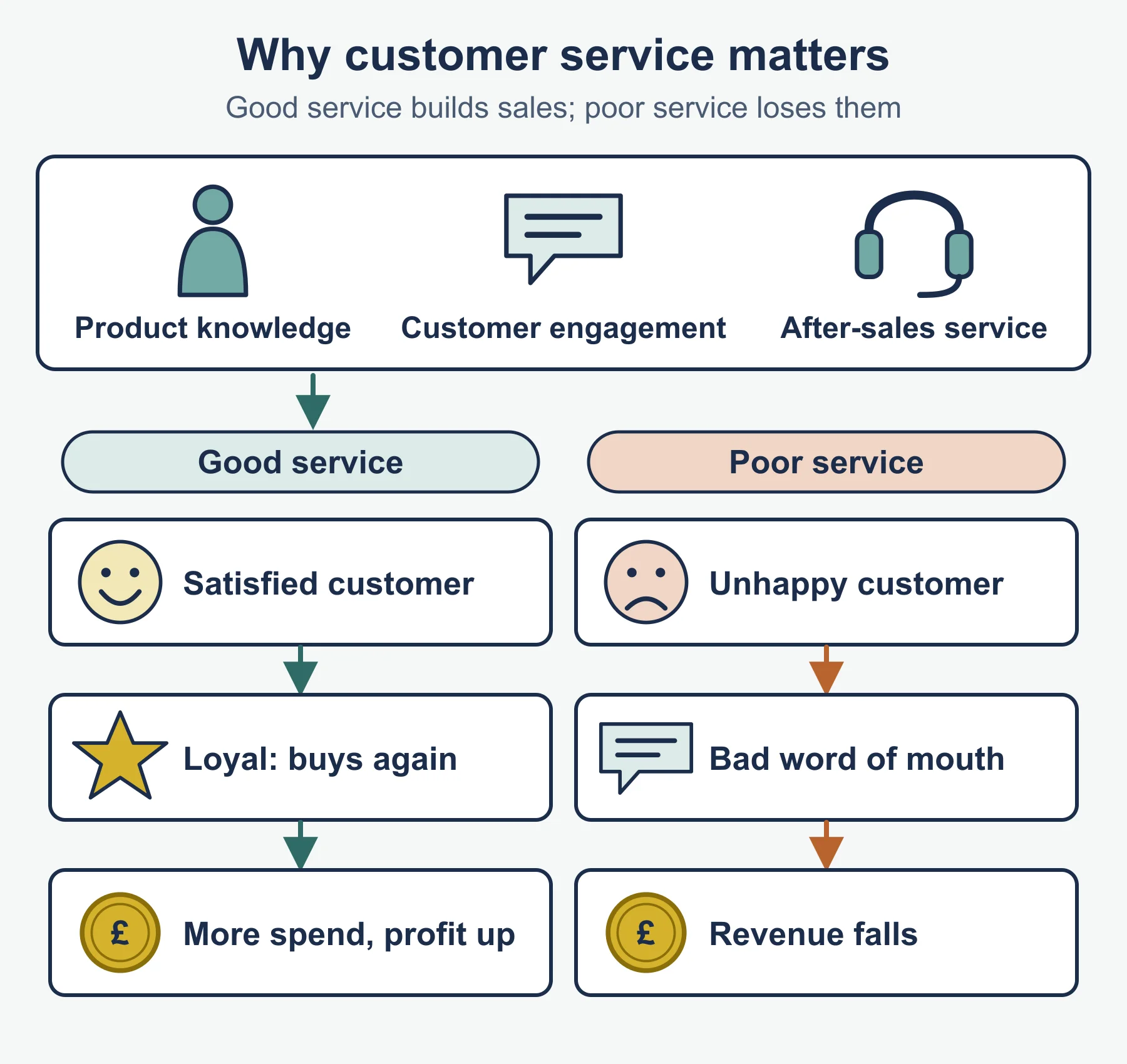
- repeat purchases and customer loyalty
- good reputation, reviews and word of mouth
- helps a business stand out from rivals, which is a competitive advantage
- can support a higher price
- poor service loses customers and damages reputation
- good service costs money, for example training, extra staff and returns policies.
Method boxes
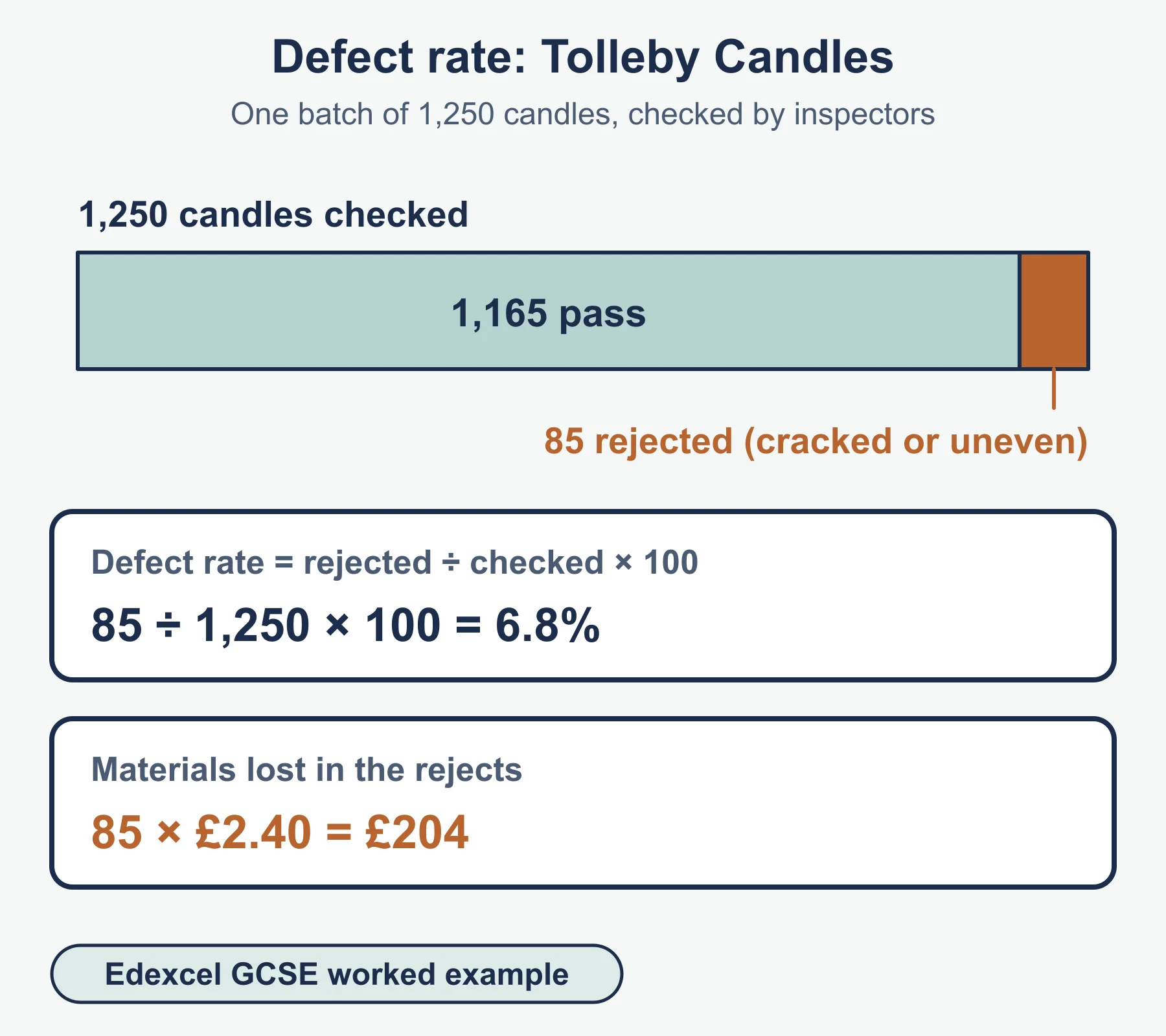
Calculating a defect rate (standard form)
- Write: defect rate = number of faulty items / total items checked x 100.
- Substitute the numbers from the question.
- Give the answer as a percentage, with the unit.
Calculating a percentage change (standard form)
- Find the change: new value minus old value.
- Divide by the old value.
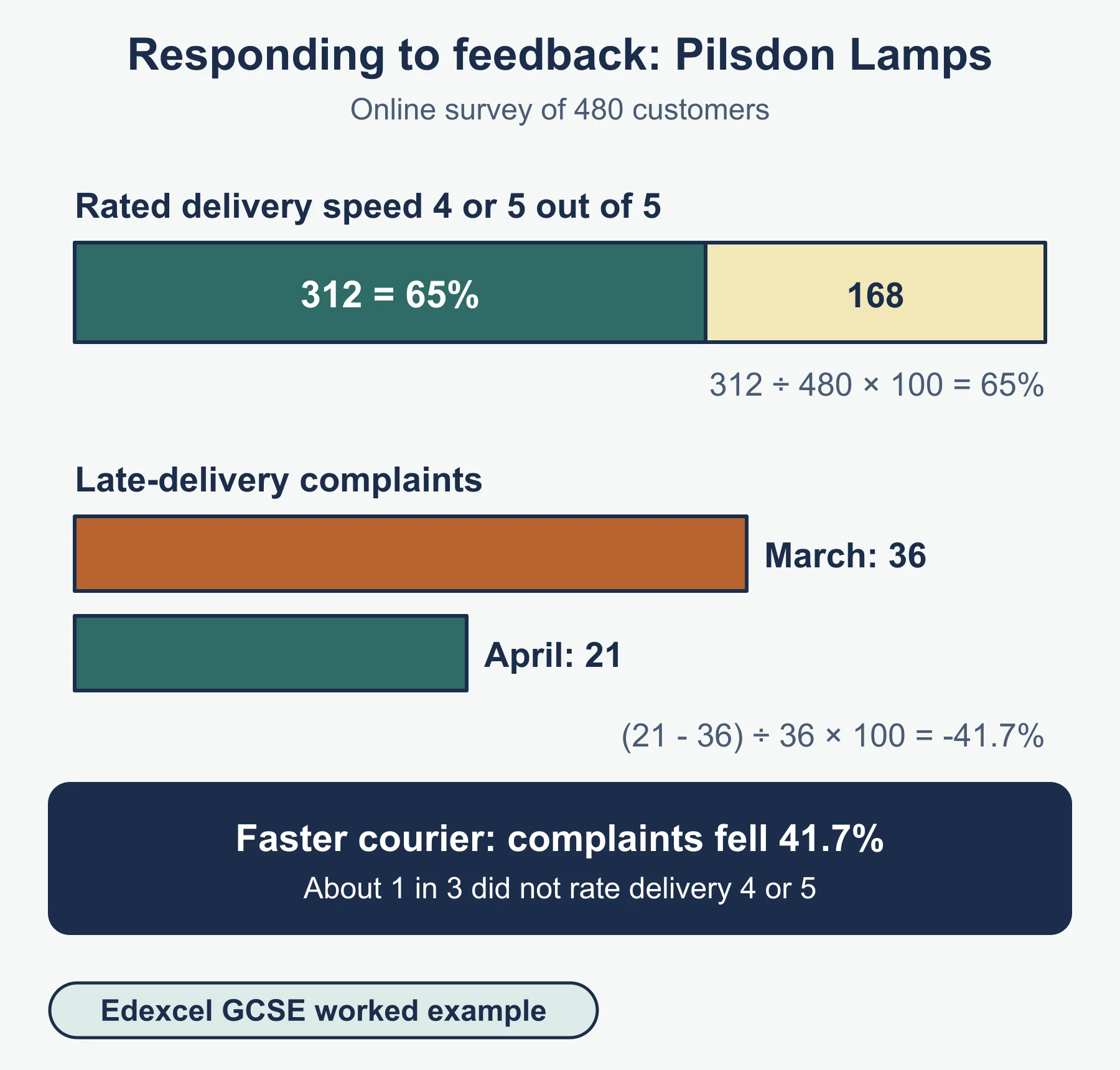
- Multiply by 100. A negative answer means a fall.
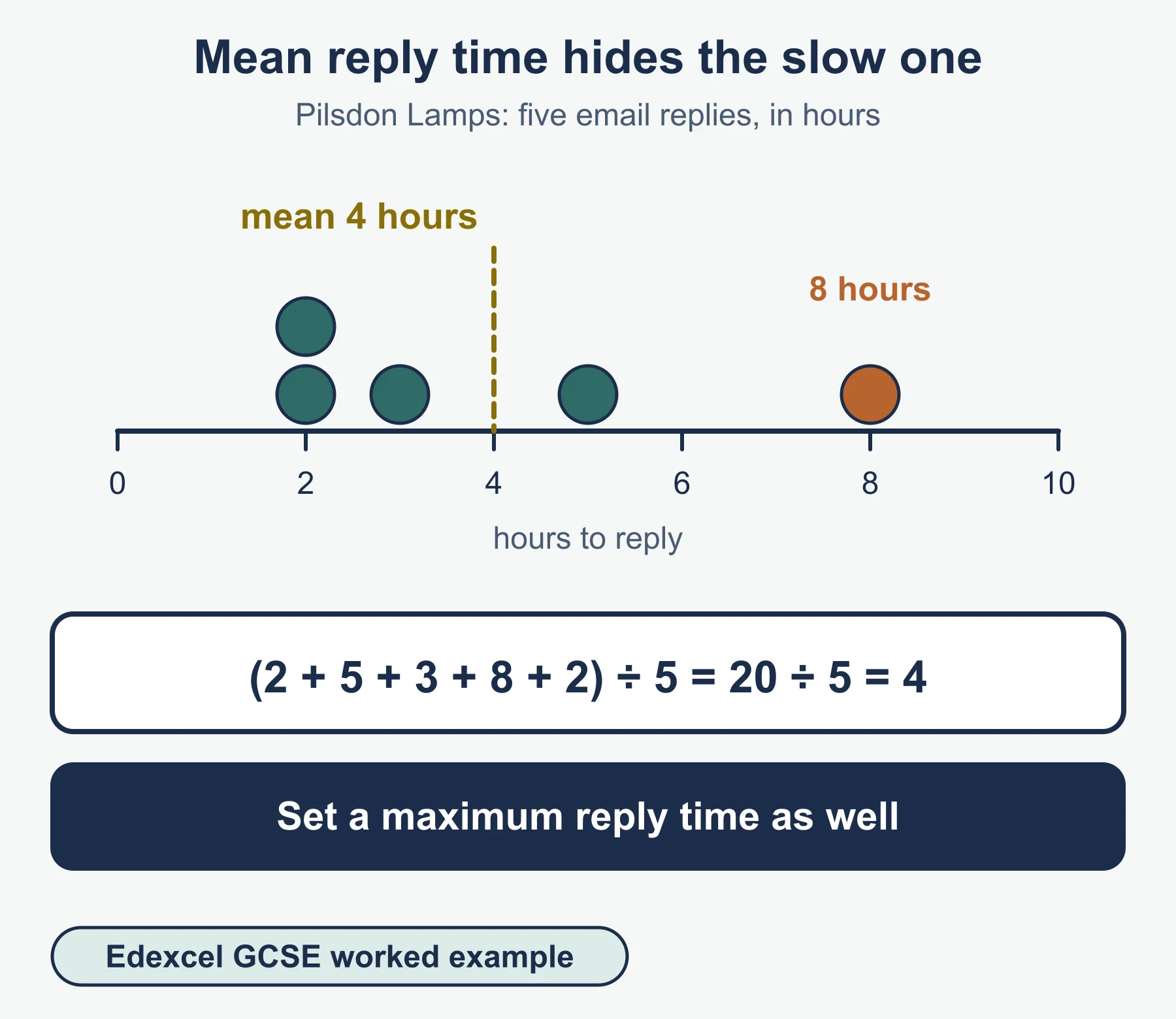
Calculating a mean
- Add all the values.
- Divide by the number of values.
Small worked reminders
- Linton Laundry checks 450 shirts and finds 9 with stains. Defect rate = 9 / 450 x 100 = 2%.
- Complaints rise from 50 to 65. Change = (65 - 50) / 50 x 100 = 30% rise.
- Five waiting times of 12, 8, 10, 6 and 9 minutes: mean = 45 / 5 = 9 minutes.
Answering by command word (as the specification describes them)
- Define: give the meaning of the term and nothing more.
- Give / State / Identify: one short answer.
- Calculate: show the working, then the answer with units.
- Outline: two linked points, placed in the business in the question.
- Explain: a fact, then two expansion points (no context needed).
- Analyse: an extended chain of reasoning, applied to the business in the question.
- Justify: use the information given to recommend one of two options.
- Evaluate: weigh the points and reach a supported conclusion.
Applying the ideas to a case
When a question gives you a business, ask four things before writing:
- Does it sell goods or a service? This decides which quality examples fit.
- Who are its customers, and what do they expect on quality and service?
- Where does it check quality now: at the end of production (control) or throughout (assurance)?
- Which part of the sales process is weakest in the data given?
Then link your point to the business. For example, a firm selling made-to-order furniture can show that a fault found at the end wastes expensive wood and workshop time, so prevention is likely to save more than extra inspection. A quick-service cafe has little to inspect after the drink is served, so staff training and a clear routine matter more.
For a judgement, weigh the cost of the quality system or the service improvement against the likely saving or extra sales revenue, say which is larger, and state what the answer depends on, such as how reliable a forecast is or how long the benefit takes to appear.
Quick self-test
- Define “quality control”.
- Give two features of quality assurance.
- A pottery inspects 600 mugs and finds 36 faulty. Calculate the defect rate.
- Complaints fall from 80 to 62 in a month. Calculate the percentage change.
- Four customers wait 6, 9, 4 and 11 minutes. Calculate the mean waiting time.
- A restaurant manager trains all waiting staff in a standard greeting and table routine. State whether this is quality control or quality assurance.
- An online shop has 2,400 orders and 5% are refunded at an average cost of £16 each. Calculate the cost of the refunds.
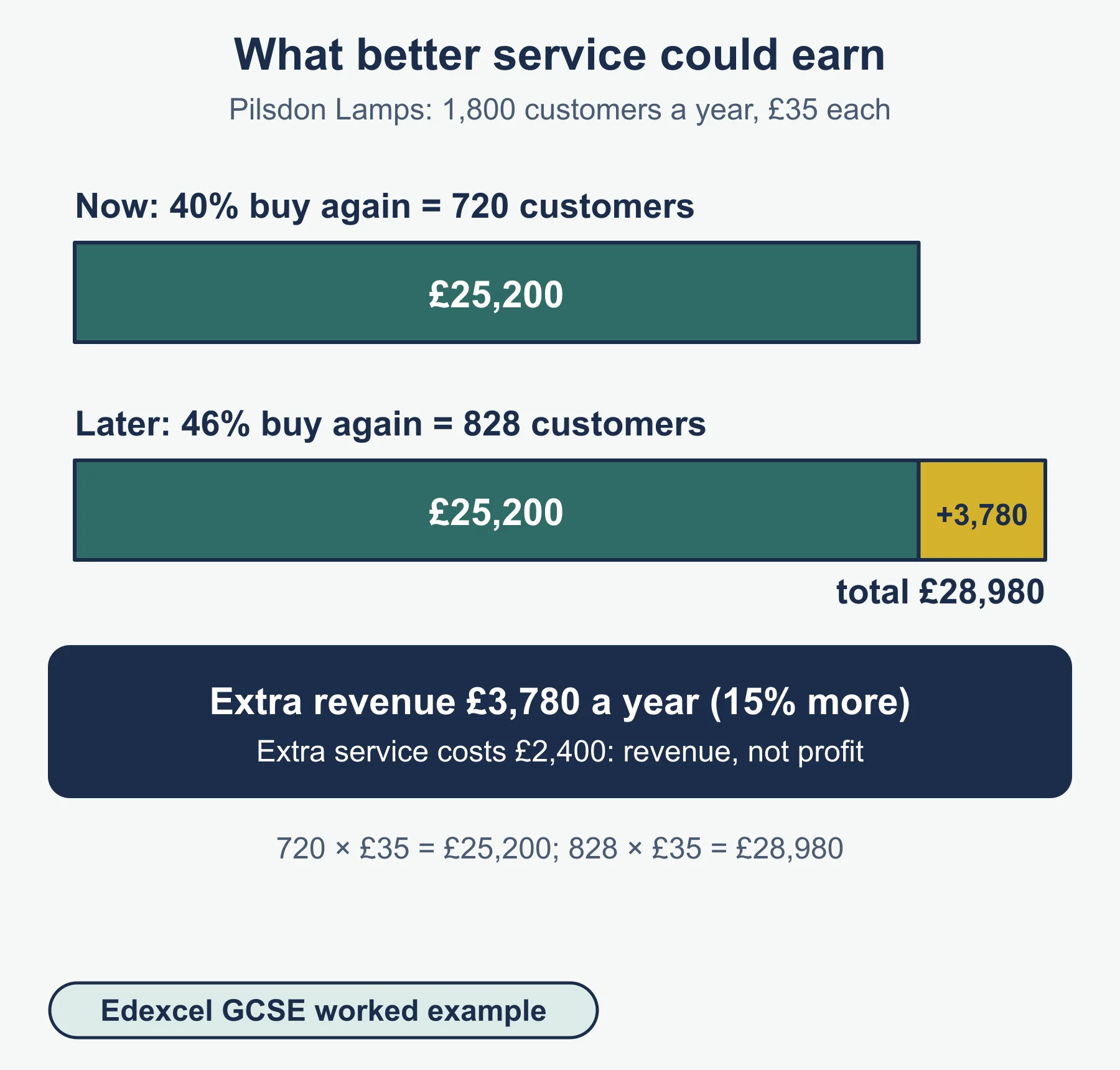
- A shop has 500 customers and 30% buy again, spending an average of £22 each. Better service lifts repeat buying to 36%. Calculate the increase in sales revenue from repeat customers.
- Give one cost to a business of providing good customer service.
- Give the five parts of the sales process named in the specification.
Answers
- Inspecting and testing products to find faults, so faulty items are removed or put right before reaching customers.
- Any two: agreed standards, staff training, checking materials and suppliers, written procedures or checklists, every worker responsible for quality.
- 36 / 600 x 100 = 6.0%.
- (62 - 80) / 80 x 100 = -22.5%, a fall of 22.5%.
- (6 + 9 + 4 + 11) / 4 = 30 / 4 = 7.5 minutes.
- Quality assurance, because it prevents mistakes across the whole process instead of inspecting afterwards.
- 2,400 x 5% = 120 refunds; 120 x £16 = £1,920.
- Now: 500 x 30% = 150 repeat customers x £22 = £3,300. After: 500 x 36% = 180 x £22 = £3,960. Increase = £660.
- Any one: training costs, wages for extra staff, the cost of repairs or replacements under guarantee, the cost of a returns policy.
- Product knowledge; speed and efficiency of service; customer engagement; responses to customer feedback; post-sales service.
Where marks are usually lost
- Writing that quality control prevents faults, when it finds them.
- Writing that quality assurance means there will be no faults at all.
- Using the right term but giving an example from the wrong kind of business, such as goods language for a service.
- Giving a benefit of customer service without saying how it helps the business, for example through repeat custom.
- Listing the five parts of the sales process without choosing the ones that fit the case.
- Leaving out the old value when finding a percentage change.
- Forgetting units: the pound sign, minutes or the percentage sign.
- In “evaluate” and “justify” answers, listing points but not weighing them or choosing an option.
- Ignoring the costs of quality and customer service when asked about their effect on profit.
Frequently asked questions
What is the difference between quality control and quality assurance? Quality control inspects and tests products at set points or at the end of production to find and remove faults. Quality assurance puts standards, training and procedures in place throughout the process so faults are prevented, with every worker responsible.
What are the five parts of the sales process in Edexcel GCSE Business? The 1BS0 specification lists product knowledge, speed and efficiency of service, customer engagement, responses to customer feedback and post-sales service.
How can quality help a business control costs? Fewer faults mean less scrapped or reworked output, fewer refunds and replacements, and less time spent on complaints. Quality systems cost money too, so the savings must be weighed against them.
Does high quality mean a high price? No. A cheap product can be good quality if it is made well and does what customers want for that price. A business aims for the level of quality its target customers expect.
Official syllabus
Pearson Edexcel Level 1/Level 2 GCSE (9-1) in Business (1BS0), Specification, Issue 2, July 2022, published by Pearson Education Limited. Theme 2, Topic 2.3 Making operational decisions, content items 2.3.3 and 2.3.4.
Get free revision emails (optional)
Occasional emails with practice questions, worked explanations and links to free resources for the qualification and subjects you choose. No spam, and you can unsubscribe from any email. The free tools on this site never need an email.
Related resources
-
Study guides
Edexcel GCSE Business: Business operations and managing stock (1BS0)
Study guide to production processes, technology, bar gate stock graphs, just in time and working with suppliers, for Pearson Edexcel GCSE Business.
Business · Pearson Edexcel · GCSE
Read guide -
Practice questions
Edexcel GCSE Business: Business operations and managing stock (1BS0) – Practice Questions
Twelve original questions with worked answers on production processes, technology, stock graphs, JIT and suppliers for Edexcel GCSE Business.
Business · Pearson Edexcel · GCSE
Try questions -
Revision notes
Edexcel GCSE Business: Business operations and managing stock (1BS0) – Revision Notes
Condensed revision notes on job, batch and flow production, technology, bar gate stock graphs, JIT and suppliers for Edexcel GCSE Business.
Business · Pearson Edexcel · GCSE
Revise topic
Related articles
-
teaching
A Level tuition in Dubai: Cambridge or Pearson Edexcel International A Level?
Schools in Dubai and Abu Dhabi teach either Cambridge International AS & A Level or Pearson Edexcel International A Level. How the two are structured, why it matters for tuition, and how online classes from Lahore work.
9 October 2026
-
curriculum guides
Choosing subjects at IGCSE and A Level
How subject choices at 14 and 16 affect university options later, and how to keep pathways open without overloading a timetable.
28 July 2026
Studying this with a teacher
Working through Business GCSE?
This page is free and stays free. If you would rather be taught it, Marlbridge runs Business classes one-to-one and in small groups of up to 15, online in your own time zone. The first trial class is free. WhatsApp replies within an hour (8am–11pm Pakistan time, every day); email the same day.
Pearson Edexcel Business teachers at Marlbridge

