
Revision Notes
Edexcel GCSE Business: Product and price decisions (1BS0) – Revision Notes
Condensed revision notes on product and price decisions for Pearson Edexcel GCSE Business Theme 2 topic 2.2, with formulae, tables and a self-test.
- Subject
- Business
- Level
- GCSE
- Topic
- Making marketing decisions
- Author
- Marlbridge Academic Team
- Updated
- Reviewed by
- Asif Iqbal (what this means)
Aligned to Pearson Edexcel GCSE Business (1BS0), Issue 2, July 2022. Official specification .
Syllabus page (what it covers and how it is assessed): Pearson Edexcel GCSE Business.
Syllabus points this page covers
1BS0
- 2.2 Making marketing decisions (whole topic)
- 2.2.1 Product
- 2.2.2 Price
Found an error? Report a correction.
Want a teacher for this? Marlbridge teaches Business online. Request a free trial class.
These notes condense Pearson Edexcel Level 1/Level 2 GCSE (9-1) Business (1BS0), Issue 2, July 2022, Theme 2: Building a business, topic 2.2 Making marketing decisions, content items 2.2.1 Product and 2.2.2 Price. For full explanations and worked examples, read the study guide. When you are ready to test yourself, use the practice questions.
Links: the Edexcel GCSE Business hub, the printable checklist and the free diagnostics. Related: the marketing mix and the business plan.
The specification sets two written papers, Theme 1 (1BS0/01) and Theme 2 (1BS0/02), each 1 hour 45 minutes, 90 marks and 50% of the qualification. Calculators may be used. Formulae are listed in the specification (Appendix 3) and are not provided in the examinations, so learn the ones below.
1. The design mix (2.2.1)
| Part | Meaning | Link to cost and price |
|---|---|---|
| Function | What the product does and how well: reliability, ease of use, durability | Better function usually costs more to build |
| Aesthetics | How it looks, feels, sounds, smells or tastes; includes packaging | Finish and styling add cost but can support a higher price |
| Cost | What it costs the business to make or provide | Limits the other two; sets the minimum price that leaves a profit |
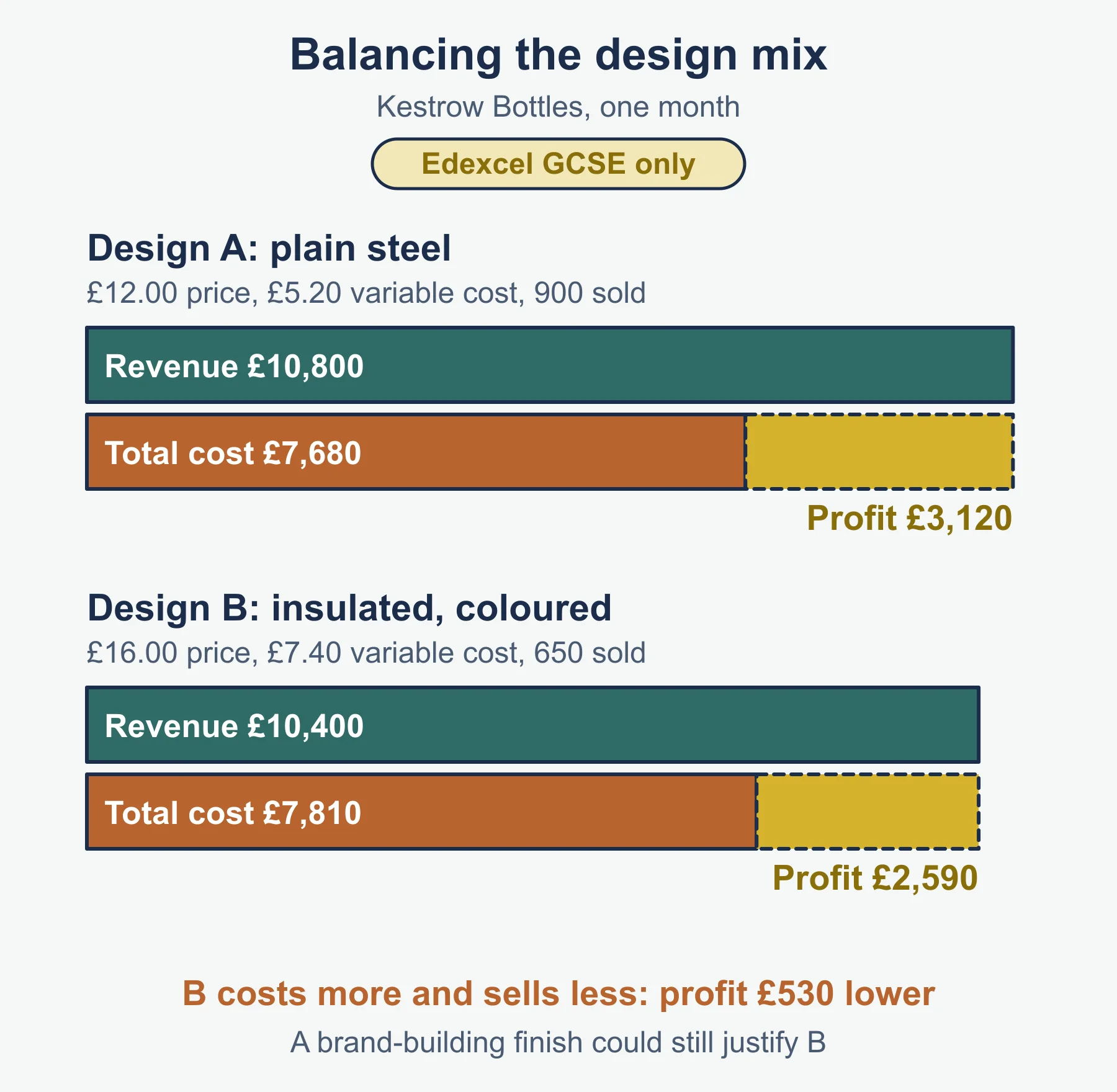
Design is a trade-off. Improving one part often raises cost, which affects price, demand and profit.
Worked reminder: cost against design
A bag costs £2.10 for materials, £0.90 for labour and £0.50 for packaging, so the unit cost is £3.50. A leather trim would add £1.20 a unit. The new unit cost is £4.70, a rise of 1.20 ÷ 3.50 × 100 = 34.3%. The trim only pays off if the higher price, or the extra sales, covers that extra £1.20 on every unit sold.
2. Differentiation (2.2.1)
Differentiation means making a product or service different from rivals’ in a way customers notice and value.
| Benefit to the business | Limit |
|---|---|
| A reason to choose it over rivals | Costs money to create |
| Can support a higher price | Can be copied |
| Builds loyalty | Worthless if customers do not value the difference |
Method in steps: answering “explain the importance of differentiation”
- Define it in a clause.
- Give one benefit (sales, price or loyalty).
- Expand with a consequence for revenue or profit.
- Where a business is named, tie the difference to its customers.
3. The product life cycle (2.2.1)
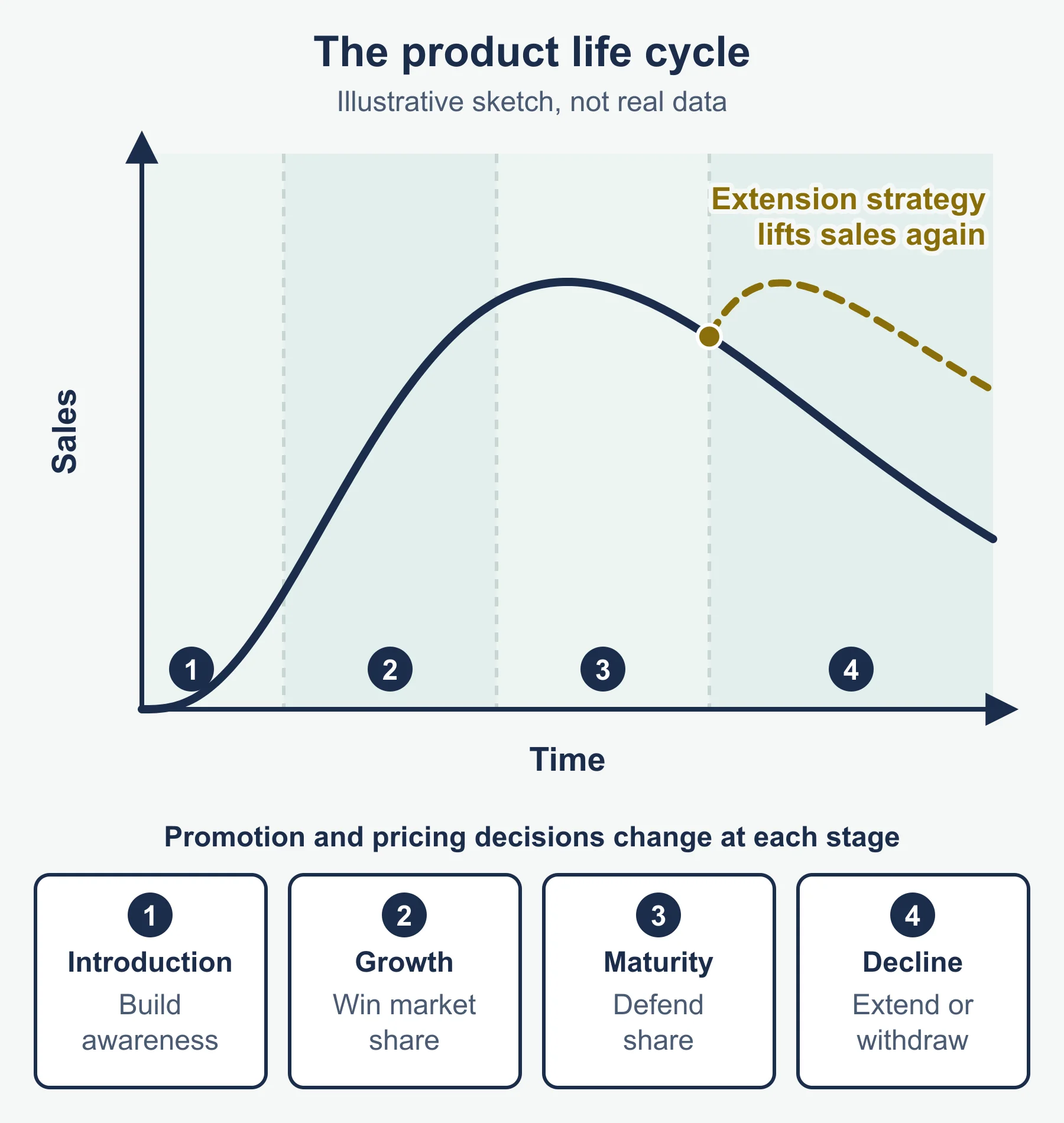
The specification refers to “the phases” without listing them. The standard four are below.
| Phase | Sales | Profit | Typical response |
|---|---|---|---|
| Introduction | Low, slow rise | Low or negative | Build awareness, encourage trial |
| Growth | Rapid rise | Rising | Build share, watch new rivals |
| Maturity | Peak, flat | Often highest, under pressure | Defend share, differentiate |
| Decline | Falling | Falling | Extend or withdraw |
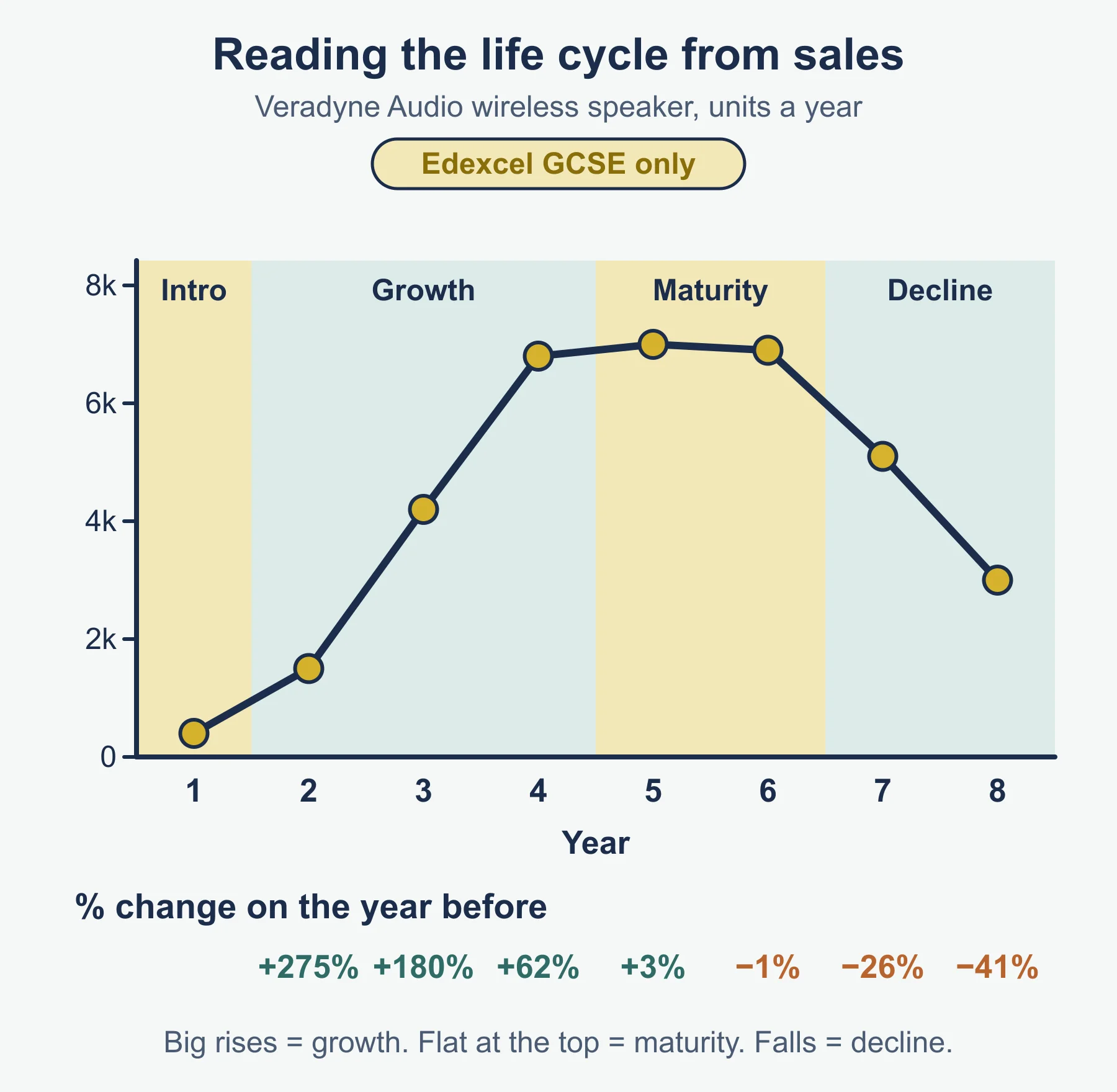
Percentage change = (new value − original value) ÷ original value × 100. This is the standard form.
Extension strategies
| Method | Example in words |
|---|---|
| Modify the product | New flavour, redesign, extra feature |
| New market | New segment or new country |
| New use | Promote for a different purpose |
| Packaging, price, promotion or place | Fresh packaging, a deal, a new sales channel |
Judge an extension by the extra sales it brings against what it costs. Contribution per unit = selling price − variable cost (standard form, not an Appendix 3 formula).
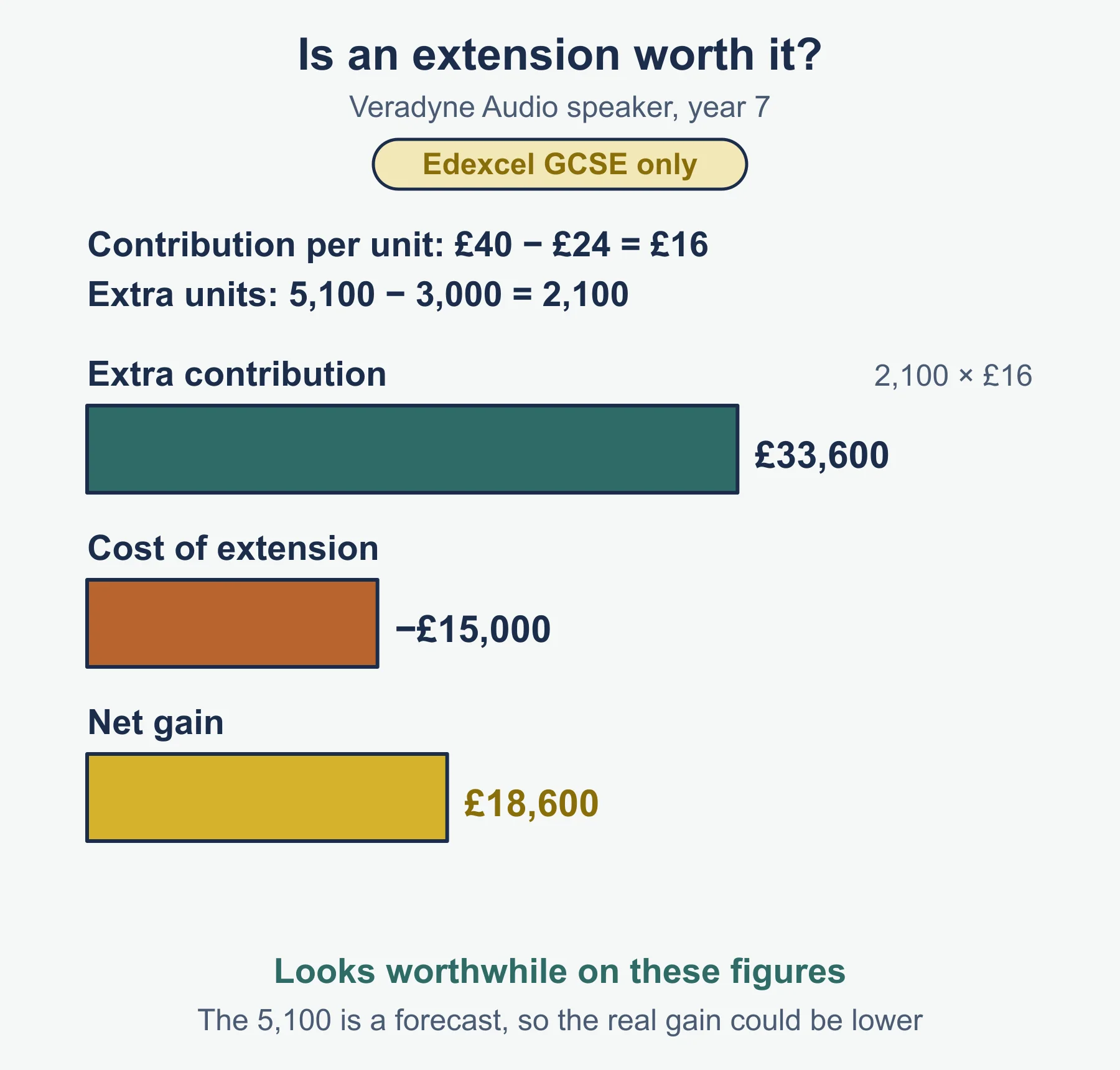
Worked reminder: is an extension worth it?
A product sells at £25 with a variable cost of £14, so contribution is £11 a unit. A relaunch costs £6,000. It pays for itself only if it adds more than 6,000 ÷ 11 = 545.45 units, so at least 546 extra units (546 × 11 = £6,006).
4. Pricing strategies (2.2.2)
The specification names “pricing strategies” without listing them. These are the standard ones.
| Strategy | Meaning | Suits | Risk |
|---|---|---|---|
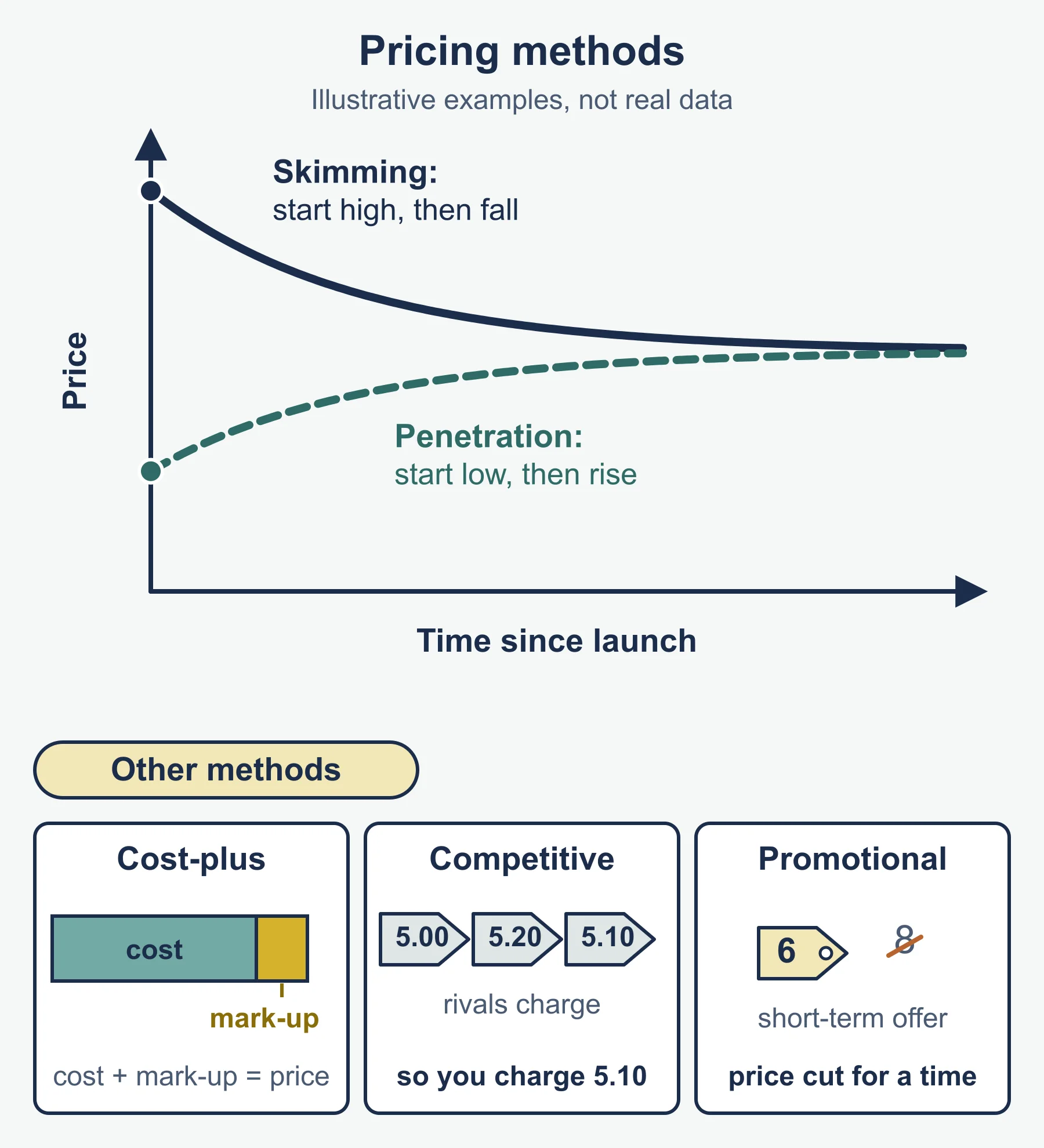
| Penetration | Low launch price to gain share | New product, many rivals, price-sensitive buyers | Low profit per unit; hard to raise price later |
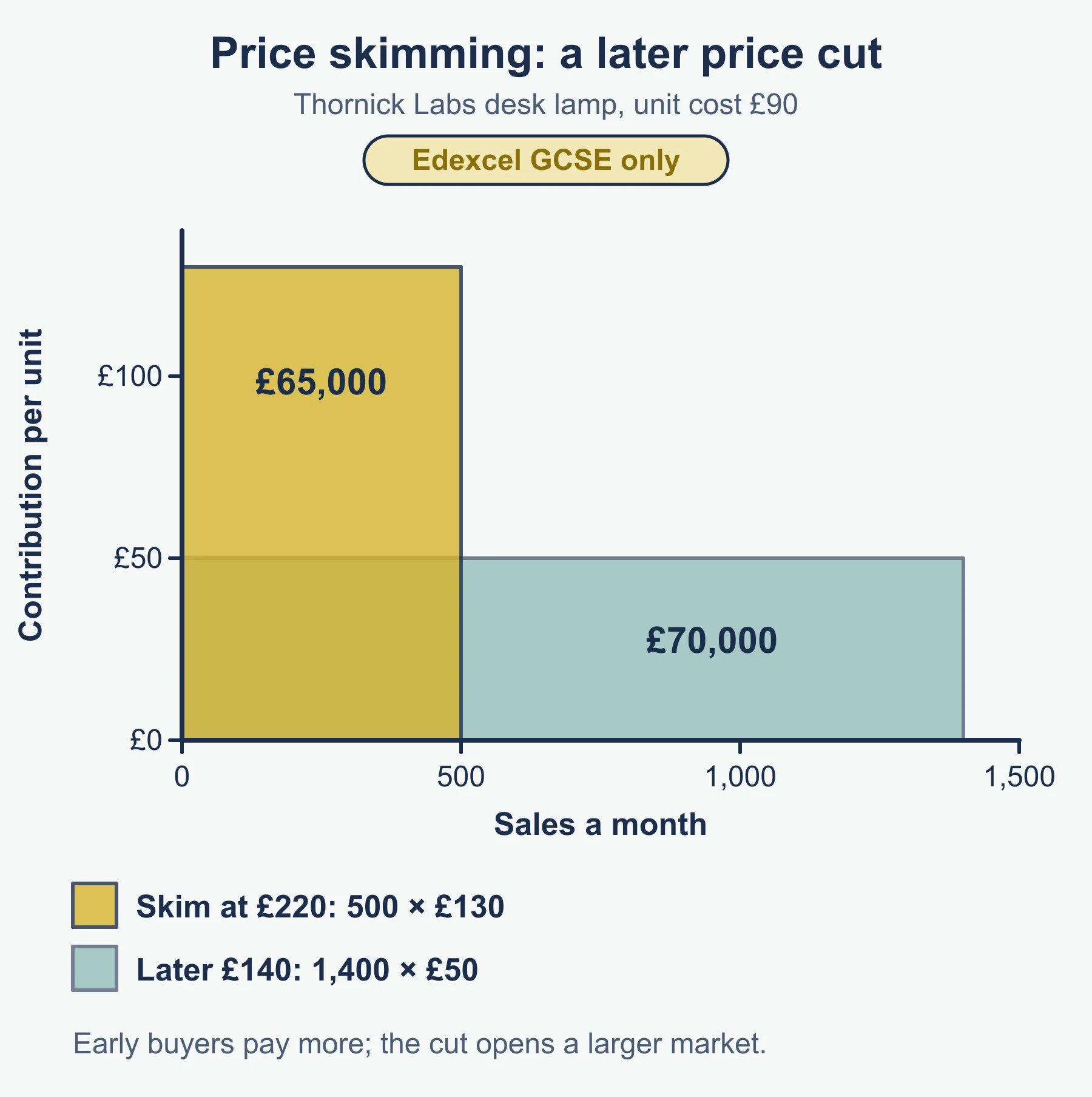
| Skimming | High launch price, cut later | Novel product, few rivals | Few buyers at first; rivals may enter |
| Competitive | Price close to rivals | Similar products, buyers who compare | Little scope to stand out on price |
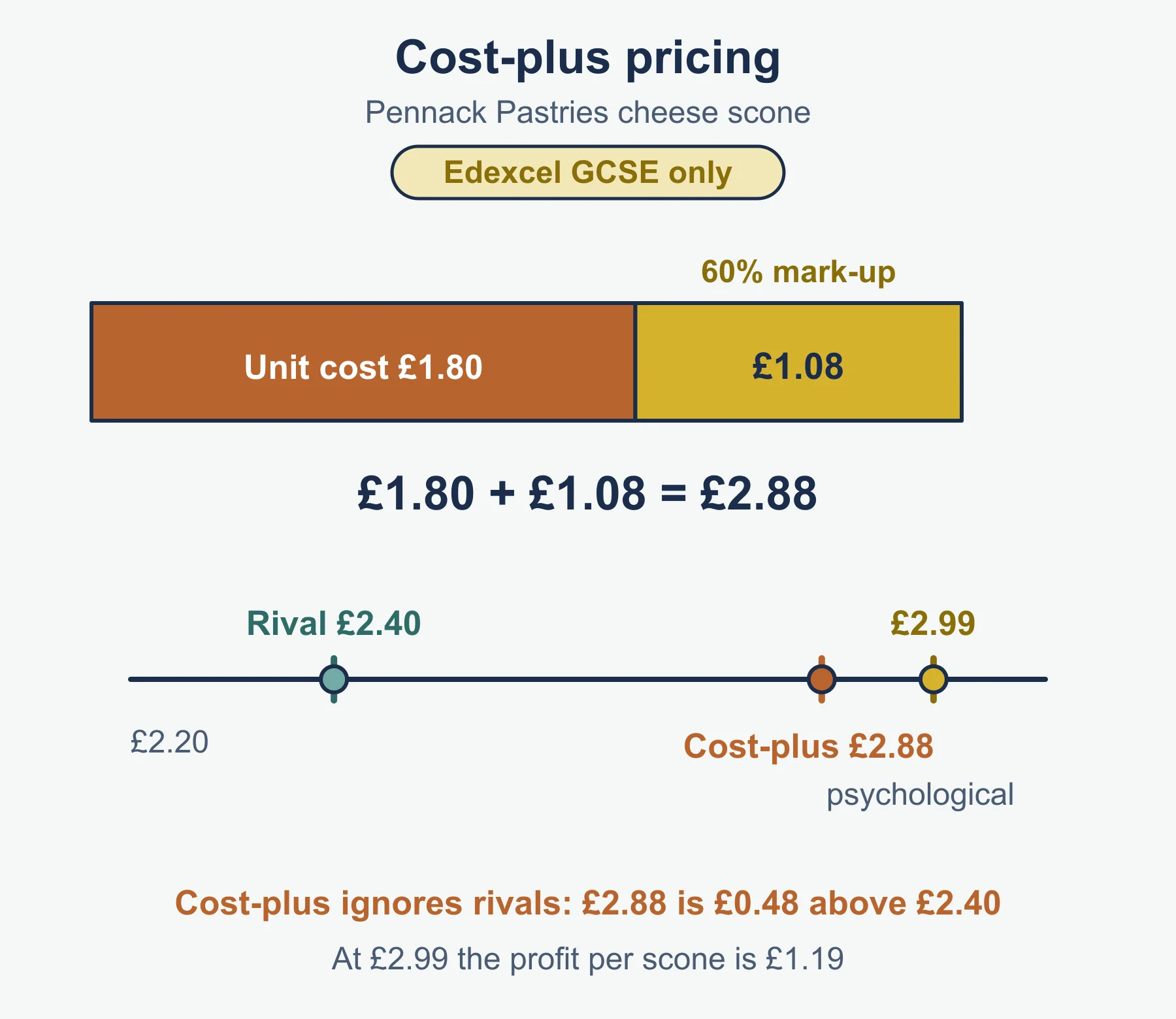
| Cost-plus | Unit cost + mark-up | Simple, set profit per unit | Ignores demand and rivals |
| Psychological | Looks lower, e.g. £7.99 | Everyday goods | Gain depends on customer perception |
| Promotional | Temporary price cut | Clearing stock, first purchase | Customers may wait for deals |
Cost-plus in standard form: selling price = unit cost + (unit cost × mark-up %). Revenue = price × quantity. Total cost = TFC + TVC (Appendix 3).
Worked reminder: revenue against contribution
A business can launch a product at £60 and sell 400, or at £45 and sell 600. The unit variable cost is £30.
- Revenue at £60: 60 × 400 = £24,000. At £45: 45 × 600 = £27,000.
- Contribution at £60: (60 − 30) × 400 = £12,000. At £45: (45 − 30) × 600 = £9,000.
The lower price earns more revenue but less contribution. Always say which measure you are using.
5. Influences on pricing strategies (2.2.2)
| Influence | Effect on pricing |
|---|---|
| Technology | Easy online price comparison pushes prices towards rivals’; automation and online selling can cut costs; prices are easy to change |
| Competition | More close rivals means less freedom; a differentiated product with few rivals has more |
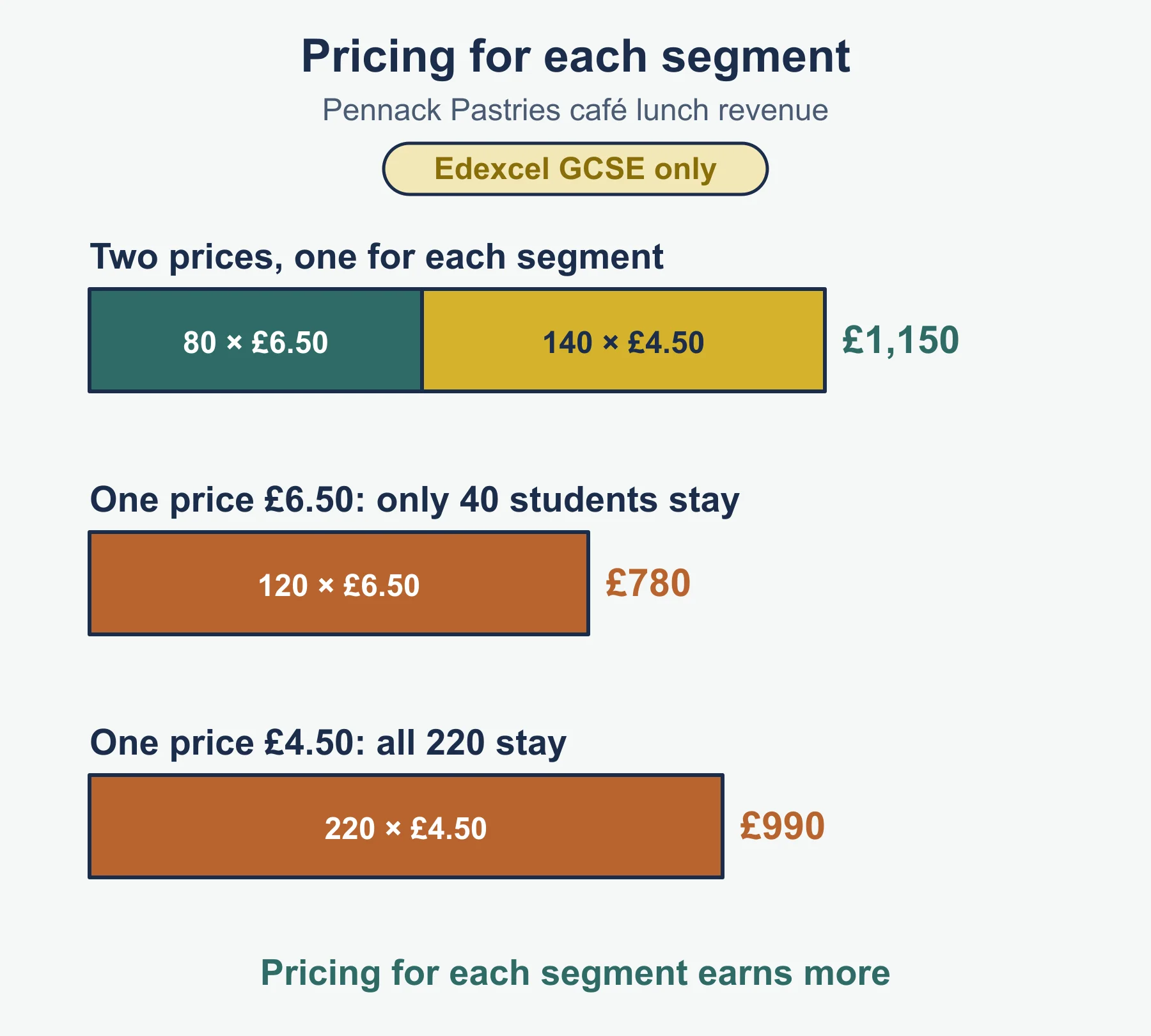
| Market segments | Groups may pay different prices, so prices can be set for each |
| Product life cycle | Skimming or penetration suit introduction; competitive pricing suits growth and maturity; promotional pricing may clear stock in decline |
Method in steps: recommending a pricing strategy
- Identify the product’s phase and the target segment from the information given.
- Say how many rivals there are and how close their products are.
- Choose a strategy that fits those facts and name it.
- Support it with a figure if one is given, such as revenue, contribution or percentage change.
- Give the main drawback and say whether it changes your choice.
- For “evaluate” or “justify”, end with a clear judgement and the reason for it.
Method in steps: reading life cycle data
- Work out the percentage change between each pair of periods.
- Large rises mean growth; small changes near the peak mean maturity; repeated falls mean decline.
- Name the phase and quote at least one figure.
- Say what the business should do next, for example extend the product.
6. Must-know distinctions
- Penetration is a low launch price; skimming is a high launch price.
- Differentiation is the difference; extension is the action to lengthen a product’s life.
- Revenue is price × quantity; profit is revenue minus total cost; contribution is price minus variable cost per unit.
- Maturity has flat sales at the peak; decline has falling sales.
- Cost-plus starts from cost; competitive pricing starts from rivals’ prices.
Quick self-test
- Define “differentiation”.
- State the three parts of the design mix.
- Sales rise from 2,000 to 2,600 units. Calculate the percentage change.
- Sales fall from 5,000 to 3,800 units. Calculate the percentage change.
- A product has flat sales at their peak and many rivals. Which phase is it in?
- A unit costs £4.50 and the mark-up is 40%. Calculate the cost-plus price.
- A business sells 1,300 units at £8.50, with fixed costs of £4,200 and a variable cost of £3.10 a unit. Calculate the profit.
- Give two extension strategies.
- Which strategy sets a high launch price and lowers it later?
- Explain one way competition can influence a pricing strategy.
Answers
- Making a product or service different from rivals’ in a way customers notice and value.
- Function, aesthetics and cost.
- (2,600 − 2,000) ÷ 2,000 × 100 = +30%.
- (3,800 − 5,000) ÷ 5,000 × 100 = −24%.
- Maturity.
- Mark-up 4.50 × 0.40 = £1.80; price 4.50 + 1.80 = £6.30.
- Revenue 8.50 × 1,300 = £11,050. Variable costs 3.10 × 1,300 = £4,030. Total cost 4,200 + 4,030 = £8,230. Profit = £2,820.
- Any two of: modify the product, find a new market, find a new use, change packaging, price, promotion or place.
- Price skimming.
- With many close rivals, a business has little freedom to charge more, because customers can switch. It may therefore use competitive or penetration pricing, which keeps sales but limits profit per unit.
Where marks are usually lost
- Naming a pricing strategy without saying what it is or why it suits this product.
- Listing life cycle phases without using the data in the question.
- Giving an extension strategy with no link to the cost, the market or the product.
- Writing “differentiation makes the product better” instead of “different in a way customers value”.
- Mixing up penetration and skimming.
- Calculating percentage change by dividing by the new value instead of the original.
- Confusing revenue, contribution and profit.
- Giving a one-sided answer to an evaluation question, with no judgement.
- Leaving out units or the pound sign in calculations.
Frequently asked questions
What is the design mix in Edexcel GCSE Business? The design mix is the set of decisions a business makes when designing a product. The 1BS0 specification names three parts: function, aesthetics and cost, which pull against each other so design is a trade-off.
What are the four phases of the product life cycle? The standard four phases are introduction, growth, maturity and decline. The specification refers to “the phases” without listing them, so these are the standard names.
What is the difference between penetration pricing and price skimming? Penetration pricing sets a low price at launch to win customers and market share quickly. Price skimming sets a high price at launch for a new or unusual product with few rivals, then lowers it later.
How do you calculate contribution per unit? Contribution per unit is the selling price minus the variable cost per unit. It is the standard measure for judging an extension strategy, and it is not one of the Appendix 3 formulae.
Official syllabus
Pearson Edexcel Level 1/Level 2 GCSE (9-1) in Business (1BS0), Specification, Issue 2, July 2022, published by Pearson Education Limited. Theme 2: Building a business, topic 2.2 Making marketing decisions, content items 2.2.1 Product and 2.2.2 Price.
Get free revision emails (optional)
Occasional emails with practice questions, worked explanations and links to free resources for the qualification and subjects you choose. No spam, and you can unsubscribe from any email. The free tools on this site never need an email.
Related resources
-
Study guides
Edexcel GCSE Business: Promotion, place and combining the marketing mix (1BS0)
Study guide to promotion, place and combining the marketing mix for Pearson Edexcel GCSE Business, Theme 2 topic 2.2, with worked examples.
Business · Pearson Edexcel · GCSE
Read guide -
Practice questions
Edexcel GCSE Business: Promotion, place and combining the marketing mix (1BS0) – Practice Questions
Twelve original practice questions with worked answers on promotion, place and the integrated marketing mix for Pearson Edexcel GCSE Business Theme 2.
Business · Pearson Edexcel · GCSE
Try questions -
Revision notes
Edexcel GCSE Business: Promotion, place and combining the marketing mix (1BS0) – Revision Notes
Condensed revision notes on promotion, place and the integrated marketing mix for Pearson Edexcel GCSE Business Theme 2 topic 2.2, with a self-test.
Business · Pearson Edexcel · GCSE
Revise topic
Related articles
-
teaching
A Level tuition in Dubai: Cambridge or Pearson Edexcel International A Level?
Schools in Dubai and Abu Dhabi teach either Cambridge International AS & A Level or Pearson Edexcel International A Level. How the two are structured, why it matters for tuition, and how online classes from Lahore work.
9 October 2026
-
curriculum guides
Choosing subjects at IGCSE and A Level
How subject choices at 14 and 16 affect university options later, and how to keep pathways open without overloading a timetable.
28 July 2026
Studying this with a teacher
Working through Business GCSE?
This page is free and stays free. If you would rather be taught it, Marlbridge runs Business classes one-to-one and in small groups of up to 15, online in your own time zone. The first trial class is free. WhatsApp replies within an hour (8am–11pm Pakistan time, every day); email the same day.
Pearson Edexcel Business teachers at Marlbridge

