
Study Guides
Edexcel GCSE Business: Promotion, place and combining the marketing mix (1BS0)
Study guide to promotion, place and combining the marketing mix for Pearson Edexcel GCSE Business, Theme 2 topic 2.2, with worked examples.
- Subject
- Business
- Level
- GCSE
- Topic
- Making marketing decisions
- Author
- Marlbridge Academic Team
- Updated
- Reviewed by
- Asif Iqbal (what this means)
Aligned to Pearson Edexcel GCSE Business (1BS0), Issue 2, July 2022. Official specification .
Syllabus page (what it covers and how it is assessed): Pearson Edexcel GCSE Business.
Syllabus points this page covers
1BS0
- 2.2 Making marketing decisions (whole topic)
- 2.2.3 Promotion
- 2.2.4 Place
- 2.2.5 Using the marketing mix
Found an error? Report a correction.
Want a teacher for this? Marlbridge teaches Business online. Request a free trial class.
This guide follows the Pearson Edexcel Level 1/Level 2 GCSE (9-1) in Business (1BS0) specification, Issue 2, July 2022. It covers Theme 2: Building a business, topic 2.2 Making marketing decisions, content items 2.2.3 Promotion, 2.2.4 Place and 2.2.5 Using the marketing mix to make business decisions. The specification has two externally examined written papers: Theme 1 Investigating small business (1BS0/01) and Theme 2 Building a business (1BS0/02). Each lasts 1 hour 45 minutes, carries 90 marks and is 50% of the qualification. Each has three sections (A 35 marks, B 30 marks, C 25 marks) of calculations, multiple-choice, short-answer and extended-writing questions, and Sections B and C use business contexts given in the paper. Calculators may be used, and the formulae in Appendix 3 are not provided in the examinations.
Course links: the Edexcel GCSE Business hub, the printable checklist and the free diagnostics. Companion pages: the revision notes and the practice questions. For the Theme 1 introduction to the four elements, see the marketing mix and the business plan. Items 2.2.1 and 2.2.2 are covered in product and price decisions. Every business and figure below is invented.
What the specification asks for
| Item | What you need to learn | Where in this guide |
|---|---|---|
| 2.2.3 | Appropriate promotion strategies for different market segments: advertising, sponsorship, product trials, special offers, branding | Section 1 |
| 2.2.3 | The use of technology in promotion: targeted advertising online, viral advertising via social media, e-newsletters | Section 2 |
| 2.2.4 | Methods of distribution: retailers and e-tailers (e-commerce) | Section 3 |
| 2.2.5 | How each element of the marketing mix can influence other elements | Section 4 |
| 2.2.5 | Using the marketing mix to build competitive advantage; how an integrated marketing mix can influence competitive advantage | Section 5 |
Product and price (2.2.1 and 2.2.2) are mentioned only where they affect promotion and place. The briefest entries below are the five promotion strategies, each given one table row.
1. Promotion strategies for different market segments (2.2.3)
Promotion is how a business informs and persuades customers. A market segment is a part of the market made up of customers with similar characteristics, such as age, income, location or lifestyle. This is the standard meaning, because the specification lists segments without defining them. A strategy is appropriate when it reaches the segment the business wants, at a cost it can afford, with a message that segment responds to.
| Strategy | Standard meaning | Suits | Main limit |
|---|---|---|---|
| Advertising | Paid messages in media such as radio, print, posters, video or websites | Wide audiences, or a narrower one if the medium is chosen carefully | Costs money whether or not anyone buys |
| Sponsorship | Paying to have the business name linked with a team, event or person | Segments that follow that event or team | Results are hard to measure |
| Product trials | Letting people try the product free or cheaply before they buy | New products; segments unsure about quality | The giveaway costs money |
| Special offers | Time-limited deals such as discounts, vouchers or buy-one-get-one-free | Price-sensitive segments; encouraging a first purchase | Profit per sale falls, and customers may wait for the next deal |
| Branding | Building a name, logo and image that customers recognise and trust | Any segment, over the long term | Slow to build and easy to damage |
Choosing between strategies
The same strategy does not suit every segment. Customers on small budgets may respond to vouchers, while busy professionals may value a trusted brand. An answer that says “advertising” without naming the segment, the medium and the reason is incomplete.
Worked example 1: matching strategies to segments
Oakspire Granola is a new brand of breakfast granola. It has two segments in mind. The first is health-conscious adults aged 25 to 40 who shop in supermarkets. The second is students living away from home, who buy cheap, filling food.
- For adults aged 25 to 40, Oakspire offers a product trial: free samples at a weekend food fair. This segment is quality-conscious and unsure about an unfamiliar brand, so tasting reduces the risk of buying.
- For students, Oakspire uses special offers: a voucher giving a lower price on the first pack. This segment is price-sensitive, so a cut in price is a strong reason to try the product.
- For both, the packaging and logo present a consistent branding: natural colours and a short slogan. Over time, this makes the product easy to spot on a shelf.
Worked example 2: the cost of a product trial
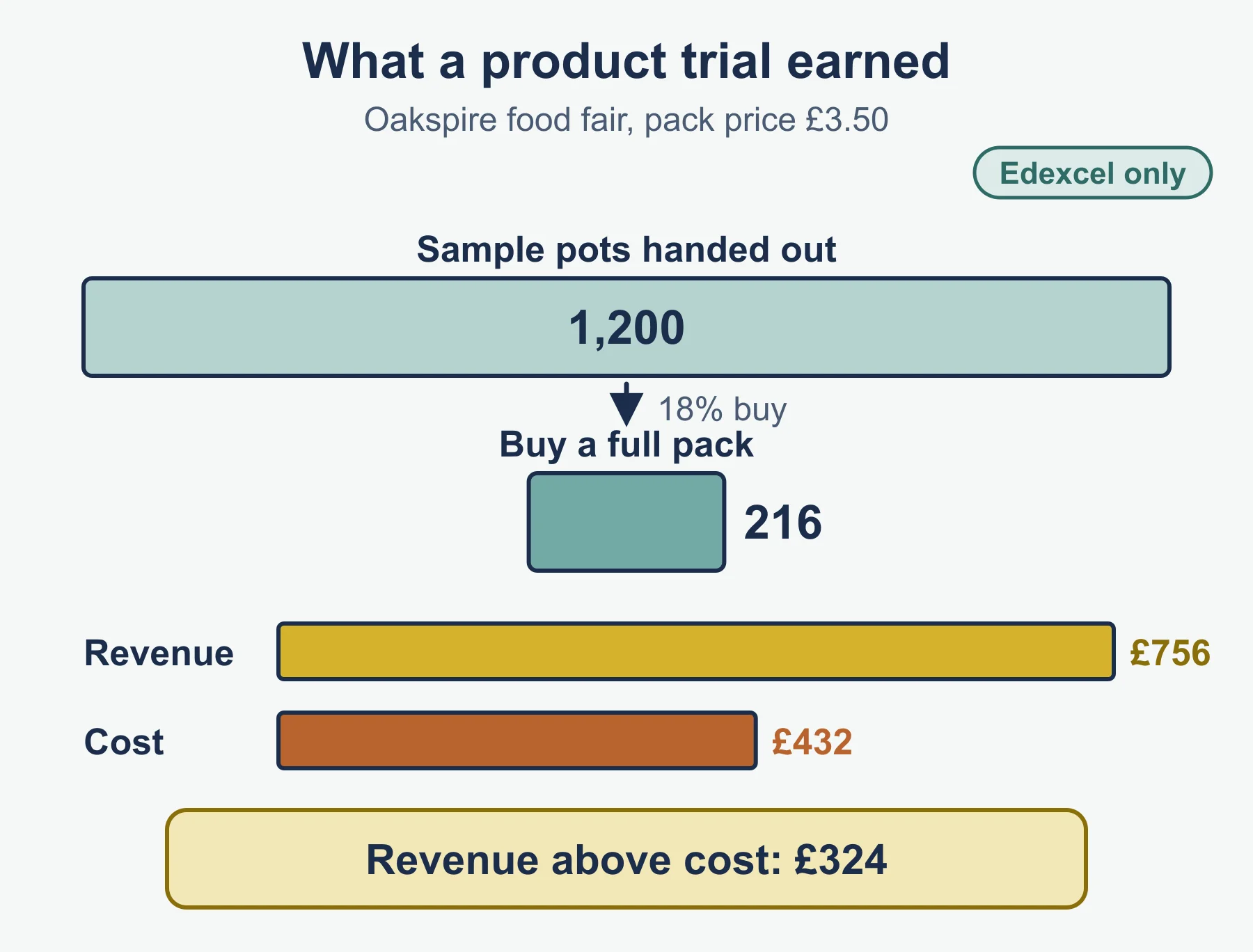
Oakspire’s stand at the food fair costs £432, including the samples. The team hands out 1,200 sample pots. Afterwards, 18% of those who took a sample buy a full pack at £3.50.
- Buyers: 18% × 1,200 = 216.
- Revenue: 216 × £3.50 = £756.
- Cost per buyer: £432 ÷ 216 = £2.00.
- Revenue above the campaign cost: £756 − £432 = £324.
This ignores the cost of making the packs, so it is not profit. The trial covered its cost on first sales alone.
2. Technology in promotion (2.2.3)
Technology lets a business choose who sees its message and measure how they respond.
Targeted advertising online
Targeted advertising online means showing adverts to selected groups of internet users, chosen by details such as age, location, interests or browsing history. It suits small businesses because they pay to reach people who fit their segment, not everybody. Clicks and purchases can be counted. Rivals can target the same audiences, and some users ignore or block adverts.
Viral advertising via social media
Viral advertising spreads because people choose to share it: a funny video, a challenge or a striking picture passed from friend to friend on social media. The spend can be small compared with the number of people reached. The weakness is that the business cannot control it: a message may not spread at all, or may spread in a way that damages the brand.
E-newsletters
An e-newsletter is an email sent regularly to people who have chosen to receive it. It gives news and offers directly to customers at low cost, and suits those who already know the business. It only reaches people who have signed up, and many emails go unopened.
Worked example 3: judging an e-newsletter
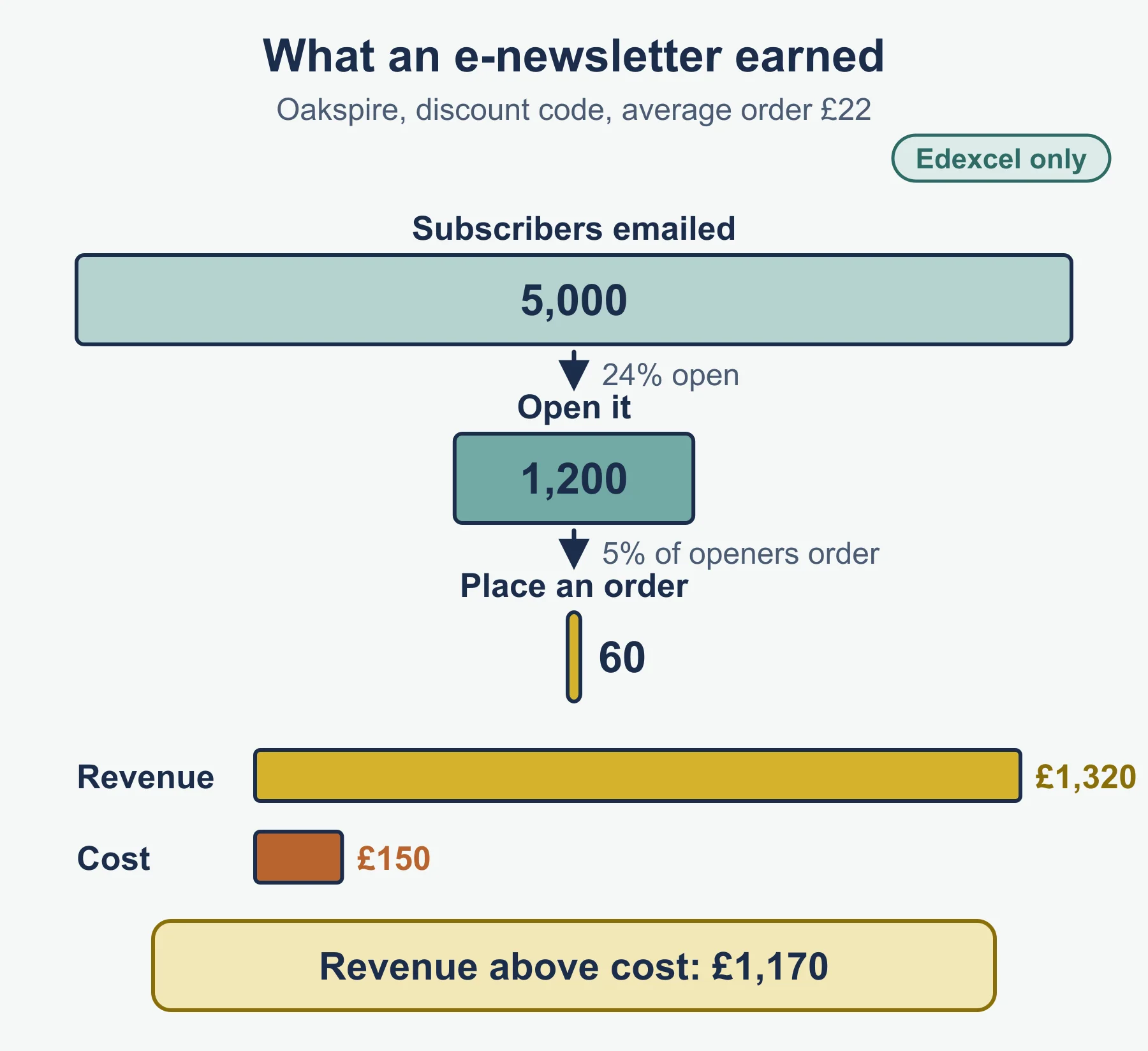
Oakspire sends an e-newsletter with a discount code to 5,000 subscribers. It costs £150 to prepare and send. 24% of subscribers open it. Of those who open it, 5% place an order, averaging £22.
- Opens: 24% × 5,000 = 1,200.
- Orders: 5% × 1,200 = 60.
- Revenue: 60 × £22 = £1,320.
- Revenue above cost: £1,320 − £150 = £1,170.
The business can tell exactly what the newsletter earned, which is harder with a poster or a sponsorship. It also shows the limit: only 60 of 5,000 subscribers bought.
3. Place: retailers and e-tailers (2.2.4)
Place is about how the product reaches the customer. The specification names two methods of distribution.
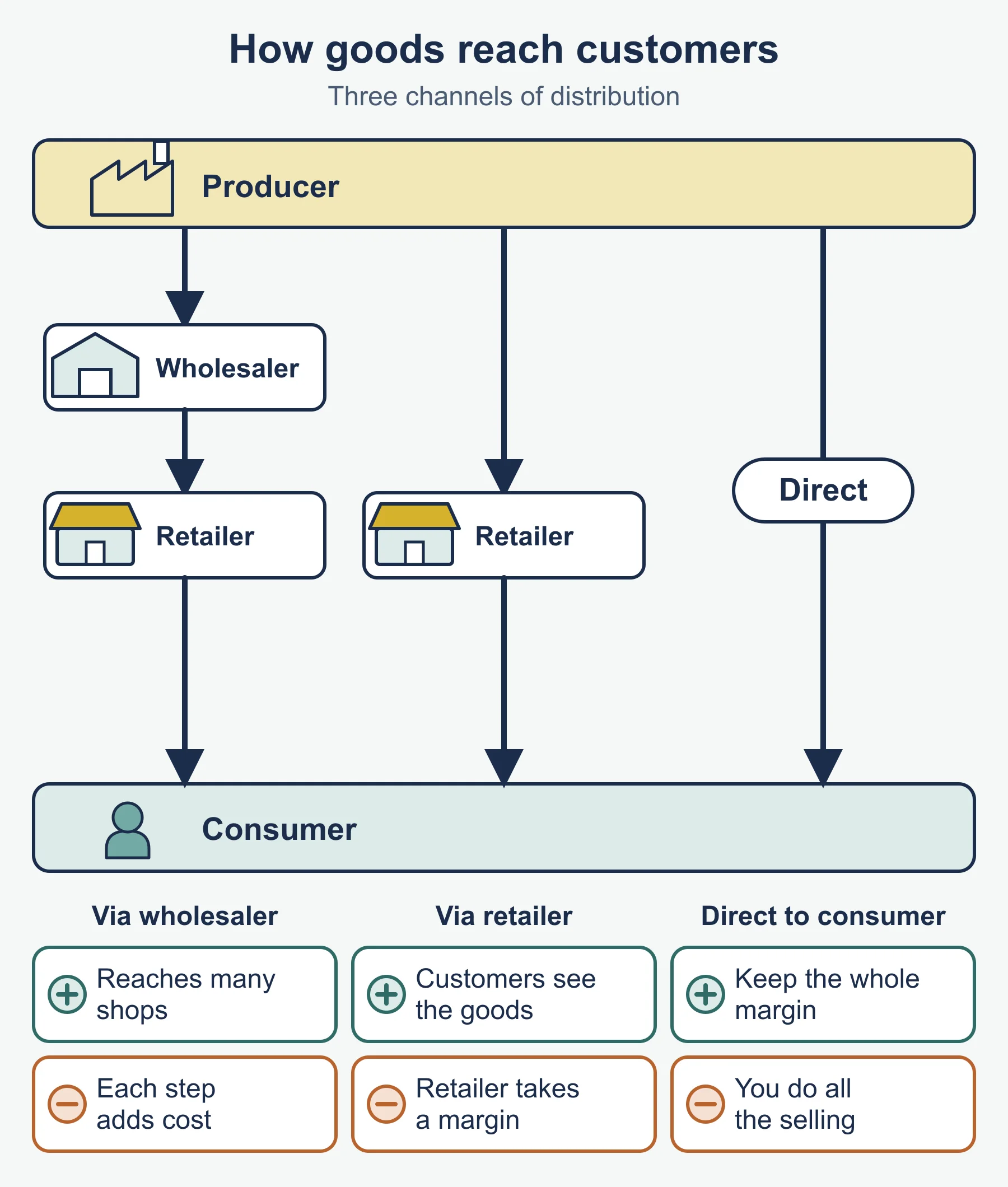
- A retailer sells to the public from a shop or other physical outlet. Customers can see, handle and try the product, and take it home at once. The retailer often buys from the producer at a lower price and sells on at a higher one, so the producer gains reach but gives up part of the selling price.
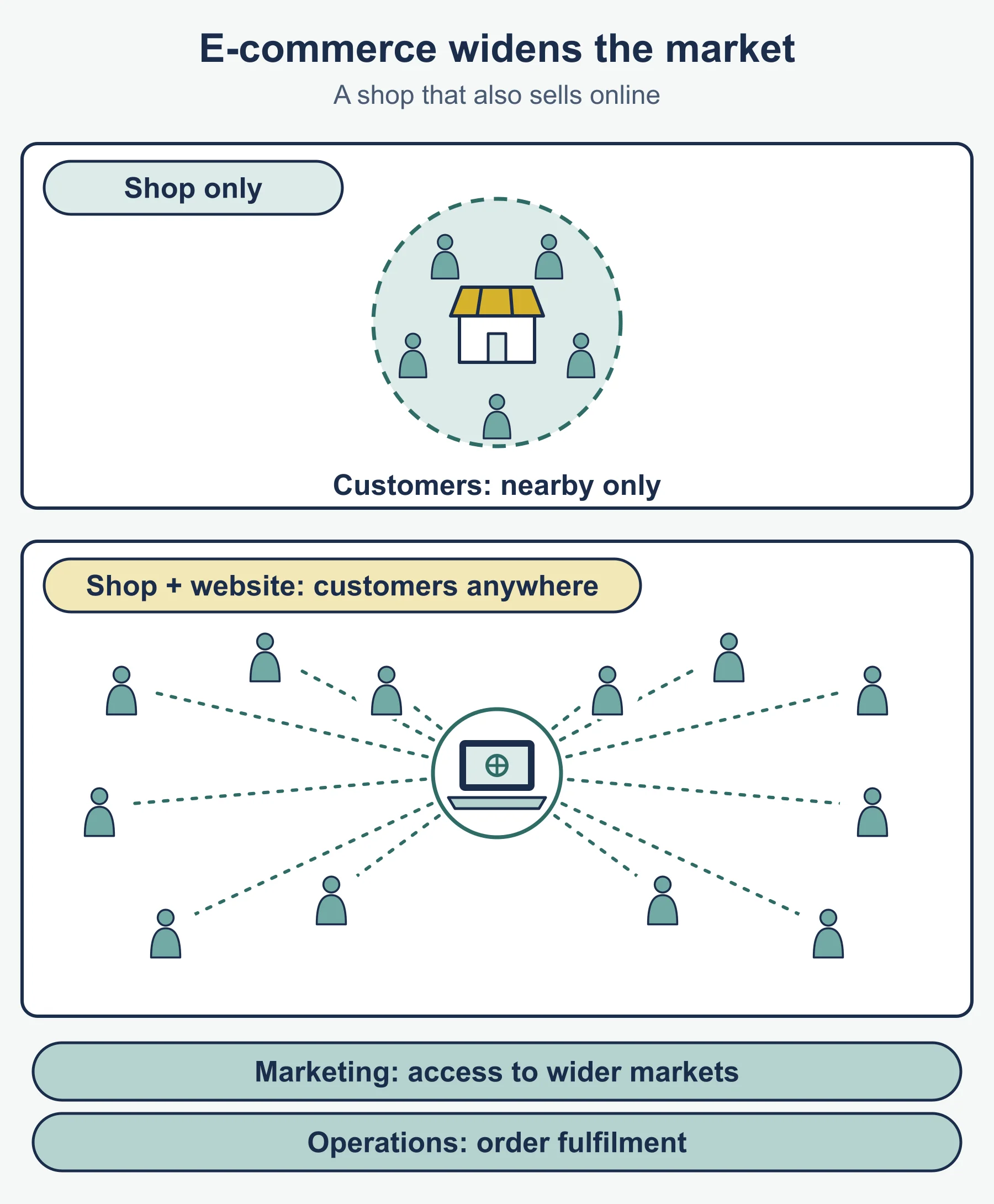
- An e-tailer sells to the public online, through a website or app. This is e-commerce. It can reach customers across the country without a shop on every high street. Customers cannot handle the product first, and the business must manage delivery, packaging and returns.
A business can use both, depending on the product, the target market and the money available.
| Retailer | E-tailer (e-commerce) | |
|---|---|---|
| Reach | Customers who visit the outlet | Customers anywhere the business can deliver to |
| Customer experience | Can see and try the product; no wait | Convenient; waiting for delivery; returns |
| Costs to the business | Shares the selling price with the shop | Website, delivery, packaging and payment costs |
| Control of the brand | Less: the shop controls display and staff | More: the business controls the website |
Worked example 4: choosing a route
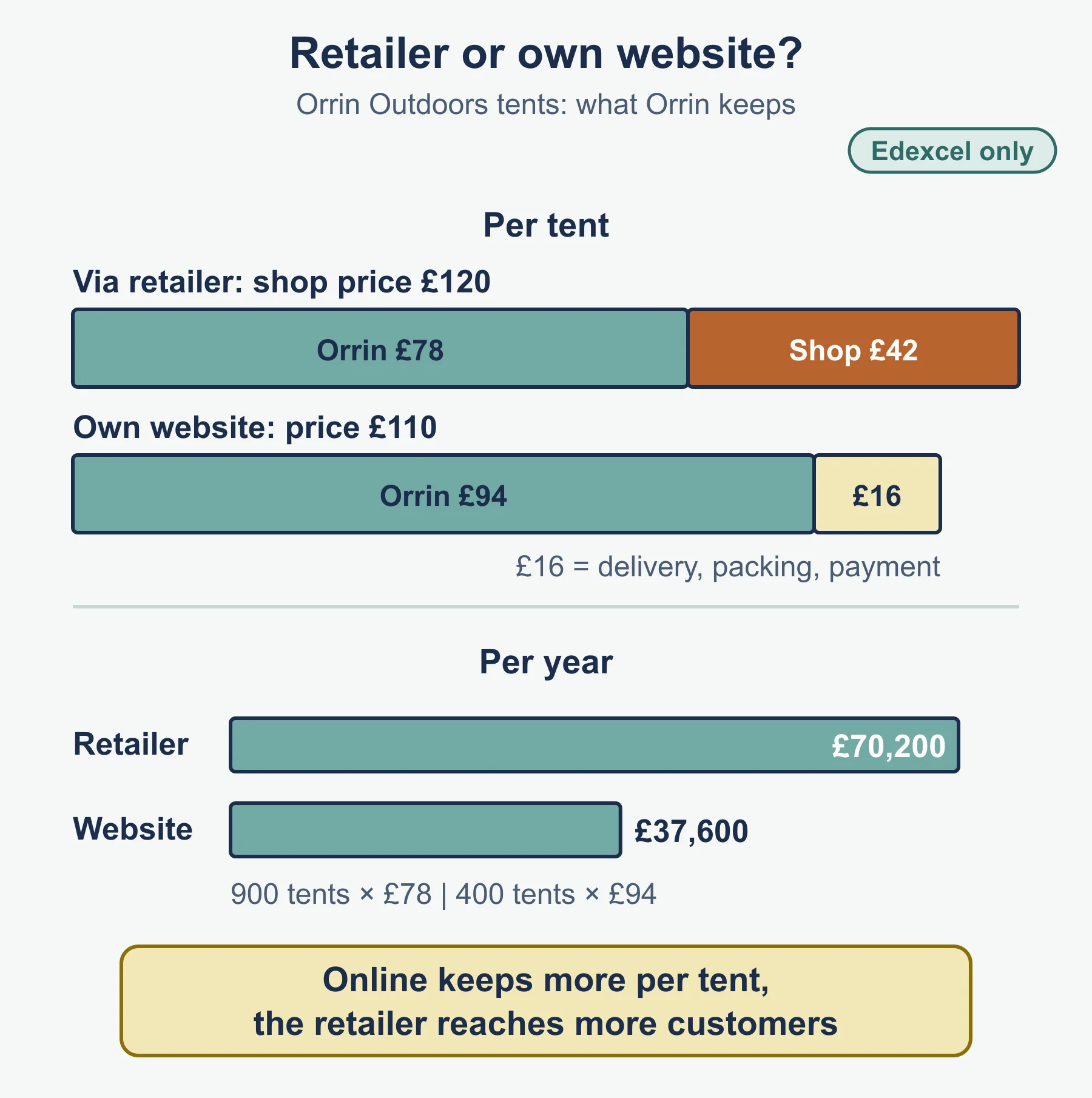
Orrin Outdoors makes tents. A retailer buys each tent at £78 and sells it for £120. Orrin’s own website sells the tent for £110, and delivery, packaging and payment costs are £16 per tent.
- Retailer’s share of the selling price: £120 − £78 = £42, which is 35% of £120.
- Orrin keeps £78 per tent via the retailer and £110 − £16 = £94 per tent online.
Online is better per tent, but volume matters. Suppose the retailer would buy 900 tents a year and the website would sell 400. The money received is 900 × £78 = £70,200 via the retailer and 400 × £94 = £37,600 online. The retailer route reaches more customers, so Orrin might use both.
4. How one element influences another (2.2.5)
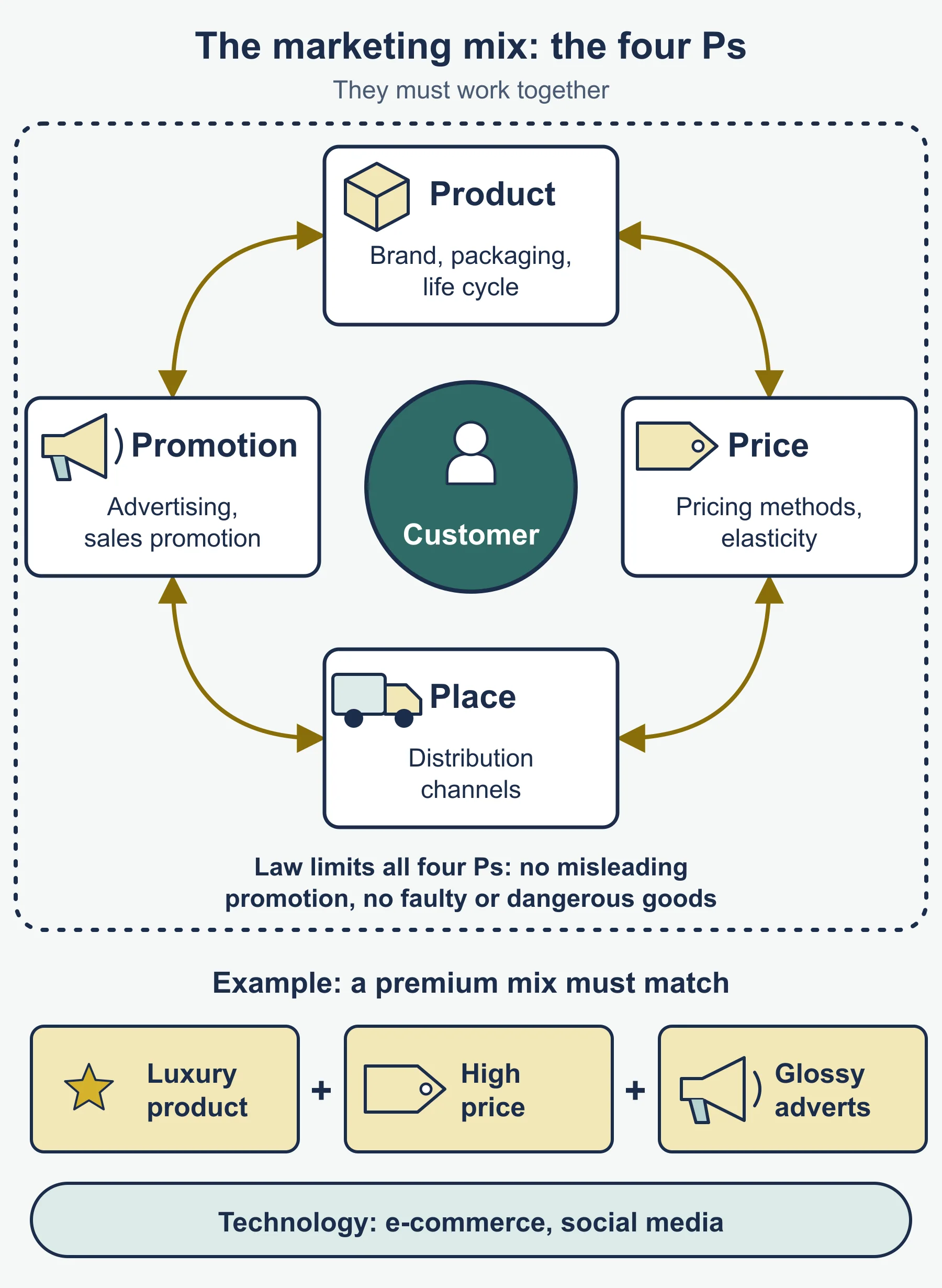
The four elements are linked. A decision on one limits or demands decisions on the others.
- Product to price: a durable, high-specification product costs more to make, so it usually needs a higher price.
- Price to promotion: a low price may be advertised as the main selling point, and a premium price needs promotion that stresses quality.
- Promotion to place: a campaign that sends customers to a website only works if the e-tailer site is ready for orders.
- Place to price: selling through a retailer means the producer must leave room for the retailer’s share, which can affect the price it can charge.
- Price to product: if customers will only pay a certain amount, the business may have to change the design or materials to hold costs down.
5. Competitive advantage and the integrated mix (2.2.5)
Competitive advantage is something a business does better, or differently, than its rivals, so customers prefer it. It may come from a distinctive product, a lower price, a stronger brand, easier access or a combination. The advantage must matter to the target market, not only to the business.
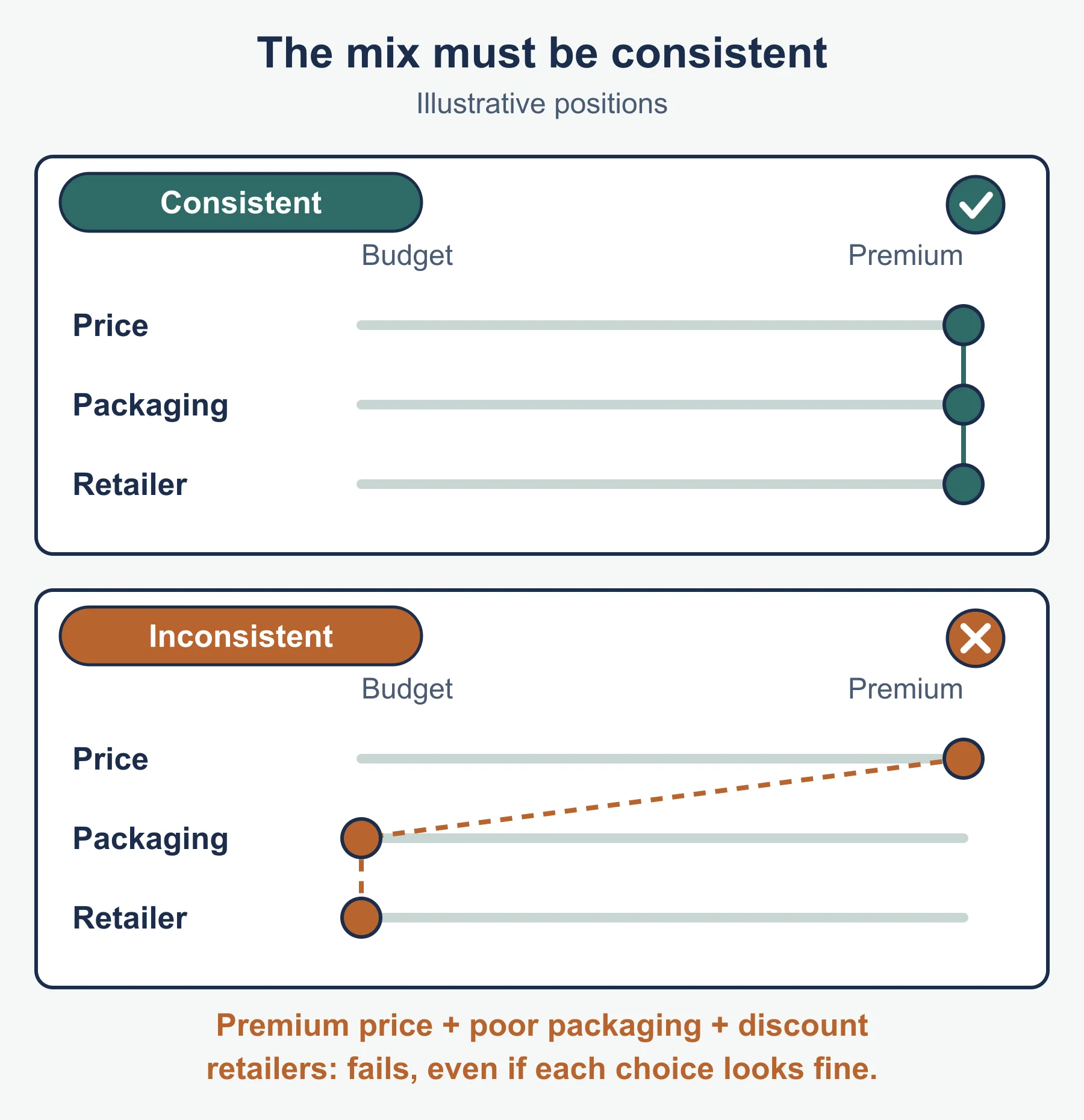
A mix is integrated when all four elements point in the same direction. The customer sees one clear offer. When the elements conflict, the offer is confused, and rivals can attack it.
Worked example 5: an integrated mix
Wheldrake Running sells lightweight running shoes to serious club runners.
- Product: a lightweight shoe tested by club athletes.
- Price: £95, a premium price in line with the specialist quality.
- Place: independent running shops where staff can check the runner’s gait, plus Wheldrake’s own website.
- Promotion: sponsorship of local running clubs and a budget of £9,500 on £95,000 of expected sales, which is 10% of revenue.
The elements support each other, so rivals find it hard to copy. A rival could copy a lower price, but not the specialist reputation built across product, shops and clubs. If Wheldrake discounted heavily or moved into discount stores, the premium message would be weakened.
Common errors
- Naming a promotion strategy without linking it to a market segment.
- Writing “social media” when the question asks for viral advertising, which depends on people sharing.
- Confusing a retailer with an e-tailer, or forgetting that an e-tailer is a method of distribution.
- Describing the four elements one by one when asked how they influence each other.
- Calling any advantage a competitive advantage without saying why customers prefer it to rivals.
Next steps
Recap with the revision notes, then use the practice questions. Take the free diagnostics to find your weakest area.
Frequently asked questions
What is a market segment? A market segment is a part of the market made up of customers with similar characteristics, such as age, income, location or lifestyle. Different segments respond to different promotion strategies.
What is targeted advertising online? Targeted advertising online shows adverts to selected groups of internet users, chosen by details such as age, location, interests or browsing history. It suits small businesses because they pay to reach people who fit their segment.
What are the advantages of an e-newsletter? An e-newsletter gives news and offers directly to customers who have signed up, at low cost, and the business can measure exactly what it earns. It only reaches people who have already chosen to receive it.
How can one element of the marketing mix influence another? For example, a high-specification product usually needs a higher price, and a premium price needs promotion that stresses quality. Selling through a retailer means leaving room for the retailer’s share, which affects the price the producer can charge.
Official syllabus
Pearson Edexcel Level 1/Level 2 GCSE (9-1) in Business (1BS0), Specification, Issue 2, July 2022, published by Pearson Education Limited. Theme 2: Building a business, topic 2.2 Making marketing decisions, content items 2.2.3 Promotion, 2.2.4 Place and 2.2.5 Using the marketing mix to make business decisions.
Get free revision emails (optional)
Occasional emails with practice questions, worked explanations and links to free resources for the qualification and subjects you choose. No spam, and you can unsubscribe from any email. The free tools on this site never need an email.
Related resources
-
Practice questions
Edexcel GCSE Business: Promotion, place and combining the marketing mix (1BS0) – Practice Questions
Twelve original practice questions with worked answers on promotion, place and the integrated marketing mix for Pearson Edexcel GCSE Business Theme 2.
Business · Pearson Edexcel · GCSE
Try questions -
Revision notes
Edexcel GCSE Business: Promotion, place and combining the marketing mix (1BS0) – Revision Notes
Condensed revision notes on promotion, place and the integrated marketing mix for Pearson Edexcel GCSE Business Theme 2 topic 2.2, with a self-test.
Business · Pearson Edexcel · GCSE
Revise topic -
Study guides
Edexcel GCSE Business: Product and price decisions (1BS0)
Study guide to product and price decisions for Pearson Edexcel GCSE Business, Theme 2 topic 2.2: design mix, life cycle, differentiation and pricing.
Business · Pearson Edexcel · GCSE
Read guide
Related articles
-
teaching
A Level tuition in Dubai: Cambridge or Pearson Edexcel International A Level?
Schools in Dubai and Abu Dhabi teach either Cambridge International AS & A Level or Pearson Edexcel International A Level. How the two are structured, why it matters for tuition, and how online classes from Lahore work.
9 October 2026
-
curriculum guides
Choosing subjects at IGCSE and A Level
How subject choices at 14 and 16 affect university options later, and how to keep pathways open without overloading a timetable.
28 July 2026
Studying this with a teacher
Working through Business GCSE?
This page is free and stays free. If you would rather be taught it, Marlbridge runs Business classes one-to-one and in small groups of up to 15, online in your own time zone. The first trial class is free. WhatsApp replies within an hour (8am–11pm Pakistan time, every day); email the same day.
Pearson Edexcel Business teachers at Marlbridge

