
Study Guides
Edexcel GCSE Business: Product and price decisions (1BS0)
Study guide to product and price decisions for Pearson Edexcel GCSE Business, Theme 2 topic 2.2: design mix, life cycle, differentiation and pricing.
- Subject
- Business
- Level
- GCSE
- Topic
- Making marketing decisions
- Author
- Marlbridge Academic Team
- Updated
- Reviewed by
- Asif Iqbal (what this means)
Aligned to Pearson Edexcel GCSE Business (1BS0), Issue 2, July 2022. Official specification .
Syllabus page (what it covers and how it is assessed): Pearson Edexcel GCSE Business.
Syllabus points this page covers
1BS0
- 2.2 Making marketing decisions (whole topic)
- 2.2.1 Product
- 2.2.2 Price
Found an error? Report a correction.
Want a teacher for this? Marlbridge teaches Business online. Request a free trial class.
This guide follows the Pearson Edexcel Level 1/Level 2 GCSE (9-1) in Business (1BS0) specification, Issue 2, July 2022. It covers Theme 2: Building a business, topic 2.2 Making marketing decisions, content items 2.2.1 Product and 2.2.2 Price. The specification has two written papers, Theme 1 (1BS0/01) and Theme 2 (1BS0/02), each 1 hour 45 minutes, 90 marks and 50% of the qualification. Calculators may be used. Formulae are listed in the specification (Appendix 3) and are not provided in the examinations.
Links: the Edexcel GCSE Business hub, the printable checklist and the free diagnostics. Companion pages: the revision notes and the practice questions. Related: the marketing mix and the business plan and revenue, costs and profit. Every business and figure below is invented.
What the specification asks for
| Item | What you need to learn | Where in this guide |
|---|---|---|
| 2.2.1 | The design mix: function, aesthetics, cost | Section 1 |
| 2.2.1 | The importance to a business of differentiating a product or service | Section 2 |
| 2.2.1 | The product life cycle: the phases | Section 3 |
| 2.2.1 | The product life cycle: extension strategies | Section 4 |
| 2.2.2 | Pricing strategies | Section 5 |
| 2.2.2 | Influences on pricing strategies: technology, competition, market segments, product life cycle | Section 6 |
The specification gives the phases of the product life cycle and the pricing strategies as headings only, without listing them. This guide uses the standard four phases and the standard pricing strategies, and says so where it does.
1. The design mix (2.2.1)
The design mix is the set of decisions a business makes when it designs a product. The specification names three parts: function, aesthetics and cost. A good design balances all three for the target market.
- Function: what the product does and how well it does it, including reliability, ease of use and durability. A product that fails at its main job will not sell however attractive it is.
- Aesthetics: how the product looks, feels, sounds, smells or tastes. Colour, shape, finish and packaging all matter, and for some products they may decide the purchase.
- Cost: what it costs the business to make or provide the product. Cost limits the other two parts. Better materials improve function and appearance but raise the cost per unit, which then pushes up the price or cuts the profit.
The three parts pull against each other, so design is a trade-off.
Worked example 1: balancing the design mix
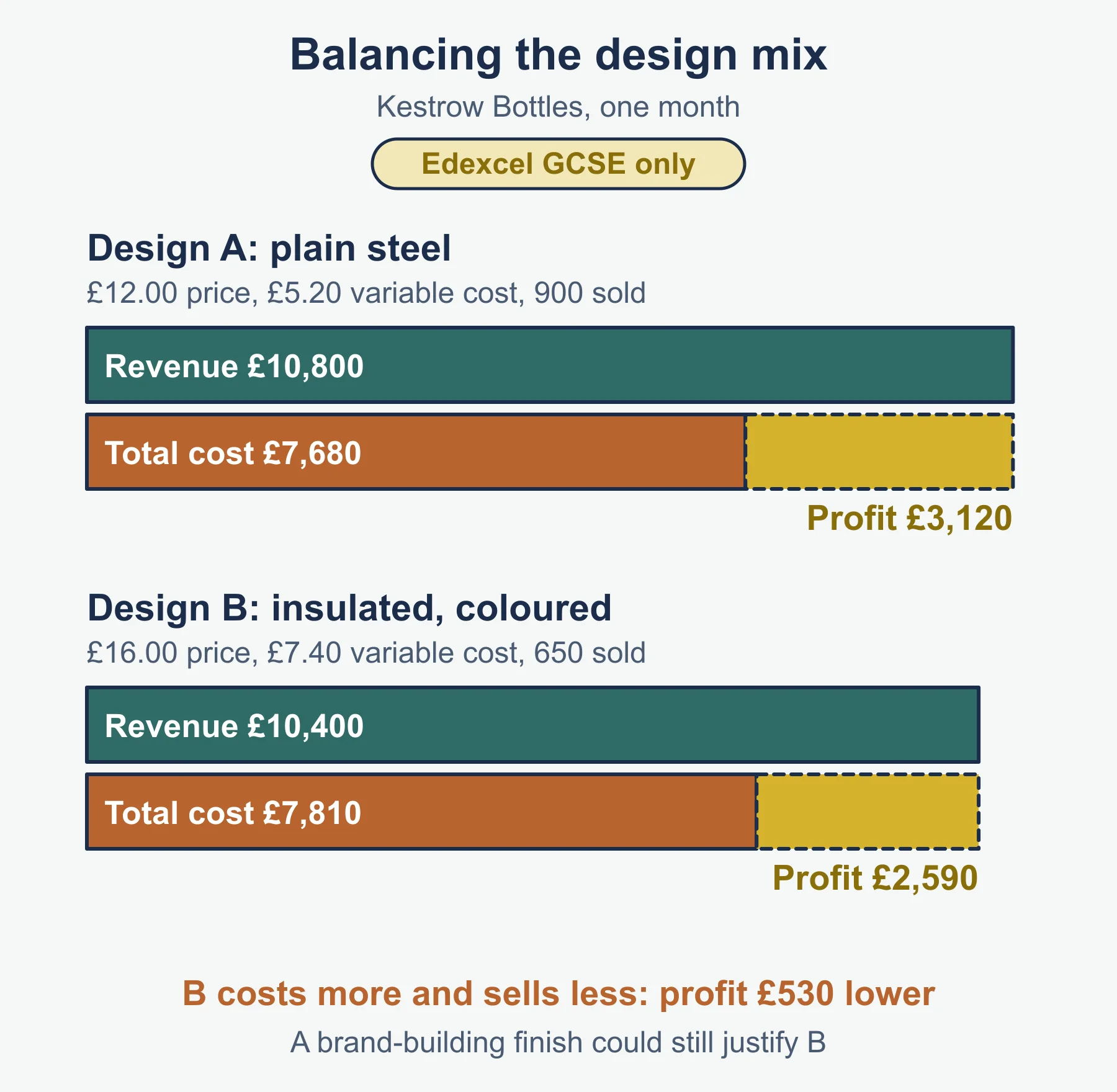
Kestrow Bottles makes drinks bottles. Design A is a plain steel bottle. Design B is insulated, with a coloured finish. Fixed costs are £3,000 a month.
| Design A | Design B | |
|---|---|---|
| Unit variable cost (£) | 5.20 | 7.40 |
| Selling price (£) | 12.00 | 16.00 |
| Expected sales (units a month) | 900 | 650 |
Using revenue = price × quantity and total cost = total fixed costs + total variable costs (both in Appendix 3):
- Design A: revenue 12 × 900 = £10,800. Variable costs 5.20 × 900 = £4,680. Total cost 3,000 + 4,680 = £7,680. Profit = £3,120.
- Design B: revenue 16 × 650 = £10,400. Variable costs 7.40 × 650 = £4,810. Total cost 3,000 + 4,810 = £7,810. Profit = £2,590.
Design B has better function (it keeps drinks cold) and aesthetics, but its higher cost and price reduce expected sales, so profit is £530 lower. Design B could still be the better choice if the finish builds a brand. A strong answer uses the numbers, then weighs non-financial points.
2. Differentiating a product or service (2.2.1)
Differentiation means making a product or service different from rivals’ in a way customers notice and value, such as a feature, design, quality, service, convenience or brand image.
Why it matters to a business:
- It gives customers a reason to choose this business, so it can win sales without having the lowest price.
- It can support a higher price, because customers pay more for what they see as better or unique.
- It can build loyalty, since customers who value it are less likely to switch.
Limits to bear in mind:
- Differentiating costs money, through research, design or better materials.
- Rivals can copy a feature.
- A difference that nobody values adds cost without adding sales.
Kestrow’s insulated bottle is differentiated by a feature, but only if its target market values it enough to pay the higher price.
3. The product life cycle (2.2.1)
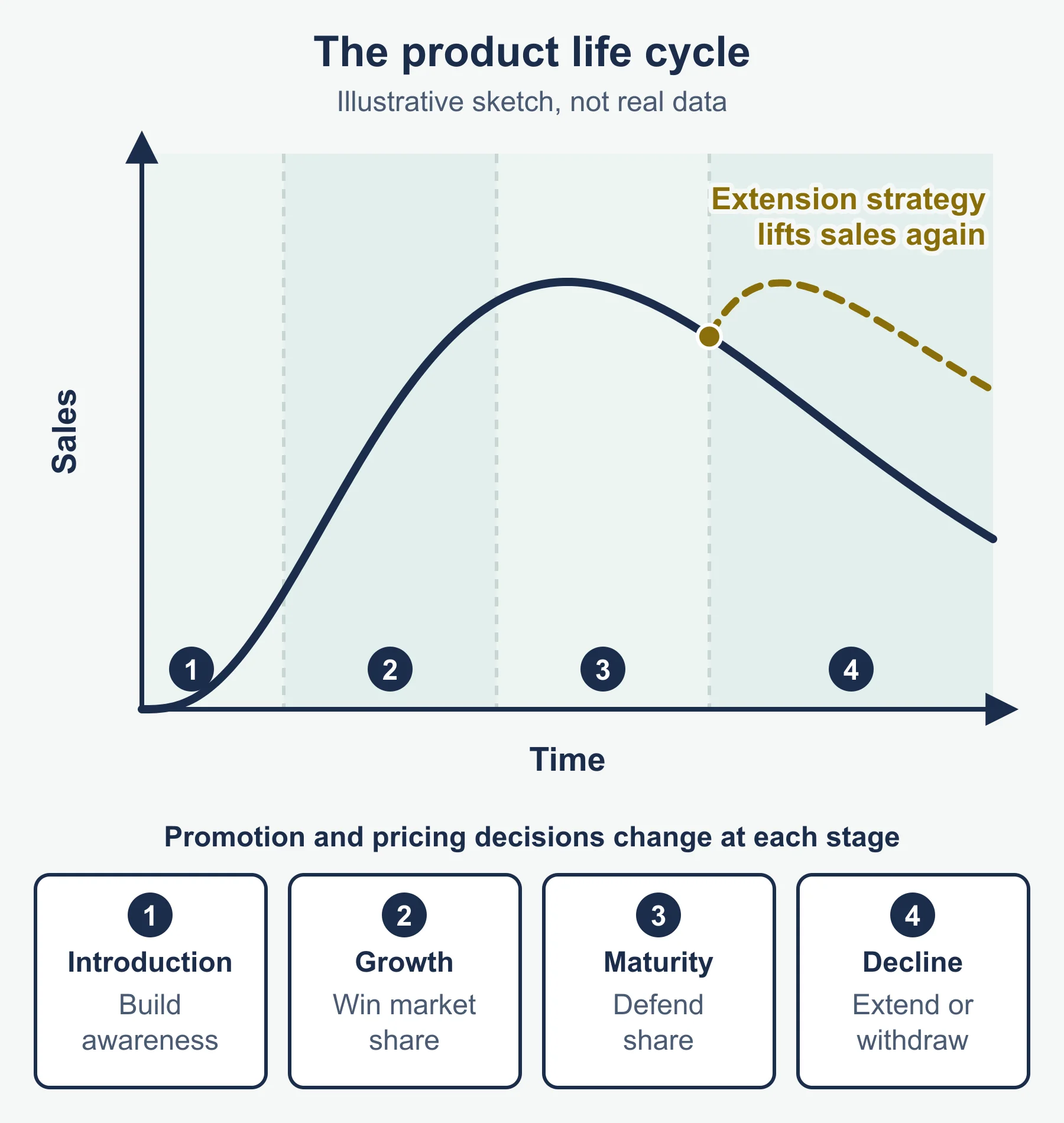
The product life cycle shows the stages a product passes through from launch until it leaves the market, tracked by sales over time. The specification refers to “the phases” without listing them. The standard four are introduction, growth, maturity and decline.
| Phase | Sales | Profit and costs | Typical business focus |
|---|---|---|---|
| Introduction | Low and slowly rising | Heavy spending on development and promotion; profit low or negative | Make customers aware; get the product trialled |
| Growth | Rising fast | Profit rises as sales spread the fixed costs; rivals start to enter | Build market share; keep quality up |
| Maturity | Levels off at or near the peak | Profit usually at its highest, but competition is strong | Defend share; look for ways to stay ahead |
| Decline | Falls | Profit falls; costs may exceed revenue | Decide whether to extend the product or withdraw it |
Worked example 2: identifying the phase
Veradyne Audio sells a wireless speaker. Annual sales in units were:
| Year | 1 | 2 | 3 | 4 | 5 | 6 | 7 | 8 |
|---|---|---|---|---|---|---|---|---|
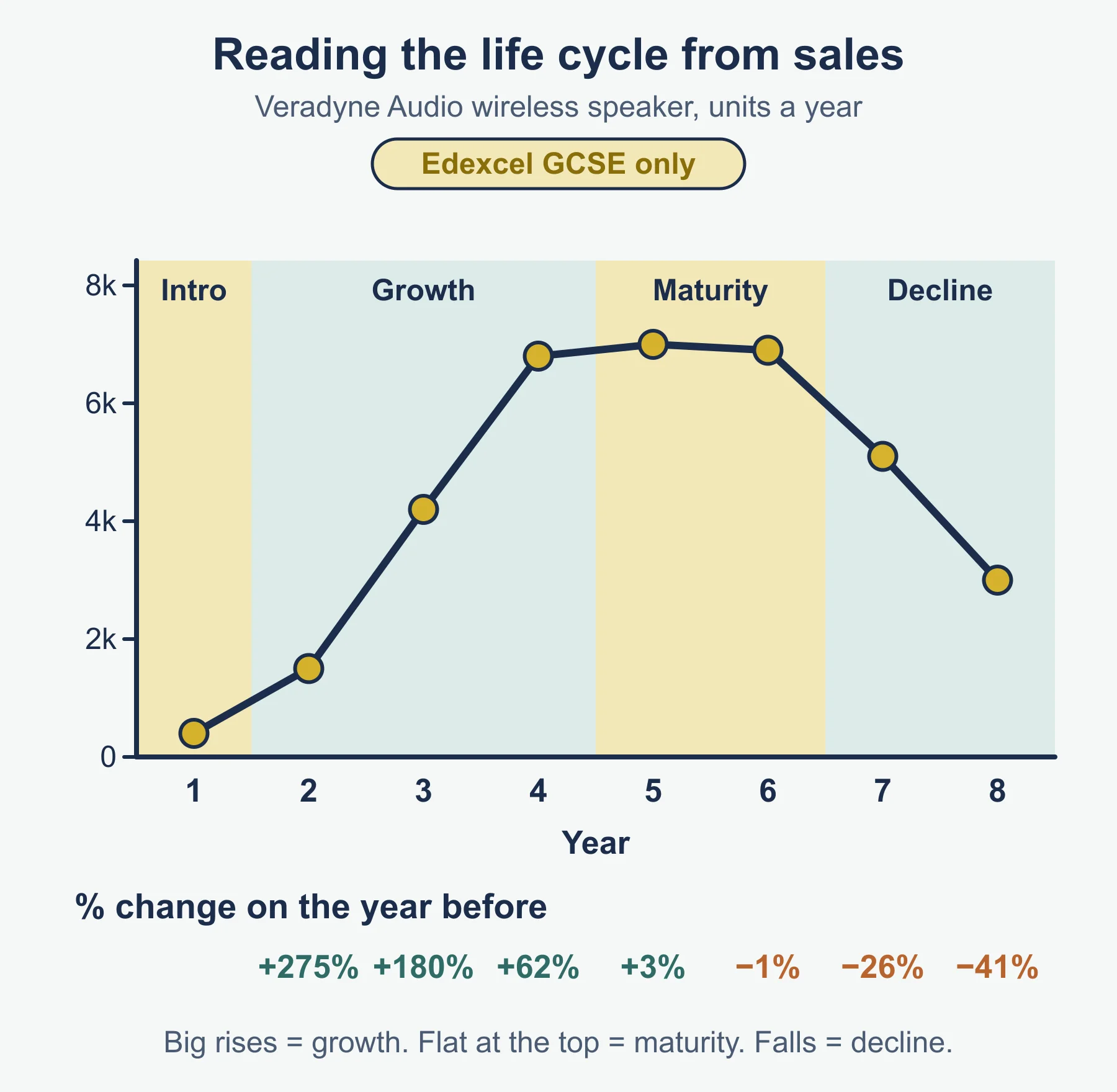
| Units sold | 400 | 1,500 | 4,200 | 6,800 | 7,000 | 6,900 | 5,100 | 3,000 |
Percentage change = change ÷ original × 100. This is the standard form, and percentage change is one of the quantitative skills in Appendix 2.
- Year 2: (1,500 − 400) ÷ 400 × 100 = +275.0%.
- Year 3: (4,200 − 1,500) ÷ 1,500 × 100 = +180.0%.
- Year 4: (6,800 − 4,200) ÷ 4,200 × 100 = +61.9%.
- Year 5: (7,000 − 6,800) ÷ 6,800 × 100 = +2.9%.
- Year 6: (6,900 − 7,000) ÷ 7,000 × 100 = −1.4%.
- Year 7: (5,100 − 6,900) ÷ 6,900 × 100 = −26.1%.
- Year 8: (3,000 − 5,100) ÷ 5,100 × 100 = −41.2%.
Year 1 is introduction, years 2 to 4 growth (large rises), years 5 and 6 maturity (sales flat), and years 7 and 8 decline (sharp falls). The boundaries are a judgement, so quote the figures.
4. Extension strategies (2.2.1)
An extension strategy is an action that keeps a product’s sales up and lengthens its life, usually as sales begin to fall. Common methods:
- Modify the product: new features, a redesign, or new colours and flavours.
- Find a new market: sell to a new segment or to a new area, including overseas.
- Find a new use: promote the product for a different purpose.
- Change the packaging, the price or the promotion, or open a new place to sell.
An extension strategy costs money, so check that the extra sales justify it.
Worked example 3: is an extension worth it?
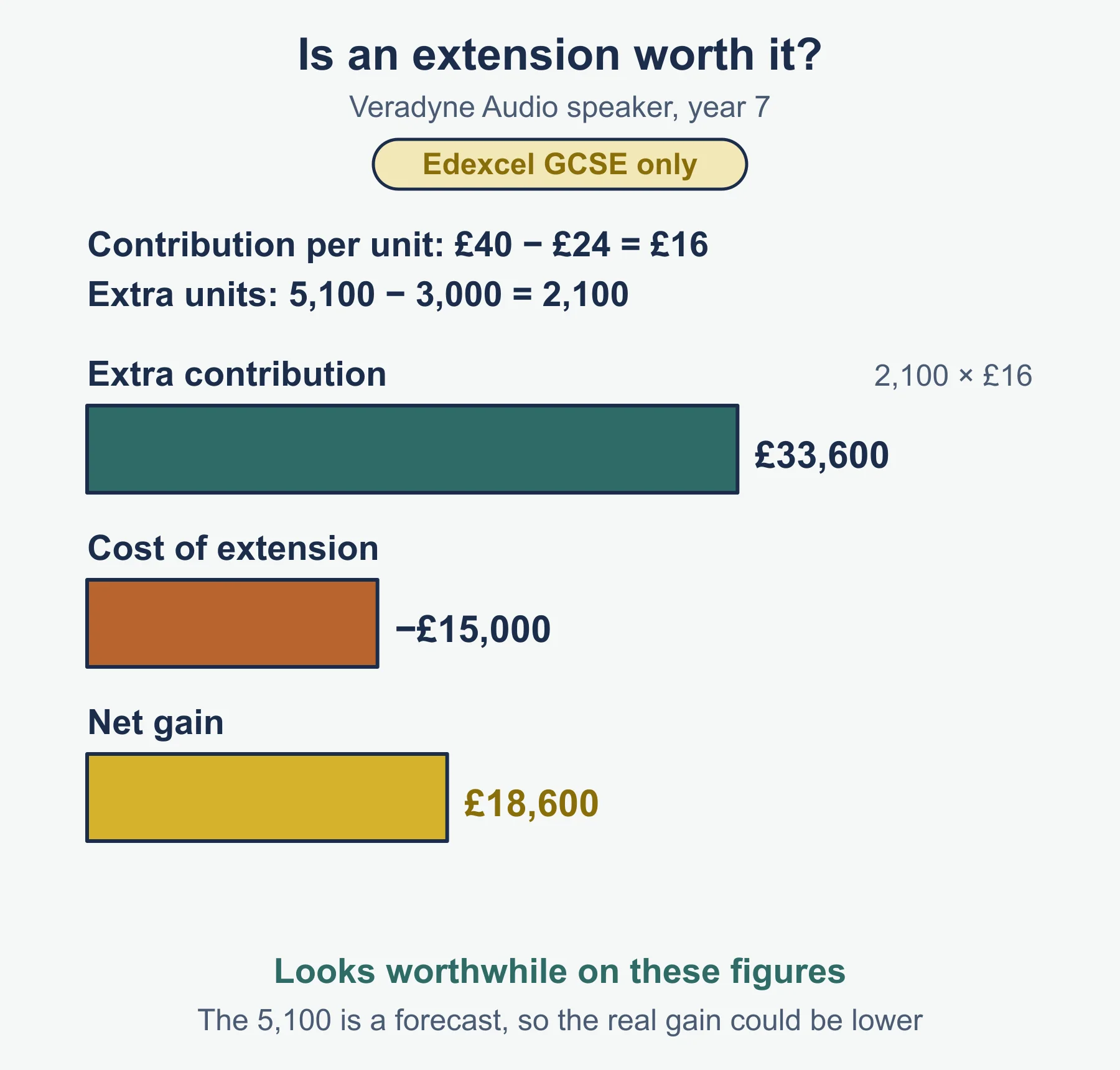
In year 7 Veradyne Audio sells its speaker at £40, with a variable cost of £24. Without action, the owner expects sales to fall to 3,000 units. An extension (new colours and a launch into a new market) costs £15,000 and is expected to hold sales at 5,100 units.
Contribution per unit = selling price − variable cost = 40 − 24 = £16. Contribution is the standard measure here, and it is not one of the Appendix 3 formulae.
- Extra units: 5,100 − 3,000 = 2,100.
- Extra contribution: 2,100 × 16 = £33,600.
- Net gain: 33,600 − 15,000 = £18,600.
The extension looks worthwhile on these figures. A balanced answer adds that the 5,100 is a forecast, so the real gain could be lower.
5. Pricing strategies (2.2.2)
A pricing strategy is the approach a business takes to setting a price. The specification names “pricing strategies” without listing them. These are the standard ones.
| Strategy | What it means | When it may suit |
|---|---|---|
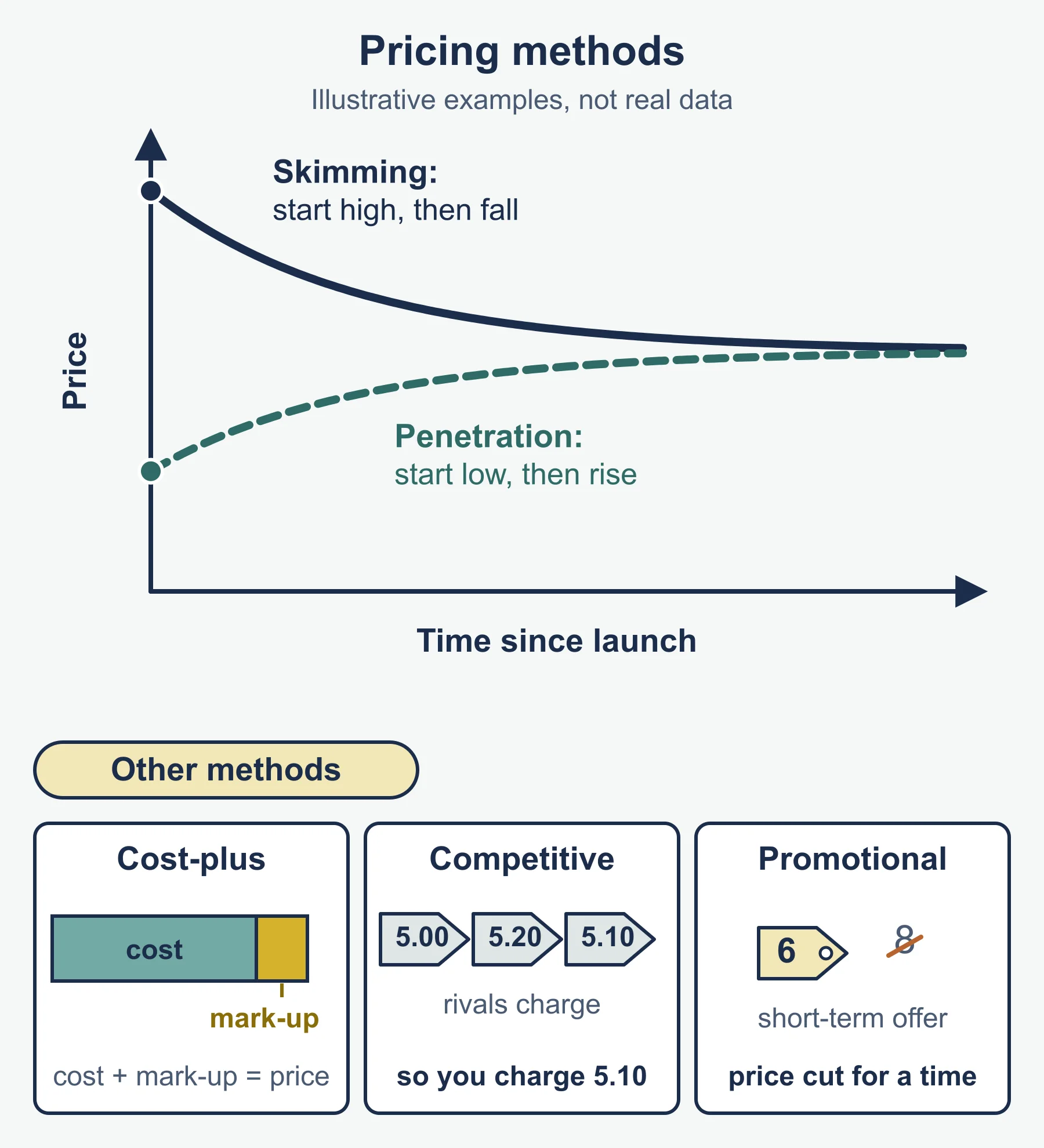
| Penetration pricing | A low price at launch to win customers and market share quickly | New product in a market with many rivals; customers who switch easily |
| Price skimming | A high price at launch, lowered later | New or unusual product with few rivals; buyers who want to be first |
| Competitive pricing | A price close to rivals’ prices | Many similar products; customers who compare prices |
| Cost-plus pricing | Unit cost plus a mark-up | Simple, when the business knows its costs and wants a set profit on each unit |
| Psychological pricing | A price that looks lower, such as £2.99 | Everyday goods where the price seems to matter |
| Promotional pricing | A temporary price cut or deal | Clearing stock; encouraging a first purchase |
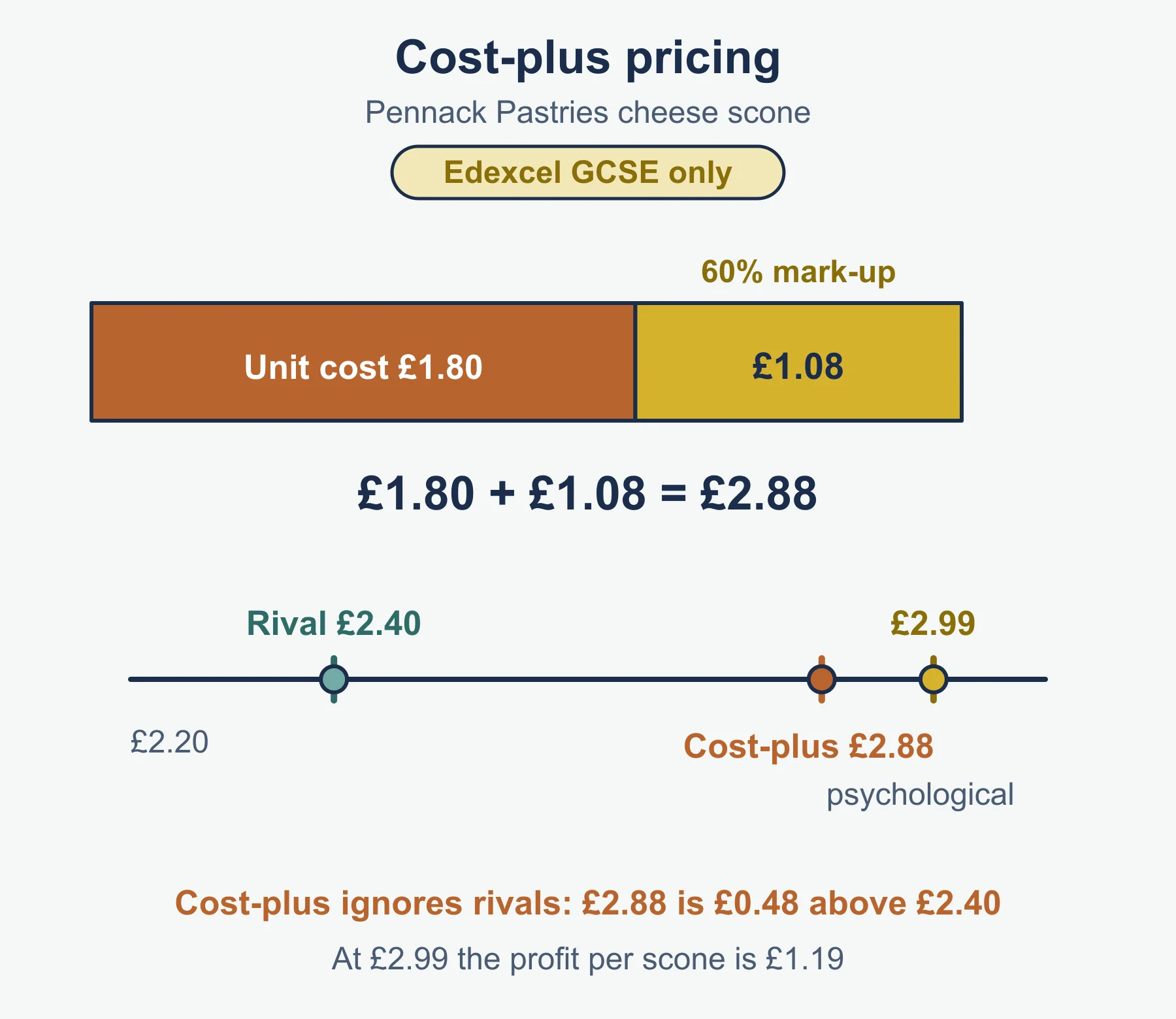
Cost-plus in its standard form is: selling price = unit cost + (unit cost × mark-up percentage).
Worked example 4: cost-plus and psychological pricing
Pennack Pastries bakes a cheese scone at a unit cost of £1.80. The owner uses a 60% mark-up.
- Mark-up: 1.80 × 0.60 = £1.08.
- Price: 1.80 + 1.08 = £2.88.
- A psychological alternative is £2.99, which keeps the profit per scone at £1.19.
Cost-plus ignores what customers will pay and what rivals charge. If a rival sells similar scones at £2.40, £2.88 may lose sales.
Worked example 5: penetration against skimming
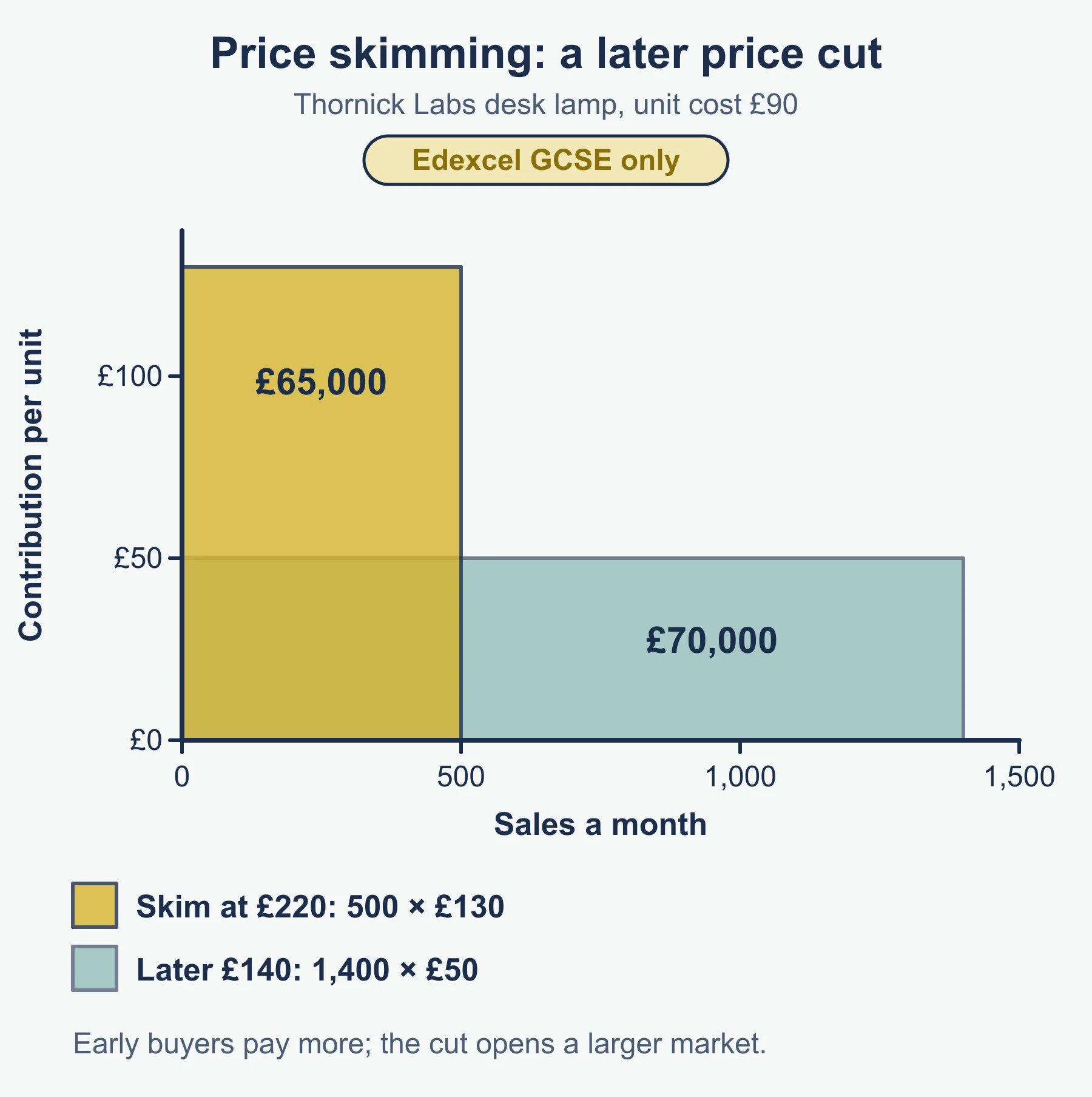
Thornick Labs launches a desk lamp that costs £90 a unit to make. If it skims at £220, it expects 500 sales a month, a total contribution of 500 × (220 − 90) = £65,000. If it later lowers the price to £140, it expects 1,400 sales: 1,400 × (140 − 90) = £70,000. Skimming works here because early buyers pay a high price and the later cut opens up a larger market. Penetration would start low to win share sooner, but the profit on each unit would be lower from the start.
6. Influences on pricing strategies (2.2.2)
Technology
Technology lets customers compare prices quickly online, which pushes prices towards the competitive level. It can also lower costs, through automation and online selling, giving room to cut prices or keep a larger profit. Online sellers can change prices easily, which supports promotional pricing.
Competition
The more close rivals there are, the less freedom a business has, so it may use competitive or penetration pricing. A differentiated product with few rivals can use skimming or a higher price. A rival’s price cut may force a response.
Market segments
A market segment is a group of customers with shared characteristics. Segments may be willing to pay different prices.
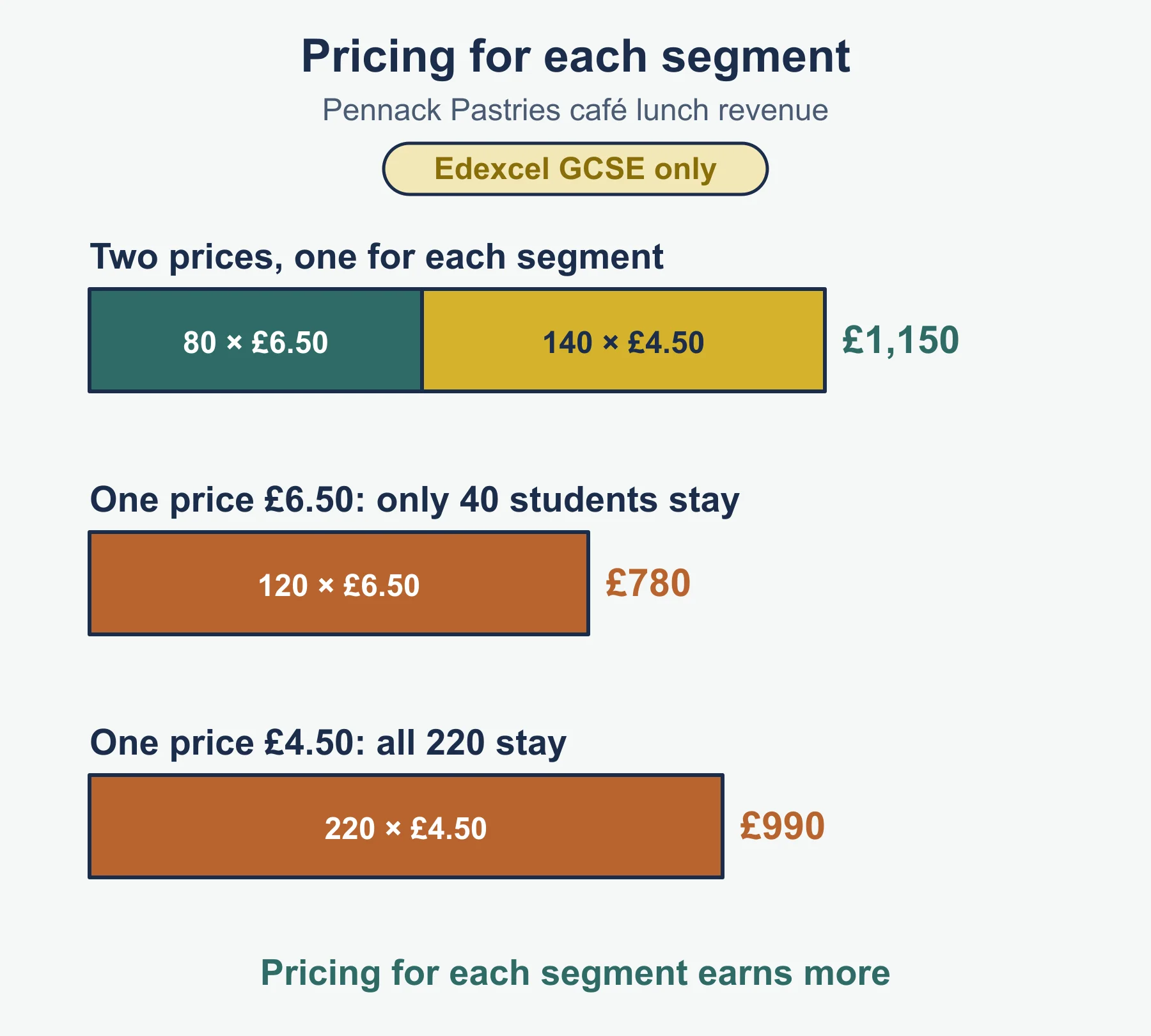
For example, Pennack’s café has 80 office workers at £6.50 per lunch and 140 students at £4.50. Revenue is 80 × 6.50 + 140 × 4.50 = 520 + 630 = £1,150. If one price of £6.50 drove away most students, with only 40 buying, revenue would be (80 + 40) × 6.50 = £780. If one price of £4.50 kept all 220 customers, revenue would be 220 × 4.50 = £990. Pricing for each segment earns more.
Product life cycle
Pricing changes through the life cycle. Skimming or penetration suits introduction. Competitive pricing is common in growth and maturity as rivals enter. In decline, promotional pricing can clear stock.
Common errors
- Defining differentiation as “being different” without saying customers must value the difference.
- Naming a life cycle phase without using the data or the context.
- Describing an extension strategy but not weighing its cost against the extra sales.
- Mixing up penetration (low launch price) and skimming (high launch price).
- Calling a strategy “best” without linking it to the market, the competition or the phase of the product.
Next steps
Use the revision notes, then test yourself with the practice questions. Try the free diagnostics too.
Frequently asked questions
Why is differentiation important to a business? Differentiation gives customers a reason to choose the business without it having the lowest price, can support a higher price and can build loyalty. It only works if customers notice and value the difference.
What is an extension strategy? An extension strategy is an action that keeps a product’s sales up and lengthens its life, such as modifying the product, finding a new market or a new use, or changing packaging, price or promotion. Its cost should be weighed against the extra sales.
What is psychological pricing? Psychological pricing sets a price that looks lower than it is, such as £2.99 instead of £3. It is often used for everyday goods where the price seems to matter.
How does the product life cycle affect pricing? Skimming or penetration pricing suits the introduction phase, competitive pricing is common in growth and maturity as rivals enter, and promotional pricing can clear stock in decline.
Official syllabus
Pearson Edexcel Level 1/Level 2 GCSE (9-1) in Business (1BS0), Specification, Issue 2, July 2022, published by Pearson Education Limited. Theme 2: Building a business, topic 2.2 Making marketing decisions, content items 2.2.1 Product and 2.2.2 Price.
Get free revision emails (optional)
Occasional emails with practice questions, worked explanations and links to free resources for the qualification and subjects you choose. No spam, and you can unsubscribe from any email. The free tools on this site never need an email.
Related resources
-
Practice questions
Edexcel GCSE Business: Product and price decisions (1BS0) – Practice Questions
Eleven original practice questions with worked answers on product and price decisions for Pearson Edexcel GCSE Business, Theme 2 topic 2.2.
Business · Pearson Edexcel · GCSE
Try questions -
Revision notes
Edexcel GCSE Business: Product and price decisions (1BS0) – Revision Notes
Condensed revision notes on product and price decisions for Pearson Edexcel GCSE Business Theme 2 topic 2.2, with formulae, tables and a self-test.
Business · Pearson Edexcel · GCSE
Revise topic -
Study guides
Edexcel GCSE Business: Promotion, place and combining the marketing mix (1BS0)
Study guide to promotion, place and combining the marketing mix for Pearson Edexcel GCSE Business, Theme 2 topic 2.2, with worked examples.
Business · Pearson Edexcel · GCSE
Read guide
Related articles
-
teaching
A Level tuition in Dubai: Cambridge or Pearson Edexcel International A Level?
Schools in Dubai and Abu Dhabi teach either Cambridge International AS & A Level or Pearson Edexcel International A Level. How the two are structured, why it matters for tuition, and how online classes from Lahore work.
9 October 2026
-
curriculum guides
Choosing subjects at IGCSE and A Level
How subject choices at 14 and 16 affect university options later, and how to keep pathways open without overloading a timetable.
28 July 2026
Studying this with a teacher
Working through Business GCSE?
This page is free and stays free. If you would rather be taught it, Marlbridge runs Business classes one-to-one and in small groups of up to 15, online in your own time zone. The first trial class is free. WhatsApp replies within an hour (8am–11pm Pakistan time, every day); email the same day.
Pearson Edexcel Business teachers at Marlbridge

