
Revision Notes
Edexcel IGCSE Accounting: Irrecoverable debts and other receivables and other payables (4AC1) – Revision Notes
Condensed revision notes for Edexcel International GCSE Accounting 4AC1 sections 2.6 and 2.7: irrecoverable debts, provisions, accruals and prepayments.
- Subject
- Accounting
- Level
- IGCSE
- Topic
- Introduction to bookkeeping
- Author
- Marlbridge Academic Team
- Updated
- Reviewed by
- Javaid Iqbal Sabri (what this means)
Aligned to Pearson Edexcel IGCSE Accounting (4AC1), Issue 1, October 2016. Official specification .
Syllabus page (what it covers and how it is assessed): Pearson Edexcel IGCSE Accounting.
Syllabus points this page covers
4AC1
- 2 Introduction to bookkeeping (whole topic)
- 2.6 Irrecoverable debts
- 2.7 Other receivables and other payables
Found an error? Report a correction.
Want a teacher for this? Marlbridge teaches Accounting online. Request a free trial class.
These notes condense sections 2.6 (Irrecoverable debts) and 2.7 (Other receivables and other payables) of Topic 2 in the Pearson Edexcel International GCSE in Accounting (4AC1) specification, Issue 1, October 2016. Full explanations and worked ledgers, read the study guide first. The specification describes two papers and does not divide them into tiers.
Links: 4AC1 course hub, printable checklist, practice questions and the free 10-minute diagnostics. The figures are made up and in dollars, with no dollar sign in the working.
Section map
| Section | Outcome | Notes below |
|---|---|---|
| 2.6 a | Why a provision is needed | Reasons list |
| 2.6 b | Irrecoverable debt against provision | Distinction table |
| 2.6 c | Calculate and record both | Method and journals |
| 2.7 a | Why other receivables and payables are accounted for | Reasons list |
| 2.7 b | Other receivables against other payables | Distinction table |
| 2.7 c | Calculate and record both | Formula and layout |
The specification’s glossary pairs the terms: other receivables with “prepayments”, other payables with “accruals”, trade receivables with “debtors”. Use the newer terms in answers.
Irrecoverable debts and the provision
Definitions
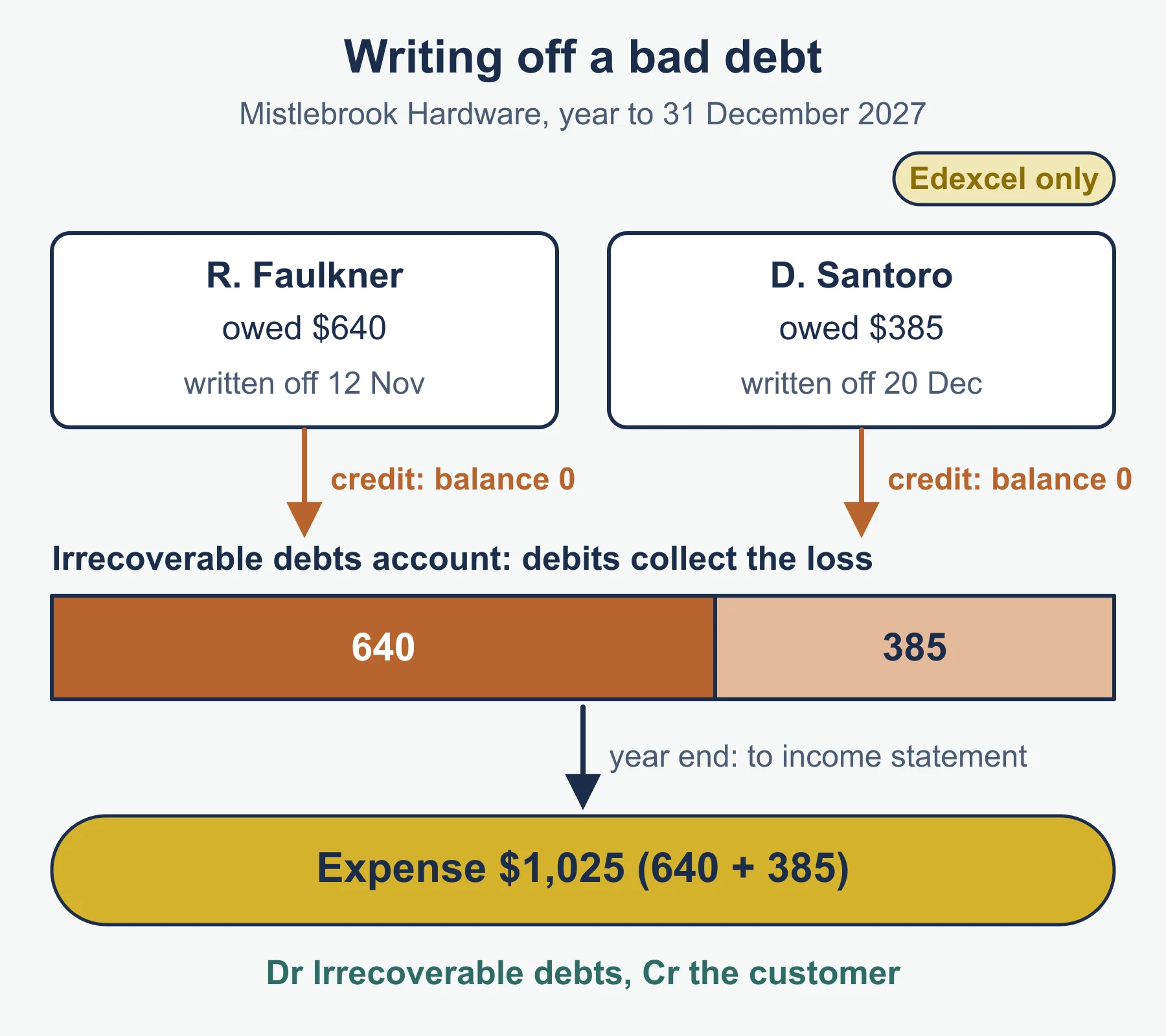
- Irrecoverable debt: a specific amount owed by a named customer that the business has decided it will not receive. It is written off as an expense.
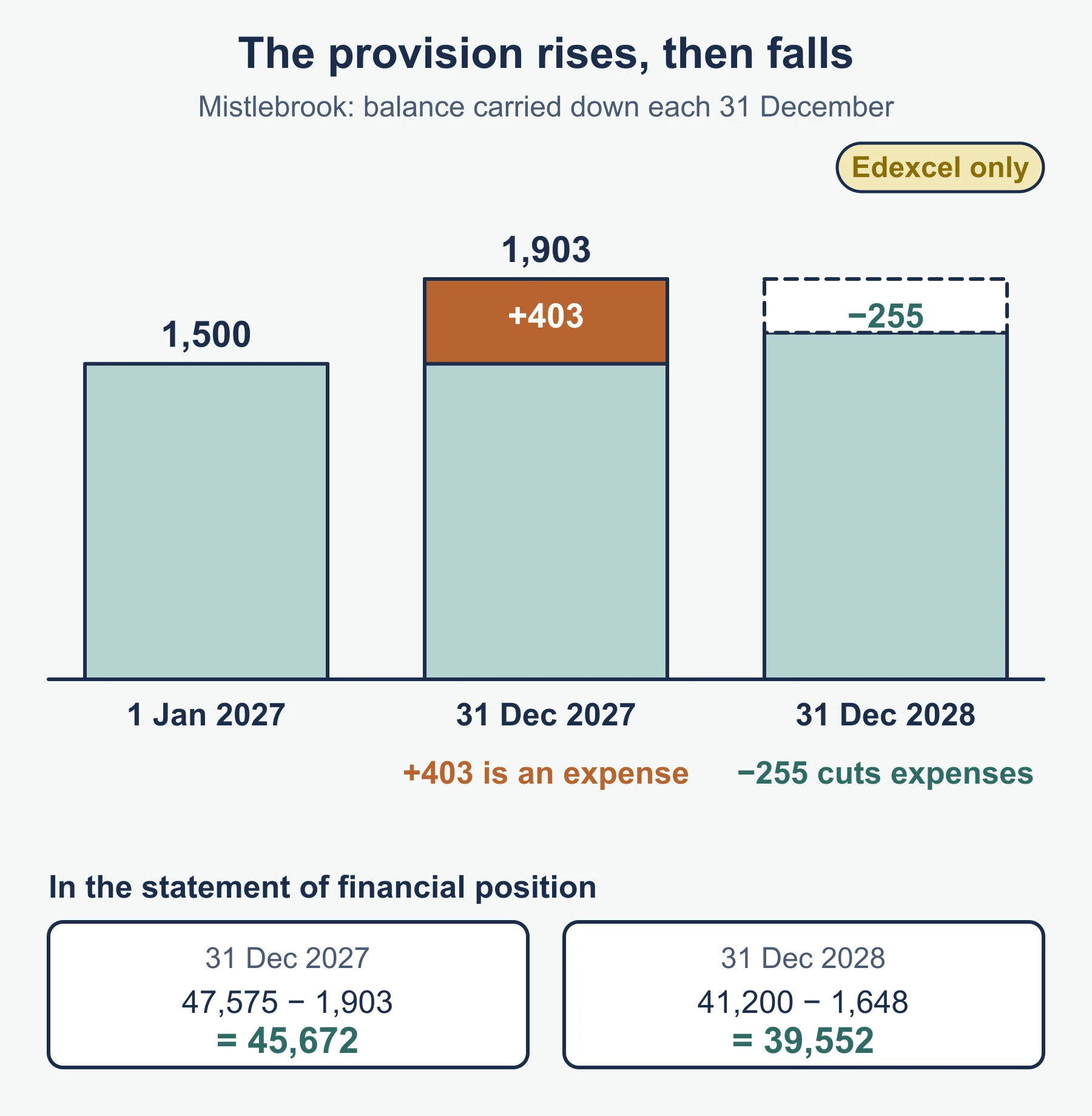
- Provision for irrecoverable debts: an estimate, usually a percentage of trade receivables, of the debts that may turn out to be irrecoverable. No customer is named. It is a credit balance, deducted from trade receivables.
Why a provision is needed (2.6 a)
- Prudence: do not overstate profit or assets when a loss is probable.
- Accruals (matching): the loss comes from this year’s credit sales, so it is charged in this year.
- Trade receivables in the statement of financial position should show an amount the business actually expects to collect.
Distinction (2.6 b)
| Feature | Irrecoverable debt | Provision |
|---|---|---|
| Nature | Known loss | Estimated future loss |
| Customer | Named | Not named |
| Customer account | Closed | Stays open |
| Statement of financial position | Removed from trade receivables | Deducted from trade receivables |
Journals (2.6 c)
| Event | Debit | Credit |
|---|---|---|
| Write off a debt | Irrecoverable debts | Customer (trade receivable) |
| Transfer to income statement | Income statement | Irrecoverable debts |
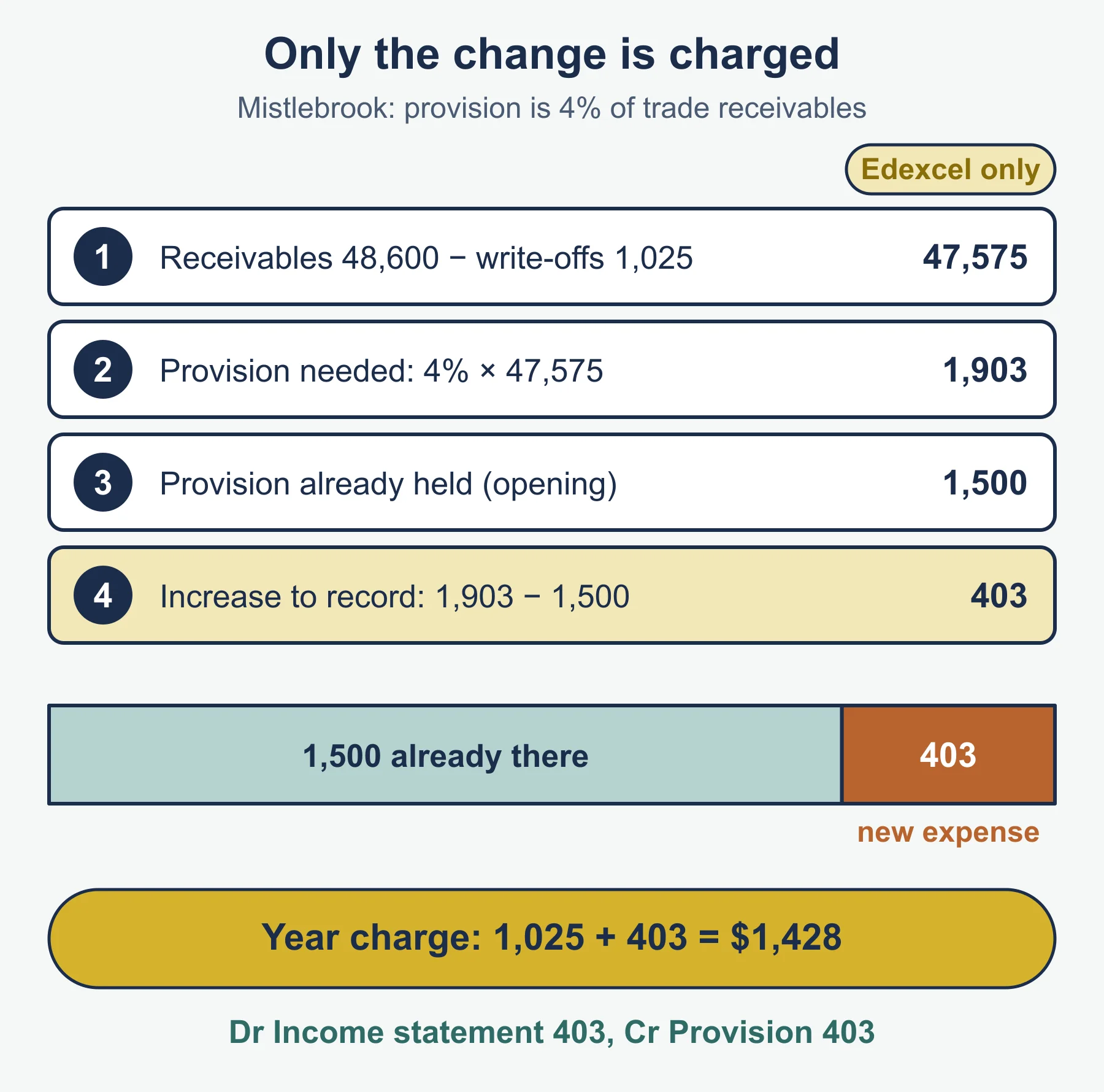
| Provision increased | Income statement | Provision for irrecoverable debts |
| Provision decreased | Provision for irrecoverable debts | Income statement |
Method in steps
- Write off the irrecoverable debts from the trade receivables.
- Calculate the provision required: percentage x remaining trade receivables.
- Subtract the opening provision. A positive answer is an increase, a negative answer a decrease.
- Journal only the difference, then show trade receivables less provision.
Worked reminder
Elmhurst Packaging has a 30 June year end. Debts of B. Ambrose (760) and C. Obuya (510) are written off, a total of 1,270. Trade receivables after the write-offs are 28,500, so before them they were 29,770. The provision is 5%, and the opening provision is 1,625.
Provision required  5% x 28,500 = 1,425
Opening provision                 1,625
Difference                         -200   (decrease)
Dr Provision for irrecoverable debts 200
Cr Income statement                  200

Trade receivables            28,500
Less provision               (1,425)
                              27,075
The expenses relating to bad debts for the year are 1,270 for the write-offs, less the decrease of 200, a net 1,070. This is the net figure that would be charged for bad debts in the income statement.
If the business has no opening provision, the full amount is the charge. If the new provision equals the old one, no entry is needed.
Other receivables and other payables
Why they are accounted for (2.7 a)
- Accruals (matching): expenses and income belong to the period in which they were used or earned, not when cash moved.
- Profit would be wrong: an unrecorded accrual makes profit too high, and an unrecorded prepayment makes profit too low.
- The statement of financial position would leave out an asset (a prepayment, income owed to the business) or a liability (an accrual, income received in advance).
Distinction (2.7 b)
| Other payables | Other receivables | |
|---|---|---|
| Expenses | Accrued: used, not yet paid | Prepaid: paid, not yet used |
| Income | Received in advance | Accrued: earned, not yet received |
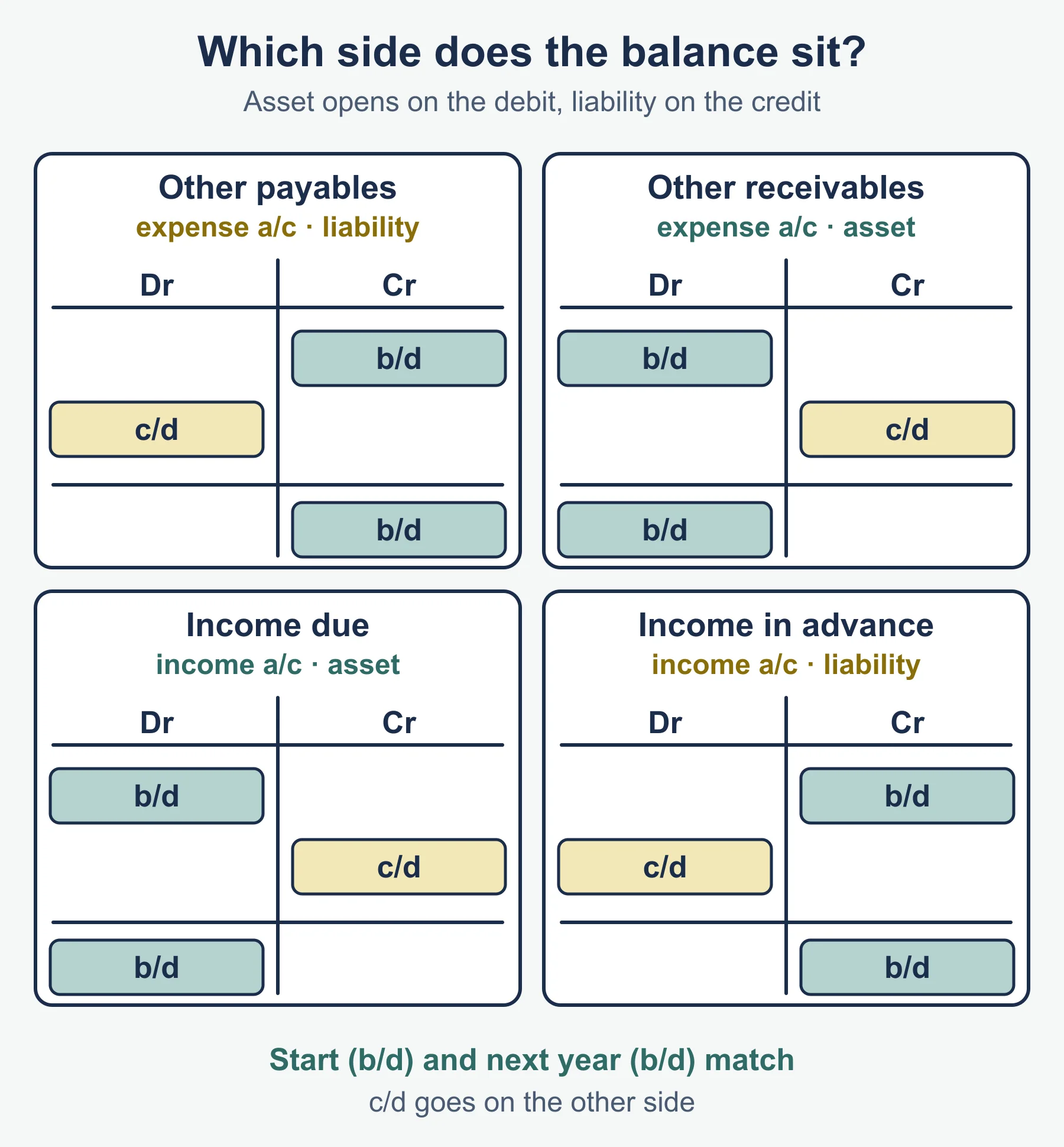
| Statement of financial position | Current liability | Current asset |
| Normal balance | Credit | Debit |
The specification words these only in general terms, so know the cases for both expenses and incomes.
Formula (2.7 c)
Expense for the year = cash paid - opening accrual + closing accrual
                       + opening prepayment - closing prepayment

Income for the year  = cash received - opening accrued income + closing accrued income
                       + opening income in advance - closing income in advance
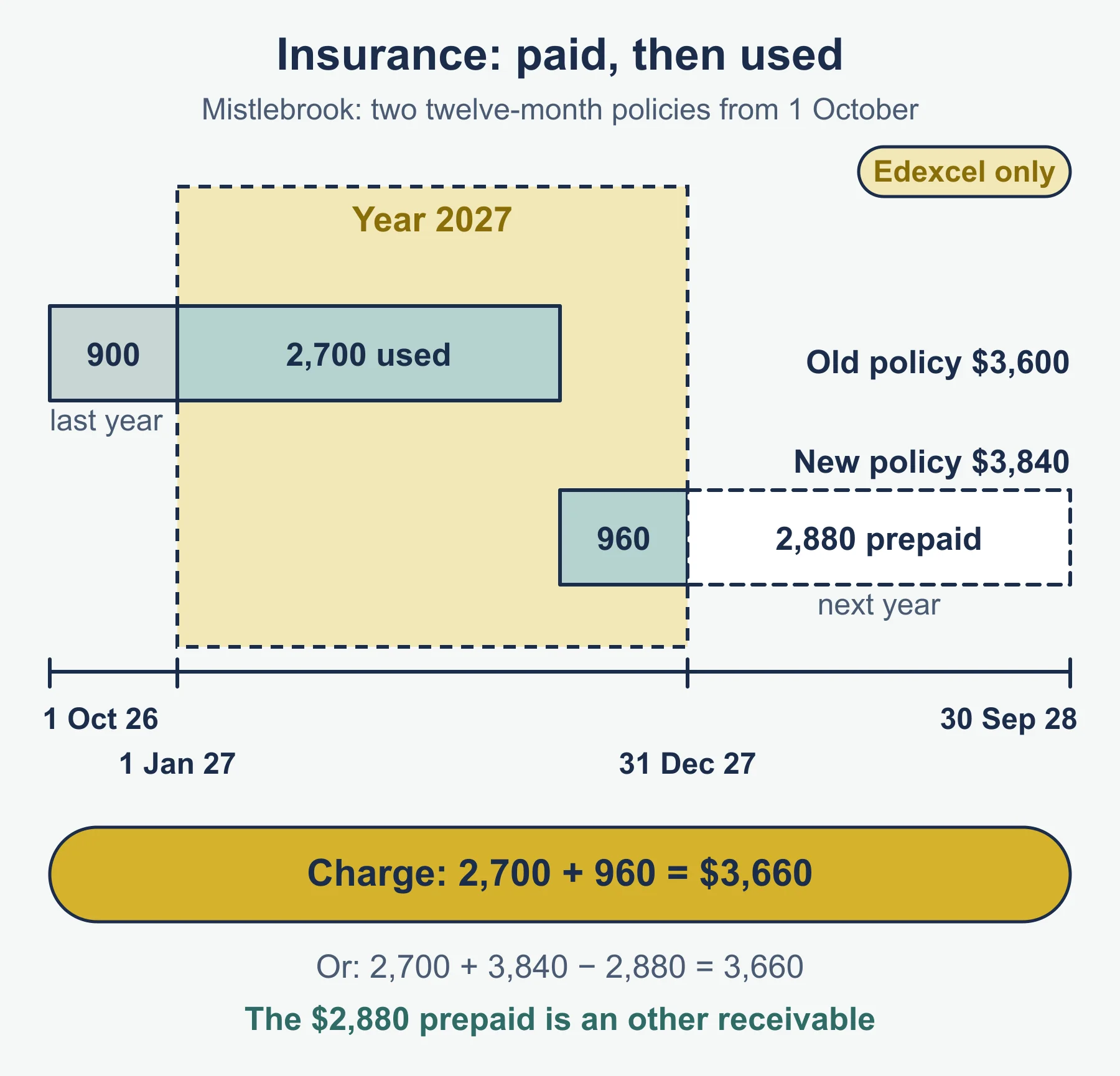
Sense check: an accrual at the year end adds to the expense, because it is a cost not yet paid. A prepayment at the year end takes away from the expense, because part of the payment belongs to next year.
Journals
| Event | Debit | Credit |
|---|---|---|
| Accrued expense at year end | Expense | Other payables |
| Prepaid expense at year end | Other receivables | Expense |
| Accrued income at year end | Other receivables | Income |
| Income in advance at year end | Income | Other payables |
Worked reminders (Elmhurst Packaging, year end 30 June 2028)
Wages: paid 41,500, opening accrual 1,200, closing accrual 1,500. Charge = 41,500 - 1,200 + 1,500 = 41,800. Closing 1,500 is an other payable.
Insurance: paid 2,300, opening prepayment 450, closing prepayment 520. Charge = 2,300 + 450 - 520 = 2,230. Closing 520 is an other receivable.
Commission income: received 3,600, owed to the business at the start 150, received in advance at the end 240. Income = 3,600 - 150 - 240 = 3,210. Closing 240 is an other payable.
          Insurance account
Bank              2,300   Income statement   2,230
Balance b/d (prepaid) 450   Balance c/d (prepaid) 520
                  2,750                      2,750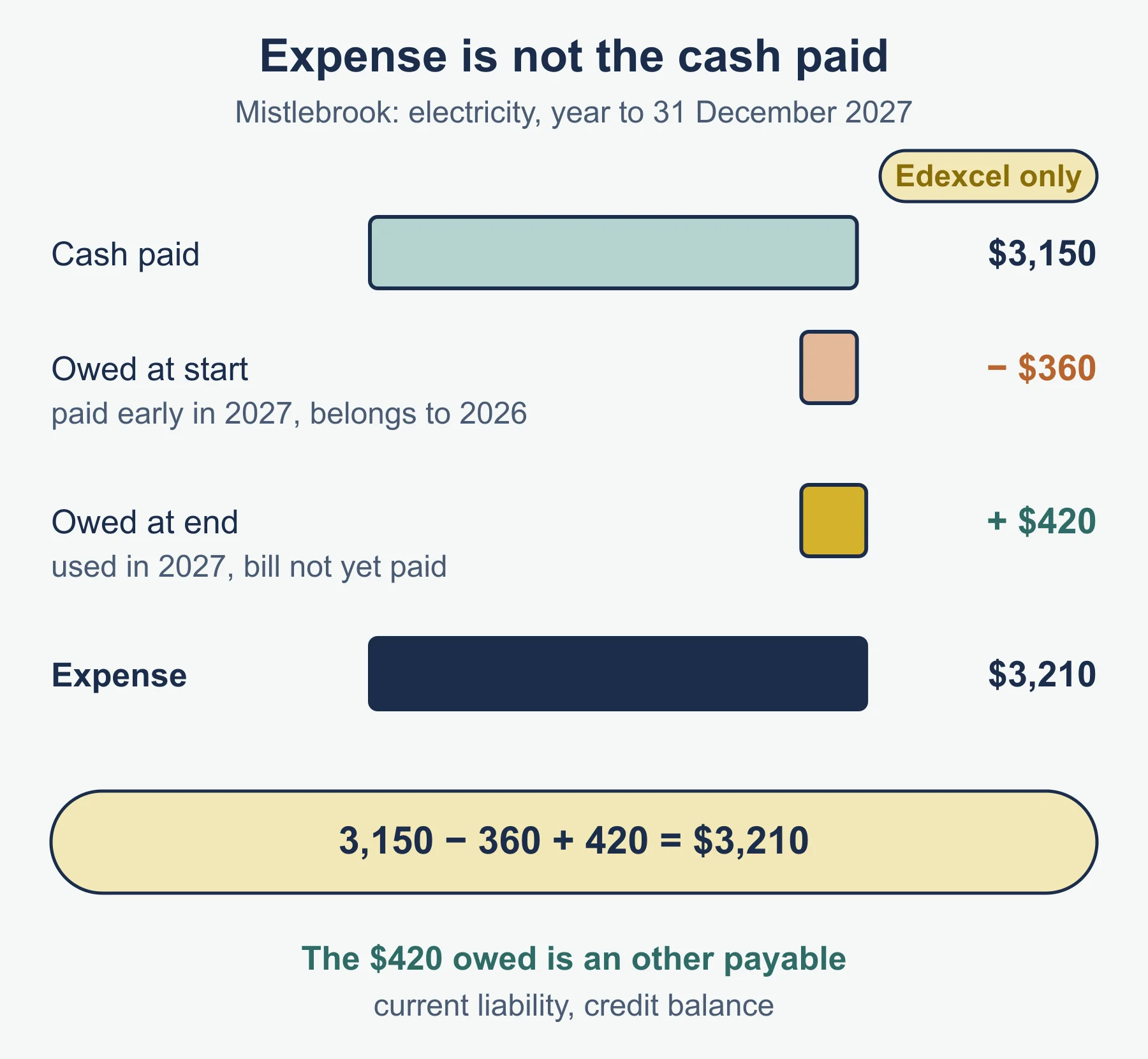
Model explanations to learn
Why a provision is needed: some trade receivables will probably not pay, but the business cannot yet say which. Charging an estimate this year follows prudence and the accruals concept, so profit is not overstated and trade receivables are shown at a realistic amount.
Why other payables must be recorded: an expense that has been used but not paid is a cost of this year. If it is left out, expenses are too low, profit is too high and the business appears to owe nothing it really owes.
Why other receivables must be recorded: a payment made for next year’s benefit is not an expense of this year. If it is left in the expense, profit is too low and an asset is missing from the statement of financial position.
A first-year provision, for example 3% of 20,000 of trade receivables with no opening balance, is a full charge of 600: Dr Income statement 600, Cr Provision 600.
Must-know distinctions
- Irrecoverable debt (known, written off) against provision (estimated, stays in the ledger).
- Increase in provision (extra expense) against decrease (reduces expenses or is income).
- Trade receivables (customers who bought goods on credit) against other receivables (prepayments, income owed).
- Trade payables (suppliers of goods) against other payables (accruals, income in advance).
- Prepaid expense (asset) against accrued expense (liability).
Quick self-test
- State what an irrecoverable debt is.
- Give the journal to write off a debt of 330 from a customer.
- Trade receivables are 31,000, including 1,000 that must be written off. A 4% provision is kept. Calculate the provision.
- The opening provision is 900 and 1,200 is now required. Give the entry.
- The opening provision is 1,200 and 900 is now required. What is the effect on profit?
- Where does the provision appear in the statement of financial position?
- Rent paid in the year is 5,000, with 400 accrued at the start and 600 accrued at the end. Find the expense.
- A subscription paid is 2,400, with 200 prepaid at the start and 300 prepaid at the end. Find the expense.
- An accrual of 700 is left out. What is the effect on profit and on liabilities?
- Classify as other receivable or other payable: rent paid in advance; wages owing; commission earned but not received; rent received in advance.
Answers
- A specific amount owed by a named customer that will not be paid, written off as an expense.
- Dr Irrecoverable debts 330, Cr the customer’s account 330.
- (31,000 - 1,000) x 4% = 1,200.
- Increase of 300: Dr Income statement 300, Cr Provision for irrecoverable debts 300.
- A decrease of 300, so expenses fall and profit rises by 300.
- Deducted from trade receivables in current assets.
- 5,000 - 400 + 600 = 5,200.
- 2,400 + 200 - 300 = 2,300.
- Profit overstated by 700, and liabilities understated by 700.
- Other receivable; other payable; other receivable; other payable.
Where marks are usually lost
- Calculating the provision before deducting the write-offs, which gives too large a figure.
- Journalling the whole provision when only the change is needed.
- Putting the increase and decrease the wrong way round.
- Adding a prepayment to the expense instead of taking it away (or the reverse for accruals).
- Putting a prepayment among liabilities, or an accrual among assets.
- Applying the provision percentage to other receivables as well as trade receivables.
- Leaving out a label or heading on a closing balance, so the reader cannot tell what it represents.
- Totalling a ledger account without checking both sides agree.
Frequently asked questions
What is the formula for an expense in the income statement? The expense for the year is the cash paid, plus the closing accrual, minus the opening accrual, plus the opening prepayment, minus the closing prepayment. For income, add amounts owed to the business and take away income received in advance.
Is a prepayment an asset or a liability? A prepayment is an other receivable, so it is a current asset. An accrual is an other payable, a current liability.
Is the provision for irrecoverable debts applied to other receivables? No. The provision relates only to trade receivables, so the percentage should not be applied to other receivables.
What happens if there was no opening provision for irrecoverable debts? If the business had no provision before, the whole new provision is the charge to the income statement. If the required provision equals the opening balance, no entry is made.
Official syllabus
Pearson Edexcel International GCSE in Accounting (4AC1) specification, Issue 1, October 2016, published by Pearson Education Limited – Topic 2: Introduction to bookkeeping, sections 2.6 Irrecoverable debts and 2.7 Other receivables and other payables. First assessment: June 2019.
Get free revision emails (optional)
Occasional emails with practice questions, worked explanations and links to free resources for the qualification and subjects you choose. No spam, and you can unsubscribe from any email. The free tools on this site never need an email.
Related resources
-
Study guides
Edexcel IGCSE Accounting: Ledger accounting (4AC1)
Study guide to ledger accounting for Pearson Edexcel IGCSE Accounting: the three ledgers, debit and credit rules, balancing, with worked examples.
Accounting · Pearson Edexcel · IGCSE
Read guide -
Practice questions
Edexcel IGCSE Accounting: Ledger accounting (4AC1) – Practice Questions
Original practice questions with worked answers on ledger accounting for Pearson Edexcel IGCSE Accounting: the three ledgers and double entry.
Accounting · Pearson Edexcel · IGCSE
Try questions -
Revision notes
Edexcel IGCSE Accounting: Ledger accounting (4AC1) – Revision Notes
Condensed revision notes on ledger accounting for Pearson Edexcel IGCSE Accounting: ledgers, debit and credit rules, balancing, and a self-test.
Accounting · Pearson Edexcel · IGCSE
Revise topic
Related articles
-
teaching
A Level tuition in Dubai: Cambridge or Pearson Edexcel International A Level?
Schools in Dubai and Abu Dhabi teach either Cambridge International AS & A Level or Pearson Edexcel International A Level. How the two are structured, why it matters for tuition, and how online classes from Lahore work.
9 October 2026
-
curriculum guides
Choosing subjects at IGCSE and A Level
How subject choices at 14 and 16 affect university options later, and how to keep pathways open without overloading a timetable.
28 July 2026
Studying this with a teacher
Working through Accounting IGCSE?
This page is free and stays free. If you would rather be taught it, Marlbridge runs Accounting classes one-to-one and in small groups of up to 15, online in your own time zone. The first trial class is free. WhatsApp replies within an hour (8am–11pm Pakistan time, every day); email the same day.
Pearson Edexcel Accounting teachers at Marlbridge

