
Revision Notes
Edexcel IGCSE Business: Economies and diseconomies of scale, and production (4BS1) – Revision Notes
Condensed Edexcel IGCSE Business revision notes on scale, production types, productivity, JIT, Kaizen and robotics, with a self-test and common errors.
- Subject
- Business
- Level
- IGCSE
- Topic
- Business operations
- Author
- Marlbridge Academic Team
- Updated
- Reviewed by
- Asif Iqbal (what this means)
Aligned to Pearson Edexcel IGCSE Business (4BS1), Issue 2, February 2026. Official specification .
Syllabus page (what it covers and how it is assessed): Pearson Edexcel IGCSE Business.
Syllabus points this page covers
4BS1
- 5 Business operations (whole topic)
- 5.1 Economies and diseconomies of scale
- 5.2 Production
Found an error? Report a correction.
Want a teacher for this? Marlbridge teaches Business online. Request a free trial class.
Quick recall for the Pearson Edexcel International GCSE in Business (4BS1) specification, Issue 2, February 2026, Topic 5 Business operations, sections 5.1 and 5.2. Full explanations and worked examples are in the study guide; questions to try are in the practice set. Course links: the Edexcel IGCSE Business hub, the printable checklist and the free diagnostics. Both papers (Paper 1 small businesses, Paper 2 large businesses) can test any of this.
1. Scale at a glance (5.1.1 and 5.1.2)
| Term | Meaning | Key line |
|---|---|---|
| Average total cost | Total cost ÷ output | The measure behind every point below |
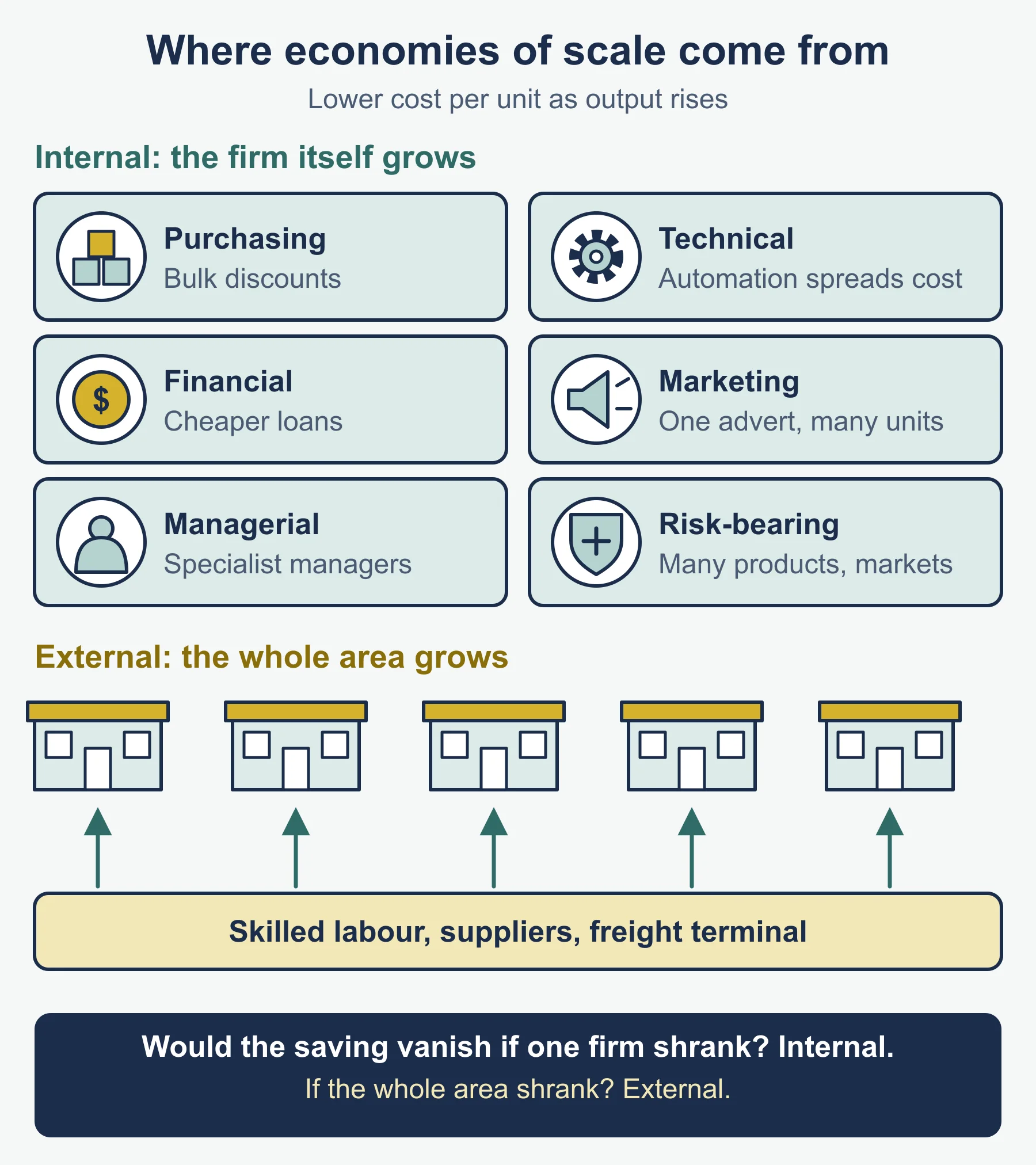
| Internal economies of scale | Falling average total costs as output increases | Come from the firm’s own growth |
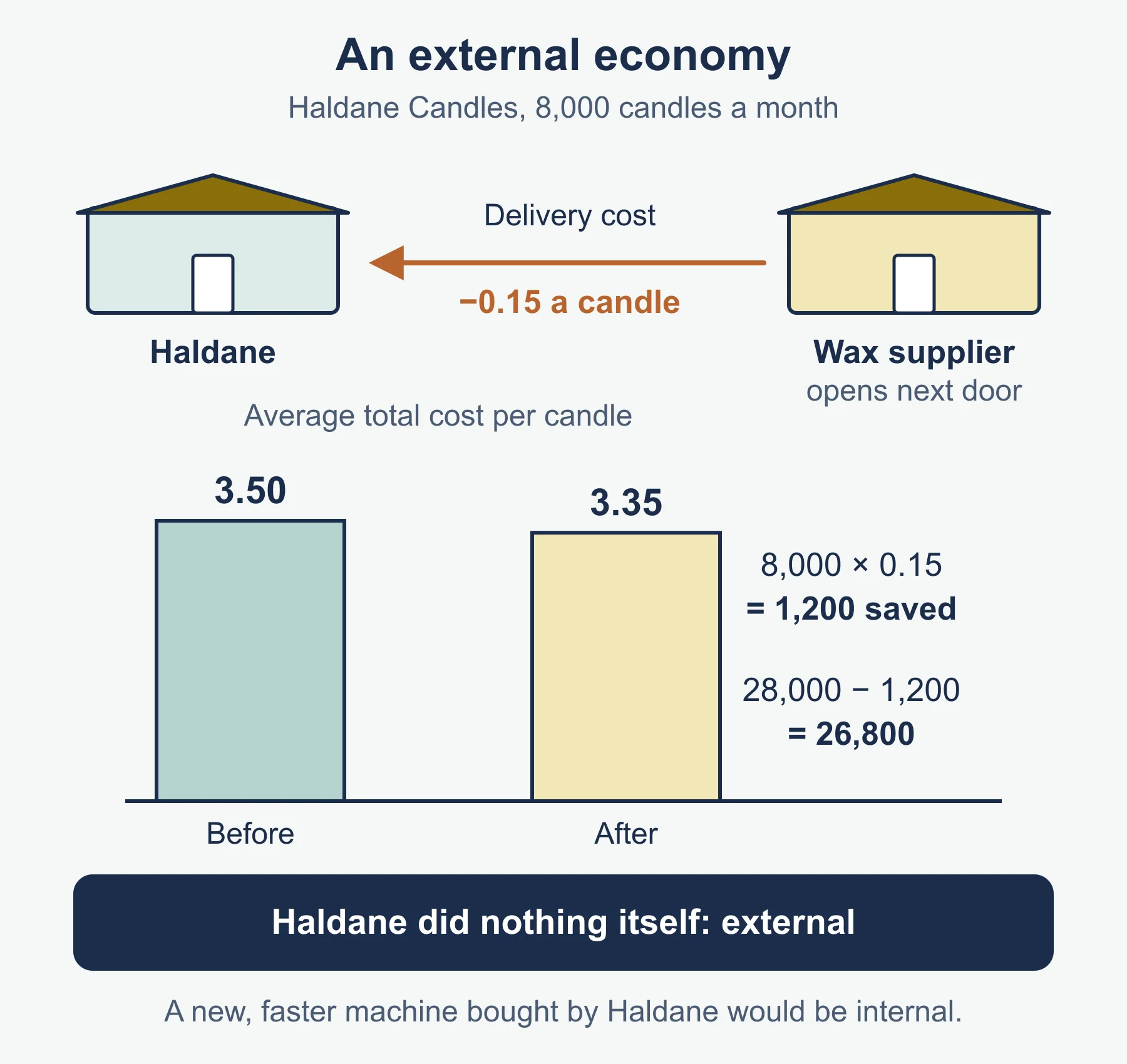
| External economies of scale | Falling average total costs due to external factors | Help many firms in an area or industry |
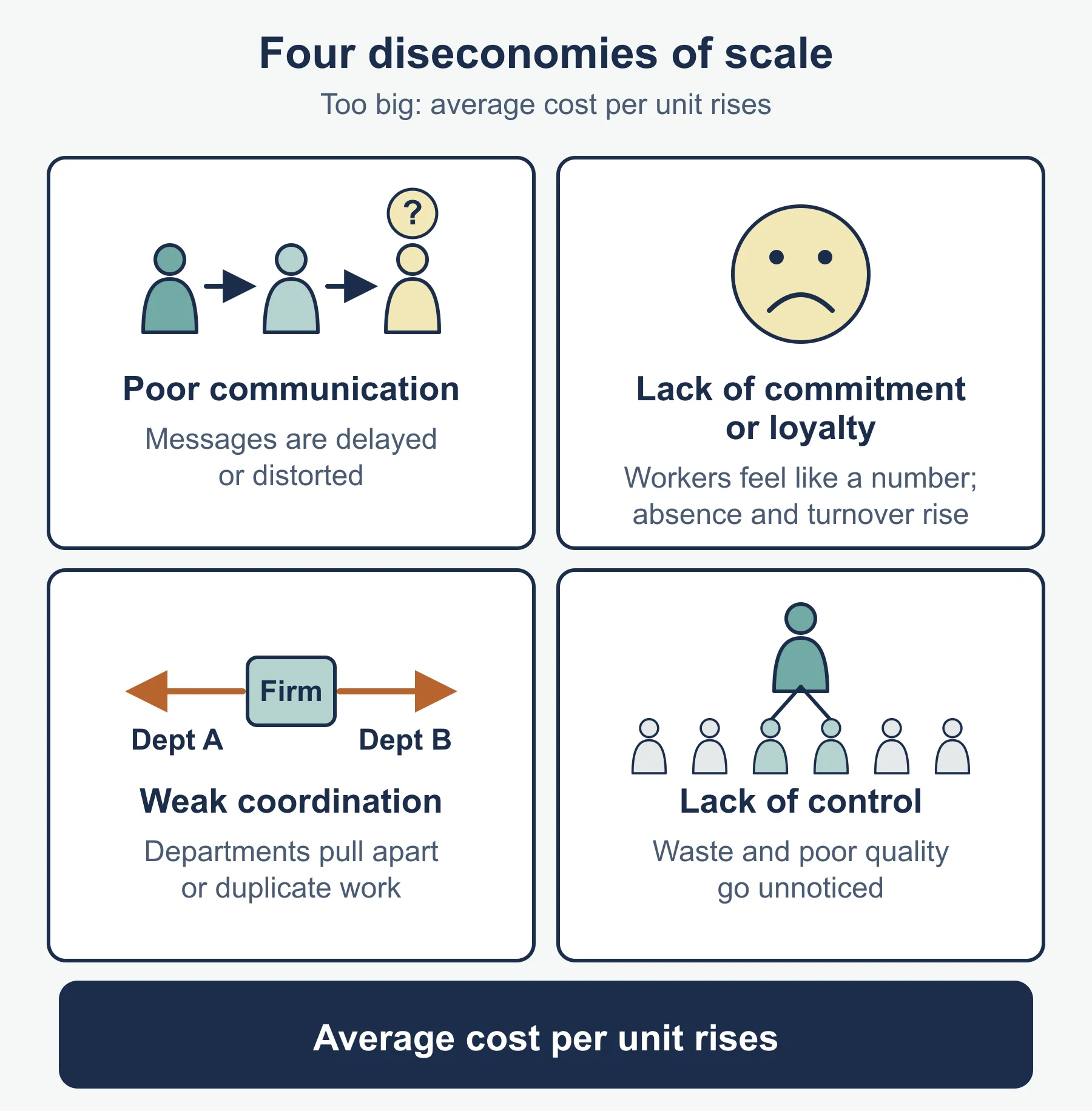
| Diseconomies of scale | Average total cost rising as output rises | Part of the limits of growth |
Sources to quote (illustrations, not a list the specification sets):
- Internal: fixed costs spread over more units; cheaper materials in bulk; more efficient machines.
- External: skilled workers in the area; a specialist supplier nearby; better roads or ports.
- Diseconomies: slow communication; weak co-ordination across sites; lower motivation; strain on capacity.
- Other limits of growth: size of the market, access to finance, owner’s wish to keep control.
Method: spotting the turning point
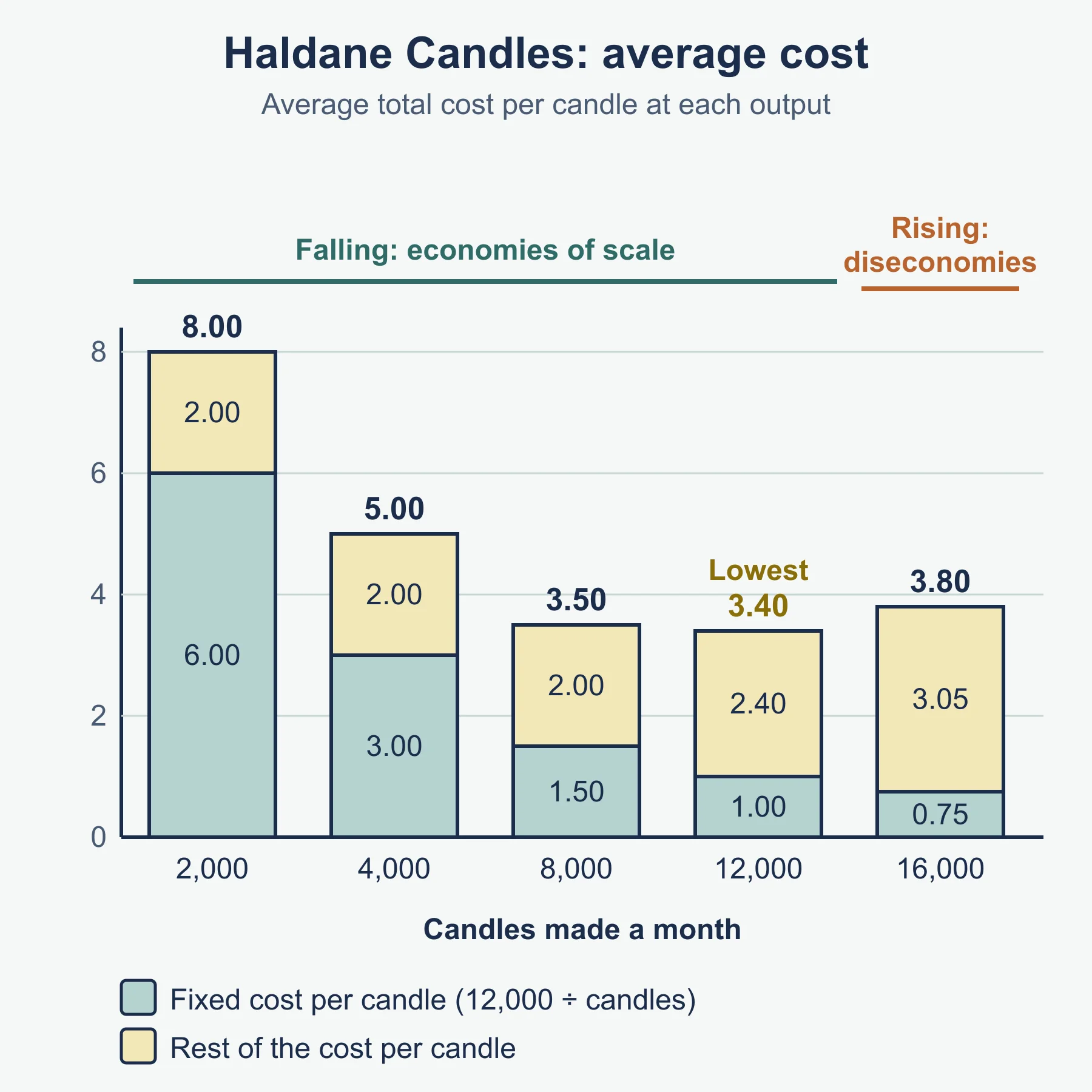
- Work out average total cost at every output (total cost ÷ output).
- Find the lowest figure. Economies operate up to there.
- Any rise after that signals diseconomies.
Reminder example, Quillon Cycles:
| Output | Total cost | Average total cost |
|---|---|---|
| 500 | 6,000 | 12.00 |
| 1,000 | 8,000 | 8.00 |
| 2,000 | 12,000 | 6.00 |
| 3,000 | 18,000 | 6.00 |
| 4,000 | 26,000 | 6.50 |
The average is lowest at 2,000 and 3,000 (6.00). It rises to 6.50 at 4,000, so diseconomies have started somewhere after 3,000.
Internal or external?
| Ask yourself | If yes |
|---|---|
| Did the business itself change (bought, grew, reorganised)? | Internal |
| Did something outside the business change, helping its costs? | External |
| Did cost per unit rise because output rose? | Diseconomy |
| Did costs rise for another reason, such as a tax or a supplier price rise? | Not a diseconomy of scale |
2. Production types (5.2.1)
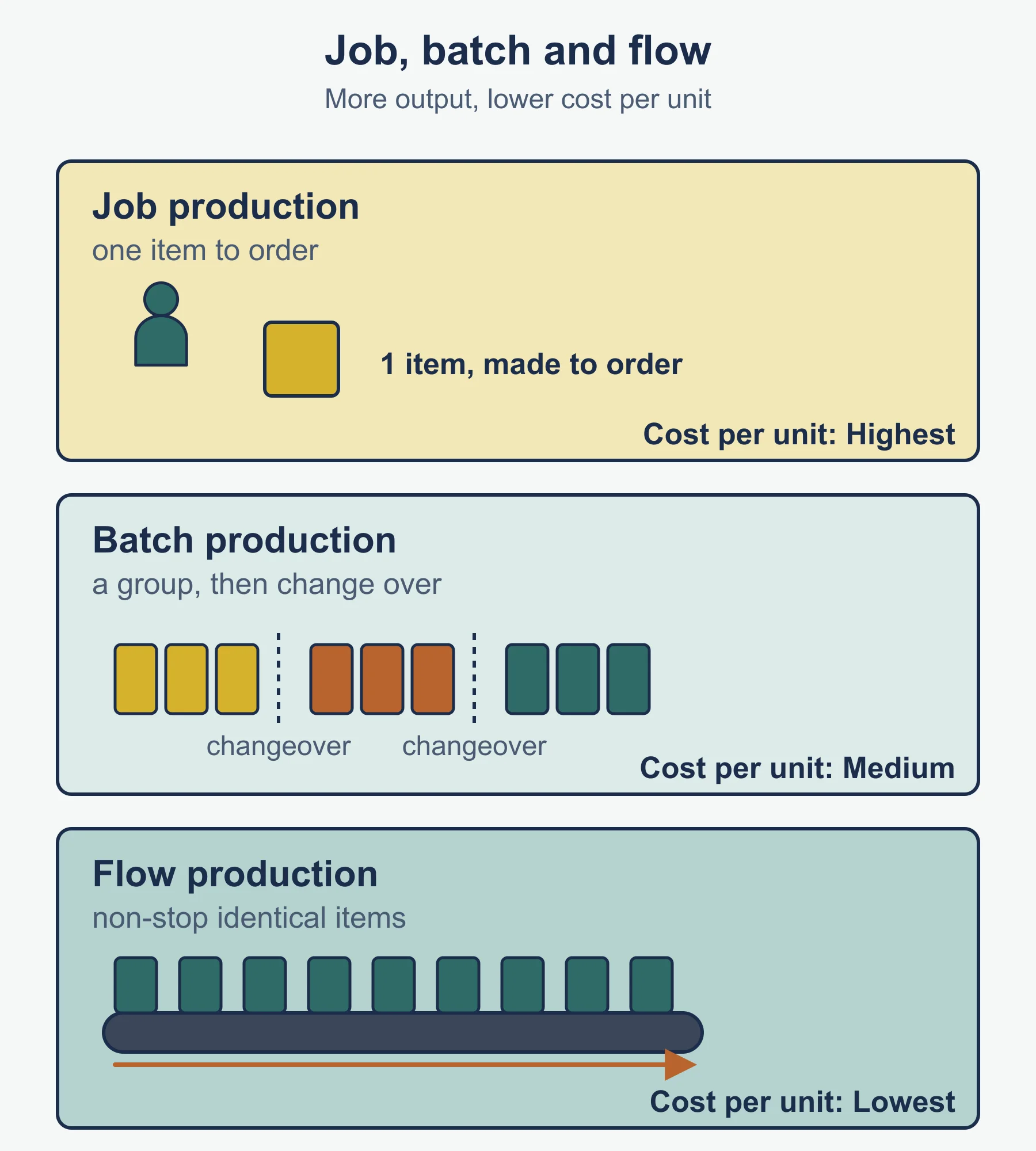
| Job | Batch | Flow | |
|---|---|---|---|
| Output | One-off item to order | Groups of identical items | Continuous, standardised |
| Unit cost | Highest | Middle | Lowest at high volume |
| Flexibility | Very high | Medium | Low |
| Capital needed | Low | Medium | High |
| Weakness | Slow, expensive | Downtime changing over; stock builds | Costly to set up; a fault halts the line |
| Invented example | A bespoke guitar maker | A factory baking 400 biscuits of one flavour, then another | A bottling line running all day |
When asked for the impact of a type, choose two or three of: unit cost, flexibility, quality, speed, worker motivation, capital cost. Link each to the business in the question.
Labour intensive and capital intensive
| Labour intensive | Capital intensive | |
|---|---|---|
| Main input | Workers | Machines and technology |
| Biggest cost | Wages | Equipment, depreciation and running costs |
| Strength | Flexible, personal service | Low unit cost at high output |
| Weakness | Wages rise; limited output per worker | Large finance needed; high fixed costs |
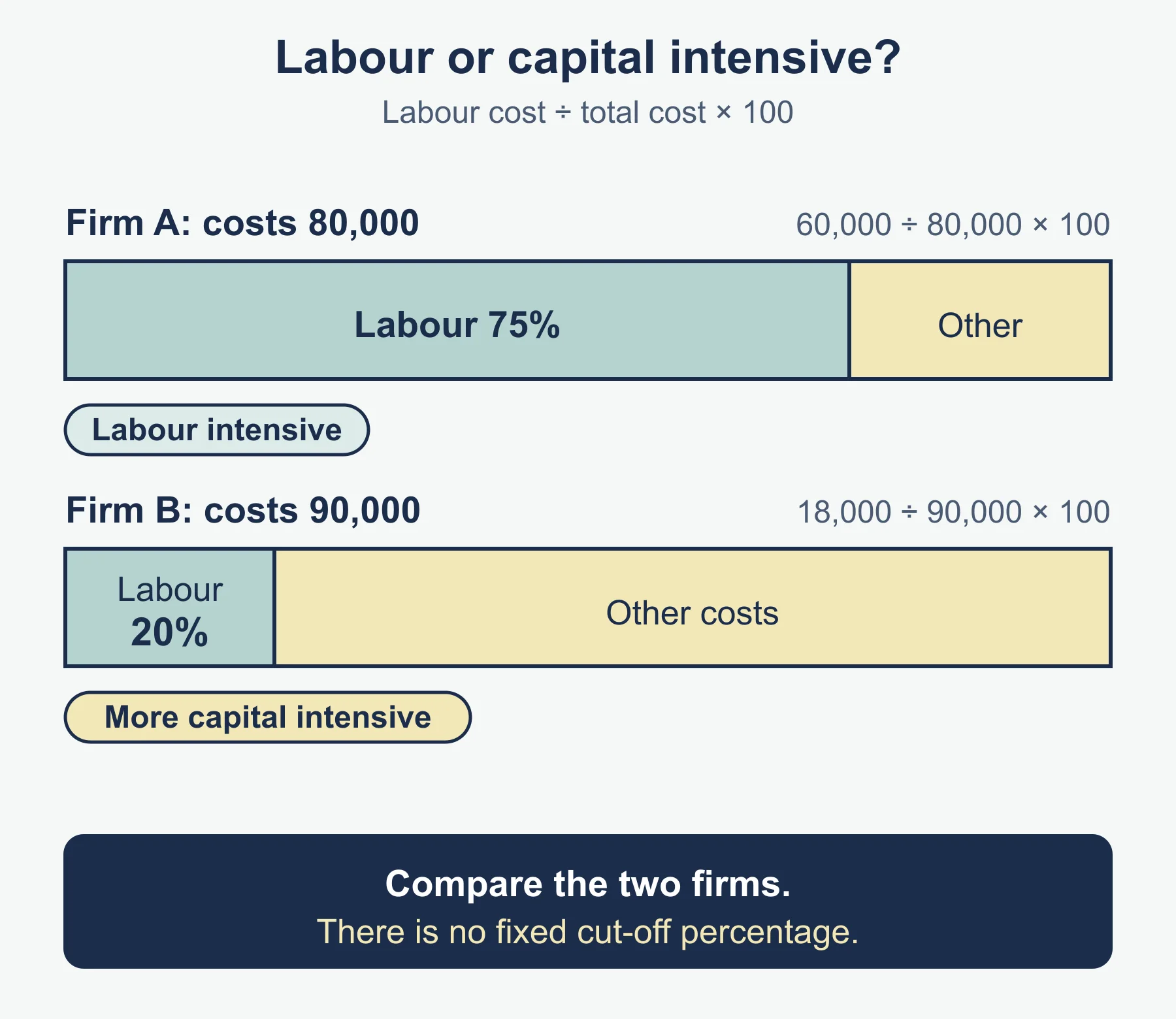
Quick test (a standard form; the specification gives no formula for intensity): labour cost ÷ total cost × 100. Labour of 24,000 out of total costs of 96,000 is 25%. Set that beside a rival whose labour is 70% of costs and you can say the first firm is the more capital intensive. The specification sets no cut-off, so always compare.
3. Productivity (5.2.1)
Standard form, because the specification gives no formula:
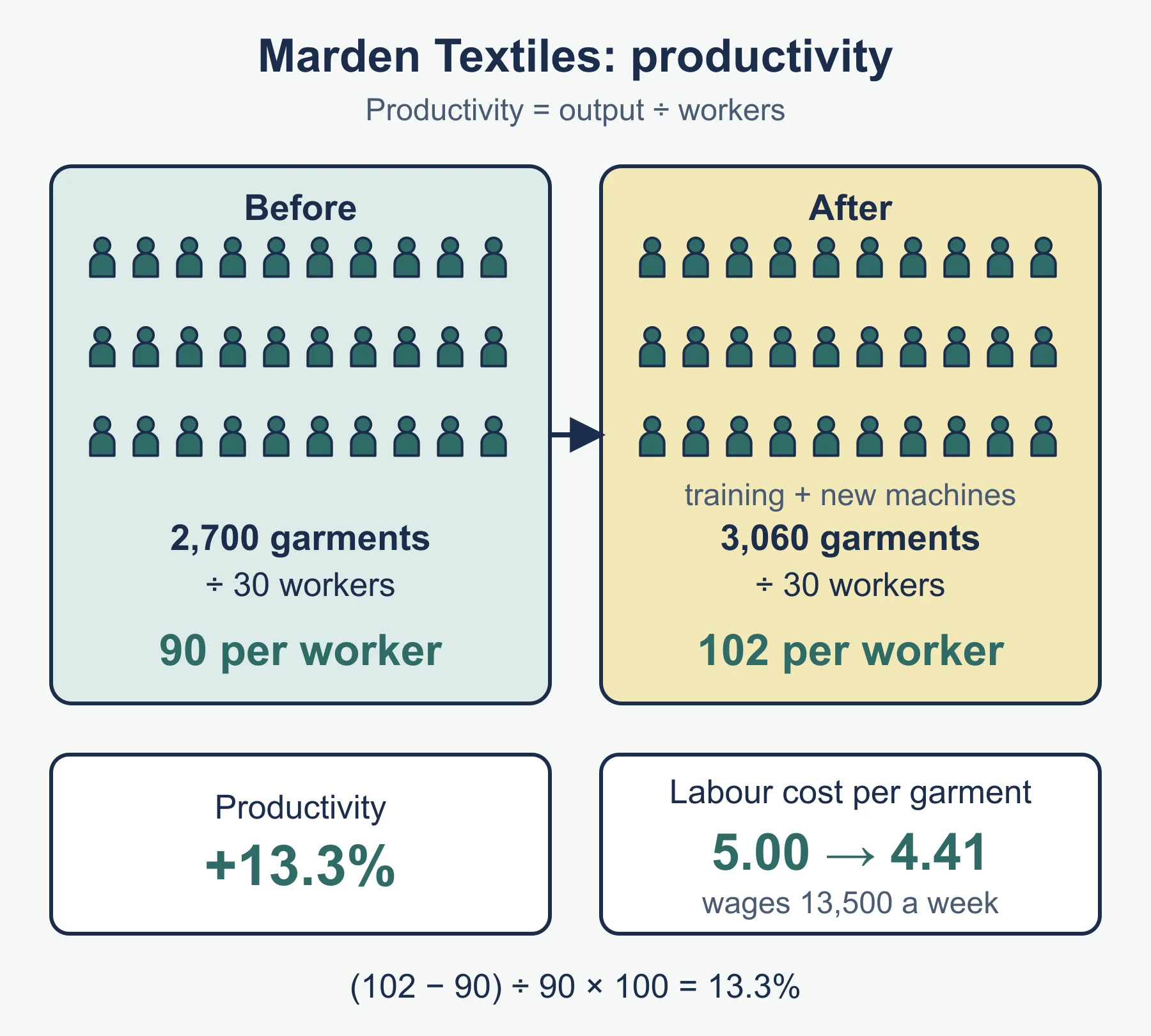
productivity = output ÷ number of inputs (for labour: output ÷ number of workers)
Method in steps:
- Write the formula with the time period (per day, per week).
- Divide output by inputs.
- State the unit: units per worker per day.
- For a change: (new − old) ÷ old × 100.
Worked reminder: 12 workers make 1,440 units a day.
- Productivity: 1,440 ÷ 12 = 120 units per worker per day.
- After new equipment, 1,800 units a day: 1,800 ÷ 12 = 150.
- Increase: (150 − 120) ÷ 120 × 100 = 25%.
- Labour cost per unit with a daily wage of 400: 12 × 400 = 4,800. Before: 4,800 ÷ 1,440 = 3.33. After: 4,800 ÷ 1,800 = 2.67.
Impact of higher productivity: lower unit costs, room to cut price or lift profit, more output from the same staff, stronger competitiveness. Watch for: lower quality or lower morale if the gain comes from pressure on workers.
4. Lean production (5.2.2)
| Idea | In one line | Benefit | Risk or cost |
|---|---|---|---|
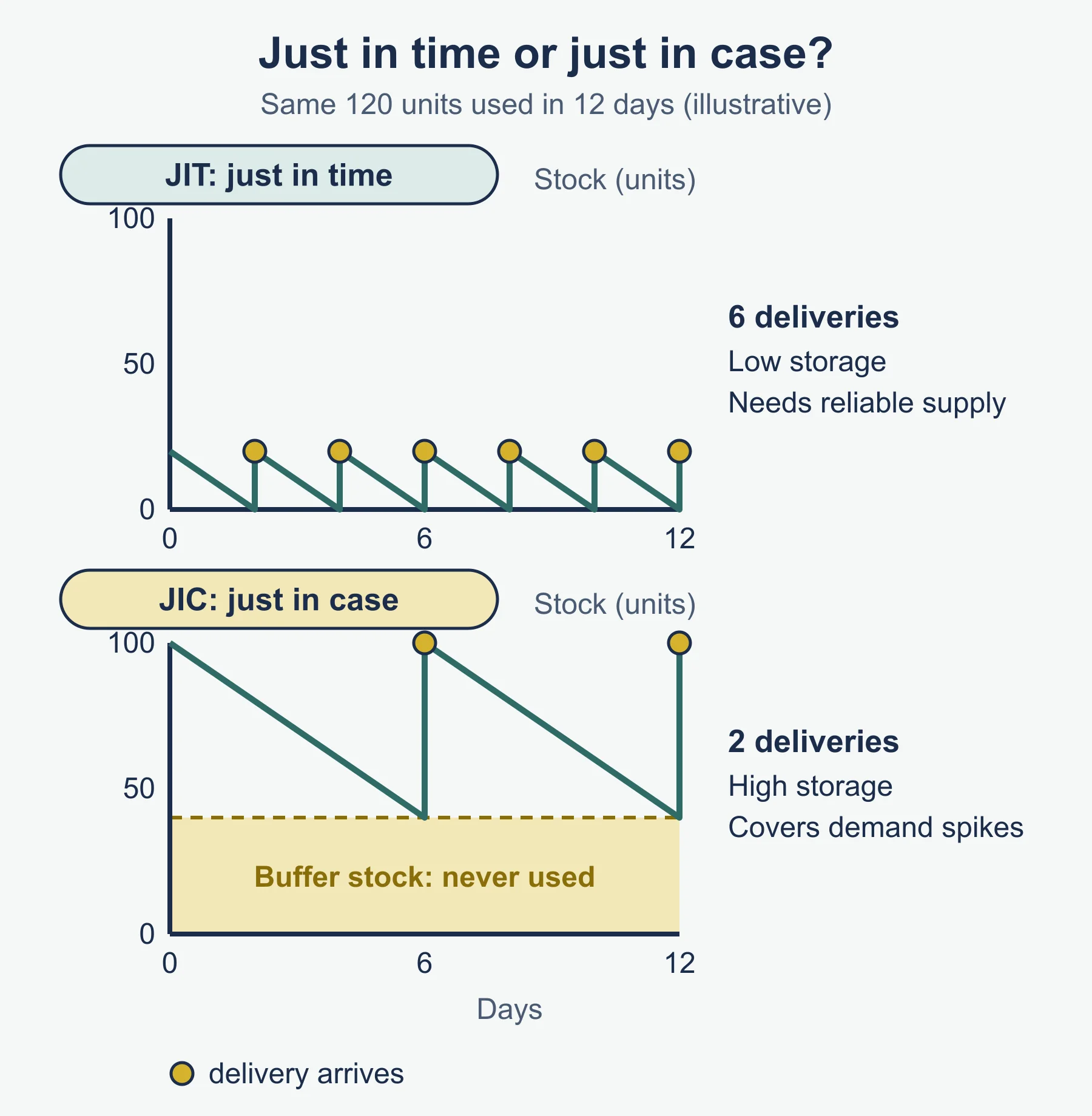
| Just-in-time (JIT) | Stock arrives when needed and goes out quickly | Less money tied up; lower storage and waste | A late delivery halts production; hard to meet sudden demand |
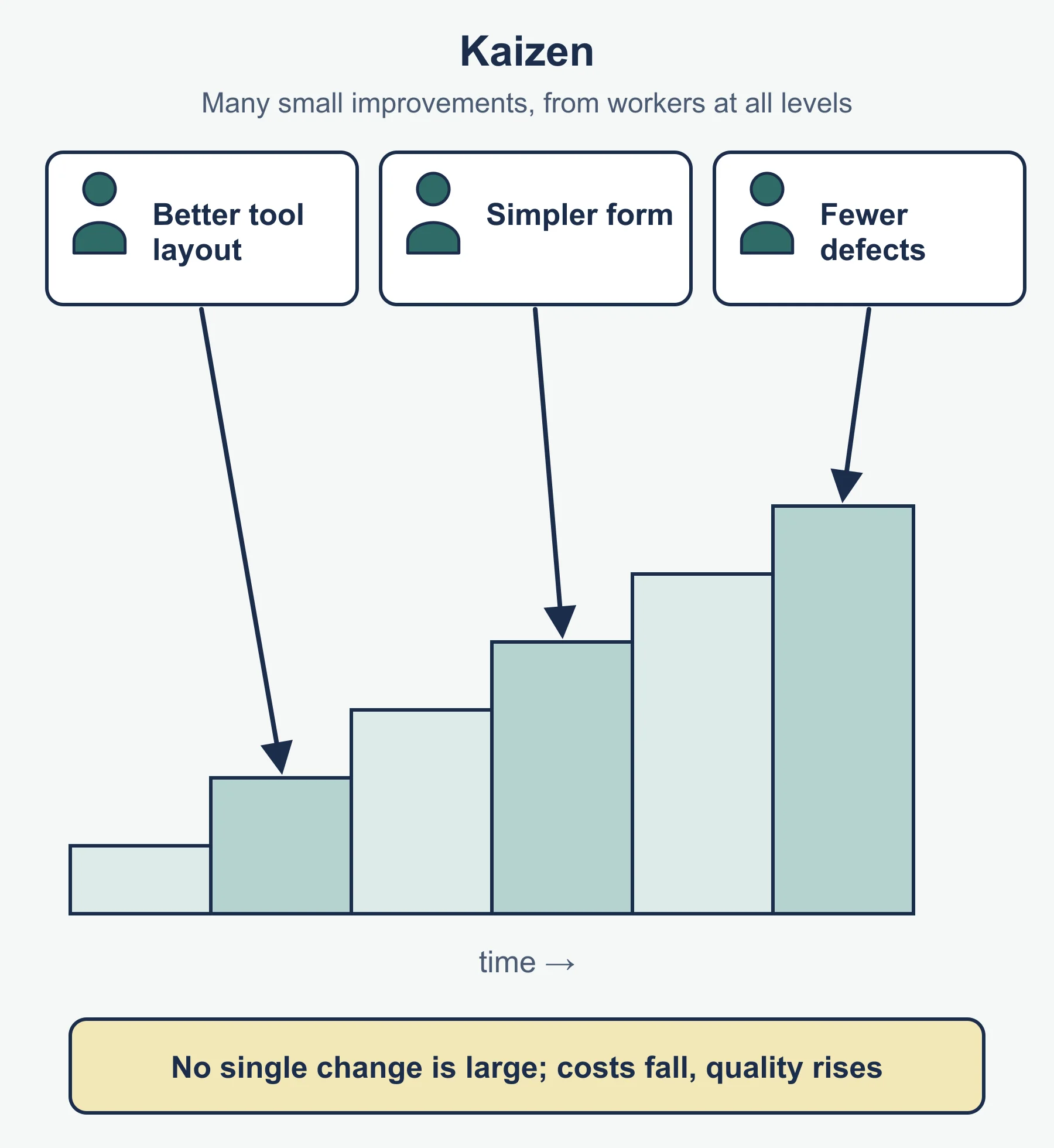
| Kaizen | Continuous improvement through many small changes from all staff | Less waste, better quality, involved workforce | Slow gains; needs time, training and listening managers |
| Using resources effectively | Make the most of materials, time, energy and space | Lower unit costs, protects profit, supports competitiveness | Takes planning and monitoring |
Example for Kaizen: a packing team notices that 36 of 1,200 parcels (3%) are damaged and suggests a firmer box. Damaged parcels fall to 12 of 1,200 (1%). Small ideas, repeated, add up.
5. Robotics and technology (5.2.3)
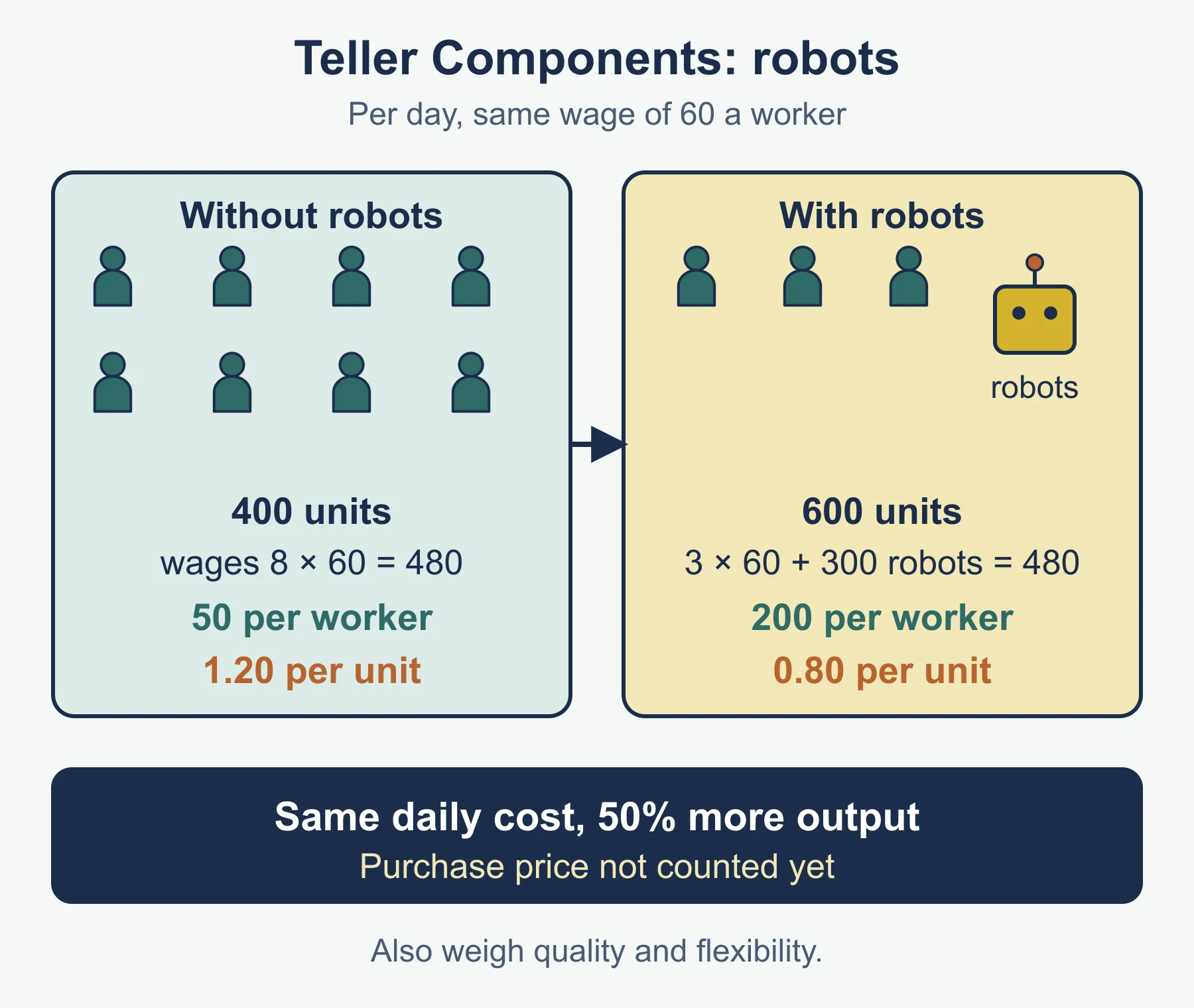
Robotics makes production more capital intensive. Weigh four factors.
- Cost: lower labour cost per unit against high purchase, installation and repair costs.
- Productivity: more output per worker and longer running hours against stoppages when something fails.
- Quality: consistent results against repeating an error across many items.
- Flexibility: can be reprogrammed against being less adaptable than people for unusual jobs.
For a judgement, decide which factor matters most to this business. A firm making millions of identical items will favour cost and productivity; a firm making custom items will favour flexibility.
Must-know distinctions
- Economies versus productivity. Economies of scale are about cost per unit as total output grows. Productivity is output per worker or other input. A firm can raise productivity without growing, and can grow without raising productivity.
- JIT versus Kaizen. JIT is about when materials and goods move. Kaizen is about the steady search for better ways of working. A firm can use both.
- Batch versus flow. Batch stops to change the equipment between groups; flow does not stop and the product stays standardised.
- Capital intensive versus capital cost. Capital intensive describes the mix of inputs. A business can be labour intensive and still own expensive equipment.
- Limit of growth versus diseconomy. A diseconomy is one limit, a rise in average total cost. Market size or finance can also limit growth with no change in unit cost.
Command words in this topic
- State or identify: one short point, no reason needed.
- Define: give the meaning, for example average total costs falling as output rises.
- Calculate: write the formula, show the working, give the unit.
- Explain: a point, then a reason, then a link to the business in the question.
- Analyse: a chain of reasoning, such as robots, then fewer workers needed, then lower wage bill per unit, then higher profit.
- Evaluate or justify: weigh both sides, then reach a reasoned decision for this business.
Quick self-test
- Define internal economies of scale.
- Quillon Cycles has total costs of 8,000 at 1,000 bikes. Calculate average total cost.
- A specialist training college opens next to a factory and its recruits cut training costs. Is this internal or external?
- State one reason why diseconomies of scale may occur.
- A firm bakes 250 identical loaves, then resets the oven for a different recipe. Name the production process.
- Which production process normally gives the lowest unit cost at high volume?
- Calculate productivity when 15 workers produce 1,800 units a week.
- Output rises from 120 to 150 units per worker. Calculate the percentage increase.
- State one risk of JIT.
- What does Kaizen aim to achieve?
- State one drawback of introducing robots.
Answers
- Falling average total costs as the business’s own output increases.
- 8,000 ÷ 1,000 = 8.00.
- External: the benefit comes from something outside the firm.
- Any one: slower communication, poorer co-ordination, lower motivation, capacity strain.
- Batch production.
- Flow production.
- 1,800 ÷ 15 = 120 units per worker per week.
- (150 − 120) ÷ 120 × 100 = 25%.
- Any one: a late delivery stops production; no spare stock if demand jumps; reliance on suppliers.
- Continuous improvement through many small changes, reducing waste and raising quality.
- Any one: high purchase and maintenance cost; breakdowns stop output; less flexible; fewer jobs for staff.
Where marks are usually lost
- Defining economies of scale without mentioning average total cost.
- Using a rise in a supplier’s price as an example of a diseconomy.
- Saying “flow production is cheap” without saying cheap per unit at high volume.
- Forgetting the unit or time period on a productivity answer.
- Dividing by the wrong figure when finding percentage change (use the old value).
- Giving advantages of JIT or robots only, when the question needs both sides.
- Describing Kaizen as one big change.
- Not applying a point to the business named in the stem.
Frequently asked questions
What is the difference between internal and external economies of scale? Internal economies come from the business’s own growth, such as spreading fixed costs over more units. External economies are falls in average total cost due to factors outside the firm, such as a skilled local labour pool or a specialist supplier nearby.
What causes diseconomies of scale? Communication problems, harder co-ordination and control, weaker motivation and capacity pressure can all make average total cost rise as a business grows.
How do you calculate labour productivity? Divide output by the number of workers, and state the time period and unit, such as 90 garments per worker per week.
What is Kaizen? Kaizen means continuous improvement: everyone, including shop-floor workers, makes many small, regular suggestions to improve how work is done, cutting waste and improving quality.
Official syllabus
Pearson Edexcel International GCSE in Business (4BS1), Specification, Issue 2, February 2026, published by Pearson Education Limited. Topic 5: Business operations, sections 5.1 Economies and diseconomies of scale and 5.2 Production, all numbered points.
Get free revision emails (optional)
Occasional emails with practice questions, worked explanations and links to free resources for the qualification and subjects you choose. No spam, and you can unsubscribe from any email. The free tools on this site never need an email.
Related resources
-
Study guides
Edexcel IGCSE Business: Factors of production and quality (4BS1)
Study guide to factors of production, capital and labour intensity, quality control and TQM for Edexcel IGCSE Business (4BS1), with worked examples.
Business · Pearson Edexcel · IGCSE
Read guide -
Practice questions
Edexcel IGCSE Business: Factors of production and quality (4BS1) – Practice Questions
Original practice questions with worked answers on factors of production, capital and labour intensity, quality control and TQM for Edexcel IGCSE Business.
Business · Pearson Edexcel · IGCSE
Try questions -
Revision notes
Edexcel IGCSE Business: Factors of production and quality (4BS1) – Revision Notes
Condensed revision notes on enterprise, capital, land, labour, capital and labour intensity, quality control and TQM for Edexcel IGCSE Business.
Business · Pearson Edexcel · IGCSE
Revise topic
Related articles
-
teaching
A Level tuition in Dubai: Cambridge or Pearson Edexcel International A Level?
Schools in Dubai and Abu Dhabi teach either Cambridge International AS & A Level or Pearson Edexcel International A Level. How the two are structured, why it matters for tuition, and how online classes from Lahore work.
9 October 2026
-
curriculum guides
Choosing subjects at IGCSE and A Level
How subject choices at 14 and 16 affect university options later, and how to keep pathways open without overloading a timetable.
28 July 2026
Studying this with a teacher
Working through Business IGCSE?
This page is free and stays free. If you would rather be taught it, Marlbridge runs Business classes one-to-one and in small groups of up to 15, online in your own time zone. The first trial class is free. WhatsApp replies within an hour (8am–11pm Pakistan time, every day); email the same day.
Pearson Edexcel Business teachers at Marlbridge

