
Revision Notes
Edexcel IGCSE Business: Factors of production and quality (4BS1) – Revision Notes
Condensed revision notes on enterprise, capital, land, labour, capital and labour intensity, quality control and TQM for Edexcel IGCSE Business.
- Subject
- Business
- Level
- IGCSE
- Topic
- Business operations
- Author
- Marlbridge Academic Team
- Updated
- Reviewed by
- Asif Iqbal (what this means)
Aligned to Pearson Edexcel IGCSE Business (4BS1), Issue 2, February 2026. Official specification .
Syllabus page (what it covers and how it is assessed): Pearson Edexcel IGCSE Business.
Syllabus points this page covers
4BS1
- 5 Business operations (whole topic)
- 5.3 Factors of production
- 5.4 Quality
Found an error? Report a correction.
Want a teacher for this? Marlbridge teaches Business online. Request a free trial class.
These notes condense topic 5, sections 5.3 Factors of production and 5.4 Quality, from the Pearson Edexcel International GCSE in Business (4BS1) specification, Issue 2, February 2026. Read the study guide for full explanations and worked examples, and test yourself with the practice questions. Course links: the Edexcel IGCSE Business hub, the printable checklist and the free diagnostics. Both Paper 1 (small businesses) and Paper 2 (large businesses) can draw on this content.
Section 5.3: factors of production
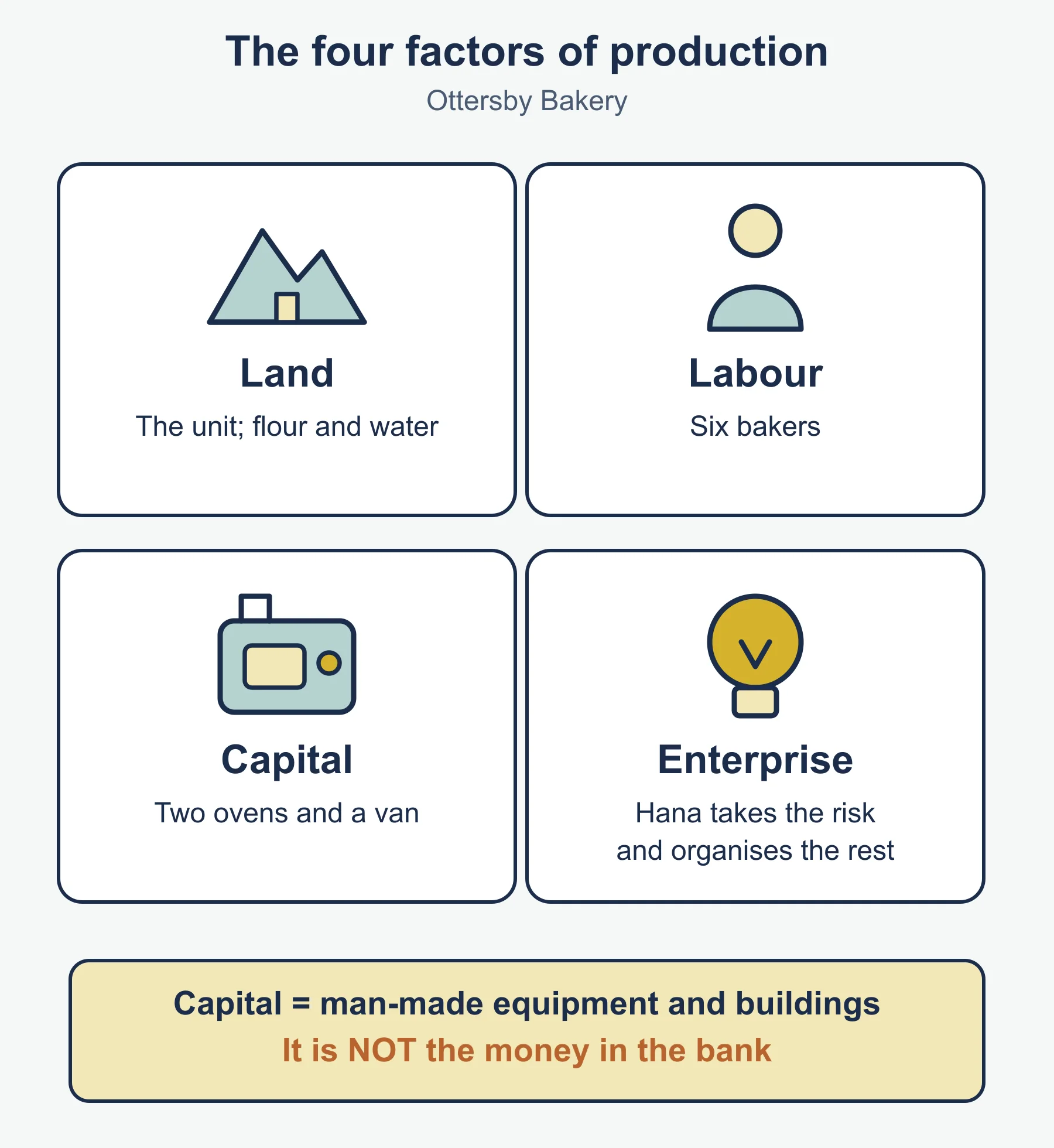
The four factors
| Factor | Meaning | Example in a bakery |
|---|---|---|
| Enterprise | Owner or entrepreneur who takes risk and organises the other inputs | The owner deciding to open a second shop |
| Capital | Equipment, machinery, vehicles, tools and technology used to make output | Ovens, mixers, delivery van |
| Land | Site, premises and natural resources | The shop and bakery unit; flour as a farm product |
| Labour | People who work for the business | Bakers, counter staff |
Key idea: the specification talks about changing relationships. The mix of the four can change, and a business can swap one input for another.
Why the mix changes
- New technology makes machines cheaper or more capable.
- Wages rise relative to equipment prices, or the reverse.
- The business grows and can afford equipment.
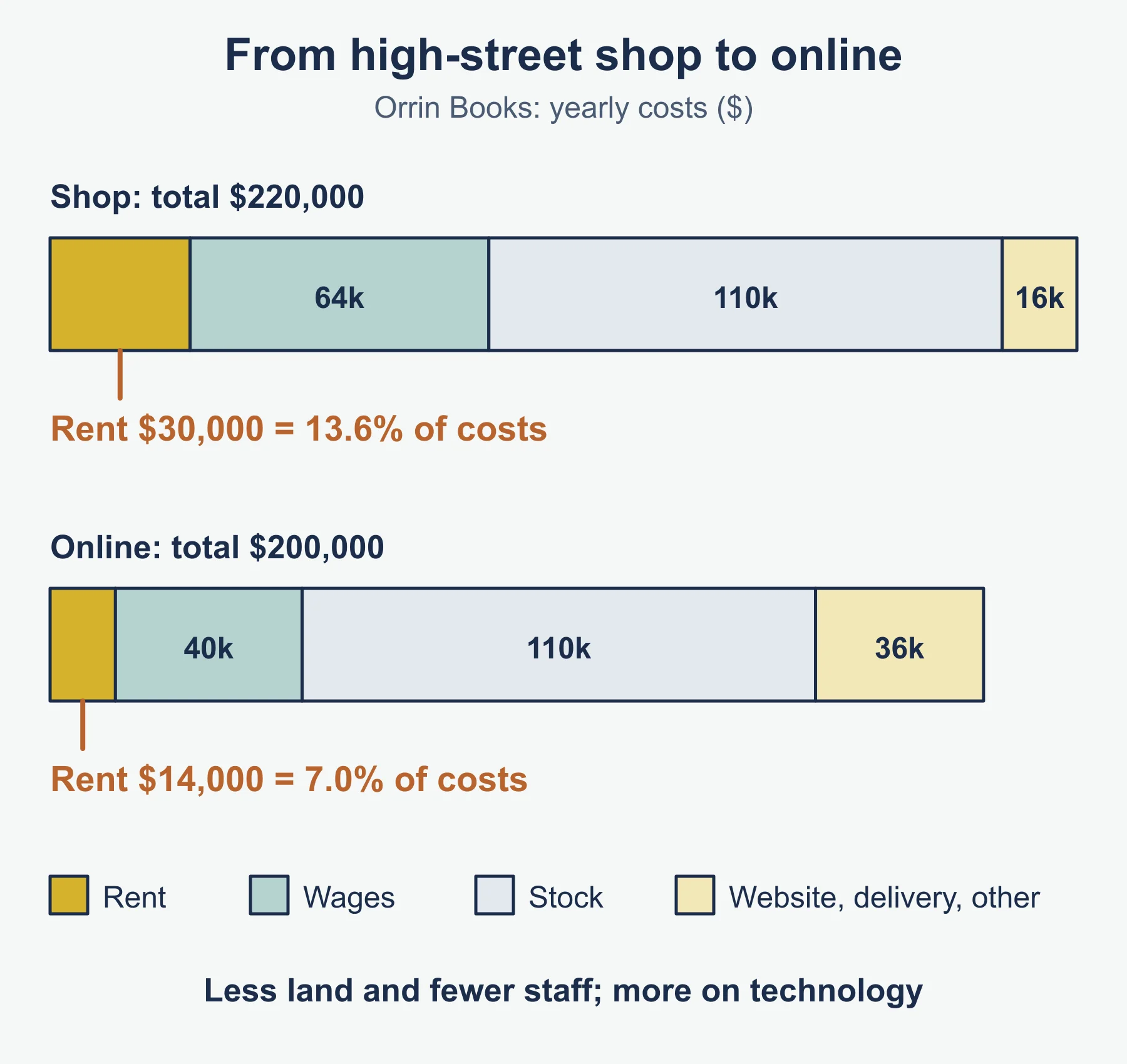
- The business changes where it sells, for example online instead of on the high street.
- The entrepreneur takes on loans and fixed costs and so more risk.
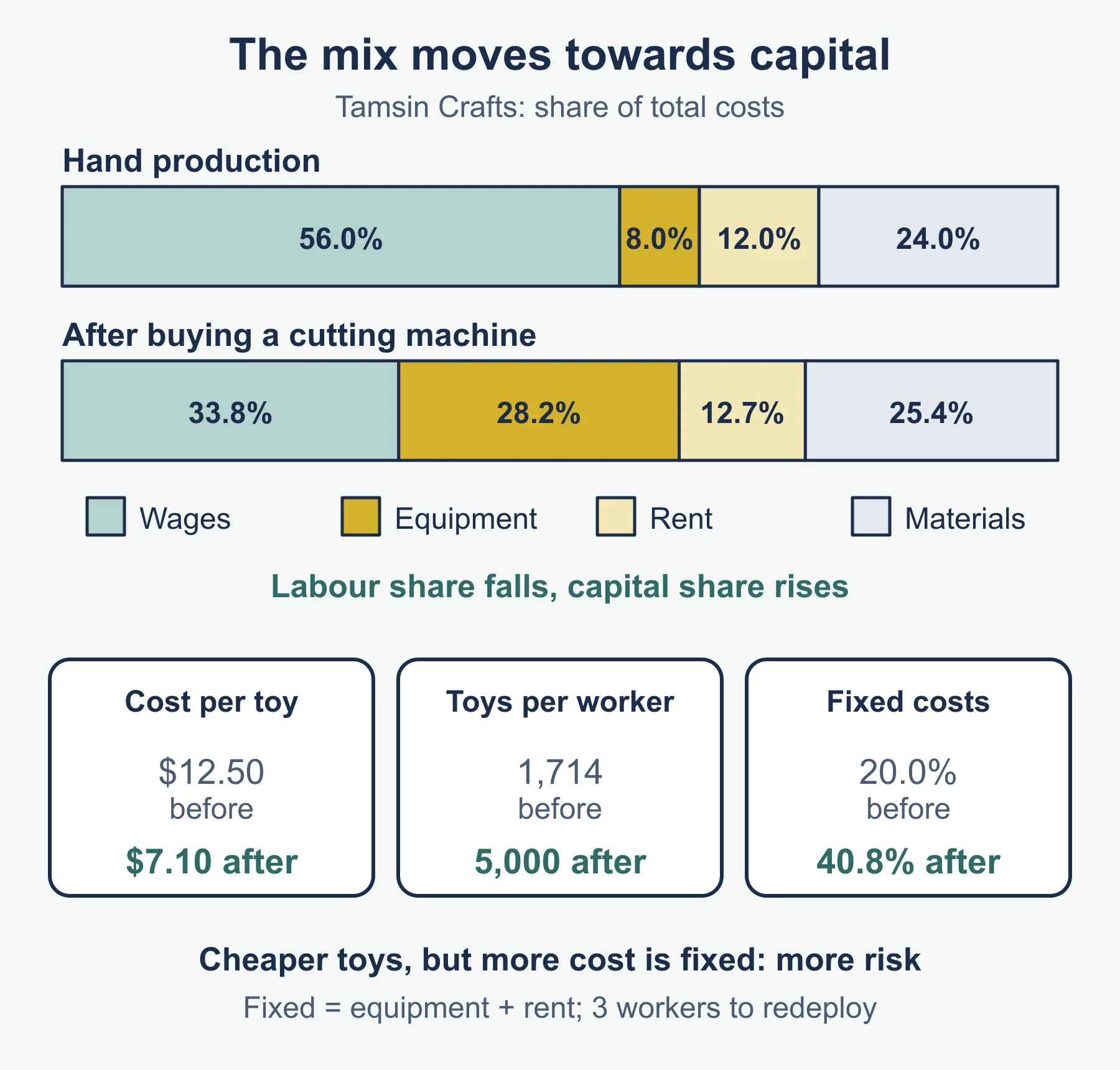
Capital-intensive and labour-intensive
| Capital-intensive | Labour-intensive | |
|---|---|---|
| Uses | A high proportion of capital to labour | A high proportion of labour to capital |
| Largest cost | Equipment, depreciation, running costs | Wages |
| Examples | Car plant, refinery, bottling line | Salon, care home, tailor |
| Strength | Consistent, high-volume output; lower cost per unit at scale | Flexible, personal service, lower fixed costs |
| Weakness | High fixed costs, expensive to change | Wage costs, less consistent output |
Test: compare the cost of capital with the cost of labour in the data, using labour cost divided by total cost multiplied by 100.
Method: showing a change in mix
- Work out each cost as a percentage of total costs, before and after.
- Work out cost per unit (total costs divided by output) before and after.
- Work out output per worker (output divided by number of workers).
- Comment on fixed costs and risk.
- Reach a judgement for this business.
Small reminder: wages 60,000, equipment 20,000, other 20,000. Labour share = 60,000 ÷ 100,000 × 100 = 60%, so labour-intensive. If equipment rises to 50,000 and wages fall to 30,000 with other costs unchanged, total costs are 100,000 and capital is the largest share (50%).
Section 5.4: quality
Key definitions
| Term | Meaning |
|---|---|
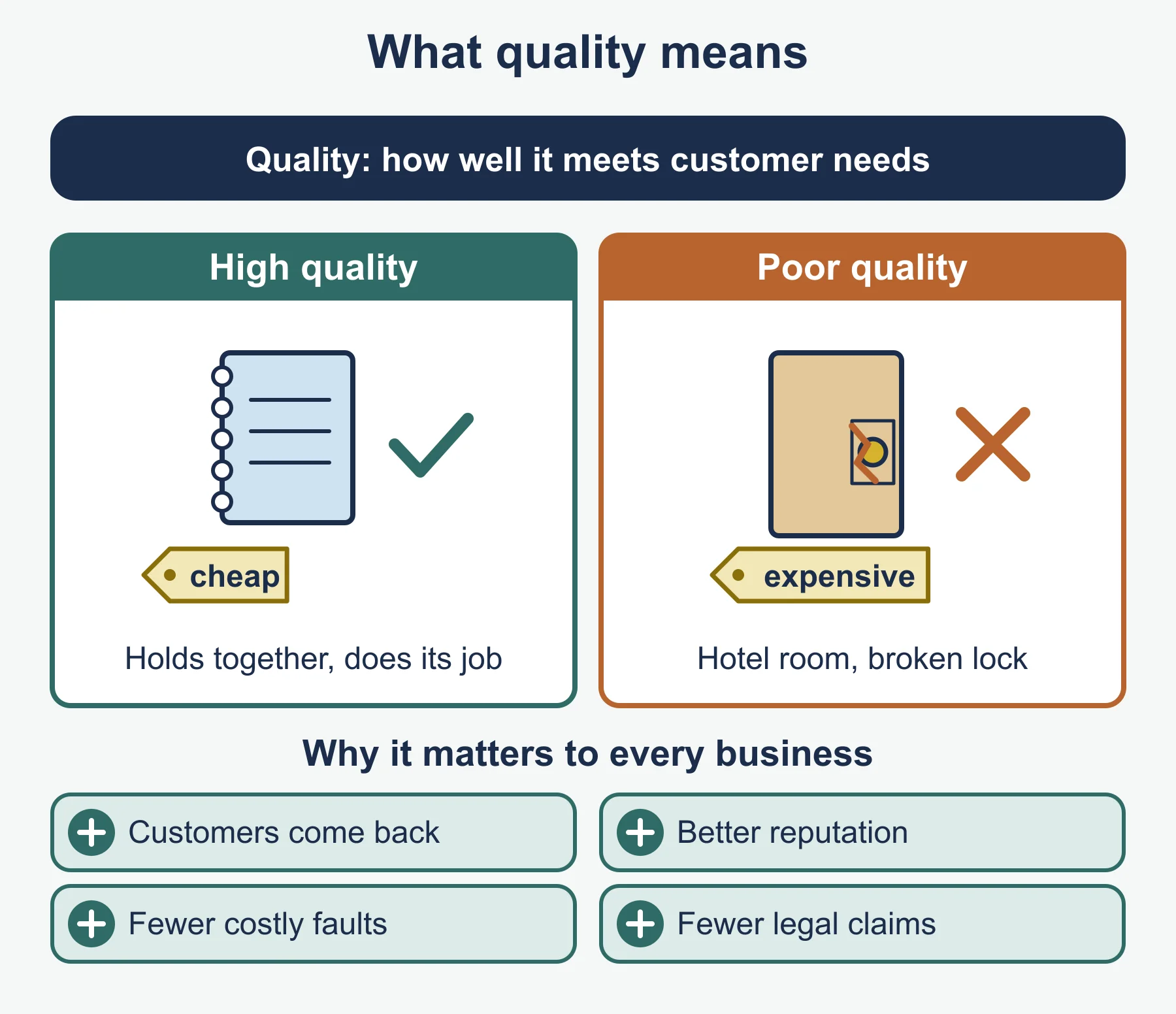
| Quality | How well a good or service meets or exceeds customer expectations and the business’s own standard |
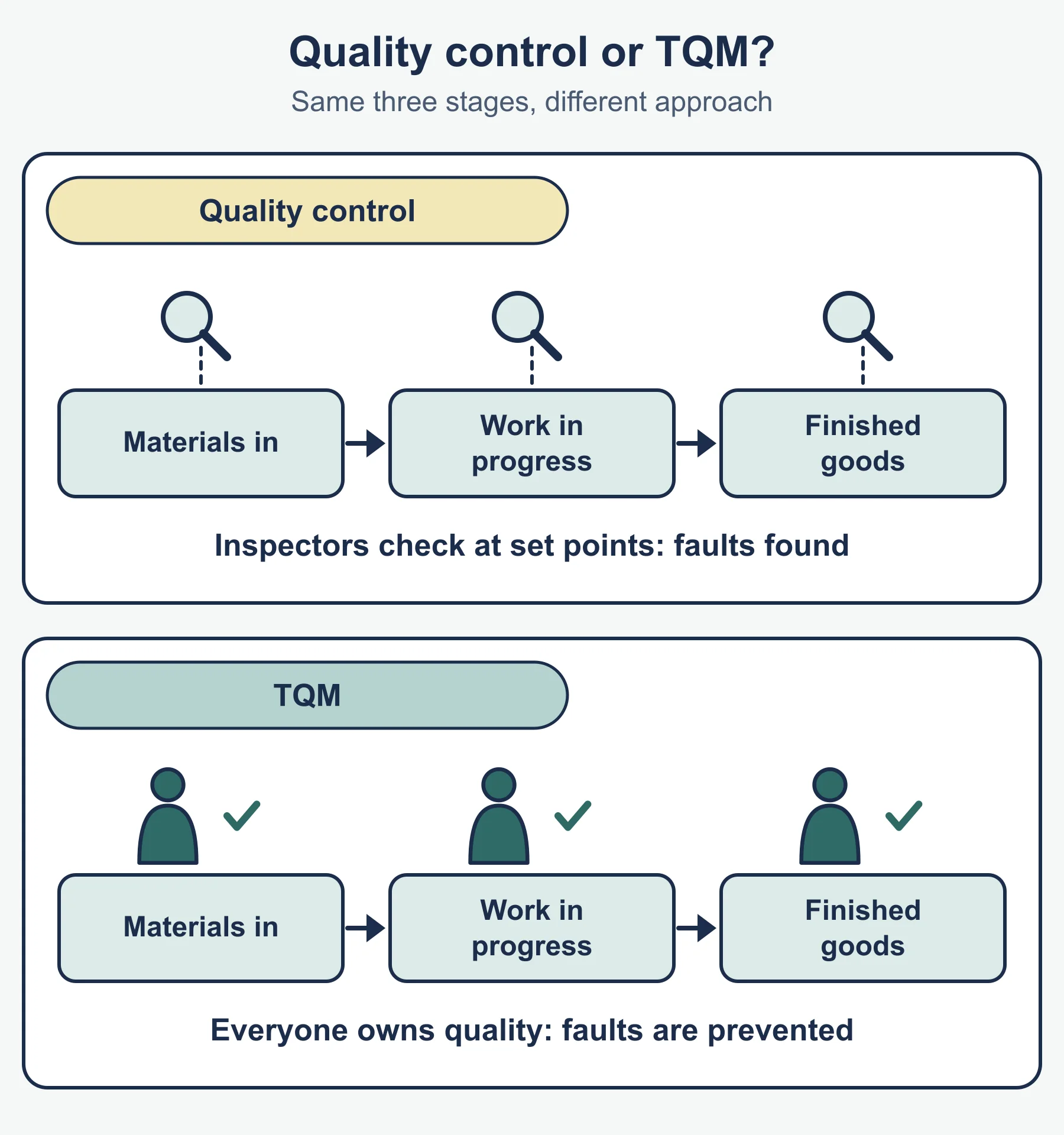
| Quality control | Checking output against a standard and removing or correcting faulty items, usually by inspection |
| Total quality management (TQM) | Approach in which everyone is responsible for quality; the aim is prevention and getting things right first time |
| Competitive advantage | Something that makes customers choose your business rather than a rival |
Quality in goods and in services
- Goods: reliability, durability, finish, safety. Faulty items can be reworked, scrapped or returned.
- Services: speed, accuracy, friendliness, consistency. A mistake is seen by the customer as it happens, and staff behaviour is part of the product.
Quality control or TQM
| Quality control | TQM | |
|---|---|---|
| Responsibility | Inspectors, quality department | Every employee |
| Focus | Finding faults | Preventing faults |
| When | At checkpoints, often at the end | Throughout the process |
| Costs | Inspection, wasted materials already used | Training, change in culture, time |
| Risk | Faults found late | Needs staff commitment to work |
Features of TQM to quote: shared responsibility, prevention, training, a customer focus (internal and external), and continuous improvement.
Quality control methods
- Inspect every item, or a sample from each batch.
- Check at several stages: materials in, work in progress, finished goods.
- For services: mystery customers, call monitoring, customer surveys.
How quality gives a competitive advantage
- Reputation and recommendations.
- Ability to charge a higher price.
- Lower costs from less waste, rework and returns.
- Customer loyalty and repeat sales.
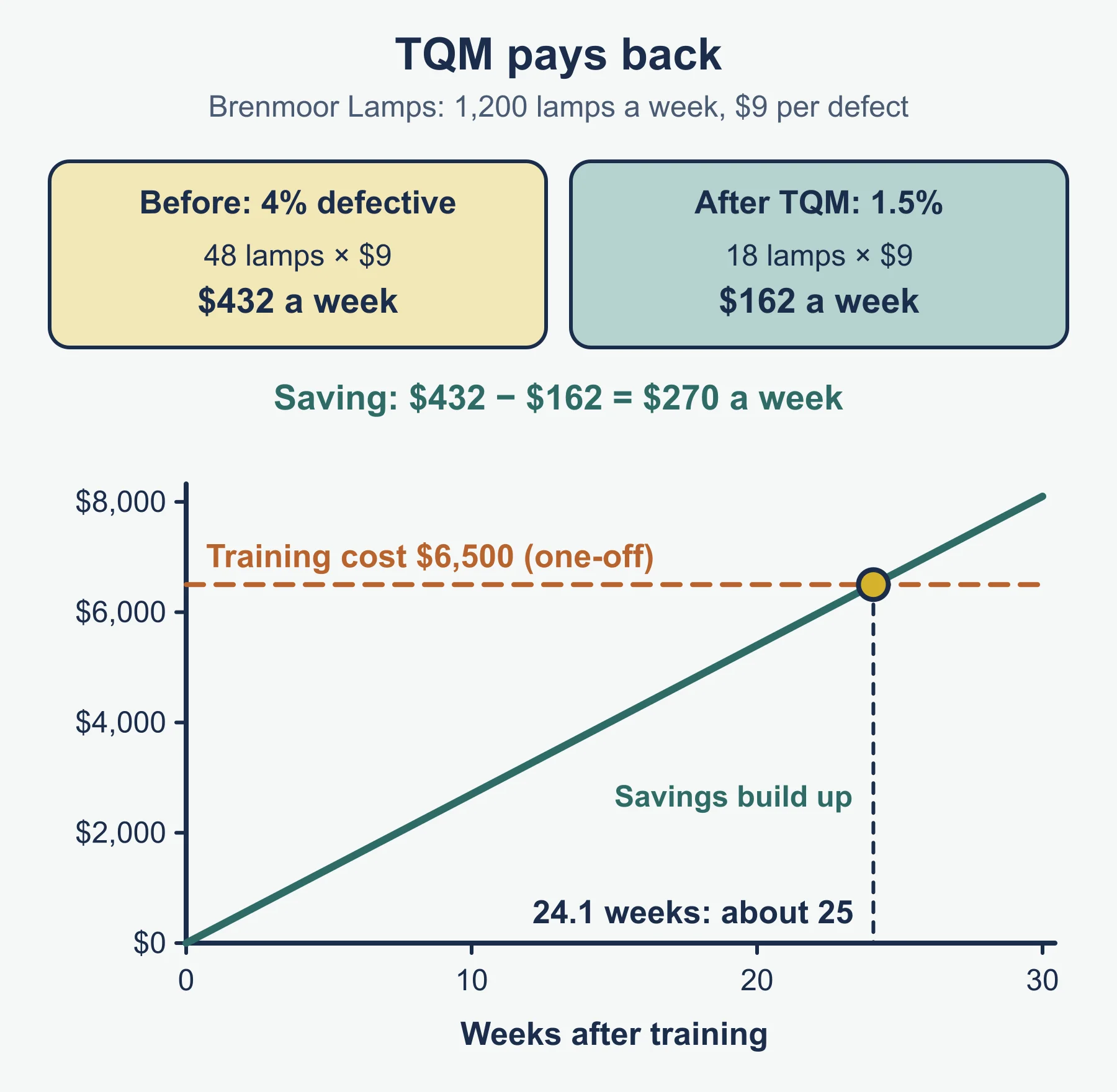
Method: cost of defects
- Defective units = output × defect rate.
- Cost = defective units × cost per defective unit.
- Saving = old cost − new cost.
- Payback time = one-off cost ÷ saving per period.
Small reminder: 2,000 units, 5% defective, 8 per defective unit. Defective units = 100; cost = 800. At 2% the cost is 40 × 8 = 320, a saving of 480. A one-off cost of 2,400 would be recovered in 5 periods.
Must-know distinctions
- Capital here means equipment and technology, not just cash.
- Capital-intensive is about the balance of capital and labour in the business, not about its size.
- Quality control detects faults; TQM prevents them.
- Quality is judged against customer expectations, so it can differ between a budget and a luxury business and still be good in both.
- A competitive advantage needs customers to notice and value the quality, and it needs to be kept up.
Command words for this topic
The specification describes how each command word is used. Apply them like this.
| Command word | What the specification asks for | Applied here |
|---|---|---|
| Define | Define a term from the content | Give a short, accurate meaning of capital-intensive, quality control or TQM |
| Calculate | Use the data given, show workings | Labour share of costs, defect cost, output per worker |
| Outline | Two linked points, placed in the context of the question | A change in the mix of inputs, then its effect on this business |
| Explain | A statement of fact with two expansion points; no context in the question | One reason quality matters, then two linked consequences |
| Analyse | Extended answer, expanding a concept or issue in the context given | A chain of reasoning from cause to effect to the business |
| Justify | Extended answer using the information to recommend one of two options | Choose one option and say why, using the figures |
| Evaluate | Extended answer reaching a supported conclusion | Weigh both sides, then decide for this business |
A short model chain for analysis
Starting point: a toy maker buys a cutting machine. Chain: machine does the cutting, so each worker produces more, so cost per toy falls, so the business can cut prices or earn more profit. Then add the other side: the machine’s cost is fixed, so if orders fall the owner still pays it. Always link back to the business named.
A short model chain for evaluation
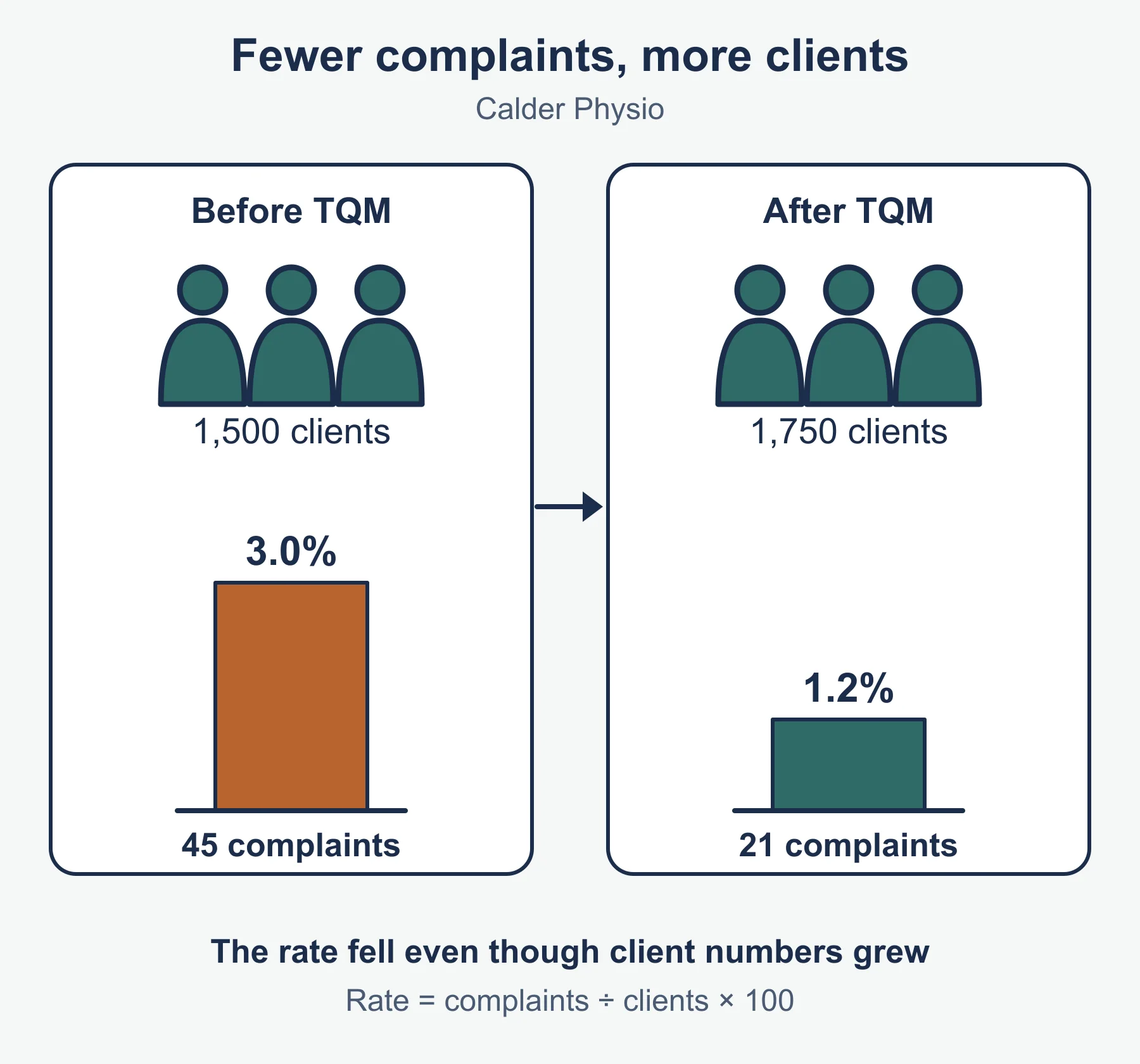
Question type: should a small clinic introduce TQM? Gains: fewer complaints, less rework, a better reputation. Costs: staff time on training, possible resistance, results that take months. Judgement: yes if the clinic can afford the training and has a stable team, because the gains keep growing while the cost is mostly one-off. Say what the judgement depends on.
Goods and services side by side
| Goods | Services | |
|---|---|---|
| Quality measures | Defect rate, returns, durability | Waiting time, complaint rate, accuracy |
| Quality control | Inspect batch or sample | Mystery customer, survey, call review |
| TQM example | Operators stop the line when they spot a fault | Every member of staff trained to solve a customer problem on the spot |
Quick self-test
- Name the four factors of production listed in the specification.
- State what is meant by a labour-intensive activity.
- A firm’s wages are 72,000 out of total costs of 160,000. Calculate the labour share of costs.
- Give two reasons why a business might replace some labour with capital.
- Give one risk for the entrepreneur when a business becomes more capital-intensive.
- State what quality control means.
- Name two features of TQM.
- A firm makes 4,000 items, with a 3% defect rate and a cost of 15 per defective item. Calculate the total cost of defects.
- Explain one way better quality can allow a business to charge a higher price.
- State one disadvantage of relying only on end-of-process inspection.
Answers
- Enterprise, capital, land, labour.
- An activity that uses a high proportion of labour compared with capital, so wages are the main cost.
- 72,000 ÷ 160,000 × 100 = 45%.
- For example: machines produce more output per worker; wages are rising faster than equipment prices; machines give more consistent output.
- Fixed costs rise, so the entrepreneur still pays them if sales fall; more borrowing may be needed.
- Checking output against a standard and removing or correcting items that fail, usually by inspection.
- For example: everyone responsible for quality; prevention of faults; staff training; customer focus; continuous improvement.
- 4,000 × 0.03 = 120 items; 120 × 15 = 1,800.
- Customers see the product as reliable and better than rivals, so more of them accept a higher price, which raises revenue per unit.
- Faults are found after the materials and labour have been used, so waste has already happened.
Where marks are usually lost
- Defining capital as money rather than equipment and technology.
- Calling a business capital-intensive without comparing capital and labour costs.
- Describing quality control and TQM in the same words.
- Giving general benefits of quality that do not use the scenario.
- Leaving out the cost side of quality when asked to evaluate or justify.
- Not giving a conclusion that is supported by the data.
- Dividing by the wrong total when finding percentages.
- Saying robots always cut costs without mentioning fixed costs, training and risk.
Frequently asked questions
What are the four factors of production in Edexcel IGCSE Business? The 4BS1 specification names enterprise, capital, land and labour. These are the inputs a business combines to make goods or provide services.
What is the difference between quality control and TQM? Quality control uses inspectors to check products against a standard and remove faults at set stages. Total quality management makes everyone responsible for quality and aims to prevent faults at source, getting things right first time.
Why does the mix of factors of production change? Technology, the relative cost of labour and equipment, growth, changes in location or sales channel and the risk the entrepreneur will accept can all push a business to use more of one input and less of another.
How do you calculate the cost of defects? Multiply output by the defect rate to find the number of faulty items, then multiply by the cost of reworking or scrapping each one.
Official syllabus
Pearson Edexcel International GCSE in Business (4BS1), Specification, Issue 2, February 2026, published by Pearson Education Limited. Topic 5 Business operations: section 5.3 Factors of production and section 5.4 Quality. The specification lists headings only for these sections, so the definitions of the four factors, quality, quality control, TQM and competitive advantage, the lists of TQM features and the payback and defect-cost methods on this page are written in Marlbridge’s own standard wording.
Get free revision emails (optional)
Occasional emails with practice questions, worked explanations and links to free resources for the qualification and subjects you choose. No spam, and you can unsubscribe from any email. The free tools on this site never need an email.
Related resources
-
Study guides
Edexcel IGCSE Business: Economies and diseconomies of scale, and production (4BS1)
Study guide to Edexcel IGCSE Business 5.1 and 5.2: economies and diseconomies of scale, production types, productivity, lean production, robotics.
Business · Pearson Edexcel · IGCSE
Read guide -
Practice questions
Edexcel IGCSE Business: Economies and diseconomies of scale, and production (4BS1) – Practice Questions
Original Edexcel IGCSE Business practice questions with worked answers on scale, production types, productivity, lean production and robotics.
Business · Pearson Edexcel · IGCSE
Try questions -
Revision notes
Edexcel IGCSE Business: Economies and diseconomies of scale, and production (4BS1) – Revision Notes
Condensed Edexcel IGCSE Business revision notes on scale, production types, productivity, JIT, Kaizen and robotics, with a self-test and common errors.
Business · Pearson Edexcel · IGCSE
Revise topic
Related articles
-
teaching
A Level tuition in Dubai: Cambridge or Pearson Edexcel International A Level?
Schools in Dubai and Abu Dhabi teach either Cambridge International AS & A Level or Pearson Edexcel International A Level. How the two are structured, why it matters for tuition, and how online classes from Lahore work.
9 October 2026
-
curriculum guides
Choosing subjects at IGCSE and A Level
How subject choices at 14 and 16 affect university options later, and how to keep pathways open without overloading a timetable.
28 July 2026
Studying this with a teacher
Working through Business IGCSE?
This page is free and stays free. If you would rather be taught it, Marlbridge runs Business classes one-to-one and in small groups of up to 15, online in your own time zone. The first trial class is free. WhatsApp replies within an hour (8am–11pm Pakistan time, every day); email the same day.
Pearson Edexcel Business teachers at Marlbridge

