
Study Guides
Edexcel IGCSE Business: Factors of production and quality (4BS1)
Study guide to factors of production, capital and labour intensity, quality control and TQM for Edexcel IGCSE Business (4BS1), with worked examples.
- Subject
- Business
- Level
- IGCSE
- Topic
- Business operations
- Author
- Marlbridge Academic Team
- Updated
- Reviewed by
- Asif Iqbal (what this means)
Aligned to Pearson Edexcel IGCSE Business (4BS1), Issue 2, February 2026. Official specification .
Syllabus page (what it covers and how it is assessed): Pearson Edexcel IGCSE Business.
Syllabus points this page covers
4BS1
- 5 Business operations (whole topic)
- 5.3 Factors of production
- 5.4 Quality
Found an error? Report a correction.
Want a teacher for this? Marlbridge teaches Business online. Request a free trial class.
This guide follows the Pearson Edexcel International GCSE in Business (4BS1) specification, Issue 2, February 2026. It covers topic 5, Business operations, sections 5.3 Factors of production and 5.4 Quality. The specification says both Paper 1 (small businesses, up to 49 employees) and Paper 2 (large businesses, more than 250 employees) can draw on the whole content, so expect this material in either paper, set in a business scenario.
Course links: the Edexcel IGCSE Business hub, the printable checklist and the free diagnostics. Companion pages: the revision notes and the practice questions.
What the specification asks for
| Point | You must be able to | Where in this guide |
|---|---|---|
| 5.3.1 | Describe the changing relationships between enterprise, capital, land and labour | Sections 1 and 2 |
| 5.3.1 | Explain the difference between capital-intensive and labour-intensive activities | Section 3 |
| 5.4.1 | Explain the concept of quality and its importance in producing goods and providing services | Section 4 |
| 5.4.1 | Explain quality control and total quality management (TQM) | Sections 5 and 6 |
| 5.4.1 | Explain how quality allows a business to gain a competitive advantage | Section 7 |
All amounts in this guide are in dollars and every business named is invented.
1. The four factors
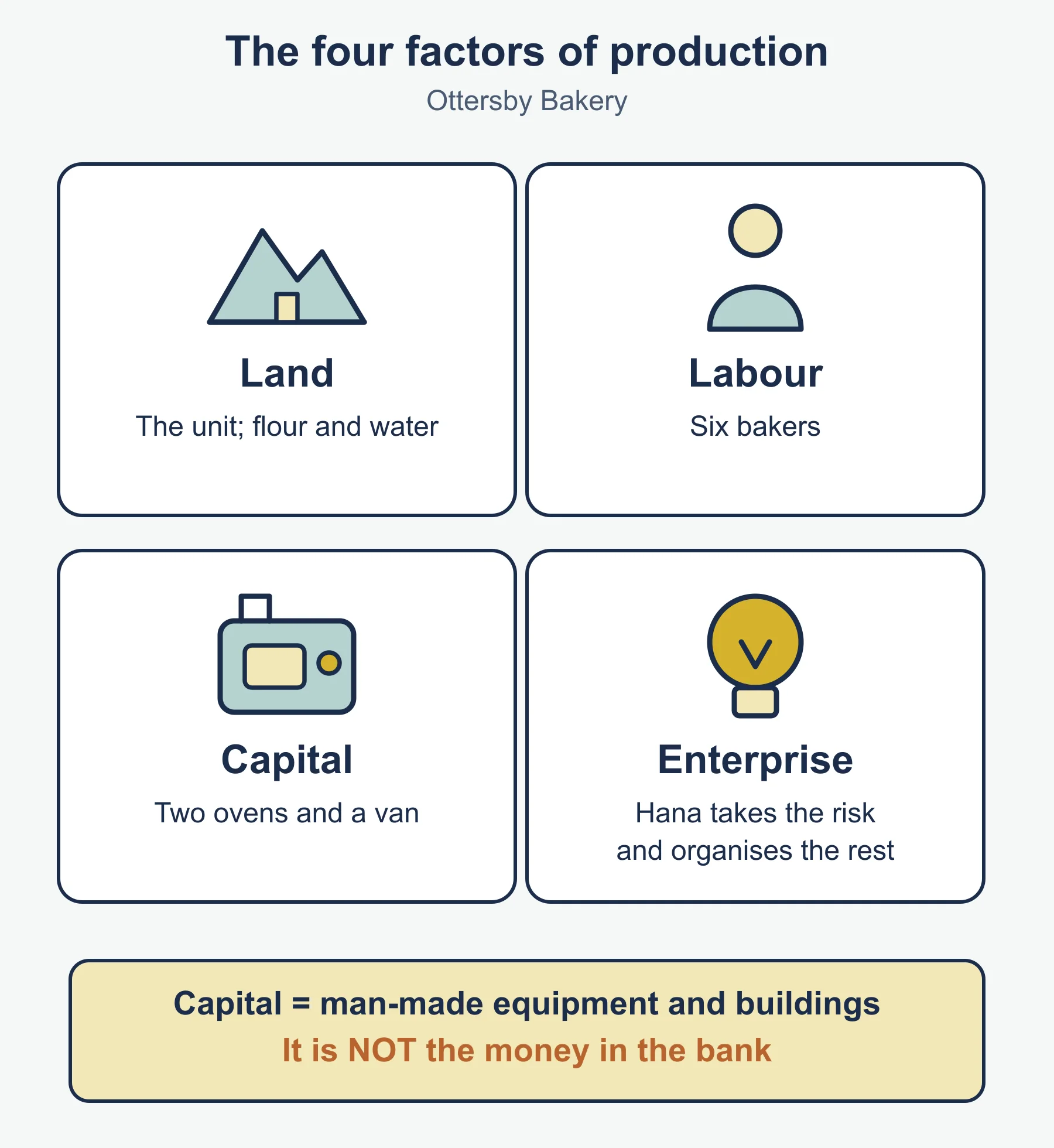
The specification names four inputs: enterprise, capital, land and labour. These are the resources a business combines to make goods or provide services.
- Enterprise is the owner or entrepreneur taking the risk, organising the other inputs and making decisions.
- Capital is the equipment, machinery, vehicles, tools, software and buildings fitted out for use that help make output. In this topic it means these physical and technological resources, not simply money.
- Land covers the site and premises a business uses, and also natural resources such as soil, water, timber and minerals.
- Labour is the people who work for the business, with their skills and effort.
The specification word is “relationships”. The key idea is that the mix is not fixed. A business can use more of one input and less of another to reach the same output, and the best mix changes over time.
2. Why the relationships change
Several forces push a business to change its mix.
- Technology. Machines, robots and software can do tasks people once did. Capital replaces some labour. The remaining staff need different, often higher, skills.
- Relative costs. If wages rise faster than the price of equipment, capital becomes the cheaper way to produce. If equipment is expensive and labour is cheap, the reverse holds.
- Growth. A larger business can afford costly equipment and spread its cost over more units. A small business may rely on its owner’s own labour.
- Location and sales channel. A business moving online may need less high-street land and more warehouse land and software.
- Enterprise. As capital spending rises, the entrepreneur carries more risk, because equipment costs must be paid even if sales fall.
Worked example 1: changing the mix
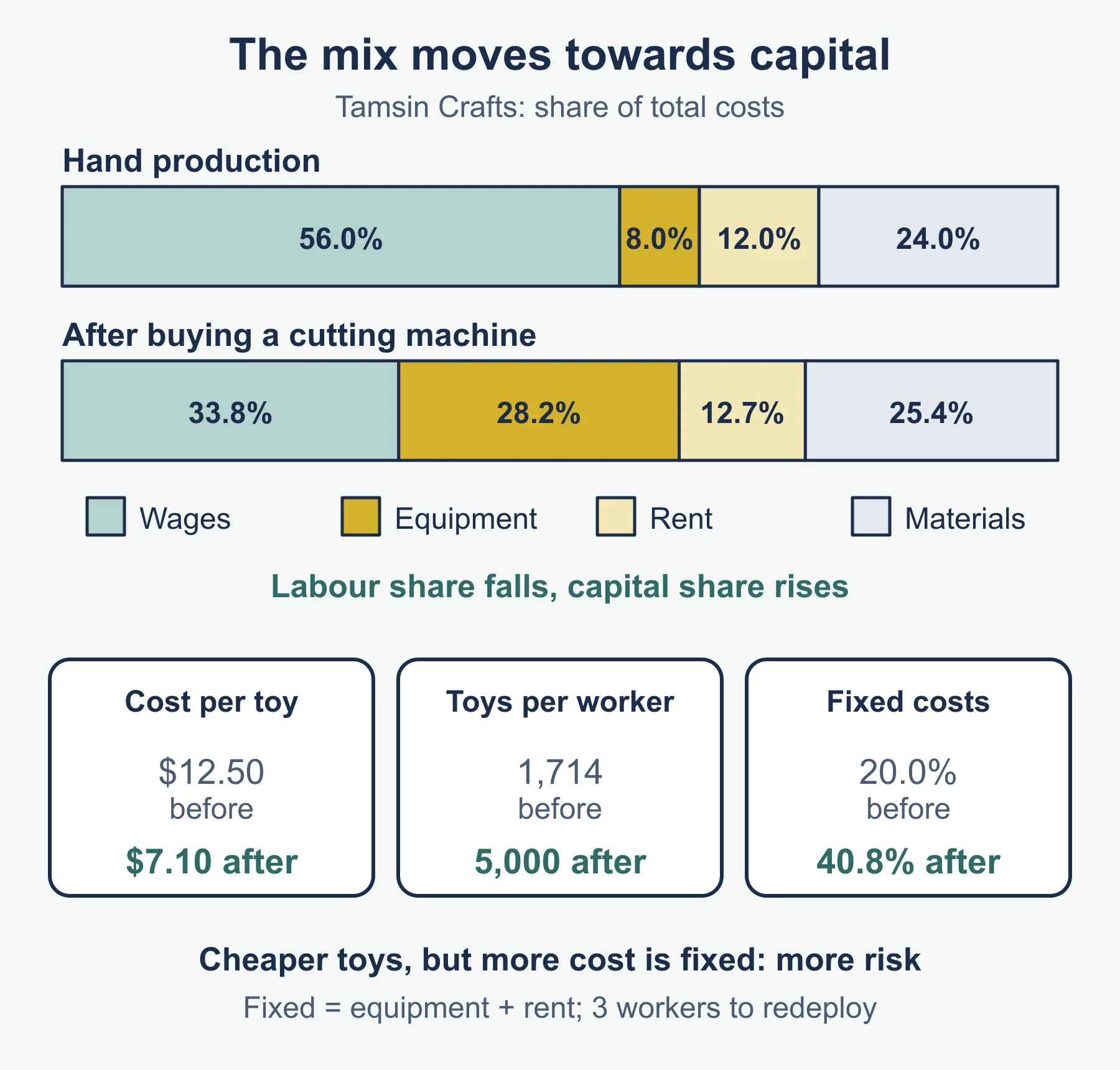
Tamsin Crafts makes wooden toys. Its yearly costs and output are below.
| Cost | Hand production | After buying a cutting machine |
|---|---|---|
| Wages | 84,000 | 48,000 |
| Equipment costs (depreciation and maintenance) | 12,000 | 40,000 |
| Rent | 18,000 | 18,000 |
| Materials | 36,000 | 36,000 |
| Total costs | 150,000 | 142,000 |
| Output (toys) | 12,000 | 20,000 |
| Workers | 7 | 4 |
Step 1: labour as a share of total costs. Before: 84,000 ÷ 150,000 × 100 = 56.0%. After: 48,000 ÷ 142,000 × 100 = 33.8%.
Step 2: capital costs as a share. Before: 12,000 ÷ 150,000 × 100 = 8.0%. After: 40,000 ÷ 142,000 × 100 = 28.2%.
Step 3: cost per toy. Before: 150,000 ÷ 12,000 = 12.50. After: 142,000 ÷ 20,000 = 7.10.
Step 4: output per worker. Before: 12,000 ÷ 7 = 1,714 toys. After: 20,000 ÷ 4 = 5,000 toys.
Step 5: the risk. Equipment costs and rent do not change with output, so they are 30,000 (20.0% of costs) before and 58,000 (40.8%) after. The owner now faces higher costs that must be paid even if orders fall.
Conclusion: the mix moved from labour towards capital. Costs per toy fell sharply, but the owner carries more risk and three workers need redeploying or retraining.
3. Capital-intensive and labour-intensive activities
- A capital-intensive activity uses a high proportion of capital compared with labour. Examples are a car assembly plant, an oil refinery or a bottling plant. Capital makes up most of the cost.
- A labour-intensive activity uses a high proportion of labour compared with capital. Examples are a hair salon, a care home or a bespoke tailor. Wages make up most of the cost.
| Capital-intensive | Labour-intensive | |
|---|---|---|
| Main cost | Equipment, running costs, depreciation | Wages |
| Output | Often high volume, consistent | Often lower volume, personal or varied |
| Cost per unit | Falls as output rises, because fixed costs are spread | Changes less with output |
| Flexibility | Costly to change or to switch products | Easier to adjust staff and tasks |
| Risk | Higher, because costs continue when sales fall | Lower fixed cost, but wage rises hurt |
You decide which description fits by comparing the cost of capital with the cost of labour in the data, not by the type of business alone. Many businesses are mixed.
Worked example 2: land and sales channel
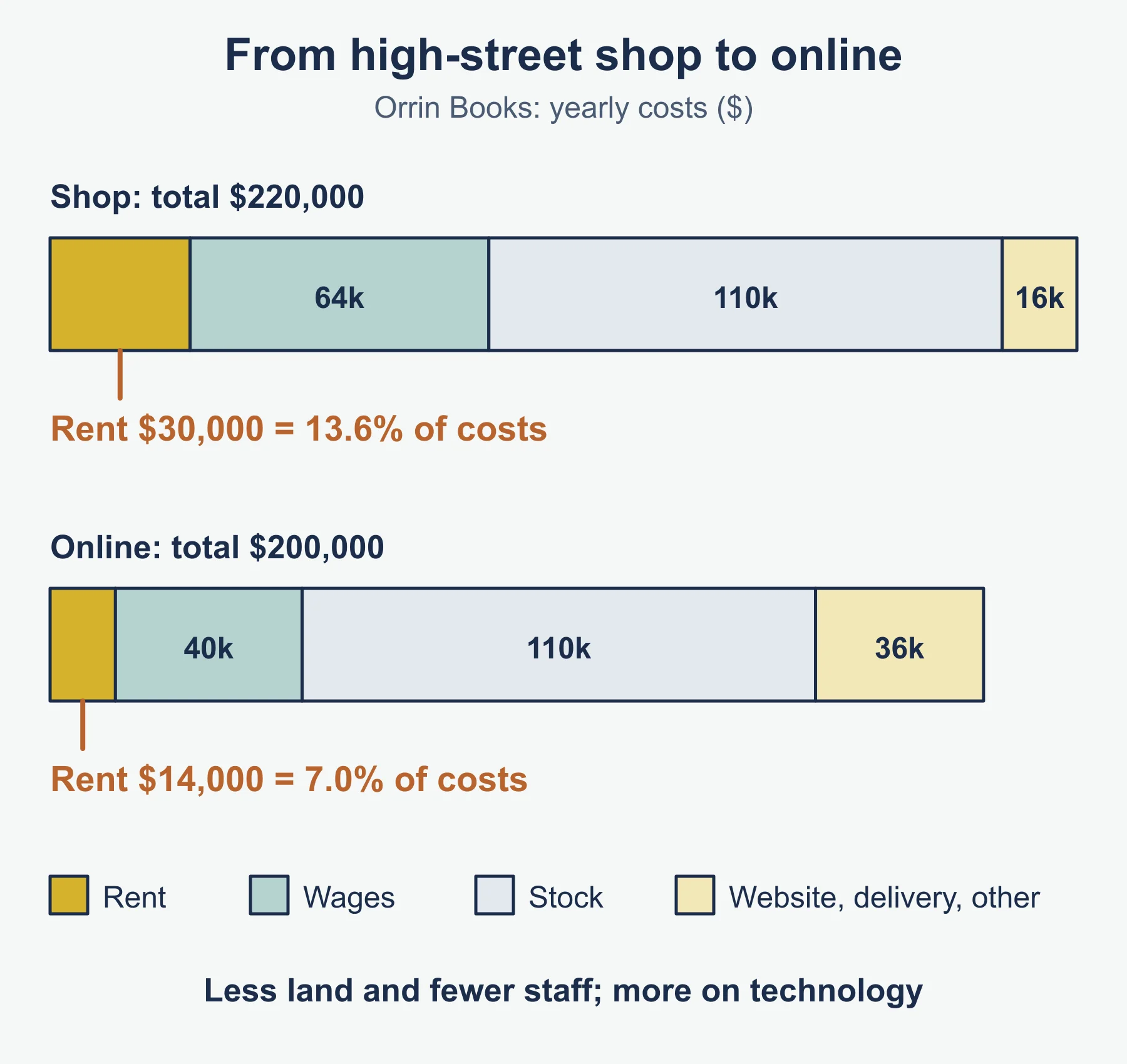
Orrin Books moves from a high-street shop to an online business.
| Cost | Shop | Online |
|---|---|---|
| Rent | 30,000 | 14,000 |
| Wages | 64,000 | 40,000 |
| Stock | 110,000 | 110,000 |
| Other (website, delivery) | 16,000 | 36,000 |
| Total | 220,000 | 200,000 |
Rent is 30,000 ÷ 220,000 × 100 = 13.6% of costs in the shop and 14,000 ÷ 200,000 × 100 = 7.0% online. The business needs less prime land and fewer staff, and spends more on technology. Land, labour and capital have all changed in importance.
4. The concept of quality
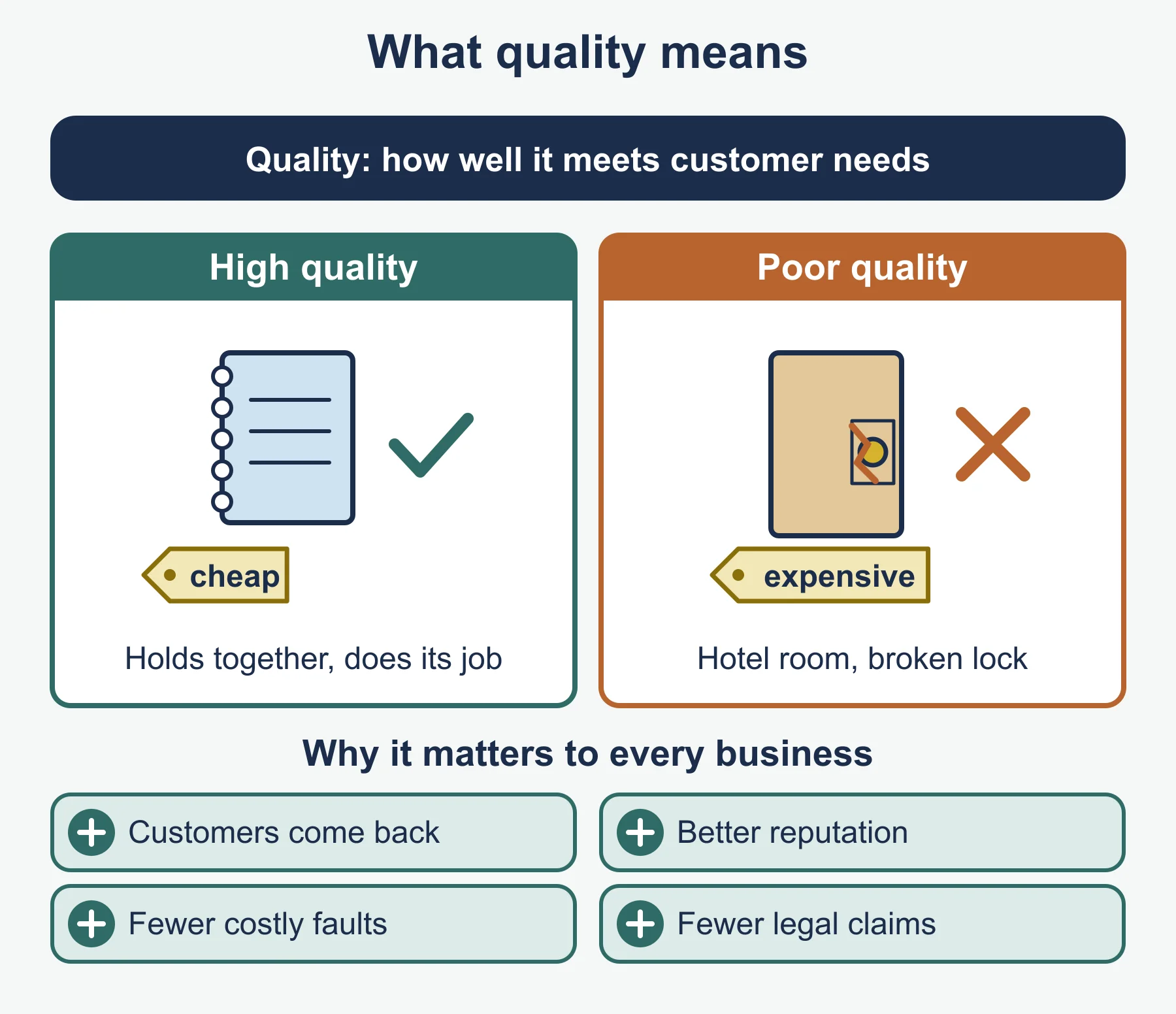
Quality is how well a good or service meets, or exceeds, what customers expect and the standard the business has set. For goods it can mean reliability, durability, finish and safety. For services it can mean speed, accuracy, friendliness and consistency.
Why it matters:
- Goods. Faulty products are scrapped, reworked or returned, which wastes materials and labour.
- Services. A service cannot be taken back and corrected once delivered, so mistakes show at once to the customer. Staff behaviour and waiting time are part of the product.
- Both. Good quality builds reputation and repeat custom. Poor quality brings complaints, refunds and lost sales.
A business sets a quality standard, then uses quality control or TQM to reach it. Higher quality usually costs money, so the business weighs this against the benefits.
5. Quality control
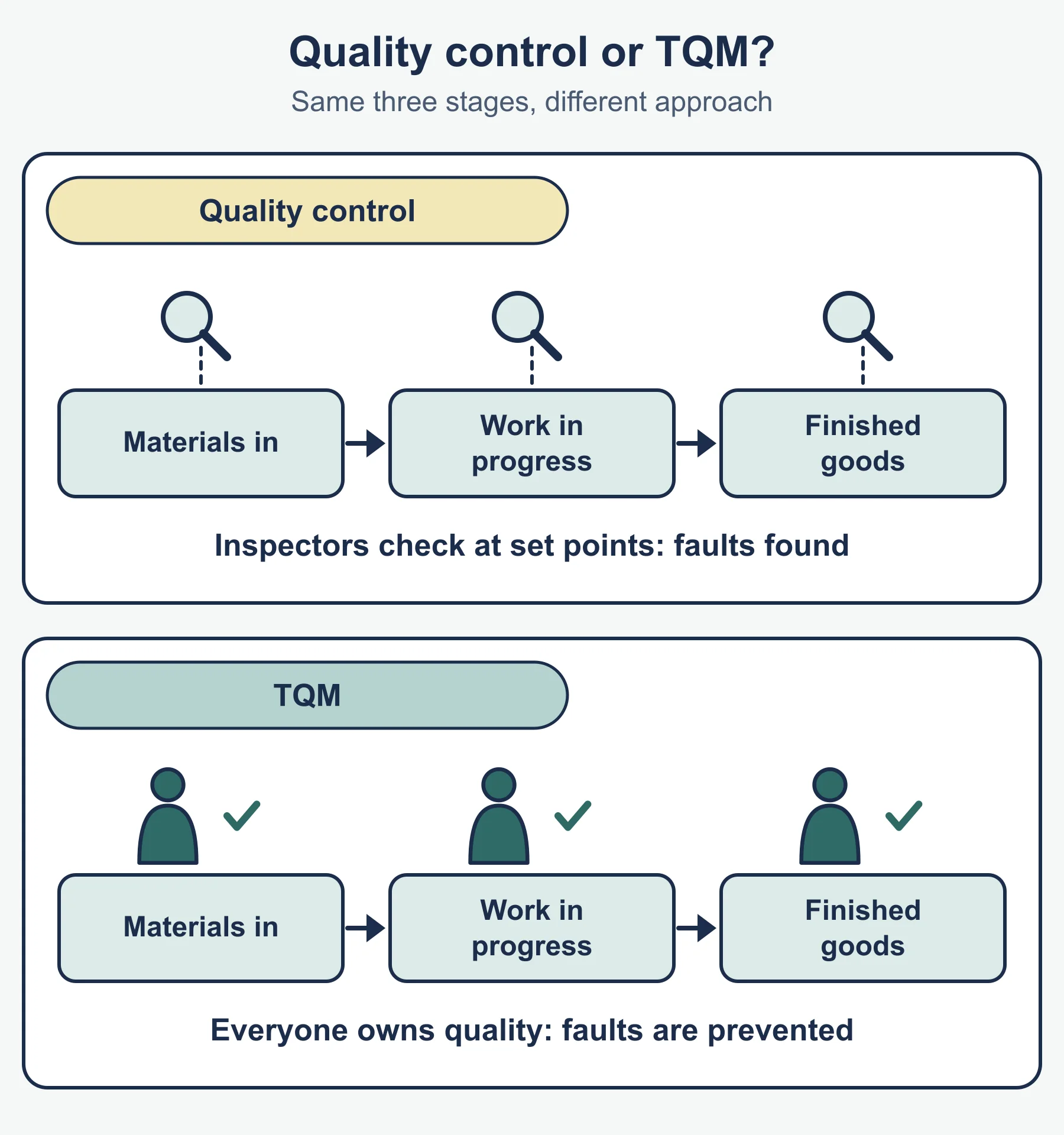
Quality control means checking products or services against a standard, then removing or correcting those that fall short. It is usually done by inspection at set stages: raw materials arriving, work in progress, finished goods before dispatch.
Methods include testing every item, or testing a sample taken from each batch. For a service, checks might be mystery customers, call monitoring or customer surveys.
| Advantages | Disadvantages |
|---|---|
| Faulty items are caught before the customer receives them | It finds faults after they occur, so waste has already happened |
| Easy to understand and set up | Inspectors add labour cost |
| Gives data on defect rates | A sample can miss faulty items |
| Staff may feel quality is the inspector’s job, not theirs |
Worked example 3: the cost of defects
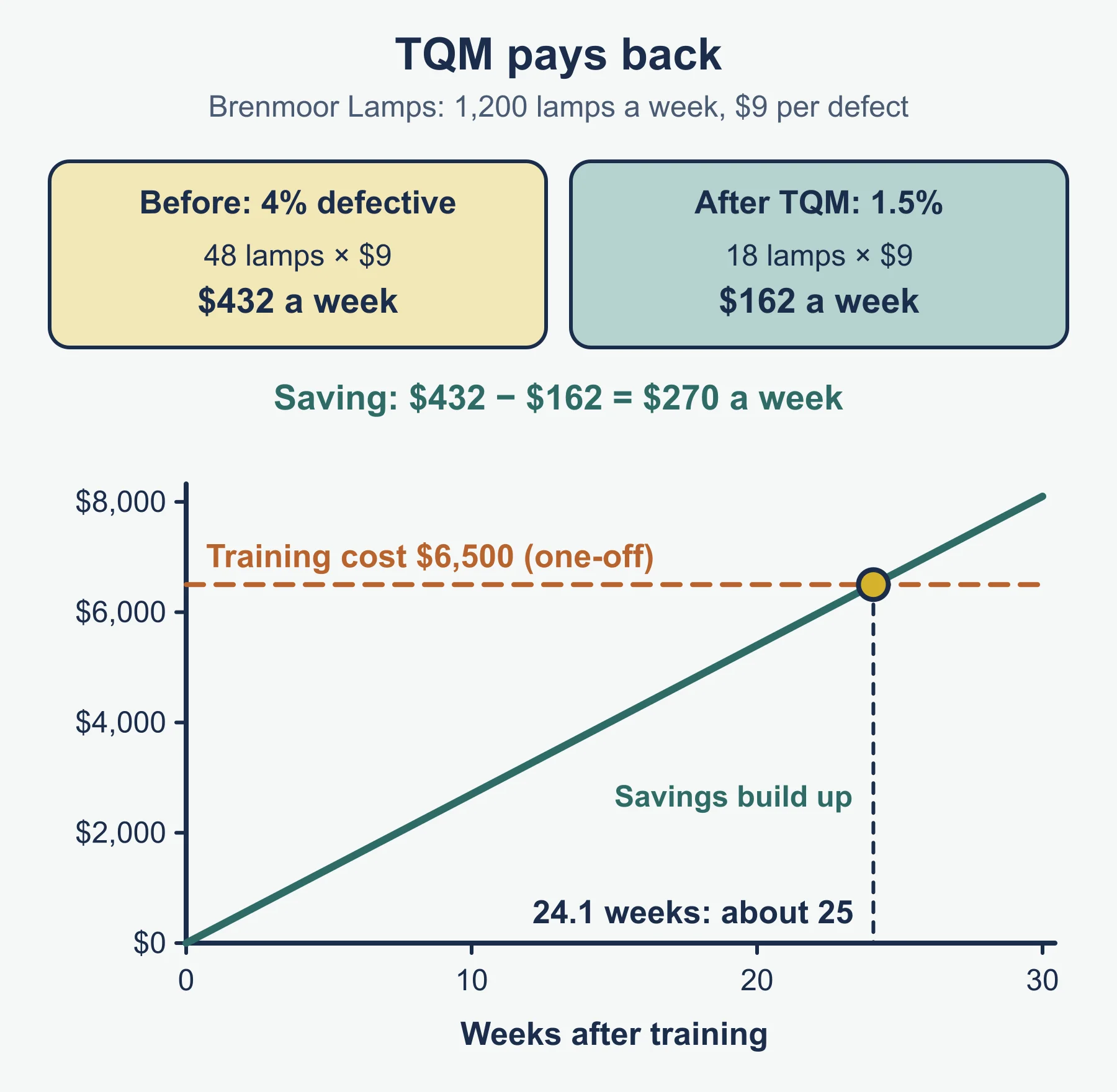
Brenmoor Lamps makes 1,200 lamps a week. 4% are defective, and each defective lamp costs 9 to rework or scrap.
Defective lamps = 1,200 × 0.04 = 48. Weekly cost = 48 × 9 = 432.
The company can catch these lamps by inspection, so customers do not see them, but it still pays the 432.
6. Total quality management (TQM)
Total quality management (TQM) is an approach in which quality is the responsibility of everyone in the business, not just inspectors, and the aim is to get things right first time. Features include:
- a culture in which every employee is responsible for quality in their own job
- prevention of faults at source, rather than detection at the end
- training for staff so they have the skills to do the job well
- attention to what customers expect, including internal customers (the next department in a process)
- continuing efforts to improve methods and reduce waste.
| Quality control | TQM | |
|---|---|---|
| Who is responsible | Inspectors or a quality department | Everyone |
| Focus | Finding faults | Preventing faults |
| Timing | Mostly at checkpoints | Throughout the process |
| Typical cost | Inspection | Training and changes in culture |
Worked example 4: moving to TQM
Brenmoor Lamps trains its staff, lets operators stop the line when they see a fault and fixes causes at source. The defect rate falls from 4% to 1.5%. Training costs 6,500 as a one-off.
New defects = 1,200 × 0.015 = 18; cost = 18 × 9 = 162. Weekly saving = 432 − 162 = 270. Payback = 6,500 ÷ 270 = 24.1 weeks, so about 25 weeks.
After that the saving continues, and fewer faulty lamps reach customers. The business should also ask whether quality will really hold, because TQM needs staff commitment and takes time.
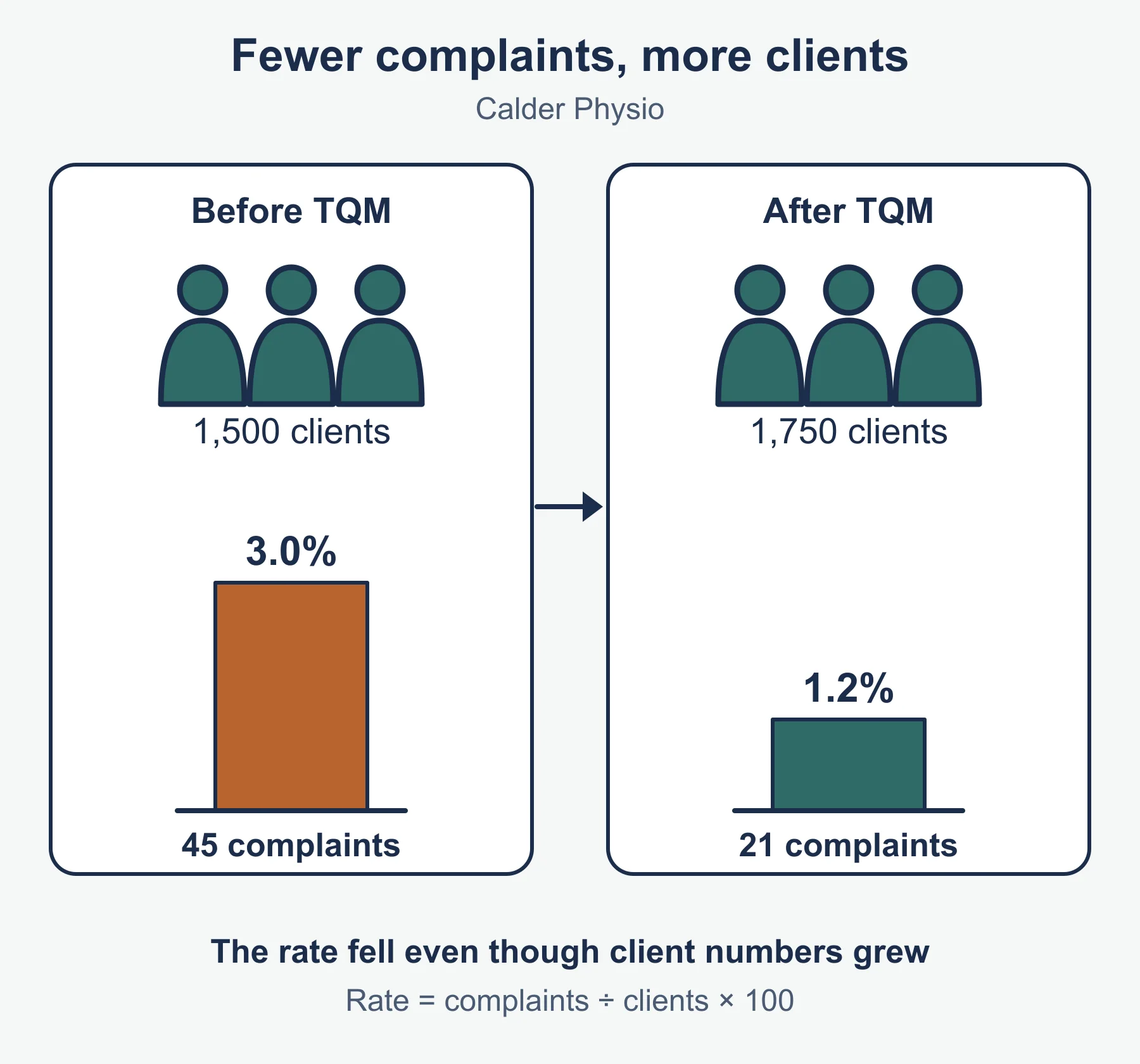
A service example: Calder Physio had 45 complaints from 1,500 clients (3.0%). After TQM training, it had 21 complaints from 1,750 clients (1.2%). The rate fell even as numbers grew.
7. Quality and competitive advantage
A competitive advantage is something that makes customers choose your business over rivals. Quality can supply it in several ways.
- Reputation. Reliable quality brings recommendations and repeat purchases.
- Price. Customers may pay more for a better product. If a hotel charges 120 a night and a rival charges 100, it charges 20% more: (120 − 100) ÷ 100 × 100.
- Lower costs. Less waste, fewer returns and less rework allow lower prices or larger profit.
- Loyalty. Satisfied customers stay, which lowers the cost of winning new ones.
Rivals can copy a product, but a quality culture is harder to copy. The advantage lasts only if quality is kept up. For an evaluation, weigh the extra cost of quality against the price premium and the sales it protects, and look at the size and market of the business in the scenario.
8. Common errors
- Saying capital means only cash. In this topic it means equipment and similar assets.
- Calling a business capital-intensive because it is large. Compare capital cost with labour cost.
- Treating quality control and TQM as the same thing.
- Claiming quality is always worth the cost without weighing training and inspection costs.
- Writing about quality in general terms without using the business in the case.
- Forgetting that robotic equipment raises fixed costs and risk.
Next steps
Condense the points with the revision notes, then test yourself with the practice questions. Return to the Edexcel IGCSE Business hub, tick off progress on the checklist or find weak spots with the free diagnostics.
Frequently asked questions
What is quality in Edexcel IGCSE Business? Quality is how well a good or service meets, or exceeds, what customers expect and the standard the business has set. For goods it can mean reliability, durability, finish and safety.
Why is quality especially important for services? A service cannot be taken back and corrected once it is delivered, so mistakes show at once to the customer, and staff behaviour and waiting time are part of the product.
How does quality give a business a competitive advantage? Reliable quality builds reputation and loyalty, can support a higher price, and lowers costs through less waste and fewer returns. A quality culture is harder for rivals to copy than a product.
What are the disadvantages of quality control? Quality control finds faults after they occur, so waste has already happened, inspectors add labour cost, a sample can miss faulty items and staff may feel quality is only the inspector’s job.
Official syllabus
Pearson Edexcel International GCSE in Business (4BS1), Specification, Issue 2, February 2026, published by Pearson Education Limited. Topic 5 Business operations: section 5.3 Factors of production and section 5.4 Quality. The definitions of the four factors, quality, quality control and TQM above are written in Marlbridge’s own words; the specification lists the headings only.
Get free revision emails (optional)
Occasional emails with practice questions, worked explanations and links to free resources for the qualification and subjects you choose. No spam, and you can unsubscribe from any email. The free tools on this site never need an email.
Related resources
-
Practice questions
Edexcel IGCSE Business: Factors of production and quality (4BS1) – Practice Questions
Original practice questions with worked answers on factors of production, capital and labour intensity, quality control and TQM for Edexcel IGCSE Business.
Business · Pearson Edexcel · IGCSE
Try questions -
Revision notes
Edexcel IGCSE Business: Factors of production and quality (4BS1) – Revision Notes
Condensed revision notes on enterprise, capital, land, labour, capital and labour intensity, quality control and TQM for Edexcel IGCSE Business.
Business · Pearson Edexcel · IGCSE
Revise topic -
Study guides
Edexcel IGCSE Business: Economies and diseconomies of scale, and production (4BS1)
Study guide to Edexcel IGCSE Business 5.1 and 5.2: economies and diseconomies of scale, production types, productivity, lean production, robotics.
Business · Pearson Edexcel · IGCSE
Read guide
Related articles
-
teaching
A Level tuition in Dubai: Cambridge or Pearson Edexcel International A Level?
Schools in Dubai and Abu Dhabi teach either Cambridge International AS & A Level or Pearson Edexcel International A Level. How the two are structured, why it matters for tuition, and how online classes from Lahore work.
9 October 2026
-
curriculum guides
Choosing subjects at IGCSE and A Level
How subject choices at 14 and 16 affect university options later, and how to keep pathways open without overloading a timetable.
28 July 2026
Studying this with a teacher
Working through Business IGCSE?
This page is free and stays free. If you would rather be taught it, Marlbridge runs Business classes one-to-one and in small groups of up to 15, online in your own time zone. The first trial class is free. WhatsApp replies within an hour (8am–11pm Pakistan time, every day); email the same day.
Pearson Edexcel Business teachers at Marlbridge

