
Study Guides
Edexcel IGCSE Business: Financial documents and accounts analysis (4BS1)
Study guide to statements of comprehensive income, statements of financial position and the six Edexcel IGCSE Business ratios, with worked examples.
- Subject
- Business
- Level
- IGCSE
- Topic
- Business finance
- Author
- Marlbridge Academic Team
- Updated
- Reviewed by
- Asif Iqbal (what this means)
Aligned to Pearson Edexcel IGCSE Business (4BS1), Issue 2, February 2026. Official specification .
Syllabus page (what it covers and how it is assessed): Pearson Edexcel IGCSE Business.
Syllabus points this page covers
4BS1
- 3 Business finance (whole topic)
- 3.4 Financial documents
- 3.5 Accounts analysis
Found an error? Report a correction.
Want a teacher for this? Marlbridge teaches Business online. Request a free trial class.
This guide follows the Pearson Edexcel International GCSE in Business (4BS1) specification, Issue 2, February 2026. It covers Topic 3 (Business finance), sections 3.4 Financial documents and 3.5 Accounts analysis. As both papers draw on the whole content, expect this material in either the small-business paper or the large-business paper.
Course links: the Edexcel IGCSE Business hub, the printable checklist and the free diagnostics. Companion pages: the revision notes and the practice questions. All businesses and figures below are invented, in dollars.
What the specification asks for
| Point | You must be able to | Where |
|---|---|---|
| 3.4.1 | Describe the main features of a statement of comprehensive income: sales, cost of sales, gross profit, expenses, operating profit; use it in decision making; explain the nature of profit and why it matters | Sections 1 and 2 |
| 3.4.2 | Describe the main features of a statement of financial position: current and non-current assets, current and non-current liabilities, capital employed; interpret one | Section 3 |
| 3.5.1 | Calculate and analyse the two profit margins, markup, ROCE (return on capital employed), the current ratio and the acid test ratio | Sections 4 and 5 |
| 3.5.2 | Explain the concept and importance of liquidity; compare with previous years and with other businesses | Section 6 |
| 3.5.3 | Use financial documents to assess performance and inform decisions | Section 7 |
The specification states that you will not be asked to construct an income statement or a statement of financial position. You read them, pull figures from them and interpret them. It also says the formulae are provided in the examination, so your job is to apply them and explain the result.
1. The statement of comprehensive income (3.4.1)
This document sets out the sales, costs and profit of a business across one trading period, normally twelve months. The main lines, from top to bottom, are:
- Sales (called revenue in the formulae): the value of goods or services sold.
- Cost of sales: the cost of the goods that were sold.
- Gross profit = revenue − cost of sales.
- Expenses: other operating costs such as wages, rent, advertising and utilities.
- Operating profit = gross profit − other operating expenses.
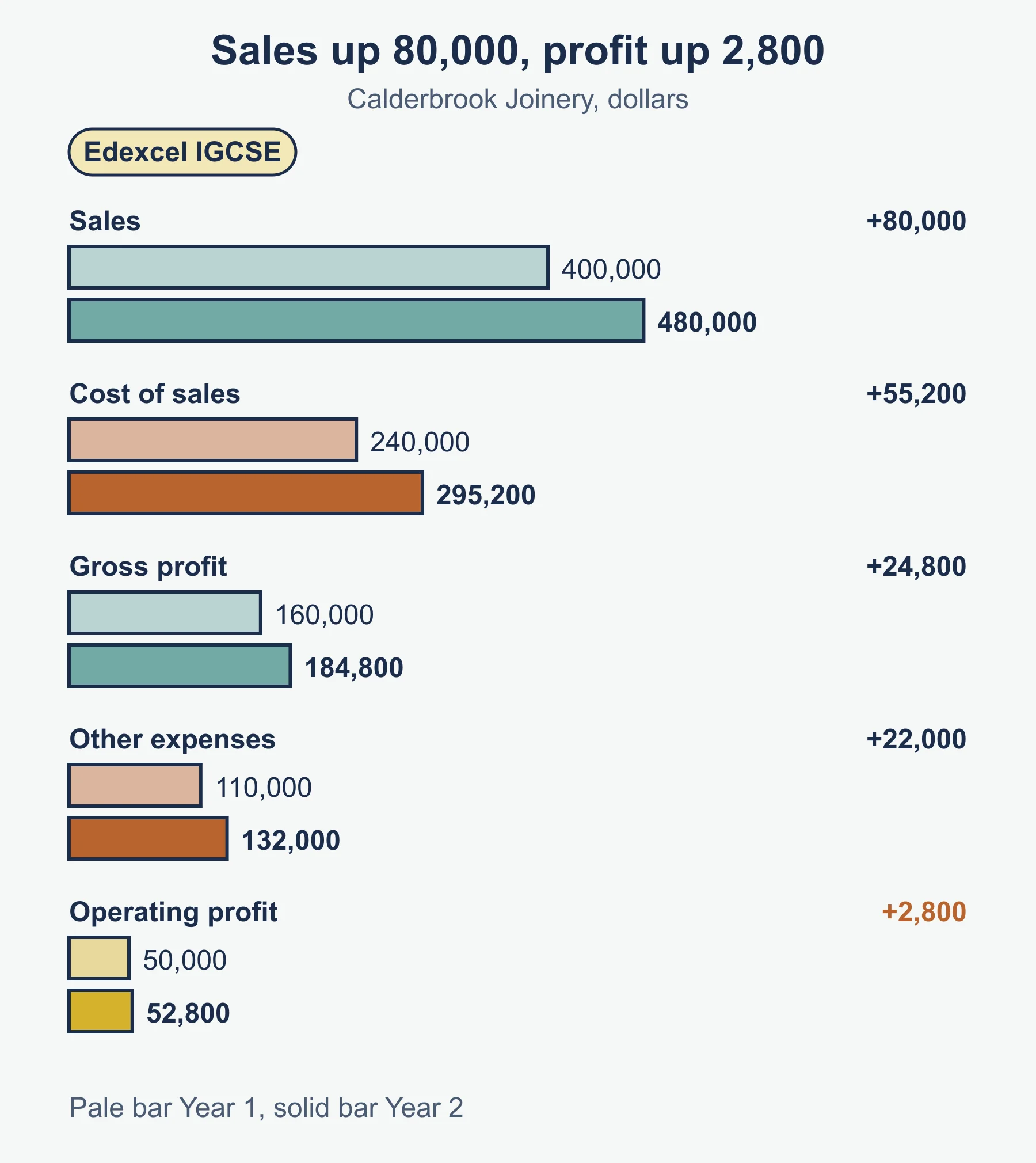
Here is Calderbrook Joinery, a small business making fitted kitchens, for two years.
| Year 1 | Year 2 | |
|---|---|---|
| Sales | 400,000 | 480,000 |
| Cost of sales | 240,000 | 295,200 |
| Gross profit | 160,000 | 184,800 |
| Other operating expenses | 110,000 | 132,000 |
| Operating profit | 50,000 | 52,800 |
Sales rose by 80,000, yet operating profit rose by only 2,800. Reading the layout line by line shows why: cost of sales grew faster than sales, and expenses rose by 22,000. That is the kind of observation a statement supports.
2. The nature and importance of profit; decision making (3.4.1)
Profit is what is left when costs are taken from revenue. Gross profit comes before the running costs; operating profit comes after them. A business needs both to be positive to survive in the long run.
Why profit matters:
- It is the reward to owners for risk and effort.
- Profit that is kept in the business (retained profit, from section 3.1) can pay for new equipment or expansion without borrowing.
- Lenders and investors look for profit before they provide funds.
- It measures success over time and against competitors.
Profit and cash are different things. A firm may show a healthy profit yet have an empty bank account if customers have not yet paid, or if its cash has been spent on inventory. Cash flow is covered in section 3.2.
Using the statement in decisions. Managers can compare expenses with the previous year and decide where to cut costs. If gross profit is weak, they can review supplier prices or selling prices. A lender can judge whether the profit is large enough to cover a loan. An owner can decide whether expanding is worthwhile. The limit is that the statement looks backwards and does not show the cash position.
3. The statement of financial position (3.4.2)
This lists the assets a business holds and the liabilities it must settle, on a single date.
- Non-current assets: kept for more than a year (machinery, vehicles, premises).
- Current assets: expected to turn into cash within a year (inventory, trade receivables, cash).
- Current liabilities: due within a year (trade payables, overdraft, other short-term amounts).
- Non-current liabilities: due after more than a year (a long-term bank loan).
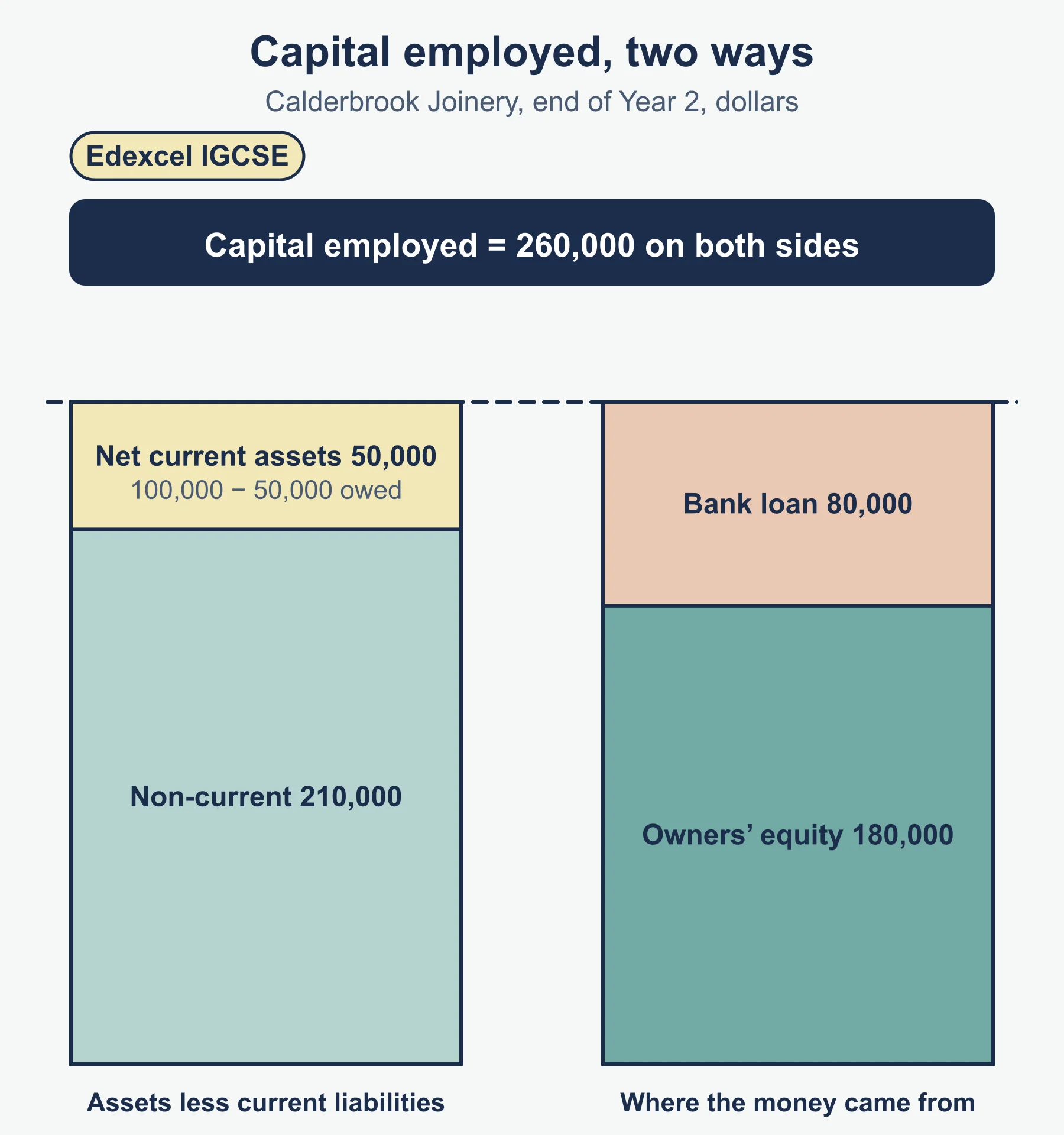
- Capital employed: the long-term funds invested in the business. The specification does not give a formula, so use the standard form: non-current assets + current assets − current liabilities. This equals owners’ equity plus non-current liabilities.
Calderbrook Joinery at the end of Year 2:
| Item | Amount |
|---|---|
| Non-current assets | 210,000 |
| Inventory | 54,000 |
| Trade receivables | 31,000 |
| Cash | 15,000 |
| Current assets | 100,000 |
| Current liabilities | 50,000 |
| Capital employed | 260,000 |
| Non-current liabilities (bank loan) | 80,000 |
| Owners’ equity | 180,000 |
Capital employed = 210,000 + 100,000 − 50,000 = 260,000, and 180,000 + 80,000 gives the same total. To interpret the statement, ask what the business owns, how much is tied up in inventory, how soon it must pay, and how much of its funding is borrowed long term.
4. Profit ratios: margins and markup (3.5.1)
The formulae are from Appendix 4 of the specification.
- Gross profit margin = (gross profit ÷ revenue) × 100
- Operating profit margin = (operating profit ÷ revenue) × 100
- Markup = (profit per item ÷ cost per item) × 100
Worked example, Calderbrook.
| Year 1 | Year 2 | |
|---|---|---|
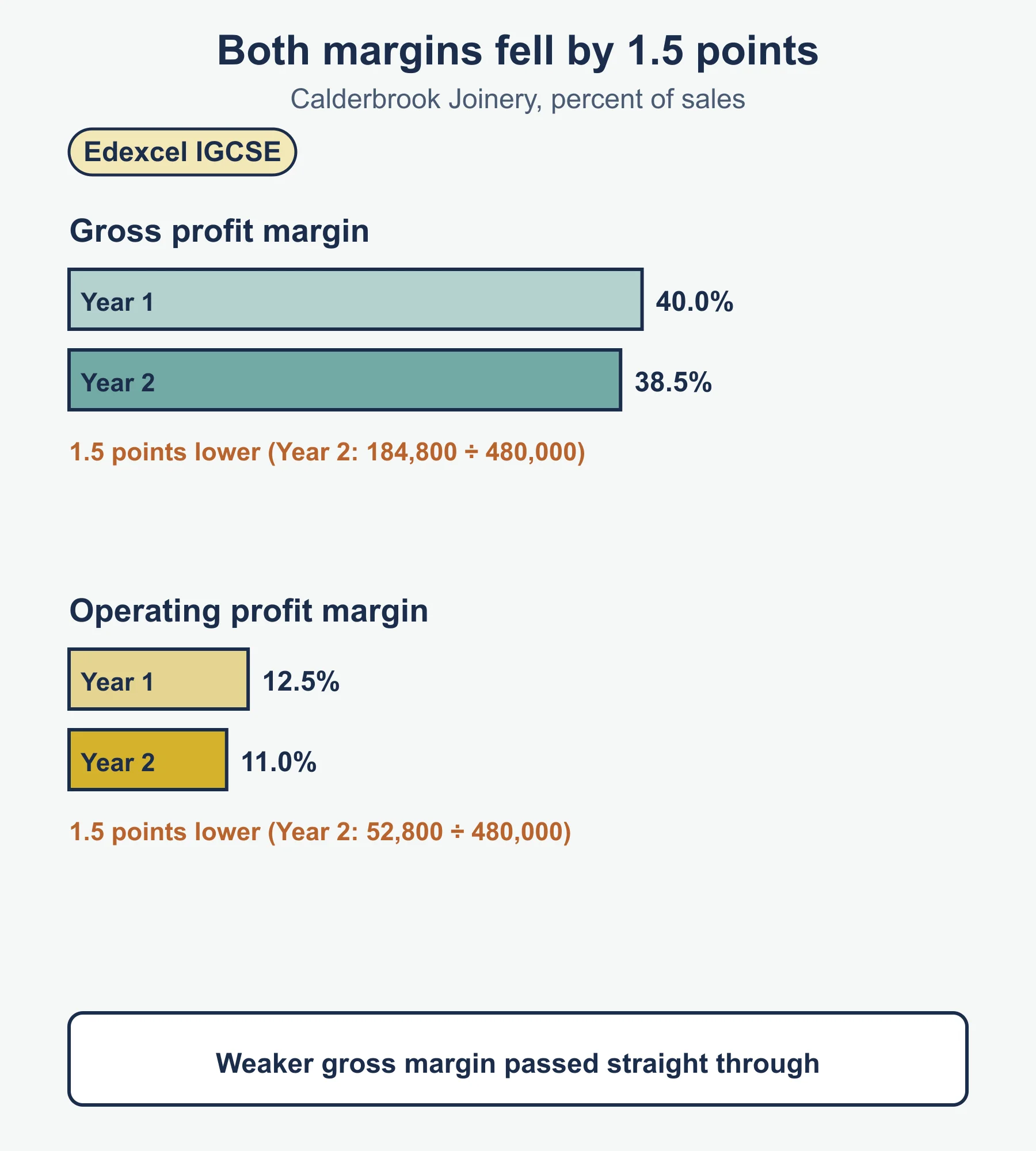
| Gross profit margin | 160,000 ÷ 400,000 × 100 = 40.0% | 184,800 ÷ 480,000 × 100 = 38.5% |
| Operating profit margin | 50,000 ÷ 400,000 × 100 = 12.5% | 52,800 ÷ 480,000 × 100 = 11.0% |
Both margins fell. The gross margin fell 1.5 percentage points, so the business kept less of each dollar after paying for materials and direct costs. The operating margin fell by the same 1.5 points, so expenses were not the cause of the fall in the second figure; the weaker gross margin passed straight through.
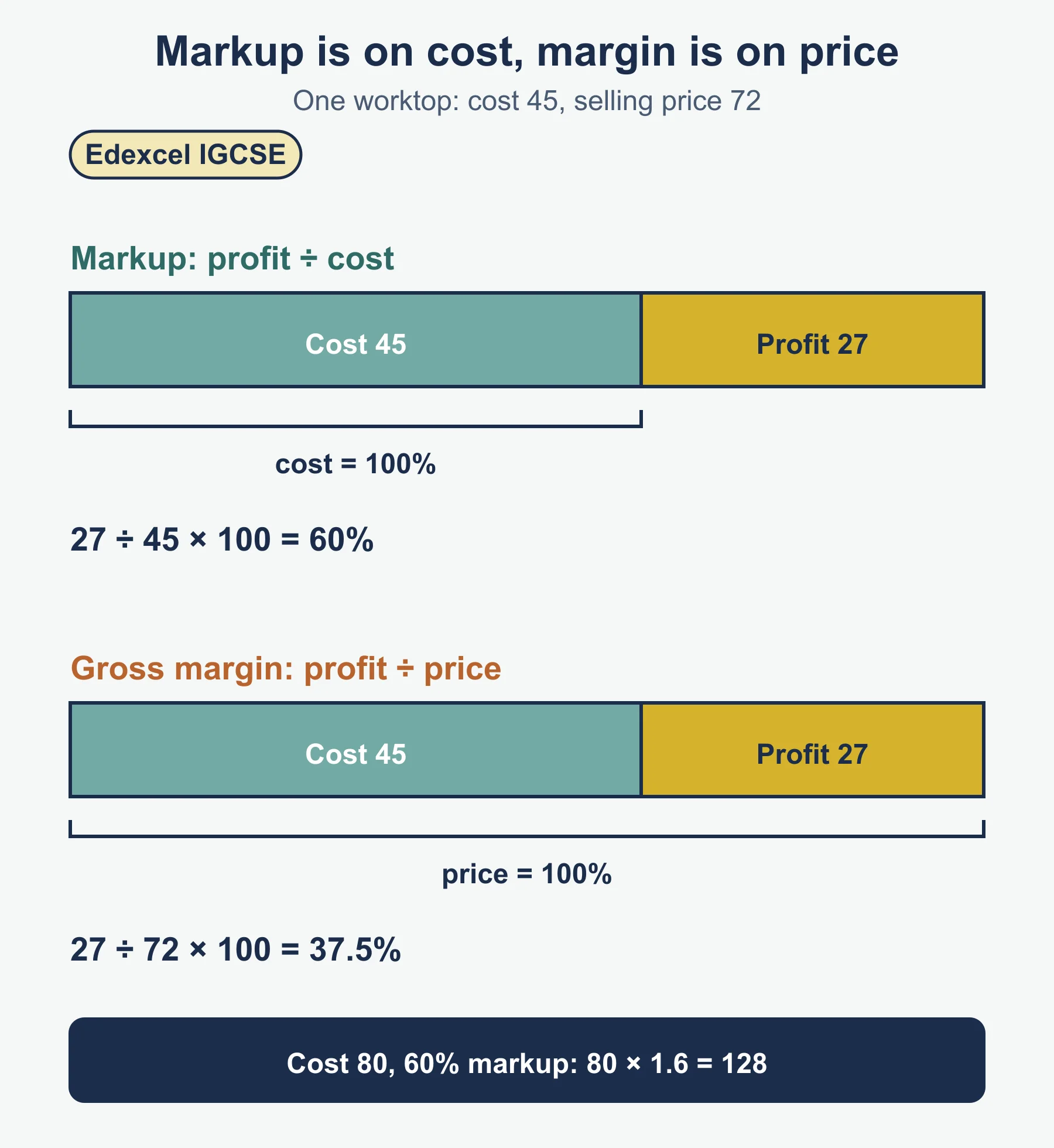
Markup. Markup is measured against cost, not against the selling price. Calderbrook buys a fitted worktop for 45 and sells it for 72.
- Profit per item = 72 − 45 = 27
- Markup = 27 ÷ 45 × 100 = 60%
- The same item gives a gross margin of 27 ÷ 72 × 100 = 37.5%
The two figures describe the same profit against different bases, so markup is always the larger. Markup helps set prices: a 60% markup on a cost of 80 gives a selling price of 80 × 1.6 = 128.
5. Return on capital employed and liquidity ratios (3.5.1)
- ROCE = (operating profit ÷ capital employed) × 100
- Current ratio = current assets ÷ current liabilities
- Acid test ratio = (current assets − inventory) ÷ current liabilities
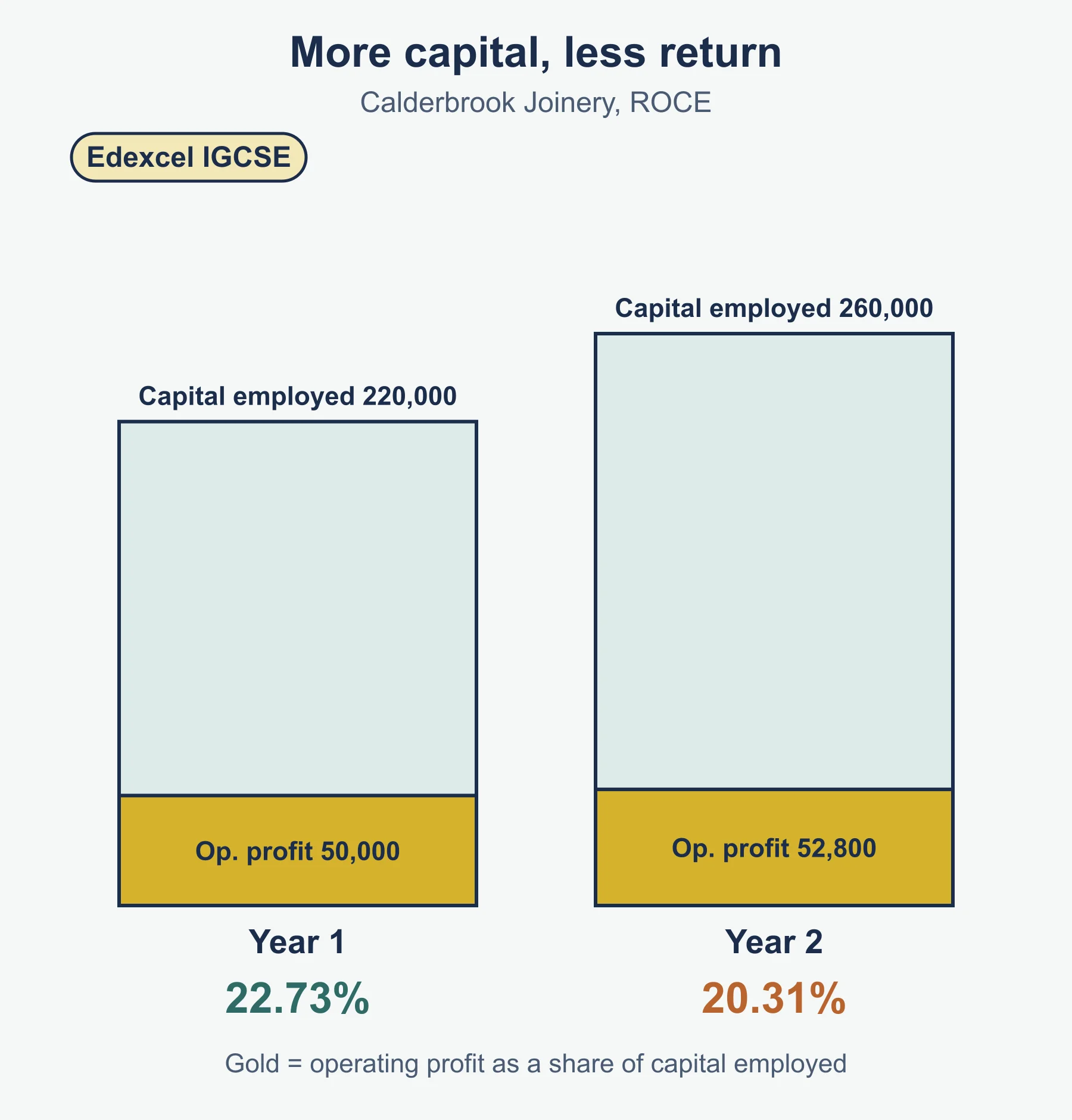
ROCE shows how much operating profit each 100 of long-term funds produced. Year 2: 52,800 ÷ 260,000 × 100 = 20.31%. Year 1 capital employed was 220,000, so ROCE was 50,000 ÷ 220,000 × 100 = 22.73%. More money was invested and each dollar earned less. A useful comparison is the return the owner could get elsewhere.
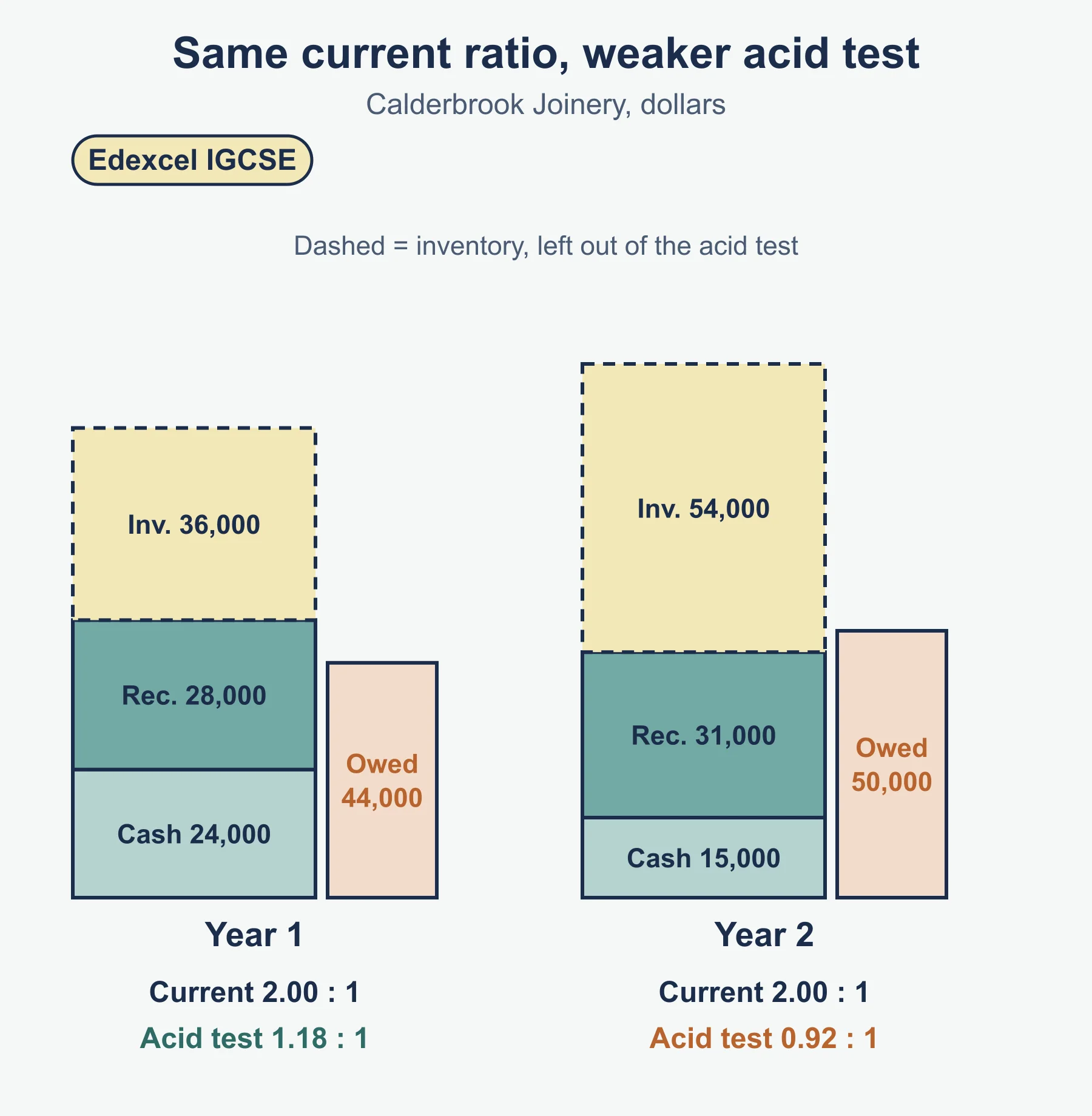
Liquidity ratios are written as a ratio such as 2.0 : 1, not a percentage. Year 1 had current assets of 88,000 (inventory 36,000), and current liabilities of 44,000.
| Year 1 | Year 2 | |
|---|---|---|
| Current ratio | 88,000 ÷ 44,000 = 2.00 : 1 | 100,000 ÷ 50,000 = 2.00 : 1 |
| Acid test ratio | 52,000 ÷ 44,000 = 1.18 : 1 | 46,000 ÷ 50,000 = 0.92 : 1 |
The current ratio did not change, which could look reassuring. The acid test ratio fell below 1 : 1 because inventory rose from 36,000 to 54,000 and cash fell from 24,000 to 15,000. The business has less cash and more stock that must still be sold. This is why the specification names both ratios: the second removes the least liquid current asset.
6. Liquidity and comparisons (3.5.2)
Liquidity is how easily a business can find the cash to meet bills that are due soon. Suppliers, employees and lenders expect payment on time, so a firm that cannot pay may fail even while profitable.
A ratio means little alone, so compare it:
- With previous years to spot trends (as with Calderbrook above).
- With other businesses of a similar type and size. Thornley Interiors, a rival, has a current ratio of 1.1 : 1 and an acid test ratio of 0.5 : 1. Calderbrook’s 2.00 : 1 and 0.92 : 1 are stronger, so it is better placed to pay its bills. Compare like with like, because a business that sells for cash needs less working capital than one selling on credit.
7. Using financial documents (3.5.3)
To assess performance, look at profit, margins and ROCE over time and against rivals. Calderbrook’s sales grew 20%, but both margins and ROCE fell, so growth cost more than it earned.
To inform decisions, link each finding to an action. For Calderbrook:
- The falling gross margin suggests reviewing material costs or raising prices.
- The rise in inventory suggests reducing stock held, to improve cash.
- A lender would note the acid test of 0.92 : 1 and ask how the loan will be repaid.
A short evaluation. Should Calderbrook borrow more to open a second workshop? In favour: operating profit is positive and the current ratio is healthy. Against: ROCE and margins are falling, the acid test is below 1 : 1, and the figures are historical and say nothing about future orders. A reasoned judgement would be to wait and fix the margin first, since more borrowing would add pressure while profit per dollar invested is weakening.
Common errors
- Dividing by sales when calculating ROCE, or by capital employed when calculating a margin.
- Using cost of sales as the base for markup in a per-item question, or dividing by the selling price.
- Deducting every current asset instead of inventory alone in the acid test.
- Expressing a liquidity ratio as a percentage.
- Describing a change without a reason or a consequence.
- Assuming a profitable firm must have plenty of cash.
- Calling a ratio good or bad without a comparison.
Next steps
Condense the formulae with the revision notes, then try the practice questions. Go back to the Edexcel IGCSE Business hub, tick progress on the checklist, or locate gaps with the free diagnostics.
Frequently asked questions
What is the difference between the current ratio and the acid test ratio? The current ratio is current assets divided by current liabilities. The acid test ratio subtracts inventory from current assets first, so it shows whether short-term debts can be paid without selling stock.
How do you calculate capital employed? The specification gives no formula, so use the standard form: non-current assets plus current assets minus current liabilities.
Why does liquidity matter if a business is profitable? Liquidity is how easily a business can find cash to meet bills due soon. A firm that cannot pay suppliers, employees or lenders on time may fail even while it is profitable.
How should ratios be compared? Compare a ratio with previous years to spot trends and with similar businesses of the same type and size. A ratio called good or bad without a comparison has little meaning.
Official syllabus
Pearson Edexcel International GCSE in Business (4BS1), Specification, Issue 2, February 2026, published by Pearson Education Limited. Topic 3: Business finance, sections 3.4 Financial documents and 3.5 Accounts analysis, with the formulae in Appendix 4.
Get free revision emails (optional)
Occasional emails with practice questions, worked explanations and links to free resources for the qualification and subjects you choose. No spam, and you can unsubscribe from any email. The free tools on this site never need an email.
Related resources
-
Practice questions
Edexcel IGCSE Business: Financial documents and accounts analysis (4BS1) – Practice Questions
Original practice questions with worked answers on financial documents, ratios and liquidity for Edexcel IGCSE Business, Topic 3 sections 3.4 and 3.5.
Business · Pearson Edexcel · IGCSE
Try questions -
Revision notes
Edexcel IGCSE Business: Financial documents and accounts analysis (4BS1) – Revision Notes
Condensed revision notes on financial documents, the six ratios, liquidity and analysis for Edexcel IGCSE Business, Topic 3 sections 3.4 and 3.5.
Business · Pearson Edexcel · IGCSE
Revise topic -
Study guides
Edexcel IGCSE Business: Sources of business finance and cash flow forecasting (4BS1)
Study guide to sources of business finance, why cash matters, and building and reading a cash-flow forecast for Edexcel IGCSE Business (4BS1).
Business · Pearson Edexcel · IGCSE
Read guide
Related articles
-
teaching
A Level tuition in Dubai: Cambridge or Pearson Edexcel International A Level?
Schools in Dubai and Abu Dhabi teach either Cambridge International AS & A Level or Pearson Edexcel International A Level. How the two are structured, why it matters for tuition, and how online classes from Lahore work.
9 October 2026
-
curriculum guides
Choosing subjects at IGCSE and A Level
How subject choices at 14 and 16 affect university options later, and how to keep pathways open without overloading a timetable.
28 July 2026
Studying this with a teacher
Working through Business IGCSE?
This page is free and stays free. If you would rather be taught it, Marlbridge runs Business classes one-to-one and in small groups of up to 15, online in your own time zone. The first trial class is free. WhatsApp replies within an hour (8am–11pm Pakistan time, every day); email the same day.
Pearson Edexcel Business teachers at Marlbridge

