
Revision Notes
Edexcel IGCSE Business: Market research and the market (4BS1) – Revision Notes
Condensed revision notes on market research, data, market share, segmentation and market change for Edexcel International GCSE Business.
- Subject
- Business
- Level
- IGCSE
- Topic
- Marketing
- Author
- Marlbridge Academic Team
- Updated
- Reviewed by
- Asif Iqbal (what this means)
Aligned to Pearson Edexcel IGCSE Business (4BS1), Issue 2, February 2026. Official specification .
Syllabus page (what it covers and how it is assessed): Pearson Edexcel IGCSE Business.
Syllabus points this page covers
4BS1
- 4 Marketing (whole topic)
- 4.1 Market research
- 4.2 The market
Found an error? Report a correction.
Want a teacher for this? Marlbridge teaches Business online. Request a free trial class.
These notes condense Topic 4, sections 4.1 Market research and 4.2 The market, from the Pearson Edexcel International GCSE in Business (4BS1) specification, Issue 2, February 2026. Read the study guide for full explanations. Then test yourself with the practice questions. Course links: the Edexcel IGCSE Business hub, the printable checklist and the free diagnostics. Both Paper 1 (small business, up to 49 employees) and Paper 2 (large business, more than 250 employees) can draw on this topic. Method strengths and weaknesses, the distinctions table and the market share formula are standard teaching, not specification text. Amounts below are in dollars and the businesses are invented.
4.1.1 Purpose of market research
Market research is collecting and analysing information about customers, competitors and the market.
| Purpose | One-line application |
|---|---|
| Identify and understand customer needs | Find what customers want and will pay |
| Identify gaps in the market | Find a want that nothing meets well |
| Reduce risk | Evidence before spending on a launch |
| Inform business decisions | Price, product, location, stock levels |
4.1.2 Methods
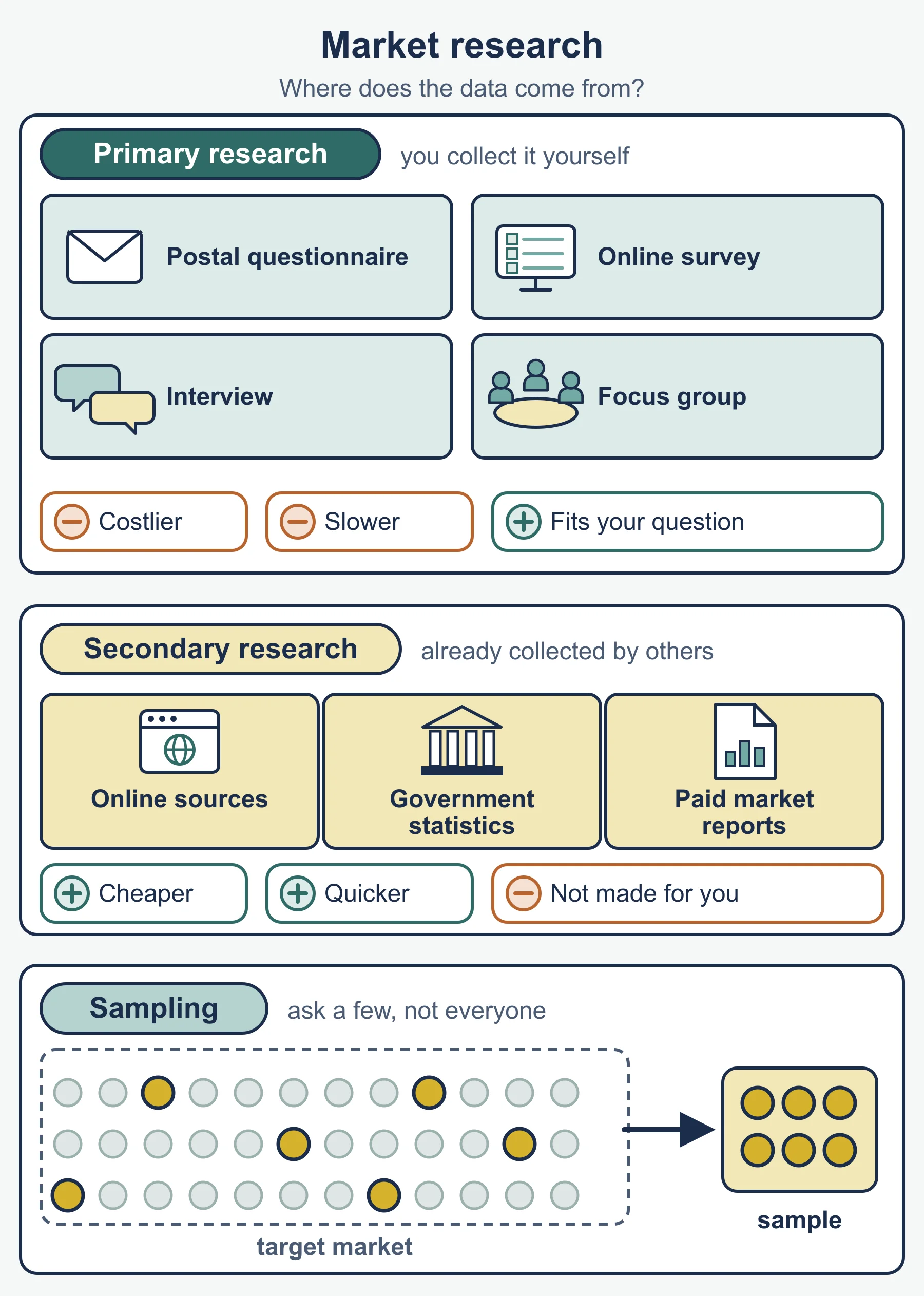
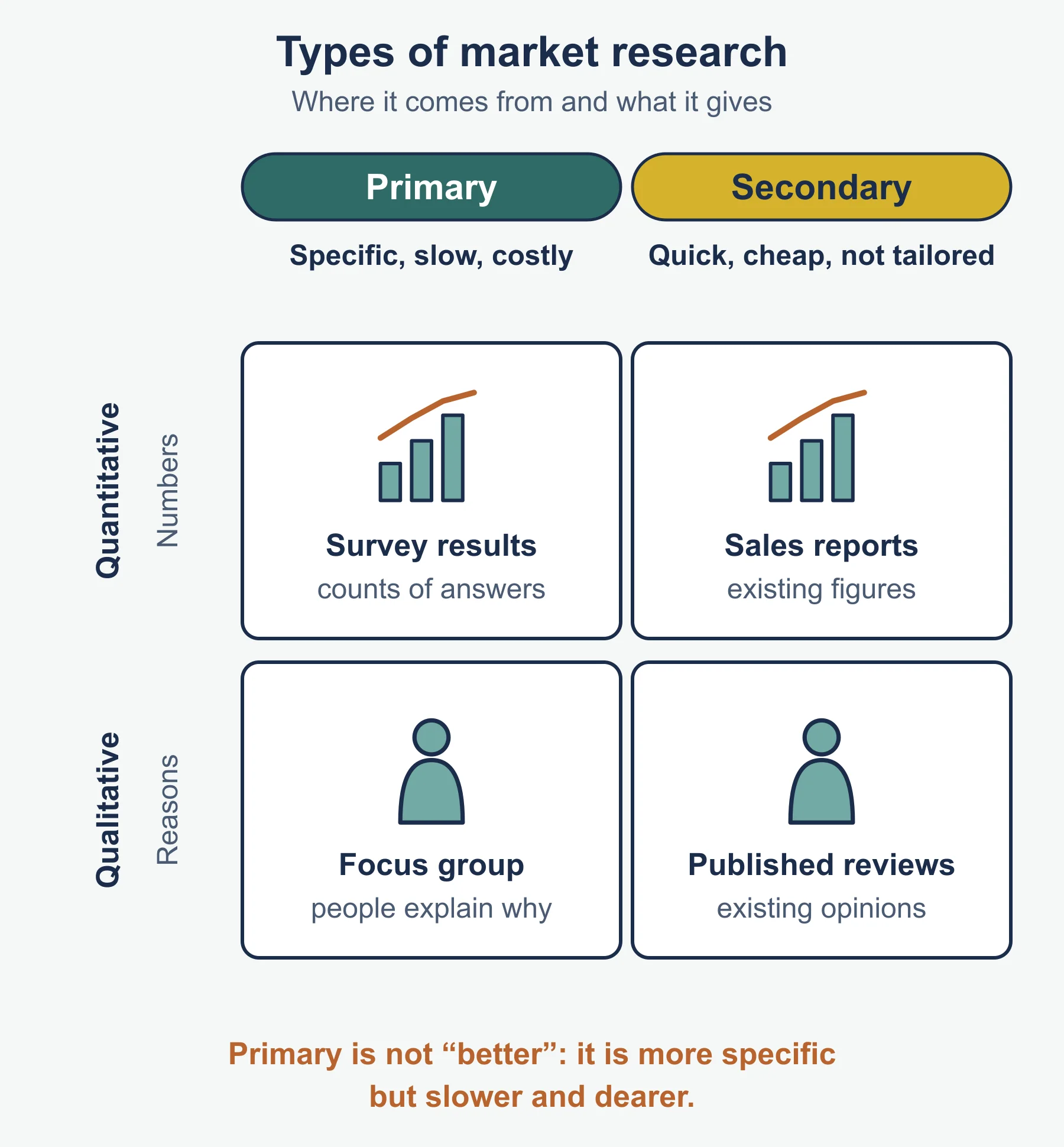
Primary = collected first-hand for this business. Secondary = already exists, collected by someone else.
| Type | Method | Remember |
|---|---|---|
| Primary | Survey | Asking a sample; counts well |
| Primary | Questionnaire | Written questions; cheap, low response rate |
| Primary | Focus group | Small group discussion; explains why; small sample |
| Primary | Observation | Watch behaviour; shows what, not why |
| Primary | Test marketing | Limited real sale before full launch; realistic but slow |
| Secondary | Internet | Fast and cheap; quality varies |
| Secondary | Market reports | Detailed; may cost money |
| Secondary | Government reports | Trusted and wide; may be dated or general |
Method in steps: recommending a research method
- State what the business needs to find out.
- Note its limits: budget, time, size.
- Compare two or three methods using cost, speed and accuracy.
- Choose one, justify it with the scenario, and name one drawback.
Primary versus secondary
| Primary | Secondary | |
|---|---|---|
| Cost | Higher | Lower |
| Time | Longer | Shorter |
| Fit to question | Exact | May not fit |
| Rivals can see it | No | Often yes |
4.1.3 Data
| Term | Meaning | Example |
|---|---|---|
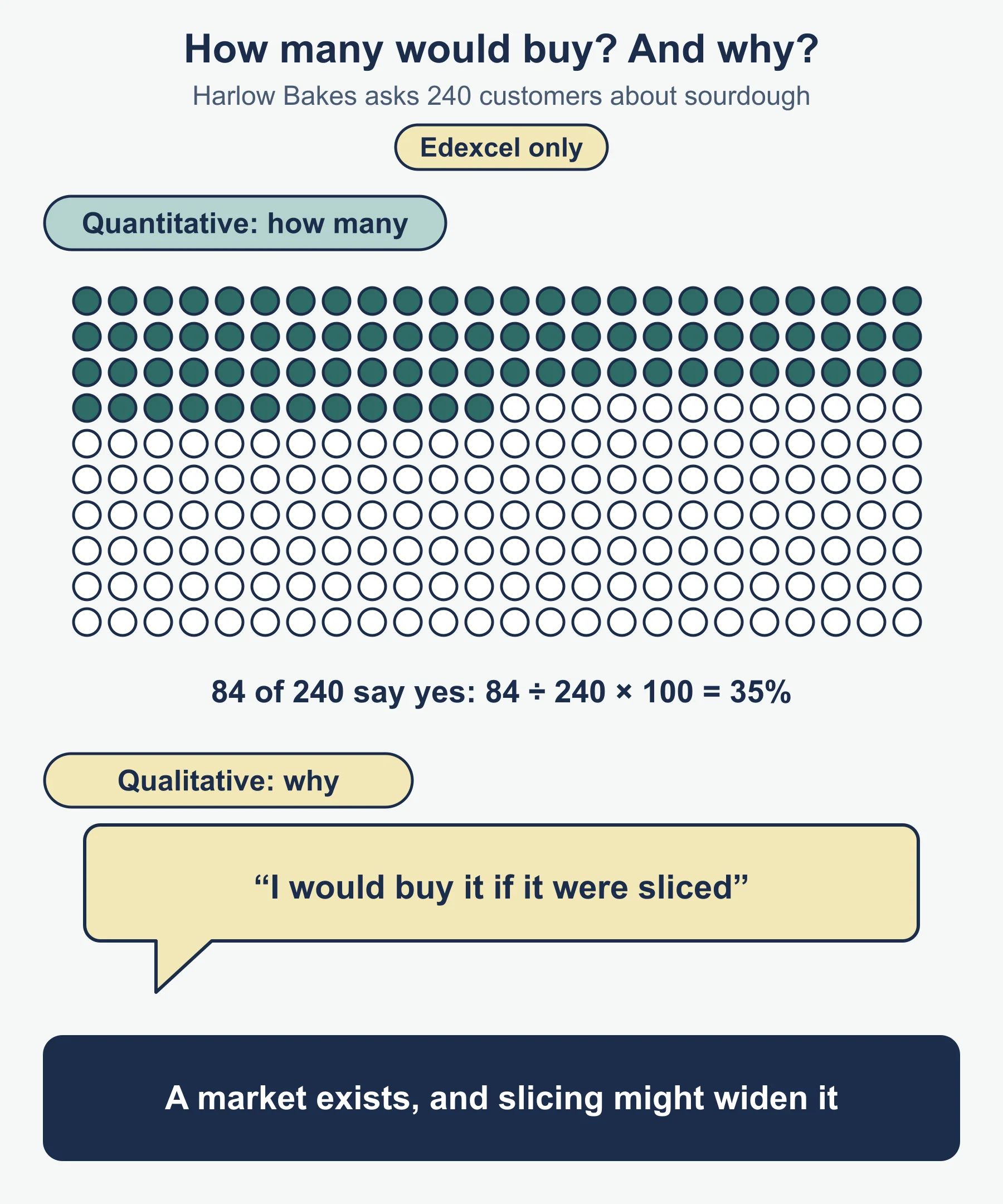
| Quantitative | Numbers; how many or how much | 35% would buy weekly |
| Qualitative | Opinions and reasons; why | “The box is hard to open” |
Social media: cheap, quick, direct contact with customers (polls, comments, reviews). Risks: unrepresentative respondents, fake or biased accounts.
Reliability checklist: sample size, representative sample, bias in questions, age of data, source. Unreliable data raises the risk of a wrong decision.
Small worked reminder
Sample 400 people, 50 would buy the new product.
50 / 400 x 100 = 12.5%If the 400 were all students at one school, the sample would not represent all customers, so 12.5% could mislead.
4.2.1 Importance of marketing
- Satisfying customer needs: more sales, fewer returns.
- Building customer relationships: valued customers return.
- Keeping customer loyalty: repeat custom, word-of-mouth, lower cost than winning new customers.
Must-know distinctions
| Pair | Difference |
|---|---|
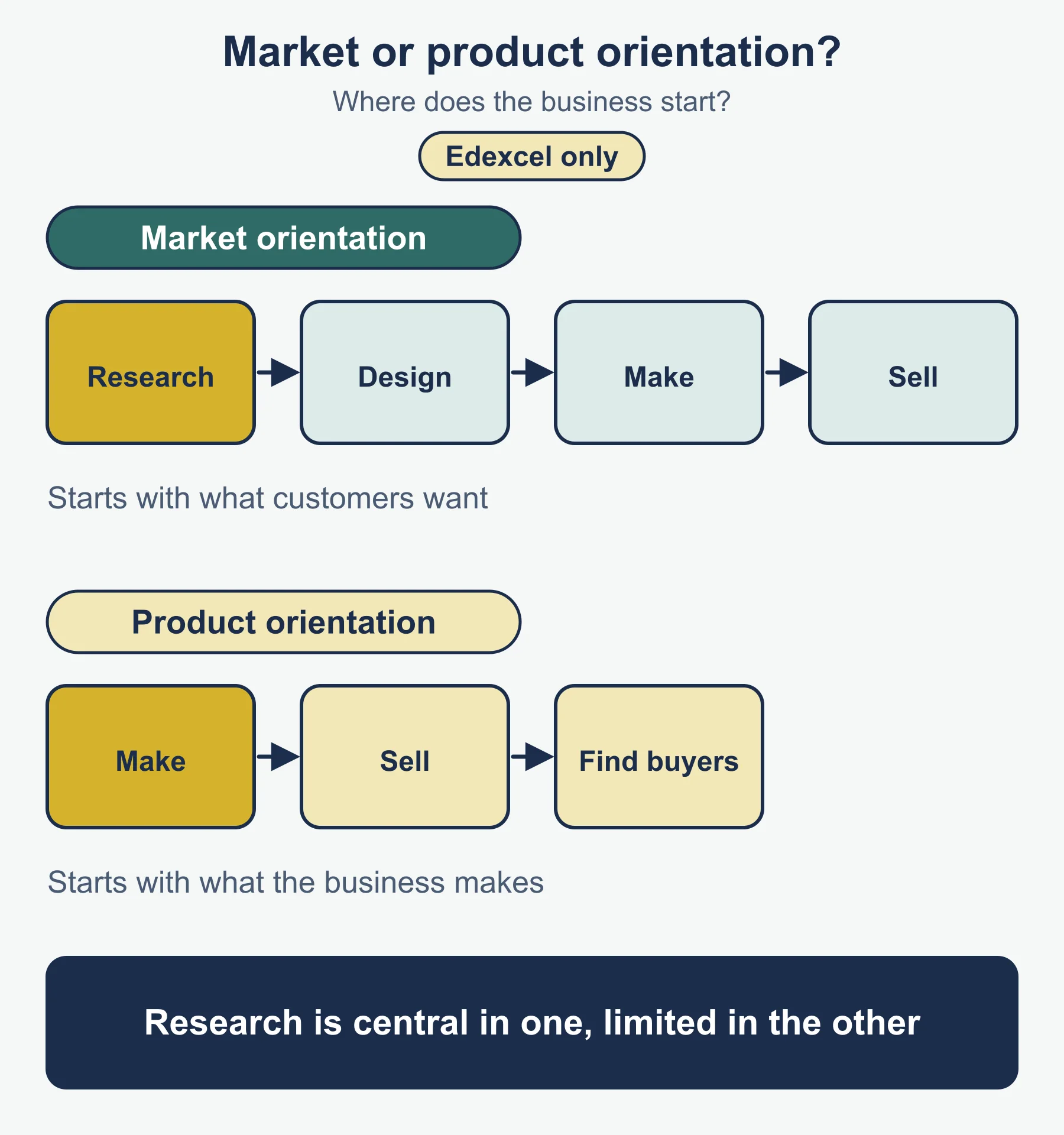
| Market orientation vs product orientation | Starts from customer wants (research) vs starts from what the business makes |
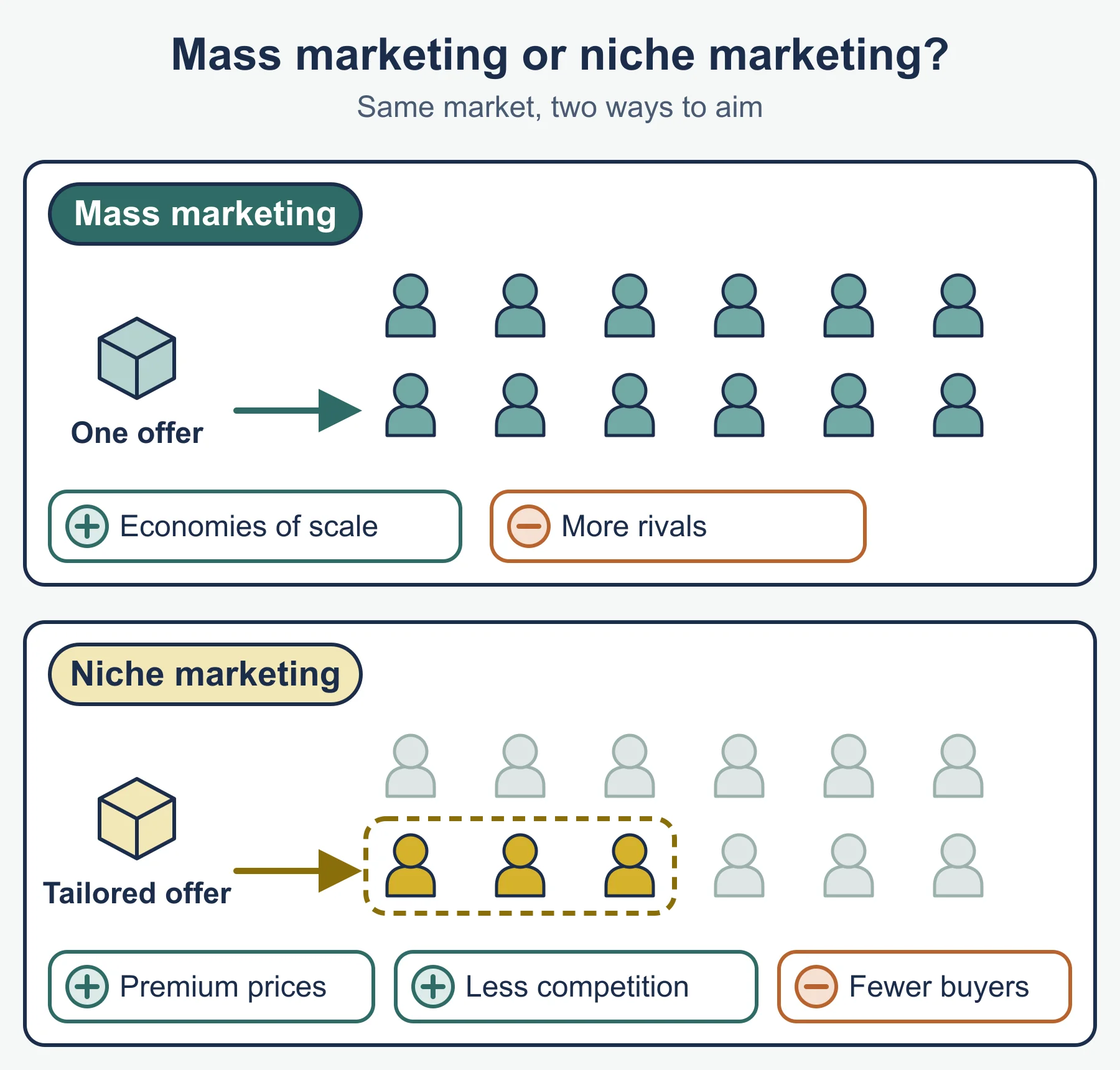
| Niche vs mass marketing | Small specialised segment vs the whole market |
| Primary vs secondary research | First-hand vs existing |
| Qualitative vs quantitative | Words and reasons vs numbers |
| Survey vs questionnaire | In standard usage: the exercise of asking a sample vs the written question list |
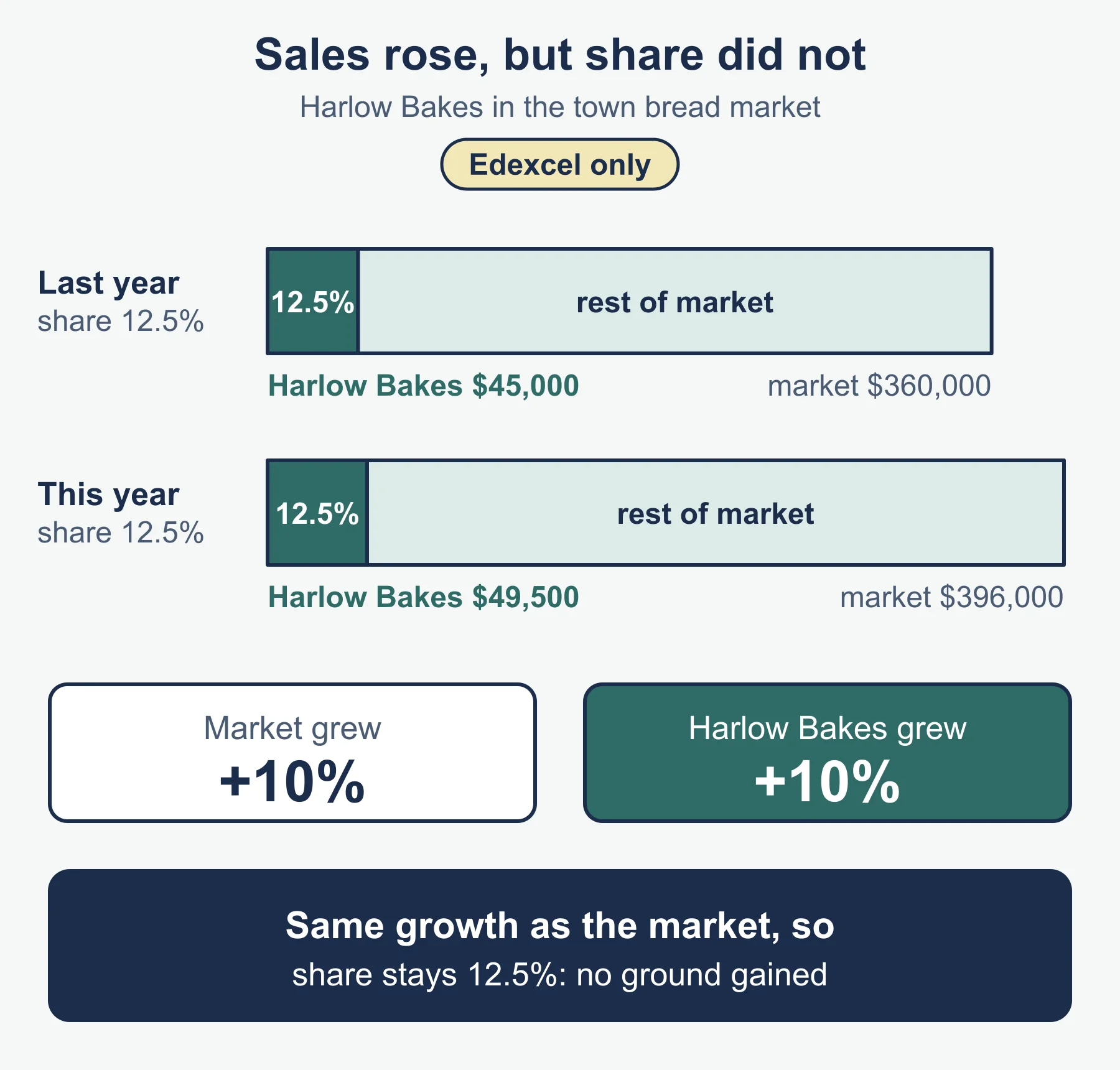
| Sales vs market share | Value of a firm’s sales vs its percentage of total market sales |
Market share (standard form; the specification gives no formula)
Market share (%) = (business sales / total market sales) x 100Worked reminder: Quillan Teas sells 18,000 in a market worth 90,000.
18,000 / 90,000 x 100 = 20%Rearranged: if share is 12.5% and the market is 160,000, sales = 0.125 x 160,000 = 20,000.
Share can stay the same when sales rise, if the whole market rises at the same rate. Share can fall when sales rise, if the market grows faster.
Market analysis: studying market size, growth, competitors’ shares and customer trends, then using it to decide whether to enter, expand or leave.
| Niche | Mass | |
|---|---|---|
| Strength | Less competition; premium price possible | Large volume; economies of scale |
| Weakness | Small base; exposed if niche shrinks | Strong competition; thin margins |
4.2.2 Responding to market change
| Change | Possible response | Watch out for |
|---|---|---|
| Changing customer needs | Research again; adapt or drop products | Cost of change |
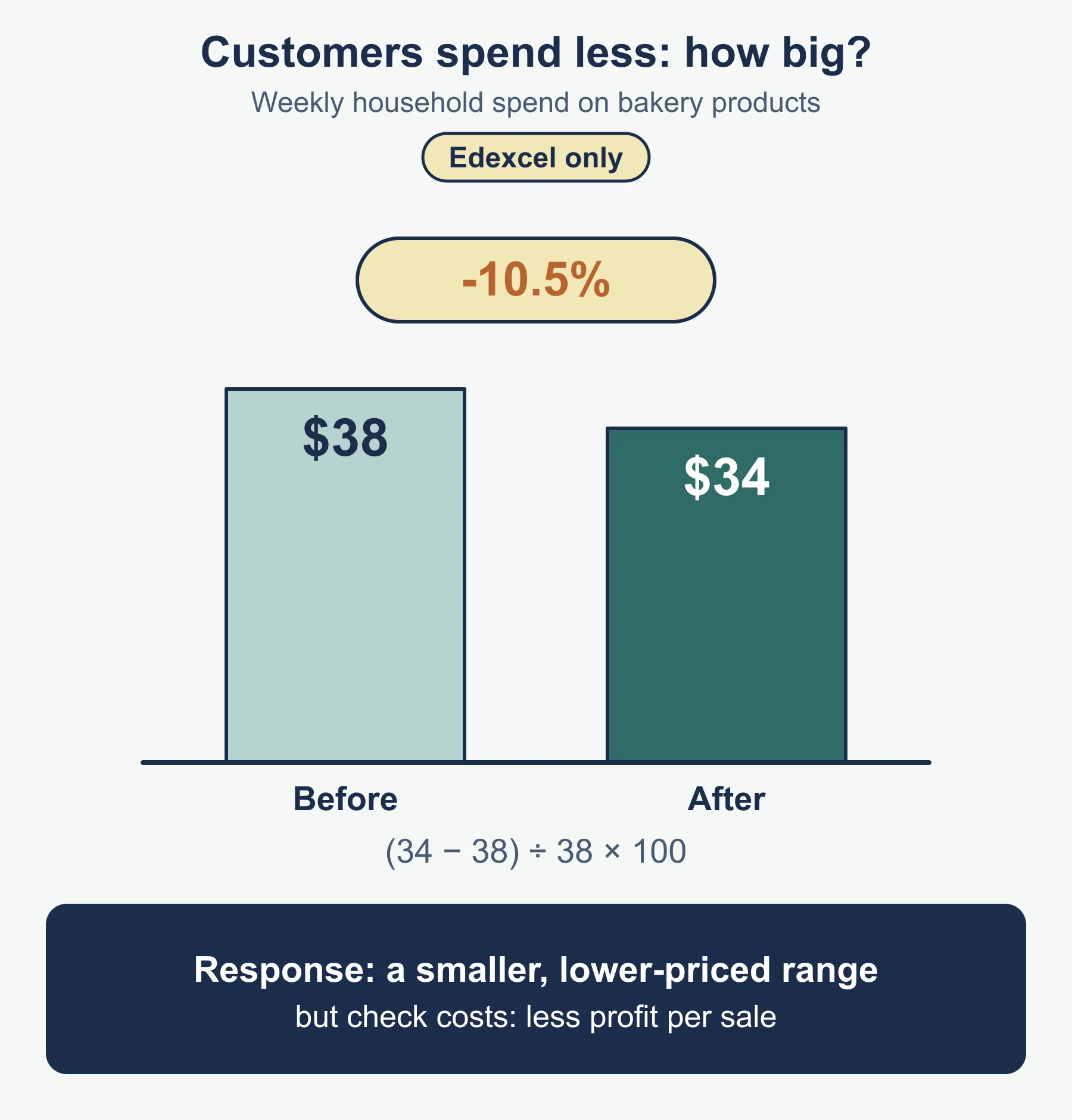
| Changing spending patterns | Value range; price changes; new sales channel | Lower profit per sale |
| Increased competition | Improve quality or service; change prices; promote more; find a niche | Price wars reduce profit |
4.2.3 Market segmentation
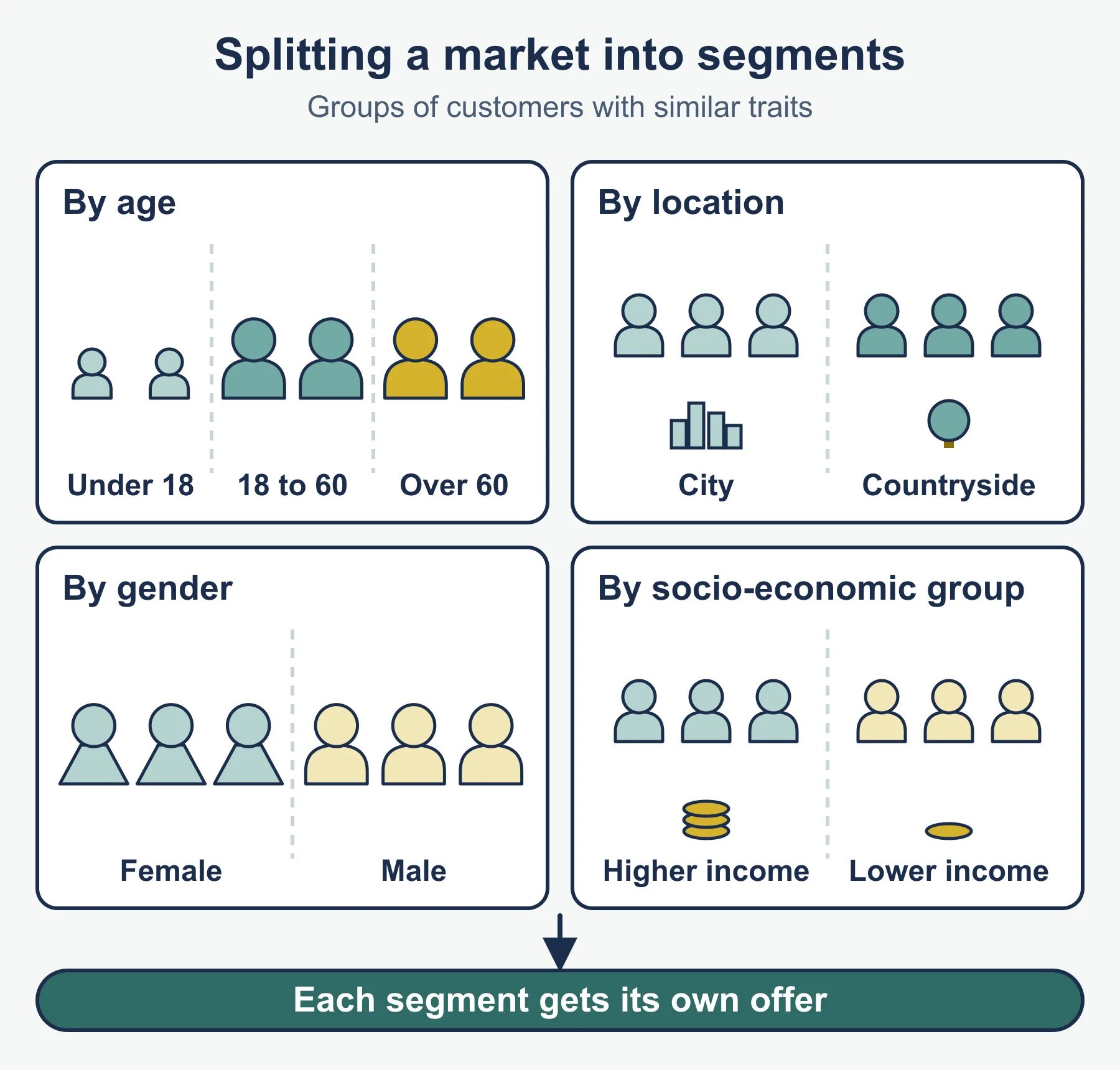
Dividing a market into groups with shared features so product, price and promotion can be aimed at them.
| Basis | Cue words |
|---|---|
| Location | Region, city, urban or rural |
| Demographics | Gender, family size, occupation |
| Lifestyle | Habits, values, interests |
| Income | Low, middle or high earners |
| Age | Children, teenagers, adults, older adults |
Benefit: less wasted spending, better-fitting product. Cost: research expense and the risk of ignoring other segments.
Percentage change reminder
Percentage change = (new - old) / old x 100Worked reminder: household spending on takeaway meals in Wexbury falls from 80 to 72 a week.
(72 - 80) / 80 x 100 = -10%Quote the direction (a fall of 10%). Use the old figure as the divisor.
Segmentation in action
| Business | Basis used | Likely marketing decision |
|---|---|---|
| A cafe near offices | Location | Open early, sell quick lunches |
| A toy maker | Demographics | Advertise in magazines read by parents |
| A hiking shop | Lifestyle | Sponsor a walking club |
| A jeweller | Income | Stock premium items, higher prices |
| A mobile phone provider | Age | Cheap data plans for teenagers |
Link the basis to a decision, as above, and the explanation is complete.
Using command words
| Command word | What to do |
|---|---|
| State, identify | Give the answer briefly; no development needed |
| Define | Say what the term means |
| Calculate | Show the formula and working, then the answer with its unit or percent sign |
| Explain | Give a point, then a reason or consequence |
| Analyse | Break the information down and link causes and effects, using figures |
| Evaluate | Weigh both sides in context, then give a reasoned judgement |
| Justify, recommend | Choose an option and support it with reasons from the scenario |
Linking the ideas
Research feeds marketing decisions. Research (4.1) tells a business what customers need and where the gaps are. Market share and market analysis (4.2.1) show how it is doing against rivals. Changing needs, spending or competition (4.2.2) trigger new research. Segmentation (4.2.3) turns research results into a chosen target group. A good scenario answer often joins two of these.
Method in steps: evaluating a market response
- Say what has changed (needs, spending or competition) and use any figure given.
- Offer a response and say how it addresses the change.
- Give a benefit and a drawback, such as extra sales against lower profit per sale.
- Judge which response suits this business, given its size, budget and customers.
- State the condition that would change your view, such as research showing the change is short-lived.
Method in steps: working out market share
- Find total market sales, not a rival’s sales.
- Divide the business’s sales by the market total.
- Multiply by 100 and write the percent sign.
- Compare years, and state whether share rose, fell or stayed the same.
Quick self-test
- State two purposes of market research.
- Is a government report primary or secondary research?
- Name one weakness of a focus group.
- Is “customers say the shop feels crowded” qualitative or quantitative?
- A business sells 27,000 in a market worth 180,000. Calculate market share.
- State one reliability concern about a social media poll.
- Define niche marketing.
- Give one response to increased competition.
- Name the five bases for segmentation given in the specification.
- Explain why higher sales do not always mean higher market share.
Answers
- Any two of: identify and understand customer needs, identify gaps in the market, reduce risk, inform business decisions.
- Secondary.
- Any one of: small sample, strong voices dominate, costs time, results are opinions not counts.
- Qualitative.
- 27,000 / 180,000 x 100 = 15%.
- Respondents may not represent all customers; some accounts may be fake or biased.
- Targeting a small, specialised part of the market.
- Any one of: improve quality or service, change prices, increase promotion, find a niche.
- Location, demographics, lifestyle, income, age.
- If the total market grows as fast or faster, the firm’s share stays the same or falls.
Where marks are usually lost
- Listing a purpose or method with no link to the business in the scenario.
- Confusing primary and secondary research, especially government reports and market reports.
- Saying a method is “cheap” or “quick” without comparing it with another method.
- Describing quantitative data as “facts” and qualitative data as “opinions” with no example.
- Dividing market sales by the firm’s sales instead of the other way round.
- Writing “market share goes up” when only sales were given.
- Naming a segmentation basis without saying how the business would use it.
- Giving a response to competition with no drawback in an evaluation answer.
- Skipping the judgement in a recommendation question.
Frequently asked questions
What are the purposes of market research in Edexcel IGCSE Business? The 4BS1 specification lists four: to identify and understand customer needs, to identify gaps in the market, to reduce risk and to inform business decisions.
What primary research methods are in the 4BS1 specification? The specification lists surveys, questionnaires, focus groups, observation and test marketing as primary methods, and the internet, market reports and government reports as secondary methods.
What is the difference between niche and mass marketing? Niche marketing targets a small, specialised part of the market, often with higher prices and less competition. Mass marketing targets most of the market with a standard product, giving large volumes and economies of scale but strong competition.
Does a rise in sales mean a rise in market share? Not necessarily. If the whole market grows at the same rate as the business’s sales, market share stays the same.
Official syllabus
Pearson Edexcel International GCSE in Business (4BS1), Specification, Issue 2, February 2026, published by Pearson Education Limited. Topic 4: Marketing, sections 4.1 and 4.2, points 4.1.1 to 4.2.3.
Get free revision emails (optional)
Occasional emails with practice questions, worked explanations and links to free resources for the qualification and subjects you choose. No spam, and you can unsubscribe from any email. The free tools on this site never need an email.
Related resources
-
Study guides
Edexcel IGCSE Business: The marketing mix (4BS1)
Study guide to product, price, place and promotion for Edexcel IGCSE Business (4BS1), section 4.3, with worked examples on pricing and the Boston matrix.
Business · Pearson Edexcel · IGCSE
Read guide -
Practice questions
Edexcel IGCSE Business: The marketing mix (4BS1) – Practice Questions
Original practice questions with worked answers on product, price, place and promotion for Edexcel IGCSE Business (4BS1), Topic 4 section 4.3.
Business · Pearson Edexcel · IGCSE
Try questions -
Revision notes
Edexcel IGCSE Business: The marketing mix (4BS1) – Revision Notes
Condensed revision notes on product, price, place and promotion for Edexcel IGCSE Business (4BS1) section 4.3, with tables and a quick self-test.
Business · Pearson Edexcel · IGCSE
Revise topic
Related articles
-
teaching
A Level tuition in Dubai: Cambridge or Pearson Edexcel International A Level?
Schools in Dubai and Abu Dhabi teach either Cambridge International AS & A Level or Pearson Edexcel International A Level. How the two are structured, why it matters for tuition, and how online classes from Lahore work.
9 October 2026
-
curriculum guides
Choosing subjects at IGCSE and A Level
How subject choices at 14 and 16 affect university options later, and how to keep pathways open without overloading a timetable.
28 July 2026
Studying this with a teacher
Working through Business IGCSE?
This page is free and stays free. If you would rather be taught it, Marlbridge runs Business classes one-to-one and in small groups of up to 15, online in your own time zone. The first trial class is free. WhatsApp replies within an hour (8am–11pm Pakistan time, every day); email the same day.
Pearson Edexcel Business teachers at Marlbridge

