
Revision Notes
Edexcel IGCSE Business: The marketing mix (4BS1) – Revision Notes
Condensed revision notes on product, price, place and promotion for Edexcel IGCSE Business (4BS1) section 4.3, with tables and a quick self-test.
- Subject
- Business
- Level
- IGCSE
- Topic
- Marketing
- Author
- Marlbridge Academic Team
- Updated
- Reviewed by
- Asif Iqbal (what this means)
Aligned to Pearson Edexcel IGCSE Business (4BS1), Issue 2, February 2026. Official specification .
Syllabus page (what it covers and how it is assessed): Pearson Edexcel IGCSE Business.
Syllabus points this page covers
4BS1
- 4 Marketing (whole topic)
- 4.3 The marketing mix
Found an error? Report a correction.
Want a teacher for this? Marlbridge teaches Business online. Request a free trial class.
These notes condense Topic 4 Marketing, section 4.3 “The marketing mix” (points 4.3.1 to 4.3.4) of the Pearson Edexcel International GCSE in Business (4BS1) specification, Issue 2, February 2026. For full explanations and worked examples, read the study guide. Test yourself with the practice questions. Course links: the 4BS1 Business hub, the printable checklist and the free diagnostics. Both papers can draw on the whole content, so expect to apply these ideas to a small business in one paper and a large business in the other.
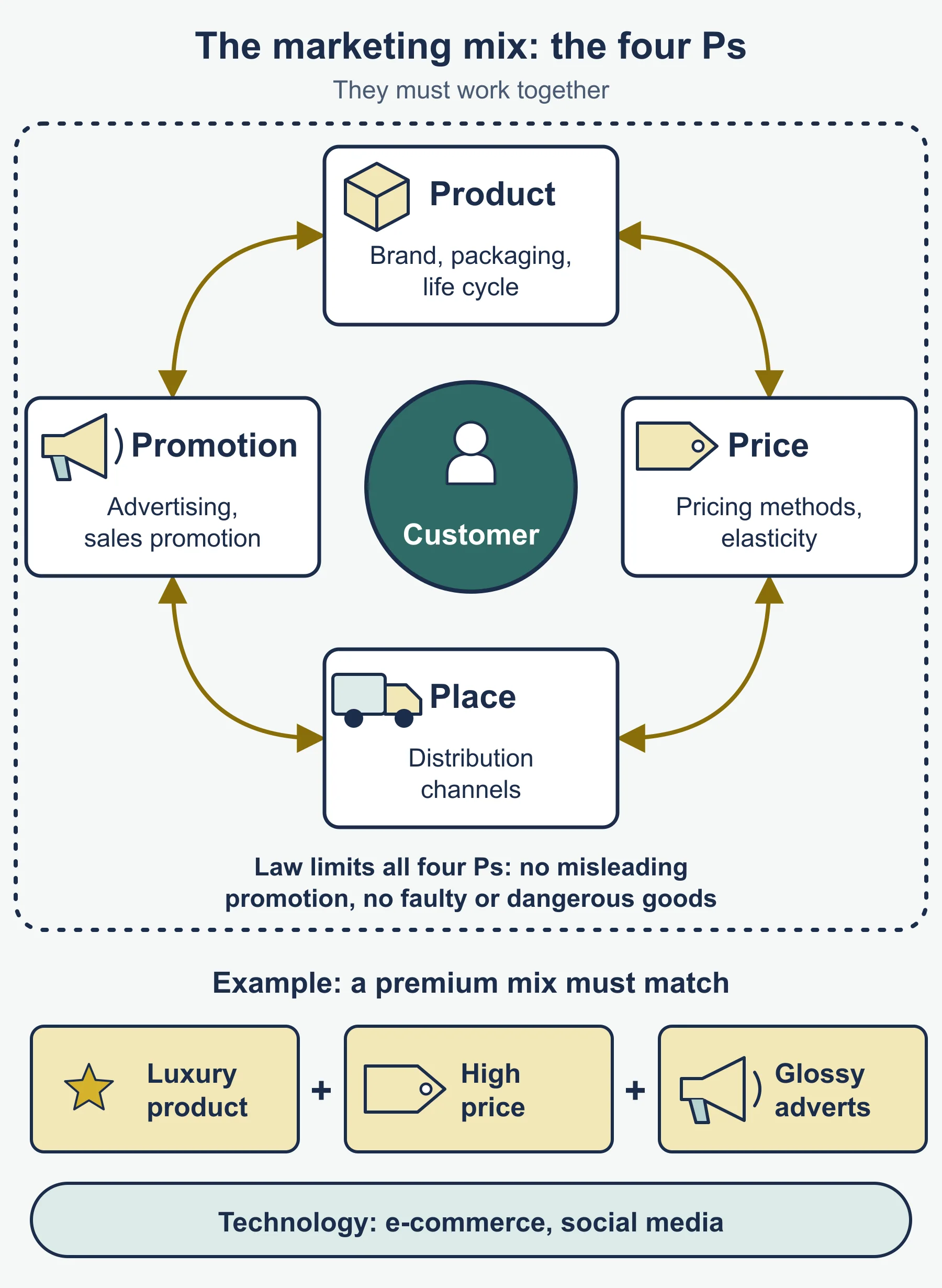
The four parts at a glance
| Part | Spec point | Core ideas |
|---|---|---|
| Product | 4.3.1 | New product development, goods v services, packaging, product life cycle, extension strategies, Boston matrix |
| Price | 4.3.2 | Cost plus, penetration, competition, skimming, promotional |
| Place | 4.3.3 | Retailers, e-tailers (e-commerce) |
| Promotion | 4.3.4 | Advertising, sponsorship, product trials, special offers, branding; above and below the line; PR; technology; brand |
Product (4.3.1)
Definitions
- Good: a physical item. Service: an activity done for the customer.
- Product portfolio: the full set of products a business offers.
- Extension strategy: action to delay decline of a product.
- Brand: the identity customers link with a product or business.
Goods v services
| Goods | Services | |
|---|---|---|
| Form | Physical | Activity |
| Stock | Can be stored | Usually cannot |
| Judging quality | Can inspect first | Often judged after use |
| Depends on | Materials and production | People delivering it |
New product development in steps. Idea, market research, design and test a sample, cost and price, launch. Purpose: lower the risk of a costly failure.
Packaging: five jobs. Protect; give information; ease transport and display; promote; support the image. Cost is the main drawback.
Product life cycle
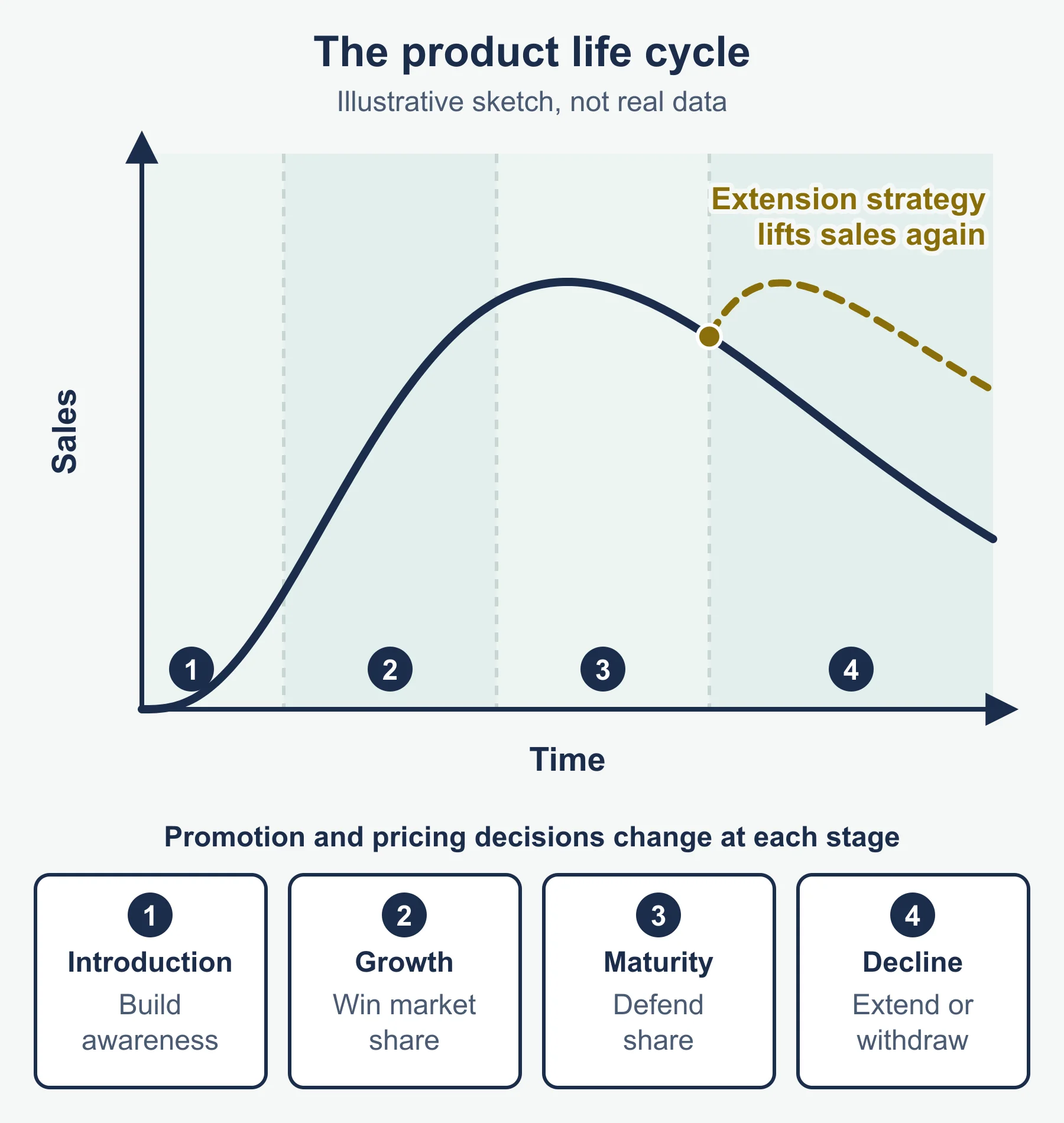
| Phase | Sales | Likely action |
|---|---|---|
| Introduction | Low | Build awareness |
| Growth | Rising fast | Expand output and outlets |
| Maturity | Levelling | Defend share |
| Decline | Falling | Extend, cut costs or withdraw |
Extension strategies: new market or segment; new packaging; new feature or flavour; price change; fresh promotion. Choose one that gives customers a new reason to buy.
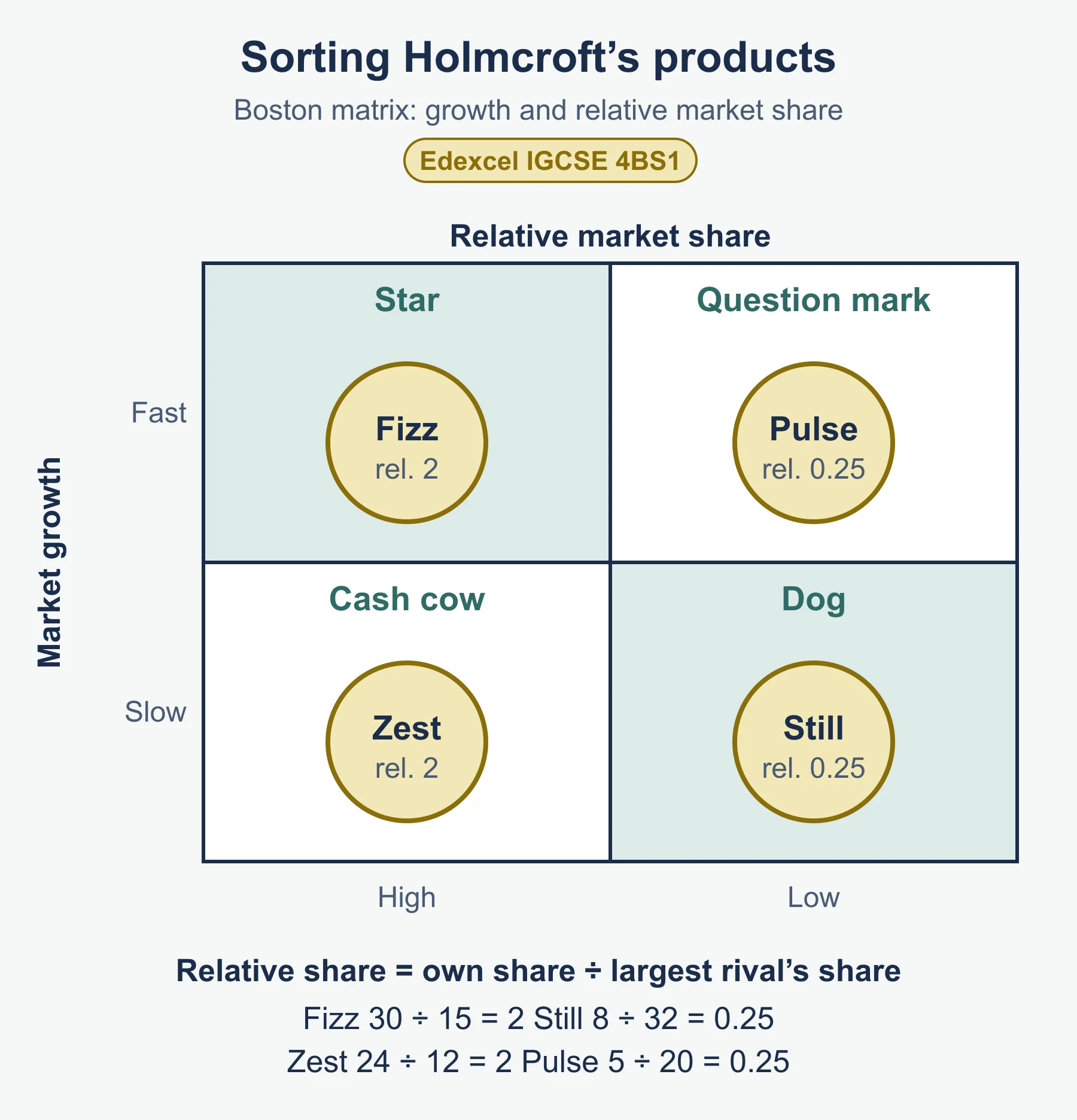
Boston matrix (standard form).
| Market growth | High relative share | Low relative share |
|---|---|---|
| High | Star | Question mark |
| Low | Cash cow | Dog |
Method in steps:
- Relative share = own share ÷ largest rival’s share.
- Decide whether share is above 1 (leader) or below.
- Decide whether market growth is fast or slow.
- Place the product in a box.
- Recommend: back stars, use cash cows to fund others, research question marks, review dogs.
Worked reminder: share 12%, largest rival 24%, market growth 9%. Relative share 12 ÷ 24 = 0.5, growth is fast, so question mark.
Price (4.3.2)
| Strategy | What the business does | When it might suit |
|---|---|---|
| Cost plus | Unit cost plus a mark-up | Wants a sure margin; few comparable rivals |
| Penetration | Low launch price | Wants quick share; price-sensitive customers |
| Skimming | High launch price, lowered later | New or distinctive product; early buyers will pay more |
| Competition | Price close to rivals | Similar products; customers compare prices |
| Promotional | Temporary price cut | Clearing stock; attracting trial; short-term boost |
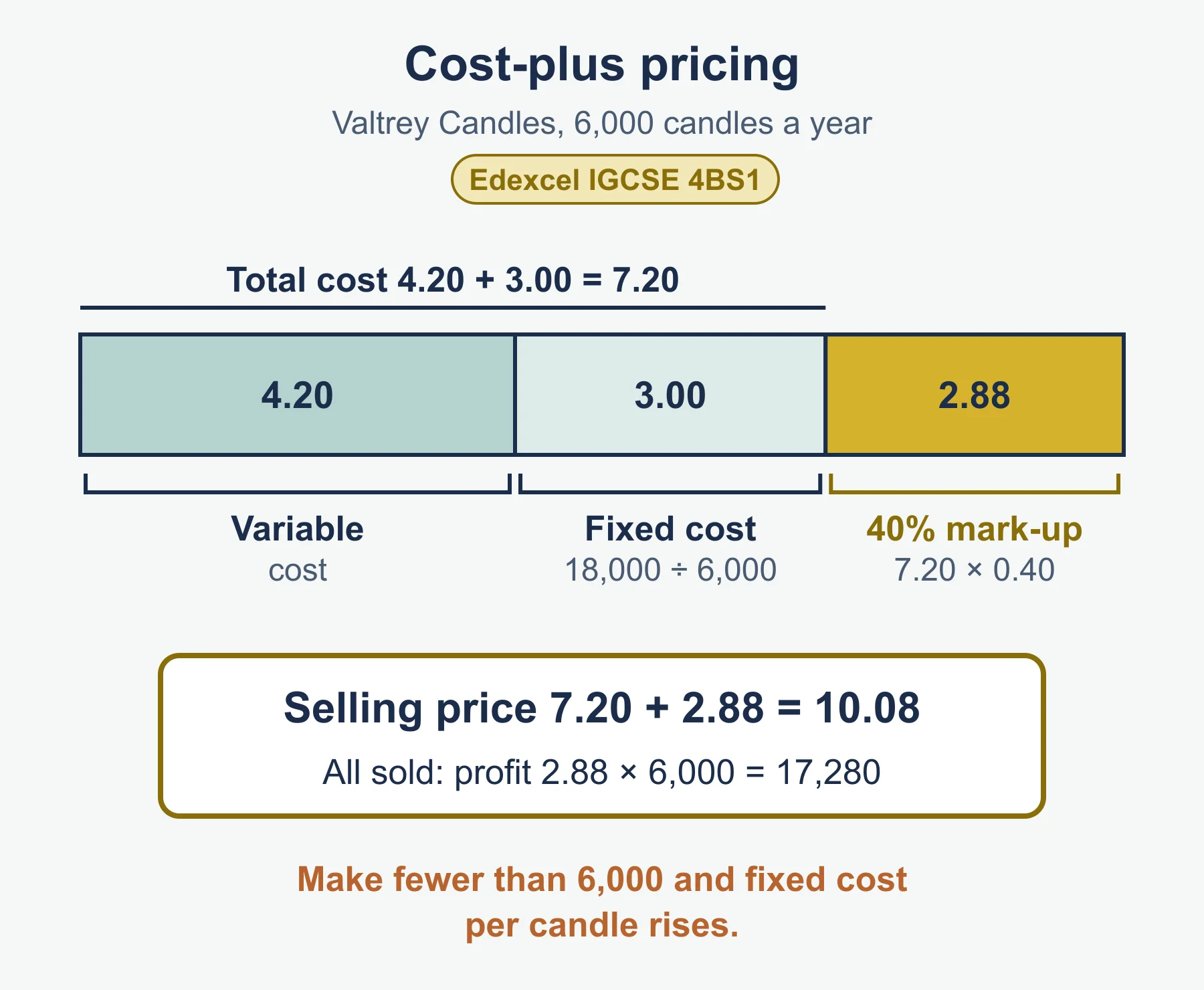
Cost plus in steps.
- Unit cost = variable cost per unit + (fixed costs ÷ output).
- Mark-up = unit cost × mark-up percentage.
- Price = unit cost + mark-up.
Worked reminder: variable cost 6.00, fixed costs 9,000, output 3,000, mark-up 50%. Unit cost 6.00 + 3.00 = 9.00; mark-up 4.50; price 13.50.
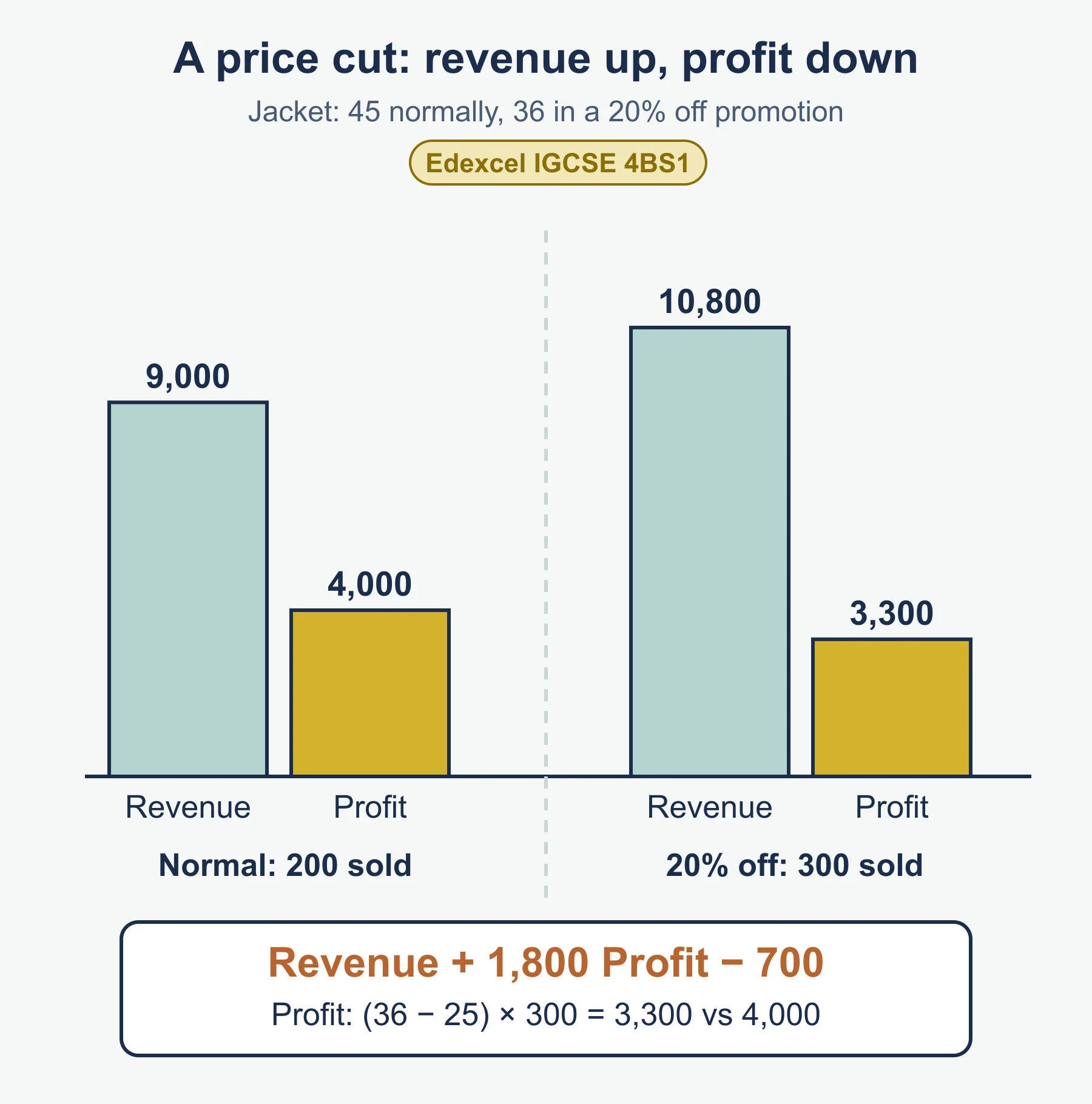
Promotional pricing check. Compare profit, not only revenue. Profit = (price − unit cost) × units. A bigger discount needs a bigger rise in sales to break even on profit.
Place (4.3.3)
| Retailer | E-tailer (e-commerce) | |
|---|---|---|
| What it is | Shop selling to the public | Business selling online |
| For | Customers can see and try; wide reach; shop visibility | Low premises cost; wide market; open any time |
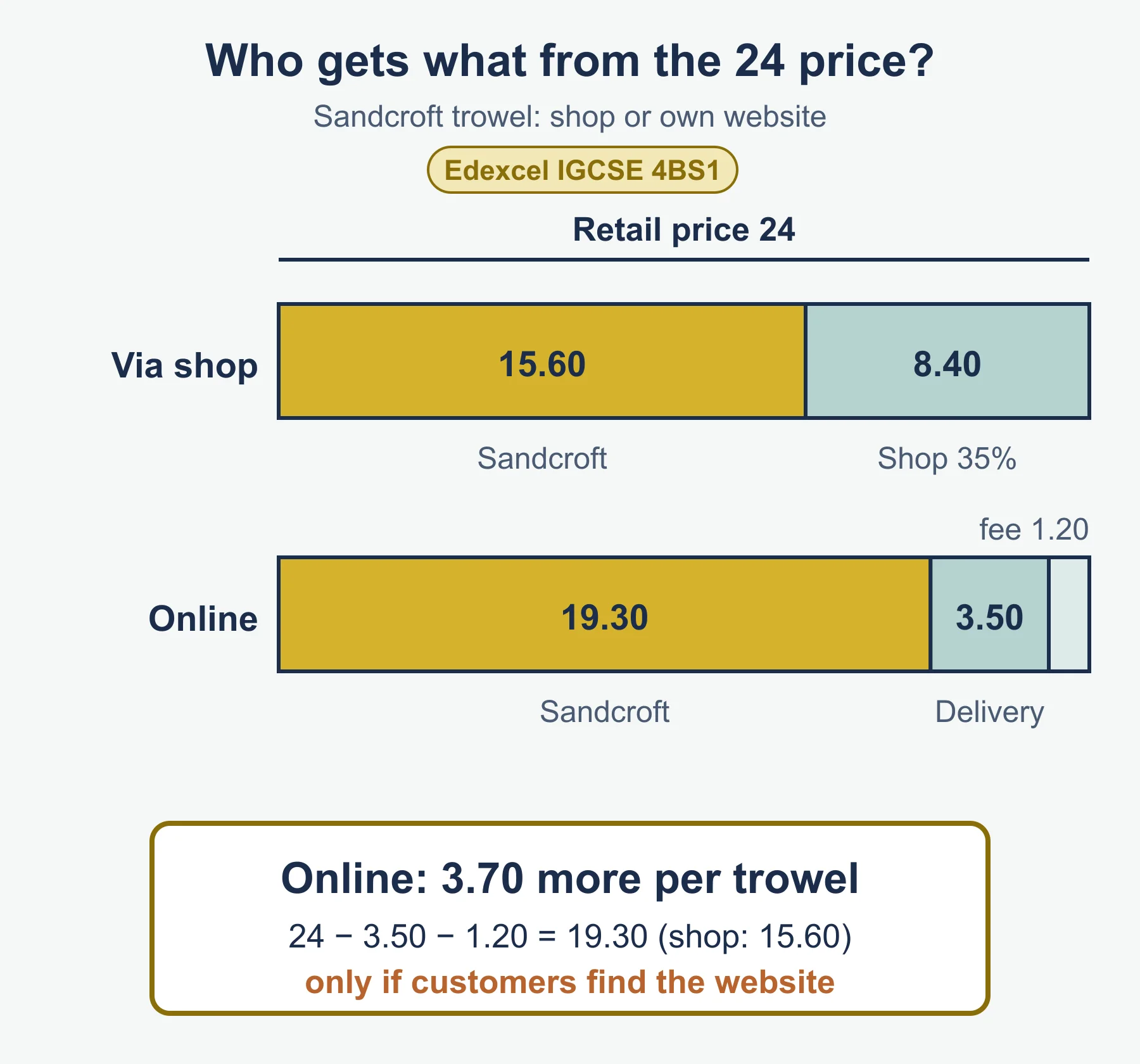
| Against | Retailer takes a share of the price; less control | Delivery and returns cost; cannot try the item; needs a good website |
Many firms use both. The right mix depends on the product, the customers and cost.
Promotion (4.3.4)
| Method | Points to make |
|---|---|
| Advertising | Wide reach; paid; can be costly |
| Sponsorship | Brand linked to an event or team; audience should match target market |
| Product trials | Lets customers try; lowers risk; good for new products |
| Special offers | Quick sales boost; lower profit per sale |
| Branding | Recognition, loyalty, ability to charge more |
Above and below the line
| Above the line | Below the line | |
|---|---|---|
| Type | Paid media aimed at a wide audience | Other methods, often direct or targeted |
| Examples | TV, radio, press, cinema | Special offers, trials, vouchers, direct mail |
Public relations. Managing how the public sees the business (news stories, charity support, handling complaints) to improve company image and brand. Not paid advertising.
Technology in promotion
- Targeted advertising online: shown to chosen groups by age, location or interests.
- Viral advertising via social media: shared by users; cheap but hard to control.
- E-newsletters: emails to people who signed up; cheap but limited to existing contacts.
Segments. Match the method to location, demographics, lifestyle, income or age. Always tie your answer to the segment in the question.
Why a brand matters. Loyalty; support for a higher price; easier launch of new products; stands out from rivals.
Answering marketing mix questions
The specification lists command words such as state, identify, define, calculate, outline, explain, analyse, justify and evaluate. A reliable pattern for the longer ones:
- Point. Name the strategy, channel or method.
- Evidence. Use a figure or fact from the case, such as the number of employees, the price, the age of the customers.
- Link. Say what follows for the business (more sales, lower profit, wider reach).
- Judgement. For evaluate and justify, weigh the other side and finish with a decision that depends on the facts given.
Answers that use the context usually earn more than a reply that would fit any business.
Must-know distinctions
- Penetration v skimming: low price first, versus high price first.
- Cost plus v competition pricing: based on your costs, versus based on rivals’ prices.
- Promotional v penetration: temporary cut on an existing product, versus a low launch price for a new product.
- Above v below the line: wide paid media, versus other (often targeted) methods.
- PR v advertising: managing public image, versus paid messages.
- Market share v relative market share: your share, versus your share divided by the largest rival’s share.
Quick self-test
- State two differences between a good and a service.
- Name the four phases of the product life cycle.
- Give two extension strategies.
- A product has 20% market share, the largest rival has 40%, and the market is growing slowly. Find its relative market share and place it on the Boston matrix.
- Unit cost is 8.00 and the mark-up is 25%. Find the price.
- Name the pricing strategy where a new product is launched at a high price.
- Give one advantage and one disadvantage of selling through a retailer.
- Classify as above or below the line: (a) a radio advert, (b) a discount voucher.
- State one benefit and one risk of viral advertising via social media.
- Explain one way a strong brand helps a business.
Answers
- Any two: a good is physical and a service is an activity; goods can be stored but services usually cannot; goods can be inspected before purchase but services are often judged after use; service quality depends on the people providing it.
- Introduction, growth, maturity, decline.
- Any two: new market, new packaging, new feature, price change, fresh promotion.
- 20 ÷ 40 = 0.5; low share in a slow-growth market, so a dog.
- 8.00 × 0.25 = 2.00; price 10.00.
- Skimming.
- Advantage: customers can see and try the product, or reach is wide. Disadvantage: the retailer takes a share of the selling price, or the producer has less control.
- (a) Above the line. (b) Below the line.
- Benefit: spreads cheaply to many people. Risk: the business cannot control how the message is shared or changed.
- For example: loyal customers keep buying, so sales are more secure; or customers accept a higher price for a trusted brand.
Where marks are usually lost
- Naming a strategy but not saying when it suits the business in the question.
- Describing a Boston matrix box without working out relative share.
- Calling a promotion successful because revenue rose, with no profit check.
- Writing “it gets the product to the customer” for place without naming retailer or e-tailer.
- Defining a method (such as sponsorship) but not linking it to a segment.
- Giving advantages only on an evaluate question, with no judgement.
- Confusing penetration and promotional pricing.
- Leaving out units or the currency in a pricing calculation.
Frequently asked questions
What pricing strategies are in the Edexcel IGCSE Business specification? The 4BS1 specification lists cost plus, penetration, competition, skimming and promotional pricing, and asks when each might be applied.
What is the difference between above-the-line and below-the-line promotion? In the standard definitions, above-the-line promotion is paid advertising in media aimed at a wide audience, such as TV, radio, press and cinema. Below-the-line promotion uses other, more direct methods aimed at a particular group, such as special offers, product trials, discount vouchers and direct mail.
What is the difference between market share and relative market share? Market share is a product’s share of total market sales. Relative market share divides that by the share of the largest rival, and a figure above 1 means the product is the market leader.
What are extension strategies? Extension strategies try to stop or delay a product’s decline, for example by finding a new market, changing the packaging or adding a new feature or flavour.
Official syllabus
Pearson Edexcel International GCSE in Business (4BS1), Specification, Issue 2, February 2026, published by Pearson Education Limited. Topic 4: Marketing, section 4.3 “The marketing mix”, points 4.3.1 to 4.3.4.
Get free revision emails (optional)
Occasional emails with practice questions, worked explanations and links to free resources for the qualification and subjects you choose. No spam, and you can unsubscribe from any email. The free tools on this site never need an email.
Related resources
-
Study guides
Edexcel IGCSE Business: Market research and the market (4BS1)
Study guide to market research methods, data and the market for Edexcel International GCSE Business, with worked examples and common errors.
Business · Pearson Edexcel · IGCSE
Read guide -
Practice questions
Edexcel IGCSE Business: Market research and the market (4BS1) – Practice Questions
Original practice questions with worked answers on market research, market share and segmentation for Edexcel International GCSE Business.
Business · Pearson Edexcel · IGCSE
Try questions -
Revision notes
Edexcel IGCSE Business: Market research and the market (4BS1) – Revision Notes
Condensed revision notes on market research, data, market share, segmentation and market change for Edexcel International GCSE Business.
Business · Pearson Edexcel · IGCSE
Revise topic
Related articles
-
teaching
A Level tuition in Dubai: Cambridge or Pearson Edexcel International A Level?
Schools in Dubai and Abu Dhabi teach either Cambridge International AS & A Level or Pearson Edexcel International A Level. How the two are structured, why it matters for tuition, and how online classes from Lahore work.
9 October 2026
-
curriculum guides
Choosing subjects at IGCSE and A Level
How subject choices at 14 and 16 affect university options later, and how to keep pathways open without overloading a timetable.
28 July 2026
Studying this with a teacher
Working through Business IGCSE?
This page is free and stays free. If you would rather be taught it, Marlbridge runs Business classes one-to-one and in small groups of up to 15, online in your own time zone. The first trial class is free. WhatsApp replies within an hour (8am–11pm Pakistan time, every day); email the same day.
Pearson Edexcel Business teachers at Marlbridge

