
Study Guides
Edexcel IGCSE Business: The marketing mix (4BS1)
Study guide to product, price, place and promotion for Edexcel IGCSE Business (4BS1), section 4.3, with worked examples on pricing and the Boston matrix.
- Subject
- Business
- Level
- IGCSE
- Topic
- Marketing
- Author
- Marlbridge Academic Team
- Updated
- Reviewed by
- Asif Iqbal (what this means)
Aligned to Pearson Edexcel IGCSE Business (4BS1), Issue 2, February 2026. Official specification .
Syllabus page (what it covers and how it is assessed): Pearson Edexcel IGCSE Business.
Syllabus points this page covers
4BS1
- 4 Marketing (whole topic)
- 4.3 The marketing mix
Found an error? Report a correction.
Want a teacher for this? Marlbridge teaches Business online. Request a free trial class.
This guide follows the Pearson Edexcel International GCSE in Business (4BS1) specification, Issue 2, February 2026. It covers Topic 4 Marketing, section 4.3 “The marketing mix”, points 4.3.1 to 4.3.4: product, price, place (distribution channels) and promotion. The specification says both papers can draw on the whole of the content, so this material can appear in the paper about small businesses (up to 49 employees) and in the paper about large businesses (more than 250 employees). Each paper is 1 hour 30 minutes and 80 marks, made up of four compulsory 20-mark questions.
Course links: the 4BS1 Business hub, the printable checklist and the free diagnostics. Companion pages: the revision notes and the practice questions. All businesses and figures below are invented.
What the specification asks for
| Point | Content | Where in this guide |
|---|---|---|
| 4.3.1 | Development of a new product/service; goods and services; packaging; product life cycle and extension strategies; managing the product portfolio (Boston matrix) | Section 1 |
| 4.3.2 | Pricing strategies and when they might be applied: cost plus, penetration, competition, skimming, promotional | Section 2 |
| 4.3.3 | Methods of distribution: retailers, e-tailers (e-commerce) | Section 3 |
| 4.3.4 | Promotion for different market segments: advertising, sponsorship, product trials, special offers, branding; above and below the line; public relations; technology in promotion; the importance of a brand | Section 4 |
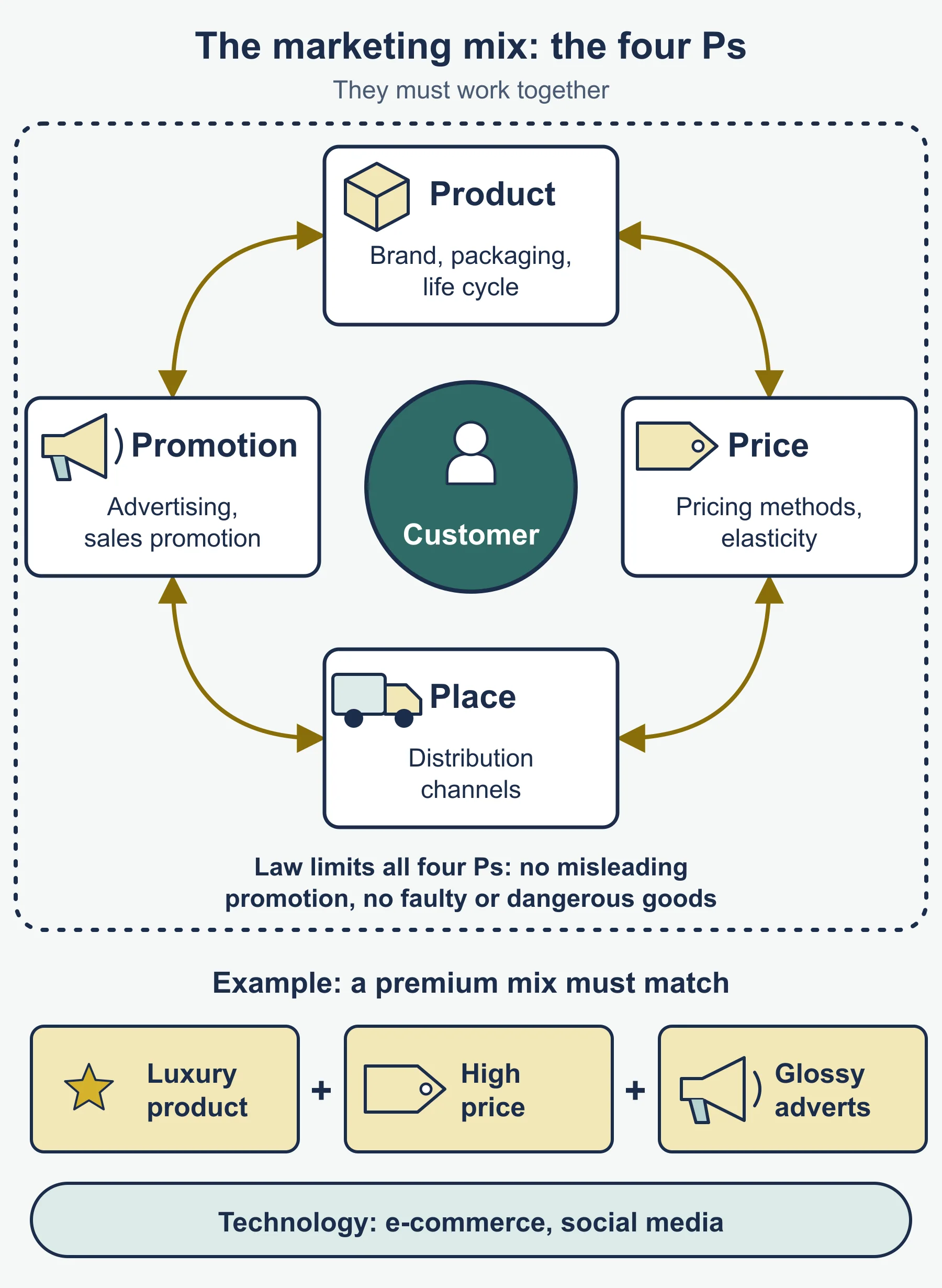
The marketing mix brings together a business’s choices on product, price, place and promotion. Those choices must be consistent with each other and suit the customers being targeted.
1. Product (4.3.1)
Goods and services
A good is a physical item you can touch, such as a pair of trainers. A service is an activity done for the customer, such as a haircut or a repair. Differences that matter for marketing: a good can be stored in stock and a service usually cannot; a good can be inspected before purchase, but a service is often judged only after it is used; the quality of a service depends heavily on the people providing it.
Developing a new product or service
Developing something new costs money and may fail, so a business tends to work in stages. A sensible sequence is: generate ideas; research the market to see whether customers want it; design and test a sample; work out the cost and price; then launch. Market research reduces the risk, because the business learns about customers before spending heavily on production.
Packaging and why it matters
Packaging does several jobs. It protects the product, keeps it fresh or safe, carries information such as ingredients and instructions, makes it easier to transport and display, and acts as promotion because a design stands out on a shelf or in a delivery box. Packaging also supports the image: a gift box suggests quality. The drawback is cost.
The product life cycle
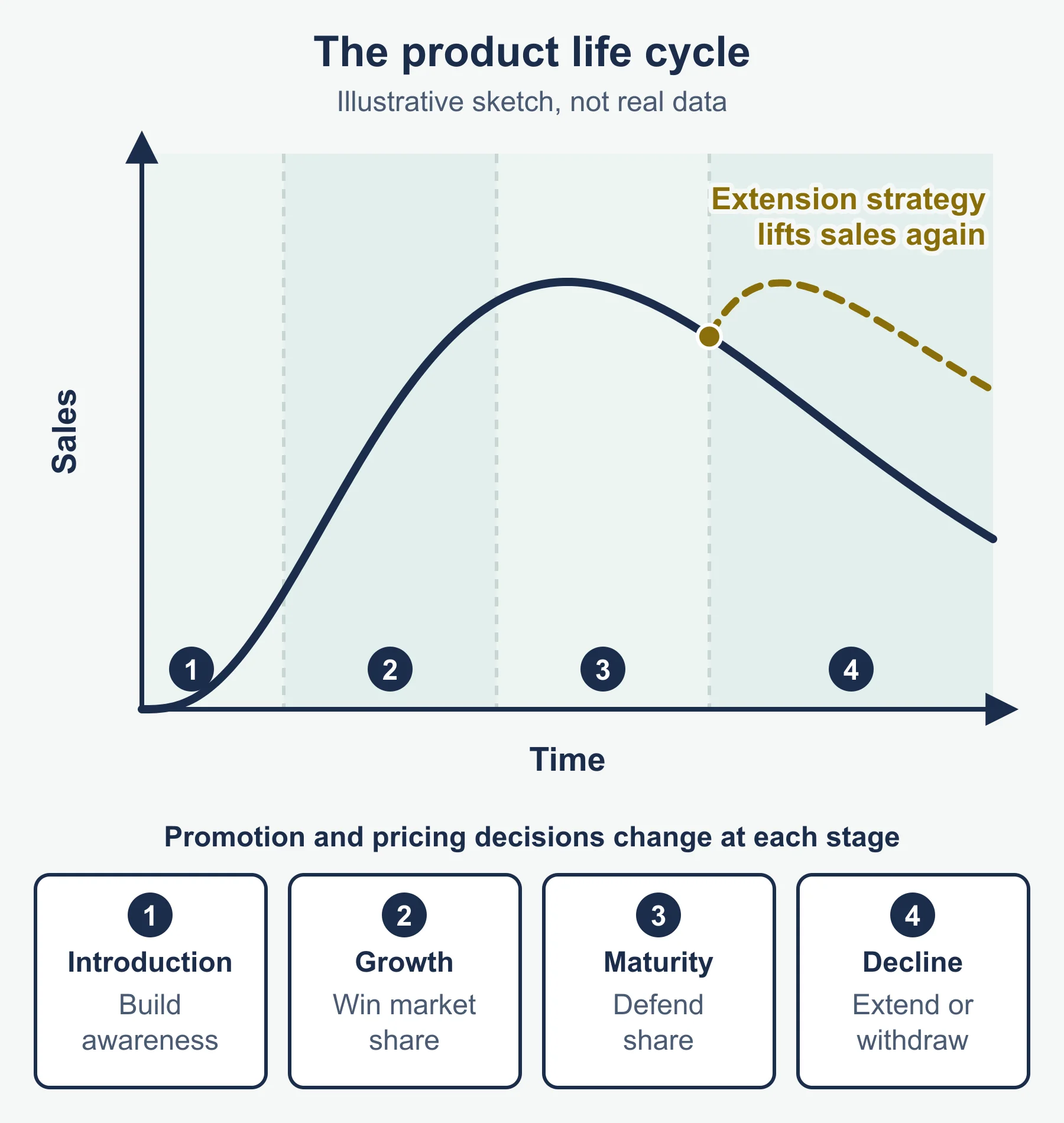
Sales of a product usually follow a pattern with main phases:
| Phase | What happens to sales | Typical business response |
|---|---|---|
| Introduction | Low; the product is new and unknown | Heavy promotion so customers learn it exists |
| Growth | Rising quickly | Build capacity, widen distribution |
| Maturity | Flattening at the top | Defend share; competition is strong |
| Decline | Falling | Cut costs, or stop selling the product |
Extension strategies try to stop or delay decline. Examples: finding a new market (selling abroad or to a different segment), changing the packaging, adding a new feature or flavour, lowering the price, or running new promotion. A strategy only helps if customers see a reason to buy again. Not every product is worth extending: some should be withdrawn.
The product portfolio and the Boston matrix
A product portfolio is everything a business has on offer at a given time. Managing it means reviewing which products to keep, develop or drop, and making sure the business is not dependent on a single product that may reach decline.
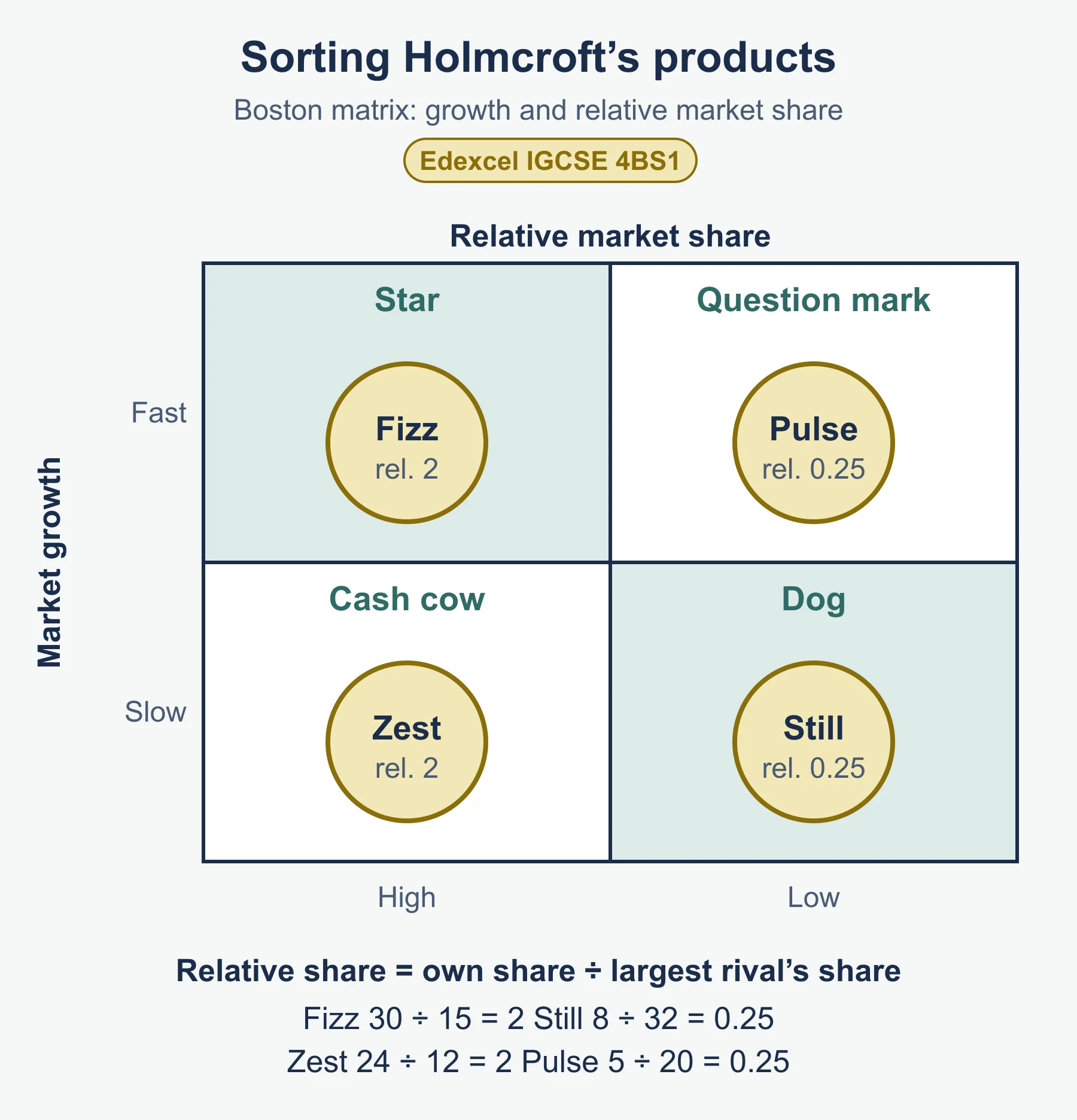
The Boston matrix places each product by market growth (fast or slow) and market share relative to rivals. The four categories below are the standard form of the model; the specification names the Boston matrix without listing the categories, so check how your teacher labels them.
| High relative market share | Low relative market share | |
|---|---|---|
| High market growth | Star | Question mark (also called problem child) |
| Low market growth | Cash cow | Dog |
Relative market share is the product’s share divided by the share of the largest rival. A figure above 1 means the product is the market leader.
Worked example. Holmcroft Drinks sells four products.
| Product | Own market share | Largest rival’s share | Market growth |
|---|---|---|---|
| Fizz | 30% | 15% | 12% |
| Still | 8% | 32% | 2% |
| Zest | 24% | 12% | 1% |
| Pulse | 5% | 20% | 15% |
Relative share: Fizz 30 ÷ 15 = 2.0; Still 8 ÷ 32 = 0.25; Zest 24 ÷ 12 = 2.0; Pulse 5 ÷ 20 = 0.25.
Classification: Fizz is a star (leader in a fast-growing market). Still is a dog (weak in a slow market). Zest is a cash cow (leader in a slow market). Pulse is a question mark (weak in a fast-growing market).
Use in decisions: use the steady income from Zest to support Fizz and perhaps Pulse; consider whether Still is worth keeping. This is the review the specification calls managing and reviewing the portfolio. The matrix uses only two factors and does not say why a product is weak.
2. Price (4.3.2)
Pricing strategies, and when each might be applied:
- Cost plus. Work out the cost of one unit and add a mark-up (the standard form of the method; the specification names it without a formula). Use when the business wants to be sure each sale makes a profit and there is no close rival to compare with.
- Penetration. Launch at a low price to gain share quickly. Suits a new product in a market with many customers who are sensitive to price, or where the business wants to win share before rivals react.
- Skimming. Launch at a high price, then lower it. Suits a new or distinctive product for which some customers will pay extra to be first, before rivals arrive.
- Competition. Set the price near rivals’ prices, or just below. Suits a market where products look much alike and customers compare prices.
- Promotional. A temporary price cut, for example to clear stock, attract new customers, or raise awareness. It is short-term, so it needs an end date.
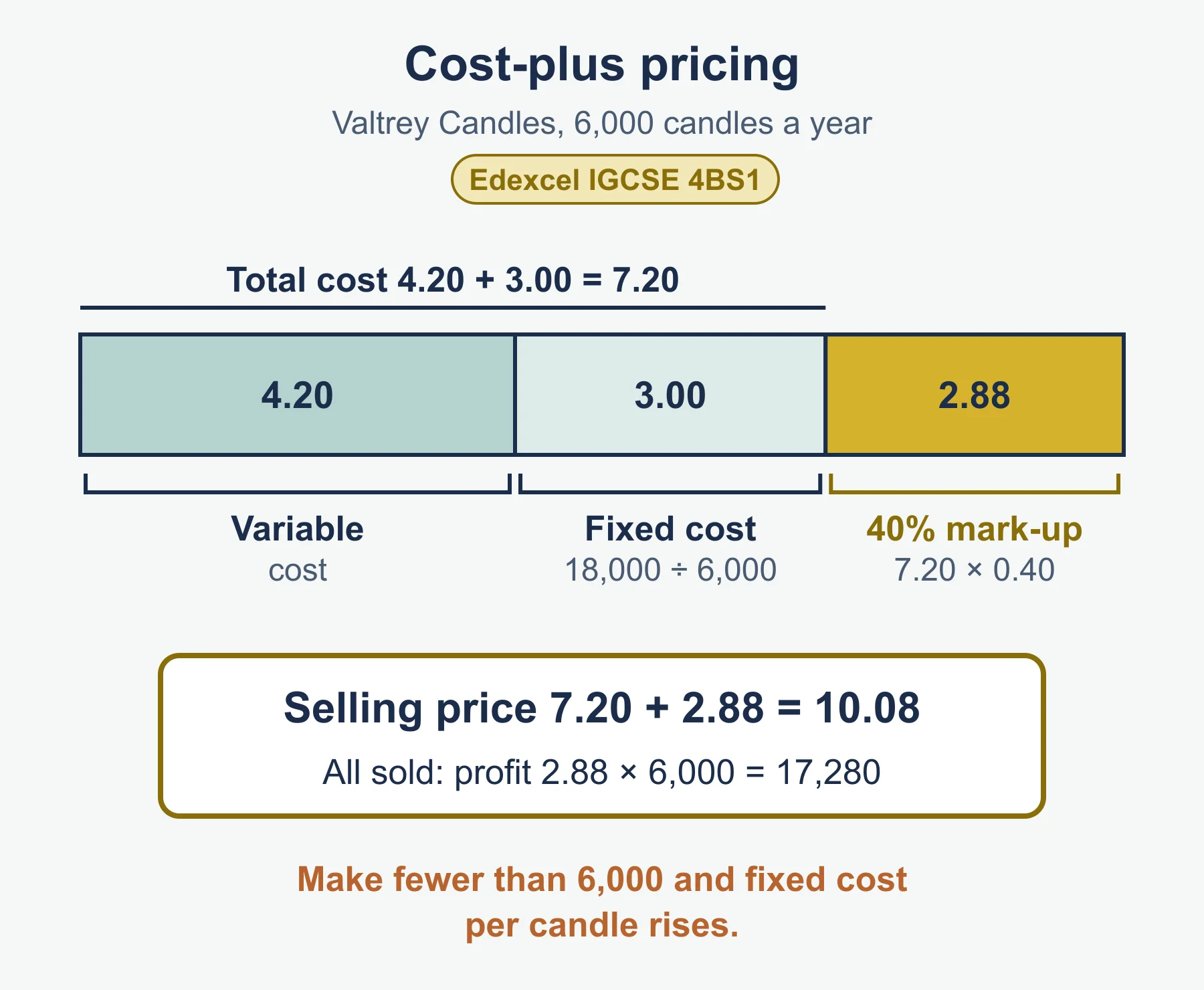
Worked example: cost plus. Valtrey Candles makes 6,000 candles a year. Variable cost per candle is 4.20 and fixed costs are 18,000.
- Fixed cost per candle = 18,000 ÷ 6,000 = 3.00.
- Total cost per candle = 4.20 + 3.00 = 7.20.
- A 40% mark-up adds 7.20 × 0.40 = 2.88.
- Selling price = 7.20 + 2.88 = 10.08.
- If all 6,000 are sold, profit = 2.88 × 6,000 = 17,280.
The unit cost is only right if output is really 6,000. If fewer are made, the fixed cost per candle rises. Cost plus also ignores what rivals charge.
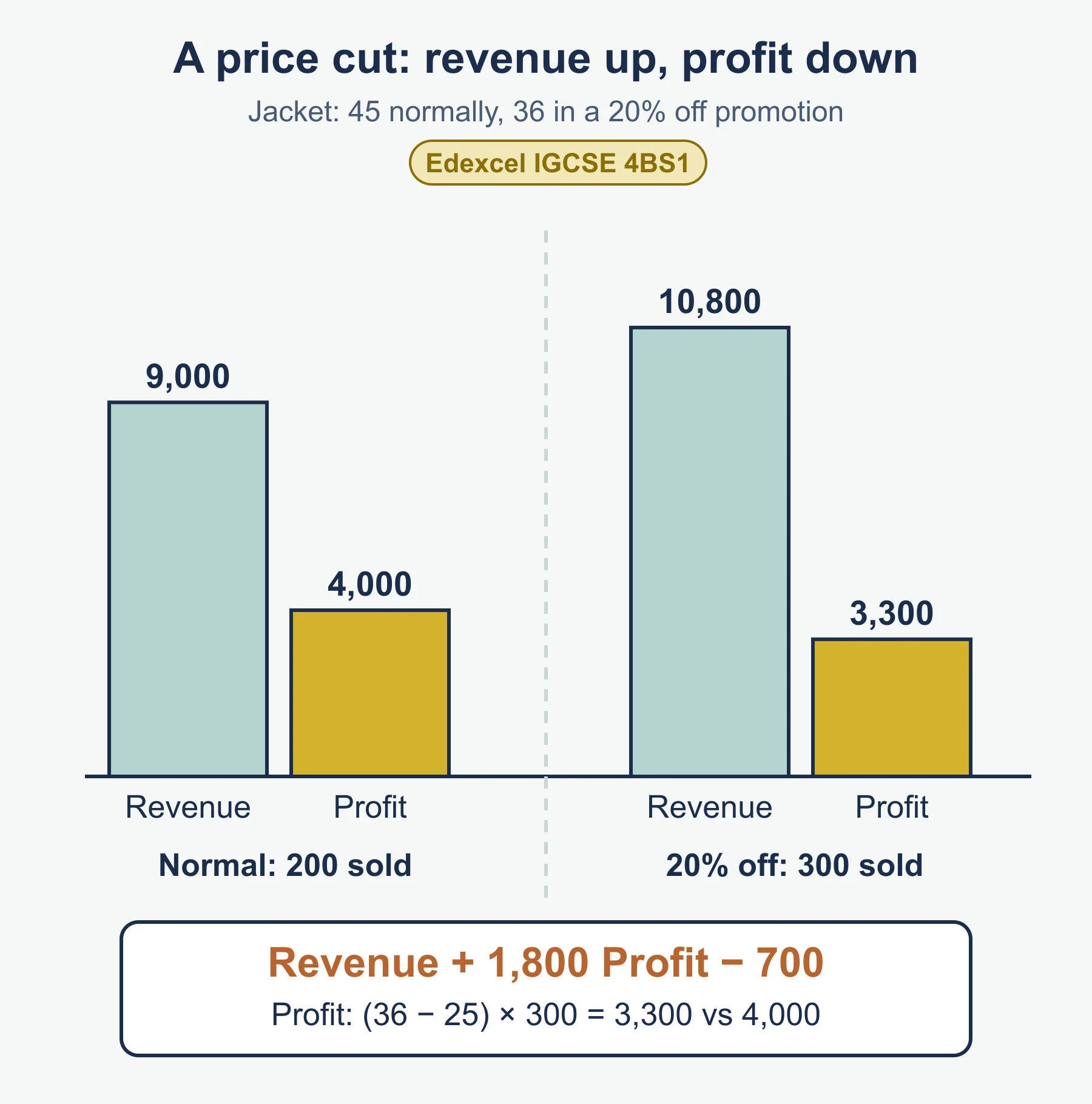
Worked example: promotional pricing. A shop usually sells a jacket at 45 and sells 200 a month at a unit cost of 25. Revenue is 45 × 200 = 9,000 and profit is (45 − 25) × 200 = 4,000. In a promotion at 20% off, the price is 45 × 0.80 = 36 and sales rise to 300. Revenue is 36 × 300 = 10,800 but profit is (36 − 25) × 300 = 3,300. Revenue rose by 1,800 while profit fell by 700. The promotion could still be sensible if the aim is to clear old stock or attract new customers, but it did not raise profit in that month.
3. Place: distribution channels (4.3.3)
Place is about how the product gets to the customer. The specification names two methods.
- Retailers. Shops that buy from the producer (or a wholesaler) and sell to the public. The retailer takes a share of the selling price. The customer can see and try the product, and the retailer carries the cost of the shop. The producer gives up some control over how the product is displayed and priced.
- E-tailers (e-commerce). Businesses that sell over the internet, either their own website or a large online marketplace. Costs of premises are low and the market is wide, even international. Customers cannot touch the product, delivery and returns cost money, and the business needs a reliable website and payment system.
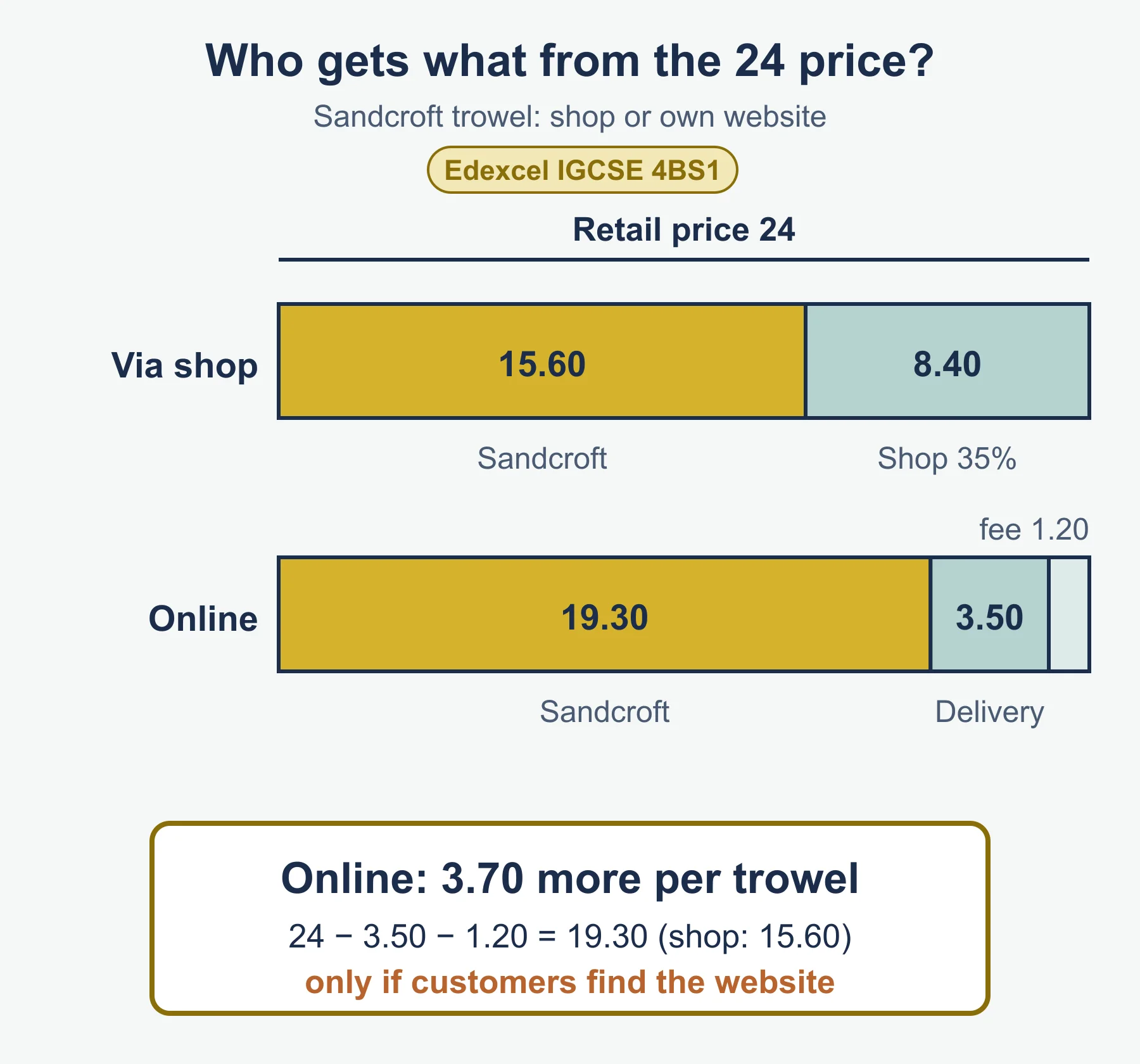
Worked example. Sandcroft Garden Tools sells a trowel at a retail price of 24. A shop keeps 35% of the retail price: 24 × 0.35 = 8.40, so Sandcroft receives 15.60. Selling through its own website, Sandcroft pays 3.50 for delivery and a payment fee of 5% of 24, which is 1.20. It receives 24 − 3.50 − 1.20 = 19.30. That is 3.70 more per trowel online, but only if enough customers find the website.
4. Promotion (4.3.4)
Promotion aims to inform, persuade and remind. The business should match the method to the market segment (section 4.2.3: location, demographics, lifestyle, income, age).
Promotion strategies
- Advertising. Paid messages in media: TV, radio, newspapers, posters, online. Wide reach but can be costly.
- Sponsorship. Paying to be linked with a team, event or person, so the brand name is seen by their audience. The benefit depends on the audience matching the target market, and it can suffer if the sponsored party behaves badly.
- Product trials. Letting customers try before they buy, such as free samples or a test drive. Useful for a new product because it reduces the customer’s risk.
- Special offers. Short-term deals such as buy one get one free or discount vouchers. They can raise sales quickly but cut profit per sale and may teach customers to wait for deals.
- Branding. A name, logo and image that make the product recognisable (see below).
Matching methods to segments. A student with a low income may respond to a discount code shared online; a high-income customer buying a premium watch is more likely to be influenced by sponsorship and quality of packaging; an older age group may still read local newspapers; people in one town may be reached with local posters or local radio.
Above the line and below the line
In the standard definitions, above the line promotion is paid advertising in media aimed at a wide audience, such as TV, radio, press and cinema. Below the line promotion uses other methods, often more direct and aimed at a particular group, such as special offers, product trials, discount vouchers and direct mail. Judge the choice by cost, reach and how well it fits the target segment.
Public relations
Public relations (PR) is managing how the public sees the business, for example by sending news stories to the media, supporting a local charity or answering complaints well. Its aim is to improve the company image and brand. PR is not paid advertising, and a good image can be damaged quickly by one bad story.
Technology in promotion
- Targeted advertising online. Adverts are shown to particular groups based on things like age, location or interests, so less money is wasted on people unlikely to buy.
- Viral advertising via social media. Content that people choose to share, so it spreads between users at low cost. It is hard to control, and the message may be changed or criticised.
- E-newsletters. Emails sent to people who have signed up, telling them about offers and news. Cheap and direct, but they only reach existing contacts.
The importance of a brand
A brand is the identity customers associate with a product or business. A strong brand can make customers loyal, support a higher price, make new products easier to launch, and make the business stand out from rivals.
Common errors
- Describing a pricing strategy without saying when it suits the business.
- Mixing up relative market share with market share.
- Saying a promotion is good because revenue rose, without checking profit.
- Listing marketing mix methods without linking them to the target segment in the question.
Frequently asked questions
What are the four categories of the Boston matrix? A star has high relative market share in a fast-growing market, a cash cow has high share in a slow market, a question mark has low share in a fast-growing market, and a dog has low share in a slow market.
What is the difference between a retailer and an e-tailer? A retailer is a shop that buys from a producer or wholesaler and sells to the public, letting customers see the product. An e-tailer sells over the internet, with low premises costs and a wide market.
What jobs does packaging do? Packaging protects the product, keeps it fresh or safe, carries information such as ingredients and instructions, makes it easier to transport and display, and helps attract customers.
Why is a brand important? A strong brand can make customers loyal, support a higher price and make new products easier to launch.
Official syllabus
Pearson Edexcel International GCSE in Business (4BS1), Specification, Issue 2, February 2026, published by Pearson Education Limited. Topic 4: Marketing, section 4.3 “The marketing mix”, points 4.3.1 to 4.3.4.
Get free revision emails (optional)
Occasional emails with practice questions, worked explanations and links to free resources for the qualification and subjects you choose. No spam, and you can unsubscribe from any email. The free tools on this site never need an email.
Related resources
-
Practice questions
Edexcel IGCSE Business: The marketing mix (4BS1) – Practice Questions
Original practice questions with worked answers on product, price, place and promotion for Edexcel IGCSE Business (4BS1), Topic 4 section 4.3.
Business · Pearson Edexcel · IGCSE
Try questions -
Revision notes
Edexcel IGCSE Business: The marketing mix (4BS1) – Revision Notes
Condensed revision notes on product, price, place and promotion for Edexcel IGCSE Business (4BS1) section 4.3, with tables and a quick self-test.
Business · Pearson Edexcel · IGCSE
Revise topic -
Study guides
Edexcel IGCSE Business: Market research and the market (4BS1)
Study guide to market research methods, data and the market for Edexcel International GCSE Business, with worked examples and common errors.
Business · Pearson Edexcel · IGCSE
Read guide
Related articles
-
teaching
A Level tuition in Dubai: Cambridge or Pearson Edexcel International A Level?
Schools in Dubai and Abu Dhabi teach either Cambridge International AS & A Level or Pearson Edexcel International A Level. How the two are structured, why it matters for tuition, and how online classes from Lahore work.
9 October 2026
-
curriculum guides
Choosing subjects at IGCSE and A Level
How subject choices at 14 and 16 affect university options later, and how to keep pathways open without overloading a timetable.
28 July 2026
Studying this with a teacher
Working through Business IGCSE?
This page is free and stays free. If you would rather be taught it, Marlbridge runs Business classes one-to-one and in small groups of up to 15, online in your own time zone. The first trial class is free. WhatsApp replies within an hour (8am–11pm Pakistan time, every day); email the same day.
Pearson Edexcel Business teachers at Marlbridge

