
Revision Notes
Edexcel IGCSE Business: Sources of business finance and cash flow forecasting (4BS1) – Revision Notes
Condensed revision notes on sources of finance, cash versus profit and cash-flow forecasts for Edexcel IGCSE Business, with a quick self-test.
- Subject
- Business
- Level
- IGCSE
- Topic
- Business finance
- Author
- Marlbridge Academic Team
- Updated
- Reviewed by
- Asif Iqbal (what this means)
Aligned to Pearson Edexcel IGCSE Business (4BS1), Issue 2, February 2026. Official specification .
Syllabus page (what it covers and how it is assessed): Pearson Edexcel IGCSE Business.
Syllabus points this page covers
4BS1
- 3 Business finance (whole topic)
- 3.1 Business finance - sources
- 3.2 Cash flow forecasting
Found an error? Report a correction.
Want a teacher for this? Marlbridge teaches Business online. Request a free trial class.
Quick recall for the Pearson Edexcel International GCSE in Business (4BS1) specification, Issue 2, February 2026, Topic 3, sections 3.1 and 3.2. Full explanations and worked examples are in the study guide. Then try the practice questions. Course links: the 4BS1 Business hub, the printable checklist and the free diagnostics. The specification says both papers draw on the whole of the subject content.
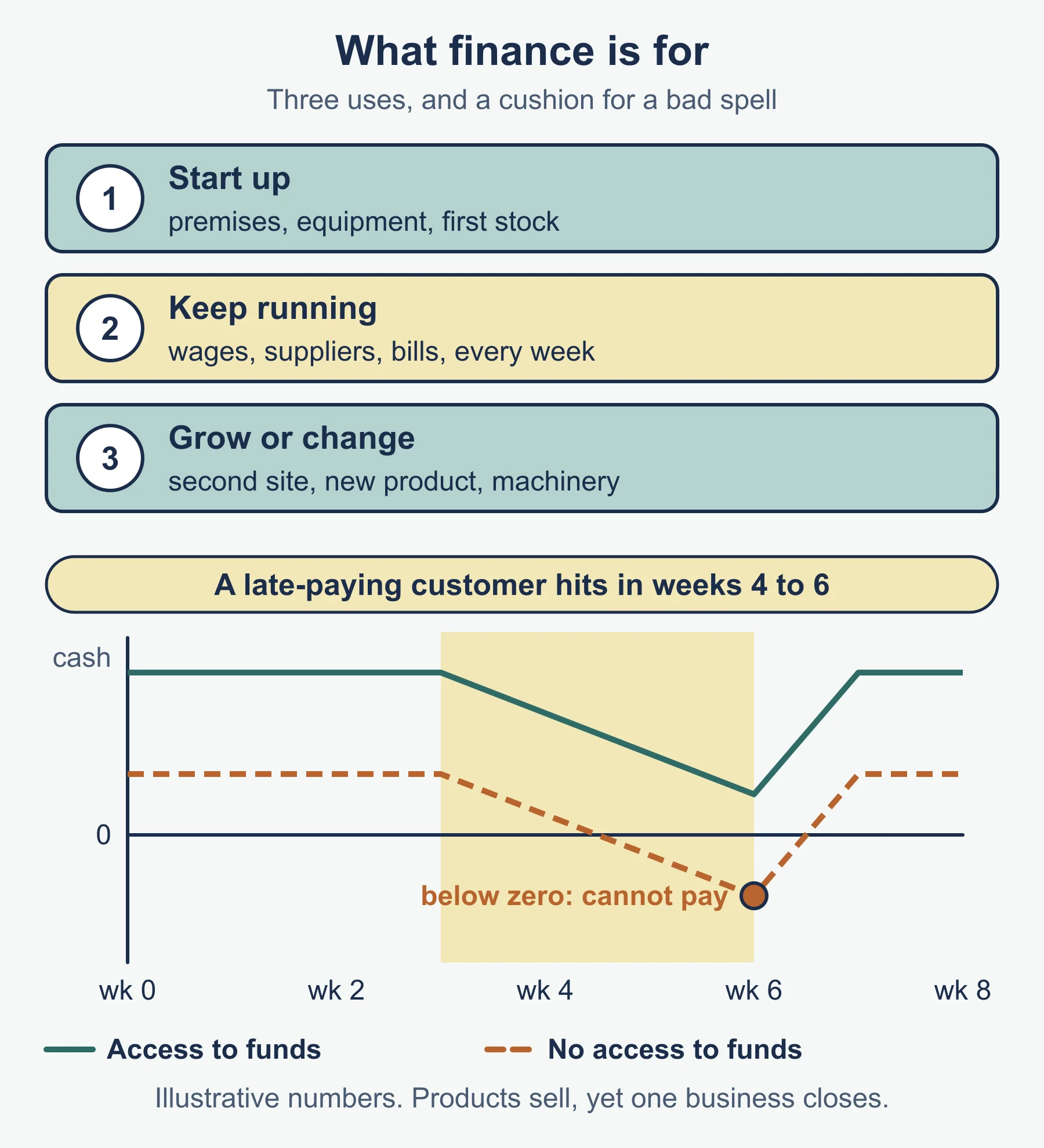
3.1.1 The need for finance
| Need | Meaning | Example |
|---|---|---|
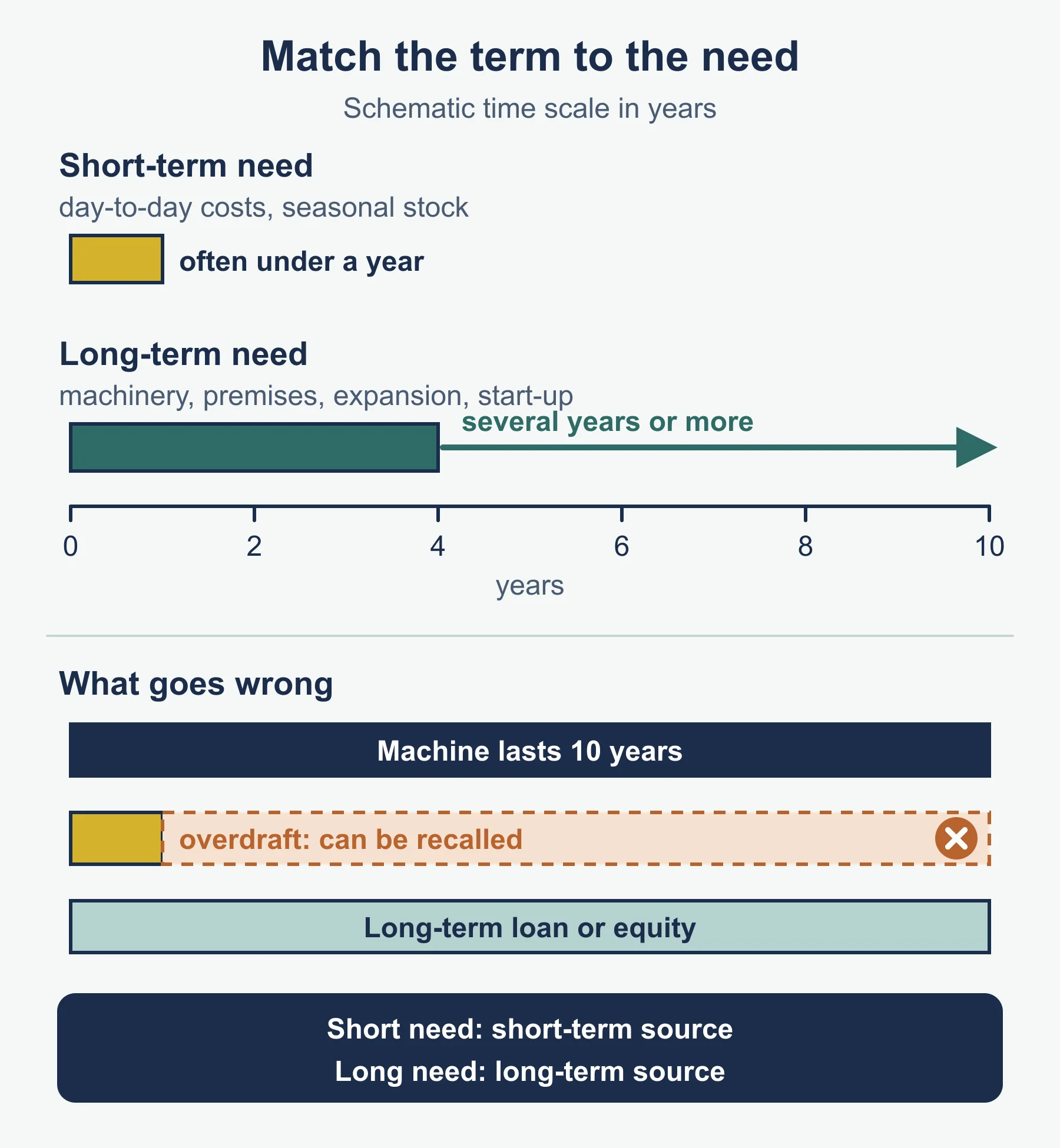
| Short-term | Covers day-to-day costs, repaid or recovered quickly | Buying inventory, paying wages before customers pay |
| Long-term | Spending on assets that last years | A new factory, vehicles |
| To start up | Costs before first sales | Premises, equipment, first inventory |
| To expand | Growth of an existing business | A second shop, a new product line |
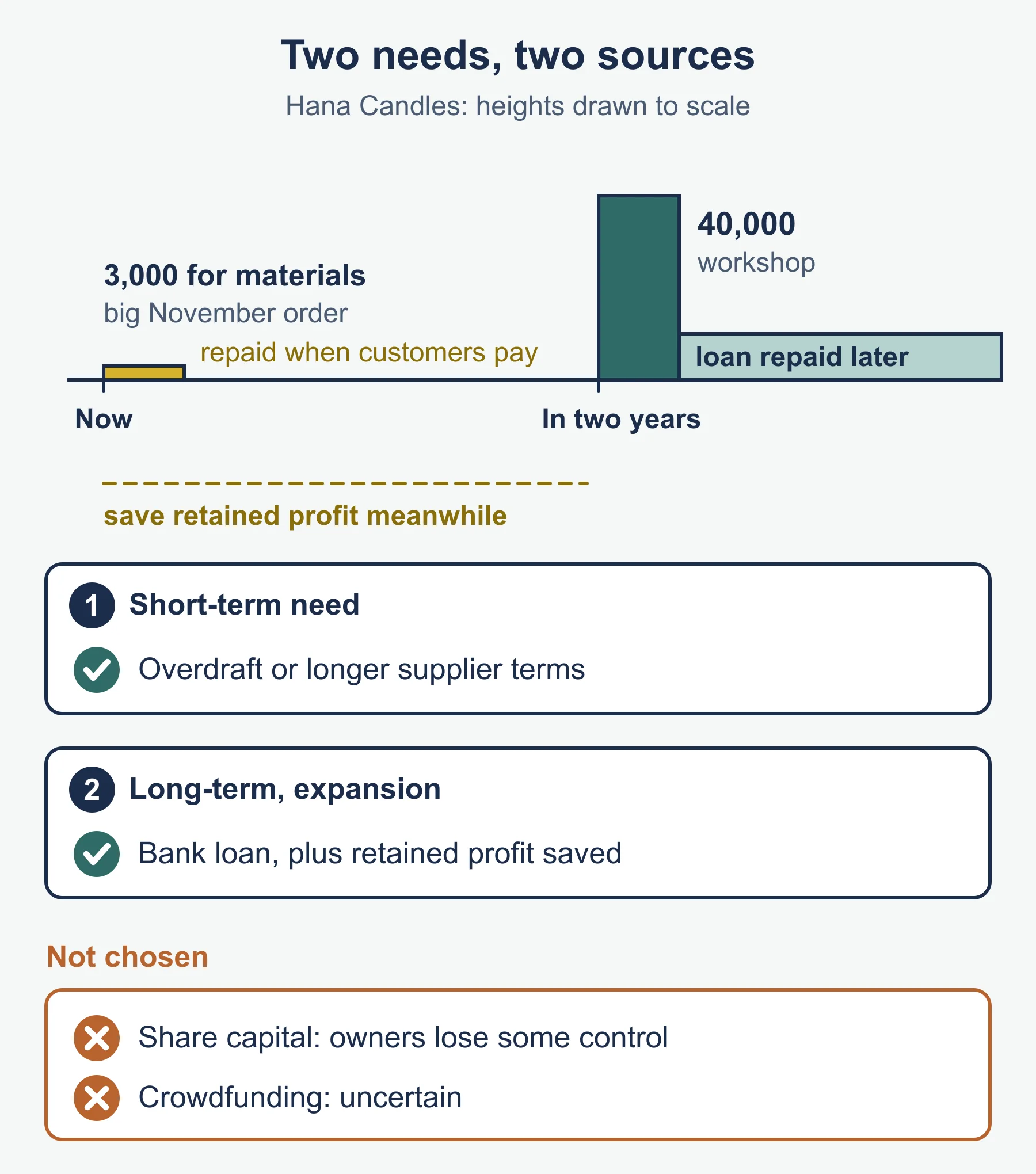
Pick finance that lasts as long as the need.
3.1.2 Internal sources
| Source | Plus | Minus |
|---|---|---|
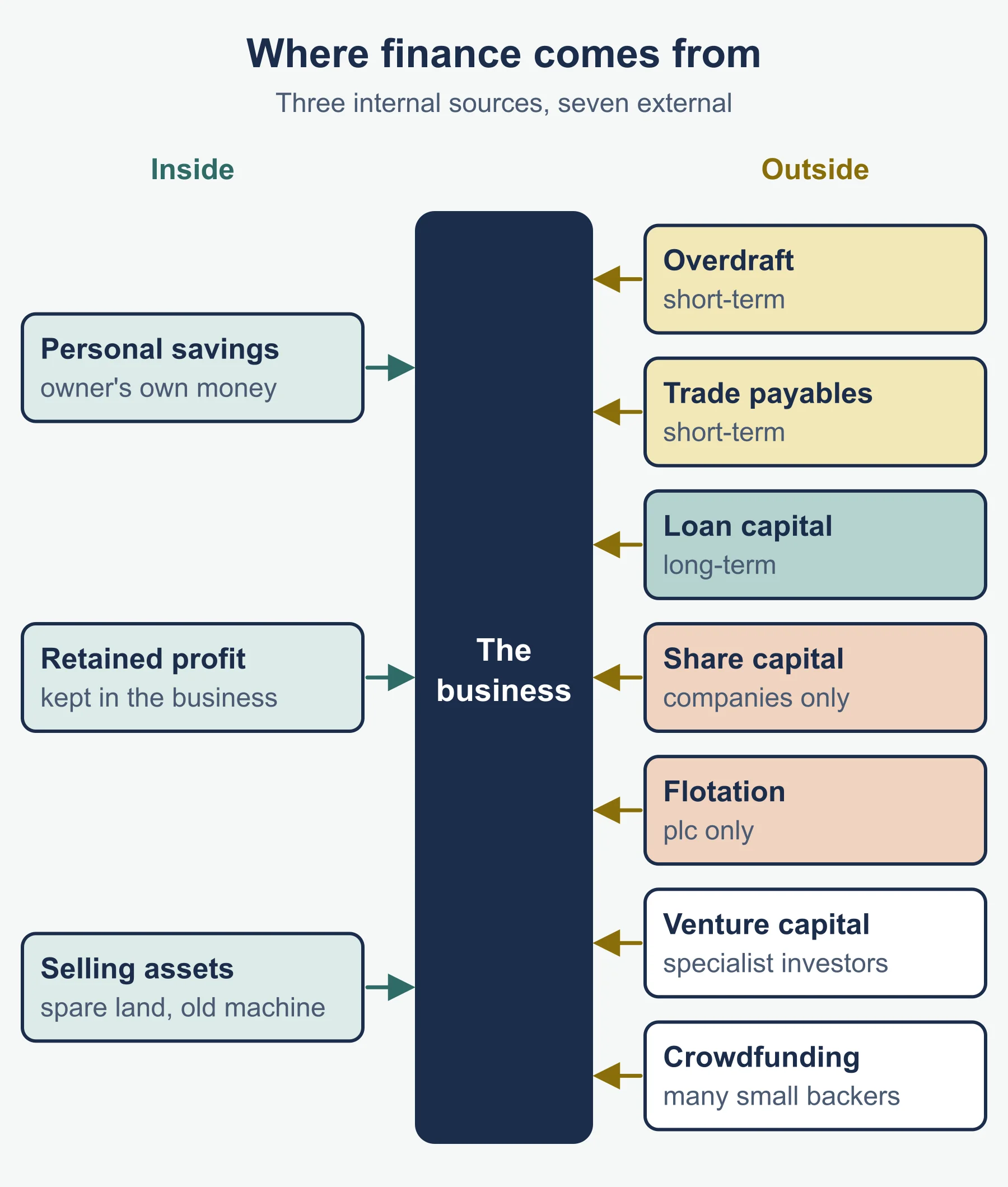
| Personal savings | No interest, no outsider control | Limited amount, owner’s own money at risk |
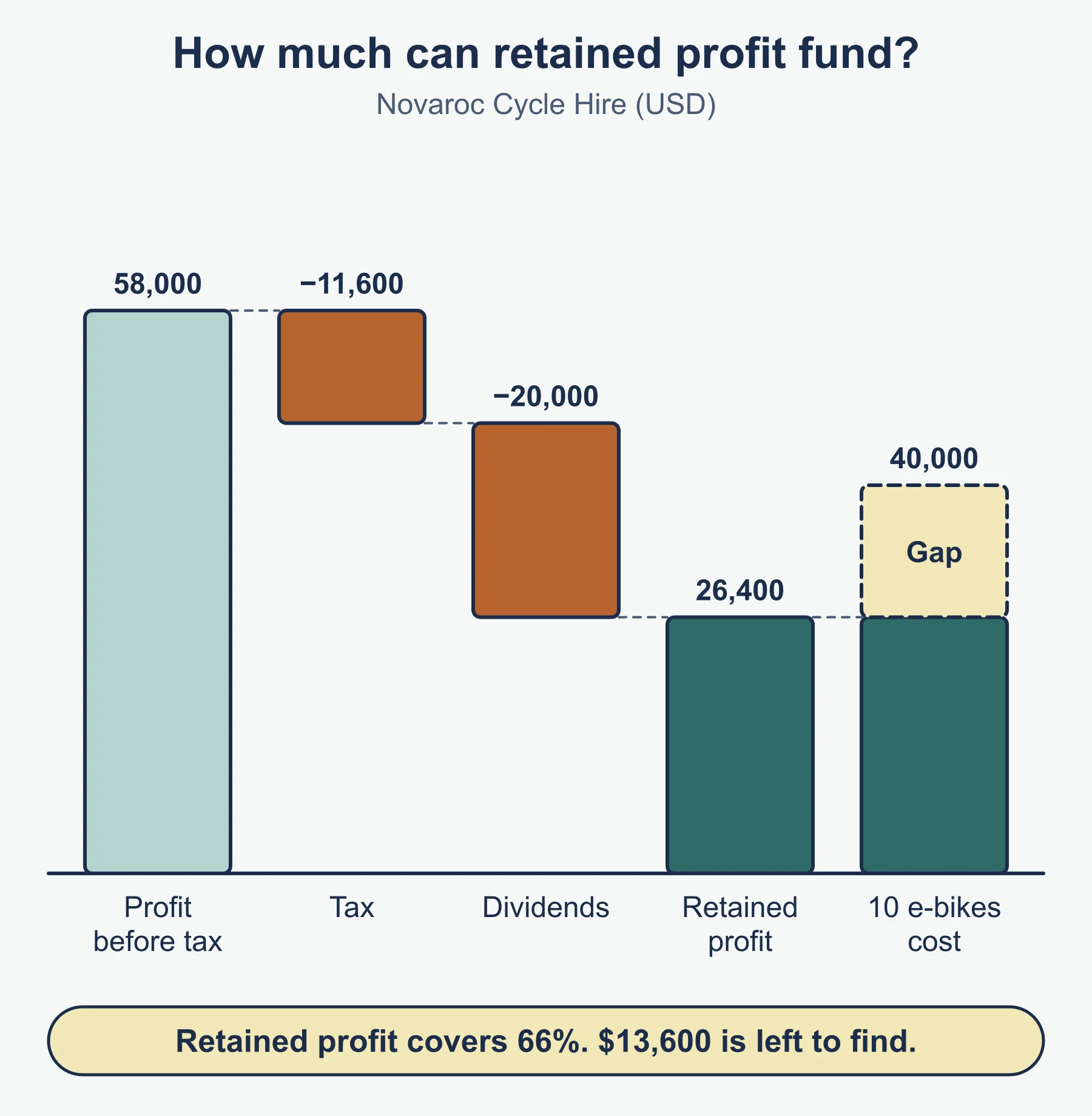
| Retained profit | No interest, no repayment | Needs past profit; less paid out to owners |
| Selling assets | Quick cash, no interest | Lose the asset; price may be low |
3.1.3 External sources
The specification names these sources only. The descriptions, pluses and minuses are standard business knowledge, not specification text.
| Source | Short or long term | Plus | Minus |
|---|---|---|---|
| Overdraft | Short | Flexible, interest only on amount used | High interest, can be recalled by the bank |
| Trade payables | Short | Free credit from suppliers | May lose discount or future credit |
| Loan capital | Long | No loss of ownership | Repayments and interest must be paid; security may be asked for |
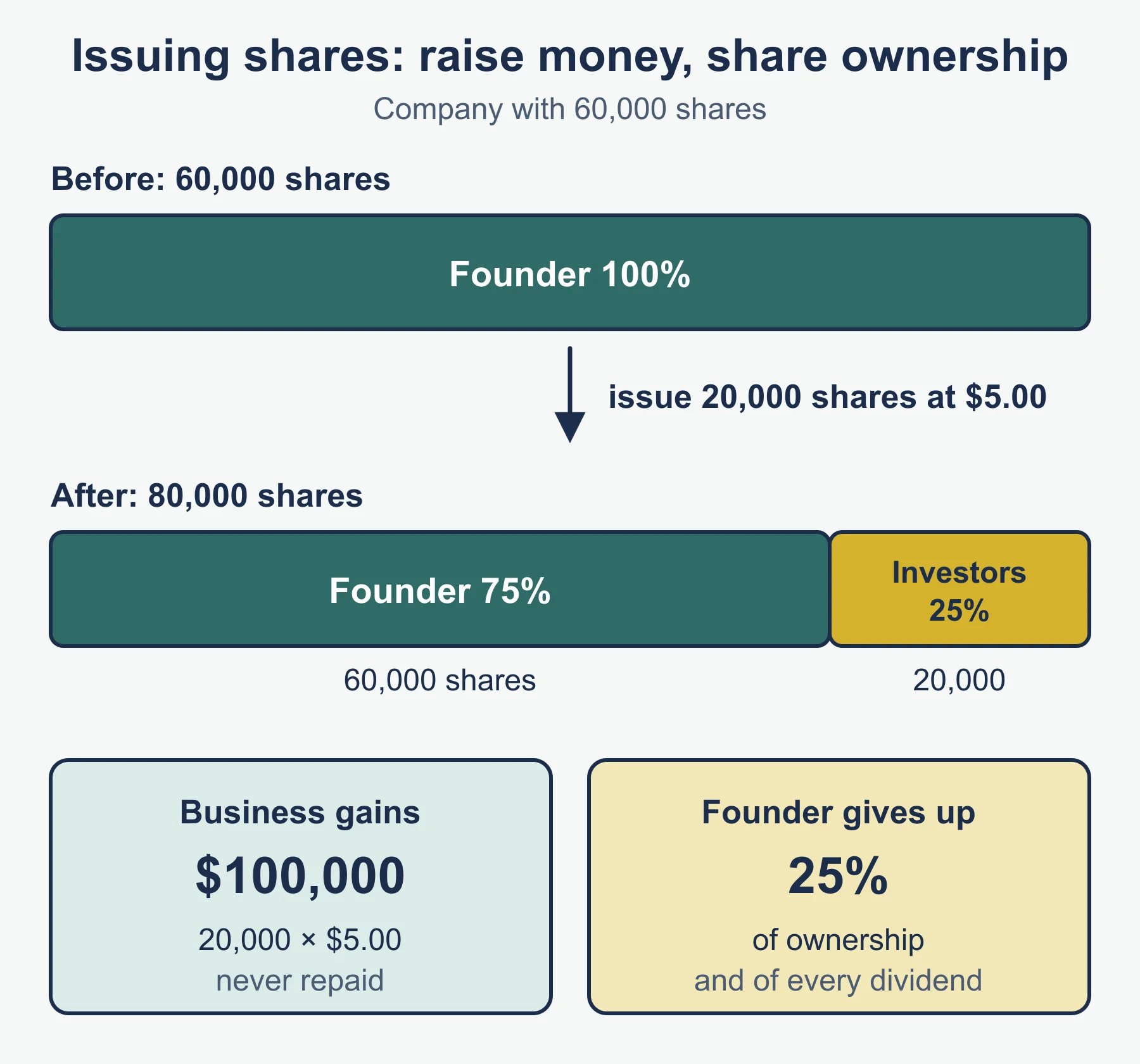
| Share capital | Long | No repayment or interest | Ownership and control shared; dividends paid |
| Stock market flotation (plc) | Long | Can raise very large sums | Costly, more reporting, takeover possible |
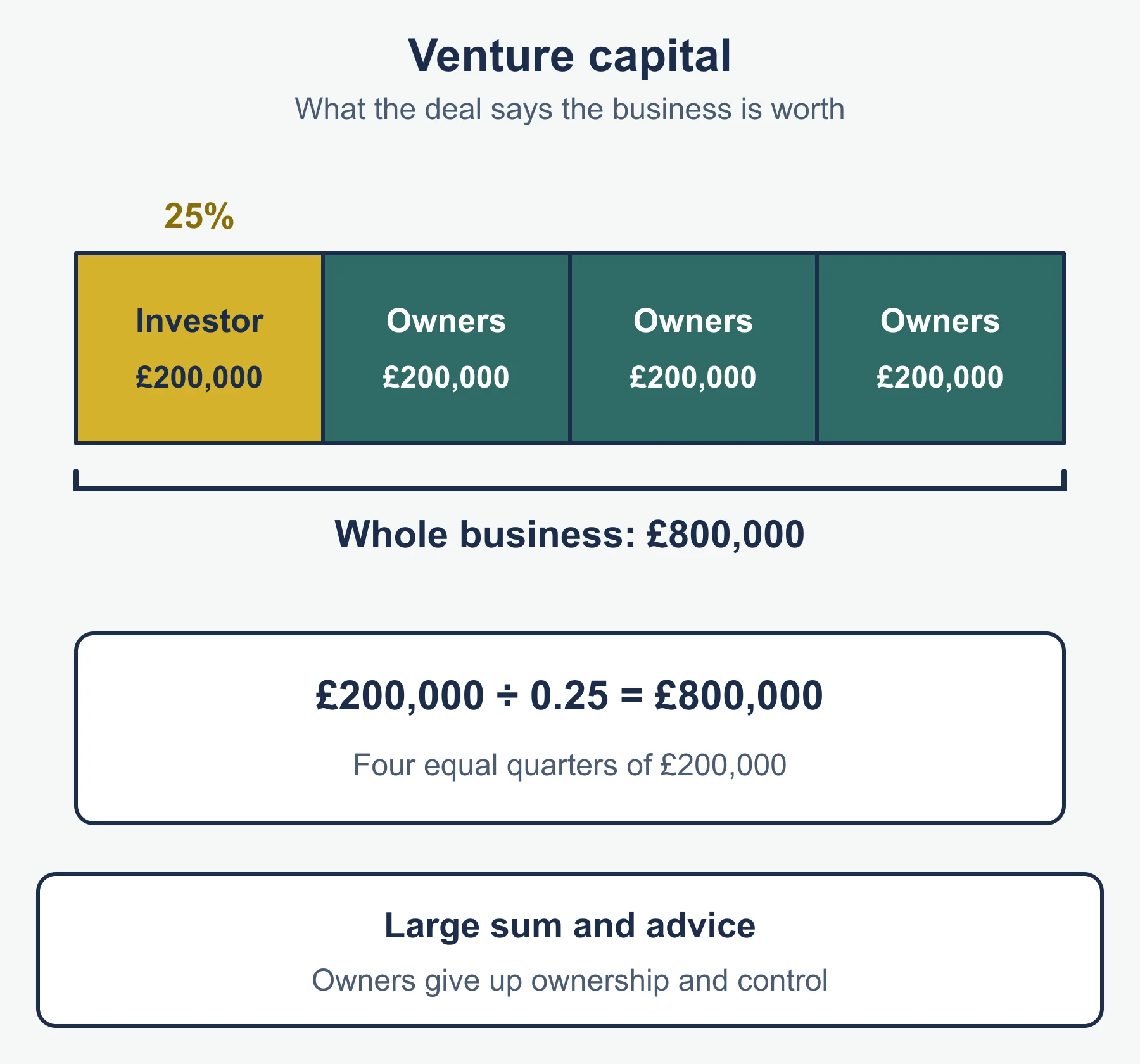
| Venture capital | Long | Funds risky ventures, advice from investors | Give up part of ownership and control |
| Crowdfunding | Either | Tests demand, no bank needed | Target may be missed, effort to run |
Method: recommend a source
- Identify the need: short-term or long-term; start-up or expansion.
- Check the business type: only companies issue shares, and only a plc can float on the stock market.
- Match the length of the finance to the need.
- Name one benefit and one drawback of your choice.
- Say why one rejected source is weaker, then give a judgement.
3.2.1 Why cash matters
- Cash pays suppliers, overheads (rent, electricity, insurance) and employees.
- A business unable to pay its debts on time is insolvent. Running out of cash can force failure even when sales are good.
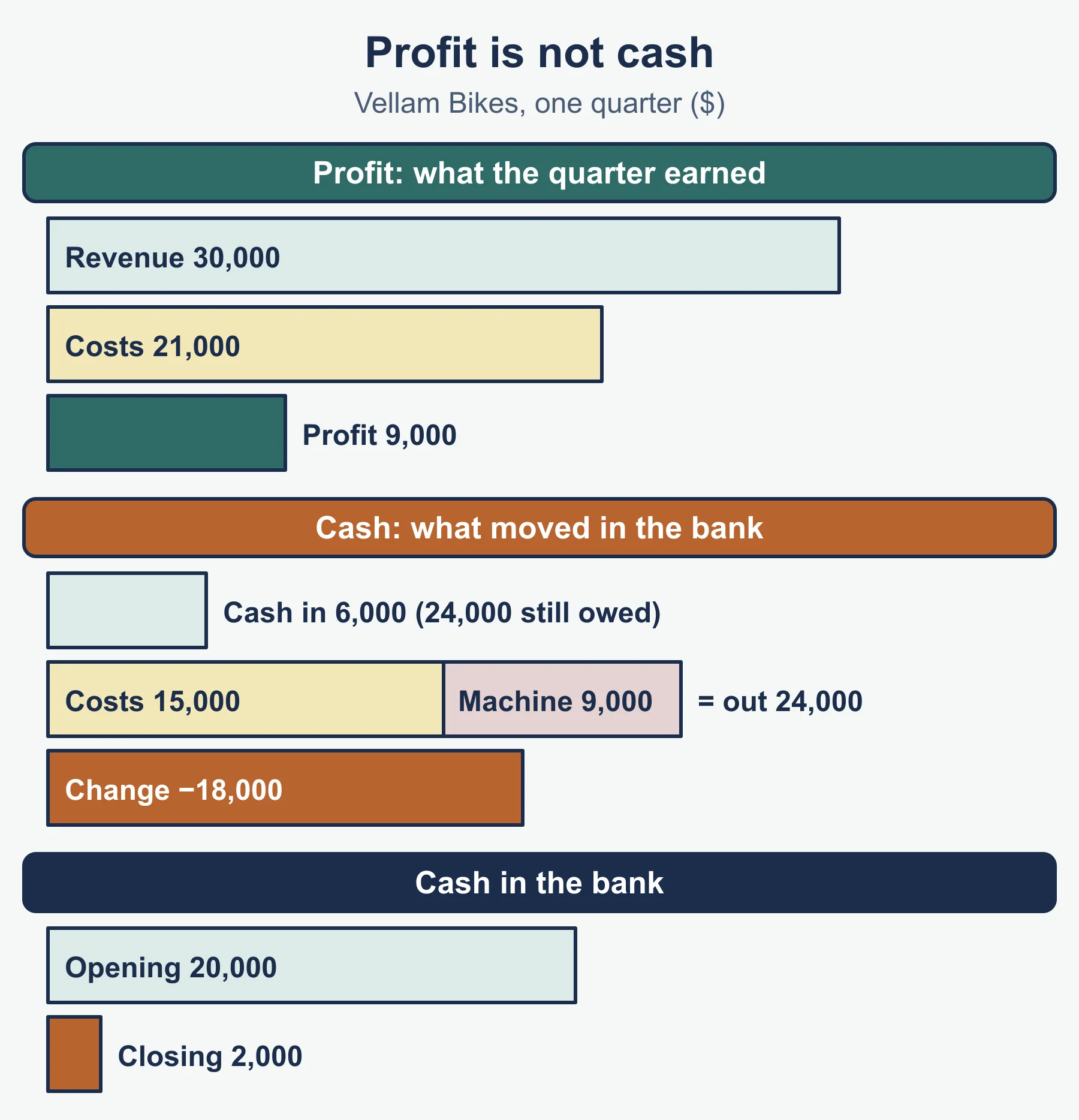
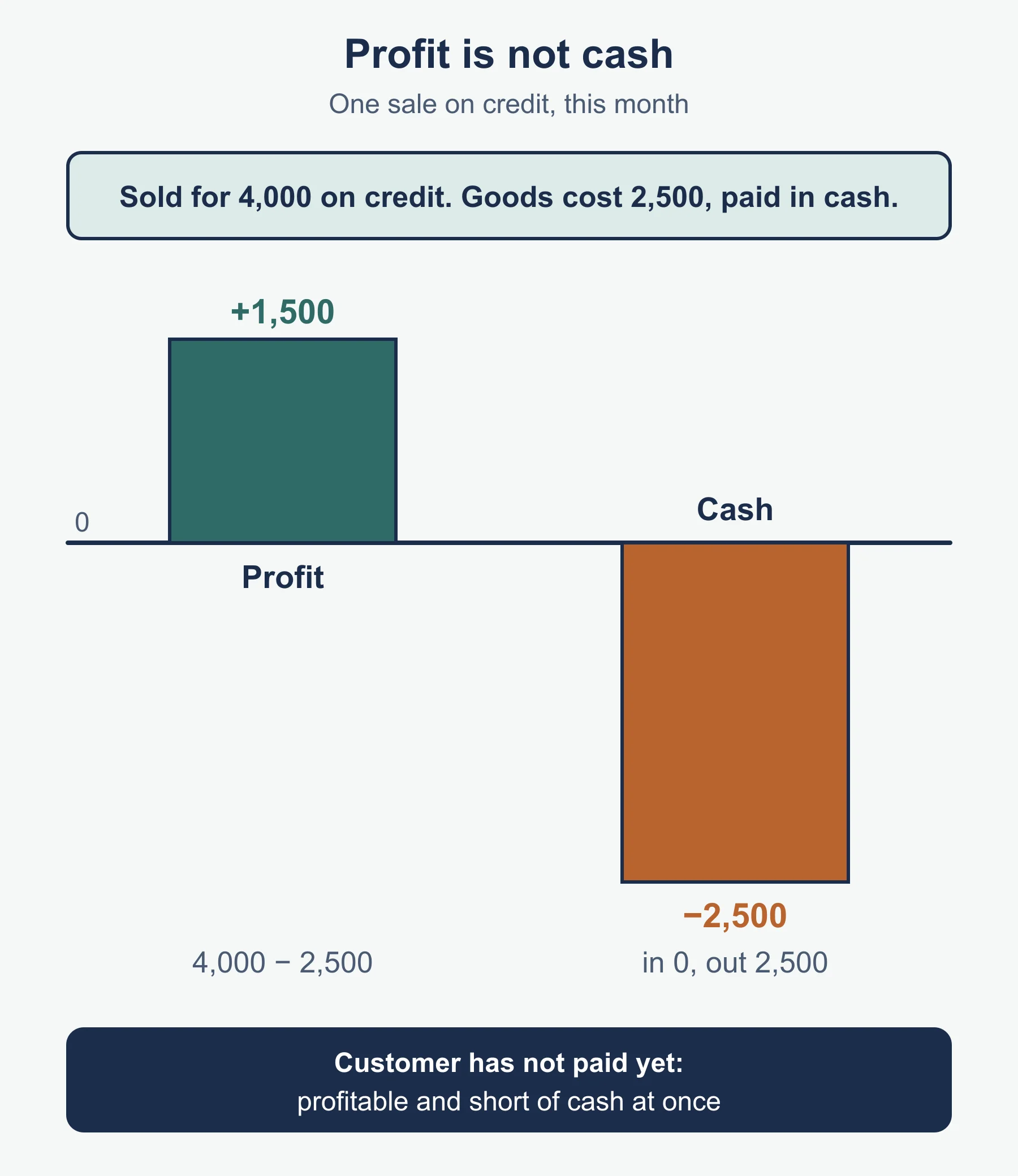
- Profit = revenue minus costs over a period. Cash = money actually received and paid. Timing makes them differ.
| Event | Effect on profit | Effect on cash |
|---|---|---|
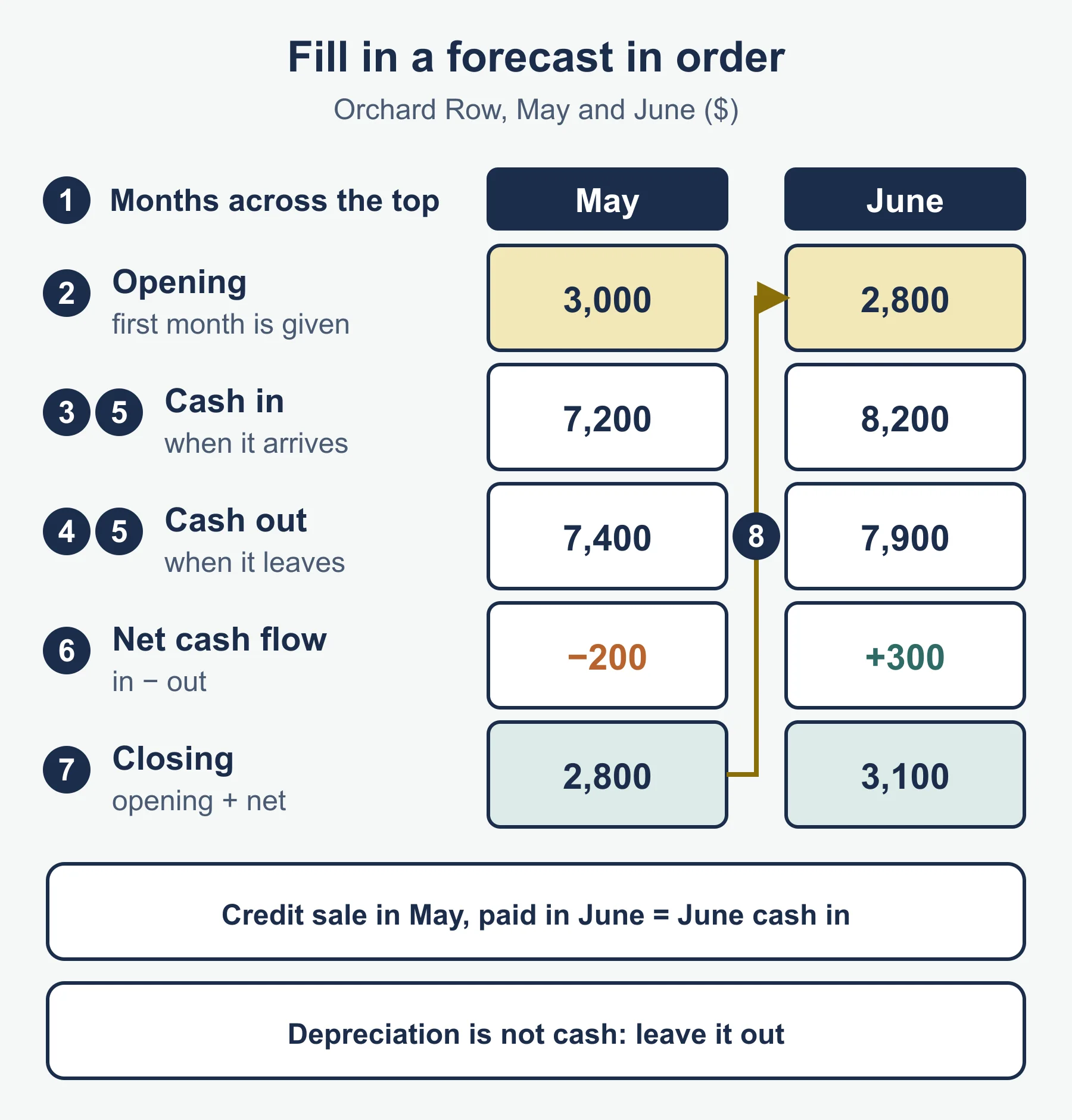
| Sale made on credit | Rises when the sale is made | No change until the customer pays |
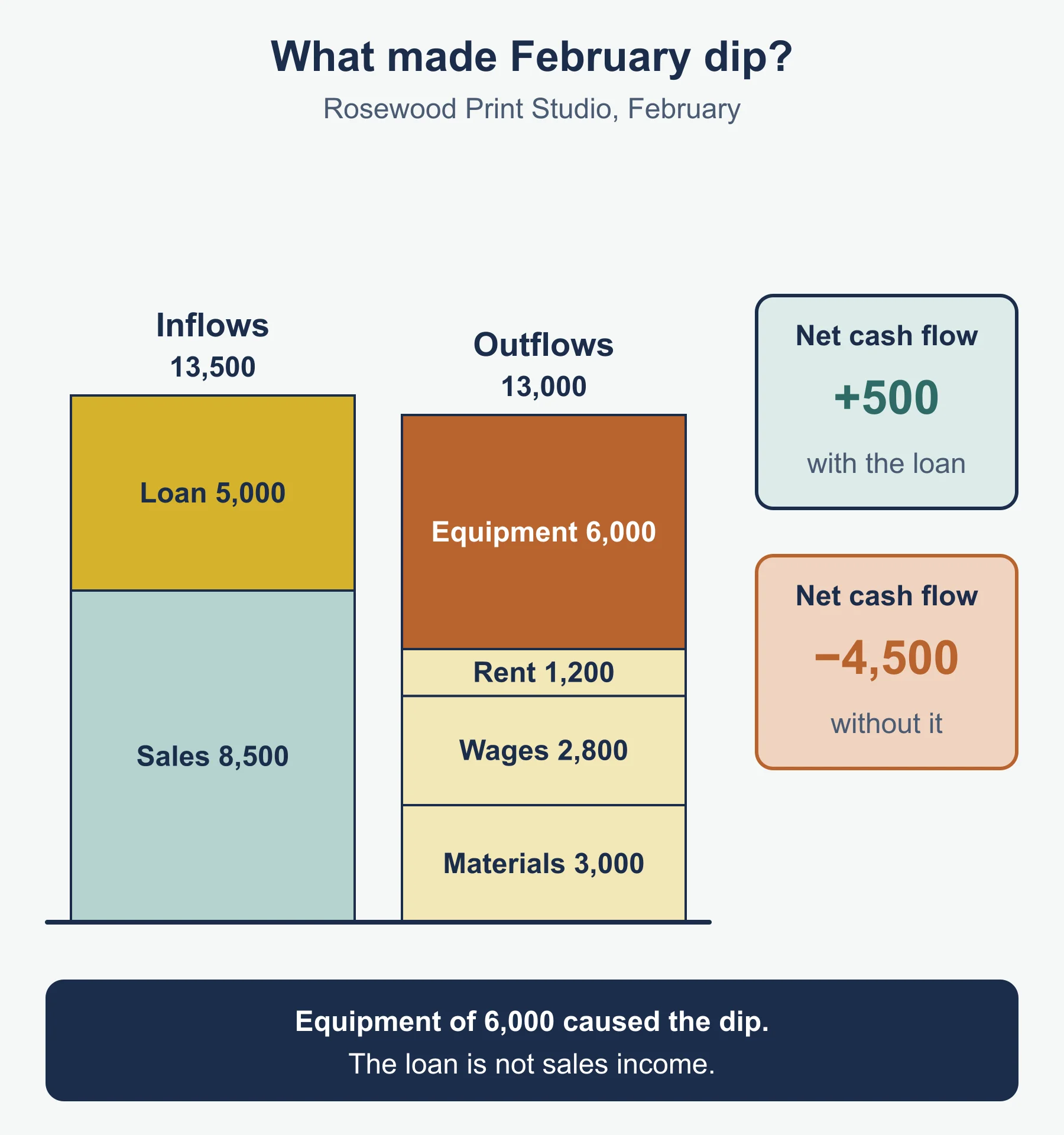
| Machine bought for cash | Cost spread over its life | Falls by the full price at once |
| Loan received | None | Rises |
| Bulk inventory bought, unsold | None yet | Falls |
3.2.2 Cash-flow forecasts
| Term | Definition |
|---|---|
| Cash inflows | Money received in the month |
| Cash outflows | Money paid out in the month |
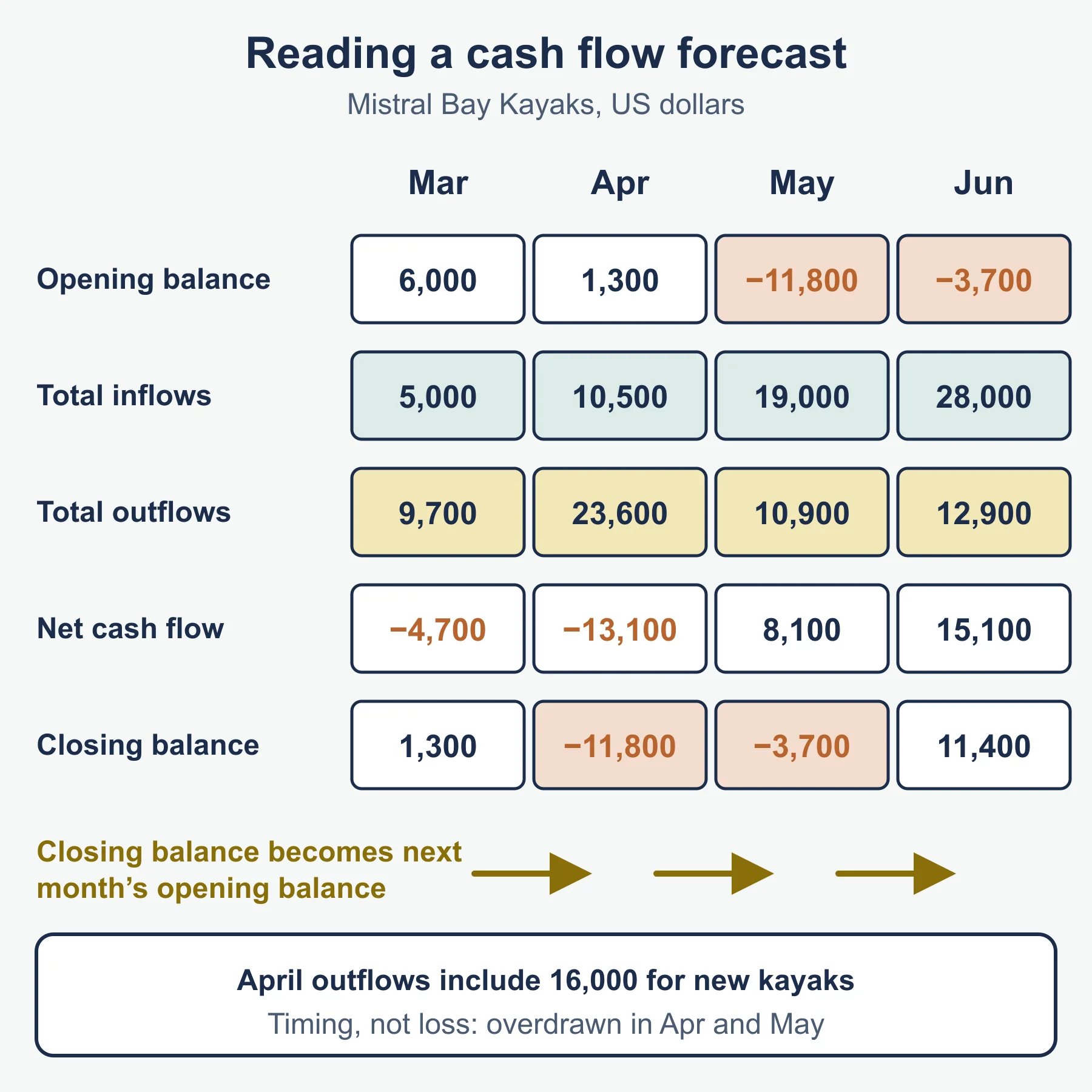
| Net cash flow | Total inflows - total outflows |
| Opening balance | Previous month’s closing balance |
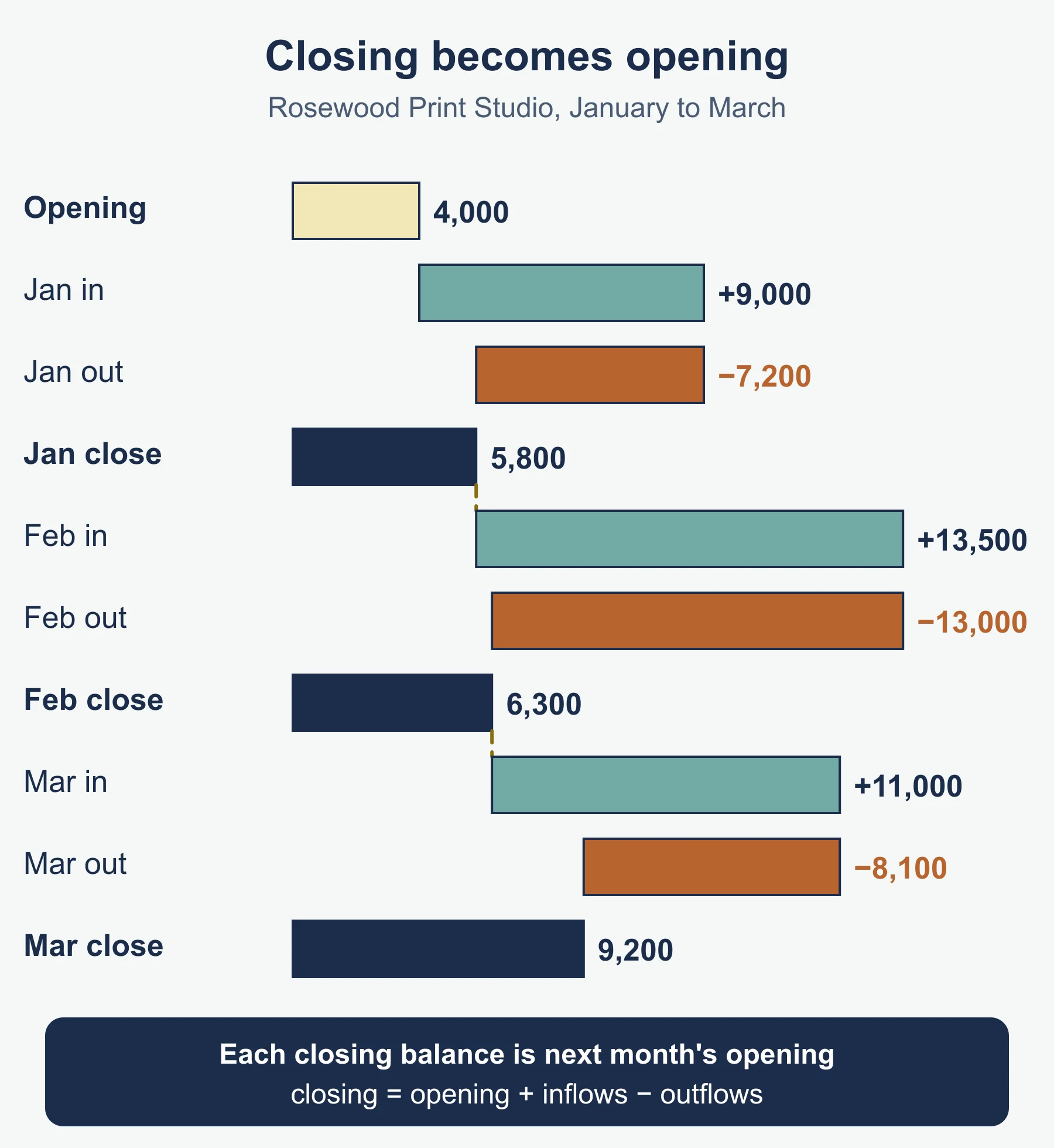
| Closing balance | Opening balance + net cash flow |
Method: complete a forecast
- Total the inflows for each month.
- Total the outflows for each month.
- Net cash flow = inflows - outflows (negative if outflows are bigger).
- Add net cash flow to the opening balance to get the closing balance.
- Make each closing balance the following month’s opening balance.
- Check the last closing balance by adding all net cash flows to the first opening balance.
Worked reminder: Tanvir’s Juice Bar
Opening balance in month 1 is 1,500.
| Month 1 | Month 2 | Month 3 | |
|---|---|---|---|
| Cash sales (inflow) | 6,000 | 5,200 | 7,400 |
| Inventory | 3,100 | 2,700 | 3,600 |
| Wages | 2,400 | 2,400 | 2,000 |
| Other costs | 800 | 500 | 500 |
| Total outflows | 6,300 | 5,600 | 6,100 |
| Net cash flow | -300 | -400 | 1,300 |
| Closing balance | 1,200 | 800 | 2,100 |
Check: 1,500 - 300 - 400 + 1,300 = 2,100. The balance never goes negative, but it falls for two months. Reading: cash is tight in months 1 and 2, so the owner should not commit to a large purchase, and a recovery in month 3 depends on sales reaching 7,400.
Interpreting: what to say
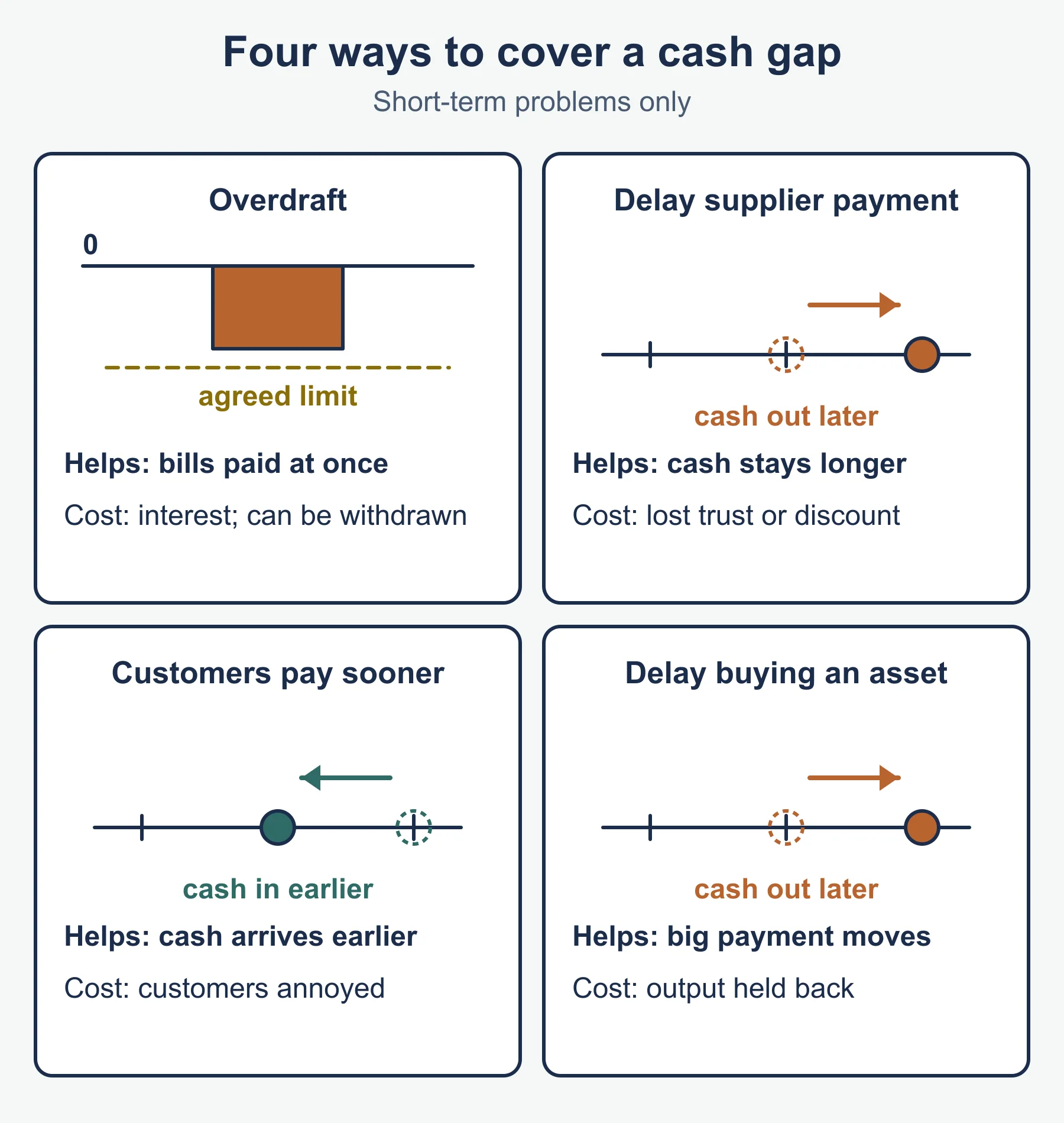
- Negative closing balance: the business is forecast to run out of cash; suggest an overdraft, longer supplier terms, faster customer payment, delaying purchases or selling an asset.
- Large positive balance: spare cash that could repay a loan or fund expansion.
- Falling trend: ask whether the cause is a one-off (equipment) or a lasting problem (costs above sales).
- A forecast is a prediction, so it can be wrong.
Building answers
For a question that asks you to explain or analyse a source of finance, build a chain: say what the source is, give one point about how it works for this business, then add a consequence.
- Point: an overdraft lets the business spend more than its balance.
- Development: so it can pay suppliers during a quiet month without selling anything.
- Consequence: but interest is charged and the bank can call it back, so it is unsafe for a long-term purchase.
For a question that asks you to evaluate or justify, weigh the source against at least one alternative, use the facts in the case (size, type of business, urgency, amount needed) and end with a judgement you have reasoned, not a list.
For a cash-flow question, show each line of working: totals first, then net cash flow, then the closing balance. State units and the sign of a negative figure.
Must-know distinctions
- Internal vs external: internal comes from the owner or the business itself; external from outsiders.
- Loan capital vs share capital: a loan is borrowed and repaid with interest, and the lender gets no ownership. Share capital is not repaid, and shareholders own part of the company.
- Overdraft vs loan: an overdraft is a flexible, short-term borrowing limit on the account; a loan is a fixed sum repaid over a set time.
- Venture capital vs crowdfunding: a few specialist investors take a share of the business; many small backers each give a little.
- Net cash flow vs closing balance: change in the month vs cash held at the end.
- Profit vs cash: a measure of earnings vs a measure of money held.
Quick self-test
- Give one example of a short-term need for finance and one of a long-term need.
- Name the three internal sources in the specification.
- State two drawbacks of an overdraft as a source of finance.
- Which type of business can use a stock market flotation?
- Explain one way trade payables act as a source of finance.
- Define insolvency.
- A business sells goods for 8,000 on credit that cost it 5,000 in cash this month. State its profit on the sale and its cash movement this month.
- Inflows are 12,400 and outflows are 14,100. Calculate the net cash flow.
- The opening balance is 2,300 and net cash flow is -3,000. Calculate the closing balance and say what it shows.
- Explain why a new business may find retained profit hard to use at start-up.
Answers
- Short-term: buying inventory or paying wages before customers pay. Long-term: buying a new building or machinery (accept equivalents).
- Personal savings, retained profit, selling assets.
- Any two from: interest can be high; the bank can ask for repayment at short notice; unsuitable for long-term needs.
- A public limited company (plc).
- The business receives goods now and pays later, so it keeps its cash for longer.
- Unable to pay debts when they fall due.
- Profit 8,000 - 5,000 = 3,000; cash movement -5,000 (the customers have not paid yet).
- 12,400 - 14,100 = -1,700.
- 2,300 + (-3,000) = -700. The business is forecast to be overdrawn, so it needs finance or action to improve cash.
- It has no past profit yet to retain, so there is nothing to reinvest.
Where marks are usually lost
- Using the word profit in answers about cash, or treating a loan or the owner’s capital as income from sales.
- Starting a month with a figure other than the previous closing balance.
- Subtracting the wrong way round and getting net cash flow with the wrong sign.
- Naming a source of finance with no link to the business’s need or size.
- Giving only advantages, or only drawbacks, when a question asks you to weigh a choice.
- Suggesting share capital or a stock market flotation for a sole trader or small partnership.
- Saying a cash shortage means the business is making a loss.
- Describing the numbers (“it falls”) without a cause or a consequence.
Frequently asked questions
What are the internal sources of finance in Edexcel IGCSE Business? The 4BS1 specification lists personal savings, retained profit and selling assets. They carry no interest, but the amounts available are limited.
What is the difference between net cash flow and closing balance? Net cash flow is total cash inflows minus total cash outflows for the month, the change in cash. The closing balance is the opening balance plus net cash flow, the total cash held at the end of the month.
What is trade payables as a source of finance? Suppliers deliver goods now and the business pays later, for example in 30 days. It is a free, short-term source of finance because the business holds on to its cash for longer.
How do you choose a suitable source of finance? Match the finance to how long the need lasts: short-term needs suit an overdraft or trade payables, while long-term needs such as machinery suit loan capital, share capital or retained profit.
Official syllabus
Pearson Edexcel International GCSE in Business (4BS1), Specification, Issue 2, February 2026, published by Pearson Education Limited. Topic 3: Business finance, sections 3.1 “Business finance - sources” (3.1.1 to 3.1.3) and 3.2 “Cash flow forecasting” (3.2.1 to 3.2.2).
Get free revision emails (optional)
Occasional emails with practice questions, worked explanations and links to free resources for the qualification and subjects you choose. No spam, and you can unsubscribe from any email. The free tools on this site never need an email.
Related resources
-
Study guides
Edexcel IGCSE Business: Costs and break-even analysis (4BS1)
Study guide to costs, profit and break-even charts for Pearson Edexcel International GCSE Business 4BS1, with worked examples and common errors.
Business · Pearson Edexcel · IGCSE
Read guide -
Practice questions
Edexcel IGCSE Business: Costs and break-even analysis (4BS1) – Practice Questions
Original practice questions with worked answers on costs, profit and break-even analysis for Edexcel International GCSE Business 4BS1, section 3.3.
Business · Pearson Edexcel · IGCSE
Try questions -
Revision notes
Edexcel IGCSE Business: Costs and break-even analysis (4BS1) – Revision Notes
Condensed revision notes on costs, profit, break-even output and break-even charts for Edexcel International GCSE Business 4BS1, section 3.3.
Business · Pearson Edexcel · IGCSE
Revise topic
Related articles
-
teaching
A Level tuition in Dubai: Cambridge or Pearson Edexcel International A Level?
Schools in Dubai and Abu Dhabi teach either Cambridge International AS & A Level or Pearson Edexcel International A Level. How the two are structured, why it matters for tuition, and how online classes from Lahore work.
9 October 2026
-
curriculum guides
Choosing subjects at IGCSE and A Level
How subject choices at 14 and 16 affect university options later, and how to keep pathways open without overloading a timetable.
28 July 2026
Studying this with a teacher
Working through Business IGCSE?
This page is free and stays free. If you would rather be taught it, Marlbridge runs Business classes one-to-one and in small groups of up to 15, online in your own time zone. The first trial class is free. WhatsApp replies within an hour (8am–11pm Pakistan time, every day); email the same day.
Pearson Edexcel Business teachers at Marlbridge

