
Study Guides
Pearson Edexcel International GCSE Physics (4PH1): Density and pressure
Density and its practical for solids and liquids, pressure = force/area, pressure in fluids and p = hρg worked examples, for Edexcel IGCSE Physics 4PH1.
- Subject
- Physics
- Level
- IGCSE
- Topic
- Solids, liquids and gases
- Author
- Marlbridge Academic Team
- Updated
- Reviewed by
- Hassan (what this means)
Aligned to Pearson Edexcel IGCSE Physics (4PH1), Issue 4. Official specification .
Syllabus page (what it covers and how it is assessed): Pearson Edexcel IGCSE Physics.
Syllabus points this page covers
4PH1
- 5b Density and pressure
Found an error? Report a correction.
Need help with this topic? Request a free trial class for IGCSE Physics (4PH1).
This guide covers sub-topic 5(b) Density and pressure, statements 5.3 to 5.7 of the Pearson Edexcel International
GCSE in Physics (4PH1), Issue 4. It is core content, so it can appear on either paper. The
Solids, Liquids and Gases study guide states the
equations; this page goes further into the density practical for every kind of sample, pressure on surfaces, why
fluid pressure acts in all directions, and multi-step problems with p = h × ρ × g.
What 5(b) covers
- 5.3 know and use
density = mass / volume(ρ = m / V); - 5.4 practical: investigate density using direct measurements of mass and volume;
- 5.5 know and use
pressure = force / area(p = F / A); - 5.6 understand how the pressure at a point in a gas or liquid at rest acts equally in all directions;
- 5.7 know and use
pressure difference = height × density × gravitational field strength(p = h × ρ × g).
All three equations are in the specification’s list of relationships that are not given in the exam, so learn them.
Density
Density is the mass of each unit of volume. It is a property of the material, not of the object: a steel nail and a steel girder have the same density. Units: kg/m³ (or g/cm³; multiply by 1000 to convert to kg/m³).
The density practical (5.4)
“Direct measurements of mass and volume” means you measure both quantities yourself. The method depends on the sample.
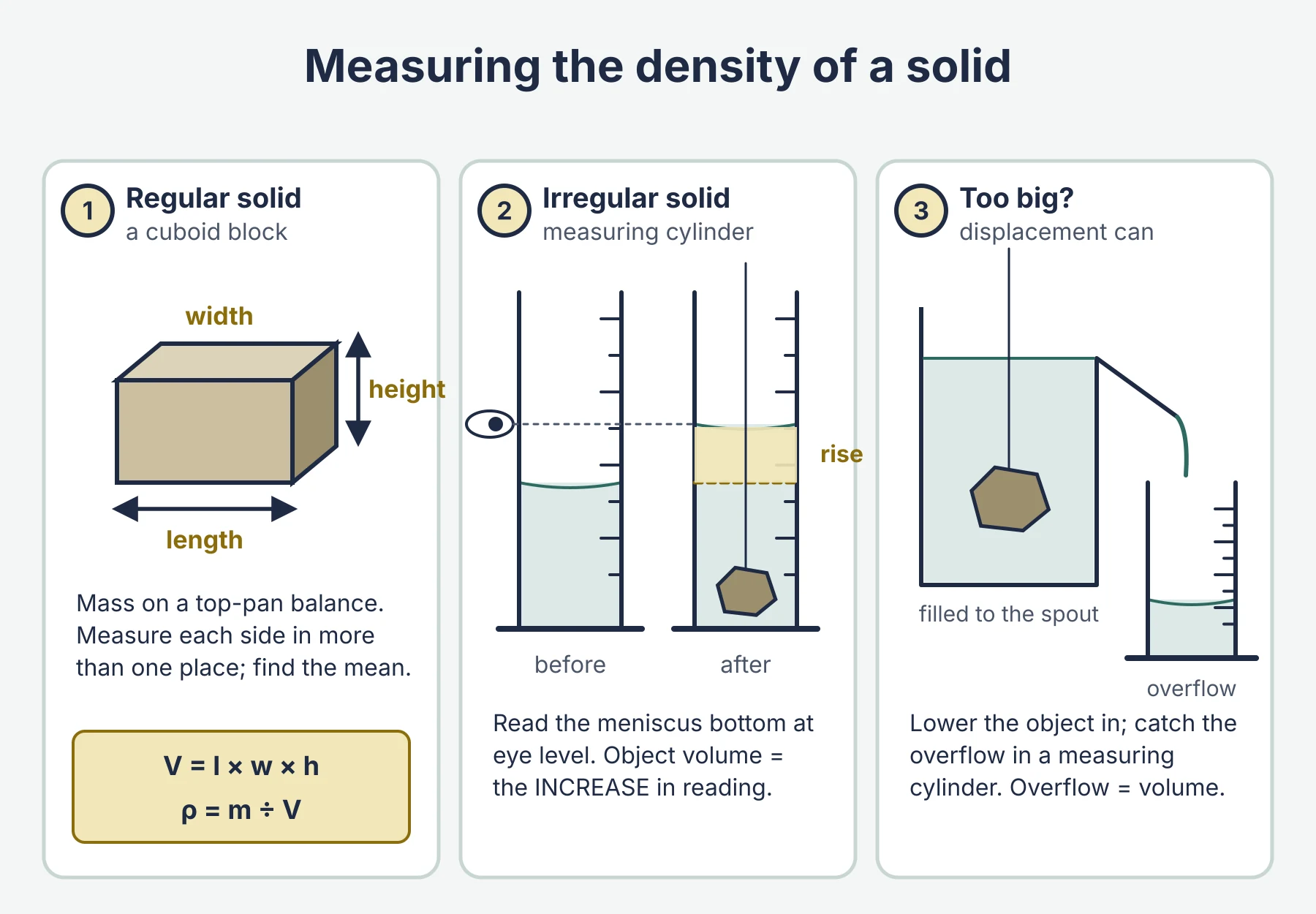
A regular solid (a cuboid block).
- Measure the mass on a top-pan balance.
- Measure length, width and height with a ruler (or a more precise instrument for small blocks), taking each measurement in more than one place and finding the mean.
- Volume = length × width × height; density = mass ÷ volume.
An irregular solid (a stone or a key).
- Measure the mass on a balance.
- Part-fill a measuring cylinder with water and read the volume at the bottom of the meniscus, with your eye level with the surface.
- Lower the object in gently on a thread so that it is fully covered, and read the new volume. The increase is the object’s volume.
- For an object too big for a cylinder, use a displacement can: fill it to the spout, lower the object in, and catch the overflowing water in a measuring cylinder.
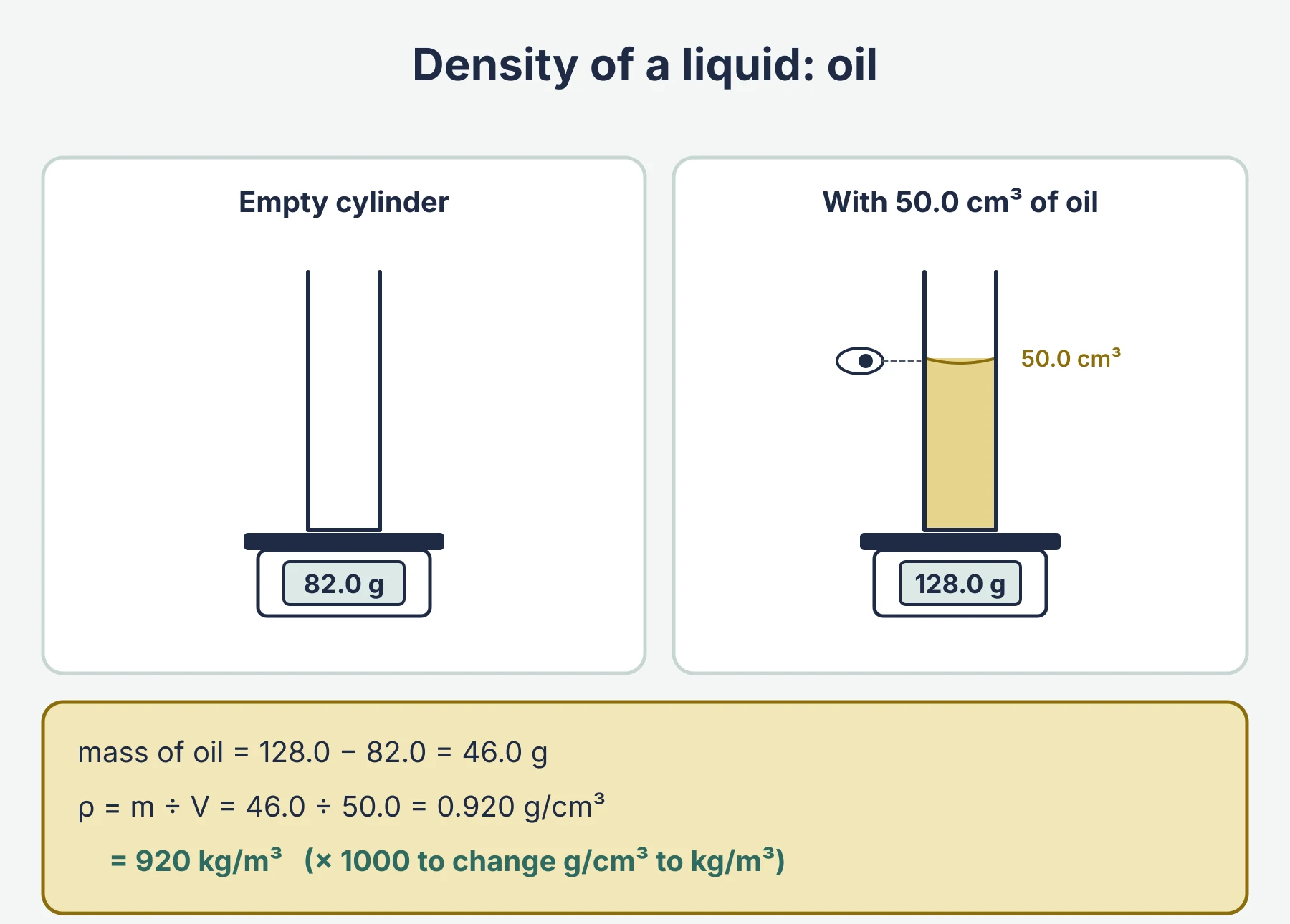
A liquid.
- Place an empty measuring cylinder on the balance and record its mass (or zero the balance with the cylinder on it).
- Pour in a measured volume of liquid, reading the meniscus at eye level.
- Record the new mass. Mass of liquid = new mass − mass of cylinder.
Worked example 1: oil. An empty measuring cylinder has a mass of 82.0 g. With 50.0 cm³ of oil in it, the mass is 128.0 g.
mass of oil = 128.0 − 82.0 = 46.0 g
ρ = m / V = 46.0 / 50.0 = 0.920 g/cm³ = 920 kg/m³
Improving the practical. Using a larger volume of liquid, or a larger object, makes the reading errors a smaller fraction of the measurement. Repeating and averaging reduces the effect of random errors. Air bubbles clinging to a stone in the cylinder make its volume look too big, so tap them off.
Pressure on a surface (5.5)
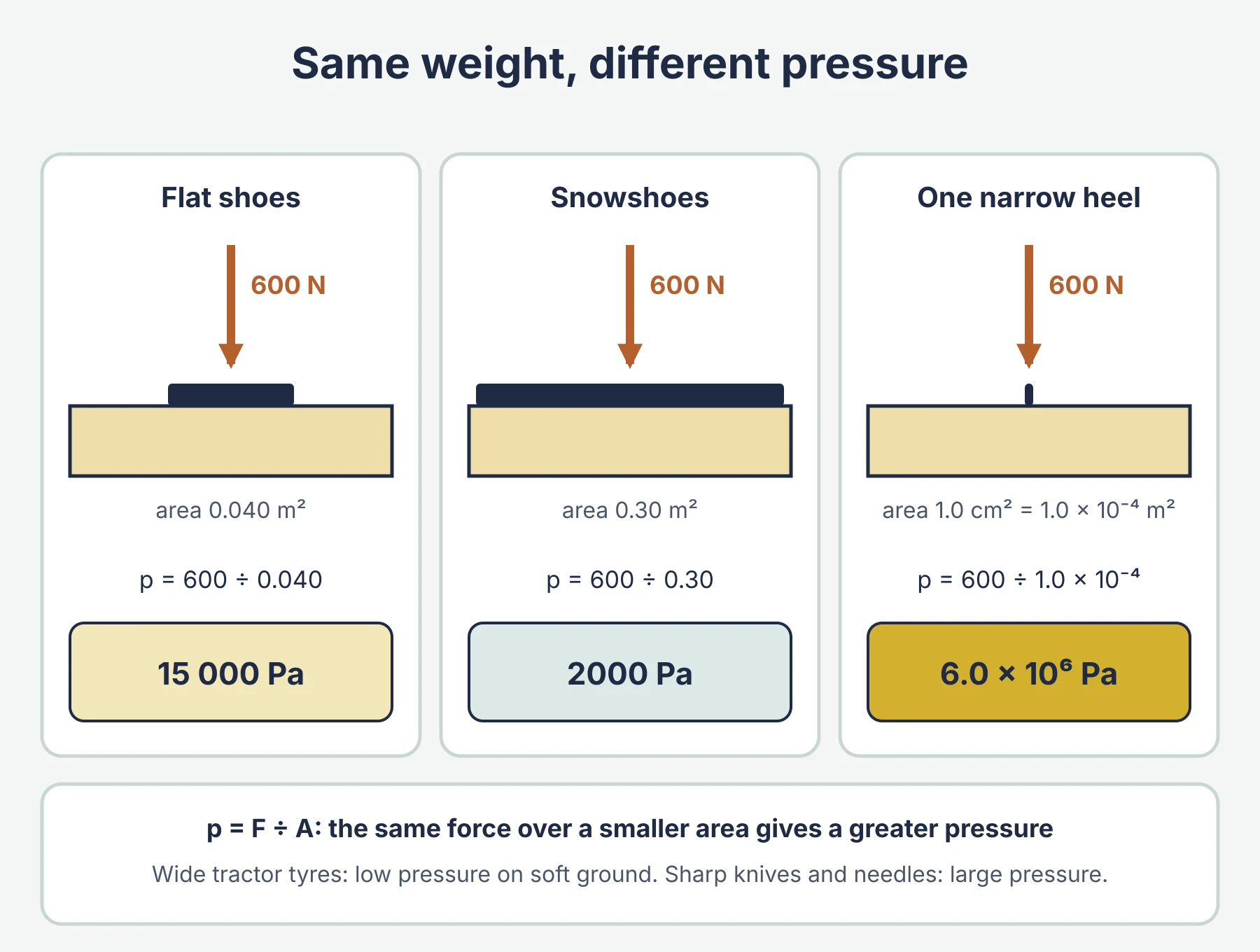
Pressure is the force acting at right angles to a surface, per unit area. The same force over a smaller area gives a greater pressure.
Worked example 2: shoes and snowshoes. A person weighs 600 N.
standing in flat shoes, total area 0.040 m²:   p = 600 / 0.040 = 15 000 Pa
on snowshoes, total area 0.30 m²:              p = 600 / 0.30  = 2000 Pa
all weight on one shoe heel of area 1.0 cm² (1.0 × 10⁻⁴ m²):  p = 600 / 1.0 × 10⁻⁴ = 6.0 × 10⁶ Pa
That is why snowshoes stop you sinking into snow and why narrow heels can dent a wooden floor. The same idea explains wide tyres on tractors (low pressure on soft ground) and sharp knives and needles (very small area, so a large pressure from a small force).
Pressure in a fluid acts in all directions (5.6)
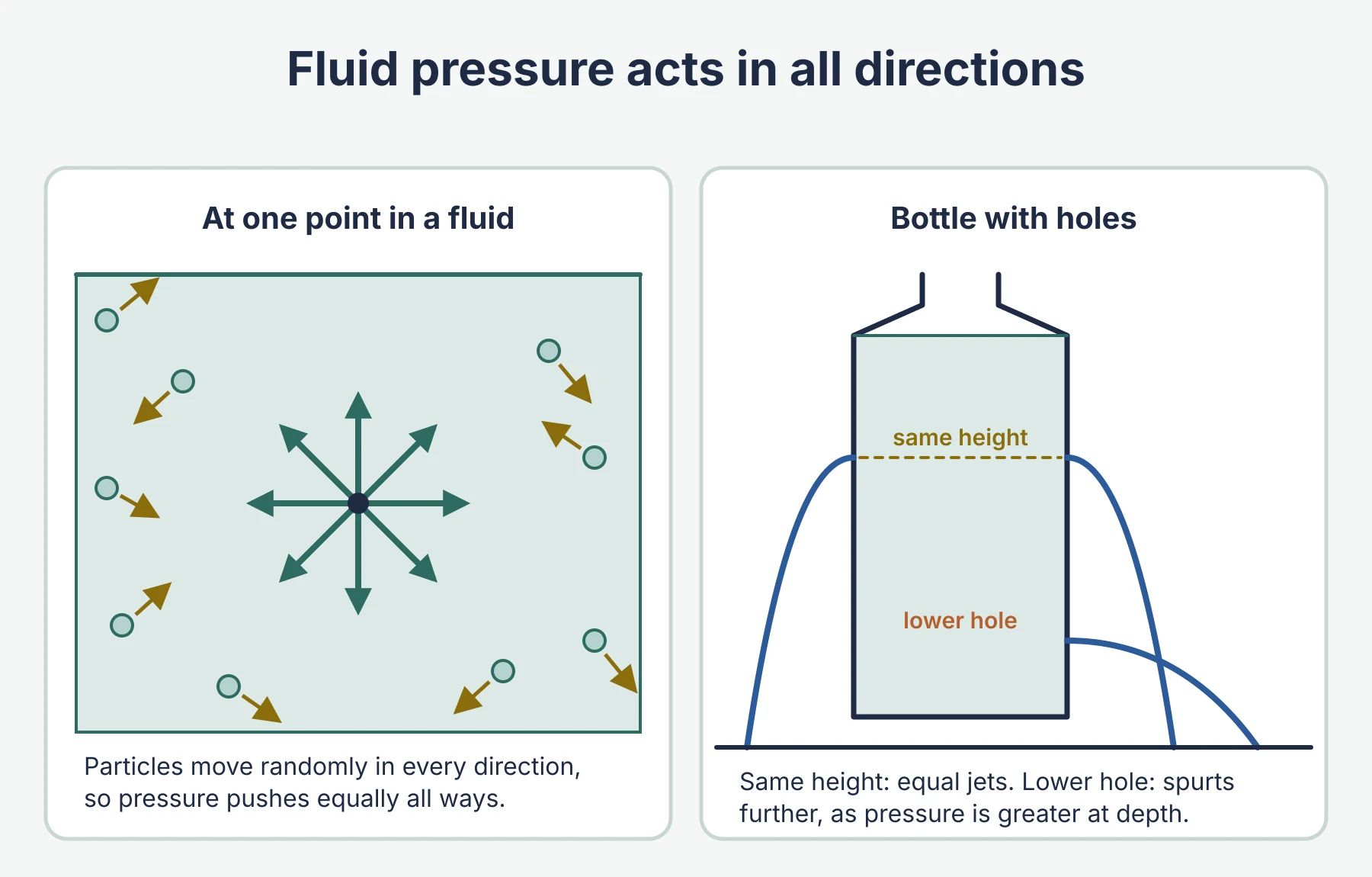
In a liquid or gas at rest, the particles move randomly in every direction and collide with any surface they meet, so at any point the pressure pushes equally in all directions: up, down and sideways. A small sensor held at one depth reads the same whichever way it faces.
You can see this with a plastic bottle of water that has several small holes punched around it at the same height: water spurts out sideways from every hole with equal force. Holes punched lower down spurt further, because the pressure is greater at greater depth. Gas pressure behaves the same way, which is why a balloon inflates into a rounded shape.
Pressure difference with depth (5.7)
p = h × ρ × gp here is the pressure difference between two points a vertical height h apart in a fluid of density ρ.
Below a liquid surface, the pressure at depth h is the pressure at the surface (usually atmospheric pressure) plus
h × ρ × g. The pressure depends only on depth, density and g, not on the shape of the container.
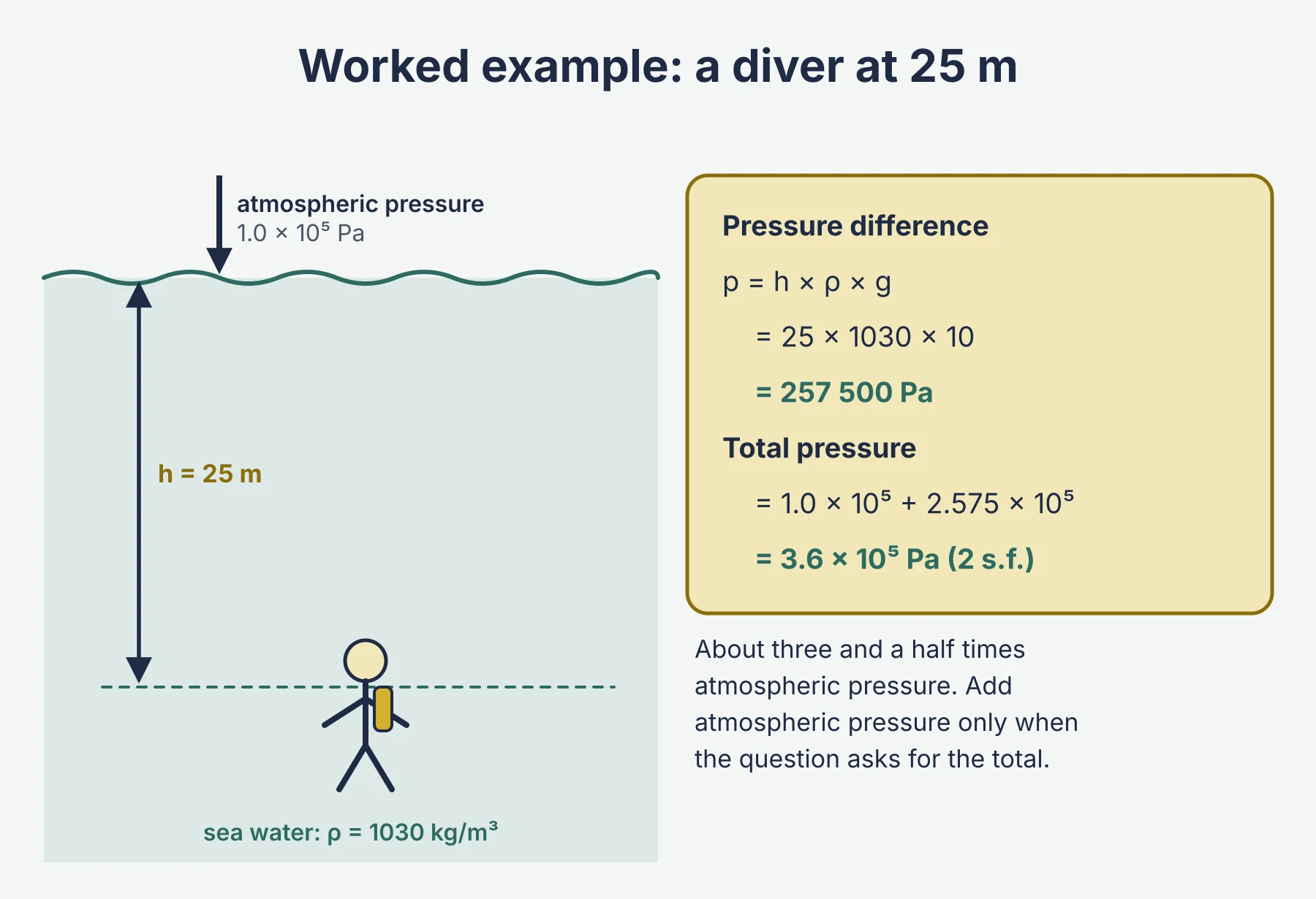
Worked example 3: a diver. A diver is 25 m below the surface of the sea. Sea water has a density of 1030 kg/m³; atmospheric pressure is 1.0 × 10⁵ Pa; g = 10 N/kg.
pressure difference = h × ρ × g = 25 × 1030 × 10 = 257 500 Pa
total pressure = 1.0 × 10⁵ + 2.575 × 10⁵ = 3.6 × 10⁵ Pa (2 s.f.)
So at 25 m the diver experiences about three and a half times atmospheric pressure.
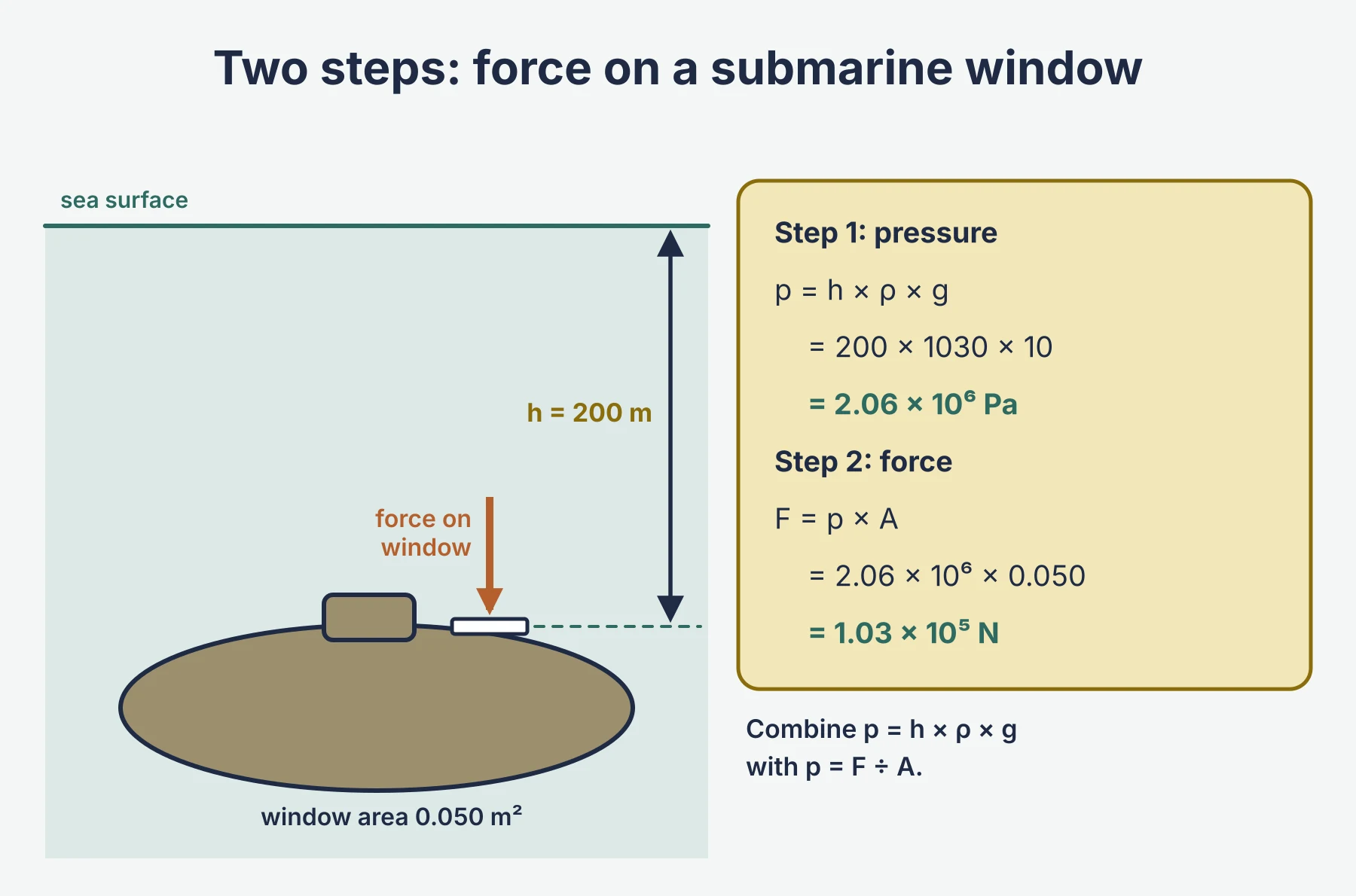
Worked example 4: force on a window. A submarine window of area 0.050 m² is 200 m below the surface of the same sea. Find the extra force on the window caused by the water above it.
p = h × ρ × g = 200 × 1030 × 10 = 2.06 × 10⁶ Pa
F = p × A = 2.06 × 10⁶ × 0.050 = 1.03 × 10⁵ N
Combining p = h × ρ × g with p = F / A like this is a common two-step question.
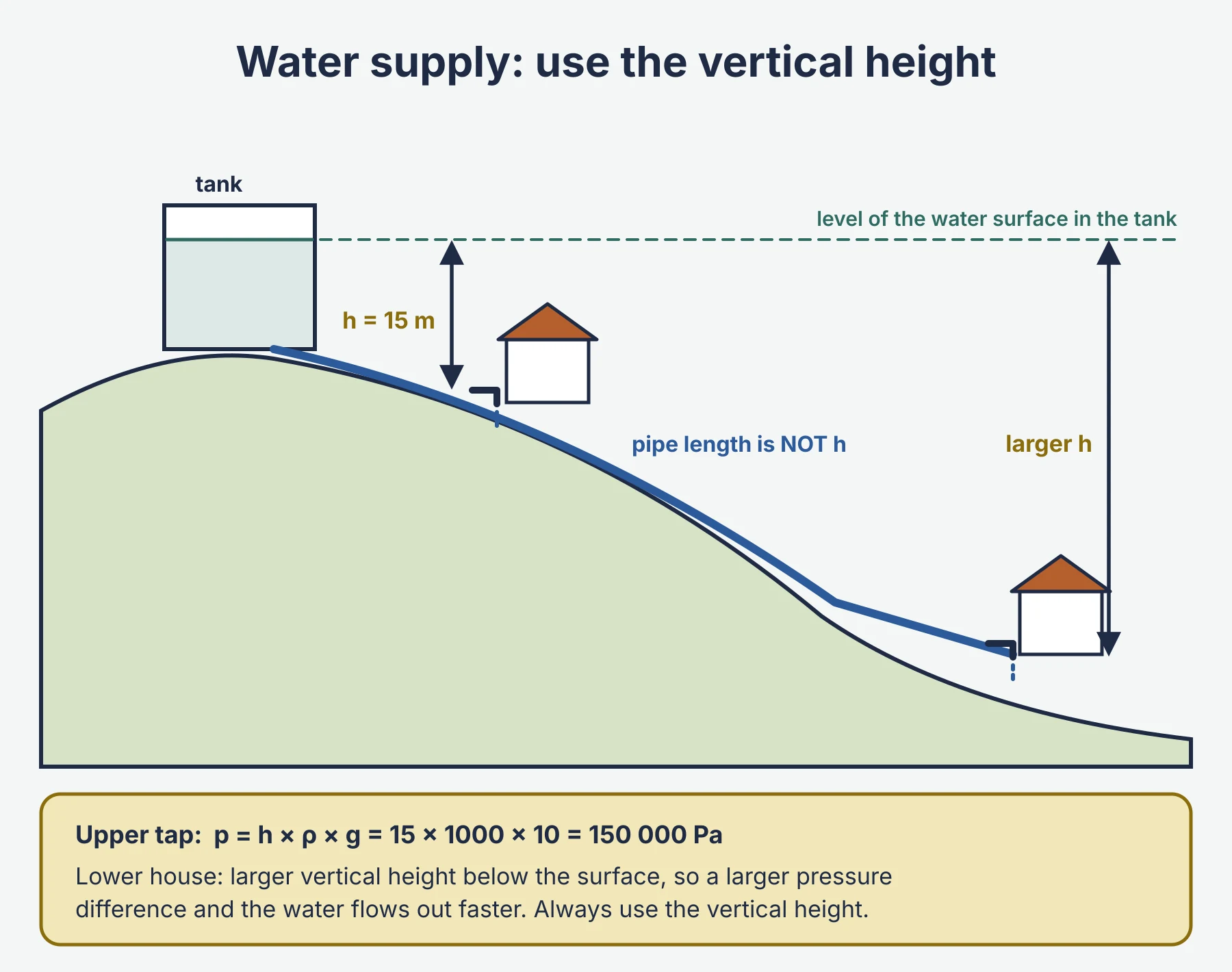
Worked example 5: a water tower. A tap is 15 m below the water surface in a storage tank on a hill. The pressure
difference driving water out of the tap is 15 × 1000 × 10 = 150 000 Pa. A tap in a house further down the hill,
and so further below the tank’s surface, has a larger pressure difference and the water flows out faster.
Common mistakes
- Using the length of a pipe or the distance along a slope as
h. It is always the vertical height difference. - Forgetting to add atmospheric pressure when the question asks for the total pressure, or adding it when the question asks only for the pressure due to the water.
- Leaving areas in cm²: divide by 10 000 to get m².
- Saying pressure acts “downwards” in a liquid. It acts in all directions.
- In the displacement method, using the total reading instead of the increase in volume.
- Measuring the mass of a liquid without subtracting the mass of the container.
Exam technique
- Describe the density practical: list the measurements, the instrument for each, and how you calculate density. Include one step that improves accuracy (meniscus at eye level, repeat readings, larger sample).
- Explain why pressure is greater at depth: more fluid above, so a greater weight of fluid presses on each unit area below.
- Calculate: write the equation, convert to m, m², m³ and kg first, and give the unit (Pa or kg/m³).
- Suggest why a design uses a large or small area: link area to pressure using
p = F / A.
Keep going
- Density and pressure revision notes
- Density and pressure practice questions
- Units for Topic 5, for area and volume conversions
Written against the Pearson Edexcel International GCSE in Physics (4PH1) specification, Issue 4. Always check the current specification for your examination year.
Related resources
-
Practice questions
Pearson Edexcel International GCSE Physics (4PH1): Density and pressure – Practice Questions
Original 4PH1 questions on density, the density practicals, pressure on surfaces, fluid pressure and p = hρg force problems, with full answers.
Physics · Pearson Edexcel · IGCSE
Try questions -
Revision notes
Pearson Edexcel International GCSE Physics (4PH1): Density and pressure – Revision Notes
Recall notes for 4PH1 sub-topic 5b: density, the density practical, p = F/A, fluid pressure in all directions and p = hρg, with a self-test.
Physics · Pearson Edexcel · IGCSE
Revise topic -
Study guides
Pearson Edexcel International GCSE Physics (4PH1): Ideal gas molecules
Gas pressure from molecular collisions, absolute zero, the Kelvin scale and the two gas laws with worked examples, for Edexcel IGCSE Physics 4PH1, 5d.
Physics · Pearson Edexcel · IGCSE
Read guide
Related articles
Get free revision emails (optional)
Occasional emails with practice questions, worked explanations and links to free resources for the qualification and subjects you choose. No spam, and you can unsubscribe from any email. The free tools on this site never need an email.